Month: June 2019

Passing the Mantle — Lectionary Reflection for Pentecost 3C (2 Kings 2)

2 Kings 2:1-2, 6-14 New Revised Standard Version (NRSV)
 

2 Now when the Lord was about to take Elijah up to heaven by a whirlwind, Elijah and Elisha were on their way from Gilgal. 2 Elijah said to Elisha, “Stay here; for the Lord has sent me as far as Bethel.” But Elisha said, “As the Lord lives, and as you yourself live, I will not leave you.” So they went down to Bethel. 

6 Then Elijah said to him, “Stay here; for the Lord has sent me to the Jordan.” But he said, “As the Lord lives, and as you yourself live, I will not leave you.” So the two of them went on. 7 Fifty men of the company of prophets also went, and stood at some distance from them, as they both were standing by the Jordan. 8 Then Elijah took his mantle and rolled it up, and struck the water; the water was parted to the one side and to the other, until the two of them crossed on dry ground. 

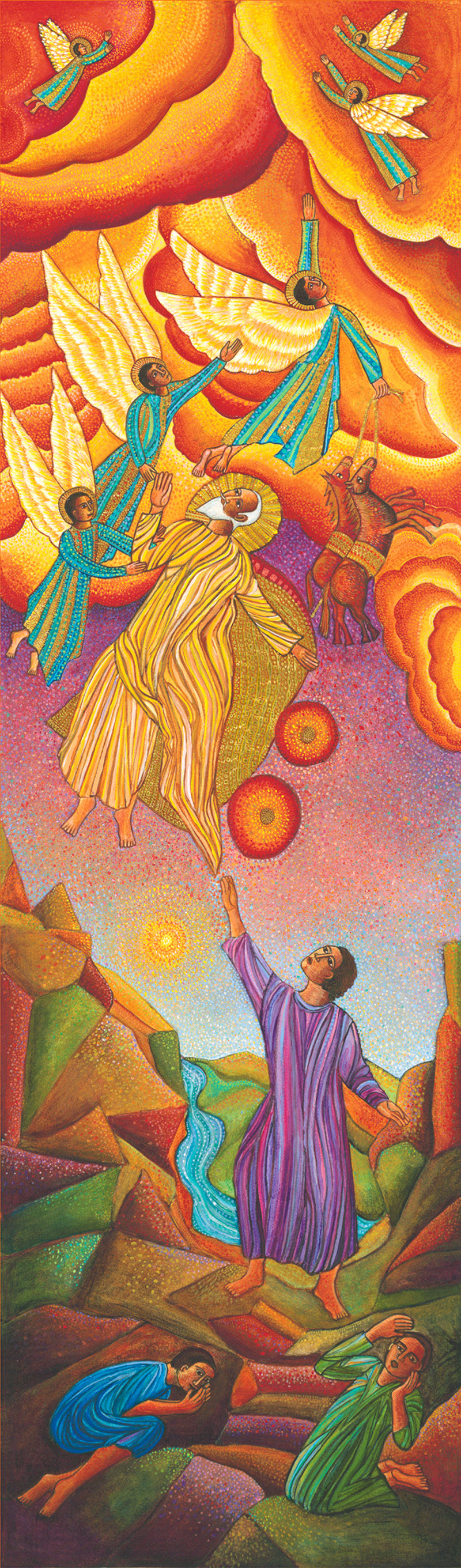
9 When they had crossed, Elijah said to Elisha, “Tell me what I may do for you, before I am taken from you.” Elisha said, “Please let me inherit a double share of your spirit.” 10 He responded, “You have asked a hard thing; yet, if you see me as I am being taken from you, it will be granted you; if not, it will not.” 11 As they continued walking and talking, a chariot of fire and horses of fire separated the two of them, and Elijah ascended in a whirlwind into heaven. 12 Elisha kept watching and crying out, “Father, father! The chariots of Israel and its horsemen!” But when he could no longer see him, he grasped his own clothes and tore them in two pieces. 

13 He picked up the mantle of Elijah that had fallen from him, and went back and stood on the bank of the Jordan. 14 He took the mantle of Elijah that had fallen from him, and struck the water, saying, “Where is the Lord, the God of Elijah?” When he had struck the water, the water was parted to the one side and to the other, and Elisha went over.

********************

                As I grow older and can see retirement on the horizon, texts like this begin to speak more loudly. I’m not Elijah or Elisha. At one level, I don’t claim to be a prophet in the form that these two figures take. At the same time, as an ordained minister, who has preached most Sundays for the past twenty-one years, I hear in this story a word spoken to my own journey. To preach requires the Spirit. The same is true for all acts of ministry. Different people will have different takes on this passage. Personal context matters. For me, it’s that sense of seeing the current pathway closing. In other words, I’ve begun to see more clearly that a time when the mantle must be passed on to the next generation. In fact, a few years back, when I was inducted into the College of Fellows of the Academy of Parish Clergy, I saw this as a recognition of a call to assist younger clergy in furthering their journeys. This is an important calling since at least half of all clergy will leave the ministry within five years of ordination. Many leave due to disillusionment. Some of that disillusionment rests at the feet of older clergy who may feel threatened by the emerging generations. Instead of offering to help with the passage into the future, they cut themselves off and important forms of wisdom don’t get passed on. When God said to Elijah that he should anoint Elisha as his successor, Elijah could have resisted. He could have felt threatened. But Elijah understood the need to mentor his successor. So, he took up the task (1 Kings 19).


This passage also came to mind as I was planning for my upcoming sabbatical. The grant application the congregation was submitting required a theme, and we chose “River Crossings” because that spoke the journey ahead.  A time of transition stands on the horizon for me as a pastor and for the congregation I serve. So, stories that speak of transition stand out. There is the story of Moses, who led the people to the Jordan but didn’t cross over. That was left to his apprentice, Joshua. Elijah crossed the river, together with his apprentice, Elisha. Once they crossed the Jordan, Elijah passed the mantle. These are two images of transition. The one before us pictures Elijah and Elisha crossing the river, but in the end, it is Elisha that continues the ministry that had once been Elijah’s. His ministry would be different from his predecessor, but Elijah was willing to serve as his guide.

                These two figures can leave us confused. Who comes first, Elijah or Elisha? The writers of 2 Kings, let us know that it is Elijah first and then Elisha. When last we saw Elijah in the lectionary readings, he had fled to the desert, where he hoped to die, feeling abandoned. His cry to God was something like “Woe is me, nobody likes me, everybody hates me.” (1 Kings 19:1-15). After that experience in the desert, Elijah is told to anoint “Elisha, son of Shaphat of Abel-meholah as prophet in your place.” With that instruction, Elijah found Elisha plowing his field and threw his mantle over him, and after a bit of negotiation, Elisha followed Elijah, becoming his apprentice (1 Kings 19:16,19-21). Now it was time to pass the mantle. It was time for Elijah to leave and Elisha to take his place. This didn’t occur until Elijah had fully instructed his apprentice, and for his part, Elisha is faithful in his following of Elijah. Elijah is the more famous of the two, but both men spoke for God to a people who didn’t always appreciate the message.

                The passage begins with Elijah and Elisha heading out from Gilgal. Elijah told his apprentice to stay behind as he headed to Bethel, but Elisha declared his desire to continue on with his master. When they arrived at Bethel, the disciples of the prophets came out and warned Elisha that God would be taking Elijah away from him. He acknowledged the fact. Elijah and Elisha would repeat this pattern regarding staying behind at each juncture on the path to the place where God would take Elijah. Each time Elisha pledged to stay with him. As they made the journey from Bethel to Jericho and then to the Jordan, fifty disciples of the prophets followed along with them, but at a distance, until they reached the Jordan. Here is where the moment of transition begins.


                Once again, Elisha is told to stay behind, as Elijah follows his path beyond the Jordan, but Elisha refuses. At this point, Elijah takes his cloak or mantle, rolls it up, and then slaps the water of the Jordan with it. With that, the water of the river divides, much like it did when Joshua led the people of Israel into the Promised Land. Though, on this occasion, Elijah intends to cross to the other side, out of the Promised Land. As they cross the river, Elisha having demonstrated his loyalty to Elijah, his master asks him: “what can I do for you before I am taken from you?”  Elisha answers: “Let a double portion of your spirit pass on to me.” (vs. 9 Tanakh). That’s asking for a lot, says Elijah. But, he’s open to the possibility, as long as Elisha keeps his focus on his master as he is taken up into the whirlwind. If not, if he fails to keep his concentration on Elijah’s departure, the deal’s off. All along the way, from Gilgal to this moment, it seems as if Elijah is testing Elisha’s resolve. This will be the last test before the mantle is passed.

                It is at this point, as they are walking and talking that a fiery chariot descends from the heavens and sweeps in to take Elijah from the earth. And as Elisha watched Elijah taken up into the whirlwind, he cries out “oh father, oh father.” When he could no longer see his master, he took his garments and tore them in grief. With that expression of mourning, Elisha picked up the mantle of his master, which Elijah had dropped. He struck the river, which parted, and he crossed over. Here is the evidence—Elisha has the spirit, perhaps more than did Elijah.  He is the heir. His turn has come. Thus, begins a new chapter, a new ministry.

Life is like that. It never stands still. Elijah was a great prophet. In actuality, his prophetic efforts were probably grander than those of Elisha, but there comes a time for the mantle to be passed. In this story, Elijah is taken from the earth. He doesn’t die; he simply is taken up. Only Enoch has the same experience. That is, “Enoch walked with God; then he was no more, for God took him” (Gen. 5:24 Tanakh). Elijah walks with God and God takes him. Elijah had his struggles. He had his victories, but he also had to flee. But the ministry goes on. A new person steps to the plate. He has shown his mettle. He stood steadfastly with his mentor. He didn’t aside and follow another pathway.  But he went forward in the spirit, having received the same spirit that empowered Elijah. The mantle, the cloak, is not the source of power but is the symbol of a spiritual power that Elisha discerned was necessary to fulfill his calling.  And off he goes, in the spirit. The same is true for us. To fulfill our callings, whether we would term them prophetic or not, requires the presence of the Spirit of God.

Picture Attribution:  Swanson, John August. Elijah, from Art in the Christian Tradition, a project of the Vanderbilt Divinity Library, Nashville, TN. http://diglib.library.vanderbilt.edu/act-imagelink.pl?RC=56543 [retrieved June 24, 2019]. Original source: http://www.JohnAugustSwanson.com – copyright 2008 by John August Swanson.


Woe Is Me: Elijah’s Lament, a lectionary reflection for Pentecost 2C (1 Kings 19)


19 Ahab told Jezebel all that Elijah had done, and how he had killed all the prophets with the sword. Then Jezebel sent a messenger to Elijah, saying, “So may the gods do to me, and more also, if I do not make your life like the life of one of them by this time tomorrow.” Then he was afraid; he got up and fled for his life, and came to Beer-sheba, which belongs to Judah; he left his servant there. 

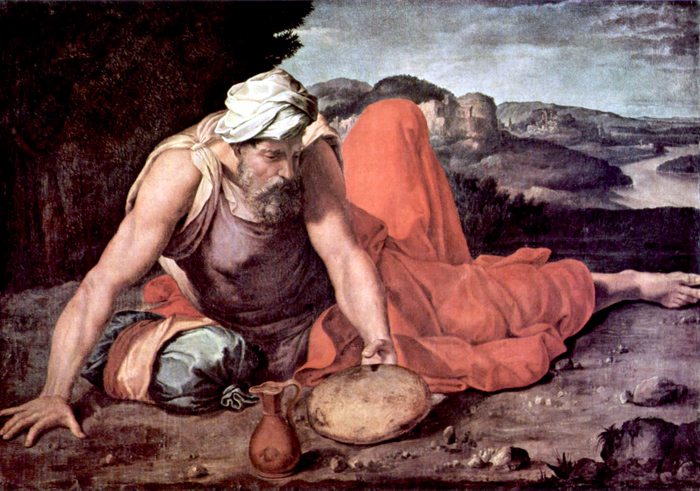
But he himself went a day’s journey into the wilderness, and came and sat down under a solitary broom tree. He asked that he might die: “It is enough; now, O Lord, take away my life, for I am no better than my ancestors.” Then he lay down under the broom tree and fell asleep. Suddenly an angel touched him and said to him, “Get up and eat.” He looked, and there at his head was a cake baked on hot stones, and a jar of water. He ate and drank, and lay down again. The angel of the Lord came a second time, touched him, and said, “Get up and eat, otherwise the journey will be too much for you.” He got up, and ate and drank; then he went in the strength of that food forty days and forty nights to Horeb the mount of God. At that place he came to a cave, and spent the night there.  

Then the word of the Lord came to him, saying, “What are you doing here, Elijah?” 10 He answered, “I have been very zealous for the Lord, the God of hosts; for the Israelites have forsaken your covenant, thrown down your altars, and killed your prophets with the sword. I alone am left, and they are seeking my life, to take it away.” 
11 He said, “Go out and stand on the mountain before the Lord, for the Lord is about to pass by.” Now there was a great wind, so strong that it was splitting mountains and breaking rocks in pieces before the Lord, but the Lord was not in the wind; and after the wind an earthquake, but the Lord was not in the earthquake; 12 and after the earthquake a fire, but the Lord was not in the fire; and after the fire a sound of sheer silence. 13 When Elijah heard it, he wrapped his face in his mantle and went out and stood at the entrance of the cave. Then there came a voice to him that said, “What are you doing here, Elijah?” 14 He answered, “I have been very zealous for the Lord, the God of hosts; for the Israelites have forsaken your covenant, thrown down your altars, and killed your prophets with the sword. I alone am left, and they are seeking my life, to take it away.” 15 Then the Lord said to him, “Go, return on your way to the wilderness of Damascus; when you arrive, you shall anoint Hazael as king over Aram.
******************
                We have moved through the Day of Pentecost and Trinity Sunday, and now we begin the long journey that takes us to Advent. This season, which is nearly six months in duration (and marked by the color green) is called, by some, ordinary time. I don’t care for this designation, so I tend to count the Sundays after Pentecost. I don’t know that any moment in time is ordinary, though there are moments, like Christmas, Epiphany, Good Friday, Easter, and Pentecost that stand out, but each Sunday has its own value. During this season there usually two choices for the first reading, all coming from the Hebrew Bible. I will normally be commenting on the semi-continuous texts, rather than the paired texts. The first of these texts is taken from 1 Kings 19, which picks up immediately following Elijah’s encounter with and triumph over the prophets of Baal at Mount Carmel. That encounter is both exciting and off-putting. It’s always good to hear that God triumphs, but the killing of the prophets of Baal—that’s not so enticing. Such violence doesn’t fit well with our sensibilities. In fact, it serves as a reminder of the tendency of religions in general and Christianity in particularity to enforce doctrinal and moral compliance with the threat of violence. At the same time, it represents the reality of the cycle of violence that is so present in our world. However, this is the background to the reading from 1 Kings 19. In fact, the prophet Elijah seems to take pride in his act of violence, which he believes cleansed the land of religious pollution (the prophets of Baal). Now it should be noted that Jezebel, Queen of Israel, had been attempting a purge of the prophets of Yahweh (1 Kings 18:4). This appears to be the way religious differences were handled back then. But despite his victory, it appears that Elijah is feeling depressed. He did his job, but it doesn’t seem to have made a difference.   
 
                When we come to chapter 19 of 1 Kings, having already watched as God answered Elijah’s prayer and had sent fire from heaven to consume the offering, something Baal could not do, the wrath of Jezebel is unleashed against him. When King Ahab told Jezebel what Elijah had done at Mount Carmel, Jezebel sent a message to Elijah threatening to do to him, what he had done to her prophets. Thus, the cycle of violence would continue, and truth be told, it continues into the present. When Elijah received this message he fled for his life, traveling to Beer-Sheba, in the neighboring country of Judah. He was safe, for now, unless Jezebel could get an extradition order for his arrest. Though he was safe, he felt depressed. He felt as if, despite his efforts, nothing had changed, and so he left his assistant in the town and headed out into the Wilderness (desert). He was ready to give up and even die. Why go on? He had no purpose.
He lay down in the desert and went to sleep (perhaps hoping not to wake up), but as he slept he was visited by an angel (I’m not sure why verses 5-7 are considered optional, as they detail the angelic vision). The angel had laid out food and water and commanded him to get up and eat. He did so, then went back to sleep. The angel woke him up and told him once more to eat, so he would have strength for forty days and nights (presumably a time of fasting as well as journeying). This time instructions were given. He needed to eat so he could make the journey to Mount Horeb, the holy mountain in the Sinai, where Moses saw the burning bush.  He traveled to Mount Horeb, where he entered a cave and spent the night. You can see here parallels to the story of Moses. Moses had to flee, and it was in the desert of Sinai, on this mountain, that God appeared to Moses and spoke to him (Exodus 3:1-6). It was here that Moses received his commission. It would be here that Elijah would hear from God.
The Lord spoke to Elijah, asking him why he was there. Elijah responded by reminding God of what he had done. He was zealous for the Lord. He’d torn down the altars to foreign gods and put to death the prophets of these gods. Now, he alone was left, and his enemies are after him, seeking to put him to death. Elijah is not in a good place. He feels abandoned. He’d done what he thought God wanted, but to what end. Sometimes we feel that way. We may not have torn down altars, or thankfully killed prophets, but we’ve given our all, and don’t have much to show for it. It’s one of the reasons so many clergy hang it up before they reach five years of service. Where is the fruit of one’s efforts? Where is the appreciation?
Burnout is a common concern among clergy. It’s one reason why pastorates tend to be short. Clergy give their all and then within a few years, feel as if they have nothing left to give to the congregation. So, it’s time to move—either to a new congregation where one can start over or to another vocation. Elijah is feeling it. He’s been battling in Israel for Yahweh for countless years. While he might have a token success here or there, the status quo remains in place, and the people simply don’t seem to care.
God responds to Elijah’s laments (and those of contemporary clergy, perhaps), but sending him out of the cave so he can experience the presence of God. The Lord promises to pass by, but what will be the form of that presence? First Elijah experiences a mighty wind, so mighty it splits mountains and breaks apart rocks. I’ve experienced some big winds, but nothing like that. Even hurricanes and tornados don’t split mountains. Nevertheless, despite the power of the wind, God is not present in the wind.  Then comes an earthquake, but God is not in the earthquake either. Both the wind and the quake suggest power and might. Though different in its makeup, God wasn’t present in the fire either. This is fascinating because the Pentecost story suggests that the Spirit came as a mighty wind and baptized with fire. But at least here, wind, quakes, and fire, are not markers of God’s presence, even though that likely was what Elijah expected (or something like it). It’s what we tend to expect as well. Our God is an awesome God, is that not true?
So how is God is present? The reading suggests that the fire was followed by “sheer silence” or as the Tanakh puts it, as “a soft murmuring sound.” This is the opposite of power, and yet this is how God chose to be revealed. Of course, the Gospels recount the story of Jesus, the revelation of God, who reveals God’s presence in and through the cross—not something one would expect of God.
I don’t know if Elijah isn’t all that impressed with this show of God’s presence. He does cover himself with his mantle (cloak), so maybe he got a bit of a scare, from the wind, quake, and fire, but then there’s the quietness. So, maybe he’s a bit underwhelmed because he goes back to his complaints in response to God’s question: “why are you here?” Elijah’s answer is simple: I was zealous for the cause. I did everything I was supposed to do, but here I am, alone with a death warrant set out for me. That’s why Elijah has gone out to the desert—not to meet God but to flee God’s call, which doesn’t seem to have made a difference.
How does God respond? God kicks Elijah in the backside and tells him to get back in the game. Go back to where you came from and along the way stop in Damascus and anoint Hazael king of Damascus, and from there go and anoint Jehu, son of Nimshi as king of Israel. Set up a rival regime in the nations. While you’re at it, anoint Elisha as your successor. It’s time for change—politically and spiritually. The kings of Damascus and Israel had their chance, but they failed, and so it’s time for another. As for Elijah, he still has work to do, but it’s also time to prepare another to take up the mantle. In the end, all who bow to Baal will fall to the sword. That is the task set before Elijah. Oh, and by the way, you’re not alone Elijah. There are seven thousand in Israel who haven’t bowed to Baal.
The word to us as the people of God is the same. Even when things look bleak, we’re not alone. There are others who are steadfast in the faith. So, get back out there. Don’t lose faith. Trust in the Lord who is present not only in the quakes and fire but in silence as well. Now, none of this is meant to downplay the realities of burnout, stress, and a sense of aloneness that many clergy feel. I know I’ve felt it. I’ve had my moments of depression over the years. So, I understand. There are times to walk away. On the other hand, there are times to persevere—in the Spirit, of course.  It is good to know, we’re not alone.

Picture Attribution: Volterra, Daniele da, ca. 1509-1566. Prophet Elijah on Mount Horeb, from Art in the Christian Tradition, a project of the Vanderbilt Divinity Library, Nashville, TN. http://diglib.library.vanderbilt.edu/act-imagelink.pl?RC=46988 [retrieved June 17, 2019]. Original source: http://yorckproject.de.


Holy Wisdom – A lectionary reflection for Trinity Sunday (Proverbs 8)

Wisdom, Prudence, and Knowledge

Proverbs 8:1-4, 22-31  New Revised Standard Version (NRSV)

 
8 Does not wisdom call,
    and does not understanding raise her voice?
2 On the heights, beside the way,
    at the crossroads she takes her stand;
3 beside the gates in front of the town,
    at the entrance of the portals she cries out:
4 “To you, O people, I call,
    and my cry is to all that live.
 
22 The Lord created me at the beginning of his work,
    the first of his acts of long ago.
23 Ages ago I was set up,
    at the first, before the beginning of the earth.
24 When there were no depths I was brought forth,
    when there were no springs abounding with water.
25 Before the mountains had been shaped,
    before the hills, I was brought forth—
26 when he had not yet made earth and fields,
    or the world’s first bits of soil.
27 When he established the heavens, I was there,
    when he drew a circle on the face of the deep,
28 when he made firm the skies above,
    when he established the fountains of the deep,
29 when he assigned to the sea its limit,
    so that the waters might not transgress his command,
when he marked out the foundations of the earth,
30     then I was beside him, like a master worker;
and I was daily his delight,
    rejoicing before him always,
31 rejoicing in his inhabited world
    and delighting in the human race.
 
 
*******************
 
                Pentecost Sunday, which celebrates the sending of the Spirit, is followed by Trinity Sunday. Now that we have the Spirit on board, we can attend to the question of the Trinity as a whole. That is, how do we fit all the pieces together as one God in three persons, blessed Trinity? As a Trinitarian, who understands the challenges presented by the doctrine, I’ve wrestled with the question. I even have a book due out any minute that explores the idea in conversation with my own denominational tradition that is by intention non-creedal. That fact—being non-creedal—always makes for an interesting Trinity Sunday.
 
The lectionary invites preachers to consider a variety of biblical texts for any given Sunday, including readings from the Hebrew Bible. The question for us this week is whether we can find allusions to the Trinity in the Hebrew Bible. We must do this while recognizing that Judaism, like Islam, is a strictly monotheistic tradition. The ancient church, using such devices as the allegorical method, found those allusions, but I’m not sure a Jewish reader would always agree. Nevertheless, Proverbs 8, which celebrates Holy Wisdom, is the chosen first reading for Trinity Sunday in year C. So, what should we make of this witness? What direction might we go with the passage on Trinity Sunday?
 
                As we consider the question, I confess to being a Trinitarian who believes that a faithful reading of Scripture reveals a Trinitarian vision of God’s nature. Nevertheless, we must be careful with how we handle texts like this. While Proverbs 8 speaks of Wisdom in elevated terms, using female descriptors, which lends itself to broadening our conception of God’s nature (moving beyond the traditional masculine vision), this particular text poses a distinct challenge. That is because, while it speaks of Wisdom calling us to pay attention to its witness, it also speaks of Wisdom as the first act of God’s creation not as being divine in any recognizable way (vs. 22). The doctrine of the Trinity, on the other hand, insists that the three persons of the Godhead (three hypostases in one substance) are eternal and uncreated. That goes for the Logos as well as Wisdom (Sophia), but the witness here is that Wisdom is the first act of creation. So, we should be wary about using this passage to inform our Trinitarian visions, even if this passage does lend itself to considering the female dimension within God’s nature. Indeed, as Liza Anderson notes, Arius used Proverbs 8:22 in reference to the Logos to affirm his premise that Christ is a created being.  She writes: 
 

Given that subsequent ecumenical councils commit us to a belief that the Spirit is likewise uncreated, a simple identification of the biblical figure of Wisdom with any of the three Trinitarian Persons seems impossible to sustain. There are still all kinds of interesting things to do with that feminine personification of Wisdom; the Russian tradition of sophiology as expressed by Bulgakov and others offers examples. But there is no easy way to conflate it with the Holy Spirit that doesn’t simply result in subordinating the Spirit to the Father and the Son.  [Liza Anderson, “Translating the Trinity,” Covenant (March 28, 2019).]

 
While the passage is suggestive, and the idea of the divine nature of Wisdom is present at points in canonical Scripture and in non-canonical texts, with this warning from a historian of the early church, it might be best if we don’t delve too deeply into conversations that take more space than I have in this essay. So, perhaps we should consider other ways of reading this passage that might prove spiritually beneficial.
 
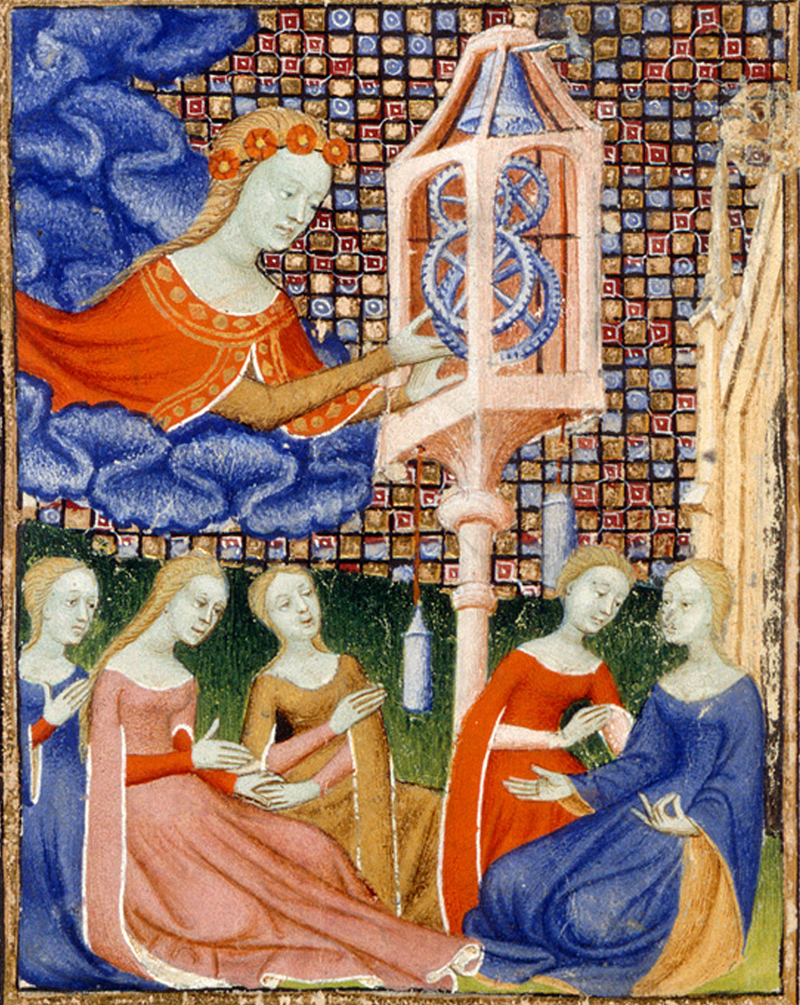
The reading begins with a depiction of Woman Wisdom as a street preacher, calling out to all who will listen, to follow her lead. This picture of Wisdom standing at the gates calling out to any who will listen comes after the author of this part of the book of Proverbs (chapters 1-9) describes both the allure and the dangers offered by the strange or loose woman (Proverbs 7). This opening section of Proverbs (chapters 1-9) depicts a father sharing wisdom with his son (a perfect Father’s Day allusion?). The key to this bit of wisdom is the contrast between the loose woman who represents folly and the righteous creation of God who offers the boy Wisdom.   
 
With the reading prefaced by the picture of Woman Wisdom standing at the gates of the city beckoning all who will hear to follow her, we come to verse 22. We might start by affirming the premise of verse 22, that Wisdom is the first act of God’s creation.  The writer of this poem lifts up Wisdom’s role in the creative process. She was there from the beginning, before anything took form, from the sea to the sky to the land. But what was the role she played?
 
Cameron Howard suggests that “Wisdom was God’s joyful companion,” a vision revealed in the fine two verses of the passage we have before us. Joy is the operative word here regarding Wisdom, so we might consider that, as Howard suggests, “to walk in the straight and righteous paths of Wisdom, then, is to connect with this same primal joy” [Connections, pg. 3-4]. This idea that Wisdom is God’s companion as God engages in the work of creation emerges from an alternative reading of verse 30. The NRSV speaks of Wisdom being the “master worker.” However, it is also possible to read this as “child.” If we read it as “master worker” or architect, then how should we understand the reference to God taking daily delight in Wisdom? Is it in terms of the work being done or something else? If we go with “child,” then Wisdom is that companion with whom God shares the joy of creation? Whatever the case, God takes delight in what is created, as does Wisdom. Indeed, Wisdom rejoices in the inhabited world and in the human race itself. All of this goes back to the pronouncement in Genesis 1 that the creation is good.
 
                So the message of the day is really one of joy. Let’s rejoice in the beauty of creation, including human life. It is good and blessed. Such joy should lead us to a commitment to care for creation. As Leanne Van Dyke suggests, “A Christian vision that looks out onto our world with the eyes of Wisdom constantly sees opportunities for participating in God’s own intentions and plans. God is not a Creator gone missing. God is intimately related to each and every creature” [Connections, p 5]. Such a vision, one that motivates us to social engagement, brings with it a sense of joy. Again, Van Dyke writes: The church certainly better fulfill its mission to communicate the gospel to a jaded world with winsome cheer and joyful delight rather than judgment and blame” [Connections, p. 6]. It is true that prophets are known to talk turkey about things in the world, and that is sometimes needed, but a constant harangue doesn’t get us far. Joy, on the other hand, it has more to offer.
 
                Trinity Sunday highlights God in God’s fullness, however we have come to understand that fullness. In celebrating God’s fullness, we acknowledge God’s role as Creator. Knowing that God takes delight in the creation, of which Holy Wisdom is both the first act and the partner, we can sing boldly: “All creatures of our God and king, lift up your voice and with us sing; Alleluia, Alleluia!”

Image attributionMaster of the Cité des Dames, active 1400-1415. Wisdom, Prudence, and Knowledge, from Art in the Christian Tradition, a project of the Vanderbilt Divinity Library, Nashville, TN. http://diglib.library.vanderbilt.edu/act-imagelink.pl?RC=56953 [retrieved June 10, 2019]. Original source: https://commons.wikimedia.org/wiki/File:Othea%27s_Epistle_(Queen%27s_Manuscript)_02.jpg.


Confused Talk — Lectionary Reflection for Pentecost Sunday (Genesis 11)

11 Now the whole earth had one language and the same words. And as they migrated from the east, they came upon a plain in the land of Shinar and settled there. And they said to one another, “Come, let us make bricks, and burn them thoroughly.” And they had brick for stone, and bitumen for mortar. Then they said, “Come, let us build ourselves a city, and a tower with its top in the heavens, and let us make a name for ourselves; otherwise we shall be scattered abroad upon the face of the whole earth.” The Lord came down to see the city and the tower, which mortals had built. And the Lord said, “Look, they are one people, and they have all one language; and this is only the beginning of what they will do; nothing that they propose to do will now be impossible for them. Come, let us go down, and confuse their language there, so that they will not understand one another’s speech.” So the Lord scattered them abroad from there over the face of all the earth, and they left off building the city. Therefore it was called Babel, because there the Lord confused the language of all the earth; and from there the Lord scattered them abroad over the face of all the earth.

***************
                It is truly annoying when people just babble on. That phrase or concept of speech that is confused and irrelevant takes its origins from this biblical story. Whether one knows the context or not, the story of the Tower of Babel is a biblical story people seem able to envision. It is an image that has been part of our cultural landscape for centuries. Now, it appears in the lectionary in connection with Pentecost Sunday. Pentecost is concerned with the birthing of the Christian movement as the Spirit empowers this fledgling community to spread the good news across the world (I’m tempted to say globe but that might be somewhat anachronistic). If Babel has to do with the confusion languages, Pentecost might have something to do with its reversal. Or does it? The story of Babel suggests that the confusion of languages is rooted in human hubris. In some way, Pentecost is seen as a means of undoing the damage done at Babel, but perhaps not be creating a monoculture, but providing an opportunity for understanding. What is scattered is now brought back together, without the diversity being removed.
                The reading from Genesis 11 is designated as a reading from the Hebrew Bible for Pentecost Sunday. To flesh out a bit more the Pentecost setting, we must turn to Acts 2, where we find the followers of Jesus gathered in a room in Jerusalem. They’ve heard their commission to take the good news to the ends of the earth. They’ve also heard the call to wait until the Spirit comes upon them. It’s during the festival of Pentecost, when Jews gathered in Jerusalem to celebrate the harvest, that the Spirit decides to descend. The gathered disciples, some 150 strong, break out in praise, each speaking a different language, a language they had not learned prior to this experience. There was a crowd of people standing outside who heard the message—each in his or her own language—and it got their attention. This led to Peter’s sermon and an altar call that led to some 3000 baptisms (or so Luke reports).
                This passage from Genesis 11 is, in the Genesis context, a self-contained story situated between genealogical listings. For our purposes, in the context of Pentecost, it provides a background to the Spirit’s provision of the gift of languages in Acts 2. What was confused becomes understandable to the glory of God. Genesis 1-11 is understood to be primeval history. It is a saga that reveals important elements of the faith but shouldn’t be understood to provide historical information. This Kairos (sacred) time, not Chronos time. If we can agree on this matter, then we’ll be able to hear the message present in the passage. We begin with the revelation that once everyone spoke the same language. The preceding chapter (chapter 10) gives us a genealogical listing of the descendants of the three sons of Noah. Thus, we would assume that the world that is migrating to the land of Shinar, as noted in this reading, are descendants of Noah and his sons Ham, Shem, and Japheth. Interestingly, the story of Babel is situated between the genealogical listings in chapter 10 and the restatement of Shem’s descendants in verse 10 of chapter11, taking us up to Abram, son of Terah. 
 
So where is the land of Shinar? The name of the city—Babel—gives us a clue that this would be a city located in the Tigris-Euphrates valley. Now, the idea that the entire world would make this journey is assuming that the human population is rather small. In fact, the founder of Babel is named in chapter 10 as Nimrod, son of Cush, son of Ham. To the original readers of this passage, this story would speak of the origins of Israel’s enemy Babylon. Of course, Babylon’s origins would be rooted in human hubris. What else would you expect? 
 
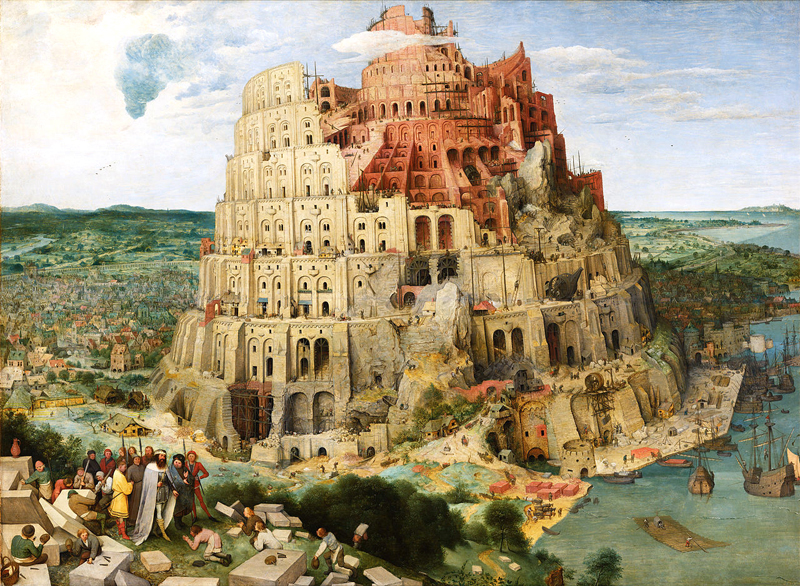
According to our story, when the migrants from the east made their way to the land of Shinar they decided to make bricks and build a city. Not only did they build a city, but they built a tower in the middle of the city so they could reach the heavens, for, of course, that’s where God (the gods) live. We know something of these towers that were prominent in the cities of Mesopotamia, including Babylon. They were known as ziggurats, towers with stairs on all sides. At the top of the tower was an altar. This was understood to be a “Stairway to Heaven” (to borrow from Led Zeppelin).  The tower had the purpose of being a place of worship. That’s understood. What’s interesting here is that they chose to build the tower to the heavens, according to this account, not for worship but so they could make a name for themselves. This was considered an evil act, one that the LORD (Yahweh) did not appreciate. Even as the denizens of Babel built their way to the heavens, the LORD came down to check things out. When it came to the contrast between the temples of Mesopotamia and those built in Israel, Peter Enns and Jared Byas note: “By contrast, Israel’s worship structures (the tabernacle and later the temple) don’t have steps going up to heaven. Instead, Israel waits for God to come down.” [Peter Enns & Jared Byas,  Genesis for Normal People, Patheos Press. Kindle loc 984].
With the tower built so that the people of Babel could make a name for themselves, lest they find themselves scattered across the land, the LORD decided to confound their plans by confusing their languages. There is a bit of fear on the part of Yahweh and the divine council. Yahweh admits that since they are one people with one language, then if something isn’t done, nothing will be impossible for them. Action is required. Now the question here is whether Yahweh is afraid of them or for them. Remember in Genesis 3, God exiles Adam and Eve so they will no longer have access to the tree of life, effectively making them immortal. Putting a barrier up kept them from engaging in actions that might ultimately be detrimental to them (or so it seems). Could the same be true here?
The view of the people of Babel seems to be that if they don’t take care of themselves, no one will. In other words, they’re not considering how God fits into the situation. Nevertheless, despite the fear that they will be scattered, the LORD, in the end, confuses their languages and scatters them across the land. And thus the nations are born (in primeval fashion). Soon Abram will appear from one of these scattered tribes, and the process of scattering will slowly be unwound (perhaps).
So, how do we hear this story at Pentecost? I noted above that Pentecost is often understood to be an unwinding of Babel, but perhaps not.  Perhaps the response of Pentecost is not a return to a mono-lingual reality, but a binding together of peoples in their diversity. Thus, Cameron B. R. Howard writes: “In the Babel account, fear is the binding agent that drives the building projects: fear of dispersal, of loss, of living with otherness. Both the Babel and the Pentecost accounts emphasize the power of human unity, without expecting human sameness, sending people out into the world to forge connections with those who are different from themselves.” [Joel B. Green, et al, Connections: A Lectionary Commentary for Preaching and Worship: 2 (Kindle Locations 9932-9934).].
So maybe difference isn’t punishment, it’s simply reality. If this is true, and I think it is, then unity is not found in uniformity but in the way in which the Spirit, who is the binding agent, removes the fear that drove the people of Babel to build the tower and drives us to build barriers to keep each other at bay. Is this not a good message for our times when fear and hubris conspire to undermine true unity in the Spirit?  


Picture Attribution: Bruegel, Pieter, approximately 1525-1569. Tower of Babel, from Art in the Christian Tradition, a project of the Vanderbilt Divinity Library, Nashville, TN. http://diglib.library.vanderbilt.edu/act-imagelink.pl?RC=56948 [retrieved June 3, 2019]. Original source: https://commons.wikimedia.org/wiki/File:Pieter_Bruegel_the_Elder_-_The_Tower_of_Babel_(Vienna)_-_Google_Art_Project_-_edited.jpg.