Month: July 2020

A Hidden Abundance — Lectionary Reflection for Pentecost 9A (Matthew 14)

A Hidden Abundance — Lectionary Reflection for Pentecost 9A (Matthew 14)

Lectionary Reflection — reposted from July 29, 2014.

Matthew 14:13-21 New Revised Standard Version (NRSV)

13 Now when Jesus heard this, he withdrew from there in a boat to a deserted place by himself. But when the crowds heard it, they followed him on foot from the towns. 14 When he went ashore, he saw a great crowd; and he had compassion for them and cured their sick. 15 When it was evening, the disciples came to him and said, “This is a deserted place, and the hour is now late; send the crowds away so that they may go into the villages and buy food for themselves.” 16 Jesus said to them, “They need not go away; you give them something to eat.” 17 They replied, “We have nothing here but five loaves and two fish.” 18 And he said, “Bring them here to me.” 19 Then he ordered the crowds to sit down on the grass. Taking the five loaves and the two fish, he looked up to heaven, and blessed and broke the loaves, and gave them to the disciples, and the disciples gave them to the crowds. 20 And all ate and were filled; and they took up what was left over of the broken pieces, twelve baskets full. 21 And those who ate were about five thousand men, besides women and children.

***************

There is only one miracle story that is found in all four gospels, and that is the feeding of the 5,000 – plus the women and children.  Whatever happened that day, it caught the imagination of the Gospel writers.  We can debate over whether an actual – factual – miraculous event occurred in which Jesus multiplied a few loaves of bread and a few fish to feed thousands.   To do so likely misses the point of the story.  As Brian McLaren suggests, when it comes to miracle stories, perhaps we should consider a third alternative viewpoint, which stands apart from the traditional yes and no arguments.  Instead “we could ask another question What happens to us when we imagine miracles happening?”  That is, what does this story do to us now?  How does it challenge our assumptions and imaginations?  Thus:

Perhaps, by challenging us to consider impossible possibilities, these stories can stretch our imagination, and in so doing, can empower us to play a catalytic role in co-creating new possibilities for the world tomorrow. [McLaren, We Make the Road by Walkingp. 97].

Keeping in mind Brian McLaren’s suggestion about a story like this playing a catalytic role in creating new possibilities for the world, what might we hear in this passage for today?  Consider for a moment that in Matthew’s gospel, this story follows immediately after Herod has had John the Baptist executed.  Jesus, knowing that his co-conspirator in proclaiming the realm of God has been killed, wants to get away from the crowds, so he can regroup.  Could he be next?  His attempt to get away – to go on vacation – fails.  Jesus’ inability to get away reminds me of what it must be like to be President.  Stuff just follows after the President.  He can’t let down, even for a moment, or someone will criticize him.  Besides, he takes with him a team of advisors.  I’m reminded too of how President Lincoln found it necessary to get away from the White House just so he could think about what was happening in the war effort.  So it is with Jesus.  He needs to find a quiet place, a place in the wilderness.  He even takes a boat so he can evade the crowds.  But his efforts to find a secluded spot falter.  When he sees them, he has compassion for them, and he begins to heal their sick.

As the day began to wind down, the disciples began to get anxious about the crowd.  They had to be hungry, and a hungry crowd can be an unruly one.  Fear is setting in.  So, they encourage Jesus to bring the healing session to a close and send them off to the surrounding villages, so they can find something to eat.  We can understand their concern.  Anyone who is tasked with logistics understands that you have to make sure things don’t get out of hand.

Jesus, as you might imagine, has other ideas.  Although he had refused to turn stone into bread to feed himself, he was willing to provide nourishment for those who had come to him seeking his blessing.  Doing this was, of course risky.  People can get used to such things – as John reminds us (John 6).  They can get the wrong idea, especially if they think you’re the one who will rescue the nation from its current overlords.  At this moment in time, as Matthew tells the story, Jesus isn’t too worried.  Instead, he tells the disciples to feed the crowd.   Yes, he tells them, you feed them.  They’re flabbergasted.  How does Jesus expect them, twelve guys, who can scrounge up just five loaves of bread and a couple of fish between them, to feed this massive crowd?

Jesus won’t be deterred by their groans (don’t you hear the groans between the lines?).  He simply asks them to give an account of what they have.  They say they have nothing, but they do have something.  They have five loaves of bread and two fish.  Jesus tells them to give what they have to him.  He looks up into the heavens, acknowledging God’s presence, gives thanks, blesses it, and then he gives the disciples this food and invites them to distribute it to the crowd.  With that many people, this would take a bit of time.  When they finish, Jesus asks them how it went.  Did they have enough to feed everyone?  Was it like a typical church potluck, where there’s always more food than people?  Amazingly they had more food after the feeding than before.  How that happened, Matthew doesn’t say.

This story invites us to consider the hidden abundance that is in our midst.  I don’t know how Jesus did it.  Was it a miracle?  Or did Jesus set the example for those who had brought food for themselves, never intending to share, but finding it appropriate to share what they had once Jesus started the distribution?  Again, we’re not told how it happened, only that everyone ate, was filled, and there was more food left over than when they began.

What about us?  What about the hidden abundance that is present in our midst?  Do we feel as if there is nothing in the pantry, or is there enough present to be used by God to bless others?   As I think about this story, I’m reminded of the children who have come to our borders from Central America.  They’re fleeing poverty and violence back home.  Some of the children are as young as six.  They’ve traveled hundreds of miles, often sitting on the top or sides of trains.  They’ve risked death to make it to the Promised Land.  Some hope to be reunited with family.  Others simply hope that their journey will lead to a better life.   What would Jesus say to them?   Would he turn them away or would he say to us on this side of the border – you feed them.  You clothe them.  You house them.  We say, but what about the cost.  We can’t afford it.  There are too many problems here at home.  What would Jesus say to us, as we down a second helping of dessert?   There are no easy solutions to the crisis at the border or to the challenges facing our urban centers and rural heartlands.  There is plenty of poverty here at home – but the challenges of the border don’t prevent us from handling these crises.  We’ve been ignoring them long before these children showed up at the border.

The story of the feeding of the 5000 falls not just after the death of John, but in Matthew’s version, it comes after Matthew has laid out his collection of parables of the kingdom.  He has shown us through Jesus’ words what the kingdom looks like (Matthew 13).  Now, in a series of miracles we see additional signs of the kingdom.  There is healing, there is feeding, there is power.  How do these stories release our imagination?  How do they dislodge the hidden resources so that they can be brought forth and used for the good of the kingdom?

The way in which Jesus goes about feeding the 5000 should evoke in our hearts and minds the image of the Eucharist.  In the story of the Last Supper, Jesus takes bread, blesses it, and gives it to the disciples.  They are told to continue the practice, eating and drinking, in memory of Jesus.  As we share bread with our neighbors, are we not remembering Jesus?  Does not the act of giving serve as an act of thanksgiving?  Should we not begin to see the sacramental table of the Lord being an open one that takes many forms – including the soup kitchen or welcoming the children knocking at our borders?

Picture attribution — Swanson, John August. Loaves and Fishes, from Art in the Christian Tradition, a project of the Vanderbilt Divinity Library, Nashville, TN. http://diglib.library.vanderbilt.edu/act-imagelink.pl?RC=56553 [retrieved July 28, 2020]. Original source: http://www.JohnAugustSwanson.com – copyright 2003 by John August Swanson.


An Elect People — Lectionary Reflection for Pentecost 9A (Romans 9)

Romans 9:1-5 New Revised Standard Version (NRSV)
 

I am speaking the truth in Christ—I am not lying; my conscience confirms it by the Holy Spirit— I have great sorrow and unceasing anguish in my heart. For I could wish that I myself were accursed and cut off from Christ for the sake of my own people, my kindred according to the flesh. They are Israelites, and to them belong the adoption, the glory, the covenants, the giving of the law, the worship, and the promises; to them belong the patriarchs, and from them, according to the flesh, comes the Messiah, who is over all, God blessed forever. Amen.

********************

                This reading from Romans is a bit truncated. It starts with a lament and concludes with a word of thanksgiving, but it feels like something is missing. It feels like there is more to this story than has been revealed in these opening lines of chapter nine. The truth is, there is more to the story. This is the opening paragraph of a conversation about the relationship of the emergent Christianity with its Jewish parentage. It is the kind of reading that lends itself to supersessionism. So, we must tread carefully.

                If we remove verses 1-3, we celebrate Israel’s chosenness. To Israel belongs adoption, glory, covenants, the law, worship, promises patriarchs. Indeed, even the Messiah (the Christ) belongs to Israel, at least according to the flesh. So, blessed be God. If this is true, then why is Paul expressing his great sorrow and anguish? If we follow the story into verse six, we get a sense of why he might be filled with sorrow. Though Israel is the elect of God, not all Israelites belong to Israel. That is, Paul is suggesting that spiritual descent, rather than physical descent is what counts in determining whether one belongs to Israel.  “This means that it is not the children of the flesh who are the children of God, but the children of the promise are counted as descendants” (Rom. 9:8). Here is where the trouble begins, at least for interpreters of Paul’s Roman letter.

                We need to read these verses with the larger context of Romans 9-11 in mind. Paul is grieving because his people, Israel, did not fully embrace Jesus as Messiah. At points in these chapters, it may appear that Paul is suggesting that God has abandoned the original covenant. While he gives that impression at points, in the end, he is clear that the covenant is everlasting (Rom. 11:29). Nevertheless, there is a lot of turmoil yet to be experienced.

Truth be told, these are difficult chapters to interpret, which means there is a lot of room for misinterpretation and misapplication, including support for anti-Judaism and antisemitism. It does appear that the rejection of Jesus as messiah has its consequences, which is why Paul is grieving. Nevertheless, in the end, Israel will be saved. We might start with the premise that while Paul heard the call to proclaim the Gospel to the Gentiles, he hadn’t forgotten Israel. So, he wrestles with the question of where Israel fits into this new work of God. He’s already affirmed in chapter 8 that nothing can separate us from the love of God in Christ Jesus. Certainly, that applies to his fellow Jews (Rom 8:38-39). As Kyle Fedler notes “the key to today’s lectionary text is 9:6, which is really just a restatement of 8:38-39. Indeed, this verse is the key to Romans 9-11: ‘It is not as though the word of God had failed.’” [Feasting on the Word, p. 306]. While the reading ends with verse 5, it is wise to continue reading, to be reminded that while we may be unfaithful, God is always faithful to the covenant. We might want to think in terms here of Paul’s feelings about the reluctance of the majority of Jews to adopt his messianic vision. He believes there are consequences to this rejection of Jesus, though not eternal ones.

                So, what should we make of this reading? It is brief and a bit ambiguous. What message might it have for us? One takeaway that we must avoid is the suggestion that has plagued Jewish-Christian relations for two millennia. That suggestion is that God has rejected the Jews in favor of Christians as the new people of God. God will remain committed to the covenant whether or not the people remain faithful.

                One word we hear in these opening lines is Paul’s sense of solidarity with his people. He wished they would respond as he had, but he doesn’t separate himself from his people. He celebrates the blessings that belong to the Jewish people, including the covenant and the messiah who emerged from within this people to bless the broader world. So, we who are Gentiles can read this as a reminder that the blessings that come to us as followers of Jesus have their origins in the Jewish people, who gave us Jesus the Messiah.

                Might we, following Karl Barth, hear in this a word about the church as being counted as among the elect of God without displacing Israel? Barth suggests in his commentary that in making this statement Paul is reluctantly breaking with the Pharisees. There is a sadness here, but he is part of a new community, the church. But, perhaps the word to us, as the church is that we should not take our place in God’s realm for granted. As Barth puts it: “In so far as ‘God’ is that which we, in the company of all other men, can know and define and worship, the assertion stands. In so far,  however, as God is He that ruleth all things,  there is embedded in the assertion a doubt, nay more, a complaint and an accusation: God does not belong to the Church.” [Barth, Epistle to the Romans, p. 339].

                Perhaps that is the word we should take to heart here, as the Church. God doesn’t belong to us. We don’t possess God. God transcends our grasp. Perhaps that means we don’t get to control access to God. As Grace Ji-Sun Kim puts it: “God remains in control and will accomplish God’s redemptive purposes. The missional life of Christians is expressed by how we live, share, and work for justice with others who are also God’s people” [Preaching God’s TransformingJustice, p. 344]. That, I believe, is a word worth hearing!   


If God Is For Us, Who Can Be Against Us — Lectionary Reflection for Pentecost 8A (Romans 8)

Le Trinite — Cristoff Baron
Romans 8:26-39 New Revised Standard Version (NRSV)
 

26 Likewise the Spirit helps us in our weakness; for we do not know how to pray as we ought, but that very Spirit intercedes with sighs too deep for words. 27 And God, who searches the heart, knows what is the mind of the Spirit, because the Spirit intercedes for the saints according to the will of God. 

28 We know that all things work together for good for those who love God, who are called according to his purpose. 29 For those whom he foreknew he also predestined to be conformed to the image of his Son, in order that he might be the firstborn within a large family. 30 And those whom he predestined he also called; and those whom he called he also justified; and those whom he justified he also glorified. 

31 What then are we to say about these things? If God is for us, who is against us? 32 He who did not withhold his own Son, but gave him up for all of us, will he not with him also give us everything else? 33 Who will bring any charge against God’s elect? It is God who justifies. 34 Who is to condemn? It is Christ Jesus, who died, yes, who was raised, who is at the right hand of God, who indeed intercedes for us. 35 Who will separate us from the love of Christ? Will hardship, or distress, or persecution, or famine, or nakedness, or peril, or sword? 36 As it is written,

“For your sake we are being killed all day long;


    we are accounted as sheep to be slaughtered.” 

37 No, in all these things we are more than conquerors through him who loved us. 38 For I am convinced that neither death, nor life, nor angels, nor rulers, nor things present, nor things to come, nor powers, 39 nor height, nor depth, nor anything else in all creation, will be able to separate us from the love of God in Christ Jesus our Lord.

************

                At times like this, as the entire world is enveloped by a pandemic that has affected millions, how do we pray? What words fit the occasion? As a pastor and preacher, I know I’ve struggled at times at finding the words to share in worship. When Paul wrote these words we have before us, he didn’t have a pandemic in mind. However, the words remind us that no matter our situation, the Spirit will intercede for us, using our mumbles if nothing else to speak to God. With this promise of the Spirit comes a promise—Nothing will separate us from the love of God in Christ Jesus.

                This is the third reading from Romans 8 that the Revised Common Lectionary invites us to consider. We’ve been assured that in Christ there is no condemnation. Instead, we experience freedom from sin. We’ve been assured that the suffering of the present is nothing when compared with the glory that awaits us. Now, we hear that the Spirit prays for and with us. Because God sees our hearts, God hears our prayers, even if we’re not able to articulate exactly what’s on our hearts. If you view this reading from a certain angle, with an openness to the possibility, you might see here hints of the Trinity.

                Paul speaks of the Spirit using our sighs or groans to communicate what is on our hearts, but which we can’t find the words to express. In a previous paragraph, Paul spoke creation itself groaning as it awaits its liberation, even as we groan as we await our redemption (Rom. 8:19-25). So, the thought is continued, only that now we know that the Spirit groans along with creation and God’s people as we await the revelation of God’s future for us. This reference in Romans 8:26, which suggests that when we, in our weakness, can’t find the words to pray, has been interpreted in Pentecostal and Charismatic circles as a reference to the gift of tongues or as it’s sometimes described—a prayer language. While Paul likely, in my estimation, doesn’t have this idea in mind, the concept of a prayer language, as I was taught it in my Pentecostal experience does make sense [on the gift of tongues or glossolalia, see my book Unfettered Spirit, pp. 122-126].

                The promise of the Spirit’s act of intercession leads to another promise, and that for those who love God, things will work out for the best. In making this claim Paul brings in the word predestine when it comes to those who will love God. That is, God directed that those who embraced the call would be conformed to the image of Christ so that Christ might be the firstborn of a large family. As we discovered in the previous reading, we have an inheritance, together with Jesus, for we are children of God by adoption (Rom. 8:14-17). This word about foreknowledge and calling serves as a sign of God’s initiative in the process of salvation. God makes the first move in Christ. As Sarah Heaner Lancaster notes: “Paul’s remarks about predestination are words of encouragement to the recipients of this letter that God would, in fact, bring the goodness of salvation out of their suffering. Paul is not speaking here of predestination as determinism of all events. Nor is he speaking of any theories of predestination that developed much later (such as eternal decrees)” [Lancaster, Romans, Belief, p. 150]. In other words, Paul isn’t a Calvinist. What Paul is focused on here is God’s initiative and faithfulness to the purpose of salvation, which in 2 Corinthians 5:17ff, he defined in terms of reconciliation. One can, regarding salvation, envision as did Origen, that this involves some form of universal salvation. For those of us who operate from a more open and relational perspective, the way forward lies open, though God will remain committed to the reconciliation of all things. Thus, as Karl Barth suggests, those whom God calls, God foreordains to be conformed to the image of Christ. The way I read Barth’s reading of Paul, is that God has disclosed that those who love God will take up their calling to “bear witness to the death of Jesus and consequently to his resurrection” [Barth, Epistle to the Romans, p. 323].

                That leads us to Paul’s next point: “if God is for us, who is against us?” (Rom 8:31 CEB). Since God risked God’s own son to reach us, then who can bring a charge against God’s people. The one who was crucified and raised serves as our defense attorney. Since this is true, nothing can separate us from Christ’s love, not “hardship, or distress, or persecution, or famine, or nakedness, or peril, or sword” (Rom 8:35). Paul draws from Psalm 44:22, to speak of the threat of death that faces the people of God, but victory is assured. This assurance, at least as I read the text is not based on a deterministic understanding of reality, where God orchestrates things. No, it is because God will not give up the cause. God in Christ perseveres. Therefore, nothing can separate us from the love of God in Christ Jesus. Not death or life. Not angels or rulers. Not present things or future things. No form of power or anything created can separate us

                Living in and through difficult circumstances always raises questions about the nature of faith and even the existence of God. Paul’s response is simply this, while suffering may occur, God goes with us. The short term may involve suffering, but in the long term, we will be more than conquerors. That is because nothing can separate us from the love of God in Christ Jesus. In this, there is hope, “for if God is for us, who can be against us.”  

Note on the image: the artist, Cristoff Baron had a series of pieces, this being one of them, which I viewed while visiting the Strasbourg Cathedral of Notre Dame in France (September 2019). 


Weeding Time? — Lectionary Reflection for Pentecost 7A (Matthew 13)

 
24 He put before them another parable: “The kingdom of heaven may be compared to someone who sowed good seed in his field; 25 but while everybody was asleep, an enemy came and sowed weeds among the wheat, and then went away. 26 So when the plants came up and bore grain, then the weeds appeared as well. 27 And the slaves of the householder came and said to him, ‘Master, did you not sow good seed in your field? Where, then, did these weeds come from?’ 28 He answered, ‘An enemy has done this.’ The slaves said to him, ‘Then do you want us to go and gather them?’ 29 But he replied, ‘No; for in gathering the weeds you would uproot the wheat along with them. 30 Let both of them grow together until the harvest; and at harvest time I will tell the reapers, Collect the weeds first and bind them in bundles to be burned, but gather the wheat into my barn.’”


36 Then he left the crowds and went into the house. And his disciples approached him, saying, “Explain to us the parable of the weeds of the field.” 37 He answered, “The one who sows the good seed is the Son of Man; 38 the field is the world, and the good seed are the children of the kingdom; the weeds are the children of the evil one, 39 and the enemy who sowed them is the devil; the harvest is the end of the age, and the reapers are angels. 40 Just as the weeds are collected and burned up with fire, so will it be at the end of the age. 41 The Son of Man will send his angels, and they will collect out of his kingdom all causes of sin and all evildoers, 42 and they will throw them into the furnace of fire, where there will be weeping and gnashing of teeth. 43 Then the righteous will shine like the sun in the kingdom of their Father. Let anyone with ears listen!


******************

                Anyone who has tried to plant or tend a garden knows that no matter what you do – there will be weeds to deal with.  We can prepare the ground, put in new soil designed so that the new plants will flourish.  We can put down a layer of Preen and mulch.  But no matter what we do – weeds will sprout.  We can pull them out (and I do), but that won’t be the end of them.  And, as sometimes happens, the weeds become so intertwined with the plants that we can’t pull them out without pulling out the good plants.  So what do we do?

                Jesus doesn’t have an answer to our gardening problems.  He doesn’t work at Lowes or the local nursery.  But, he does have something to say about weeds.  In the prior week’s Gospel reading from Matthew 13, we come upon the “Parable of the Sower” (Matthew 13:1-9, 18-23).  This week we encounter a follow-up parable.  Now that the seeds have been sown, and some of them have taken root in good soil, it’s time to start planning for the harvest.  But, low and behold, someone (the enemy) has gone into the freshly planted soil and sown weed seeds.  And now the weeds are coming up, threatening, perhaps, to choke out the wheat (Matthew 13:24-30).    So what should be done?  The field has the promise of a great harvest, but how do we get rid of the invasive weeds?  Should we go and pull them out?  The Sower responds to their question with a firm no.

                But why?  Why let the weeds remain?  After all, it’s possible they could threaten the more desirable grains.  Now, I’m not a wheat or corn farmer.  I don’t know what the best policy is.  I’ve seen vineyards where every weed is pulled out and vineyards where weeds have been allowed to take root.  The latter doesn’t look very good, but I’m not sure that the presence of the weeds is detrimental to the grapes.  So perhaps the same is true of wheat fields.  Whatever is the best policy, we should acknowledge that Jesus isn’t in the business of providing gardening advice.  He could be totally wrong about what to do with weeds.  But Jesus does know something about human nature.  He understands that in every community of faith there will be the righteous and the unrighteous.

                The truth is, every church has a few “weeds” living amongst the righteous grains.  These are the people who cause problems.  They’re disruptive and counterproductive.  If the church decides to go right, they’ll make a fuss about the importance of turning left.  Or these folks become clergy killers, doing everything they can to undermine the ministry of those called to serve the congregation.   These kinds of people can even give the church a bad name, especially if the dirty laundry spills out into the public sphere.  So, what do you do?

                One of the reasons why it’s currently popular to be spiritual but not religious is that the institutional church is considered too stifling for a person’s spiritual growth.  But the other reason has to do with the presence of hypocrites in the churches.   If only “they” weren’t there, then we’d go to church.  They say:  If I could find a church where people agreed with my politics or my theology, then I’d go.  Yes, if only I could find the perfect church, then I’d go to church.

This desire for purity is also found within the churches — among both conservative and liberal strands of the Christian community.  We see it being played out in denominations struggling to make sense of Marriage Equality – much as they did with women in ministry and civil rights.  Will they stay together or break apart.  Often this is an issue of power – who gets to control the agenda.  But there is also an idealism present in many communities that leads them to believe that if only the problem causers could be weeded out, then the church could get on with its mission.

                But, who makes us the judges?  Why should we have the responsibility to go out and pull up the “weeds” that have been sown by the “enemy”?

                Many centuries ago, at a time when the early Christian community was emerging from the shadows, a question arose.  What should we do with bishops and other church leaders who betrayed the trust of the community by burning incense to the Emperor or turning in sacred writings to the authorities?  Shouldn’t they be excluded from the faithful?  Hadn’t they committed the unforgivable sin?  Did they not soil the church, and therefore should be excluded.  Not only that, but shouldn’t the sacraments that they administered be considered suspect?  Such was the position that the Donatist Movement took during the fourth and fifth centuries CE.  They believed that they alone were pure – because they didn’t allow anyone in the church, or at least in church leadership, who was a “traditore,” one who betrayed the church.  St. Augustine, being a leading bishop in North Africa where the Donatists had a strong presence, responded forcefully – perhaps overly aggressively – but he had a point.   The holiness of the church and its sacraments shouldn’t be dependent on the people who make up the church.  For Augustine the church was holy, not because of the people who comprised it were holy, but because God is holy.

                Yes, it would be more peaceful in the church, if there were no people because if there were no people in the church, there would be no problems.  Of course, there would be no church either.   And so here we are – the Church of Jesus Christ.  We are members of an imperfect body, made perfect through the grace of God.  But it is what it is.  Within its circle there are conservatives and liberals.  There are “true believers” and hangers-on.  There are the morally impure and the relatively pure.   Jesus says – let them grow up together because if you start casting people out, you’re liable to throw out the good with the bad.  In fact, you may find yourself on the short end of the stick.

                As Jesus puts it – the angels will take care of things at the end.  God will sort it out.  That’s not our job.  Of course, the Scriptures do speak of church discipline.  But the fact is the church is a mixed company of righteous and unrighteous.  If should try to find a “pure church,” we’re likely to end up in a smaller and smaller company.  History has shown that schism leads to schism.  Protestantism is by its very nature a product of schism that has given way to more schisms.

My own denominational tradition began as a unity movement and bequeathed to the Christian world at least three – maybe more – varieties.  Our identity statement declares that “we are a movement of wholeness in a fragmented world.”  It is useful to remember that the fragmentation needing to be healed begins in our own back yard.   Sharon Watkins, General Minister and President of my denomination, the Christian Church (Disciples of Christ), writes:

All too often the image people have of Christianity is one of narrowness rather than inclusion, judgment rather than acceptance of different points of view, fear rather than love. The truth is that we Christians have a lot of work to do.  We are not as good as we should be at showing the world what this God of love is like.  We fall short of being the best possible ambassadors of that love. [Sharon Watkins, Whole: A Call to Unity in Our Fragmented World, p. 100]

                Jesus speaks of judgment.  In fact, he speaks of the workers (angels of God) separating out the weeds from the grain (after harvesting them) and burning the weeds and chaff.  But, as for us, we’re to leave judgment to God.  While the parable ends with a word of judgment, can we not also consider the possibilities of redemption present in the church.  Perhaps if we learn to love the difficult people in our lives, then we will discover that they, like us, have experienced hurt and disappointment in life.  That is not to say there is no room for discipline to protect the vulnerable – but there can be room for redemption and reconciliation as well.


Originally published July 15, 2014 –Ponderings on a Faith Journey  https://www.bobcornwall.com/2014/07/weeding-time-lectionary-reflection-for.html


Claiming Our Inheritance – Lectionary Reflection for Pentecost 7A – Romans 8

Claiming Our Inheritance – Lectionary Reflection for Pentecost 7A – Romans 8

Romans 8:12-25 New Revised Standard Version (NRSV)

12 So then, brothers and sisters, we are debtors, not to the flesh, to live according to the flesh— 13 for if you live according to the flesh, you will die; but if by the Spirit you put to death the deeds of the body, you will live. 14 For all who are led by the Spirit of God are children of God. 15 For you did not receive a spirit of slavery to fall back into fear, but you have received a spirit of adoption. When we cry, “Abba! Father!” 16 it is that very Spirit bearing witness with our spirit that we are children of God, 17 and if children, then heirs, heirs of God and joint-heirs with Christ—if, in fact, we suffer with him so that we may also be glorified with him. 

18 I consider that the sufferings of this present time are not worth comparing with the glory about to be revealed to us. 19 For the creation waits with eager longing for the revealing of the children of God; 20 for the creation was subjected to futility, not of its own will but by the will of the one who subjected it, in hope 21 that the creation itself will be set free from its bondage to decay and will obtain the freedom of the glory of the children of God. 22 We know that the whole creation has been groaning in labor pains until now; 23 and not only the creation, but we ourselves, who have the first fruits of the Spirit, groan inwardly while we wait for adoption, the redemption of our bodies. 24 For in hope we were saved. Now hope that is seen is not hope. For who hopes for what is seen? 25 But if we hope for what we do not see, we wait for it with patience.

**************

                In movies and TV dramas, the reading of the will is always a moment of tension. What will I get? Will I be included or excluded? If you saw the recent movie Knives Out, the drama is centered on the inheritance (spoiler alert—people get murdered because of the inheritance). Of course, an inheritance can lead to blessing, if it’s shared. But the reading of the will does suggest a moment of transition. Whatever the outcome, one’s life will be different!

                Here in Romans 8, Paul speaks in near-apocalyptic terms of the prospect of moving from the present age into the future age. While the current age involves suffering, the coming age will provide freedom from suffering—both for the children of God and for creation itself. That future hope, in Paul’s terms, involves glory. This is the inheritance promised to God’s children.

According to Paul, if we are in Christ, something he’s been developing throughout the letter to the Romans, then we are children of God. Here in the reading for the seventh Sunday after Pentecost, we continue our reading of Romans 8. Paul begins by contrasting the way of the flesh and the way of the Spirit, which he had explored in the opening verses of the chapter. Paul is concerned that his readers embrace the way of the Spirit, rather than the flesh. If we live according to the Spirit, then we will experience life and not death. Here in our reading, Paul reaffirms the relationship of the Christian to the Spirit. If we are led by the Spirit, then we are children of God, literally sons of God (in verses 14-15, whereas Paul switches to the inclusive tekna in verses 16-17). It is a status that we share with Jesus the Son of God (Rom. 8:3). As such, we are no longer slaves to fear, for we are children of God by adoption.

                That word adoption is key here. In the Roman world, adoption was a common method of passing on an inheritance. Julius Caesar adopted Octavian (Augustus) as his heir, and Octavian used that adoption as the foundation for his claim to leadership in Rome. The same was true of Tiberius, who was adopted by Augustus (and on it goes). And, one could be adopted out of slavery (remember Ben Hur?). The reader would have understood the importance of adoption. So, having been adopted into the family of God, we can call out “Abba! Father!” This we do through the witness of the Spirit of God.

Since we have been adopted by God as God’s children, that makes us heirs of God, together with Jesus, whom we confess to be the Son of God. Note that Paul reminds the reader that if we are joint-heirs with Jesus, we shall likely share in his suffering. In making this point, Paul reminds us that to be in Christ does not free us from suffering, for Jesus himself suffered. Karen Chakoian writes that suffering is not to be seen as divine punishment or a sign of divine absence (something to remember in this time of pandemic). Thus, “suffering in no way negates the glory, truth, and promise of the resurrection. Rather, suffering offers evidence that these Christians are in fact already united with Christ” [Feasting on the Word, p. 259]. With this in mind, they can affirm that the inheritance (glory/salvation) is greater than the suffering.  So, while once we were enslaved, now we are children of God through adoption, and therefore, we are heirs of God and joint-heirs with Christ. Here is how Karl Barth describes this reality, in relationship to Abraham.

Like Abraham (iv.13), we are heirs of the promise, heirs of the world which God has blessed and made good, heirs of the eternal life and being and having and doing of God Himself, which, because of sin, had become invisible and indescribable, unreal and impossible. Living in the flesh, we await and hope for resurrection, we await our body with its new predicates. Of this hope our present life is the reflection, impress, and witness. Pledged to hope, our life finds there its goal. [Barth, Epistle to the Romans, p. 300].


Therefore, let us claim our inheritance, as heirs of God, and joint-heirs with Jesus, and live accordingly.

                As heirs with Jesus, we know that living with and for him, may include suffering. But this suffering, Paul suggests does not compare with the future glory that awaits us as we inherit eternal life. But we are not alone in awaiting the fruit of our inheritance. According to Paul, creation itself awaits the opening and reading of the will (to use my opening analogy). Creation, Paul tells us, “waits with eager longing for the revealing of the children of God” (Rom. 8:19). Indeed, creation, which has been subjected to futility is groaning in anticipation of its liberation. In other words, even as we are redeemed, so will creation be redeemed. In this age of debate over climate change and its related environmental challenges, it is a good reminder that God is concerned not only about humans, but creation itself. This suggests a symbiotic relationship between us as children of God and the broader created order.

                When we read Paul here, we need to use our imagination so we can envision the cosmic nature of God’s relationship with creation. Yes, God is concerned about us, and about the world we live in, but as our minds stretch to take in the larger universe, we need to consider how God might embrace the universe as a whole. I’m enough of a science fiction fan to consider the possibility that we’re not alone in the universe. So, how might the larger universe await the revealing of the children of God? In this regard, what is the expectation for the future? How might the hope of glory be revealed, which includes, according to Paul, the redemption of our bodies? It is in this spirit that we wait, patiently, for the reading of the will so we can claim our inheritance.


Picture Attribution: Fowler, John. Rising Star, Milky Way, from Art in the Christian Tradition, a project of the Vanderbilt Divinity Library, Nashville, TN. http://diglib.library.vanderbilt.edu/act-imagelink.pl?RC=56313 [retrieved July 12, 2020]. Original source: https://commons.wikimedia.org/wiki/File:Milky_Way_-_28_June_2014.jpg.

Freedom in the Spirit – Lectionary Reflection for Pentecost 6A (Romans 8)

Romans 8:1-11 New Revised Standard Version (NRSV)
There is therefore now no condemnation for those who are in Christ Jesus. For the law of the Spirit of life in Christ Jesus has set you free from the law of sin and of death. For God has done what the law, weakened by the flesh, could not do: by sending his own Son in the likeness of sinful flesh, and to deal with sin, he condemned sin in the flesh, so that the just requirement of the law might be fulfilled in us, who walk not according to the flesh but according to the Spirit. For those who live according to the flesh set their minds on the things of the flesh, but those who live according to the Spirit set their minds on the things of the Spirit. To set the mind on the flesh is death, but to set the mind on the Spirit is life and peace. For this reason the mind that is set on the flesh is hostile to God; it does not submit to God’s law—indeed it cannot, and those who are in the flesh cannot please God. 


But you are not in the flesh; you are in the Spirit, since the Spirit of God dwells in you. Anyone who does not have the Spirit of Christ does not belong to him. 10 But if Christ is in you, though the body is dead because of sin, the Spirit is life because of righteousness. 11 If the Spirit of him who raised Jesus from the dead dwells in you, he who raised Christ from the dead will give life to your mortal bodies also through his Spirit that dwells in you.


******

                The Second Reading for the Sixth Sunday after Pentecost is something of a reprise of the reading for the Fifth Sunday of Lent. That reading focused only on verses 6-11, so when we visited that reading we didn’t hear the opening word of the chapter, which pronounced a not guilty verdict on those who are in Christ Jesus. That is, there is no condemnation for those who are in Christ Jesus. The slate has been wiped clean. This is good news. It suggests we get to start life anew. That is because, in Christ, the Spirit of life has set us free from the spirit of sin and death. But, we need to be careful with what we do with this pronouncement. It’s not a perpetual get of jail card that we can use to do as we please. That would involve giving free rein to our own worst instincts, which is something Paul or Jesus would want us to do.

                When I wrote my reflection on Romans 8:6-11 for Lent, we were in the early stages of a pandemic that continues to this day. It appeared on March 24th. We knew that something big was happening, but we didn’t know what the future held. We hoped that we could be back to full strength for Easter Sunday. That was not to be, and as we pass the 4th of July weekend, cases are surging once again across the country. As we face this ongoing reality, what word might Paul have for us?

While Paul doesn’t directly address the pandemic, he does suggest that there is a path that leads to life and one that leads to death. We can think in spiritual terms only, but I think we might miss something if we only think in terms of the afterlife.  It’s good to know that when we stand before the judgment seat of God we can turn in our not guilty card. But what about the life and death issues that face us each day during this pandemic? When I consider this question, I need to confess that I live a fairly sheltered life. I live in a suburban community that has a low number of cases and deaths. But the city of Detroit, which lies just ten miles to the south from my house, has been hit hard, with African Americans suffering the greatest numbers of cases and deaths.

As I ponder these realities, I wonder about the choices we face. Like I said, I can live my life fairly safely. I can control my interactions with the public, unlike my brother who works in a grocery store or the folks that work in hospitals, nursing homes, and other similar places of work. Then there all the first responders, who also put themselves in danger. They have fewer choices because their jobs are risky. But whatever situation we find ourselves, we can consider the choice between the Spirit of life and the spirit of death. Paul speaks of either having a mindset on the flesh or one set on the Spirit. The choice is ours. I think it’s interesting that the Common English Bible uses the word selfishness where the NRSV uses flesh. While I don’t want to press this too far, could we be indulging the flesh if we refuse to wear masks and keep our distance from one another? On the other hand, might we exhibit our connection to the Spirit of life when we wear masks as a sign of our love of neighbor? Again, I realize I’m reading something into the text, but there are times when we simply need to take every opportunity to address the challenges of our day.

Even as we come to terms with the pandemic, we are also facing the reality that our nation’s history has a very problematic underside that is rooted in white supremacy and racism, which is America’s original sin. So, I want to add into the mix here this word I encountered reading James Baldwin for the first time. In a letter to his nephew, Baldwin writes:

 This innocent country set you down in a ghetto in which, in fact, it intended that you should perish. Let me spell out precisely what I mean by that, for the heart of the matter is here, and the root of my dispute with my country. You were born where you were born and faced the future that you faced because you were black and for no other reason. The limits of your ambition were, thus, expected to be set forever. You were born into a society which spelled out with brutal clarity, and in as many ways as possible, that you were a worthless human being. You were not expected to aspire to excellence: you were expected to make peace with mediocrity. [Baldwin, The Fire Next Time (p. 7). Knopf Doubleday Publishing Group. Kindle Edition.]

So, what might Paul have to say to us about the lingering legacy of slavery in the United States? How is it an expression of the law of sin and death, which we’ve been able to eradicate from our land? Paul does suggest that Jesus came into the world to deal sin and death a blow, by taking on sinful flesh. This is the good news. The bad news is that Christians, including me, find it difficult to live into that good news.

                It should be noted, that when Paul speaks here of the Law, he doesn’t have the Torah in mind. He’s speaking more generally of the values that are expressions of the spirit of death. To be in Christ is to have broken free of that law, but we have take hold of that offer so that we might participate in Jesus’ act of taking on sinful flesh so that sin might be dealt its own death blow.

                The call here is to live according to the Spirit, who brings life. Paul invites us to set our minds on the things of the Spirit and not the things of the flesh (and flesh he doesn’t mean the body, but the passions that lead us away from the things of God). So, what are we talking about here? We might think in terms of arrogance, narcissism, and similar passions. These are rooted in living our lives outside of a relationship with God. In fact, the flesh is hostile to God and the things of God. If we define God in terms of love, then it’s hostility to the love of God and others. So, getting back to the pandemic, might we think of wearing a mask as an act of love that reflects our relationship with the Living God. After all, we know that wearing a mask can deter the spread of the virus. So why do many people, including Christians vociferously object to wearing a mask? This includes preachers! Since this is true, it should not surprise us that churches that have flouted the rules have spread the virus. All this has been done in the name of “religious freedom,” though I think this is more about flesh (selfishness—CEB) than the Spirit. This is especially true since this can lead not only to spiritual death but physical death.

             When it comes to freedom, there is a sense of limits. As we consider this message from Paul, to whom do we owe our allegiance? Who/what has dominion in our lives? The choice is ours. We can give our allegiance to the Spirit or the flesh. One way leads to life and the other to death. May live in the Spirit who raised Jesus from the dead, and gives life to our mortal bodies. That is true freedom!

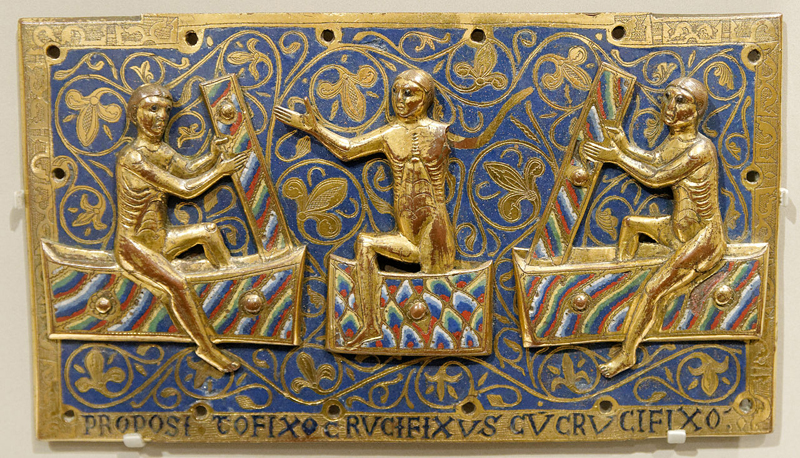
Resurrection of the Dead, from Art in the Christian Tradition, a project of the Vanderbilt Divinity Library, Nashville, TN. http://diglib.library.vanderbilt.edu/act-imagelink.pl?RC=57310 [retrieved July 5, 2020]. Original source: https://commons.wikimedia.org/wiki/File:Plaque_resurrection_dead_VandA_M.104-1945.jpg.