Month: March 2021

From Glory to Glory by Way of the Cross – Lectionary Reading for Passion Sunday (Philippians 2)

Philippians 2:5-11 New Revised Standard Version (NRSV)
 

Let the same mind be in you that was in Christ Jesus,
who, though he was in the form of God,
did not regard equality with God
as something to be exploited,
but emptied himself,
taking the form of a slave,
being born in human likeness.
And being found in human form,
    he humbled himself
and became obedient to the point of death—
even death on a cross.
Therefore God also highly exalted him
and gave him the name
that is above every name,
10 so that at the name of Jesus
every knee should bend,
in heaven and on earth and under the earth,
11 and every tongue should confess
that Jesus Christ is Lord,
to the glory of God the Father.

**************
                The Sunday before Easter presents the church with two choices when it comes to the lectionary. Should we go with the Palms or the Passion? As there is no established second reading for Palm Sunday, the choice has been made for us by the creators of the lectionary. That’s because I’m currently working through the second reading in this cycle. Therefore, the reading comes from the Passion Sunday selections. As a result, I am essentially resharing last year’s reflection. As with 2020, we remain caught up in the COVID-19 pandemic. Last year we were still in the early stages of the pandemic. In-person worship was largely canceled. Churches are starting to open up, but many congregations still are being careful and are limiting the number of participants. So, choirs and palm processions remain problematic.
The appointed Gospel reading comes from Matthew 27:11-54, which takes us from Jesus’ appearance before Pilate through the crucifixion to the Centurion’s declaration “Truly this was God’s Son!” (As a side note, I can’t read this without hearing John Wayne intone those words in The Greatest Story Ever Told – a 1960s Jesus movie starring Max Von Sydow as Jesus). Here in Philippians 2, we hear a word about the incarnation of the one who was in the form of God but did not exploit his equality with God but chose to empty himself of his pre-existent heavenly state, become human, and face death on a cross, all of which leads to his exaltation to the position of ruler of the cosmos. Paul offers this Jesus to us as an example, so that we might find unity as the body of Christ by becoming servants to one another and thus being of one mind. If we read between the lines, the Philippian church, which Paul founded, was experiencing a time of conflict.  Thus, Paul tells them to take on the mind of Christ, as revealed in this ancient hymn that Paul has appropriated for this purpose. The hymn reminds us that Jesus endured humiliation for our benefit and was vindicated by God as a result. The one who was crucified was then exalted by God so that he might move from humility to glory.
                When Paul wrote his letter to the Philippian Church, he was sitting in a jail cell (Phil. 1:12-17). Where he was being detained is unknown to us. Paul doesn’t identify the location though he does mention the Praetorian guard. That would suggest a cell in Rome. It’s a clue but not proof. That he is in prison, suggests confinement at best and perhaps a degree of suffering as well. That is his situation. The letter suggests that the congregation was facing its own sets of difficulties. While Paul was the founding pastor of this congregation, he could only reach out to them virtually, offering guidance by way of a letter.
 Regarding the internal concerns, he asks that they exhibit unity. He asks them to make his joy complete by having the same mind, love, and unity. He asks that they not do anything out of selfishness or conceit. Instead, he asks that they have the same mind as Jesus (Phil. 2:1-5). That request leads to what many scholars (and I tend to agree) consider an early Christian hymn that takes note of Jesus’ pre-existence with God (his divine status), his self-emptying (humility) that leads to the cross, and finally, his exaltation by God, thus vindicating Jesus by establishing him as ruler of the cosmos. Thus, to fully embody God’s realm, one should embrace the way of Jesus, which has the promise of exaltation.
                The hymn takes note of three distinct phases of the Christ event. We begin with an affirmation of Christ’s pre-existence. The hymn states unequivocally that “though he was in the form of God . . . but emptied himself, taking the form of a slave, being born in human likeness” (Phil. 2:6-7). This isn’t quite the same wording as John’s prologue (John 1:1-18), but it’s close. The second phase is Christ’s self-emptying of himself of divinity so that he might become human and face death on a cross. Finally, the second half of the hymn celebrates God’s vindication of Jesus by exalting him to the position of ruler of the cosmos [Ronald J. Allen, Connections, Kindle loc 4177-4192].
                For those of us who affirm the divinity of Christ, this is one of the most direct statements (along with John 1) in support of that position. Pre-existence doesn’t prove divinity, but it suggests that in Paul’s estimation that Jesus has a status that is ultimately different from us, even if he experienced life as being fully human. Karl Barth writes that “this equality of Christ with God is, so to speak, the fixed, ultimate background from which his road sets out to which he returns” [Epistle to the Philippians, p. 61]. This is the starting point for a movement from heaven to earth and back, so to speak. But the point here is not his equality with God, but what he does with it that is the point. That leads to the emptying of himself of his stature as the Father’s equal so that he might become a human and ultimately face death on a cross. Thus, his humanity fully covers his divinity, and this was of his own doing, his own choosing, and yet it was an act of obedience. This is the point of Passion Sunday, the willingness to go to the cross, to experience death, and not just any death, but the most humiliating of deaths. He descended to the depths in his self-emptying and bore upon himself the brokenness of the old age.
                This is not the final word in the story. The second part of the hymn (verse 2) reveals that God vindicated Jesus by exalting him to the position of ruler of the cosmos. This exaltation is revealed in the name given to him, which stands above every name, so that “at the name of Jesus every knee should bend, in heaven and on earth and under the earth, and every tongue should confess that Jesus Christ is Lord, to the glory of God the Father.” As I read this, I can’t help but think about the context in which it is revealed. Caesar is the exalted one, to whom every knee would bow, and whose name would be confessed as Lord. In this confession, Paul (or the hymn writer) reveals that Jesus, the one whom Rome crucified, had been exalted above Caesar. Thus, Jesus, not Caesar, is Lord. While Caesar might rule an empire, Jesus ruled the cosmos and that to the glory of God.
  
                Paul opens up this reading by asking that we be like Christ, who emptied himself of his glory so as to taste life as we live it, even to the point of death, as a result, God vindicated him by raising him to a position of glory. If this is true for Jesus, as those who are his people, might we participate in what is his by nature? As we ponder this question, I leave you with this word from one of Gregory of Nazianzus’ Festal Orations:

Let us become like Christ, since Christ also became like us; let us become gods because of him, since he also because of us became human. He assumed what is worse that he might give what is better. He became poor that we through his poverty might become rich. He took the form of a slave, that we might regain freedom. He descended that we might be lifted up, he was tempted that we might be victorious, he was dishonored to glorify us, he died to save us, he ascended to draw to himself us who lay below in the Fall of sin. Let us give everything, offer everything, to the one who gave himself as a ransom and an exchange for us. But one can give nothing comparable to oneself, understanding the mystery and becoming because of him everything that he became because of us. [Gregory of Nazianzus, Festal Orations, p. 59].

                As we begin a Holy Week that will continue to be different from “normal years,” may we take up the mantle of Jesus, and find in him a path of obedience that leads to salvation.


High Priestly Duties – A Lectionary Reflection for Lent 5B (Hebrews 5)

Hebrews 5:5-10 New Revised Standard Version

So also Christ did not glorify himself in becoming a high priest, but was appointed by the one who said to him,

“You are my Son,
today I have begotten you”;

as he says also in another place,

“You are a priest forever,
according to the order of Melchizedek.”

In the days of his flesh, Jesus offered up prayers and supplications, with loud cries and tears, to the one who was able to save him from death, and he was heard because of his reverent submission. Although he was a Son, he learned obedience through what he suffered; and having been made perfect, he became the source of eternal salvation for all who obey him, 10 having been designated by God a high priest according to the order of Melchizedek.

***************

                In 1 Peter 2, we’re told that to be in Christ is to be part of a royal priesthood (1 Peter 2:9). That revelation led to the doctrine, especially prominent among Protestants, of the “priesthood of all believers.” The document that guides the ordering of ministry in my denomination—The Theological Foundations for the Ordering of Ministry in the Christian Church (Disciples of Christ)—speaks directly to this understanding of priesthood: “In Christ the individual becomes a member of ‘a royal priesthood, a holy nation, a people of God’s own possession’ (1Peter 2:9). Thus it has been common to speak of the ‘priesthood of all believers’ —the persons who live as faithful disciples of Jesus Christ in the church and in the world. This language highlights the sacramentality of the work of the laity through whose witness and service the grace of God is made manifest.” If we are all part of this royal priesthood, who is the high priest? In the Book of Hebrews, we are told that Jesus is the high priest. Of course, there is a caveat here, and we’ll need to address it. That caveat has to do with the qualifications for being a priest and whether Jesus actually qualifies.

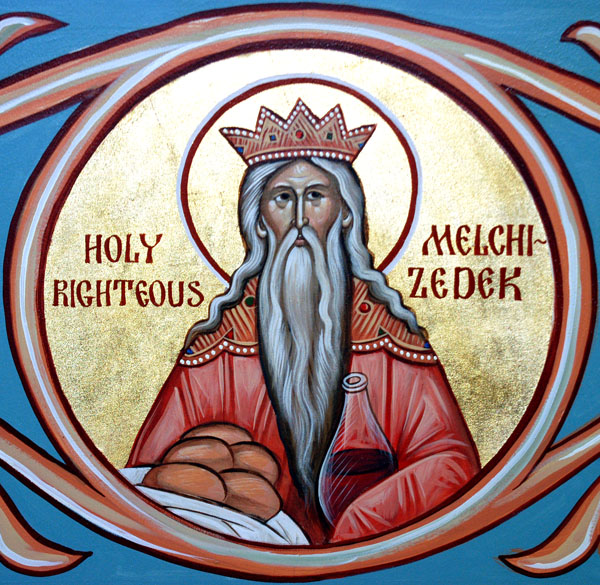
                In ancient Israel, the priesthood was limited to the tribe of Levi, while the high priests were to be lineal descendants of Aaron. As for Jesus, he was neither a Levite nor a descendant of Aaron. So, how might he be our high priest? According to the genealogies in Matthew and Luke Jesus was a descendant of David, which made him a member of the tribe of Judah. That seeming barrier does stop the author of Hebrews from creating a workaround so that Jesus might qualify. While Jesus might not be a descendant of Aaron, Hebrews simply calls Jesus a priest according to the order of Melchizedek.

                Before we get to this mysterious Order of Melchizedek, we would be wise to begin with the question of Jesus’ appointment to the office of high priest. Then we can turn to Melchizedek and the implications of this passage for our Lenten journey.  The reading from Hebrews 5:5-10 is part of a larger section of the letter that begins in verse 14 of chapter 4. In the opening lines of the section, the author of Hebrews (Hebrews is anonymous) writes that “since, then, we have a great high priest who has passed through the heavens, Jesus, the Son of God, let us hold fast to our confession.” We’re also told that this high priest can sympathize with our weaknesses. He was “tested as we are” and yet he did not sin. Therefore, we can “approach the throne of grace with boldness, so that we may receive mercy and find grace to help in time of need” (Heb. 4:15-16).  

                Having learned about this high priest who was tested and yet without sin, when we come to verses 5-6 of chapter 5, we are told that when appointed to this position, Jesus did not glorify himself but was appointed to the position by God. Thus, the author draws upon the Psalms to describe the qualifications of this high priest. First, God says of this high priest, “you are my Son, today I have begotten you” (Ps. 2:7). So, the main qualification here is that Jesus is the Son of God. Then, we learn that Jesus is “a priest forever, according to the order of Melchizedek” (Ps. 110:4).  

                The author of Hebrews makes it clear that one does not appoint oneself to the position of high priest. In the verse prior to our passage, we read that “one does not presume to take this honor, but takes it only when called by God, just as Aaron was (Heb. 5:4). As noted above, Jesus did not descend from the priestly line, so Hebrews links him to the mysterious Melchizedek, who appears in Genesis as the priest-king of Salem who receives tithes from Abraham and blesses him (Gen. 14:17-20). This figure suddenly appears and then disappears from the story. But, the author of Hebrews discovers in this mysterious figure the means to unlock Jesus’ high priestly calling. He might not have an Aaronic pedigree, but he has something else, something rooted in mystery. Interestingly, it’s only in Hebrews that Jesus is connected to Melchizedek. But the identification of the too is intriguing.   

                Having been appointed to this position as a high priest according to the order of Melchizedek by God, in large part because of his status as Son of God, Jesus takes up his priestly duties. During his earthly life, Jesus “offered up prayers and supplications, with loud cries and tears, to the one who was able to save him from death.” Here is a reference to Jesus’ priestly duties taken up, it would appear, while on the cross. He was heard because of his submission to the one who appointed him to this role. He was heard because of his submission. Though he held the status as Son of God, in words reminiscent of what Paul said of Jesus in Philippians 2—he “learned obedience through what he suffered.” It was in this suffering that he was perfected and became the source of our salvation. Nothing is said here about being a substitute sacrificed for our sins. The point simply is that his pathway to this priesthood of Melchizedek included the suffering of the cross.  

                Back in Hebrews 4, the author reveals that Jesus is not a high priest who is unable to sympathize with our weaknesses. He too has been tested and yet did not sin (Heb 4:15-17). That testing includes suffering. Jesus can understand our struggles, our sufferings, because he also suffered. This is the foundation of his priesthood. You might say that he graduated from the school of hard knocks. This is true even though he was the Son of God. That status did not prevent him from experiencing human realities, therefore, we can put our trust in him. In this, we find good news.

The Rich Mercy of God – Lectionary Reflection for Lent 4B (Ephesians 2)

Ephesians 2:1-10 New Revised Standard Version

You were dead through the trespasses and sins in which you once lived, following the course of this world, following the ruler of the power of the air, the spirit that is now at work among those who are disobedient. All of us once lived among them in the passions of our flesh, following the desires of flesh and senses, and we were by nature children of wrath, like everyone else. But God, who is rich in mercy, out of the great love with which he loved us even when we were dead through our trespasses, made us alive together with Christ—by grace you have been saved— and raised us up with him and seated us with him in the heavenly places in Christ Jesus, so that in the ages to come he might show the immeasurable riches of his grace in kindness toward us in Christ Jesus. For by grace you have been saved through faith, and this is not your own doing; it is the gift of God— not the result of works, so that no one may boast. 10 For we are what he has made us, created in Christ Jesus for good works, which God prepared beforehand to be our way of life.

***********

                As the Lenten journey continues, we are continually invited to engage in self-examination. That can be challenging. If we look too deeply, we might find things buried inside that we’d rather not see the light of day. We all have those secret things that we wrestle with, and that we work hard at keeping them at bay, so they don’t define our lives. Here in the Ephesian letter, we read a word likely spoken to Gentiles, whom the author of the letter suggests had been children of wrath. That is, they once lived in bondage to a spiritual power that kept them separated from their Creator. But there is good news here. God’s mercy reigns. There will be liberation from the bondage. Once they were children of wrath, but that is no longer true, so now they can embrace the good works God has prepared from them.

                Before we get to the heart of the matter, I need to address the question of authorship. While traditionally authorship has been assigned to Paul. After all, the letter begins with a greeting from the Apostle (Eph. 1:1). Nevertheless, many scholars have questioned that claim, believing that the letter comes from a later time. As for the identity of the author, I tend not to take sides. When I wrote my study guide on Ephesians, I left the question of authorship open. There are good arguments on both sides, but I’m not sure that authorship is going to make too much of a difference to our interpretation of this passage. However, in the pursuit of brevity, I’m going to use Paul’s name in this meditation. As I do so, I hold this ascription very lightly!

                What I discern here in Ephesians 2 is a reminder that there is a spiritual realm that influences/affects our lives. According to Paul (remember for our purposes I’m using the traditional author) there are powers, both good and evil present in the universe. We would be wise to keep that in mind as we attend to our Lenten journey. Concerning this spiritual realm, Richard Beck has done a marvelous job in explaining how things work in his book Reviving Old Scratch. Just to be clear, “Old Scratch” is another name for the devil. He writes: “I’d love to have a Christianity full of rainbows and daisies, full of love and inclusion. But there are forces working against love and inclusion in the world, and some of those forces are at work in my own heart and mind. We call those forces hate and exclusion, to say nothing about everything else that is tearing the world to shreds, pushing the loving and gracious rule of God out of the world” [Reviving Old Scratch, p. 10]. So, have you noticed those forces at work of late? I have and sometimes they’ve been at work in me.

                Might this be what Paul has in mind when speaking of the ruler of the power of the air? The Enlightenment mindset sought to eliminate the spiritual/supernatural realm. Science or at least reason was expected to explain everything (I’m not anti-science here, just to be clear). In this modern view of things, there was no room for the devil. While there might not be a “personal” devil out there, I do believe there are malignant spiritual forces that entrap us and keep us in bondage. Lent gives us the opportunity to pause and check to see if any of these forces have taken hold of our lives. If so, we can give thanks for God’s mercy that can recalibrate our lives, so we live in tune with God’s vision for creation. Although these spiritual forces continually seek to push God out of the picture, God isn’t going anywhere.

                The good news that comes to us from the Ephesian letter is that God is “rich in mercy.” In fact, God loved us even when we were caught up in this web of wrath and because of that, God has been providing us a way out of the morass through faith in Christ. As we consider how Jesus does this, we might want to keep in mind that the Gospel writers regularly picture Jesus engaging in exorcisms. It was one of the ways in which he healed people. He did so as an expression of God’s mercy and grace. So, it is by this grace that we are saved, we are healed.  We receive the healing by faith, but it is the work of God that provides the healing/salvation. In doing this, God raises us up with Christ so that we might be seated with him in the heavenly places.

                In this passage, the emphasis is on grace. We can’t work our way into the heavenly places? We don’t earn the right to sit with Jesus. That’s a gift of grace. However, that doesn’t mean there’s nothing for us to do. In fact, God has prepared works for us to do. These works also come as gifts of grace. So, who we are now is not the same as who we were before the divine encounter with Jesus, and so we live accordingly. Once we were dead in our sins, now we are alive in Christ! That is because, due to the rich mercy of God, the prince of the power of the air no longer holds sway in our lives! That is good truly news.   

The Foolishness of the Cross – Lectionary Reflection for Lent 3B (1 Corinthians 1)


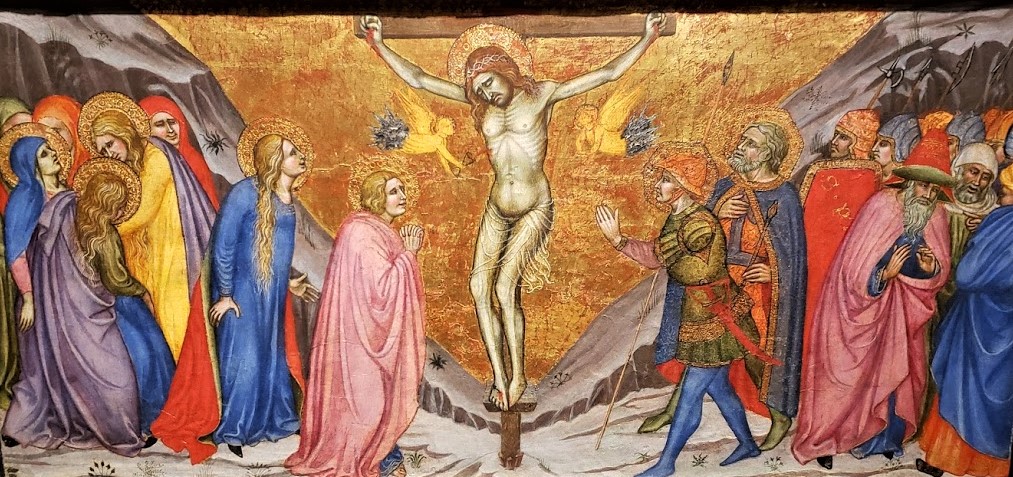
The Crucifixion — Taddeo di Bartolo (Art Institute of Chicago)


1 Corinthians 1:18-31 New Revised Standard Version

18 For the message about the cross is foolishness to those who are perishing, but to us who are being saved it is the power of God. 19 For it is written, 

“I will destroy the wisdom of the wise,
    and the discernment of the discerning I will thwart.”

20 Where is the one who is wise? Where is the scribe? Where is the debater of this age? Has not God made foolish the wisdom of the world? 21 For since, in the wisdom of God, the world did not know God through wisdom, God decided, through the foolishness of our proclamation, to save those who believe. 22 For Jews demand signs and Greeks desire wisdom, 23 but we proclaim Christ crucified, a stumbling block to Jews and foolishness to Gentiles, 24 but to those who are the called, both Jews and Greeks, Christ the power of God and the wisdom of God. 25 For God’s foolishness is wiser than human wisdom, and God’s weakness is stronger than human strength.

26 Consider your own call, brothers and sisters: not many of you were wise by human standards, not many were powerful, not many were of noble birth. 27 But God chose what is foolish in the world to shame the wise; God chose what is weak in the world to shame the strong; 28 God chose what is low and despised in the world, things that are not, to reduce to nothing things that are, 29 so that no one might boast in the presence of God. 30 He is the source of your life in Christ Jesus, who became for us wisdom from God, and righteousness and sanctification and redemption, 31 in order that, as it is written, “Let the one who boasts, boast in the Lord.”

***********

Ah, holy Jesus, how has thou offended, 

that mortal judgment that on thee descended?

By foes derided, by the world rejected, O most afflicted! 

—Johannn Heerman (Chalice Hymnal, 210).

                The scandal of the Gospel is that it is centered in a message about a crucified  messiah. What is it about a figure who suffered a humiliating death on one of the cruelest forms of execution ever devised that would attract anyone? Truly it would be foolishness to embrace such a one as Jesus of Nazareth, who met his death on a Roman cross outside a city in a backwater part of the Roman Empire.

                The cross continues to be a scandal. For some within the Christian community, the way in which Jesus is often portrayed as a means of satisfying the demands for blood on the part of a wrathful God causes angst.  This is because some forms of atonement theory can look a lot like divine child abuse. Thus, for some, it seems as if it would be better if we eschew the message of Good Friday and simply skip from Palm Sunday to Easter, from one triumph to another. Of course, there are others who worry that a religious leader who dies on a cross might look like a loser. Who wants to be associated with a loser. Maybe we can photoshop out the cross and simply focus on a Jesus sitting on a throne.  Nevertheless, Paul makes it clear to critics, both Jewish and Greek, ancient and modern, that he is going to “proclaim Christ crucified.” Just so you know, Paul’s not afraid of being associated with someone the world might consider a loser.

               It’s appropriate to situate this word about the cross in an imperial context. The Romans valued power. They ruled a vast empire on the basis of their military might. They built roads that made commerce efficient, but just like our modern interstates, these roads had a military purpose. In fact, it was the Roman legions who built the roads so they could move quickly across the empire. The religions of the empire tended to emphasize power as well. The mystery religions promised their adherents access to power that was intoxicating. So, it’s not surprising that these young Christians in Corinth would have expected something similar from their religious tradition. Some of them might have been embarrassed by Paul’s preaching a gospel that placed the cross at the center.

                We encounter this word from Paul as we journey through Lent, a season that invites us to let go of things that impede our relationship with Jesus. It invites us to consider how the cross of Jesus defines our faith. Perhaps it’s the desire for power that we need to let go of so that we might share in a different kind of power. This is the kind of power that emerges from humility. It’s a very different message from the one proclaimed by imperial Rome. Is it not different from the message we hear in our culture? Who wants to be a loser or aligned with a loser?

                Here is how Paul defined the way of the cross. He informed his readers that God wasn’t interested in hanging out with the rich and powerful of this world. Instead, God had chosen the “low and despised in the world” to identify with. This is the message revealed in Jesus’s death on a cross. What we see in Paul’s letter to the Corinthians is evidence of class-based division. Most likely a large portion of this Christian community was poor. Many might have been slaves. There were, of course, wealthier members, who seemed intent on having power over the poor and the despised. Paul responds to this division by reminding the people that Jesus had died on a cross, despised by those who were in power and those who prized power.

                Paul emphasized God’s identification with the ones the world considered to be expendable and losers, recognizing that for many it appeared that Rome’s power reigned supreme. Was not Jesus’ death an expression of weakness? If so, is this not foolishness? Now, Paul understood that there was more to the story than simply Jesus’ death. Paul knew that his proclamation of this message of the cross included the resurrection. It might appear that Rome won, but did it really? That is a question we need to wrestle with in our day. What does it mean to win?

                Ever since Constantine decided to make Christianity a recognized religion, we’ve tended to rethink the message of the cross. For Constantine, it was a symbol of conquest. He would not be the last to conquer in the name of the cross. What was once a symbol of weakness has been transformed into a symbol of political and military power. Many Christians today have found the promise of gaining power over others, of using the premise of religious liberty to discriminate, rather intoxicating. In fact, it appears that quite a number of Christians have given their allegiance to a figure who promised them power in exchange for loyalty. They have given themselves over to his vision of dominance over others. Lest we think ourselves immune from the intoxicating allure of political power, we might want to heed Paul’s words here. We might want to remember that we are called to live in a relationship with one whose death on a cross was deemed foolish.

                It might help us gain perspective on our place in the world if we remember that this message Paul delivers to the Corinthians is rooted in an eschatological vision of reality. Rome represented the old age, while Jesus represents the new age. We have a choice. We can stay with Rome, which promises victory. Or we can embrace Jesus, who also offers a vision of victory, but of a very different kind. Yes, it might appear that Rome has won, but if dive below the surface of our reality, we will discover that the crucified Jesus is risen and has set in motion a new way of living before God. That is a message worth considering during this Lenten season.