Month: August 2021

Jesus Doesn’t Play Favorites – Lectionary Reflection for Pentecost 15B (James 2:1-17)

Diego Rivera Mural, Detroit Institute of Art

James 2:1-17 New Revised Standard Version

                2 My brothers and sisters, do you with your acts of favoritism really believe in our glorious Lord Jesus Christ? For if a person with gold rings and in fine clothes comes into your assembly, and if a poor person in dirty clothes also comes in, and if you take notice of the one wearing the fine clothes and say, “Have a seat here, please,” while to the one who is poor you say, “Stand there,” or, “Sit at my feet,” have you not made distinctions among yourselves, and become judges with evil thoughts? Listen, my beloved brothers and sisters. Has not God chosen the poor in the world to be rich in faith and to be heirs of the kingdom that he has promised to those who love him? But you have dishonored the poor. Is it not the rich who oppress you? Is it not they who drag you into court? Is it not they who blaspheme the excellent name that was invoked over you?

                        8 You do well if you really fulfill the royal law according to the scripture, “You shall love your neighbor as yourself.” But if you show partiality, you commit sin and are convicted by the law as transgressors. 10 For whoever keeps the whole law but fails in one point has become accountable for all of it. 11 For the one who said, “You shall not commit adultery,” also said, “You shall not murder.” Now if you do not commit adultery but if you murder, you have become a transgressor of the law. 12 So speak and so act as those who are to be judged by the law of liberty. 13 For judgment will be without mercy to anyone who has shown no mercy; mercy triumphs over judgment.

                        14 What good is it, my brothers and sisters, if you say you have faith but do not have works? Can faith save you? 15 If a brother or sister is naked and lacks daily food, 16 and one of you says to them, “Go in peace; keep warm and eat your fill,” and yet you do not supply their bodily needs, what is the good of that? 17 So faith by itself, if it has no works, is dead.

*********

                If we’re honest, we all play favorites. There are some people we really don’t enjoy being around and others we really want to be with. I remember when church growth theory was all the rage, with its message of homogeneity. In other words, churches grow when we target specific groups of people because “birds of a feather flock together.” There is truth to this observation. But, apparently, that’s not the way it works with Jesus, who does play favorites. Though, he does seem to prefer bringing Peter, James, and John with him when he goes off by himself. At least that’s what I’ve noticed when reading the Gospels. Nevertheless, according to James, Jesus doesn’t want us to show favoritism.

                Here in James 2, Jesus begins with a word about favoritism and then our reading ends with a word about faith being dead if it’s not accompanied by works. Once again, we see why Luther preferred Paul to James. Paul indeed focuses on grace and faith rather than works, but I’m not sure Paul would disagree with what James writes in this letter. After all, Paul takes the Corinthians to task for their classist behavior.  But, we’re not focused here on Paul. Instead, we need to listen to what James has to say about wealth, partiality, murder and adultery, and more (the lectionary creators put verses 11-13, where we read the word about murder and adultery, in parentheses. So if you don’t like those verses you can skip over them). Behavior, in James’ estimation, is the best expression of one’s faith in Jesus.

                At first sight, this is a word about egalitarianism that targets the wealthy, whom James warns the church against favoring over the poor. However, James not only warns against favoring the wealthy, who could be benefactors to the life of the church (what church wouldn’t like to have a few wealthy donors to endow the budget), but he also speaks of God’s decision to favor the poor. Much like the Magnificat, in which God brings down the rich and powerful and lifts up the poor and lowly (Lk. 1:46-55), James affirms God’s “preferential option for the poor.” What James does here in chapter 2 is contrast the way the rich and poor are often treated by society (including the church). It is to their shame as the church if they welcome with open arms the person with gold rings and fine clothes and then ignore the one who is poor and wearing dirty clothes.  The persons James has in mind here are probably field hands and other workers who come to church after work, tired, hungry, and yes dirty. Whether slave or free, they likely weren’t paid well. Thus, they make up the working poor who are taken advantage of by the wealthy whom the church leaders may have wanted to honor by letting them take the seat of honor, while the poor are pushed to the side where they must either stand or sit on the floor. So, by showing partiality and making distinctions in this way, they become judges with evil thoughts. What should a preacher do with a passage like this? [A note here, in 2021 (when this reflection first appears), the text is due to be read on Labor Day, making this an interesting conversation for that day.] 

                One takeaway is that James provides the foundation for claiming God’s “preferential option for the poor.” In making his point here concerning the poor, James reflects the message of Jesus in the Sermon on the Mount, where Jesus declares: “Blessed are the poor in spirit, for theirs is the kingdom of heaven” (Mt.5:3). God takes the side of the underdog, the one who is marginalized. The wealthy, well, they know how to take care of themselves. As for the poor, they are oppressed by the rich. In fact, James suggests that readers of this letter  are themselves the subject of abuse on the part of the rich who drag them into court. So, in honoring the rich and powerful who oppress they give honor to those who blaspheme the God who welcomes the poor. Thus, maybe Jesus does play favorites!

                James brings the Law into the conversation, and that is the Royal Law, that one should love one’s neighbor as oneself (Lev. 19:18). If you show partiality—toward the rich—then you transgress that law. This is on the same level as adultery and murder. So, the passage concludes with a reminder that faith without works is dead. It does nothing to say to a brother or sister who is naked and lacks daily food to “go in peace; keep warm and eat your fill.”  Such faith is dead. It has no value. As Robert Wall points out, for James “the mere profession of orthodox faith does not save anyone if it is not demonstrated by works of mercy” [Connections,  p. 292]. Those who wish the preacher would stick to the “Gospel” and not engage in politics, probably won’t appreciate this word from James. Nevertheless, what sounds a lot like what some call the “Social Gospel,” if we take James seriously should we not say that this is the Gospel? That is, unless the Gospel is simply a matter of getting to heaven when we die, then surely the Gospel has something to say about how we live together in this world, in the here and now. That includes recognizing that Jesus doesn’t play favorites, except in lifting up those who are poor and marginalized, while bringing down those who are high and mighty!

Pure Religion – Lectionary Reflection for Pentecost 14B (James 1)

James 1:17-27 New Revised Standard Version

17 Every generous act of giving, with every perfect gift, is from above, coming down from the Father of lights, with whom there is no variation or shadow due to change. 18 In fulfillment of his own purpose he gave us birth by the word of truth, so that we would become a kind of first fruits of his creatures.

19 You must understand this, my beloved: let everyone be quick to listen, slow to speak, slow to anger; 20 for your anger does not produce God’s righteousness. 21 Therefore rid yourselves of all sordidness and rank growth of wickedness, and welcome with meekness the implanted word that has the power to save your souls.

22 But be doers of the word, and not merely hearers who deceive themselves. 23 For if any are hearers of the word and not doers, they are like those who look at themselves in a mirror; 24 for they look at themselves and, on going away, immediately forget what they were like. 25 But those who look into the perfect law, the law of liberty, and persevere, being not hearers who forget but doers who act—they will be blessed in their doing.

26 If any think they are religious, and do not bridle their tongues but deceive their hearts, their religion is worthless. 27 Religion that is pure and undefiled before God, the Father, is this: to care for orphans and widows in their distress, and to keep oneself unstained by the world.

************

                The word purity has become problematic. This is due in large part to the “purity” culture present in some parts of the Christian community. That culture is focused largely on keeping young women “pure” so they can become good wives (virgins). That’s not what James has in mind when writes in his letter to the“Twelve Tribes of the Dispersion” about “pure and undefiled religion.” What James is interested in is relationships that reflect God’s wisdom. We see this concern present throughout the letter.

                Having worked our way through the Ephesian letter, we will spend the next five weeks with James. Not everyone has appreciated James’ words of wisdom. Consider that Martin Luther called it an “epistle of straw” because, in his mind, it didn’t preach Christ. Luther preferred Paul’s emphasis on grace to James’ message that “faith without works” being dead (Jms. 2:17). I’m not sure that Paul and James were as far apart in their thinking as we usually presume, but his message that is rooted in the Wisdom tradition seems appropriate to our times. In fact, if we followed his lead, we might find an antidote to much that ails us in this twenty-first century.

                So who is this letter writer who calls himself “James, a servant of God and of the Lord Jesus Christ?” That’s a question that needs some attention since this is the first of five reflections on lectionary readings from James. So, I will begin with an introduction to the letter. As I noted, the author introduces himself simply as “James, a servant of God and of the Lord Jesus Christ” (Jms.1:1). He addresses the letter to the “twelve tribes in the Dispersion.” Although this would appear to suggest that James is writing to Jews, we don’t know who James is targeting. Jewish Christians would have been a receptive audience since James is drawing on Wisdom traditions. It’s impossible to precisely identify the author, though Tradition suggests that the author is James, the Lord’s brother, who was a primary leader of the church in Jerusalem. The author doesn’t make that claim, but it seems like a good possibility If this is true, then the letter is rather early because Josephus records that James was martyred in 62 CE. The only other viable option is someone writing in the name of James, which would allow for a later date of authorship. There are arguments on both sides, but for our purposes, I will stick with Tradition. As for the destination, that’s unclear as well. What is clear is that this is an example of wisdom literature with a special focus on ethics. We might call James’ focus one of “orthopraxis” over “orthodoxy.”

                Our reading begins in verse 17 with an acknowledgment that “every generous act of giving, with every perfect gift, is from above.” God is the source of every perfect gift because God is not fickle or capricious. Of the “Father of Lights,” James tells us that there “is no variation or shadow due to change” (Jms. 1:17). That doesn’t necessarily mean that God is “immutable” or “impassible,” to use two Greek philosophical terms that have found a home within Christianity. God can and does respond, adapting to situations, giving us options. Besides, the universe isn’t static, so how could God be static? Nevertheless, according to James God is faithful. That’s a message deeply rooted in the covenant that defines God’s relationship with Israel, a covenant that James surely has in mind as he writes
this word.

                Having been given birth by the word of truth, the readers (we are secondary readers) are the first fruits of this new work of God. As such, James gives words of guidance as we live into this word of truth. First of all, “be quick to listen, slow to speak, slow to anger.” Later in the letter, James will speak to the destructive power of the tongue, but for now, the word is to listen first, then speak if necessary. Don’t be quick in your anger. Don’t overreact and scream and yell. After all, anger is doesn’t produce divine righteousness. Therefore, get rid of the “stuff” that soils your life, that is all forms of wickedness and sordidness. If this was written to Gentiles, as Paul’s letters were, James might be focused on their former “pagan” lifestyle. But, assuming the audience is made up of Jewish Christians, it is a recognition that we are all liable to such disabilities! Instead, of allowing such wickedness to define your life, welcome “with meekness the implanted word that has the power to save your souls.”

                James envisions God planting the word that saves us in our hearts, even as a farmer or gardener plants a seed in the ground so that it might take root and produce good fruit. We can compare this word with that of Jeremiah who speaks of the new covenant in which the law is written on the heart rather than stone (Jer.31:33). James goes on to speak of the law of liberty, so he likely has Jeremiah in mind.

                This message concerning the implantation of the word is followed by an imperative. “Be doers of the word, and not merely hearers who deceive themselves” (Jms. 1:22). This is no “once saved, always saved” vision of the Christian life in which one is now free to do as one pleases because they’re on the team without any chance of being cut. When the word is implanted in us, it is expected that it will bear fruit in our lives. James understands faith to be active, not passive. It doesn’t mean that God doesn’t initiate the process. After all, the word is implanted, but that should lead somewhere.

                Those who hear but don’t do, are like people who look in a mirror and walk away forgetting who they are. Those who look at the perfect law, which is the mirror, and persevere, don’t forget and as a result, they are blessed. Remember that this is a law that liberates. This does sound a bit different from what Paul had to say, but remember the audiences are different. In Galatians, the issue is circumcision as a prerequisite for membership in the community. Here the issue is behavior that reflects well the word of God implanted in us.

                In verse 26, James returns to the use of the tongue. Having already told us to be quick to listen and slow to speak, James tells the reader that if they think they’re religious but don’t bridle their tongues they deceive themselves. Indeed, their “religion is worthless.” As I read this, I look at myself and the way I speak, especially I speak out of anger. Living as we do in an “anti-PC” age when so many in our culture feel they are entitled to say whatever they please, whenever they please, James has a point here. That’s especially true when the people who feel entitled to say what they please also claim to be people of faith.

                Having laid bare this negative issue that has plagued the church from the beginning, James turns to a positive. This is what pure and undefiled religion should look like. It takes care of widows and orphans in their distress, as well as keeping oneself unstained from the world.

                I’ll first take up the word about widows and orphans. We know from history that early Christians were known for their care of widows and orphans. They would take in abandoned children who were left to die. As I write this, thousands of Afghan citizens are seeking asylum as the Taliban takes over. At the same time, I hear voices that supposedly defend “Christian values” in the United States calling them terrorists who should be abandoned. It doesn’t make sense to me. This isn’t pure and undefiled religion.

                After speaking of widows and orphans James calls on the readers to keep themselves unstained from the world. This sounds about “comeoutism,” which is a pattern in some quarters of the Christian world. Keep to yourself as a community so you don’t get contaminated by the broader culture. Perhaps a better way for us to read this passage is to think in terms of how our culture forms us. What values does our culture seek to implant in us that stand opposed to the “law of liberty”? After all, Paul recognized that even all things are lawful, not all things are beneficial (1 Cor. 10:23).

                For many in our world today the word “religion” has negative connotations. People prefer to be “spiritual” rather than “religious.” That’s because religion is understood in institutional terms, and institutional religion has a lot of problems. In fact, for many, Christianity as a religion, is defined by hypocrisy. So, who wants to be religious?

               When James uses the word religion, he has something different in mind. For him, true religion calls for guarding the tongue, caring for the poor, the widow, the orphan. As for keeping oneself separate from the world, it would be wise not to get caught up in the schemes of this world that are destructive to creation and people. As Martha
Moore-Keish writes: “To be a ‘word-doer’ is simply to love those whom the world has treated as unlovable. It is to look for the ones who are the most crushed by systems of power and oppression (widows and orphans in James’s day) and care for them. Rather than following the cyclical and power-hungry ways of the world, to be word-doers who embody ‘pure religion’ is to place ourselves as beacons of light in the darkness, even as God has shone light into the weary darkness of the world.” [James: Belief, pp. 77-78]. That is true religion!

Stand Up, Stand Up for Jesus – Lectionary Reflection for Pentecost 13B (Ephesians 6:10-20)

Ephesians 6:10-20 New Revised Standard Version

10 Finally, be strong in the Lord and in the strength of his power. 11 Put on the whole armor of God, so that you may be able to stand against the wiles of the devil. 12 For our struggle is not against enemies of blood and flesh, but against the rulers, against the authorities, against the cosmic powers of this present darkness, against the spiritual forces of evil in the heavenly places. 13 Therefore take up the whole armor of God, so that you may be able to withstand on that evil day, and having done everything, to stand firm. 14 Stand therefore, and fasten the belt of truth  around your waist, and put on the breastplate of righteousness. 15 As shoes for your feet put on whatever will make you ready to proclaim the gospel of peace. 16 With all of these, take the shield of faith, with which you will be able to quench all the flaming arrows of the evil one. 17 Take the helmet of salvation, and the sword of the Spirit, which is the word of God.

18 Pray in the Spirit at all times in every prayer and supplication. To that end keep alert and always persevere in supplication for all the saints. 19 Pray also for me, so that when I speak, a message may be given to me to make known with boldness the mystery of the gospel, 20 for which I am an ambassador in chains. Pray that I may declare it boldly, as I must speak.

**********

                Two hymns stand out from my early years growing up in the Episcopal Church. The reading from Ephesians 6 brings them to memory. They may or may not be recognizable to everyone because they don’t appear in most Mainline Protestant hymnals published over the past few decades. These hymns are “Stand Up, Stand Up for Jesus” and “Onward Christian Soldiers.” These hymns pick up aspects of the biblical message, including the one we find here in Ephesians 6.  And as the second verse of “Onward Christian Soldiers” declares:

At the sign of triumph, Satan’s host doth flee;
On, then, Christian soldiers, On to victory.
Hell’s foundations quiver, At the shout of praise;
Brothers, lift your voices, Loud your anthems raise.
Onward, Christian soldiers! 
Marching as to war, 
Looking unto Jesus, who is gone before. 

These hymns have disappeared from most of our hymnals as Mainline Protestants have rightfully tried to step away from the militaristic dimensions of our former commitment to the expansion of Christendom. But you can see why they might resonate with a church that saw itself as the vanguard of God’s saving work in the world.

                As our exploration of the Ephesian letter, which has been featured in the post-Pentecost season, comes to an end, we encounter this call to put on the whole armor of God. The author of the letter (we’ll once again call him Paul for the sake of tradition) envisions the church in a battle with the devil. If you’re in a battle you will need protection and weapons so you can stand against the “wiles of the devil.” For early Christians who lived as a religious minority within an often hostile culture, this call to arms seems appropriate. The same is true for Christians living today in places where survival as Christians is always under threat. For middle-class Mainline Protestants living in suburban North America or Europe, such a message might seem out of place. But is there a message here that speaks to our situation without embracing the militarism that seems to be tied up in the metaphor? As my Muslim friends remind me, jihad can be conceived as a form of spiritual struggle rather than holy war.  Might we understand the passage here in the same way?

                As for this passage, the author makes use of an image that would be immediately recognizable by any reader living in the Roman Empire.  With the call to put on the whole armor of God issued, we need to take an inventory of that armor that will be used not in physical warfare but spiritual warfare. Paul begins with the belt of truth. The belt might seem irrelevant, but it holds everything together. From there we move to the breastplate of righteousness. That piece of armor is much more prominent as it is the key piece of protective body armor. From there we go to the shoes (military grade), shield, helmet, and finally the sword. Now Paul gives each of these armaments a spiritual definition. Thus, the belt of truth and the breastplate of righteousness are foundational elements for the definition of the Christian identity. Christians by definition should be committed to truth and righteousness (justice. From there we move to the shoes, which enable the legionnaire to march across the empire imposing Rome’s vision of good news/peace. For early Christians, this image is a reminder that theirs is a missionary movement. They have good news to share as well, and they likely will be traversing the Roman roads, which requires sturdy shoes. So, be ready when the call comes. Recognizing that not everyone will receive their message with open arms, but might shoot flaming arrows, a good shield is required. Of course, every soldier needs a helmet, and here the helmet represents salvation, the ultimate protection. With all of this protective equipment, the soldier for Christ is ready to go on the offensive with the sword of the Spirit, which is the word of God. That is, the proclamation of the good news of Jesus. Paul seems to recognize that this evangelistic work of proclaiming the peace of God could be dangerous. So, it’s good to be prepared for opposition.

                Paul’s use of this imagery is rooted in his cosmic vision. For him, to proclaim the good news of Jesus is to engage in spiritual warfare. He might be using imagery taken from the Roman legions that were ubiquitous across the empire, especially in more restive provinces, but he’s not envisioning forced conversions. While this is a spiritual battle for the hearts and minds of the people, the enemy is Satan who has taken control of the world situation. This battle to deliver the people from Satan’s control is not a battle against flesh and blood. It is instead a spiritual battle. Unfortunately, it’s easy to move from spiritual to actual battle. This is especially true when non-Christian religions and traditions with the gods of the other traditions being conceived as demons. Thus, Christianity is good, the other religions are evil. Therefore, they must be destroyed (together with their adherents). We’ve seen this take place down through the centuries. As Miguel de la Torre and Albert Hernández write: “Over the next two thousand years, this exclusive understanding, coupled with the historical process of conquest and colonization, will lead to much suffering, misery, and death between Christians and the people of other faiths and cultures” [The Quest for the Historical Satan, p. 79]. So, whatever we say about this passage, we must be careful not to use it to justify oppression, conquest, and more.

                I should say something here about the mythological imagery here (I should note that I’ve been reading a bit of Rudolph Bultmann lately). Paul’s vision reflects a particular worldview that we moderns may have set aside, but the language of myth is designed to communicate deeper truths. For Bultmann, this imagery needed to be set aside through the process of “demythologization,” so that it could be more accessible to moderns. I’m not so sure we can completely remove the mythological elements from the conversation, because there is a growing feeling that there is more to the universe than meets the eye. So, maybe the language here is filled with mythological elements, but at the same time, it reflects cosmic realities that lay behind the evils present in this world. One way to look at this passage and conceive of our work as Christians is to recognize the reality that structural evil exists and that these structures take on a life of their own that envelope us. So, the work of God involves resistance to those cosmic forces that seek to enslave us.

                This is a war of resistance, but the question is the nature of our response. Paul doesn’t mention love here, but it probably should be brought into the conversation. Richard Beck has written an insightful book titled Reviving Old Scratch. Old Scratch is a nickname for Satan that Beck encountered as he taught a bible study in a maximum-security prison. He writes that what he learned at the prison was that “there are forces in the world satanically opposed to love. So, if love is going to invade and establish a beachhead in our lives, we’re going to have to fight for it. That is what I mean by spiritual warfare.” It is a path that took Jesus to the cross [Reviving Old Scratch, p. 97]. In the book, Beck reminds us that social justice is itself a form of spiritual warfare, and therefore needs to be engaged in with spiritual weapons lest we make people the enemy rather than Old Scratch.

                The work of spiritual warfare as outlined here includes the proclamation of the good news of God’s peace (as opposed to the Roman peace) and prayer. The closing paragraph of our passage calls on the readers to “pray in the Spirit at all times in every prayer and supplication.” This requires alertness and perseverance as they pray for the saints of God, including Paul and his companions. In fact, Paul (or whoever the author is) asks that they pray for him specifically asking that he might have boldness as he proclaims the “mystery of the gospel.” Why? Because he is an “ambassador in chains.” Tradition suggests that Paul is writing to the Ephesians from prison, perhaps in Rome. Yes, even in prison he continues his work of proclamation. Therefore, he asks for boldness. Yes, knowing that the churches are praying for him gives him boldness. The question then for us as modern Christians who likely aren’t sitting in prison is what does boldness look like?

                We live in challenging times. Churches are struggling to survive. In North America and Europe, it’s not a matter of persecution and oppression, but the world is not as receptive to the message. To be honest, Christians have been part of the problem. But there is also something spiritual out there that requires our attention. It requires boldness. But standing firm for what is true and just requires boldness also requires grace and love so that we might be peacemakers, not spiritual warmongers.

                For more background on the passage see my Ephesians: A Participatory StudyGuide, (Energion Publications, 2010), pp. 85-97.

Wise Living – Lectionary Reflection for Pentecost 12B (Ephesians 5)

Lamp of Wisdom – Waterperry Gardens, Oxfordshire


Ephesians 5:15-20 New Revised Standard Version


15 Be careful then how you live, not as unwise people but as wise, 16 making the most of the time, because the days are evil. 17 So do not be foolish, but understand what the will of the Lord is. 18 Do not get drunk with wine, for that is debauchery; but be filled with the Spirit, 19 as you sing psalms and hymns and spiritual songs among yourselves, singing and making melody to the Lord in your hearts, 20 giving thanks to God the Father at all times and for everything in the name of our Lord Jesus Christ.


*************

            Be imitators of God. That is the message we heard from the previous lectionary reading (Eph. 5:1). As we discovered any attempt to live in this way requires the assistance of the Holy Spirit.  As chapter 5 continues, the author (for simplicity we will call the author Paul) calls on the readers, most of whom were of Gentile background, to live as children of light (Eph. 5:8) rather than as children of darkness. There is a bit of “comeoutism” here, as Paul reminds the readers of their former lives that were marked by all manner of disobedience. So, don’t go back to that life (Eph. 5:3-14). Remember, you are a new creation in Christ, so live accordingly. What we have here is not only an ethical imperative but a call to discipleship. This is what it means to be a disciple of Jesus.

            The reading from Ephesians 5 is brief, but it follows upon what came before concerning their new status as children of life and precedes the household code that presents so many problems to Christians. What does it mean for wives to submit themselves to their husbands? What does it mean for husbands to love their wives as Christ loved the church? The lectionary creators have chosen to avoid these verses, which gives preachers a break but doesn’t give us the ability to answer that question (for a discussion of the household codes and the idea of mutual submission see my Ephesians’ study guide, pp 71-81).

            Here in our reading, the focus is on wise living. So, as Paul writes: “Be careful then how you live, not as unwise people but as wise, making the most of the time, because the days are evil” (Eph. 5:15-16). You will notice a bit of the apocalyptic here with the reference to the days being evil. For a minority religious community whose beliefs and practices stand apart from the rest of the community, this seems like an apt description of the situation. For Jewish Christians, there is a long tradition to draw upon, but for Gentile Christians, this is all new. To be in Christ is to leave behind everything they understood to be true. So, Paul asks them to live wisely. For Jewish Christians at least, the Wisdom tradition might have given them guidance, whether that be the canonical book of Proverbs or the non-canonical books like Wisdom of Solomon. So, guided by Wisdom (Sophia), they should refrain from all foolishness. Instead, seek to discern the will of God. In other words, wisdom and the will of God are parallel to each other.

            Paul issues a contrast here. Don’t get drunk with wine because that’s debauchery. No Bacchanalia for these believers, who might have participated in the rites of Bacchus/Dionysius before their conversion. For Mainline Protestants, many of our traditions were at one point committed to a temperance message. My own denomination, the Disciples of Christ, can claim as one of its own Cary Nation, who was known for taking her hatchet to saloons to do damage to their trade. In recent years, we’ve thrown that message off, even if we continue to use grape juice in communion. The danger is to go the other direction in reaction. Unfortunately, we are beginning to see the growth of alcoholism among Protestant clergy. While a sermon about refraining from too much alcohol consumption might not go over well in our congregations, the warning to stay clear of drunkenness is likely worth heading as drunkenness is not a good expression of Christian discipleship. In addition, addictions of any kind can be damaging to the health of individuals and communities.

            So, instead of getting drunk with wine, which might have been part of these Christians’ former worship experiences, Paul invites them to be filled with the Spirit. This call to be filled with the Spirit reminds us of the promise we hear in Acts 2, where those who are being saved in Christ will receive the gift of the Holy Spirit (Acts2:38). Here in Ephesians, it is the Spirit who inspires and empowers the people of God as they move toward maturity in Christ, gifting the church with persons/gifts that equip the saints for ministry as they move toward maturity in Christ (Eph. 4:11-13). [For more on the subject of spiritual gifts see my book Unfettered Spirit: Spiritual Gifts for a New Great Awakening, 2nd edition, (Energion Publications, 2021)].

            This call to be filled with the Spirit leads to the next point in the passage. That point has to do with worship. The worship of God is the foundation of the Christian life. So, as we are filled with the Spirit we gather to worship God, sharing together in singing “psalms and hymns and spiritual songs among yourselves.” Yes, as we are filled with the Spirit we can sing and make melody in our hearts to the Lord. As someone who finds singing to be foundational to my own worship life, I’m especially appreciative of this encouragement to sing to the Lord. Interestingly, the next phrase in the reading takes us beyond the corporate worship experience, though assumedly it flows out of that experience. Paul asks us to give thanks to God the Father As we do this, we can give thanks to God “at all times and for everything in the name of our Lord Jesus Christ” (Eph. 5:20).

            With that, the reading ends, but the chapter does not. Interestingly, the Common English Bible extends the sentence to include verse 21: “and submit to each other out of respect for Christ.”  So, wise living includes submission to one another out of respect for Christ. That, of course, leads into the Household code that begins in verse 22 and continues through Ephesians 6:9. It is important to note that the verb in verse 22, which enjoins wives to submit to their husbands is derived from verse 21. In that transition verse, the author calls on the people of God to submit themselves to each other “out of reverence for Christ.” [For more on mutual submission see my Marriage in Interesting Times: A Participatory Bible Study, (Energion Publications, 2016), pp. 55-64]

            Whether the author (Paul) envisioned this as a call for a form of mutual submission that would overturn the traditional understanding of the household codes is difficult to discern. Nevertheless, however the household codes are understood, the call here is to live wisely as an expression of the Spirit-filled life that shows respect and reverence for Christ Jesus. In doing so, one will be an imitator of God (Eph. 5:1).

For more on this passage and its larger context see my Ephesians: A Participatory Study Guide, (Energion Publications, 2010), pp. 59-83].


Image Attribution: Lamp of Wisdom, from Art in the Christian Tradition, a project of the Vanderbilt Divinity Library, Nashville, TN. https://diglib.library.vanderbilt.edu/act-imagelink.pl?RC=54977 [retrieved August 8, 2021]. Original source: http://www.flickr.com/photos/rowanbank/5815103193/.

A Christian Way of Living – Lectionary Reflection for Pentecost 11B (Ephesians 4:25-5:2)

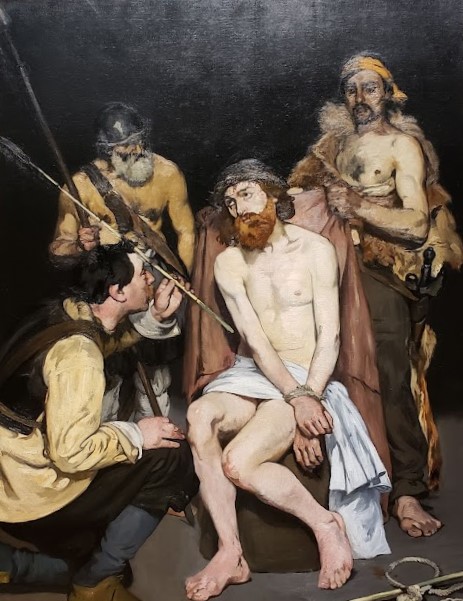
Jesus Mocked by the Soldiers – Eduoard Manet 1865

Ephesians 4:25-5:2 New Revised Standard Version

25 So then, putting away falsehood, let all of us speak the truth to our neighbors, for we are members of one another. 26 Be angry but do not sin; do not let the sun go down on your anger, 27 and do not make room for the devil. 28 Thieves must give up stealing; rather let them labor and work honestly with their own hands, so as to have something to share with the needy. 29 Let no evil talk come out of your mouths, but only what is useful for building up, as there is need, so that your words may give grace to those who hear. 30 And do not grieve the Holy Spirit of God, with which you were marked with a seal for the day of redemption. 31 Put away from you all bitterness and wrath and anger and wrangling and slander, together with all malice, 32 and be kind to one another, tenderhearted, forgiving one another, as God in Christ has forgiven you. Therefore  be imitators of God, as beloved children, and live in love, as Christ loved us and gave himself up for us, a fragrant offering and sacrifice to God.

************

                Interestingly, polls suggest that people are leaving the church (dones) or avoiding Christianity altogether (nones) is that they feel that Christians don’t live a very Christian life. I want to rebut this feeling, but when I look around at the state of the world, especially American Christianity, it’s hard to disagree with the sentiment. Clergy scandals that range from pedophilia to embezzlement are rampant. There are political alliances that undermine Jesus’ call to love one’s neighbor. I know I was appalled to see the “Christian Flag” being carried by rioters as they stormed the capital building (to be honest I’ve never liked the Christian flag, but that was the last straw for me). Now, I know that these are not the only expressions of “Christianity” present in our midst, but they do resonate with the broader public. So, a word like the one we hear in the reading from Ephesians for the Eleventh Sunday after Pentecost is worth considering as an antidote to the current situation. What we hear in this reading is a call to live one’s life in a way that reflects the message of Jesus. Surely this would be a good vaccine!

                The word we encounter here at the end of chapter 4 and the beginning of chapter 5 of Ephesians picks up after a conversation concerning spiritual gifts. According to Paul (remember for sake of tradition and brevity I’m assuming Pauline authorship even though it is disputed) these gifts have been given to the church by the grace of God to equip the saints for ministry so that the saints might move toward maturity in Christ (Eph. 4:7-16). The reading for the Eleventh Sunday is an outgrowth of that earlier word from Ephesians 4. There is, however, a paragraph that separates the two lectionary readings that need to be mentioned. In verses 17-24 Paul tells the readers, who are mostly Gentile, not to live as Gentiles. That is, they should not live in the futility of their minds with darkened understandings that result from living outside the sphere of God’s reign. Paul reminds them that because they are in Christ, they have to put away their old (may we say pagan) way of living. In line with the eschatological vision of the early church, Paul reminds them that to be in Christ means moving from the old world/life/creation to the new world/life/creation. Since they are in Christ they should clothe themselves in a manner that reflects that they have been “created in the likeness of God in true righteousness and holiness”  (Eph. 4:24).

                The paragraph omitted by the lectionary creators is an important connector between the word about spiritual gifts and the call to live a life that is worthy of their calling as saints of God. Now that they are clothed with Christ, Paul tells the Ephesians (and all other readers if this was, as it appears, a circular letter) to put away falsehood, speak truth to one’s neighbors (now that’s a word for today), not let anger lead to sin (Paul recognizes that anger is a normal experience, just don’t let it fester and lead to evil deeds), and finally, he tells them not to make room for the devil. This last reference needn’t be taken literally in reference to a personage called the devil, but it is a recognition that evil is a spiritual force that can take root in our lives if we give it room to maneuver (vs. 25-27).

                Now Paul’s not finished. He also speaks of those who transgress the law by stealing rather than engaging in honest work so they can set aside a provision for the  needy. Paul’s is still not finished. He also includes a word about our speech. Don’t let any evil talk come from your mouth is the message that he gives them. What does he mean by this? Well, the phrase that follows is pretty clear. Let what you say build up others and provide words of grace. It is worth considering the message of James concerning the tongue, which he calls a “restless evil, full of deadly poison” (James 3:8). Yes, it can be used to bless God, but it can also be used to curse those who are created in the likeness of God. James tells us that this is not the way things are supposed to be (James 3:9-10).  While we don’t have a full rundown of the Ten Commandments here, I think we get the point. The Christian life may begin with grace, but there are ethical expectations for us.

                Earlier in the chapter, Paul speaks of his desire that the people experience the “unity of the Spirit in the bond of peace.” He reminds us that there is but one body and one Spirit as well as one Lord, one baptism, and one God (Eph. 4:3-5). If you go to this passage do you see a possible allusion to the Trinity? In our reading, we hear the author tell the people not to “grieve the Holy Spirit of God with which you were marked with a seal for the day of redemption” (Eph. 4:30). The reference to the seal of the Spirit could be understood as being baptism. So, to those who are sealed in the Holy Spirit through baptism, they are called upon to live accordingly. Don’t grieve the Spirit by living in a way that dishonors the Gospel with which they are sealed through baptism.

                Having spoken of this seal of the Spirit, the author again addresses the Gentile way of living. Since they are sealed in the Spirit, they should put away bitterness, wrath, anger, wrangling, slander, and malice. Instead, they should be kind to each other, be tenderhearted, and forgive one another, even as God in Christ has forgiven them. With this word as a foundation, Paul makes a major ask of them— “Therefore be imitators of God, as beloved children, and live in love, as Christ loved us and gave himself up for us, a fragrant offering and sacrifice to God” (Eph. 5:1-2).

                Imitate God as beloved children. How might one imitate God? Paul’s answer is this: “live in love, as Christ loved us and gave himself up for us, a fragrant offering and sacrifice to God.” Later in this chapter, Paul will encourage husbands to love their wives as Christ loved the church by giving themselves up for their wives (Eph. 5:25). However, we read that reference (and it can be read as a call to mutual submission (Eph. 5:21), it seems logical to answer the question of how to imitate God is to love as Jesus loves. Perhaps if we love as Jesus loves we will show the world a different face. Is that not a message for today?

                For more background on the passage see my book Ephesians: A Participatory Study Guide, (Energion Publications, 2010), chapter 6.