Author: Dennis

Zacchaeus and the Multiverse – Lent 5

comesundayfb

Narrative Lectionary Reflection

April 2, 2017

Luke 18:31-19:10

If you read or watch enough science fiction or comic books, you will run into the multiverse.  It’s the belief or theory that there isn’t one universe, but hundreds or thousands of different universes all taking place at the same time.  There is the famous thought experiment by Erwin Schrodinger where he talks about a cat being placed in a box with a small amount of a radioactive substance, a hammer and cyanide.  Without going into the whole theory, as long as the box is closed, we don’t know if the cat is alive or was killed by the poison.  In theory, the cat could be both alive and dead at the same time. This experiment has been used to explain multiverses because you can be a famous singer in one universe or a serial killer in another one all at the same time. There is that famous episode in Star Trek where Kirk is transported to mirror universe where the peaceful Federation is now the Terran Empire.  Characters who were good in the main universe were sadistic in this new one.  And of course, there is Spock who in the mirror universe is sort of evil and you can tell because he now has a goatee.

I’ve thought about multiverses in thinking about a tension in today’s text.  There are two different understandings when it comes to the tax collector named Zacchaeus.

For years, Zacchaeus was the short guy who had dinner with Jesus and gave money to the poor.  It’s a classic story of redemption, of a “bad guy” who became good.  But in recent years, it has been revealed that there is some tension when it comes to the verb tense in verse 8.  Verse 8 reads:“Look, Lord, I give half of my possessions to the poor. And if I have cheated anyone, I repay them four times as much.”

This passage in the original Greek is in a present tense.  It could mean that Zacchaeus was already giving his money to the poor.  But the present tense could also be indicating a future action meaning he will do this.  This is how pastor Dan Clendenin explains it:

Even though the verbs are in the present tense, the typical way of reading of this story follows scholars like Robert Stein and translations like the NRSV and NIV. They render the present tense verbs as a “futuristic present.” That is, Zacchaeus the sinner repents and vows that henceforth he’ll make restitution.

           The second option follows commentators like Joseph Fitzmyer and translations like the KJV and RSV. They render the verbs as a “progressive present tense.” In this reading, Zacchaeus is a hidden saint about whom people have made all sorts of false assumptions about his corruption. And so he defends himself: “Lord, I always give half of my wealth to the poor, and whenever I discover any fraud or discrepancy I always make a fourfold restitution.”

So which one is it?  Is it the story of corrupt rich man that pledges to do right?  Or is it a story of affirmation, of Jesus blessing Zacchaeus for the work that he is doing?

I’m beginning to wonder if it is both; that like Schrodinger’s cat, Zacchaeus is in a superpositions state: both sinner and saint.

Having gone to a Lutheran seminary, I remember learning how Martin Luther believed that Christians are both sinner and saint.  In Luther’s mind a saint was a forgiven sinner, and we were always both forgiven and still imperfect on this side of heaven.

I don’t know if Zaccheus had already been making amends or would promise to do it.  What I do know if that he was both sinner and saint, one that was part of a corrupt system and trying to atone.  Jesus called this flawed man a “son of Abraham” one that belong in God’s kingdom.

The good news is that we aren’t that different from ol’ Zach.  We are sinners and we can’t hide that fact.  But in Christ we are forgiven, we are redeemed by Christ and sent to act with justice and grace toward others.

And you don’t need the multiverse to understand that.

Dennis Sanders is the Pastor at First Christian Church of St. Paul in Mahtomedi, Minnesota. He’s written for various outlets including Christian Century and the Federalist.

The Good One- Lent 3

comesundayfb

Narrative Lectionary Reflection

March 19, 2017

Luke 15:1-32


JESUS MAFA. Prodigal Son, from Art in the Christian Tradition, a project of the Vanderbilt Divinity Library, Nashville, TN. http://diglib.library.vanderbilt.edu/act-imagelink.pl?RC=54662 [retrieved March 15, 2017].
Being an only child, it’s not easy to understand the sibling dynamics taking place in the Parable of the Prodigal Son.  That said, I do have sympathy for the older brother.  He was the good one.  He followed the rules. He stayed at his father’s side.  He did everything right.

I understand this because I’ve always been the Good One.  I was always the kid that people would say is so well-behaved and mature. I was the kid that didn’t rebel.

So, I can understand why the older brother is livid at how his father is treating his younger brother who humiliated his father by taking his inheritance early and then going off to spend it all.  Why should he be welcomed with open arms after what he did to the father?

In the wake of the 2008 housing crisis, there was debate on whether or not to bail out homeowners who were in danger of losing their home.  Some believed that they should and others were dead set against.  They brought houses with questionable loans and bought more house than they had money.  Because of this, some said that it was the homeowner’s fault for being foolish with their money. Let them suffer the consequences.

I tended to side with the later argument. Why?  Because I was the Good One. Fools should suffer their fate.

This all explains why this story is so necessary.  Jesus told this story to a crowd including a number of Pharisees that Jesus heard grumbling because he shared meals with sinners and tax collectors.  Jesus hits these leaders, who were the Good Ones, right where it hurts in this parable.  We see the older son seething in anger.  The father comes out to meet his “faithful” son, in the same way that he came to greet his youngest son.  In each case we see a father full of love for his sons, even though they don’t really deserve it.

This story is a study in grace, and what we learn from it is how “scandalous” grace is.  The father receives the younger son with open arms and has a party.  He did this because his son that he feared would never come back has arrived.  This sort of lavish joy is almost embarrassing and certainly not deserved.  But that’s how God is when a sinner comes home.  God meets them with open arms.

But God also greets the older sons, the Good Ones who in the end aren’t so good.  He reminds them that they are loved with this same grace.  The older son probably did the hard work to please his father.  But the father didn’t care about that.  He loved this son, even when he was acting like a jerk.

Did the older son ever “get it?”  We will never know.  I would like to think he did, that he was willing to stop trying to please his father and just enjoy life knowing he is loved by his father all the time.

And maybe he will understand that being a Good One isn’t about doing the right things, but knowing you are loved with an endless love.


Dennis Sanders is the Pastor at First Christian Church of St. Paul in Mahtomedi, Minnesota. He’s written for various outlets including Christian Century and the Federalist.

Is God With Us? – Lectionary Reflection – Lent 3A (Exodus)

cropped-comesundaylogov2.png

Exodus 17:1-7 Common English Bible (CEB)

17 The whole Israelite community broke camp and set out from the Sin desert to continue their journey, as the Lord commanded. They set up their camp at Rephidim, but there was no water for the people to drink.The people argued with Moses and said, “Give us water to drink.” Moses said to them, “Why are you arguing with me? Why are you testing the Lord?” But the people were very thirsty for water there, and they complained to Moses, “Why did you bring us out of Egypt to kill us, our children, and our livestock with thirst?” So Moses cried out to the Lord, “What should I do with this people? They are getting ready to stone me.” The Lord said to Moses, “Go on ahead of the people, and take some of Israel’s elders with you. Take in your hand the shepherd’s rod that you used to strike the Nile River, and go. I’ll be standing there in front of you on the rock at Horeb. Hit the rock. Water will come out of it, and the people will be able to drink.” Moses did so while Israel’s elders watched.He called the place Massah and Meribah, because the Israelites argued with and tested the Lord, asking, “Is the Lord really with us or not?”

*********

In Advent we heard the message of Emmanuel—God is with Us—in Lent we hear the question—“Is the Lord really with us or not?” The Advent declaration appears in the revelation to Joseph that the child of his betrothed was conceived of the Holy Spirit and that God would save the people from their sins through him (Matt. 1:18-25). The Lenten question is raised during a rather tense encounter between Moses and the people of Israel as they wandered across the desert. The murmuring or complaining of the people of Israel is a constant theme in Exodus. The people cried out to God, seeking deliverance from slavery. Now that they are free, they have other complaints, and the person who bears the brunt of these complaints is Moses. A chapter earlier, the complaint had to do with food. Now it’s a lack of water that concerns the people. You have to feel for Moses, because he has been put in an untenable position. He had claimed that he was acting on behalf of God, after demonstrating God’s power, the people agreed to follow him. Whether they understood the full ramifications of this decision is unknown. Of course, had we been among the people affected, we probably would be complaining as well. After all, water is essential to life, so why would you camp in place where water was absent?

Here is Moses. He’s being forced to explain the lack of water. Moses responds, strangely enough, with a question for the people: “why are you testing God?” What does Moses mean by that statement?  As for the people, they are putting the onus on Moses. Why did he bring them to this place? Why did he rescue them only to lead them to certain death from thirst?   In other words, slavery was bad. Dying of thirst was worse!

Even if we’ve not experienced such thirst, most of us have been exposed to the issue. I like watching nature programs like Planet Earth and Planet Earth II. When the programs focus on deserts, you will be exposed to animals searching for water. Perhaps you will watch as a troop of elephants cross foreboding desert sands in search of an elusive watering hole. A wide shot from the air reveals nothing but sand in all directions, but the troop marches on. Most likely this troop will include at one least one calf struggling to keep up, its only hope of survival being the discovery of that water hole. You want to root for that calf to make it, but that’s not always the way things end. In a recent show, the calf fell and couldn’t get up. The mother stayed behind, watching over her calf, even though she too was now at risk because she was separated from the rest of the troop. You grieve for that mother.

If you grieve for the elephants, then surely you must grieve for the people of Israel who face a similar fate. There are children in this caravan. They would be most vulnerable. Think of the recent stories of refugees fleeing the violence in Syria and Iraq. Remember the faces of children who face hunger and thirst. Do we hear their murmurings? Do we empathize with them, and thus with the people of Israel camped in the desert with no water in sight?

The people are understandably upset, and Moses seems to be caught in the middle. He is the one God charged with leading them out of Egypt, but did he lead them out of Egypt to a place where death was certain? For his part, Moses is wondering what he had gotten himself into when he answered the call of the burning bush. Yes, he had been able to do miracle upon miracle, including parting the sea. But, none of that mattered now, as a thirsty people demanded water. I can hear Moses say to God: “What I do to deserve this?” “What am I supposed to do with this people?” I can hear him say to God, “I didn’t learn how to deal with this kind of a problem in seminary. So, what am I supposed to do? They’re about to stone me.”  In other words, Moses was about to resign his leadership position! This is a sentiment that often marks clergy as they try to lead congregations that won’t go easily into the night. In this case, the people seem to have a point. They didn’t sign on to a trip that would to their death in a land without water.

Of course, it wasn’t Moses who delivered the people from Pharaoh. It wasn’t Moses who opened the sea or provided manna. It was YHWH. Fortunately, God had a solution. God told Moses to take the elders with him, along with the staff he used to strike the Nile, and go to the rock at Horeb, which is where God will be found standing on the rock. God instructed Moses to strike the rock with his staff, and when he did this, water would flow from that rock. If only drought-stricken lands had a staff like that. When Moses followed this command, he struck the rock in the sight of the Elders, and water began to flow so that the people could drink.

As is often the case in Exodus, this place takes on a new name. It is called Massah (Test) and Meribah (Quarrel). That is because the people tested God and quarreled. As they quarreled and tested God, they asked “Is the LORD among us or not?” They had seen God at work, but they still weren’t sure that God was with them. This episode might be remembered as one of those times when Israel tested God. That is, they showed a lack of faith. Consider the word of the Psalmist: “They tested God again and again, and provoked the Holy One of Israel” (Ps. 78:41).

I have never seen the parting of the sea, bread fall from heaven, or see someone strike a rock to get water to flow from it. Now, I know that there will be those who want to explain how all of this could happen. We moderns love natural explanations of biblical miracles. Regardless of the explanations, I’ve not seen anything close to what is described here with my own eyes. So how might I as a human being know if God is with me? Should I take my ability to find a rare parking spot as being a sign of divine presence? I would love to have the power to pray for one of my parishioners who is experiencing health problems, and watch those problems immediately disappear, but I’ve not seen that happen, though I do believe in healing and I do pray for people. I trust that God hears my prayers. But, how do I know that God is with me?

In this story, God provided the people with water to sustain them. God provides us with water as well that will sustain us—spiritually. Remember the story of Jesus and the Samaritan woman. He offers her living water. He tells her that everyone who drinks the water of Jacob’s well would again thirst, but “those who drink of the water that I will give them will never be thirsty. The water that I will give will become in them a spring of water gushing up to eternal life.” The woman told Jesus, “I want some of that water” (Jn. 4:13-15).  So do I!

So, the answer is—yes, God is with us!
Picture Attribution: Chagall, Marc, 1887-1985. Moses Striking the Rock and Bringing Forth the Water, from Art in the Christian Tradition, a project of the Vanderbilt Divinity Library, Nashville, TN. http://diglib.library.vanderbilt.edu/act-imagelink.pl?RC=54659 [retrieved March 13, 2017]. Original source: http://www.flickr.com/photos/abeppu/3815912913/.

bobcornwall

Robert Cornwall is the Pastor of Central Woodward Christian Church in Troy, Michigan and is the author of a number of books including Marriage in Interesting Times (Energion, 2016) and Freedom in Covenant (Wipf and Stock, 2015).

One Last Time – Lent 2

comesundayfb

Narrative Lectionary Reflection

March 12, 2017

Luke 13:1-9, 31-35


Interstate 35W Bridge Collapse, Minneapolis, MN, August 2007.

A man leaves home to head into the Big City and work in one the cities tallest buildings.  But it was September 11, and the man’s family never saw their husband and father again.

A woman calls home to tell her husband and daughters that she is leaving work and will be home for dinner.  She leaves downtown and heads on the freeway during rush hour.  She wades though traffic as it crawls across a bridge over the Mississippi River.  Out of nowhere, the bridge collapses and the woman never comes home.

A man drops off his husband at his workplace.  The man heads home and a few hours later sees a breaking news report of a mass shooting at his husband’s place of work.  He calls his spouse over and over, and no one ever picks up the phone.   After a frantic day and night of trying  going to hospitals to find his partner, he gets a phone call.  What he feared has come true; his husband was dead by shooter.


Why do these things happen?  Why did this person die and not this other one?

These are some of the questions people have as they hear about a tragedy that took place in Galilee.  Pilate, the governor of the area, killed Galileans as they were making sacrifices.  It was a sacrilege.

This shocking event made people wonder: did these people do something, did they sin, in order for this to happen.


This was the prevailing belief among many in Jesus’ time. If you did something wrong, then bad things will happen to you.

But Jesus doesn’t agree.  He asks if the Galileans who perished at Pilate’s hand were more sinful than others. What about those who died when a building collapse killing 18 people? Were they more sinful than others?

Jesus never answers that question but instead tells them to change their hearts and minds while there is time.

Jesus isn’t interested in asking why bad things happen.  Jesus is interested in repentance, turning around, devoting our lives to Jesus.  We only have so much time. How will we be present to God and others?

There is an old Simpson’s episode called “One Fish, Two Fish, Blowfish, Blue Fish.” In this episode the family goes to a local Japanese restuarant in Springfield.  Homer eats a fish that was possibly poisonous and could kill him in a day.  When he realizes that he only has one day left to live, he creates a list of things he needed to do before the day ends.  He has a man-to-man talk with Bart. He listens to Lisa play her sax.  He borrows a camera and tapes a message to baby Maggie.  He reconciles with his father and spends one last time together with his wife Marge.  

During the night, he gets up and decides to sit a chair in the living room rather than die next to Marge.  He listens to the tape and falls asleep.  The next morning, Marge comes into the living room seeing Homer slumped in his chair.  Fearing the worst, she walks towards him and realizes that he is alive.  Homer and Marge rejoice that he has been spared from death.

We only have so much time.  How will we live? Will we live lives of gratitude, knowing we are forgiven and express that gratitude in love towards others?

Dennis Sanders is the Pastor at First Christian Church of St. Paul in Mahtomedi, Minnesota. He’s written for various outlets including Christian Century and the Federalist.

A Blessing to the Nations – A Lectionary Reflection for Lent 2A (Genesis 12)

cropped-comesundaylogov2.png

Genesis 12:1-4 Common English Bible (CEB)

Abram’s family moves to Canaan
12 The Lord said to Abram, “Leave your land, your family, and your father’s household for the land that I will show you.I will make of you a great nation and will bless you. I will make your name respected, and you will be a blessing.
I will bless those who bless you,
those who curse you I will curse;
all the families of the earth
will be blessed because of you.”
Abram left just as the Lord told him, and Lot went with him. Now Abram was 75 years old when he left Haran.

**********

This short passage is one of the most foundational texts in scripture (at least that’s my view). God calls Abram (name not yet changed to Abraham) to leave his home and extended family, and travel to a foreign land. If he does this then God promises that he will become a “a great nation” blessed by God. Not only will Abram be blessed, but in addition “all the families of the earth will be blessed because of you.” The lectionary selection is brief and yet powerful. God asks a lot of Abram, telling him to leave behind everything he has known. In a world in which tribe was central, it was risky to go to go to a land in which one was a stranger. While the promise itself was wonderful, the question was how would it work out?
The outworking of this call would have many twists and turns, and as the writer of Hebrews notes, Abraham set out “not knowing where he was going.” Abraham, Isaac, and Jacob, all lived in tents and Sarah was barren, but the promise revealed itself over time, but “all of these died in faith without having received the promises, but from a distance they saw and greeted them” (Hebrews 11:8-13). There would be times when Abraham took matters into his hands, such as when in pursuit of an heir he took Sarah’s slave, Hagar, and had child with her. Despite the twists and turns, the journey to blessing starts here, and continuing through the Covenant of Sinai to that of Calvary and the embrace of the Gentiles into God’s realm.

As a Christian, I interpret the call of Abraham through the lens of Jesus. He is, as Paul suggests, the seed of Abraham, through whom the blessings of God would be revealed to the nations (Gal.3:15-18). With this in mind, it’s appropriate to remember that Matthew’s genealogy traces Jesus’ lineage back to Abraham (Matthew 1:1-17). For Matthew Jesus, the Messiah, is the son of David and the son of Abraham. But connecting Jesus’ mission to Abraham, he envisions Jesus as the one through whom all the nations will be blessed. That is, he will save the people from their sins (Mt.1:21). From this perspective, the coming of Jesus is not a course correction on the part of God, but a natural extension of the call of Abram. That means the church doesn’t replace Israel, but as Paul notes, the Gentiles are grafted into the olive tree that is Israel, so that the nations might share in the blessing that God first promised to Abraham and to Israel (Rom. 11). As we ponder the call and the end result, it is wise to remember the promise of Second Isaiah, that Israel would be a light to the nations so that God’s salvation would reach the ends of the earth (Is. 49:6).

Theologian Clark Williamson has devoted much attention to the question of the church’s relationship to Israel, especially in a post-Shoah world. He writes:

Israel was to be a priestly people, serving others, not itself. God’s covenant was not merely for Israel’s good but for the good of all human beings, Gentiles and Jews. God chose Israel as an instrument so that all peoples may come to know God and God’s purposes for them. [A Guest in the House of Israel, p. 125].

So, for Christians reading this call, which will be formalized more fully in Genesis 15 when the promise a child and heir is given (and sealed through sacrifice), and then again in Genesis 17, when God explicitly makes a covenant with Abram and in the process changes his name to Abraham (and that of Sarai to Sarah).

According to the reading from Genesis 12, Abram accepted the call and headed out from Haran to Canaan. He did so, accompanied by Lot and those closest to him, with only the promise of a blessing.  The promise is this—the families of the earth will be blessed through him. As we contemplate this call it’s good to note that while God seems narrow the focus to one family, the earliest readers of this promise, as descendants of Abraham and Sarah, would have understood themselves to be that nation through which God would bless the families of the earth. They had a special calling from God. They had a message to share with the nations. While it would be easy to forget this calling, and focus inward rather than outward, time and again messengers would remind the people of their calling. It wasn’t just Israel that was to be blessed, it was the entire creation. Having attended a stewardship workshop recently, I’m reminded that this is a stewardship issue. That would mean that the promise ultimately is rooted in the creation of humanity, who are blessed by God and charged with having dominion (management) of God’s creation (Gen.1:26-31).

The call on Abram and his descendants was to be a blessing to the nations. It would be through this people that God would bless creation. For Christians, this means recognizing that we have been, as noted earlier, grafted into the olive tree that is Israel. We have been adopted into the family through the one who is the seed of Abraham. But as the Gentiles are drawn into the family, and blessed by God, that doesn’t nullify the previous covenant (Gal. 3:15-18). There is a tendency for Christians to read Paul in a supersessionist manner, so that Jesus replaces Israel. That would be inappropriate. For our purposes, let us simply understand Paul’s reference to seed to be a sign that God always intended to bring all of creation into the fold, and that Israel plays an important role in this, as does Jesus.

While there will always be interpretive questions to wrestle with, since three religious traditions claim descent from Abraham, and that these three traditions have often been at odds with each other, it would be wise to affirm the common ancestry, and move to the question of the nature of this blessing. After all, the words bless and blessing figure prominently in this passage and in Genesis. Lest anyone think too highly of one’s self, it is also good to remember that the blessing spoken of here is a gift of God, though it is a gift that must be received. Remember that Abram is told that those who bless him will be blessed and that those who curse him will be cursed. As James McTyre notes, “Abram is called by God to serve as a mirror. Instead of images, Abram will reflect blessings and curses on the land where he will sojourn” [Feasting on the Word, Year A, 2:51].

From a Christian point of view, the church, as the body of Christ, reflects God’s blessings to the world. But what does this mean? What is a blessing? It’s a good question since the words bless or blessing figure prominently in this passage and in the rest of the story. For modern readers the word blessing may seem quaint but not all that meaningful. However, in Hebrew the word connotes a sense of well-being or flourishing. That is what God wants to see happen for creation. He wants it to once again flourish. As to what this means, Miroslav Volf suggests that flourishing means that one does not live by bread alone. The material world is important, for we are material beings, but in his argument as to why a globalized world needs religion, Volf notes that “when we live by bread alone, there is enough bread, not enough even when we make so much of it that some of it rots away; when we live by bread alone, someone always goes hungry; when we live by bread alone, every bite we take leaves a bitter aftertaste; . . . living by ‘mundane realities’ and for them alone, we remain restless and that restlessness in turn contributes to competitiveness, social injustice, and the destruction of the environment as well as constitutes a major obstacle to more just, generous, and caring personal practices and social relationships.” We need bread, but we need more than bread. We need the bread of life.   [Volf, Flourishing, p. 22].


There is a thread that runs from creation (Genesis 1) to new creation (Revelation 22). It runs through Abram and on to Jesus, through whom we are grafted into the tree, so that we might be reconciled and share in the blessings of God as was promised to Abram as he left Haran for a new land.

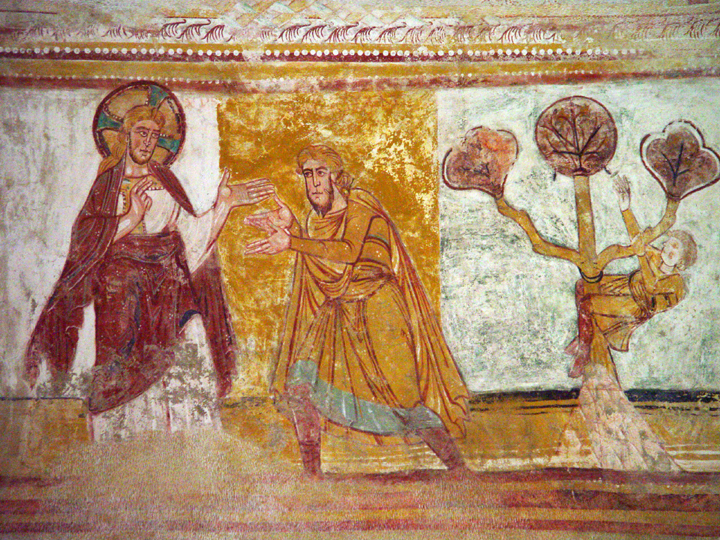
Picture attribution: St. Savin – Calling of Abraham, from Art in the Christian Tradition, a project of the Vanderbilt Divinity Library, Nashville, TN. http://diglib.library.vanderbilt.edu/act-imagelink.pl?RC=33460 [retrieved March 7, 2017]. Original source: Images donated by Anne Richardson Womack, Vanderbilt University, and James T. Womack, Montgomery Bell Academy, Nashville, TN.

bobcornwall

Robert Cornwall is the Pastor of Central Woodward Christian Church in Troy, Michigan and is the author of a number of books including Marriage in Interesting Times (Energion, 2016) and Freedom in Covenant (Wipf and Stock, 2015).

Be Holy, Love Thy Neighbor! – Lectionary Reflection – Epiphany 7A (Leviticus)

cropped-comesundaylogov2.png

Leviticus 19:1-2,9-18  New Revised Standard Version (NRSV)

19 The Lord spoke to Moses, saying:  2 Speak to all the congregation of the people of Israel and say to them: You shall be holy, for I the Lord your God am holy. 9 When you reap the harvest of your land, you shall not reap to the very edges of your field, or gather the gleanings of your harvest. 10 You shall not strip your vineyard bare, or gather the fallen grapes of your vineyard; you shall leave them for the poor and the alien: I am the Lord your God. 11 You shall not steal; you shall not deal falsely; and you shall not lie to one another. 12 And you shall not swear falsely by my name, profaning the name of your God: I am the Lord. 13 You shall not defraud your neighbor; you shall not steal; and you shall not keep for yourself the wages of a laborer until morning. 14 You shall not revile the deaf or put a stumbling block before the blind; you shall fear your God: I am the Lord. 15 You shall not render an unjust judgment; you shall not be partial to the poor or defer to the great: with justice you shall judge your neighbor. 16 You shall not go around as a slanderer among your people, and you shall not profit by the blood of your neighbor: I am the Lord. 17 You shall not hate in your heart anyone of your kin; you shall reprove your neighbor, or you will incur guilt yourself. 18 You shall not take vengeance or bear a grudge against any of your people, but you shall love your neighbor as yourself: I am the Lord.

********

Gray and Gold, John Rogers Cox - Cleveland Museum of Art
Gray and Gold, John Rogers Cox – Cleveland Museum of Art

The people of God are called to emulate God’s holiness. The word “holy” carries a bit of baggage, because it’s often linked to smug self-righteousness. Words like puritanical, legalistic, and pharisaical are offered as synonyms.  When it comes to the holiness code detailed in Leviticus, we tend to think in terms of ritual purity, rather than in terms of calls for compassion and service. Then we come to Leviticus 19, which calls for the people of God to be holy, even as God is holy. Here holiness is spoken of in terms of loving one’s neighbor as one’s self.  Indeed, Jesus draws the second great command from Leviticus 19:18—the first command, the call to love God with one’s entire being is drawn from Deuteronomy 6:4-5 (Matt. 22:34-40). So, perhaps we need rethink our understanding of holiness.

The Old Testament reading for the seventh Sunday after Epiphany (Year A) includes the call to holiness, and then moves to the social implications of this call to holiness. It is the only time in the three-year lectionary cycle that we visit Leviticus, and that is only if the season extends to at least seven weeks. Thus, we might be missing out on important words from scripture.

The selection begins with the call to be holy, but ends with a call to love one’s neighbor. These two bookends are important, because they suggest that Torah (Law, Teaching) connects love and holiness. It is a reminder that grace and love are present in scripture prior to the New Testament. Jesus did not invent grace, he simply offered us a new way of understanding that biblical vision. In fact, his own vision of human relationships, especially as laid out in the Sermon on the Mount, is formed by what we read here in Leviticus 19.

Because Leviticus is understood to be a book of rules and regulations, Christians tend to avoid it. It presents us with too many problems, so we go elsewhere for inspiration and guidance. Nonetheless, there is much wisdom to be found in the book’s instructions on what it means to be holy as God is holy (Jesus picks up on this call to holiness in the Sermon on the Mount, with the rendering in Matthew 5 speaking of being perfect as God is perfect—Matthew 5:48). So, what does it mean to be holy as God is holy?

Leviticus 19 provides us with a collection of instructions. Ron Allen and Clark Williamson note that “imitation of God is manifest primarily in responsible actions toward the vulnerable” [Preaching the Old Testament: A Lectionary Commentary, (WJK Books) p. 23]. This call to care for the “least of these” is rooted in the biblical vision of God’s nature, who is “merciful and gracious, slow to anger, and abounding in steadfast love and faithfulness” (Exodus 34:6).  The lectionary reading omits the opening section of Leviticus 19 (vss. 3-8), which focuses on revering parents and honoring God. Instead, it jumps to the second section of the chapter, which offers us a vision of “holiness in neighborliness” [Walter Kaiser, “Leviticus,” New Interpreter’s Bible, (Abingdon Press), 1:131]. It is a word of instruction regarding social ethics. These instructions remind us that religion not only speaks to the divine-human relationship, but also has implications for the way in which we conduct ourselves in public. Each section or paragraph closes with the refrain: “I am the Lord.” It is a reminder that the way in which we conduct our lives is a reflection on the Lord (YHWH) our Creator.

With the United States in the midst of a debate about immigration and refugee status, the opening paragraph is instructive. The author instructs Israel’s farmers to make portions of their fields and vineyards available to the poor and the alien. In an agrarian economy, this is essentially a government imposed safety net. Why? Because “I am the Lord your God.”

The commands move on from caring for the alien, the foreigner, to other areas of concern. Holiness is more than ritual purity. It has community implications. There are calls to refrain from stealing, defrauding one’s neighbor, lying to one another, bearing false witness. There is a call to respect persons with disabilities—the deaf and the blind. It is instructive that this particular word of guidance is accompanied by a call to fear God.  This is a word that churches might want to heed, as they consider ways of responding to those with disabilities. What obstacles do we put in the way of people who seek to come and worship?

There is a call for judges to be fair and impartial. This word is interesting because judges are not to distinguish between poor and rich. This word seems to stand in contrast with the idea that God has a “preferential option for the poor.” It would seem from this reading, that God doesn’t prefer the poor or the rich, but God judges each equally. It is justice that must be served. But, I wonder how we should read this passage. On the surface, it would seem that the judicial system should make no allowance for the poor, but is that the point? As Ron Allen and Clark Williamson point out, “in our times perhaps we should say that the poor should be provided with lawyers as able as those whom the rich can afford” [Preaching the Old Testament, p. 24]. Even if we affirm God’s preferential option for the poor, this is not to say that God has no concern about the welfare of the wealthy. God is God of all people, rich and poor.

At a time when “hate” seems strong in our midst, it is important to hear the call to not hate our kin. It is important that we not try to gain vengeance. It’s okay to reprove our neighbor, though I would caution great care. It’s easy to become “judgmental” and a meddler. Still, if we can, we should help our neighbors get back on track.

We began with a command to be holy, and we end with a command to love our neighbors as we love ourselves—what is often called the Golden Rule. It is worth noting, especially at this time and place in history, that if we continue reading down in Leviticus 19, that the people of Israel should “love the alien as yourself, for you were aliens in the land of Egypt” (Lev. 19:34). This broadens out what is meant in scripture by loving one’s neighbor as one self.  Allen and Williamson note that this command, to love the alien is repeated thirty-six times in Scripture, suggesting, at least by repetition, that “it is the most important commandment in the Torah” [Preaching the Old Testament, p. 25].

While we might not find every word in Leviticus appropriate to our time, these are important words that do reflect the message of grace and compassion that are present throughout scripture. They reflect the covenant commission given to Abraham and Sarah, that through their descendants that peoples of the earth would be blessed (Gen. 12:1-3).

bobcornwall

Robert Cornwall is the Pastor of Central Woodward Christian Church in Troy, Michigan and is the author of a number of books including Marriage in Interesting Times (Energion, 2016) and Freedom in Covenant (Wipf and Stock, 2015).

Thanks. I Needed That. – Epiphany 7

comesundayfb

Narrative Lectionary Reflection

February 19, 2017

Luke 7:36-50


In the early 1970s, there was a brand of aftershave that made a commercial that had a hand slap a man.  He would feel his face and then say, “Thanks. I need that.”

It was an interesting commercial, mostly because I don’t think anything like it could be made today at all.  It’s seem a little weird that the basis of this TV ad is having a hand slap an actor rather hard.  That actor had to have one sore cheek after a day of filming.

The ad had an affect- on me.  I was only about three or four at the time.  I remember that my mother punished me for something and my response to her was, “Thanks. I needed that.”

photo credit: http://wayneforte.com/picture/anointing-his-feet-2/

That phrase is in my mind when I think about this unnamed woman who crashes Simon’s dinner party.  Her need was different from mine and she expressed it in a way that showed she really needed this and was willing to do what it took to get what she needed.

This woman was deemed a “sinner.” We don’t know what made her a sinner, but whatever it was, the people in town knew.  She came into the room probably feeling the hot stares of the dinner guests and Simon.  But she makes a beeline to Jesus and begins washing his feet with her hair and tears. She then opens a jar of oil and begins annointing Jesus’ feet.  It is a passionate scene.

What this woman wanted is forgiveness.  She had lived with shame for a long time and she sees Jesus, the one that parties with tax collectors and sinners, as one that would forgive her.  She could even feel that she was forgiven already.  So she shows her love, her gratitude in this embarassing and “shameful” way.


It would be easy to place myself in the role of the woman, but too often I am like Simon, probably a well-meaning man, but someone who is so well-versed in the faith that I can tend to not be hungry for forgiveness and have a joy that bursts out in thankfulness to the Messiah.  I’ve been in the faith long enough to think that I’m not in need of anything. We don’t want to admit our own sin and the need to be forgiven.

But I need Jesus and so do you.  We all are sinners and we are in need of forgiveness.  We need to know that Jesus has forgiven us.  We need to feel that sense of gratitude that propels us to serve God and our sisters and brothers.

“Thanks, I needed that.”  Because I do need it and so do you.  And so do we all.

Dennis Sanders is the Pastor at First Christian Church of St. Paul in Mahtomedi, Minnesota. He’s written for various outlets including Christian Century and the Federalist.

Me and the Mona Lisa- Epiphany 6

comesundayfb

Narrative Lectionary Reflection

February 12, 2017

Luke 7:18-35


It’s been nearly 20 years since I took my first trip abroad.  I spent two weeks trekking Spain, France and the UK seeing all the stops that one is supposed to do when in Europe.

One evening, while in Paris, I went to the Louvre.  I was interested in seeing the Leonardo daVinci’s famous Mona Lisa.  This has to be the most well-known painting in the world.  It is talked about so much that you start to think this is a grand painting in size.  So you enter the room where it is located.  A crowd is gathered it around it and it is the only painting that is encased in a plastic box to protect it from the masses.

If you were expecting a painting that might fill the gallery wall, your expectations would be dashed pretty quickly.  It’s maybe a bit larger than the a regular size iPad.

None of this takes away from its beauty.  But the real thing is not always what we expect.

Which is probably what John the Baptist was thinking in today’s text.  He’s sitting in jail and hearing from his disciples that Jesus is healing the servant of a Roman centurion and raising a widow’s son from the dead Our faith is always about God and people.

This probably wasn’t what John was expecting.  He was preaching about fires and threshing floor and separating wheat from chaff.  John was hardcore, and he expect the one he was preparing the way for was going to kick the Romans out and put those Pharsiees in their place.

But then the real Jesus shows up and it’s not what he expected. So he asks Jesus that question,”Are you the one who is coming, or should we look for someone else?”

Jesus’ response is interesting because he doesn’t directly answer John.  Instead he tells John what he’s done: “Those who were blind are able to see. Those who were crippled now walk. People with skin diseases are cleansed. Those who were deaf now hear. Those who were dead are raised up. And good news is preached to the poor.”

Jesus tells John the Baptist what he’s done instead of saying who he is.  John learns who Jesus is through what he has done.  John is to witness what Jesus has done.

Who is Jesus to you?  What do we expect from Jesus?  Maybe we expect Jesus to prevent hunger or keep kids from dying in wars or stop terrorist attacks.  We have an imaginary God that  does what we expect and then we have a real God that is not doing what we expect at all.

We will be disappointed at times that God isn’t all that we wanted.  But remember what Jesus said: the blind can see.  The dead are raised.  The poor have good news. Remember what God has done in your life and in the life of others.

Jesus never lives up to our expectations.  But the Jesus we get, the real one is far more wonderful than anything we could have expected.

Dennis Sanders is the Pastor at First Christian Church of St. Paul in Mahtomedi, Minnesota. He’s written for various outlets including Christian Century and the Federalist.

Choose God, Choose Life — Lectionary Reflection for Epiphany 6A (Deuteronomy)

cropped-comesundaylogov2.png

Deuteronomy 30:15-20New Revised Standard Version (NRSV)

15 See, I have set before you today life and prosperity, death and adversity. 16 If you obey the commandments of the Lord your God that I am commanding you today, by loving the Lord your God, walking in his ways, and observing his commandments, decrees, and ordinances, then you shall live and become numerous, and the Lord your God will bless you in the land that you are entering to possess. 17 But if your heart turns away and you do not hear, but are led astray to bow down to other gods and serve them, 18 I declare to you today that you shall perish; you shall not live long in the land that you are crossing the Jordan to enter and possess. 19 I call heaven and earth to witness against you today that I have set before you life and death, blessings and curses. Choose life so that you and your descendants may live, 20 loving the Lord your God, obeying him, and holding fast to him; for that means life to you and length of days, so that you may live in the land that the Lord swore to give to your ancestors, to Abraham, to Isaac, and to Jacob.


*********

We have choices to make in life. Sometimes the choices are inconsequential, such as a flavor of ice cream. Other times, they determine life and death. I’m not of the mindset or theology that suggests that God has everything planned out. That’s not to say I don’t think that God is active in the world, it’s just that I think we contribute a great deal to our futures. In my understanding of things, we have free will and so our choices make a difference. Such is the message we find here in Deuteronomy 30.

In his closing message to the people of Israel, as they prepare to cross the river, Moses offers a warning of sorts, as well as a word of blessing to the people of Israel. They will soon enter a new land, the land of promise. Their future prosperity depends on the choices they make. Will they embrace their God who led them to this point? Or, will they depart from the ways of God? Moses won’t be crossing the river them. Whatever happens on the other side of the river, will happen without his involvement.  This will be his final resting spot. He’s made his choices, but those who cross the river will have their own choices to make.

If they desire prosperity and life, rather than adversity and death, then the people will love God, walk in God’s ways, and obey God’s commandments. The heart of their life together is rooted in the commandments as summarized in the Shema: “Hear, O Israel: The Lord is your God, the Lord alone. You shall love the LORD your God with all your heart, and with all your soul, and with all your might” (Deut. 6:4-5). In other words, their future is wrapped up in the covenant that God had made with them as they left slavery and crossed the desert toward ultimate freedom. The choices they make as they prepare to cross the river will have consequences for them, but also for their descendants. That is why, after Moses delivered the Commandments to the people, he told them to pass on the words he shared to their children (Deut. 6:6).

So, if the people choose wrongly. That is, if they choose to give themselves to other gods and other ways, they will experience death. Remember the foundation of the covenant is choosing to love God “with all your heart, and with all your soul, and with all your might.” So, if your heart is led astray and you embrace other gods, you will experience the consequences of those choices. You will perish and not live for long in the land of promise. The key sin here is idolatry. So, we are faced with a question. Are we given to idolatry? Are we tempted to give our loyalty to gods other than the God of Abraham, Isaac, Jacob? The consequence here ultimately is alienation from the Land. You shall not live in it for long, if you don’t keep the covenant stipulations. Brett Younger puts it this way:

Most of our decisions do not seem important, but life and death are before us every day. We choose death when we ignore God and choose anything inferior. Death is a slow process of giving ourselves to what does not matter. Modern life is impoverished with a lack of purpose. We rush to meet deadlines that are insignificant and bow before ideas that are not worthy. [Feasting on theWord, pp. 341, 343].

So, what is significant that we should give our attention to it? What is God’s desire? What is it that God wants from us?  The prophet Micah offers some clues: justice, mercy, humility (Mic. 6:8). At this moment in time we’re confronted with the plight of refugees who flee persecution and war. How is this a concern of God? What is required of us? We witness a diversifying of our communities. How is this a concern of God? If these are concerns of God, and the word to us, is to walk in the ways of God, how should we respond?

I spend time with social media, probably more than I should, and what I witness are choices being made. Some are productive, many are not. Indeed, many of our choices as expressed on social media are destructive. They express our idolatries, our desire for power and prestige. They give vent to our anger. These are often choices that bring death not life. So, how do we move from death to life?

As we read Moses’ final sermon, his summing up of the Law, it’s not all bad news. Remember there’s a choice involved. Moses would rather the people choose life. Yes, “Choose life so that you and your descendants may live, loving the Lord your God, obeying him, and holding fast to him; for that means life to you and length of days, so that you may live in the land that the Lord swore to give to your ancestors, to Abraham, to Isaac, and to Jacob.”

I again turn to the words of Brett Younger, who writes:

Worship with all your heart. Pray genuinely. Love your church. Believe that God loves you. Remember the stories of Jesus. See Christ in the people around you. Share God’s love with someone who has forgotten it. Delight in God’s good gifts. See that all of life is holy. Open your heart to the Spirit. Search for something deeper and better than your own comfort. Live in the joy beneath it all. Let God make your life wonderful. [Feasting on the Word, p. 343].

These are wise words. These are words of life that are reflective of the message of Deuteronomy. The choice is ours. We have free will. We’re not beholden to idolatry, even if t sometimes comes easily to us. The river stands before us. We have choice as to whether we will cross over into the promised land. Once there, we’ll have other choices that are matters of life and death. Which will you choose? Life or death?

bobcornwall

Robert Cornwall is the Pastor of Central Woodward Christian Church in Troy, Michigan and is the author of a number of books including Marriage in Interesting Times (Energion, 2016) and Freedom in Covenant (Wipf and Stock, 2015).

Ernie’s Sabbath- Epiphany 4

Ernie’s Sabbath- Epiphany 4

comesundayfb

Narrative Lectionary Reflection

January 29, 2017

Luke 6:1-11

kytt8l5jlds-zach-bettenErnie is someone you couldn’t forget.

Ernie attended a church that I served at in Minneapolis.  He has some intellectual disabilities which means that he doesn’t really have a sense of when to speak and when to keep quiet.  It was not unusual for him to speak up in a loud voice during worship about a certain issue.  Ernie just didn’t do quiet.

The interesting thing was that the congregation was not bothered by Ernie’s frequent outbursts.  In the nearly five years I served at this church, I never once saw anyone make a face at Ernie for speaking out of turn.  Everyone acted as if this was just a normal part of the worship experience, because in reality it was a normal part of worship.  Ernie was part of the liturgy of this congregation and there was always room for whatever he was going to say.

Worship is a serious thing, but sometimes it can become a performance that seeks total perfection.  In some places, Ernie would not be tolerated because he interuppted the service.  This church took worship seriously as well, but it didn’t take it so seriously that it forgot the people who were a part of the worship experience.

In Luke 6, Jesus has two encounters over two Sabbaths with the Pharisees.  The first encounter was when some of Jesus disciples picked off the heads of wheat, rolled them and then ate them.  The Pharisees (who I guess were taking part in massive dragnet of Galilean wheatfields) asked Jesus why he was allowing this violation of the Sabbath.  Jesus responds telling them about the time when David and his fighters were in need of food and all that was around was the bread of the Presence, a ceremonial bread.  David broke a law, but it was for an important reason, to allow fighters to eat.  For Jesus, the Sabbath was made for humanity and not the other way around.

On another Sabbath, Jesus sees the Pharisees in the audience and Jesus heals a man with withered hand.  He heals the man, which might have again been seen as a violation of the law.  But for Jesus what mattered at that moment was healing this man.

Jesus wasn’t dismissing Sabbath.  He was a Jew, after all.  But he was upset when adherance to the law trumped serving God and their neighbor.

Going back to Ernie, of course you want to have an orderly worship service.  But it doesn’t have to come at the expense of welcoming Ernie to worship God.

Our faith is always about God and people.  When we start to worry about other things like making sure we do all the right things in our faith, we start to lose the whole meaning of the faith we proclaim.

Ernie could be hard to deal with at times, but I am glad for having known him.  He helps me not to take things so seriously and reminds me what this whole God thing is all about people and God.  

Dennis Sanders is the Pastor at First Christian Church of St. Paul in Mahtomedi, Minnesota. He’s written for various outlets including Christian Century and the Federalist.