Category: Lent

Is God With Us? – Lectionary Reflection – Lent 3A (Exodus)

cropped-comesundaylogov2.png

Exodus 17:1-7 Common English Bible (CEB)

17 The whole Israelite community broke camp and set out from the Sin desert to continue their journey, as the Lord commanded. They set up their camp at Rephidim, but there was no water for the people to drink.The people argued with Moses and said, “Give us water to drink.” Moses said to them, “Why are you arguing with me? Why are you testing the Lord?” But the people were very thirsty for water there, and they complained to Moses, “Why did you bring us out of Egypt to kill us, our children, and our livestock with thirst?” So Moses cried out to the Lord, “What should I do with this people? They are getting ready to stone me.” The Lord said to Moses, “Go on ahead of the people, and take some of Israel’s elders with you. Take in your hand the shepherd’s rod that you used to strike the Nile River, and go. I’ll be standing there in front of you on the rock at Horeb. Hit the rock. Water will come out of it, and the people will be able to drink.” Moses did so while Israel’s elders watched.He called the place Massah and Meribah, because the Israelites argued with and tested the Lord, asking, “Is the Lord really with us or not?”

*********

In Advent we heard the message of Emmanuel—God is with Us—in Lent we hear the question—“Is the Lord really with us or not?” The Advent declaration appears in the revelation to Joseph that the child of his betrothed was conceived of the Holy Spirit and that God would save the people from their sins through him (Matt. 1:18-25). The Lenten question is raised during a rather tense encounter between Moses and the people of Israel as they wandered across the desert. The murmuring or complaining of the people of Israel is a constant theme in Exodus. The people cried out to God, seeking deliverance from slavery. Now that they are free, they have other complaints, and the person who bears the brunt of these complaints is Moses. A chapter earlier, the complaint had to do with food. Now it’s a lack of water that concerns the people. You have to feel for Moses, because he has been put in an untenable position. He had claimed that he was acting on behalf of God, after demonstrating God’s power, the people agreed to follow him. Whether they understood the full ramifications of this decision is unknown. Of course, had we been among the people affected, we probably would be complaining as well. After all, water is essential to life, so why would you camp in place where water was absent?

Here is Moses. He’s being forced to explain the lack of water. Moses responds, strangely enough, with a question for the people: “why are you testing God?” What does Moses mean by that statement?  As for the people, they are putting the onus on Moses. Why did he bring them to this place? Why did he rescue them only to lead them to certain death from thirst?   In other words, slavery was bad. Dying of thirst was worse!

Even if we’ve not experienced such thirst, most of us have been exposed to the issue. I like watching nature programs like Planet Earth and Planet Earth II. When the programs focus on deserts, you will be exposed to animals searching for water. Perhaps you will watch as a troop of elephants cross foreboding desert sands in search of an elusive watering hole. A wide shot from the air reveals nothing but sand in all directions, but the troop marches on. Most likely this troop will include at one least one calf struggling to keep up, its only hope of survival being the discovery of that water hole. You want to root for that calf to make it, but that’s not always the way things end. In a recent show, the calf fell and couldn’t get up. The mother stayed behind, watching over her calf, even though she too was now at risk because she was separated from the rest of the troop. You grieve for that mother.

If you grieve for the elephants, then surely you must grieve for the people of Israel who face a similar fate. There are children in this caravan. They would be most vulnerable. Think of the recent stories of refugees fleeing the violence in Syria and Iraq. Remember the faces of children who face hunger and thirst. Do we hear their murmurings? Do we empathize with them, and thus with the people of Israel camped in the desert with no water in sight?

The people are understandably upset, and Moses seems to be caught in the middle. He is the one God charged with leading them out of Egypt, but did he lead them out of Egypt to a place where death was certain? For his part, Moses is wondering what he had gotten himself into when he answered the call of the burning bush. Yes, he had been able to do miracle upon miracle, including parting the sea. But, none of that mattered now, as a thirsty people demanded water. I can hear Moses say to God: “What I do to deserve this?” “What am I supposed to do with this people?” I can hear him say to God, “I didn’t learn how to deal with this kind of a problem in seminary. So, what am I supposed to do? They’re about to stone me.”  In other words, Moses was about to resign his leadership position! This is a sentiment that often marks clergy as they try to lead congregations that won’t go easily into the night. In this case, the people seem to have a point. They didn’t sign on to a trip that would to their death in a land without water.

Of course, it wasn’t Moses who delivered the people from Pharaoh. It wasn’t Moses who opened the sea or provided manna. It was YHWH. Fortunately, God had a solution. God told Moses to take the elders with him, along with the staff he used to strike the Nile, and go to the rock at Horeb, which is where God will be found standing on the rock. God instructed Moses to strike the rock with his staff, and when he did this, water would flow from that rock. If only drought-stricken lands had a staff like that. When Moses followed this command, he struck the rock in the sight of the Elders, and water began to flow so that the people could drink.

As is often the case in Exodus, this place takes on a new name. It is called Massah (Test) and Meribah (Quarrel). That is because the people tested God and quarreled. As they quarreled and tested God, they asked “Is the LORD among us or not?” They had seen God at work, but they still weren’t sure that God was with them. This episode might be remembered as one of those times when Israel tested God. That is, they showed a lack of faith. Consider the word of the Psalmist: “They tested God again and again, and provoked the Holy One of Israel” (Ps. 78:41).

I have never seen the parting of the sea, bread fall from heaven, or see someone strike a rock to get water to flow from it. Now, I know that there will be those who want to explain how all of this could happen. We moderns love natural explanations of biblical miracles. Regardless of the explanations, I’ve not seen anything close to what is described here with my own eyes. So how might I as a human being know if God is with me? Should I take my ability to find a rare parking spot as being a sign of divine presence? I would love to have the power to pray for one of my parishioners who is experiencing health problems, and watch those problems immediately disappear, but I’ve not seen that happen, though I do believe in healing and I do pray for people. I trust that God hears my prayers. But, how do I know that God is with me?

In this story, God provided the people with water to sustain them. God provides us with water as well that will sustain us—spiritually. Remember the story of Jesus and the Samaritan woman. He offers her living water. He tells her that everyone who drinks the water of Jacob’s well would again thirst, but “those who drink of the water that I will give them will never be thirsty. The water that I will give will become in them a spring of water gushing up to eternal life.” The woman told Jesus, “I want some of that water” (Jn. 4:13-15).  So do I!

So, the answer is—yes, God is with us!
Picture Attribution: Chagall, Marc, 1887-1985. Moses Striking the Rock and Bringing Forth the Water, from Art in the Christian Tradition, a project of the Vanderbilt Divinity Library, Nashville, TN. http://diglib.library.vanderbilt.edu/act-imagelink.pl?RC=54659 [retrieved March 13, 2017]. Original source: http://www.flickr.com/photos/abeppu/3815912913/.

bobcornwall

Robert Cornwall is the Pastor of Central Woodward Christian Church in Troy, Michigan and is the author of a number of books including Marriage in Interesting Times (Energion, 2016) and Freedom in Covenant (Wipf and Stock, 2015).

One Last Time – Lent 2

comesundayfb

Narrative Lectionary Reflection

March 12, 2017

Luke 13:1-9, 31-35


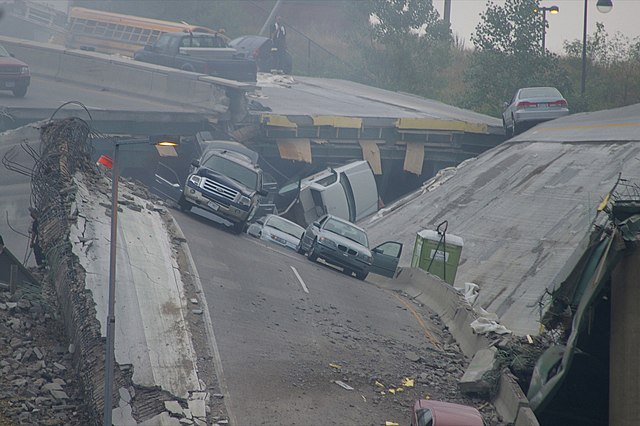
Interstate 35W Bridge Collapse, Minneapolis, MN, August 2007.

A man leaves home to head into the Big City and work in one the cities tallest buildings.  But it was September 11, and the man’s family never saw their husband and father again.

A woman calls home to tell her husband and daughters that she is leaving work and will be home for dinner.  She leaves downtown and heads on the freeway during rush hour.  She wades though traffic as it crawls across a bridge over the Mississippi River.  Out of nowhere, the bridge collapses and the woman never comes home.

A man drops off his husband at his workplace.  The man heads home and a few hours later sees a breaking news report of a mass shooting at his husband’s place of work.  He calls his spouse over and over, and no one ever picks up the phone.   After a frantic day and night of trying  going to hospitals to find his partner, he gets a phone call.  What he feared has come true; his husband was dead by shooter.


Why do these things happen?  Why did this person die and not this other one?

These are some of the questions people have as they hear about a tragedy that took place in Galilee.  Pilate, the governor of the area, killed Galileans as they were making sacrifices.  It was a sacrilege.

This shocking event made people wonder: did these people do something, did they sin, in order for this to happen.


This was the prevailing belief among many in Jesus’ time. If you did something wrong, then bad things will happen to you.

But Jesus doesn’t agree.  He asks if the Galileans who perished at Pilate’s hand were more sinful than others. What about those who died when a building collapse killing 18 people? Were they more sinful than others?

Jesus never answers that question but instead tells them to change their hearts and minds while there is time.

Jesus isn’t interested in asking why bad things happen.  Jesus is interested in repentance, turning around, devoting our lives to Jesus.  We only have so much time. How will we be present to God and others?

There is an old Simpson’s episode called “One Fish, Two Fish, Blowfish, Blue Fish.” In this episode the family goes to a local Japanese restuarant in Springfield.  Homer eats a fish that was possibly poisonous and could kill him in a day.  When he realizes that he only has one day left to live, he creates a list of things he needed to do before the day ends.  He has a man-to-man talk with Bart. He listens to Lisa play her sax.  He borrows a camera and tapes a message to baby Maggie.  He reconciles with his father and spends one last time together with his wife Marge.  

During the night, he gets up and decides to sit a chair in the living room rather than die next to Marge.  He listens to the tape and falls asleep.  The next morning, Marge comes into the living room seeing Homer slumped in his chair.  Fearing the worst, she walks towards him and realizes that he is alive.  Homer and Marge rejoice that he has been spared from death.

We only have so much time.  How will we live? Will we live lives of gratitude, knowing we are forgiven and express that gratitude in love towards others?

Dennis Sanders is the Pastor at First Christian Church of St. Paul in Mahtomedi, Minnesota. He’s written for various outlets including Christian Century and the Federalist.

A Blessing to the Nations – A Lectionary Reflection for Lent 2A (Genesis 12)

cropped-comesundaylogov2.png

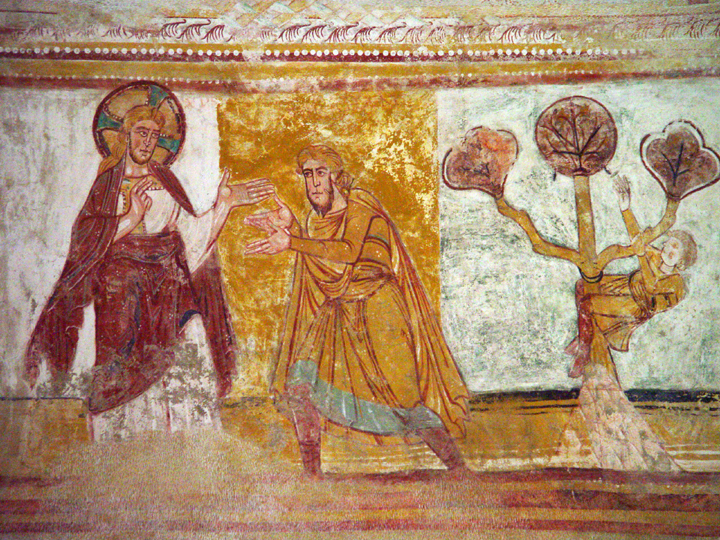
Genesis 12:1-4 Common English Bible (CEB)

Abram’s family moves to Canaan
12 The Lord said to Abram, “Leave your land, your family, and your father’s household for the land that I will show you.I will make of you a great nation and will bless you. I will make your name respected, and you will be a blessing.
I will bless those who bless you,
those who curse you I will curse;
all the families of the earth
will be blessed because of you.”
Abram left just as the Lord told him, and Lot went with him. Now Abram was 75 years old when he left Haran.

**********

This short passage is one of the most foundational texts in scripture (at least that’s my view). God calls Abram (name not yet changed to Abraham) to leave his home and extended family, and travel to a foreign land. If he does this then God promises that he will become a “a great nation” blessed by God. Not only will Abram be blessed, but in addition “all the families of the earth will be blessed because of you.” The lectionary selection is brief and yet powerful. God asks a lot of Abram, telling him to leave behind everything he has known. In a world in which tribe was central, it was risky to go to go to a land in which one was a stranger. While the promise itself was wonderful, the question was how would it work out?

The outworking of this call would have many twists and turns, and as the writer of Hebrews notes, Abraham set out “not knowing where he was going.” Abraham, Isaac, and Jacob, all lived in tents and Sarah was barren, but the promise revealed itself over time, but “all of these died in faith without having received the promises, but from a distance they saw and greeted them” (Hebrews 11:8-13). There would be times when Abraham took matters into his hands, such as when in pursuit of an heir he took Sarah’s slave, Hagar, and had child with her. Despite the twists and turns, the journey to blessing starts here, and continuing through the Covenant of Sinai to that of Calvary and the embrace of the Gentiles into God’s realm.

As a Christian, I interpret the call of Abraham through the lens of Jesus. He is, as Paul suggests, the seed of Abraham, through whom the blessings of God would be revealed to the nations (Gal.3:15-18). With this in mind, it’s appropriate to remember that Matthew’s genealogy traces Jesus’ lineage back to Abraham (Matthew 1:1-17). For Matthew Jesus, the Messiah, is the son of David and the son of Abraham. But connecting Jesus’ mission to Abraham, he envisions Jesus as the one through whom all the nations will be blessed. That is, he will save the people from their sins (Mt.1:21). From this perspective, the coming of Jesus is not a course correction on the part of God, but a natural extension of the call of Abram. That means the church doesn’t replace Israel, but as Paul notes, the Gentiles are grafted into the olive tree that is Israel, so that the nations might share in the blessing that God first promised to Abraham and to Israel (Rom. 11). As we ponder the call and the end result, it is wise to remember the promise of Second Isaiah, that Israel would be a light to the nations so that God’s salvation would reach the ends of the earth (Is. 49:6).

Theologian Clark Williamson has devoted much attention to the question of the church’s relationship to Israel, especially in a post-Shoah world. He writes:

Israel was to be a priestly people, serving others, not itself. God’s covenant was not merely for Israel’s good but for the good of all human beings, Gentiles and Jews. God chose Israel as an instrument so that all peoples may come to know God and God’s purposes for them. [A Guest in the House of Israel, p. 125].

So, for Christians reading this call, which will be formalized more fully in Genesis 15 when the promise a child and heir is given (and sealed through sacrifice), and then again in Genesis 17, when God explicitly makes a covenant with Abram and in the process changes his name to Abraham (and that of Sarai to Sarah).

According to the reading from Genesis 12, Abram accepted the call and headed out from Haran to Canaan. He did so, accompanied by Lot and those closest to him, with only the promise of a blessing.  The promise is this—the families of the earth will be blessed through him. As we contemplate this call it’s good to note that while God seems narrow the focus to one family, the earliest readers of this promise, as descendants of Abraham and Sarah, would have understood themselves to be that nation through which God would bless the families of the earth. They had a special calling from God. They had a message to share with the nations. While it would be easy to forget this calling, and focus inward rather than outward, time and again messengers would remind the people of their calling. It wasn’t just Israel that was to be blessed, it was the entire creation. Having attended a stewardship workshop recently, I’m reminded that this is a stewardship issue. That would mean that the promise ultimately is rooted in the creation of humanity, who are blessed by God and charged with having dominion (management) of God’s creation (Gen.1:26-31).

The call on Abram and his descendants was to be a blessing to the nations. It would be through this people that God would bless creation. For Christians, this means recognizing that we have been, as noted earlier, grafted into the olive tree that is Israel. We have been adopted into the family through the one who is the seed of Abraham. But as the Gentiles are drawn into the family, and blessed by God, that doesn’t nullify the previous covenant (Gal. 3:15-18). There is a tendency for Christians to read Paul in a supersessionist manner, so that Jesus replaces Israel. That would be inappropriate. For our purposes, let us simply understand Paul’s reference to seed to be a sign that God always intended to bring all of creation into the fold, and that Israel plays an important role in this, as does Jesus.

While there will always be interpretive questions to wrestle with, since three religious traditions claim descent from Abraham, and that these three traditions have often been at odds with each other, it would be wise to affirm the common ancestry, and move to the question of the nature of this blessing. After all, the words bless and blessing figure prominently in this passage and in Genesis. Lest anyone think too highly of one’s self, it is also good to remember that the blessing spoken of here is a gift of God, though it is a gift that must be received. Remember that Abram is told that those who bless him will be blessed and that those who curse him will be cursed. As James McTyre notes, “Abram is called by God to serve as a mirror. Instead of images, Abram will reflect blessings and curses on the land where he will sojourn” [Feasting on the Word, Year A, 2:51].

From a Christian point of view, the church, as the body of Christ, reflects God’s blessings to the world. But what does this mean? What is a blessing? It’s a good question since the words bless or blessing figure prominently in this passage and in the rest of the story. For modern readers the word blessing may seem quaint but not all that meaningful. However, in Hebrew the word connotes a sense of well-being or flourishing. That is what God wants to see happen for creation. He wants it to once again flourish. As to what this means, Miroslav Volf suggests that flourishing means that one does not live by bread alone. The material world is important, for we are material beings, but in his argument as to why a globalized world needs religion, Volf notes that “when we live by bread alone, there is enough bread, not enough even when we make so much of it that some of it rots away; when we live by bread alone, someone always goes hungry; when we live by bread alone, every bite we take leaves a bitter aftertaste; . . . living by ‘mundane realities’ and for them alone, we remain restless and that restlessness in turn contributes to competitiveness, social injustice, and the destruction of the environment as well as constitutes a major obstacle to more just, generous, and caring personal practices and social relationships.” We need bread, but we need more than bread. We need the bread of life.   [Volf, Flourishing, p. 22].


There is a thread that runs from creation (Genesis 1) to new creation (Revelation 22). It runs through Abram and on to Jesus, through whom we are grafted into the tree, so that we might be reconciled and share in the blessings of God as was promised to Abram as he left Haran for a new land.

Picture attribution: St. Savin – Calling of Abraham, from Art in the Christian Tradition, a project of the Vanderbilt Divinity Library, Nashville, TN. http://diglib.library.vanderbilt.edu/act-imagelink.pl?RC=33460 [retrieved March 7, 2017]. Original source: Images donated by Anne Richardson Womack, Vanderbilt University, and James T. Womack, Montgomery Bell Academy, Nashville, TN.

bobcornwall

Robert Cornwall is the Pastor of Central Woodward Christian Church in Troy, Michigan and is the author of a number of books including Marriage in Interesting Times (Energion, 2016) and Freedom in Covenant (Wipf and Stock, 2015).