
Category: Ordinary Time

You Gotta Serve Somebody: Pentecost 21

You Gotta Serve Somebody: Pentecost 21

Narrative Lectionary Reflection

October 14, 2018

Read Joshua 24:1-25 (CEB)

Introduction 

Joshua was the successor to Moses.  He had led the people across the Jordan River to begin taking the land.  Now, the land was theirs and Joshua, now an old man, wants the people to recommit to God again.

God had defeated the Egyptians, allowing for their escape. God was with them as the warred with the people living on the land promised for them.  But now as the land has been subdued, the people are being challenged.  Meeting other cultures, meant meeting other gods.  As Joshua is getting ready to pass from the scene, he wants the people to take stock of their lives and choose who they would worship or serve: the gods of their neighbors or the God that led them out of slavery? 

Today we study the farewell speech Joshua and the people of Israel’s response.

Engaging the Text

 I sent the hornetb]”>[b] before you. It drove them out before you and did the same to the two kings of the Amorites. It wasn’t your sword or bow that did this. 13 I gave you land on which you hadn’t toiled and cities that you hadn’t built. You settled in them and are enjoying produce from vineyards and olive groves that you didn’t plant.

-Joshua 24:12-13

Joshua 24 includes some of the last words of Joshua.  He was a protégé of Moses, and when Moses died, Joshua took over.  He is speaking to the people after they wandered in the desert for 40 years, after they crossed the Jordan into the Promised land, after the people had battled the inhabitants of Canaan, and after they had set up the beginnings of a nation.  It took decades, but the Israelites had arrived in more ways than one.

Instead of kicking back and enjoying their new life, God is calling them to enter into covenant with God.  Joshua gives a final speech that is in three parts: recalling God’s mighty acts, discussion the covenant and then solemnizing the covenant.  When he speaks it is in the first person, meaning that it was not simply him speaking, he was speaking with divine authority.

It’s important to note that when the Israelites conquered the different nations, that meant coming into contact with foreign gods. Joshua’s talk is a reminder to make a choice to follow God, and sometimes that choice has to made daily.

Joshua starts by recounts the story of the Israelites, showing what God had done for them; the calling of Abraham and giving he and Sarah a son named Issac.  Issac had Jacob and Esau. Leading the Israelites out of Egypt, the destruction of Pharoah’s Army, and God being with them as they battled differing nations.  God even reminds them that they were given land they didn’t toil  and living in homes they didn’t build, reminding them they didn’t do this on their own. 

Everything that the Israelites had done; winning battles against the different nations, the vineyards they planted, the cities they lived in, the fields they farmed were not done by them alone.  Joshua reminds the people that all the good things they had at this moment, came from God. It was God that brought them to this moment. And because God got them to this point, they should give thanks to God.  Joshua wasn’t saying that they should just say thanks and move on, no, they were to give thanks to God’s goodness by serving God.

This concept that God is the one who is at work in our lives is something that is hard for our modern society to understand.  For good or for ill, modern society is focused on the self. It doesn’t matter what your political orientation is, we all tend to look at our achievements as solely the result of our hard work.  In Joshua’s speech, God is continually saying that it was Yahweh that did so much for the people.  Yahweh brought Israel into being and then led them out of Egypt. It was Yahweh that defeated all the enemies of the Israelites.  Joshua tells the people they are free to worship other gods. In verse 15 God says that a choice has to be made: “then choose today whom you will serve. Choose the gods whom your ancestors served beyond the Euphrates or the gods of the Amorites in whose land you live. But my family and I will serve the Lord.”

This is a call to choosing to follow God and it is also a call to live a life of gratitude. One of my Old Testament professors at Seminary shared his view on how people take communion and how that has changed over time.  In the past, the congregants would come to the communion table in fear and trembling. They didn’t even take the bread, but opened their mouths and the pastor would place it on their tongues like a mother bird to her chicks.  In modern times, people come joyfully to the table, take the bread and wine and had back to their seats almost skipping.

In the future, the professor envisioned church members stomping down the aisle to the communion table.  The pastor shakes in fear. These members grab their bread and wine and then stomp back to their pew.

His little tale brought a few laughs in the room, but there was some seriousness about it.  It showed how one can go from having a grateful and humble heart to thinking that they don’t really need God and in fact, God should be honored they are doing this. We can go from gratitude to a sense of entitlement, thinking God didn’t do anything for us.

Joshua was trying to remind his people that their lives are not simply their own.  The Israelites were part of something bigger than themselves. They were part of God’s salvation story, God’s attempt to redeem creation from the bondage of sin.  

At the end of the passage, the people recommit to following Yahweh. Of course, the Israelites would forget what God had done in their lives.  Joshua knew this. But at that moment, the Israelites get it. They will strive to live the life of a servant.

In some ways, this reminds us that we say “yes” to God day after day.  It isn’t just a “one and done” debate. People in recovery usually say that the road to sobriety is one day at a time.

Conclusion

I heard a phrase a lot when I was growing up.  It’s phrase you hear a lot in the black church.  “God woke me up this morning and started me on my way.”  When I was a kid, I had a hard time understanding this. Was God sitting next to my bed and maybe nudging me to wake up?  

As I got older, I began to understand what that meant; it means that our lives are not are own.  God has done wonderous things for us and our response is a life of service to God and to our sisters and brothers.  It’s to enter into God’s continuing salvation story and see how we can model and show what it means to be a disciple of Jesus.

Do we see that the God that demanded allegiance to the Israelites long ago, also demands our allegiance?  We are being asked who we will serve.  We can choose the ways of the world that leads to “death” or will we choose the one who brought us salvation through Jesus Christ.

Choose this day who you will serve. Who will you serve? As singer  Bob Dylan says, “you gotta serve somebody.”

Dennis Sanders is the Pastor at First Christian Church of St. Paul in Mahtomedi, Minnesota. He’s written for various outlets including Christian Century.
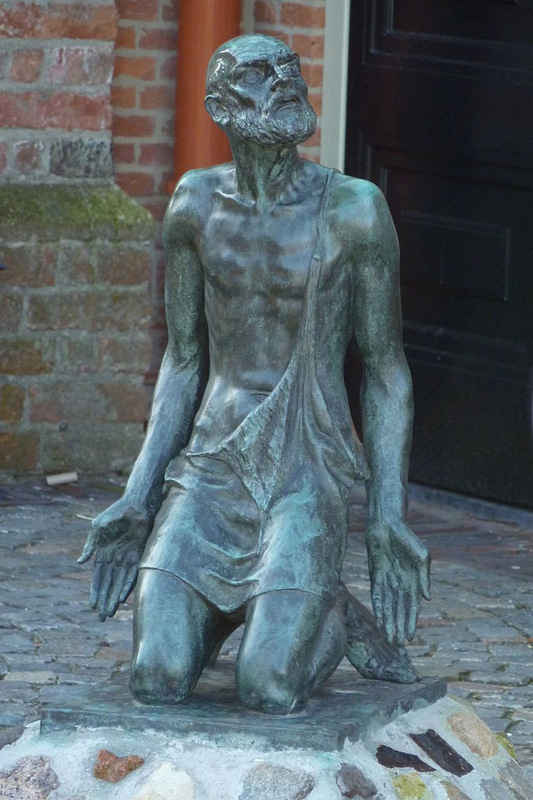

A Bitter Complaint – A Lectionary Reflection for Pentecost 21B (Job 23)

A Bitter Complaint – A Lectionary Reflection for Pentecost 21B (Job 23)


Job Talks to God
 
23 Then Job answered:
“Today also my complaint is bitter;
his hand is heavy despite my groaning.
Oh, that I knew where I might find him,
that I might come even to his dwelling!
I would lay my case before him,
and fill my mouth with arguments.
I would learn what he would answer me,
and understand what he would say to me.
Would he contend with me in the greatness of his power?
No; but he would give heed to me.
There an upright person could reason with him,
and I should be acquitted forever by my judge.
“If I go forward, he is not there;
or backward, I cannot perceive him;
on the left he hides, and I cannot behold him;
I turn to the right, but I cannot see him.
10 But he knows the way that I take;
when he has tested me, I shall come out like gold.
11 My foot has held fast to his steps;
I have kept his way and have not turned aside.
12 I have not departed from the commandment of his lips;
I have treasured in my bosom the words of his mouth.
13 But he stands alone and who can dissuade him?
What he desires, that he does.
14 For he will complete what he appoints for me;
and many such things are in his mind.
15 Therefore I am terrified at his presence;
when I consider, I am in dread of him.
16 God has made my heart faint;
the Almighty has terrified me;
17 If only I could vanish in darkness,
and thick darkness would cover my face!
 
***************
                The story of Job is revealing. It speaks to our human concerns regarding the nature of God and God’s relationship with creation. It addresses the perennial question of the existence or presence of God amidst human suffering. If God is truly loving, then why does God allow suffering? The easiest answer is that we get what we deserve. If you are suffering you must have done something to deserve it. The poor experience poverty because of their failures. Women are assaulted and raped because of the way they dress. You have heard the message time and again. But reality is never that easy. I don’t know that there are any easy answers and solutions, at least not ones that assume God’s omnipotence. It is in the context of questions like these that Job often speaks. Here is the righteous person, who has done everything he can to keep himself holy, and he makes sure that he pays any debts owed to God by his family. He’s the kind of person you want on your church board. He’s honest, faithful, hard working. As we learned in the first reading last week, the reading from Job 2, God is impressed by his righteousness. But, then God goes and messes with the paradigm by engaging in a wager with Satan that allows Job to be put through a living hell. Despite his suffering, Job clings to his sense of righteousness, and despite the encouragement to do otherwise refuses to curse God.
                In this second reading from Job, we hear Job complain bitterly about his situation. He may not curse God, but he would like to have a word with a God who appears to be absent. His bitterness is compounded by the conversations he has had with his so-called friends. In the intervening chapters, which we have skipped over, Job’s friends, who at first came to comfort him, have in turn urged him to confess his sins so he might be saved from his torment. His friends embrace a vision of reality, Job likely once held, that sin leads to suffering. We call this retributive justice—we get what we deserve. Having heard Job claim innocence, Job’s friends rebuke him. Their interpretation of Job’s plight starts with the suffering and works back to the “cause,” which must be Job’s sins. Again, this is easy to do. Bad things happen to bad people. We have been seeing it influencing our politics as we eat away at the safety net, threaten to take funds from under-performing schools (rather than providing more resources, we take them away), and turn away refugees fleeing from humanitarian disasters. There is, of course, the flip side to this. If you are rich or successful, you must be righteous.
Job has been responding to these arguments with a series of rants, complaining to whoever listen, that he is innocent. He resists the arguments of his “friends,” who are offended by his ongoing confession of innocence. However Job may feel about things, his defenses do not mesh with their theological system. He has upset their religious and cultural values. Yes, he’s unorthodox. I expect that Job wants to agree with his friends, having embraced their theology, but it no longer works. It doesn’t fit his experience of life. Therefore, there must be a different answer. As that answer doesn’t seem to be forthcoming, he cries out in bitter complaint. If you’ve read the first couple of chapters, you know that Job has a reason to be bitter. You would be too! He could go along with his friends’ advice and confess to sins he doesn’t believe he’s committed, but he’s not going to do so. In the omitted verses you get a hint that Job is hopeful that he will be vindicated. God might be absent, but things will work out. In any case, God will do what God wants (see verses 10-15).
                Many of us were taught that it was not appropriate to argue with God. God knows best, so don’t protest. Just take it in. Fortunately, Scripture offers us a counter view. Many of us have found encouragement in Job’s rebellious response to God. Now Job doesn’t curse God or give up faith in God, but Job is willing to lay it on the line with God. If only I could find God, I would give God a piece of my mind—something like that.  Job speaks to the times in our lives when we feel we are suffering unjustly. He speaks here of his sense of God’s absence. We all have felt the same. Yes, we know that God is always and everywhere present (it’s an article of faith—we call it omnipresence), but that doesn’t mean we don’t feel otherwise. We see similar complaints in the Psalms, and this is in its own way a Psalm.
                Job understands that his traditional views don’t work, but how will he respond? In verse 17 we read Job’s response: “If only I could vanish in darkness, and thick darkness would cover my face!” (NRSV). Or is it? The New International Version offers a different take: “Yet I am not silenced by the darkness, by the thick darkness that covers my face.” The NRSV offers a Job in despair. The NIV offers a in the words of Mark Throntveit, “defiant, feisty Job, more intent than ever to press his case” [Feasting on the Word, p. 151]. Both are possible translations, but they offer different versions of Job. Personally, I prefer the defiant, feisty Job, though I understand the one who lives with despair. Throntveit does suggest that the NIV reading connects well to the word we read in verse 2, where Job declares that his complaint is bitter! Throntveit comments: that by connecting verse 17 with verse 2, the author offers a “smoother transition to chapter 24,” where we find Job’s “scathing indictment of what God’s absence means in a world where the wicked run roughshod over the weak.”
Does this not speak to where we find ourselves at this moment in time? Churches are trying to be faithful, but they’re struggling. They see other churches thriving and wonder why they can’t. It does seem as if we’re wandering around in the dark. The choices seem to be living in despair or fighting on. So, here we are, in the dark, making our case. We cry out—where are you God? At one level this doesn’t preach. We want a message of success. We want to hear about light. That is not the message for this week, at least from Job. But, maybe, just maybe, we’ll find solace here. If we persist, perhaps God will hear us. At least that’s Job’s hope.

Job Talks to God, from Art in the Christian Tradition, a project of the Vanderbilt Divinity Library, Nashville, TN. http://diglib.library.vanderbilt.edu/act-imagelink.pl?RC=55467 [retrieved October 8, 2018]. Original source: http://commons.wikimedia.org/wiki/File:Noordwijk_Sint-Jeroenskerk_beeld.jpg.

10646937_10204043191333252_4540780665023444969_nRobert Cornwall is the Pastor of Central Woodward Christian Church in Troy, Michigan. He holds the Ph.D. in Historical Theology from Fuller Theological Seminary. He is the author of a number of books including Out of the Office (Energion, 2017), Marriage in Interesting Times (Energion, 2016), and Freedom in Covenant (Wipf and Stock, 2015) and blogs at Ponderings on a Faith Journey.
Ten Words from God: Pentecost 20

Ten Words from God: Pentecost 20

Narrative Lectionary Reflection

September 30, 2018

Introduction 

In the waning days of the Roman Empire, a monk named Benedict wrote a document that would direct how his fellow monks would live.  Used by Benedictine monks for 15 centuries, the Rule of St. Benedict laidout how monks were to live in a communal environment.  The rule provides order as well as helping the monks foster a sense of the relational nature of humans.

The Israelites crossed the sea and are now  “safe” on the other side.  Pharaoh and his army are gone. No more Egyptians to worry about.  But now they were out in the wilderness where they faced many unexpected challenges. In Egypt,  they followed Egyptian laws, but they weren’t in Egypt anymore.  They were now out in the wilderness. Rules were needed to help everyone get along outside the structure of Egyptian society and law. Common expectations and community norms were needed. The needed a rule, like the the Rule of St. Benedict.

As the people journey together, Moses presents them with a new Law from God.   The core of God’s Law for the Israelites is the Ten Commandments. Received by Moses and delivered to God’s people, these laws became important not only among the Israelites but also to many cultures and governments around the world.  In our own nation today, the Ten Commandments are widely accepted as social and spiritual norms.

It is important to note that the Ten Commandments were given to the Jews (actually the male Jewish head of households) and were not intended for universal use.  That said, we they can help us understand how we should live as Christians, what God expects from us and how following rules can be seen as an act of grace.

Engaging the Text

The Lord called to him from the mountain, “This is what you should say to Jacob’s household and declare to the Israelites: You saw what I did to the Egyptians, and how I lifted you up on eagles’ wings and brought you to me. So now, if you faithfully obey me and stay true to my covenant, you will be my most precious possession out of all the peoples, since the whole earth belongs to me.

-Exodus 19:3-5

It’s easy to see the Ten Commandments as rules to be on God’s good side.  But that’s not really what they are about.  In fact that aren’t really about us at all.  Theologian Rolf Jacobson notes that there are two things the Ten Commandments don’t do; they aren’t a pathway to salvation and they aren’t there to make you a better you.  Jacobson says the following:

The first is that God does not give the law as a means to salvation. To use the law to earn salvation, to win your soul’s way into heaven, is like trying to build a faster-than-the-speed-of-light spaceship or a time-travel machine out of plywood. It’s not possible. And neither is it possible to earn salvation through the law. God does not give the law as a way to establish relationship with the people. God establishes the relationship and then gives the law.

That leads to the second point about the law. It isn’t about “us,”per se. God does not give you and me the law in order to perfect us or even to make us a better “you”or a better “me.”The law is not about us — it is about our neighbors. God gives you the law, not so that you can get more spiritual or have your best life now, but so that your neighbor can have her best life now.1

The Ten Commandments are for our neighbor and for God.  How do we relate to our neighbors?  How do we relate to God?  We aren’t blessed when we do good, but when we do good to the other and the other does good to us.

The first four commandments deal with our relationship to God.  The next four deal with our relationship to others and the last two deals with the desires of the heart.

We will look briefly at each commandment starting with the first one.

You shall have no other God’s before me. Don’t put anything or anyone ahead of God.  We are to pledge sole alligence to God. When we fail to love God, our neighbor is affected. As Jacobson notes, “When we center our lives around things other than God — whether it be money, fame, power, pleasure, beauty, even religion, or anything else — our neighbors will pay.”

 Don’t make yourself an idol. God is supposed to come first over everything.  It is easy to think we could love God and something else, but God commands that there are to be no idols.

 Don’t use the name of God wrongly.We call upon God to forgive us when we sin, to offer praise, to seek healing. God’s name is powerful so we should use it with care.

Take the Sabbath off.    The Sabbath is a day to worship God, but more importantly, it is usually about rest and fairness. This commandment gives the poor a day of rest. It is also a reminder that in Egypt, the Israelites had to work without a day off. Now they are free from having to work all the time, so take the time to rest.

Relating to Others.The next four focus on who we take care of our neighbors.  That includes are parents. The first one of these commandments, honoring your parents is about loving the other, our neighbors.  In a more modern tone, we are to care for the elderly in our midst.  We are also not to take the life of another (again, to murder is to not care for the other), not stealing and not having sex with a person’s spouse.  Again, we don’t do these things to get on God’s good side, but we do it for the benefit of the neighbor.

State of the Heart. The last two commandments deal with the heart.  Don’t bear false witness against a neighbor and don’t covet anything of the neighbor.

An aside about how Jews might see the Ten Commandments. Protestant Christians tend to look at law and gospel or grace differently than Jews.  Starting with Martin Luther, we emphasize grace and sometimes see the law as something that is archaic and has nothing to do with our faith.

Jews, however, see this differently.  They see the law as a response to God’s goodness.  Theologian Geoff McElroy explains: 

At first glance the Decalogue seems to be a list of regulations, and that’s what we assume they are, a list of do nots.  But maybe they are more like a framework through which life, specifically life with God, is interpreted.

Jewish tradition about the Decalogue gets this in a way that post-Pauline Christianity has seemed to have lost.  For many Christians, the Ten Words are “law” vis-à-vis the gospel or good news of God revealed in Jesus and even though we’ll still think following them is a good thing, they are seen as something distinct from the concept of God’s grace, as things that we as humans have failed to live up to and thus we need saving.

But in Jewish tradition, the Ten Words are a response to grace.  The Jews traditionally order their commandments differently; what the Jews regard as the first commandment or word, many Christians just dismiss as a prologue or introduction to the commandments.  But in Jewish tradition, the first commandment is not to have “no other gods before me,” but is instead: “I am the LORD your God, who brought you out of the  land of Egypt, out of the house of slavery”  (Exo 20:2).

In other words, the first word of life with God is to, “Remember what God has done for you!” 2

Conclusion

As Christians, especially  Protestants, it’s easy to look at the Ten Commandments as rules to follow or rules that weigh us down, take away our fun.  Because we are all children of the Reformation, Protestants tend to believe in grace over law.  That we are saved by grace is the central message that reformers like Luther and Calvin.

However, these passages were originally written by and for Jews,  so we need to see how Jews responded to these Commandments.  Jews tend to see the Ten Commandments or Ten Words as a response to grace.  The Ten Commandments are a response to grace.   The law is the vehicle for grace.  

It’s important to realize that the first commandment in the Jewish tradition is not You should haven’t other gods before God.  Instead, the first commandment is “I am the LORD your God, who brought you out of the  land of Egypt, out of the house of slavery.”

It’s these sentences that the rest of the commandment flows from.  The rules that follow are not God keeping tabs as it is a response to what God has done.  If God has shown mercy to you, then you are to not make idols to other Gods.  If God has led you out of Egypt, then you are to care for the elderly.  If God has loosed the bonds of slavery, then you are to not steal or covet anything your neighbor has.

Theologian Thomas Long has likened following the Ten Commandments to a dance.  He writes:

The Decalogue begins with the good news of what the liberating God has done and then describes the shape of the freedom that results. If we want to symbolize the presence of the Ten Commandments among us, we would do well to hold a dance. The good news of the God who set people free is the music; the commandments are the dance steps of those who hear it playing. The commandments are not weights, but wings that enable our hearts to catch the wind of God’s Spirit and to soar.3

Like the Ten Commandments,  Communion reminds us of God’s wondrous acts of freedom through Jesus Christ.  How will we respond?  If God has freed us, then we should take the bread and wine with great joy, learning to follow God’s ways in joyous response.  We will fail at times, but God forgives us and we are reminded again of God’s love.  

  1. Rolf Jacobson, Working Preacher, June 15, 2014.
  2. Geoff McElroy, Desert Scribblings, 2008 (http://gmcelroy.typepad.com/desertscribblings/)
  3. Thomas G. Long, Christian Century, March 7, 2006, p.17.


Dennis Sanders is the Pastor at First Christian Church of St. Paul in Mahtomedi, Minnesota. He’s written for various outlets including Christian Century.

Saving Our Skins? A Lectionary Reflection for Pentecost 20B (Job 2)

Saving Our Skins? A Lectionary Reflection for Pentecost 20B (Job 2)

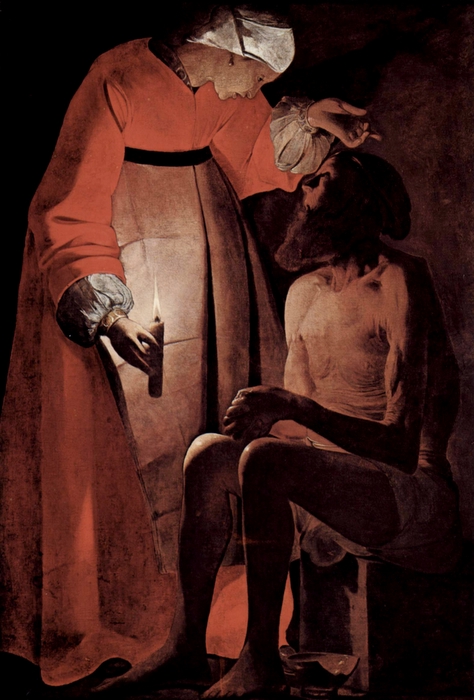
Job & his wife – La Tour
1:1 There was once a man in the land of Uz whose name was Job. That man was blameless and upright, one who feared God and turned away from evil.
2:1 One day the heavenly beings came to present themselves before the Lord, and Satan also came among them to present himself before the Lord. 2 The Lord said to Satan, “Where have you come from?” Satan answered the Lord, “From going to and fro on the earth, and from walking up and down on it.” 3 The Lord said to Satan, “Have you considered my servant Job? There is no one like him on the earth, a blameless and upright man who fears God and turns away from evil. He still persists in his integrity, although you incited me against him, to destroy him for no reason.” 4 Then Satan answered the Lord, “Skin for skin! All that people have they will give to save their lives. 5 But stretch out your hand now and touch his bone and his flesh, and he will curse you to your face.” 6 The Lord said to Satan, “Very well, he is in your power; only spare his life.” 
7 So Satan went out from the presence of the Lord, and inflicted loathsome sores on Job from the sole of his foot to the crown of his head. 8 Job took a potsherd with which to scrape himself, and sat among the ashes. 
9 Then his wife said to him, “Do you still persist in your integrity? Curse God, and die.” 10 But he said to her, “You speak as any foolish woman would speak. Shall we receive the good at the hand of God, and not receive the bad?” In all this Job did not sin with his lips.
******************
                Job was a righteous man from the land of Uz (wherever that is), whom Satan dared God to torment, to test his faith. God agreed to the wager, and as a result Job’s children were killed by raiding parties and his property destroyed. It was a sad day for Job, but he remained firm in his righteousness. He grieved but didn’t curse God. That’s the essence of chapter one of Job, though the lectionary includes only the introductory verse in the selection for Pentecost 20B. That’s because the focus is on chapter two and a second wager, this time involving Job’s own body. Will Job remain faithful with this twist in the story.
                As in chapter one, in chapter two of Job, the heavenly council gathers with Yahweh presiding. Satan appears once again before Yahweh, who once again asks Satan what he’s been up to. The answer is, “I’ve been traveling around the earth, checking things out, seeing what people are doing.” Once again, Yahweh asks Satan, what he thinks of Job. After all, “there is no one like him on the earth, a blameless and upright man who fears God and turns away from evil. He still persists in his integrity, although you incited me against him, to destroy him for no reason.” Did you notice God’s response? Job remained blameless and upright, even though Satan had “incited me against him, to destroy him for no reason.” God is rather proud of this man, whom God had allowed to be tested.
                I have always been intrigued by the story of Job. It invites us to think through our understanding of God, including God’s relationship to the world. In my theology, God is love, and a God who is love doesn’t go around messing people’s lives. Yet, that is the story, which should cause us to pause before embracing a literalist interpretation. In this picture of God, God is rather petty. God play games with a man’s life, by letting his children be murdered and his property destroyed, just to see if Job will stay firm in his faith. Job does, despite everything that is thrown at him. Job is righteous, but what about God? Is God so thin-skinned that God can be manipulated by Satan? It’s a question we must face, if we’re to hear this story.
                If we’re to read Job in a way that informs us theologically, we need to affirm at the very beginning that this fiction. The first clue ought to be Job’s homeland. Where is Uz? It could be Edom, but who knows. The picture of the heavenly court is also a clue, though it gives evidence of its rootedness in a pre-monotheist Israel. Whatever its origins, the book raises questions about our understanding of God, the nature of faith, and the challenge posed to that faith by human suffering. With that is our opening point, we need to also address this important character who appears in the early chapters, and that is the person of Satan. The character of Satan as depicted here is not the devil of human imagination. This is no figure with red skin, horns, and a pitchfork. This figure is more an informant, sent out by God, as would a king, to keep watch for rebellious activities. In this set of exchanges, Satan raises questions about Job’s piety. Is it based on living the good life, and if that good life is taken away, the piety would go away as well? It’s a good question, and whether we like the way the question is set up, it does speak to our own realities.
                In chapter two, when God asks Satan what he thinks of Job’s response to misfortune, Satan responds that this is to be expected. It’s one thing to lose your family and property. It’s another thing to have your own body afflicted. Isn’t it human nature to do whatever we can to save our own skins, even at the expense of those closest to us? That’s just the way things are. Jesus knew that. In the Gospel of John, we hear him say: “No one has greater love than this, to lay down one’s life for one’s friends” (John 15:13). Jesus will do that for his friends, but what about us? When push comes to shove, won’t we save our own skins? That’s the wager. So, God goes along with the wager, allowing Job to be afflicted, but not killed. Pushed to the limit, will he curse God?  That’s the question.
                Satan went and cursed Job, causing sores to appear on his body running from the soles of his feet to the crown of his head. In other words, the totality of his body was covered with “loathsome sores.” He was miserable. He probably wished to die. But he remained firm in his faith. He did so, even when his wife suggested that he curse God, so he might die. Curse God and get it over with. That was her advice. But he refused. He remained firm in his faith, despite everything.
                Satan was wrong. Job didn’t save his own skin by cursing God, though Job’s wife encouraged him to do so. He told his wife that one should expect both the good and the bad from the hand of God. That isn’t a comforting word on Job’s part. It doesn’t fit with my own theology. It’s not that I plan on cursing God, but I am troubled by the idea that God would authorize the bad. God might allow something bad to occur, or maybe, just maybe, there are things God simply cannot do. Through it all, however, Job remains firm in his faith.
This response on Job’s part, his decision to accept his fate and not curse God sets up the next phase of the story, his encounter with his “friends,” who at first seek to comfort him and then as time passes, and Job won’t confess his sins, raise questions about Job’s righteousness. After all, isn’t suffering the result of wrong doing? So far, however, Job does nothing to warrant his suffering, if suffering results from wrongdoing. His suffering comes from a divine directive.
                The questions raised by the Book of Job are important ones. In some ways the Book challenges another strain of Wisdom Literature that presumes that blessing is a sing of righteousness and suffering is a sign of unrighteousness. It also invites us to consider the we view the divine-human relationship. Marvin Sweeney, a Jewish scholar of the Hebrew Bible (and my son’s professor) at a Protestant seminary, offers these words of insight:

The book of Job deliberately presents the model of a righteous man who suffers with no apparent moral justification in an effort to force critical reflection on the issue. The arguments posed by Job’s friends concerning the meaning of human suffering and their assertions of divine righteousness even in the face of evil and Job’s responses to each of them are in fact the key issues of the book. The book of Job is intended to question the standard theological premises of the Torah and the Prophets, viz., is it really the case that observance of the divine will leads to success and peace in life? Is it really the case that the wicked suffer— and not the righteous? Is it really the case that G-d is just? Indeed, the final episode in which G-d affirms Job’s demands for an explanation for his suffering— even though G-d never provides such explanation— indicates that such a critical agenda is in fact the purpose of the book. In the end, the book of Job affirms divine presence and it appears to affirm divine righteousness, but the book also affirms the right and obligation of human beings to ask such questions of G-d. In this respect, Job points to and affirms a model of a human being in critical dialog with G-d.  [Sweeney, Marvin A. Tanak: A Theological and Critical Introduction to The Jewish Bible (Kindle Locations 11439-11447). Fortress Press. Kindle Edition.]

                The door is open. Are willing to walk through? Are willing to enter a critical dialog with God, as Sweeney proposes? The lectionary moves quickly, jumping from chapter two to chapter twenty-three. We don’t get to see the dialog with the friends, but we do experience Job’s complaint, which is set up by this attack on Job’s skin.

Picture attribution: La Tour, Georges du Mesnil de, 1593-1652. Job and his Wife, from Art in the Christian Tradition, a project of the Vanderbilt Divinity Library, Nashville, TN. http://diglib.library.vanderbilt.edu/act-imagelink.pl?RC=46621 [retrieved October 1, 2018]. Original source: http://www.yorckproject.de.

10646937_10204043191333252_4540780665023444969_nRobert Cornwall is the Pastor of Central Woodward Christian Church in Troy, Michigan. He holds the Ph.D. in Historical Theology from Fuller Theological Seminary. He is the author of a number of books including Out of the Office (Energion, 2017), Marriage in Interesting Times (Energion, 2016), and Freedom in Covenant (Wipf and Stock, 2015) and blogs at Ponderings on a Faith Journey.

The Final Showdown: Pentecost 19

The Final Showdown: Pentecost 19

Narrative Lectionary Reflection

September 30, 2018

Introduction 

In our last lesson, we talked about Joseph the great-grandson of Abraham who was sold in slavery in Egypt.  He becomes the head caretaker in the house of Potiphar, only to be pestered by Potiphar’s wife and her advances.  He is then falsely accused when he rejects her temptations and is placed in jail.

But all is not lost for Joseph.  We are told over and over in this story that God was with Joseph and indeed, God was present in both good times and in times that were challenging.  He is released from prison becomes the most powerful man in Egypt after the Pharaoh, and saves his family from a local famine.  Pharaoh invites all of Joseph’s kin come and live in Egypt, a happy ending. But of course, it wasn’t a happy ending.  Today we talk about Joseph’s descendents as they leave the place that was one a refuge and became of place of hardship.

Engaging the Text

13 But Moses said to the people, “Don’t be afraid. Stand your ground, and watch the Lord rescue you today. The Egyptians you see today you will never ever see again. 14 The Lord will fight for you. You just keep still.”

-Exodus 14:13-14

As the book of Exodus starts, we find things are not so good for the descendants of Joseph and his brothers. The book opens us by telling us that a new pharaoh rules the land and he “did not know Joseph.” Between the time of Joseph and the current period, the Hebrews grew in size from a handful of people to a vast group within Egypt.   The new Pharaoh did not have the same generous attitude as the first Pharaoh. He feared the Hebrews because of their large numbers. In order to keep the Hebrews from being a threat due to their vast numbers, he set them to work doing hard labor on his building projects.  A people who were once guests were now slaves.

Enter Moses.  He was saved from a terror campaign initiated by the Pharaoh which killed every Hebrew male child.  Ironically, Moses grows up in the Pharaoh’s household taken care of by Pharaoh’s daughter.  God calls Moses to lead his people out of Egypt.  Pharaoh refuses to let the people leave and it become a match between Pharaoh and God.  A series of plagues strike the Egyptians until after a final plague kills all the firstborn Egyptians, Pharaoh lets the Hebrews go.

But then Pharaoh’s heart was hardened and he sends the army after the Hebrews.  This is where the story beings for us.

Pharaoh sends his army on chariots to catch the Hebrews who are stopped at the seashore.  Word gets to the Hebrews of the advancing Egyptian army who naturally, freak out.

Moses tells the people to calm down.  See God’s work of salvation at hand.  God was going to save the Hebrews once and for all in spectacular fashion.

It seems that God is working long before the showdown at the sea.  Jewish commentaries note that God had the Hebrews take a circuitous route to the promised land instead the more direct route- which would make a great escape route back to Egypt if things got dicey.  This wandering would make it seem like the Israelites were lost, which then prompted the Egyptians to attack. (Beshalach Aliyah Summary, Chabad.org.)

It’s important to note that the two pillars that led the Hebrews, a cloud and fire are examples of God’s presence.

While the common story is that the Hebrews crossed the Red Sea, some biblical scholars think they crossed the Reed Sea, which is shallow and surrounded by marshy land.  East winds can push the water away. The Egyptian army gets bogged down in the soggy soil.

Did all of this happen at the Red Sea or the Reed Sea?  If it’s the Reed Sea, how could the Egyptian army be drowned in shallow water? Who knows.  The story was handed down orally and there  is a possibility the story became “bigger” with each telling. Whether it happened at the Red See or the Reed Sea; whether it was winds that pushed away the shallow water or a huge wall of water is not the main point of the passage.  The point is that God saves the Hebrews from oppression.  The people see the power of God and place their trust in God.


Conclusion

This text is a well-known one not simply because the story has been told over and over, but because of movies that have dramatized the event.  In Cecil B. DeMille’s Ten Commandments the most memorable scene is when Moses (played by Charleston Heston) lifts up his rod and the mighty waters are swept away for provide a corridor for escape. 

While we know Hollywood’s telling of this story, what does this story have to do with our own story?  How do we see ourselves in this larger story?

The story of the Israelites in Egypt has been a story that resonated with African Americans.  Bogged down by slavery and then official segregation, Blacks in the United States looked to these passages as assurance that God was on the side of the oppressed and that someday, Pharaoh would be toppled.

Beyond this application, what does this story mean to you?  What does the liberation of a people thousands of years ago by God have anything to do with us today?


Dennis Sanders is the Pastor at First Christian Church of St. Paul in Mahtomedi, Minnesota. He’s written for various outlets including Christian Century.

A Reversal of Fortunes – Lectionary Commentary for Pentecost 19B (Esther)

A Reversal of Fortunes – Lectionary Commentary for Pentecost 19B (Esther)

Esther 7:1-10; 9:20-22 New Revised Standard Version (NRSV)

7:1 So the king and Haman went in to feast with Queen Esther. 2 On the second day, as they were drinking wine, the king again said to Esther, “What is your petition, Queen Esther? It shall be granted you. And what is your request? Even to the half of my kingdom, it shall be fulfilled.” 3 Then Queen Esther answered, “If I have won your favor, O king, and if it pleases the king, let my life be given me—that is my petition—and the lives of my people—that is my request. 4 For we have been sold, I and my people, to be destroyed, to be killed, and to be annihilated. If we had been sold merely as slaves, men and women, I would have held my peace; but no enemy can compensate for this damage to the king.” 5 Then King Ahasuerus said to Queen Esther, “Who is he, and where is he, who has presumed to do this?” 6 Esther said, “A foe and enemy, this wicked Haman!” Then Haman was terrified before the king and the queen. 7 The king rose from the feast in wrath and went into the palace garden, but Haman stayed to beg his life from Queen Esther, for he saw that the king had determined to destroy him. 8 When the king returned from the palace garden to the banquet hall, Haman had thrown himself on the couch where Esther was reclining; and the king said, “Will he even assault the queen in my presence, in my own house?” As the words left the mouth of the king, they covered Haman’s face. 9 Then Harbona, one of the eunuchs in attendance on the king, said, “Look, the very gallows that Haman has prepared for Mordecai, whose word saved the king, stands at Haman’s house, fifty cubits high.” And the king said, “Hang him on that.” 10 So they hanged Haman on the gallows that he had prepared for Mordecai. Then the anger of the king abated. 
9:20 Mordecai recorded these things, and sent letters to all the Jews who were in all the provinces of King Ahasuerus, both near and far, 21 enjoining them that they should keep the fourteenth day of the month Adar and also the fifteenth day of the same month, year by year, 22 as the days on which the Jews gained relief from their enemies, and as the month that had been turned for them from sorrow into gladness and from mourning into a holiday; that they should make them days of feasting and gladness, days for sending gifts of food to one another and presents to the poor.   [note: verses 8-9 are omitted from the Revised Common Lectionary]

********

The lectionary invites us to make a quick stop in the Book of Esther. This is the only lectionary stop, which means a lot of context is lost. We would need to reconstruct the context to fully appreciate the message, but perhaps the lectionary creators would have us consider the origins of the Jewish festival of Purim, which is rooted here in Esther. There’s not time or space here to fully reconstruct, but it’s worth noting that this story is somewhat unique in that it never mention’s the name of God. In fact, God is not really an actor in this story. It is the human participants who do what they need to do to survive. We can, if we wish, read between the lines, filling in the white space with a theological component. Of course, the fact that God isn’t mentioned made this a good book to use to learn Hebrew (thus, we used this book when I took Hebrew many years ago). This is a rather untheological book (which is why we used it to learn Hebrew in seminary).
To give a brief foundation to our story, Esther is set in the post-exilic period, after the Persians had displaced the Babylonian Empire, and the exile had been ended. This story features two Jews who remain behind in the Persian capital. One of the figures is perhaps a minor official in the king’s service, a man named Mordecai. The second person is Mordecai’s cousin and adopted daughter, who is named Esther. In the course of the story, Esther becomes queen of Persia, putting her in a position to help her people when under threat. Esther becomes queen of Persia after the former queen, Vashti was dethroned, because she refused to dance for husband’s friends. As time passed, the king was feeling lonely and regretting ridding himself of Vashti, so his servants suggested finding another queen. That led to an empire-wide search, a beauty pageant, and the selection of Esther as the new queen (apparently with some help from Mordecai, who saw this as an opportunity to protect himself and his people should a threat arise. Remember, for the Jewish people survival was always in doubt).
There are two other figures to take note of here. The first is the king, Ahasuerus [possibly Xerxes (486-465 BCE)]. The second figure is Haman, the king’s first minister, who became annoyed when Mordecai refused to bow to him. In response, Haman devised a plot to get rid of Mordecai, along with Mordecai’s people. In other words, Haman threatened genocide. Fortunately, Mordecai gets wind of the plot and calls upon his adopted daughter, now the queen, to intervene. It will take some convincing, because even queens must be invited into the presence of the king. So, she must devise a plan to get him in her presence, so she can make the big reveal. That leads to a series of banquets. One of things you’ll notice in Esther is that there are lots of banquets and feasts. Some of them last for lengthy period. They like their wine and food!
That is where we pick up the story in chapter seven of Esther. The Queen and Mordecai have conceived a plot to out Haman. To do this, she has scheduled a more intimate dinner party, inviting both the king, who in this story is easily manipulated, and his chief minister, Haman. Of course, Haman is excited to have been invited to dine with the queen and her husband. Apparently, to this point Haman has connected Esther and Mordecai (why we’re not told, except that Mordecai had made sure that Esther not reveal her true ethnic identity). He’s just excited about the party. As for the king, he likes to party. Then there’s Esther, who must be careful, for Haman is an important and respected servant of the king (if a bit arrogant). Will the king believe her? Will she, in revealing her identity, cause the king problems? This was a risky venture, but Mordecai had assured her that this is why she had become queen. It was for a time like this, when she could protect her people.
When the passage begins, the king and Haman have arrived at the party and are having a great time, until Esther decides to rock the boat and bring up a rather unsavory topic. That topic was a plot to destroy her people, and her with it. Now, this got the king’s attention because he was very attracted to Esther. But that’s not all, she was savvy, and she suggested that if she and her people were to be destroyed, this would dishonor the king. With that, she has the upper hand. She has manipulated both the king and the henchman who sought the destruction of her people. When asked who the culprit was, she pointed her finger at the king’s chief minister, Haman, who was jealous of Mordecai. The king gets angry and storms out of the room, only to return to find his chief minister throwing himself on the queen. Verses 8-9, which describe Haman throwing himself on the queen, not to assault her, as the king thought, but to beg for his life, are omitted in the Revised Common Lectionary. While verses 8-9 might not be included in the lectionary reading, they are helpful in truly understanding the fullness of the king’s anger.
Whatever Haman thought he might accomplish by begging for his life was now impossible. The king might have spared him before, but not now. At this the king’s sermon points to the gallows being built outside for Mordecai, suggesting that they might now be used to execute Haman. It is worth noting that Harbona, the servant, reminds the king that it was Mordecai who warned the king of the plot against his life. Thus, Haman is executed, and the king’s anger subsides.
It’s all a rather exciting story that might even be useful in our day, as the question of sexual assault and harassment has become an important conversation. Of course, the situations are very different, as is the cultural context. The king might be more concerned about an assault on someone who is his property than her safety. In any case, the sight of Haman near his wife only compounded the situation revealed by the Queen.
With this story revealed, we jump down into chapter 9, where we find Mordecai writing a letter to all the Jews in the Empire, asking that they gather for an annual festival on the fourteenth and fifteenth days of Adar, to celebrate the moment when the Jews gained relief from their enemies, and as the month that had been turned for them from sorrow into gladness and from mourning into a holiday.” The festival so-noted is Purim.
As we read this passage, which describes a reversal of fortunes, we might want to do so in contrast to other passages of scripture, where God is the primary actor. Why did a book like this make it into the canon since God is not mentioned? I appreciate the interpretation given by Noelle Damico. She comments on the passage, noting that the book offers us “vulnerable characters who are unafraid to handle power and who view their future as something for which they, not a monarch or even God is responsible.” This is the story of human agency in defense of their own personhood. Since Damico’s comments on Esther are found in a lectionary commentary addressing justice, she addresses our own times:

In our own day it’s not only political leaders that hold the fate of whole peoples in their hand, but corporations and international agreements as well as economic, political, and social systems. How is the church working together with vulnerable people to analyze and alter those forces that treat people as expendable? [Preaching God’s Transforming Justice, p. 416].

What might we learn from the story of Esther and Mordecai? Might we discern that God has empowered us to take on the powers that be? We have been equipped for this task. Mordecai and Esther were from a small and marginal people, and yet they stood toe to toe with a mighty empire and not only survived but stood tall in the world. And as Mordecai reminded his people, this was something to celebrate!
One other suggestion, if one is preaching the text, it might be worth encouraging the congregation to read the entire story.

Picture Attribution: Victors, Jan, 1619-1676. Esther and Haman before Ahasuerus, from Art in the Christian Tradition, a project of the Vanderbilt Divinity Library, Nashville, TN. http://diglib.library.vanderbilt.edu/act-imagelink.pl?RC=54179 [retrieved September 24, 2018]. Original source: http://commons.wikimedia.org/wiki/File:Jan_Victors_-_Esther_en_Haman_voor_Ahasverus.jpg.

10646937_10204043191333252_4540780665023444969_nRobert Cornwall is the Pastor of Central Woodward Christian Church in Troy, Michigan. He holds the Ph.D. in Historical Theology from Fuller Theological Seminary. He is the author of a number of books including Out of the Office (Energion, 2017), Marriage in Interesting Times (Energion, 2016), and Freedom in Covenant (Wipf and Stock, 2015) and blogs at Ponderings on a Faith Journey.

The Young and the Restless: Pentecost 18

The Young and the Restless: Pentecost 18

Narrative Lectionary Reflection

September 23, 2018

Read Genesis 39:1-23 (CEB)

Introduction 

Americans love a good “rags to riches” story. We love hearing about the poor man (it is usually a man in these stories) who works hard and becomes a rich person.  The person who helped plant these stories in the American imagination was Horatio Alger.  His books, written in the 19th century, focused on you teenage boys who either worked hard or committed some act of bravery that brings the boy wealth and riches. The story basically says that if you work hard, then good things will happen to you.   A religious version of this has taken hold in modern times. Called the Prosperity Gospel it says that if you follow God, you will be blessed financially.

On its surface, the story of Joseph seems like a Horatio Alger story.  He was the youngest son in a large family that was sold by his brothers to Egypt.  He is now a slave.  But then fortuned steps in and he ends up in a place of honor.  But the story here is not about Joseph working hard as it was about God being with Joseph in the good times and the bad.  So, let’s look at Jospeh as he works in Potiphar’s house.

Engaging the Text

Now Joseph was taken down to Egypt, and Potiphar, an officer of Pharaoh, the captain of the guard, an Egyptian, bought him from the Ishmaelites who had brought him down there. 2The Lord was with Joseph, and he became a successful man; he was in the house of his Egyptian master. 3His master saw that the Lord was with him, and that the Lord caused all that he did to prosper in his hands. 4So Joseph found favor in his sight and attended him; he made him overseer of his house and put him in charge of all that he had.

-Genesis 39:1-4

Before we go into today’s text, some backstory.  In our last lesson, we see God speaking to Abraham about being the father of a great nation.  After a long wait, God’s promise came true in the form of Issac.  Issac later had two sons, Jacob and Essau. Joseph was the son of Jacob who happened to be the grandson of Abraham.  God had kept God’s promise- a nation is being built through the family of Abraham.

Joseph was the youngest of Jacob’s sons. We start to see a textbook case of sibling rivalry. Jacob doted on his youngest, keeping him from doing the really hard work. He even gave him a fancy robe, something his brothers didn’t get.

Of course, his older brothers hated their little brother.  But they didn’t react by whining.  Instead, they wanted to kill Joseph.  Ruben, one of the brothers was able to disuade his brothers from offing Joseph.  Instead, Joseph was sold into slavery and was soon on his way to Egypt.

So now Joseph is in Egypt.  He is far from home, far from his family.  But even when things might seem dark for Joe the passage notes that “the Lord was with Joseph.” That phrase is used 4 times in this passage and it is the phrase on which this whole story hangs on. Theologian Walter Brueggemann that this phrase is not that with God, everything will work out.  He notes that three times the word is used when Joseph finds success. But the fourth time it is used is when Joseph is not successful.  In essence this phrase goes against prevailing wisdom of the culture.  God was not the good luck charm, but something very different.

Verse 2 notes that Joseph was “successful” meaning that he was making progress and indeed he was.  He ended up as the personal attendant of Potiphar and the guy in charge of the day-to-day handling of Potiphar’s house.

Throughout these early verses of chapter 39, we find that God is continually looking out for Joseph and even bless those who treat him kindly.  It seems like things were going well for Joseph and one could just end the story here, with Joseph in a nice job in an exotic locale and away from his jealous brothers.

his is where the story veers from local-boy-does-good to something out of a soap opera.  The wife of Potiphar is attracted to Joseph and more than once begs, pleads for Joseph to take part in some hanky panky.

By this point, Joseph might be in his mid 20s and according to some scholars the outfit he wore what could be considered shorts and a t-shirt.  Which means that in the eyes of Potiphar’s wife, Joseph is a hottie.

Joseph was in a pickle.  He had to obey the wife of Potiphar, but he knew he was entrusted to look after Potiphar’s household and he also knew of his covenant with God. “How could I do this great wickedness and sin against God?” he says.

Potiphar’s wife is anything if not persistent.  She keeps trying to tempt Joseph until one day she grabs Joseph and seems to jump right out of his clothes to get away from her.

There is a lot that can be unpacked from this encounter.  One way to think about this is that Joseph was tempted. Jewish midrash suggests that Joseph was a sexual being that was tempted to have a fling with Potiphar’s wife.  But the midrash goes on to say that just a the moment he gives in he remembers his relatives. Jewish theologian Louis Ginzberg explains:

[Zuleika] stood before him suddenly in all her beauty of person and magnificence of raiment, and repeated the desire of her heart. It was the first and the last time that Joseph’s steadfastness deserted him, but only for an instant. When he was on the point of complying with the wish of his mistress, the image of his mother Rachel appeared before him, and that of his aunt Leah, and the image of his father Jacob.… The vision of the dead, and especially the image of his father, brought Joseph to his senses.1

The midrash shows Joseph was a human being who was tempted, but remembers who he is and comes to his senses. 

Bruggeman sees this as a set up between God and empire, with Joseph and Potiphar’s wife as stand-ins for each. Her desire to take advantage of Joseph is an example of the powerful seeing themselves beyond the reach of the Torah and ultimately God.  But Joseph saw this as a road to ruin. ” How could I do this terrible thing and sin against God?” he says.

Joseph’s story is not unlike the temptation that so many politicians face. You could see this story play itself out in our hall of power, our state capitals, Congress and the White House.  He could have said yes to the temptations of what Brueggeman calls “empire” or what some say the ways of the world, but he had to say “no.”  This was not God’s way.2

Realizing that she was never going to get her man, Potiphar’s wife then runs to her husband and makes up a story of Joseph trying to take advantage of her.  His days at the House of Potiphar were over.

But God was with Joseph. The common punishment for rape in that time as death, not imprisonment. Why didn’t Potiphar have Joseph executed? Is this an example of God being with Joseph? Potiphar might have known what his wife was doing and opted for the least bad option.  

But Joseph is now back at square one.  He went from running the house of one of the most powerful men in Egypt to now being a common criminal.  But then there’s that phrase again: the Lord was with Jospeh. Joseph ended up being the person in charge of all the other prisoners.  He was still a prisoner, but something good came out of this injustice.

This is where the story ends.  We learn later that Joseph is released from prison and becomes second in command to the Pharaoh. He saves Egypt from famine as well as his family who come to live with him. Through the good times and the bad, the Lord was with Joseph.


Conclusion

What does it mean to be blessed?  There is a common understand among some people that God means for us to be happy and wealthy. The Prosperity Gospel mentioned earlier that God intends for good things and when those good things happen, God is blessing us.

But is blessing only about good things?  Joseph was good person, maybe even blessed, but that didn’t prevent him from becoming sold by his brothers or getting falsely accused or ending up in prison.  

The Lord was with Joseph.  That phrase tells us a lot.  No matter what was going on in Joseph’s life, God was with him.  God was with him as he rose to favored position in Potiphar’s house and was there when Joseph was in prison.

We all need to be blessed.  But that blessing is not about having it all.  God blessed Joseph by being present in Joseph’s life and Joseph responded by following God, even if it meant losing it all.

In Paul’s letter to the Romans he says in chapter 8 verse 28 that “all things work together for good[a] for those who love God, who are called according to his purpose.”

The point of this verse isn’t that good can come out of some horrible experience as it has sometimes been interpreted as. No, it is that God remembers us in the good times and the bad.


There is a saying that I’ve heard many times over the years.  It’s goes like this, “God is good. All the time. All the time, God is good.”  God is good. Sometimes we have a hard time believing this. We might wonder where was God during certain points of our lives.  We may wonder if God is good when we are diagnosed with cancer. Was God good when a child dies? How about when your job is eliminated and you are left wondering how in the world you are going to make it financially.  

But the reality is, God is good, not because God is a spiritual Superman that comes in and saves the day.  God is good because we are not forgotten by God. God didn’t forget Joseph.

The rest of the story of Joseph is that he is freed from prison and again rises in power to become the second most powerful person in the land of Egypt.  He reunites with his brothers whom he forgives. His whole family moves to Egypt and after Jacob dies, his brothers wonder if he will bear a grudge. Joseph responds, “ Even though you intended to do harm to me, God intended it for good, in order to preserve a numerous people, as he is doing today.”

All of us who call ourselves Christ followers are blessed by God.  We are blessed in the good days, when we have a good job and good health and we are blessed when we are laid off and dealing with a chronic disease. God is there working for the good of all, working to remind us we are loved by God and that God is always with us.


  1. Ginzburg, Louis. The Legend of the Jews. The Jewish Publication Society, Philadelphia, 2003.
  2. Brueggemann, Walter. Genesis: Interpretation: A Bible Commentary for Teaching and Preaching (p. 313). Presbyterian Publishing Corporation, Louisville, 1986.

Dennis Sanders is the Pastor at First Christian Church of St. Paul in Mahtomedi, Minnesota. He’s written for various outlets including Christian Century.

The Warrior-Like Woman of Wisdom – Lectionary Reflection for Pentecost 18B (Proverbs 31)

The Warrior-Like Woman of Wisdom – Lectionary Reflection for Pentecost 18B (Proverbs 31)

Proverbs 31:10-31 New Revised Standard Version (NRSV)
 
10 A capable wife who can find?
She is far more precious than jewels.
11 The heart of her husband trusts in her,
and he will have no lack of gain.
12 She does him good, and not harm,
all the days of her life.
13 She seeks wool and flax,
and works with willing hands.
14 She is like the ships of the merchant,
she brings her food from far away.
15 She rises while it is still night
and provides food for her household
and tasks for her servant-girls.
16 She considers a field and buys it;
with the fruit of her hands she plants a vineyard.
17 She girds herself with strength,
and makes her arms strong.
18 She perceives that her merchandise is profitable.
Her lamp does not go out at night.
19 She puts her hands to the distaff,
and her hands hold the spindle.
20 She opens her hand to the poor,
and reaches out her hands to the needy.
21 She is not afraid for her household when it snows,
for all her household are clothed in crimson.
22 She makes herself coverings;
her clothing is fine linen and purple.
23 Her husband is known in the city gates,
taking his seat among the elders of the land.
24 She makes linen garments and sells them;
she supplies the merchant with sashes.
25 Strength and dignity are her clothing,
and she laughs at the time to come.
26 She opens her mouth with wisdom,
and the teaching of kindness is on her tongue.
27 She looks well to the ways of her household,
and does not eat the bread of idleness.
28 Her children rise up and call her happy;
her husband too, and he praises her:
29 “Many women have done excellently,
but you surpass them all.”
30 Charm is deceitful, and beauty is vain,
but a woman who fears the Lord is to be praised.
31 Give her a share in the fruit of her hands,
and let her works praise her in the city gates.
 
******************
 
            As a preacher in the twenty-first century, I might choose to pass by this passage that closes out the Book of Proverbs. Here is a woman who works from sun up to sun down so her husband can sit at the city gates and talk politics with the other men in town. A wife like the one described here is truly worth far more than precious jewels. She is indispensable. She gets up early, does all the work of the family, is a business woman, and a purveyor of wisdom. As she engages in all this work, her husband enjoys a life of leisure. I know that the passage has been used as the basis of many a Mother’s Day sermon. The preacher probably thinks he (it will be a he) is honoring the mothers in the room for their hard work. All I can say is that if you use this on Mother’s Day, be careful, because the message conveyed might be that to be a good wife and mother, one must be Superwoman. As a man, I’d rather not have that message returned to me—that is, I hope I don’t have to be a superhero to be a good husband and father.
                The NRSV opens with the words “a capable wife who can find?” The message here might be one of usefulness. When we read through the passage, it’s clear that it emphasizes the capable wife’s industriousness and her leadership abilities. This allows her husband to put his trust in her. That is all well and good, and yet it may hold up an impossible ideal, especially if in a patriarchal context a wife/woman is expected to be someone no man would be expected to be. I can imagine many a woman looking at this list, perhaps feeling inspired (at first) but then overwhelmed by the expectations.
                So, maybe there is a different message inherent in this passage. Maybe the utilitarianism of the NRSV translation leads us astray. Kathleen O’Connor suggests that the NRSV translation isn’t strong enough. Better is the translation a “strong woman;” or even better is “warriorlike woman.” Now we are moving in a new direction. This warrior-like woman could be, and I think is, Lady Wisdom (Gk. Sophia). O’Connor writes that “she is a mysterious figure who greatly rewards anyone who settles down to live in her household” [Feasting on the Word, p. 75]. Since this is the closing chapter of the Book of Proverbs, which personifies Wisdom as a woman, it makes sense that this passage would have wisdom in mind. Thus, O’Connor writes that “her behavior summarizes the virtues of wise living promulgated by the book and enjoyed by anyone who follows her call” [p. 75]. In other words, this “capable wife” is a model not just for mothers and wives, but for all of us. This is the ideal of wisdom personified.
                If we adopt the translation here “warrior-like woman,” then perhaps we can discern the power of Wisdom to form our lives as we live in the world. The path of Wisdom does good, not harm. It is industrious. It is productive. It is discerning. As we have seen before, for the writer of Proverbs, Wisdom is concerned about those who are poor and living on the margins. It is not self-serving.
                Yes, the “ode” is written in a patriarchal culture and expresses patriarchal elements, but the point here is not whether marriage is egalitarian or inegalitarian, concepts likely unknown to the culture that produced this word. While this is true, I do think we can take something important from the passage regarding the role of women in society. At the very least the writer of this song recognizes and acknowledges that women can be wise, industrious, and capable. In other words, it counters the lie that has been told, often in Christian circles that women are inferior to men, can’t engage in business, or serve as leaders. That the author could conceive of women operating in these roles should be the final nail in the coffin that limits women’s place in church and society. We need not expect any woman or any person to embody all these traits. We simply need to affirm the possibility that women are as capable as men to live a life of wisdom.
                If we can affirm the place of women in society, and acknowledge that women can be powerful persons, that is “warrior-like” then we can better envision Wisdom as our path of life. As Kenneth Carter puts it:

Wisdom maybe defined as a life well lived, a life that matters. Wisdom in the Bible is not enlightenment. Rather, wisdom is a lifetime of obedience to God, discipline honed in daily decisions. . .. In scripture wisdom is a way of life that includes justice, righteousness, humility, compassion and fairness” [Feasting on the Word, p. 76].

The woman portrayed here embodies these traits, and we are encouraged to follow in her footsteps. It may be more aspirational than descriptive, but it is a goal toward which we might move.
10646937_10204043191333252_4540780665023444969_nRobert Cornwall is the Pastor of Central Woodward Christian Church in Troy, Michigan. He holds the Ph.D. in Historical Theology from Fuller Theological Seminary. He is the author of a number of books including Out of the Office (Energion, 2017), Marriage in Interesting Times (Energion, 2016), and Freedom in Covenant (Wipf and Stock, 2015) and blogs at Ponderings on a Faith Journey.


Wisdom Calls – A Lectionary Reflection for Pentecost 17B (Proverbs 1)

Wisdom Calls – A Lectionary Reflection for Pentecost 17B (Proverbs 1)

 
Proverbs 1:20-33 New Revised Standard Version (NRSV)
 
20 Wisdom cries out in the street;
in the squares she raises her voice.
21 At the busiest corner she cries out;
at the entrance of the city gates she speaks:
22 “How long, O simple ones, will you love being simple?
How long will scoffers delight in their scoffing
and fools hate knowledge?
23 Give heed to my reproof;
I will pour out my thoughts to you;
I will make my words known to you.
24 Because I have called and you refused,
have stretched out my hand and no one heeded,
25 and because you have ignored all my counsel
and would have none of my reproof,
26 I also will laugh at your calamity;
I will mock when panic strikes you,
27 when panic strikes you like a storm,
and your calamity comes like a whirlwind,
when distress and anguish come upon you.
28 Then they will call upon me, but I will not answer;
they will seek me diligently, but will not find me.
29 Because they hated knowledge
and did not choose the fear of the Lord,
30 would have none of my counsel,
and despised all my reproof,
31 therefore they shall eat the fruit of their way
and be sated with their own devices.
32 For waywardness kills the simple,
and the complacency of fools destroys them;
33 but those who listen to me will be secure
and will live at ease, without dread of disaster.”
                        ********
    How long before Wisdom’s call will be answered? The failure to heed the call of wisdom has important consequences. Should we hate knowledge, should we choose not to “fear the Lord” disaster awaits us. The word we hear in this passage is not encouraging. That it is found in the first chapter of Proverbs should serve as a warning. Ignore Wisdom to your own detriment. So, wake up. Look around. Pay attention. Give heed to knowledge. Don’t bury your head in the sand. Wisdom has taken her place in the streets, on the street corners, crying out at anyone who will listen and heed her warnings? Perhaps like the preacher who stands and the corner and shouts at the passersby, we ignore her words. The word here is that we do so at our own peril?
It’s easy to ignore the sidewalk preacher. We scoff at the message and the messenger, and yet perhaps there is a word that needs to be heard. We live at a time when people are uncertain about the future. We are skeptical of our leaders. We don’t trust them. We’re willing to entrust our government to inexperienced hands, and even hands that might be dangerous. Only time will tell, but are we listening to Wisdom’s counsel? Or are we simply wandering around in a daze, heading off a cliff?
What should we make of this word? As I ponder this word from Wisdom herself, there are many situations that come to mind. Having lived through the hottest summer on record, I’m ready to heed the warning that climate change is at work. In my homeland of California and Oregon, fire season is getting longer and more devastating. Why? Heat, drought. Climate. Of course, not everyone agrees with the science, nor, apparently, their eyes and ears. But Wisdom warns us—ignorance is not bliss. We ignore the warnings at our peril.She tells us that if we give heed to her words, she will pour out her wisdom. If ignore them. Well . . .
There is good news. If we heed the words of Wisdom, we will dwell secure. That offer of blessing might be a bit premature, but it is a reminder that in most cases, when we pay attention to the facts we will be better off. Not in every case, of course, but normally. Whenever I read the Book of Proverbs, I keep in mind the counter voice of Job. He was righteous. He did was right. Bad things still happened to him. Bad things do happen to good people. But, while that is true, we can, should we choose to heed Wisdom’s warnings, work against those bad things, and perhaps turn things in a different direction.
Life is filled with choices. We can heed the warnings, or we can ignore them. It is true that if we tune Wisdom out, Wisdom may cease calling out to us. Again, that is at our peril. We don’t to wait until its too late to listen. Listening is best done in community. J.B. Blue writes: “Life is lived in community, and we who seek to live wisely bear responsibility to consider the consequences of personal and social choices.” We must listen for those consequences in every area of our lives. [Preaching God’s Transforming Justice, p. 396].
Wisdom calls out to us. Wisdom warns us of danger. Wisdom points us in the right direction. Will we heed the call?

Picture Attribution:  Lamp of Wisdom, from Art in the Christian Tradition, a project of the Vanderbilt Divinity Library, Nashville, TN. http://diglib.library.vanderbilt.edu/act-imagelink.pl?RC=54977 [retrieved September 8, 2018]. Original source: http://www.flickr.com/photos/rowanbank/5815103193/.

10646937_10204043191333252_4540780665023444969_nRobert Cornwall is the Pastor of Central Woodward Christian Church in Troy, Michigan. He holds the Ph.D. in Historical Theology from Fuller Theological Seminary. He is the author of a number of books including Out of the Office (Energion, 2017), Marriage in Interesting Times (Energion, 2016), and Freedom in Covenant (Wipf and Stock, 2015) and blogs at Ponderings on a Faith Journey.


The Wisdom of Justice – Lectionary Reflection for Pentecost 16B (Proverbs 22)

The Wisdom of Justice – Lectionary Reflection for Pentecost 16B (Proverbs 22)

South American Potluck – Emily Schaefer
Proverbs 22:1-2, 8-9, 22-23 New Revised Standard Version (NRSV)
 
22 A good name is to be chosen rather than great riches,
    and favor is better than silver or gold.
2 The rich and the poor have this in common:
    the Lord is the maker of them all. 

8 Whoever sows injustice will reap calamity,
    and the rod of anger will fail.
9 Those who are generous are blessed,
    for they share their bread with the poor. 

22 Do not rob the poor because they are poor,
    or crush the afflicted at the gate;
23 for the Lord pleads their cause
    and despoils of life those who despoil them.
****************
                It is said that you can prove just about anything from Scripture. There is some truth to this, as people have been from time immemorial scouring scripture for proof-texts to support all manner of positions, from the support of slavery to the suppression of women. When it comes to the Book of Proverbs, there are texts that seem to support the premise that wealth is a sign of divine blessing, and that poverty is a sign of divine judgment. Consider a word like this: “I walk in the way of righteousness, along the paths of justice, endowing with wealth those who love me, and filling their treasuries” (Prov. 8:20-21). Such a vision can lead to what is known as the “retribution dogma.” It is a dogma that has ancient roots and continues to be popular. It is used to support the idea of a prosperity doctrine, but it is also used as support for the idea that the poor are to blame for their poverty. While it is true that in some cases poverty is the result of bad choices, this is not always true. It might not be true in most cases. But you have heard it said, perhaps even from the pulpit, that if you are poor, it must be because you are lazy or spend your money on things you shouldn’t. The corresponding message is that if you really wanted to rise out of poverty, you would take the necessary steps to get yourself out of your poverty. After all, doesn’t scripture say that “God helps those who help themselves?” Just a reminder—there is no such biblical passage.
                The reading from Proverbs 22 offers a counter proposal, suggesting that whether we are rich or poor, we are all created by God. Whatever the reason for one’s poverty or wealth, we are all created by God, and therefore bear God’s image. This means as those created by God (and as Genesis 1 reminds us, we’re created in the image of God), are equal in the sight of God. As for riches, well a good name is better!
                You might say that these passages are an expression of the social gospel, suggesting that justice for the poor is a mark of wisdom. Consider for a moment the message of verse 8: “Whoever sows injustice will reap calamity, and the rod of anger will fail.” Now there is a word of judgment here, but it is directed at those who engage in injustice. They will suffer the judgment of God.  If those who are unjust will experience judgment, in verse 9 we read that “those who are generous are blessed, for they share their bread with the poor.” Some might read this to suggest that all that is needed is charity. Bread is enough. There is no need for the church to get involved in advocating for policies on the part of the government that would alleviate poverty. I do not believe that this is the case. This is the baseline. We should care for those in need, but that doesn’t mean we leave the conditions that lead to poverty untouched. That would, in my mind, involve sowing injustice.
                The third set of verses (22-23), makes this much clearer. First, we hear the word: “Do not rob the poor because they are poor, or crush the afflicted at the gate.” Here, I’m reminded of the parable that Nathan told David, after David took Bathsheba, sexually assaulted her, and then had her husband killed—something about a lamb (2 Sam. 12:1-14). The poor are often poor because they are defenseless. They are easily exploited. As it is said, the rich get richer and the poor get poorer. Some might bring in the principles of “social Darwinism” (not to be confused with biological evolution, which this idea seeks to emulate socially)—those who are the fittest will survive and be successful.
                The word that follows speaks of God’s role in all of this. In verse 23 we hear the that “the Lord pleads their cause and despoils of life those who despoil them.” Could this be a foundational text for the principle of God’s “preferential option for the poor”? In a passage from the New Testament, the Letter of James warns against showing partiality to the rich over the poor. Indeed, James writes to the people of God: “Has not God chosen the poor in the world to be rich in faith and to be heirs of the kingdom that he has promised to those who love him?” (James 2:5B). In fact, James suggests that his readers might want to remember that it is the rich not the poor who oppress them. The lectionary invites us to consider the words of James and the writer of Proverbs, recognizing that if there is a place for favoritism, it is on behalf of the poor.
                As we consider the message of these verses from Proverbs 22, we should take into consideration the overall ambivalence present in Proverbs concerning wealth and poverty. We should not forget that here, in chapter 22, we have a word that declares that “The reward for humility and fear of the Lord is riches and honor and life” (vs. 4). When we read a word like this, it is natural for us to take the next step and assume that poverty is the mark of arrogance and rejection of God’s authority. Thus, as Julia O’Brien suggests:

The wise interpreter, then, will find a way to honor this ambiguity as well as to honor the insistence of Proverbs on integrity, wisdom, and justice. One way to do so is to recognize how a given claim to truth resonates differently in different life contexts; another is to listen to the life stories and life truths of others. [Feasting on the Word, p. 31].

This is a wise word to us. Let us listen to the stories of others before making rash judgments. There are wealthy people who are righteous, and wealthy people who are unjust. The same can be said for those on the other end of the spectrum. For this week, however, let us hear the word of wisdom that God is truly concerned about the lives of those who are poor, and as the people of God, we should share that concern.

Picture Attribution: Emily Schaffer. South American Potluck, from Art in the Christian Tradition, a project of the Vanderbilt Divinity Library, Nashville, TN. http://diglib.library.vanderbilt.edu/act-imagelink.pl?RC=54157 [retrieved September 3, 2018]. Original source: Emily Schaffer.

Robert Cornwall is the Pastor of Central Woodward Christian Church in Troy, Michigan. He holds the Ph.D. in Historical Theology from Fuller Theological Seminary. He is the author of a number of books including Out of the Office (Energion, 2017), Marriage in Interesting Times (Energion, 2016), and Freedom in Covenant (Wipf and Stock, 2015) and blogs at Ponderings on a Faith Journey.