Category: Ordinary Time

Do Remember Me – Pentecost 22

October 16, 2016
I Samuel 1:4-20 and 2:1-10

Do Lord, O, Do Lord, O do remember me,
Way beyond the blue.

I was diagnosed with Aspergers Syndrome a few years ago.  For the uninitiated, this is considered a form of high-functioning autism on the spectrum.  The diagnosis answered a lot of questions that I had, but the knowledge also created a sense of isolation.  No matter what you do, people don’t always understand what it means to have High-Functioning Autism.  People, even those close to you, don’t always understand what you are going through.  All of the sudden, you feel that you are alone, because no one really gets what you are dealing.

I can only imagine how it feels for women when they face infertility.  There would have to be some sense of isolation, a sense that in a world where everyone is happy, you are the only sad person in all the world.
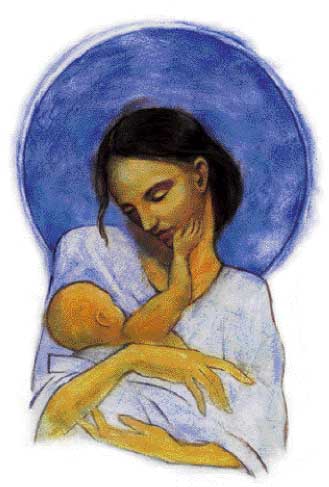
hannaIn our text, we are introduced Elkanah, a well-to-do Israelite that has two wives.  One wife, Peninnah, was able to give Elkanah many children, while the other wife, Hannah wasn’t able to have children. Hannah’s barreness said many things about the women in ancient times. If a woman was barren, it was usually considered the woman’s fault. People around Hannah would wonder what she had done to earn this judgement from God. This is why her co-wife Peninnah would taunt her.

Not having children could also be an issue of life or death for a woman. If Elkanah died, the inheritance would go to Peninnah’s sons. She would have to rely on the kindness of those sons. Because she had no son, she could end up on the street if Peninnah’s sons chose not to help her.

On top of all this, she would have to deal with the shame of being infertile. Not only was Peninnah taunting her, but you have to think the other women in the town were talking as well. She probably had no one to turn if just to vent.

The men in her life weren’t much help either. Elkanah loved Hannah more than Peninnah, and showed her kindness. He tires to tell her that he is worth more than 10 sons. He meant well, but it wasn’t really helping Hannah.

When she prayed to God in the temple, Eli the priest chastised her, thinking she was drunk. Again, not helping.

Hannah was alone. No one could help her, let alone understand her.

In desparation, she prays to God. She asks for God to remember her, when everyone else forgot about her.

God didn’t forget. Before she even conceived, her sadness went away. Maybe her husband couldn’t understand her. Maybe her co-wife was mean. Maybe the priest was rude. But God remembered her and that made her feel that she wasn’t alone. I think that’s why she could raise her voice in song in chapter two, because God remembered her in her moment of weakness.

People may not understand when we face hard times, but we can trust that God always remembers us and that can make us feel a little less lonely.

Dennis Sanders is the Pastor at First Christian Church of St. Paul in Mahtomedi, Minnesota. He’s written for various outlets including Christian Century and the Federalist.
 

I Promise.

424gfhrainbowcopy
Genesis 6:16-22; 9:8-15
September 7, 2014
Ordinary Time

I don’t know when I noticed that Noah and the ark wasn’t such a wonderful little story for kids.  All of the sudden the images of happy animals in a boat gave way to a crowed boat filled with animals-animals that poop.  I’m a city kid so farm life isn’t familiar to me.  But I’ve been to enough animal barns at the State Fair to know that having pigs and horses and elephants and so on is going to create one big mess.

But then, that’s not the most frightening thing about this passage.  God is upset over God’s creation.  God saw the evil taking place and regretted even creating the earth.

So, what does God do?  God sets the reset button.

The water that floods the world is in some way an undoing of the creative process we see in Genesis 1.  The water comes and sweeps away all of the evil in the world.  No more animals no more humans.

Except not everything has been swept away.  God spares Noah, his family and all the animals.  This small remnant of creation will be the seed that rebuilds the earth.  Even as God judges, God also brings salvation.

The rainbow that God talks about is a reminder to God that God would never flood the earth again.  God’s creation would continue to sin, continue to drift away from God.  No matter, God would not destroy the earth with water again and the rainbow is God’s promise: no more hitting the reset button.  God would find another way to deal with the waywardness of God’s creation.  The rest of the biblical story is God finding a different way to restore God’s creation.

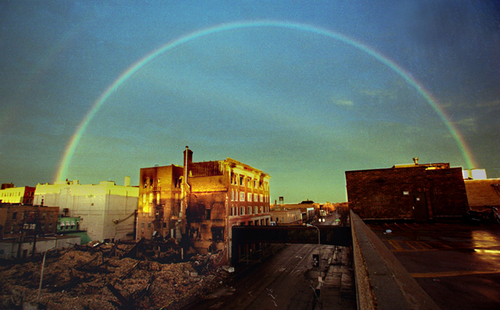
In 1997, a great flood hit the Red River Valley which straddles Minnesota and North Dakota.  Communities up and down the Red River were threatened with flood waters.  One such community was Grand Forks, North Dakota, the state’s 3rd largest city.  Despite a noble effort by citizens and volunteers, the rising flood waters could not be held back.  Fifty thousand people had to flee their houses as a result.  As the waters filled the city, a fire started in one of the buildings downtown.  Water everywhere and now a fire.  As the firefighters tried to deal with the fire using boats, a photographer for the local newspaper snapped a photo that became iconic.  In the midst of flood and fire, there was a rainbow.  The rainbow became a sign of hope to a beleagured community, a promise that things would be better.

In the midst of pain and sorrow, God tells creation and most importantly Godself that things will be better. Hope is around the corner.

I promise.

Come Sunday: The Breakfast Club (September 1, 2013)

Fifteenth Sunday of Pentecost (Year C)

September 1, 2013

Luke 14:1-14

“The next time you put on a dinner, don’t just invite your friends and family and rich neighbors, the kind of people who will return the favor. Invite some people who never get invited out, the misfits from the wrong side of the tracks. You’ll be—and experience—a blessing. They won’t be able to return the favor, but the favor will be returned—oh, how it will be returned!—at the resurrection of God’s people.”

-Luke 14:12-14 (The Message)

I was never one of the popular kids.

Oh, I had friends in high school.  But I wasn’t the guy that went to all the parties.  I tended to keep to myself.

High school is one of those places where there really is a clear demarcation: popular folks here, jocks over there, the smart ones all around you.  Then there were those , like me, who really didn’t fit in any of those groups.

The gospel text for this Sunday has me thinking about high school cliques and tables.  Jesus tells two stories that revolve around the meal table.  The first one tells people to not take the seat of highest honor, but instead take the lowest seat as possible.  The second one tells people to invite the poor, the unpopular, the kind of folk that will be able to pay you back.

Jesus tells these stories as both a commentary on first century society and also as an introduction into the kingdom of God.  In God’s eyes, what matters is not wealth or pride, but humility and compassion.  The system of hierarchy has been overthrown.  Equality rules.

As I read this text, two things came to mind.  The first is that I am writing this on August 27, 2013.  Tomorrow, August 28 is the fifthtieth anniversary of the March on Washington.  The most important part of that day was the speech by Rev. Martin Luther King that is now called the “I Have a Dream” speech.  The speech talks about the system of racial heirarchy found in the American South.  King calls for its destruction, to be replaced with a new system of equality, or as King says:

I have a dream that one day on the red hills of Georgia, the sons of former slaves and the sons of former slave owners will be able to sit down together at the table of brotherhood.

King takes Jesus’ words to heart and envisions a society where the descendants of masters and slaves would sit down at a table where all are equal.
The second though is the 1985 classic, The Breakfast Club.  The movie, directed by John Hughes, is set in the Chicago suburbs where an assortment of high school kids spend a Saturday in detention.  These teens had nothing in common and they were from the various parts of high school society.  While they come into the library that morning divided by their respective cliques, they leave understanding each other.  What was a hierarchy, becomes an odd little community.
Jesus seems to tell us that the Kingdom of God is not just for the beautiful people.  It is really for everyone.  In God’s economy, the CEO in the pews is equal with the guy who just got out of the hospital after another bout of schizophrenia.