Category: revised common lectionary

Faithful Living in Challenging Times – A Lectionary Reflection for Easter 6A (1 Peter 3)


13 Now who will harm you if you are eager to do what is good? 14 But even if you do suffer for doing what is right, you are blessed. Do not fear what they fear, and do not be intimidated, 15 but in your hearts sanctify Christ as Lord. Always be ready to make your defense to anyone who demands from you an accounting for the hope that is in you; 16 yet do it with gentleness and reverence. Keep your conscience clear, so that, when you are maligned, those who abuse you for your good conduct in Christ may be put to shame. 17 For it is better to suffer for doing good, if suffering should be God’s will, than to suffer for doing evil. 18 For Christ also suffered for sins once for all, the righteous for the unrighteous, in order to bring you to God. He was put to death in the flesh, but made alive in the spirit, 19 in which also he went and made a proclamation to the spirits in prison, 20 who in former times did not obey, when God waited patiently in the days of Noah, during the building of the ark, in which a few, that is, eight persons, were saved through water. 21 And baptism, which this prefigured, now saves you—not as a removal of dirt from the body, but as an appeal to God for a good conscience, through the resurrection of Jesus Christ, 22 who has gone into heaven and is at the right hand of God, with angels, authorities, and powers made subject to him.


****************
 

                How do we live faithfully in challenging times? In other words, how does our Christian faith guide our actions when we face challenges? As I write this we are experiencing a pandemic that has shut down most of the world’s economies. Most of us are sheltering-in-place to reduce the spread of a deadly virus because we lack an effective treatment or vaccine. There are those, of course, who in the name of religious freedom are declaring their immunity from all government requirements or advisements (such as not having in-person worship services). This is our situation as we read this passage from 1 Peter. The communities to which this letter is written (whether by Peter or someone using his name) are experiencing some form of distress or suffering. They may be struggling to find answers, but Peter wants them to stay strong, stay focused, and live faithfully.

                We pick up this reading from 1 Peter for the Sixth Sunday of Easter. The reference in verses 21-22 speaks of resurrection and ascension, making this a truly Easter text. The reading as a whole continues a conversation about how one should behave as a Christian and how that behavior demonstrates the truth of one’s confession of faith in the risen Christ. As part of this conversation, Peter introduces what is known as the “household code.” In the first century, this code made complete sense. It reflected societal norms. Today we find them problematic at best. Nevertheless, Peter speaks to three forms of relationship: family life, slavery, and the relationship of the Christian to the state. Wives are encouraged to submit to their husbands (embracing patriarchy), Slaves are instructed to obey their masters (one would assume that a large number of early Christians were slaves, who are instructed to grin and bear their condition in the expectation of an eternal reward). Finally, Peter encourages the people to honor the emperor and submit to the governing authorities who are authorized to punish evil and praise what is good. This instruction suggests that widespread requirements to offer sacrifices to the emperor had yet to take full force. Nevertheless, the point here is related to Peter’s reminder that they are aliens and exiles. Therefore, he encourages them to ”conduct yourselves honorably among the Gentiles, so that, though they malign you as evildoers, they may see your honorable deeds and glorify God when he comes to judge” (1 Peter 2:11-12). It is also worth noting that these congregations likely were made up largely of people who were slaves whose masters were likely pagans and wives whose husbands might be pagans. So, be careful with how you live, because your life in Christ will set you apart.

While the lectionary creators may have omitted the “household codes,” they are an important part of the story. We needn’t embrace them, but it is helpful to take of them to understand their condition. They are already under suspicion, so don’t rock the boat any further than had to. Perhaps we can learn something from these instructions about living in ways that give a good witness to the gospel that reflect the changing dynamics of modern life.

                So, do what is right. Fear God (reverence God) but don’t fear human persecutors. If you suffer, then suffer for what is right and good. Then when asked, give a defense of your faith. Share why you are a follower of Jesus. I don’t think Peter has in mind a theological dissertation. He is not suggesting that one explain each of the finer points of the Nicene Creed or Paul’s letter to the Romans for that matter. Just be ready to share how your faith guides your life before God. Share what it means to be a true follower of Jesus and do so “with gentleness and reverence.” In living this way, one emulates Jesus, who suffered on our account, “the righteous one on behalf of the righteous. He did this to bring you into the presence of God” (1 Peter 3:18 CEB).

                What begins as a call to emulate Jesus moves off into a conversation about the fullness of Jesus’ vindication. Though Jesus suffered, that is not the final verdict. Before he is fully resurrected and has ascended into the heavens taking his rightful place at God’s right hand, he takes a major detour. As verse 19 suggests (this is an intriguing verse that can lead to several possible interpretations) Jesus preached to the spirits in prison, primarily those who had disobeyed at the time of Noah. This verse gave rise to the idea that in that interim between burial and resurrection, Jesus descended to Hades and preached there. This is called the “harrowing of hell.” It is a perspective that had wide usage in the ancient church. It’s one of those passages that is suggestive, but not conclusive. Though it did find its way into the Apostles Creed. The point that Peter makes here is that those who had disobeyed had an opportunity to repent and be restored to life in the resurrection. 


                Before moving to the resurrection, Peter uses the story of Noah and his family as a prefigurement of baptism. Just as they were saved from judgment through water, now we are saved through baptism, “not as a removal of dirt from the body, but as an appeal to God for a good conscience, through the resurrection of Jesus Christ” (1 Pet. 3:21). In other words, this isn’t a magical act. It is a turning to the risen Christ and finding salvation in his resurrection and ascension.

                This leads back to the beginning, which is the call to live faithfully in the face of suffering. There is a rather pragmatic view in place, which suggests that if we do what is right then a difficult situation might become less difficult, or at least not become more difficult than it already is. Regarding slaves and wives, if they are Christians and their masters/husbands are not, they could be in for a difficult situation. So, there is a degree of pragmatism at work here. As Scot McKnight puts it:

His optimistic hope about the value of doing good is tempered by a genuine realism, for in several places he suggests the likelihood of being persecuted. Thus, it is important that his pragmatic argument not be given too much weight in his overall strategy for living Christianly in the world. But the argument is nonetheless valid: If we assume (1) the similarity of human nature and (2) the general limitation of such an argument, then it becomes important to urge Christians who are being persecuted to live godly and good lives so that those who are against them might be more tolerant of them. That is, human beings in general do appreciate being respected, and when they are respected, they will be kinder. [McKnight, 1Peter (The NIV Application Commentary Book 17) (pp. 218-219). Zondervan Academic. Kindle Edition.]

                Peter isn’t a radical. He’s pragmatic, but he is also faithful. So, as we read him, it’s important to remember that different contexts require different responses. Nevertheless, we are called to live faithfully, and so far as it is possible, we shouldn’t give offense to our neighbors. So, in the context in which we find ourselves right now, wearing a mask, use physical distancing, and follow the government guidelines is a good witness. It isn’t about my right to do as I please. It is about the call to love my neighbor by caring for their needs. By doing this we express our baptismal confession in the risen and ascended Christ.   


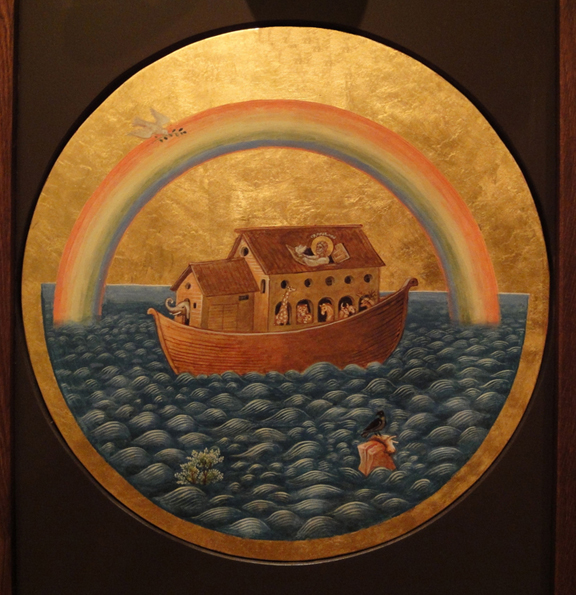
Image attribution: Ermakova, Natalia. Noah’s Ark Icon, from Art in the Christian Tradition, a project of the Vanderbilt Divinity Library, Nashville, TN. http://diglib.library.vanderbilt.edu/act-imagelink.pl?RC=56487 [retrieved May 9, 2020]. Original source: https://www.flickr.com/photos/jimforest/4338027250/ – Jim Forest.


By His Wounds, We Are Healed – A Lectionary Reflection for Easter 4A (1 Peter 2:19-25)

1 Peter 2:19-25 New Revised Standard Version (NRSV)
 

19 For it is a credit to you if, being aware of God, you endure pain while suffering unjustly. 20 If you endure when you are beaten for doing wrong, what credit is that? But if you endure when you do right and suffer for it, you have God’s approval. 21 For to this you have been called, because Christ also suffered for you, leaving you an example, so that you should follow in his steps. 

22 “He committed no sin,
    and no deceit was found in his mouth.” 

23 When he was abused, he did not return abuse; when he suffered, he did not threaten; but he entrusted himself to the one who judges justly. 24 He himself bore our sins in his body on the cross, so that, free from sins, we might live for righteousness; by his wounds you have been healed. 25 For you were going astray like sheep, but now you have returned to the shepherd and guardian of your souls.

****************

                As I write this over two million people around the world are or have been suffering the effects of a novel coronavirus outbreak. Tens of thousands have died, with the numbers climbing every day. There is no vaccine and treatments that look promising seem to fall short on every front. Stores, schools, and faith communities are all shut down. Holy Week and Passover were observed in ways no one can remember. Now Muslims observe Ramadan in the same fashion. Daily life is not what it was, and whatever emerges after the worst is over will not be the same. We will not be the same. Some will be embittered by their experience, while others will be strengthened.

                In this passage from 1 Peter 2, Peter addresses the suffering experienced by his audience. He distinguishes between those who suffer justly and suffer unjustly. If you suffer for doing wrong, then you probably are getting what you deserve. But, for those who suffer unjustly, for righteousness, well that’s different. Getting back to the pandemic, we tend to distinguish between those who get the virus when flouting the recommendations from those who contract it and even die for no fault of their own. This is especially true for those front-line folks in hospitals, nursing homes, first responders, grocery workers, and others whose jobs have been deemed essential. The word here is that if you do what is right and endure in the midst of it, then you receive God’s approval.

                Peter then points to Jesus, not as a substitute but as an example. Therefore, he encourages his readers to follow in the steps of the one who “committed no sin, and no deceit was found in his mouth,” and when he suffered, as a result, he didn’t return abuse on his abusers. In making this statement Peter is drawing on Isaiah 53 and the vision of the suffering servant. The challenge posed by this passage is that it seems to suggest that there is redemptive value in suffering so that suffering is glorified. Contextually, the call to follow the lead of Jesus comes as part of a word given to slaves, who are told to obey their masters. The creators of the lectionary, however, have chosen to omit what is, in reality, the thesis statement of the passage. I understand why the lectionary creators chose to omit verses like this, but as Barbara Lundblad notes, the inclusion of the verse gives preachers “permission to talk about the need for biblical interpretation.” She suggests that it might give preachers and teachers to consider the impact of passages like this on persons who have suffered abuse and hear that they should endure the abuse as Christ endured abuse [Feasting on the Word, 437]. What was heard by Christians living in the first century when they were a religious minority, struggling to survive in a culture where slavery was a central part of the economic system, over which they had no control. That is different than a context such as antebellum North America where Christians were not a religious minority.

                When we approach texts like 1 Peter, which speaks of being servants of God and freedom in Christ, how do we as God’s free people we navigate a society that is not always conducive to our freedom? Verse 18, which is the lead-in to the lectionary reading, instructs slaves to obey their masters, not just those who are kind and gentle, but even the harsh ones. A verse like this was a powerful tool in antebellum America in efforts to justify slavery and oppress those who were slaves. Thus, we must speak against it. We can try to sugar coat it but to no avail. But what about Peter’s context? Why would he write such a word to the church?

When Peter speaks here of freedom, he was thinking of spiritual freedom. He didn’t have in mind, necessarily emancipation from slavery or an end to patriarchy. These were not within the realm of possibility, though manumission was common in the first century. Slavery wasn’t race-based nor was it necessarily permanent. When Peter appeals to the household codes he was drawing on the common cultural understandings, which suggests that Peter was telling the people to keep their heads down, be good citizens, and then perhaps they could be good witnesses for Christ’s kingdom. Thus, interpreting and applying a text like this takes a lot of wisdom.

While the creators of the lectionary decoupled Peter’s instruction to slaves, to make the passage more preachable (or at least more comfortable for preachers who could focus on Christology), we shouldn’t forget the context. If we take into consideration the larger context and disabuse ourselves of thinking that suffering is in itself redemptive, then perhaps we can hear word for today. In fact, we might hear a word of encouragement to persevere, to endure, in the midst of suffering, as we pursue the path that leads to the realm of God.

Peter doesn’t celebrate imperial authority, slavery, or patriarchy, he just assumes that this is the way things are in the world. That is not our context. We have long rejected slavery, and while we might apply some of this to employer-employee relations, even there we need to be careful. At least in my circles, we have set aside patriarchy (or are working on it). As for imperial authority, it is good to remember that in a democracy, the voice of the people is the final authority, not the president. Thus we need to find ways of hearing a word in a passage that contextually poses problems. Nevertheless, we might read a passage like this through a liberation lens. We can read it through the lens of the Civil Rights Movement, which persisted in nonviolent resistance to Jim Crow and segregation, despite facing violent responses. Consider the events that transpired on the Edmund Pettis Bridge in Selma, Alabama. This was suffering endured in a just cause, that eventually overturned injustice.

As for Jesus, he bore our sins that we might be healed. This as we, who “were going astray like sheep, . . . have returned to the shepherd and guardian of your souls.” We needn’t read this through the lens of “penal substitutionary atonement.” That is a temptation, but it’s not a necessary one (I don’t think Peter had worked out a distinct atonement theory here). Instead, we can hear in this word a reminder that we serve the crucified God who suffers with us, and as Bonhoeffer suggests, only such a God can bring healing.


An Imperishable Inheritance – A Lectionary Reflection for Easter 2A (1 Peter 1)

Jesus in Majesty  by Christoff Baron —  Notre Dame Cathedral, Strasbourg, France
 

Blessed be the God and Father of our Lord Jesus Christ! By his great mercy he has given us a new birth into a living hope through the resurrection of Jesus Christ from the dead, and into an inheritance that is imperishable, undefiled, and unfading, kept in heaven for you, who are being protected by the power of God through faith for a salvation ready to be revealed in the last time. In this you rejoice, even if now for a little while you have had to suffer various trials, so that the genuineness of your faith—being more precious than gold that, though perishable, is tested by fire—may be found to result in praise and glory and honor when Jesus Christ is revealed. Although you have not seen him, you love him; and even though you do not see him now, you believe in him and rejoice with an indescribable and glorious joy, for you are receiving the outcome of your faith, the salvation of your souls.

******

                We come to this reading from 1 Peter as God’s people who have found a living hope in the resurrection of Jesus.  At least that is my starting point. We also engage this passage during an ongoing pandemic that is taking lives and causing disruption of life as we had known it. We don’t know when things will change or what they’ll look like when we begin to reenter a more normal pattern of life. Most likely we will enter a new state of normality. The way we view the world, ourselves, and God likely will have changed. That which sustains me at this moment is my faith in the living hope rooted in the resurrection of Jesus, and in the imperishable inheritance that comes with that living hope.

                Easter, like Christmas, is accompanied by a plethora of activities and meanings that may not connect directly to the message of Jesus. Easter eggs and Easter bunnies, even the word Easter itself, likely has roots outside the Christian faith. The fact that at least in the northern hemisphere Easter follows the spring equinox is also suggestive that life emerges out of death. The timing of Easter is rooted in the Passover celebration, which is in modern Judaism a spring holy event. So, whatever the roots of the day, the Easter season is understood to be a celebration of life. In the resurrection, Jesus triumphs over death, bringing life to all who would embrace his message. In this reading from 1Peter, the resurrection is connected to an imperishable inheritance, which is the salvation of our souls.  


                Before we go too far with the discussion of this lectionary reading for the Second Sunday of Easter, I should say something about authorship and orientation of the letter, since we’ll be in 1 Peter for several weeks. According to the letter’s self-identification, the author is the Apostle Peter, who is writing to “exiles of the Dispersion” living in what is now Turkey (1 Pet. 1:1-2). The reference to the Dispersion or Diaspora could suggest that the audience for this letter is a community of Jewish Christians, though there are also hints in the letter that the audience was Gentile. While the audience is not easily defined, neither is the authorship. On the face of it, St. Peter is the author. If so, then this letter is rather early, as it is believed that Peter died during the reign of Nero, possibly in Rome, and near about the time that Paul was also executed. Nevertheless, there is other internal evidence that suggests that this is a much later document. Ultimately, we simply can’t say for sure, and the meaning of this passage isn’t dependent on identifying the author. So, for simplicity’s sake, I will refer to the author as Peter.

Contextually, Peter seems to be concerned about the relationship of these early Christians to their culture. We see this in his use of household codes that make parts of the letter very problematic for us today. In terms of this particular passage, the reference to exile suggests a particular cultural context. It suggests that Christians, like Jews, live on the periphery of society. In many ways, this is a self-chosen reality, because, like Jews, Christians would have been perceived as anti-social. This is because they refused to participate in patriotic duties like honoring the Roman gods. The Romans were very tolerant of religious differences, as long as you honored their gods. You can be a devotee of Isis or Mithras, just don’t neglect to give allegiance to the official state religion. For Christians, if Jesus is Lord, then Caesar cannot be lord. Thus, to confess faith in Christ led to exile/dispersion. While this is true, this letter is suggestive that Christians should keep their heads down and not call attention to themselves. All the while, Peter urges them to keep their focus on their heavenly destination. In other words, Peter presents us with an eschatological vision that is focused on the people of God bearing witness to their faith by being a holy people, even as they separate themselves from the Roman cultural and religious life.  


To follow Jesus was to take a “road less traveled.” But that road led to new birth in Christ, and thus a new beginning. It is rooted in the resurrection of Jesus, who provides us with an inheritance that is “imperishable, undefiled, and unfading.” This is, according to the promise of God our destiny. This is the inheritance given to us in Christ and kept for us in heaven. We have access to the inheritance, but not its fullness. We can taste some of its benefits, but not all of them, because of the resurrection of Jesus. You might say that our inheritance has been in a trust until such time as we are ready to receive it. While the inheritance is set aside for us, there is, apparently a few tests that need to be experienced. The genuineness of our faith is to be tested by fire so that our faith may lead to the praise, glory, and honor of Christ when he is revealed. In other words, being heirs with Christ does not mean we do not experience suffering or pain. This is part of life. Some endure more than others. But together we share in the inheritance, that is our salvation. Thus, this is not just an Easter message, it’s an eschatological one. Easter is the starting point of something that will eventuate in our own resurrection. May we, as we hear this word concerning our inheritance find hope in this moment.

This is a day of new beginnings, time to remember and move on,
Time to believe what love is bringing, laying to rest the pain that’s gone.
For by the life and death of Jesus, God’s mighty spirit, now as then,
Can make for us a world of difference, as faith and hope are born again.
                                —Brian Wren, Chalice Hymnal 518 (vs. 1-2)


Raised with Christ – Lectionary Reflection for Easter A (Colossians 3)

Colossians 3:1-4 NRSV


So if you have been raised with Christ, seek the things that are above, where Christ is, seated at the right hand of God. Set your minds on things that are above, not on things that are on earth, for you have died, and your life is hidden with Christ in God. When Christ who is your life is revealed, then you also will be revealed with him in glory.

************

                Although Easter has arrived, this particular year (the year I write this), churches won’t be gathering for in-person services (or at least they shouldn’t be gathering in person). Instead of in-person gatherings, most of us are trying to find alternate ways of being together online. While we grieve the loss of this opportunity to join in singing the great Easter hymns (Christ the Lord is Risen, Crown Him with Many Crowns) and share in all the other elements that make Easter special, it might be worth remembering that on that first Easter morning, the followers of Jesus were either scattered to their own homes or perhaps hiding out in an upper room, while a few brave souls, including Mary Magdalene, Peter, and John checked out the tomb. They didn’t gather in a sanctuary colorfully decorated with lilies and tulips. While I find the organ to be a powerful instrument on Easter morning, they didn’t have organs either.

With that reminder concerning the first Easter morning, might we hear the witness to the resurrection offered to us by the Colossian letter? Whether the author is Paul or not (and for the sake of simplicity I’m assuming Pauline authorship), this letter offers us one of the most robust discussions of the Cosmic Christ in the hymn (Col. 1:15-20). While the reading for today comes from chapter 3, which has a more practical application, I think it is appropriate to consider that hymn as the backdrop to this reading.

15 He is the image of the invisible God, the firstborn of all creation; 16 for in him all things in heaven and on earth were created, things visible and invisible, whether thrones or dominions or rulers or powers—all things have been created through him and for him. 17 He himself is before all things, and in him all things hold together. 18 He is the head of the body, the church; he is the beginning, the firstborn from the dead, so that he might come to have first place in everything. 19 For in him all the fullness of God was pleased to dwell, 20 and through him God was pleased to reconcile to himself all things, whether on earth or in heaven, by making peace through the blood of his cross. (Col. 1:15-20)

The one, whose resurrection, we celebrate is the “image of the invisible God.” In him, all things were created. In him, the “fullness of God was pleased to dwell.” This is the one whose resurrection and exaltation we come to celebrate. We have been raised with Christ who sits exalted at the right hand of God. Yes, Easter has cosmic implications. Death has met its match. So, let us “crown him with many crowns.”

                In these four verses of chapter 3 of Colossians Paul applies the message of the resurrection to the daily lives of the Christians gathered in Colossae. Note the realized eschatology present here— “If you have been raised with Christ, seek the things that are above.” Paul is assuming that they were already resurrected with Christ, maybe not physically, but they received the promissory note of resurrection, so in Paul’s mind, they should live accordingly. That is they should “seek the things that are above, where Christ is, seated at the right hand of God.” Yes, Paul presumes that the heavens lie above the earthly realm, so looking up is an appropriate metaphor. We might not view the universe in quite the same way as first-century folks did, but I think we can work with the metaphor. Paul wants the church to focus on the things of God, rather than on earthly things. That may sound like an encouragement to live our lives in such a way that we’re so heavenly minded that we’re of no earthly good, I don’t think so. Instead, the concern here is the orientation of our lives. Do we orient our lives to the ways of God, or do we follow the lead of a narcissistic culture?  


                As we read this word, we might want to think in terms of baptism. While it’s not explicit here, we could read this in light of Romans 6, where Paul makes a clear connection between one’s baptism and one’s participation in the death, burial, and resurrection of Jesus. This is the word we read in Romans: “Do you not know that all of us who have been baptized into Christ Jesus were baptized into his death? Therefore, we have been buried with him by baptism into death, so that, just as Christ was raised from the dead by the glory of the Father, so we too might walk in newness of life” (Rom. 6:3-4).

                While Paul assumes that our resurrection is accomplished in the resurrection of Jesus, we still live mortal lives. We still await the full revelation of Christ’s glory, but the promise is there. If you read further along in the chapter, from verses 5-11, you will find more specific instructions as to what it means to live a resurrection life.  

But now you must get rid of all such things—anger, wrath, malice, slander, and abusive language from your mouth. 9 Do not lie to one another, seeing that you have stripped off the old self with its practices 10 and have clothed yourselves with the new self, which is being renewed in knowledge according to the image of its creator. 11 In that renewal there is no longer Greek and Jew, circumcised and uncircumcised, barbarian, Scythian, slave and free; but Christ is all and in all!  (Col. 3:8-11 NRSV)

With this word of admonition, might we celebrate the day of Christ’s resurrection? And, If we understand this word in light of the letter’s cosmic vision, the resurrection of Jesus has turned everything upside down, or perhaps better right-side up. We have drawn into that cosmic vision because we share in the resurrection in Christ, and we can enjoy the blessings of that event.

                As John of Damascus declared many centuries in the past:

                Now let the heavens be joyful! Let earth its song begin!
                                The world resound in triumph, and all that is therein;
                Let all things seen and unseen their notes of gladness blend;
                                For Christ the Lord has risen, our joy that has no end
—“The Day of Resurrection!” Chalice Hymnal, #228, vs. 3


From Glory to Glory by Way of Death – Lectionary Reflection for Passion/Palm Sunday (Philippians 2)

Philippians 2:5-11 New Revised Standard Version (NRSV)
 

Let the same mind be in you that was in Christ Jesus,
who, though he was in the form of God,
    did not regard equality with God
    as something to be exploited,
but emptied himself,
    taking the form of a slave,
    being born in human likeness.
And being found in human form,
    he humbled himself
    and became obedient to the point of death—
    even death on a cross.
Therefore God also highly exalted him
    and gave him the name
    that is above every name,
10 so that at the name of Jesus
    every knee should bend,
    in heaven and on earth and under the earth,
11 and every tongue should confess
    that Jesus Christ is Lord,
    to the glory of God the Father.

**************

                The Sunday before Easter presents the church with two choices when it comes to the lectionary. Should we go with the Palms or the Passion? As there is no established second reading for Palm Sunday, the choice has been made for us by the creators of the lectionary. That’s because I’m currently working through the second reading in this cycle. Therefore, the reading comes from the Passion Sunday selections. In this particular year, this seems to be an especially appropriate decision in any case. Since the world is facing a pandemic that has led to the cancelation of worship services across the globe, which will result in few if any palm processions (and the same goes for in-person Easter services this year).

The appointed Gospel reading comes from Matthew 27:11-54, which takes us from Jesus’ appearance before Pilate through the crucifixion to the Centurion’s declaration “Truly this was God’s Son!” (As a side note, I can’t read this without hearing John Wayne intone those words in The Greatest Story Ever Told – a 1960s Jesus movie starring Max Von Sydow as Jesus). Here in Philippians 2, we hear a word about the incarnation of the one who was in the form of God but did not exploit his equality with God but chose to empty himself of his pre-existent heavenly state, become human, and face death on a cross, all of which leads to his exaltation to the position of ruler of the cosmos. Paul offers this Jesus to us as an example, so that we might find unity as the body of Christ by becoming servants to one another and thus being of one mind. If we read between the lines, the Philippian church, which Paul founded, was experiencing a time of conflict.  Thus, Paul tells them to take on the mind of Christ, as revealed in this ancient hymn that Paul has appropriated for this purpose. The hymn reminds us that Jesus endured humiliation for our benefit and was vindicated by God as a result. The one who was crucified was then exalted by God so that he might move from humility to glory.

                When Paul wrote his letter to the Philippian Church, he was sitting in a jail cell (Phil. 1:12-17). Where he was being detained is unknown to us. Paul doesn’t identify the location though he does mention the Praetorian guard. That would suggest a cell in Rome. It’s a clue but not proof. That he is in prison, suggests confinement at best and perhaps a degree of suffering as well. That is his situation. The letter suggests that the congregation was facing its own sets of difficulties. While Paul was the founding pastor of this congregation, he could only reach out to them virtually, offering guidance by way of a letter.

 Regarding the internal concerns, he asks that they exhibit unity. He asks them to make his joy complete by having the same mind, love, and unity. He asks that they not do anything out of selfishness or conceit. Instead, he asks that they have the same mind as Jesus (Phil. 2:1-5). That request leads to what many scholars (and I tend to agree) consider an early Christian hymn that takes note of Jesus’ pre-existence with God (his divine status), his self-emptying (humility) that leads to the cross, and finally, his exaltation by God, thus vindicating Jesus by establishing him as ruler of the cosmos. Thus, to fully embody God’s realm, one should embrace the way of Jesus, which has the promise of exaltation.

                The hymn takes note of three distinct phases of the Christ event. We begin with an affirmation of Christ’s pre-existence. The hymn states unequivocally that “though he was in the form of God . . . but emptied himself, taking the form of a slave, being born in human likeness” (Phil. 2:6-7). This isn’t quite the same wording as John’s prologue (John 1:1-18), but it’s close. The second phase is Christ’s self-emptying of himself of divinity so that he might become human and face death on a cross. Finally, the second half of the hymn celebrates God’s vindication of Jesus by exalting him to the position of ruler of the cosmos [Ronald J. Allen, Connections, Kindle loc 4177-4192].

                For those of us who affirm the divinity of Christ, this is one of the most direct statements (along with John 1) in support of that position. Pre-existence doesn’t prove divinity, but it suggests that in Paul’s estimation that Jesus has a status that is ultimately different from us, even if he experienced life as being fully human. Karl Barth writes that “this equality of Christ with God is, so to speak, the fixed, ultimate background from which his road sets out to which he returns” [Epistle to the Philippians, p. 61]. This is the starting point for a movement from heaven to earth and back, so to speak. But the point here is not his equality with God, but what he does with it that is the point. That leads to the emptying of himself of his stature as the Father’s equal so that he might become a human and ultimately face death on a cross. Thus, his humanity fully covers his divinity, and this was of his own doing, his own choosing, and yet it was an act of obedience. This is the point of Passion Sunday, the willingness to go to the cross, to experience death, and not just any death, but the most humiliating of deaths. He descended to the depths in his self-emptying and bore upon himself the brokenness of the old age.

                This is not the final word in the story. The second part of the hymn (verse 2) reveals that God vindicated Jesus by exalting him to the position of ruler of the cosmos. This exaltation is revealed in the name given to him, which stands above every name, so that “at the name of Jesus every knee should bend, in heaven and on earth and under the earth, and every tongue should confess that Jesus Christ is Lord, to the glory of God the Father.” As I read this, I can’t help but think about the context in which it is revealed. Caesar is the exalted one, to whom every knee would bow, and whose name would be confessed as Lord. In this confession, Paul (or the hymn writer) reveals that Jesus, the one whom Rome crucified, had been exalted above Caesar. Thus, Jesus, not Caesar, is Lord. While Caesar might rule an empire, Jesus ruled the cosmos and that to the glory of God.


                Paul opens up this reading by asking that we be like Christ, who emptied himself of his glory so as to taste life as we live it, even to the point of death, as a result, God vindicated him by raising him to a position of glory. If this is true for Jesus, as those who are his people, might we participate in what is his by nature? As we ponder this question, I leave you with this word from one of Gregory of Nazianzus’ Festal Orations:

Let us become like Christ, since Christ also became like us; let us become gods because of him, since he also because of us became human. He assumed what is worse that he might give what is better. He became poor that we through his poverty might become rich. He took the form of a slave, that we might regain freedom. He descended that we might be lifted up, he was tempted that we might be victorious, he was dishonored to glorify us, he died to save us, he ascended to draw to himself us who lay below in the Fall of sin. Let us give everything, offer everything, to the one who gave himself as a ransom and an exchange for us. But one can give nothing comparable to oneself, understanding the mystery and becoming because of him everything that he became because of us. [Gregory of Nazianzus, Festal Orations, p. 59].

                As we begin a Holy Week like no other I’ve experienced in life, may we take up the mantle of Jesus, and find in him a path of obedience that leads to salvation.


Living in the Spirit – A Lectionary Reflection for Lent 5A (Romans 8)

Romans 8:6-11 New Revised Standard Version (NRSV)
 

To set the mind on the flesh is death, but to set the mind on the Spirit is life and peace. For this reason the mind that is set on the flesh is hostile to God; it does not submit to God’s law—indeed it cannot, and those who are in the flesh cannot please God. 

But you are not in the flesh; you are in the Spirit, since the Spirit of God dwells in you. Anyone who does not have the Spirit of Christ does not belong to him. 10 But if Christ is in you, though the body is dead because of sin, the Spirit is life because of righteousness. 11 If the Spirit of him who raised Jesus from the dead dwells in you, he who raised Christ from the dead will give life to your mortal bodies also through his Spirit that dwells in you.

************

                As I write this reflection, the world is caught up in a deadly pandemic that threatens to take the lives of perhaps millions of people. It is a moment when fear is rampant, and for good reason. Most faith communities have suspended in-person services and are looking at a wide assortment of alternatives so that they can keep in touch with each other. (Even if faith communities might have exemptions from some of these regulations, it is unwise to flout them!) In this moment in time, how do we speak of flesh and Spirit, death and life? This is especially true for those of us who are called to preach. How do we address Paul’s message about flesh and Spirit, death and life when death and the prospects of death seem to be very real?

                According to Paul, setting the mind on the flesh is death, while setting the mind on the Spirit is life. By flesh, I don’t believe Paul means the body (he’s not a gnostic). Instead, as C.K. Barrett notes, flesh “in this context means a mind from which God is excluded” [Barrett, The Epistle to the Romans, p. 158].  When Paul speaks of setting the mind on the flesh, it would probably be best to think in terms of a mindset. In this case, to have a fleshly mindset is to live a life that is focused on pleasing one’s self at the expense of living for God. Might we call this spiritual narcissism? As Sarah Heaner Lancaster suggests this is a question of allegiance. Thus, “there is no neutrality. One either lives for God or not, and by not living for God one displays loyalty to another dominion.” [Lancaster, Romans, p. 134]. In doing so, we settle for lesser things, which ultimately leads to death. Right now, I think we might consider this a warning against taking unwise actions that could lead to our deaths or the deaths of others because we don’t think the warnings about Covid-19 apply to us.

                As we ponder the message of the passage and Paul’s emphasis on the Spirit, it is important to remember that he has a very strong pneumatology. He envisions the church living by the Spirit, making use of the gifts of the Spirit (charismata) in such a way that the body of Christ is built up. We’ve not reached that point in the letter, but in chapter 12, Paul speaks of spiritual gifts and their use in the community: “For as in one body we have many members, and not all the members have the same function,  so we, who are many, are one body in Christ, and individually we are members one of another. We have gifts that differ according to the grace given to us” (Rom. 12:4-6a). Thus, if we are to live by the Spirit, then we will bring into the community the gifts given to us by the Spirit. We do this not to necessarily benefit ourselves, but so that the body of Christ can be built up until we reach the fulness of Christ (Eph. 4:11-13). This is what it means to live in the Spirit—follow the way of love (1 Cor. 13).

Paul is known to offer dualisms in his presentations of the gospel, as do other New Testament writers (especially John). When we consider this contrast between flesh and Spirit, death and life, we might think in terms of the old and new age, a contrast that is true to Paul’s theology. As he writes in 2 Corinthians 5, the old age has passed away, and the new age has broken through into the world. Like what we have here in Romans 8, Paul’s message in 2 Corinthians 5, has an eschatological orientation. Paul is clearly envisioning a major transition point in history that is centered in the cross and resurrection.

                While the lectionary reading begins in verse 6 of Romans 8, we should keep in mind the opening words of the chapter, which opens with the declaration that “there is therefore now no condemnation for those who are in Christ Jesus.  For the law of the Spirit of life in Christ Jesus has set you free from the law of sin and of death” (Rom. 8:1-2). It is this promise of forgiveness that sets the tone for this word concerning the relationship between flesh and spirit. The Spirit sets us free from the grasp of the flesh.  The path forward has been set, but the choice is ours as to how we engage with it.

                The focus here is, of course, living in the Spirit. To be in Christ is to live in the Spirit. It is to live in a state of transformation marked by the resurrection. The body may be dead, but the Spirit lives. Perhaps this is where we should focus. After all the Resurrection of Jesus is an eschatological event that inaugurates the new age of the Spirit. We may still live an embodied life, but our destiny is defined by the Spirit and not by the flesh. The promise here is that Spirit who raised Jesus from the dead lives in us.

                The reality is that death will come to our mortal bodies. That is a given. But there is the promise of the resurrection. We’re not yet at Easter, and right now, as I write, in-person Easter celebrations remain in doubt. Nevertheless, the promise of resurrection is there, giving us hope even in times of distress.


Living in the Light – A Lectionary Reflection for Lent 4A (Ephesians 5)

Ephesians 5:8-14 New Revised Standard Version (NRSV)
 

For once you were darkness, but now in the Lord you are light. Live as children of light— for the fruit of the light is found in all that is good and right and true. 10 Try to find out what is pleasing to the Lord. 11 Take no part in the unfruitful works of darkness, but instead expose them. 12 For it is shameful even to mention what such people do secretly; 13 but everything exposed by the light becomes visible, 14 for everything that becomes visible is light. Therefore, it says,
“Sleeper, awake!
Rise from the dead,
and Christ will shine on you.”

***********

                As we continue our Lenten journey our world is being turned upside down by a major viral pandemic. Schools, libraries, restaurants, and congregations are shutting down. Store shelves are empty of everything from bread to toilet paper. People are starting to hunker down because they don’t know what tomorrow will bring. Fear is rampant. Even for people of faith, times like this can be daunting. We can hold on to the promise that there is no fear in love, but when dark cloud hovers over us, blocking out the sunlight, hope may seem fleeting. You might even say that things are looking somewhat apocalyptic.


                Into this moment of darkness, we hear this word from Ephesians 5. It reflects a certain dualism separating darkness from light. In this case, it’s not just that we might live in darkness, but we are darkness. On the other hand, it’s possible that we not only live in the light, but we are light. Yes, “once you were darkness, but now in the Lord you are light” (Eph. 5:8a).


                When I read this passage, I can’t help but view it through a Star Wars lens. I am, after all, a Star Wars fan, going back to my college days when I took in the very first episode (Episode IV). For those who know the Star Wars story, the Force is an energy field that has a dark side and a light side. The dark side is quite powerful and therefore it’s enticing. The dark side of the Force feeds off of fear and anger, which are emotions easily ignited, especially when we feel threatened. I doubt George Lucas was reading Ephesians 5 when he developed the Star Wars saga, but it seems to fit. While Darth Vader (otherwise known as Anakin Skywalker) was once a brave and powerful Jedi Knight, he was seduced by the dark side of the force and became darkness itself. It made him very powerful, but it transformed him into something quite evil. The word we hear in Ephesians 5 is that we were once possessed by darkness, but that’s no longer true. As happened in Episode VI, The Return of the Jedi, Vader had a conversion of sorts and returned to the light.


                What we have here in this passage is a conversion text. It speaks of a radical transformation, much like that experienced by Vader. In this experience of transformation from darkness to light, the old self is exchanged for the new. While the question of authorship of Ephesians remains open (see my study guide on the Book of Ephesians for more on that question), there are similarities to this message and what Paul writes in 2 Corinthians 5. There Paul speaks of becoming a new creation so that the old is now gone, and a new creation comes into existence. The message here is that because of this conversion from darkness to light, one should live accordingly. If we’re to live in the light, this means stepping away from the old life and embracing a new way of living. The word here is: “Take no part in the unfruitful works of darkness, but instead expose them” (Eph. 5:11).

This call to separate oneself from the works of darkness, but rather expose them, is a call to action. Stand up for justice, for what is good and right. But also remember that darkness is powerful. We might want to heed this word of warning from Reinhold Niebuhr: “It must be understood that the children of light are foolish not merely because they underestimate the power of self-interest among the children of darkness. They underestimate this power among themselves.” [Niebuhr, The Children of Light and the Children of Darkness, University of Chicago Press. Kindle Edition].


                Niebuhr’s warning about the power of self-interest is apropos at this moment. We should not underestimate its power over our lives as we face the challenges of the moment. At this moment the challenge comes in the form of a world-wide Coronavirus pandemic. How do we care for ourselves, but not put others in danger? We’ve watched as people hoard goods and prices for necessary goods skyrocket. When it comes to health care, who will be considered expendable if the resources need to be rationed? Too often we think about things in abstract terms, but this is reality. What is light and what is darkness? How does self-interest work its way into the conversation?

 As we ponder this question of moving from darkness into light, hearing the call to live as children of light, exposing the deeds of darkness, what is our responsibility? How do we speak truth without exploiting fear? We know it will occur politically. This is, after all, a political season. But, what about faith? It’s easy to exploit fear for religious gain. People are looking for hope amid news that only brings despair. How do we offer hope without manipulating these fears? Times like this can bring out both the worst and the best in us.

Since this is the season of Lent, when confession of sin becomes a significant part of our experience, even in communities (like my own) that generally eschew prayers of confession, we have the opportunity to allow light to be shined into our lives. The darkness that is present will be exposed. Turning back to Star Wars, when Vader became once again Anakin, his son, Luke, said of him, “I knew there was still goodness in you.” There is a view of things that suggests that we are totally depraved, and without any hope outside the grace of God. I wonder, could it be that the image of God, in which we are created, might be clouded over by darkness, but never completely erased? This reading from Ephesians doesn’t answer that question, but I wonder. Might there still be a fragment of light present that can be set free in Christ, so that we might act as light, ever mindful that even as Children of Light there is still the possibility of falling back into darkness?

            The reading closes with this declaration that might be part of an early Christian hymn:

                “Sleeper, awake!
                                Rise from the dead, and Christ will shine on you.”

May the light that is Christ sine on us, and through us, so that life might be fully embraced. Yes:

                Come, heav’nly brightness, light divine,
and deep within our hearts now shine;
                There light a flame undying!  (O Morning Star, Chalice Hymnal, 105, vs. 2)
               

Image attribution: Hartman, Craig W.. Cathedral of Christ the Light, from Art in the Christian Tradition, a project of the Vanderbilt Divinity Library, Nashville, TN. http://diglib.library.vanderbilt.edu/act-imagelink.pl?RC=54202 [retrieved March 16, 2020]. Original source: http://www.flickr.com/photos/sicarr/3251258111/.

The Blessings of Abraham’s Faith – Lectionary Reflection for Lent 2A (Romans 4)

Romans 4:1-5, 13-17 New Revised Standard Version (NRSV)

4 What then are we to say was gained by Abraham, our ancestor according to the flesh? 2 For if Abraham was justified by works, he has something to boast about, but not before God. 3 For what does the scripture say? “Abraham believed God, and it was reckoned to him as righteousness.” 4 Now to one who works, wages are not reckoned as a gift but as something due. 5 But to one who without works trusts him who justifies the ungodly, such faith is reckoned as righteousness. 

13 For the promise that he would inherit the world did not come to Abraham or to his descendants through the law but through the righteousness of faith. 14 If it is the adherents of the law who are to be the heirs, faith is null and the promise is void. 15 For the law brings wrath; but where there is no law, neither is there violation. 

16 For this reason it depends on faith, in order that the promise may rest on grace and be guaranteed to all his descendants, not only to the adherents of the law but also to those who share the faith of Abraham (for he is the father of all of us, 17 as it is written, “I have made you the father of many nations”)—in the presence of the God in whom he believed, who gives life to the dead and calls into existence the things that do not exist.

******************

                 The Revised Common Lectionary started off the Lenten season with a reading from Romans 5:12-19. The focus there was on the contrast between the first Adam, through whom sin and then death entered the world, and the last Adam, Jesus, through whom life was restored. With that word laid before us, we gather for the second week of Lent. This week the Lectionary’s Second Reading asks us to step back to the fourth chapter of Romans. Here Paul speaks not of Adam, nor even of Jesus, but of Abraham, our ancestor in the faith. The message here is that justification comes not through law, which did not exist at the moment of Abraham’s call, but rather through grace. In other words, writing to a new Christian community Paul skips over Moses and goes directly to Abraham, our father in the faith.

                Abraham was the ancestor, according to the flesh, of the Jewish people through Isaac and his descendants. It is to this community of descendants that the Law would eventually be given. This was according to the promise of God, that Abraham would be the ancestor to many nations. Truth be told, Abraham’s family tree spread out not only through Isaac but also through Ishmael (son of Abraham and Hagar). Isaac had two sons. Jacob, known also as Israel, would be the ancestor of the Jewish people, but his brother Esau would be the ancestor of Edom. So, when we hear the promise that through his descendants the nations would be blessed, we might ask which descendants we’re talking about.

                Abraham is an interesting figure, and I think we probably need to go beyond Paul’s descriptions to truly get a sense of his place in the story. Paul wants us to see Abraham as our spiritual ancestor, even if we don’t descend from his lineage according to the flesh. According to Paul, the way this happens is through grace. Paul’s reading of Scripture, more specifically Genesis 15:6 (LXX), tells us that “Abraham believed God and this was reckoned to him as righteousness.” Thus, no works are involved, just belief or trust. However, as CEB Cranfield notes, Rabbinic readings, as well as Philo, read this quite differently [Cranfield, Romans, 1:229]. For them, more than Abraham’s belief or trust in God; it also involved specific actions (Works). These works included circumcision, something Paul didn’t want to impose on Gentile believers. Nevertheless, Paul took on a verse that might prove otherwise and suggested that he had the correct interpretation.  Interestingly, the Common English Bible version of Genesis 15:6, which draws not from the Septuagint but the Masoretic text would seem to go against Paul’s reading: “Abram trusted the Lord, and the Lord recognized Abram’s high moral character” (Gen 15:6 CEB). So, who has the correct interpretation? Paul or the Rabbis?

                As we continue our journey into Lent, how might we engage this account of Abraham being our spiritual ancestor? It’s clear that Paul is seeking to expand the definition of what it means to be a descendant of Abraham, extending the definition of being a child of Abraham to those who are not circumcised (even though Abraham circumcised the males in his household as a sign of his faithfulness to the covenant). In Paul’s mind, if Abraham’s call and the promise that goes with it predates the giving of the Law, then something other than adherence to the Law would define one’s position in the family tree. After all, Abraham couldn’t have been justified on the basis of the Law of Moses, which had not been revealed. So, as Sarah Heaner Lancaster notes, Abraham “obeyed God, but he did not do so by following the written prescriptions that were to come. In this, too, he is like the Gentiles about which Paul is concerned, who obey by following something unwritten rather than something written. Abraham was in right standing with God because he was faithful in his trust of God, so his faithfulness justified him” [Lancaster, Romans, p. 77]. If this is true for Abraham, might it also be true for Gentile believers who come to God through Christ, but not through the Law? Later, Paul will reveal that Gentile believers have been grafted into the vine that is Abraham’s descendants, but only through faith not by works (Rom 11:17-21).

                The first reading for the week, from Genesis 12:1-4a contains the promise that Paul takes hold of in verse 17 of Romans 4. In that original divine call, Abraham receives the promise that will lead him to pack up the family and head off to a new land, walking simply by faith. This, according to Paul, is the act of faith to which we are to take hold of, and which brings Gentiles into the fold. But remember, this faith goes both ways. God puts faith in Abraham, even as Abraham puts faith in God’s promises.

                All this said, is Paul an antinomian? That is, does he believe that there is no such thing as right or wrong? Does he mean that ethics don’t matter? I don’t think so. But I do believe Paul wants us to keep things in their proper order. Do we start with works or merit or do we start with grace? Might it be that good works are the product of a life of faith? If the latter is true, then we might read James as a not so subtle reminder that sometimes readers of Paul got him wrong. Remember that Paul did say that while all things are lawful, not all things are profitable. (1 Cor. 6:12; 1 Cor. 10:23).

                The Good News for us here is that we are children of Abraham, and to Abraham and his descendants has been given the covenant that involves being a blessing to the nations. While God seems intent on providing an heir to Abraham through his marriage to Sarah (Gen. 17), we should not forget that Abraham had another son, his firstborn, with Hagar. God promised to make a nation of him as well (Gen.21:9-21). So, might we take this as a word to us to be in relationship, as Christians, with all of Abraham’s descendants, whether they be Jewish, Muslim, or Christian? Might we then extend that even further to all of God’s children, whether descending from Abraham by the flesh or the Spirit?


Nature or Nurture? A Lectionary Reflection for Lent 1A (Romans 5)

Hans Holbein the Younger – Adam and Eve (Kunst Museum, Basel)
  
Romans 5:12-19 New Revised Standard Version (NRSV)
12 Therefore, just as sin came into the world through one man, and death came through sin, and so death spread to all because all have sinned— 13 sin was indeed in the world before the law, but sin is not reckoned when there is no law. 14 Yet death exercised dominion from Adam to Moses, even over those whose sins were not like the transgression of Adam, who is a type of the one who was to come.
15 But the free gift is not like the trespass. For if the many died through the one man’s trespass, much more surely have the grace of God and the free gift in the grace of the one man, Jesus Christ, abounded for the many. 16 And the free gift is not like the effect of the one man’s sin. For the judgment following one trespass brought condemnation, but the free gift following many trespasses brings justification. 17 If, because of the one man’s trespass, death exercised dominion through that one, much more surely will those who receive the abundance of grace and the free gift of righteousness exercise dominion in life through the one man, Jesus Christ.

18 Therefore just as one man’s trespass led to condemnation for all, so one man’s act of righteousness leads to justification and life for all. 19 For just as by the one man’s disobedience the many were made sinners, so by the one man’s obedience the many will be made righteous.

******************

                Did you follow that? I know that Paul can get a bit tongue-tied as he makes his points. Nevertheless, this is one of the most consequential passages in the New Testament, as it has served as a key foundation to the doctrine of original sin. The question that emerges from the passage is not whether sin exists, but whether human sin stems from a genetic predisposition or from one’s social context. In other words, is it nature or nurture? Augustine would say nature. John Locke would have said nurture (Tabula Rasa—Blank Slate). Whether it’s nature or nurture, what seems clear from reading Romans 5 is that Sin and Death entered the picture through one person’s actions, and that person is Adam. While sin has come into the world via Adam, the solution to the problem comes through grace provided through another man, the man Jesus Christ.

In Romans 5 Sin is accompanied by Death. Both appear to be spiritual forces that have disrupted God’s creation. They have taken on a life of their own. The question we have continually asked is how Sin and Death have come to have dominion over human life. According to Paul, Death spread because of human Sin. This word concerning sin and death stands as the opening message from Paul to us during the season of Lent. Lent is a penitential season, set up to enable us to take stock of our lives and make any necessary changes to our lives. Thus, this is a good season for us to make a confession of sin. But confession of sin is only the beginning, not the end of the process. We needn’t take up any harsh practices such as self-flagellation, but we might make some lasting changes to our lives. The good news is that should we undertake this path, there is grace available to us in Christ.

                Many years ago, during my seminary years, I wrote a paper for my Systematic Theology class on the topic of original sin. In that paper, I made my case for why the doctrine should be rejected, while the doctrine of universal sin should be adopted. One of the central biblical texts I addressed was this one. While St. Augustine has been credited with creating the doctrine, it has much earlier roots, perhaps here in Romans 5. Augustine did offer a description of the means of transmission that has come to dominate in the Christian West, it’s not the only view. The Eastern Churches have taken a more modest view, but then they read the original in Greek, not Latin, the latter of which seems to have led Augustine and others to think in genetic terms (though that’s a bit of an anachronism as Augustine didn’t know about genetics, which is why he linked it to concupiscence). For Augustine, original sin is a genetic predisposition. We sin because we inherit that predilection from Adam. In the Enchiridion he writes that after Adam sinned he was exiled and “bound also his progeny, which y his sin he had damaged within himself as though at its root, by the penalty of death and condemnation.” His offspring born of him and his wife were condemned with him, for they had been “born through the concupiscence of the flesh which was their punishment” [On Christian Belief, p. 289]. In other words, we are tainted with original sin passed on through the sexual relationship. You understand then why celibacy became a path to godliness! Therefore, our only hope is the grace of God that comes to us through Christ. I will confess that I haven’t found that reading convincing, but it has been the dominant interpretation in Western Christianity since at least Augustine.

If we don’t follow Augustine, might we still speak of an “original” sin? Or better, might we speak of universal sin? Instead of embracing a genetic predisposition, might we speak of the universal presence of sin a consequence of living in a sinful environment? Take racism for instance. Are we genetically predisposed, or is this a learned behavior? My view is that it is a learned behavior that is sin. In other words, we might speak of systemic sin.

As top whether it is nature or nurture, Paul doesn’t say. He’s not so interested in the how as the what. He recognizes that this is a universal problem that requires a solution that can come to us only through the grace of God. This grace comes to us through Christ. According to Paul even as Sin and Death made their presence known through the actions of Adam and all who shared in them, the answer to be found in Christ, and all who receive his grace.

This reading from Romans 5 acknowledges the universality of sin, and Adam’s involvement in its spread (notice that Eve is not mentioned by Paul). What is often missing from the conversation is the possibility that salvation is spread to all. If, as I believe we should see Adam as a type, and Jesus has the countertype, might we see this as the foundation for the possibility that all will be restored in Christ? “For as in Adam all die, even in so in Christ shall all be made alive” (1 Cor 15:22 KJV).

Whether we understand this to be a nature or nurture issue, the reality is that we live an immoral society. There are sins that must be confessed. Too often we focus on minor sins, rather than the big ones, like racism or sexism. Perhaps this is because we rather not face the realities of our participation in that which is sin. But, if grace is to do its work in our society, then confession will be good for the soul and for the world.    


We Have Seen His Glory – A Lectionary Reflection for Transfiguration Sunday (2 Peter)

2 Peter 1:16-21 New Revised Standard Version (NRSV)
 
16 For we did not follow cleverly devised myths when we made known to you the power and coming of our Lord Jesus Christ, but we had been eyewitnesses of his majesty. 17 For he received honor and glory from God the Father when that voice was conveyed to him by the Majestic Glory, saying, “This is my Son, my Beloved, with whom I am well pleased.” 18 We ourselves heard this voice come from heaven, while we were with him on the holy mountain. 
19 So we have the prophetic message more fully confirmed. You will do well to be attentive to this as to a lamp shining in a dark place, until the day dawns and the morning star rises in your hearts. 20 First of all you must understand this, that no prophecy of scripture is a matter of one’s own interpretation, 21 because no prophecy ever came by human will, but men and women moved by the Holy Spirit spoke from God.
*****************

                Epiphany begins with a star shining in the night sky pointing us to the child born in Bethlehem. It ends with this same Jesus, now an adult who is fully engaged in his ministry, standing on a mountain-top, his glory fully revealed and witnessed to by a voice from heaven. The day on which we celebrate this revealing of Christ’s majesty is called Transfiguration Sunday. While you will find a full description of this event in the reading for today in Matthew’s Gospel (Matt.17:1-9), there is another witness to the event, that witness is found here in 2 Peter. The season of light is coming a close, with this brief revelation of Christ’s glory, but the witness continues on to this day.

                This passage bears witness to the moment of transfiguration. The author, whose identity is not known to us, tells us that what is being made known is not a “cleverly devised myth.” It is an event to which there were witnesses. Now, the author claims to be a witness to the event, but scholars suggest that this is a rather late document. We need to recognize the irony here of a message that opposes cleverly devised myths with eyewitness testimony given by an unknown, rather late in the game, author. Nevertheless, even if this wasn’t written by St. Peter, as claimed by the letter, it is likely rooted in a communal witness that goes back to the apostolic era. The reason for claiming apostolic authorship is to support the authoritative nature of the witness. The original readers likely knew this wasn’t written by Peter, but they accepted it as an authentic witness. For our purposes, it stands in line with the witness of the Gospels. In fact, it’s rather sparse in its details.

                Although no mention is made here of the transformation of Jesus’ appearance or the presence of Moses and Elijah (nor of James and John for that matter), what is referenced is the voice of God. It is God who bears witness to Jesus’ majesty, declaring: “This is my Son, my Beloved, with whom I am well pleased.” The author reveals that he was present to witness this voice from heaven. Now, he shares it with others.

                The purpose of sharing this message of the Transfiguration is revealed in the words that follow. That has to do with the prophetic witness of Scripture. Be attentive to it, the author says. He compares it to a lamp shining in a dark place. That is a message that resonates during Epiphany. We’re told that the revelation of Christ’s glory and majesty on the mountain top gives credibility to the message of Scripture and their witness to it. While Protestants, and I count myself among them, have hailed the right of the individual to read and interpret Scripture for themselves, the author of 2 Peter isn’t quite as sanguine about this. The author writes that “you must understand this, that no prophecy of scripture is a matter of one’s own interpretation” (vs. 20). Instead, the prophecy of Scripture, the revelation of God, comes as men and women are moved by the Holy Spirit to speak for God.        


                While what we call the New Testament is in formation by the time 2 Peter is written, it’s still forming. Gospels and letters are floating around, but they’ve been organized into a whole that one would call Scripture. So, we’re likely talking here about what Christians call the Old Testament, most likely that testament was written in Greek, what is known as the Septuagint (LXX).

                Whatever is meant here by prophecy and Scripture, the author is clear that it can’t mean whatever we want it to mean. Contextually, the interpretation of prophecies was often a matter of conjecture. As Pheme Perkins notes, this was known to occur at places like Delphi. She writes that “Second Peter insists that prophetic words inspired by the Holy Spirit are not that sort of prophecy; they reflect God’s purposes, not human cleverness” [Feasting on the Word, p. 451].

                So, this reading reminds us that we should be attentive to the witness of Scripture, that it might be a lamp to light the way forward, until the morning dawns and the full light of God has been revealed to our hearts.

                The story of the Transfiguration suggests that for just one moment the full majesty of Jesus’ identity was revealed. Only a few people (Matthew names Peter, James, and John) got to see that revelation. Only they got to hear the divine witness to Jesus’ identity. We the readers of the Gospels and of this letter must take their word as being true. This witness is extended to Scripture, which isn’t open to just any interpretation but requires the movement of the Spirit. That is tricky because it’s easy to claim the Spirit’s lead. How do we discern when and how the Spirit is leading? It’s a question that we preachers ask all the time as we consider the message found in Scripture and seek to bring something of value to our congregations. We pray for the Spirit’s guidance. We also pray that the Spirit will speak in, through, under, or over our words (that’s something akin to consubstantiation, just applied to Scripture rather than the Eucharist).  


                As we move into Lent and journey toward Easter, may the lamp that 2 Peter speaks of light our way until morning dawns and we can see more fully the things of God.

                 
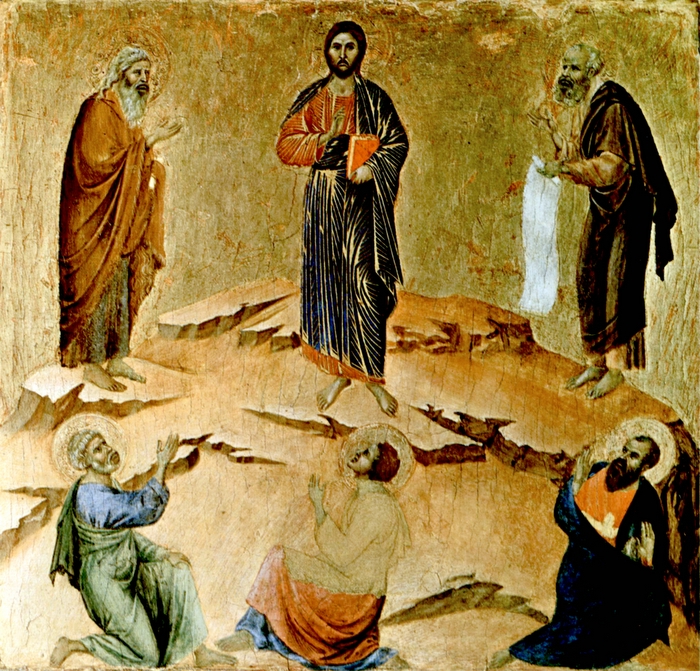
Image attribution: Duccio, di Buoninsegna, d. 1319. Transfiguration of Christ, from Art in the Christian Tradition, a project of the Vanderbilt Divinity Library, Nashville, TN. http://diglib.library.vanderbilt.edu/act-imagelink.pl?RC=46150 [retrieved February 16, 2020]. Original source: http://www.yorckproject.de.