
Category: revised common lectionary

Who Am I to Judge? Lectionary Reflection for Pentecost 15A (Romans 14)

Who Am I to Judge? Lectionary Reflection for Pentecost 15A (Romans 14)

Judgment Day – Aaron Douglas
 
Romans 14:1-12 New Revised Standard Version
 

14 Welcome those who are weak in faith, but not for the purpose of quarreling over opinions. Some believe in eating anything, while the weak eat only vegetables. Those who eat must not despise those who abstain, and those who abstain must not pass judgment on those who eat; for God has welcomed them. Who are you to pass judgment on servants of another? It is before their own lord that they stand or fall. And they will be upheld, for the Lord is able to make them stand. 

Some judge one day to be better than another, while others judge all days to be alike. Let all be fully convinced in their own minds. Those who observe the day, observe it in honor of the Lord. Also, those who eat, eat in honor of the Lord, since they give thanks to God; while those who abstain, abstain in honor of the Lord and give thanks to God. 

We do not live to ourselves, and we do not die to ourselves. If we live, we live to the Lord, and if we die, we die to the Lord; so then, whether we live or whether we die, we are the Lord’s. For to this end Christ died and lived again, so that he might be Lord of both the dead and the living. 

10 Why do you pass judgment on your brother or sister? Or you, why do you despise your brother or sister? For we will all stand before the judgment seat of God. 11 For it is written, 

“As I live, says the Lord, every knee shall bow to me,


    and every tongue shall give praise to God.” 


12 So then, each of us will be accountable to God.


***************
 

                Pope Francis raised a few eyebrows when in an impromptu conversation with the press on board his plane in 2013, he responded to a question about his view of homosexuality in the church, he simply said: “Who am I to judge?” Now, the church’s policies haven’t changed all that much, but the answer opened a conversation about who has the responsibility for judgment. Even though he’s the Pope, he declined to excise judgment in this case. For those of us who come from an open and affirming posture, this was pretty groundbreaking. The thing is, it’s to judge other people. We size each other up according to weight, height, education, race, gender, sexual orientation, or religion. When we do so, we often depend on stereotypes. That’s understandable. Stereotypes provide us with categories to judge whether a person is worth getting to know or can be trusted. Unfortunately, too often we both prejudge and misjudge. 


                The topic of judgment comes up as Paul brings his letter the Romans to a close. It’s important to remember that this a congregation that Paul not only didn’t found, but it’s one he’s never visited. This letter is intended as an introduction to the community since Paul is hoping to visit this previously established Christian community. He’s heard reports that there are dissension and division within this community of believers. While we can’t date it with certainty, a date around 57 CE would fit. So, we’re still in the early decades of the Christian community. The church is starting to attract Gentile believers, but it still has a significant Jewish component. And apparently, they’re not always on the same page, especially when it comes to issues like eating or honoring particular days.


One senses from reading the letter that the community is being divided over matters involving their eating habits and the celebration of certain days. If, as some believe, the Jewish and Gentile members of the community are struggling to find a place of unity, then this makes sense. Now, as to the identity of the weak and the strong, that’s uncertain. It’s quite possible that the weak are the rule followers and the strong are the less scrupulous, but we simply don’t know. There are all kinds of issues at play. Jewish Christians might be concerned about kosher rules and thus choose a more vegetarian diet, while some Gentile Christians might feel less constrained and be more likely to eat meat with abandon. Of course, as the conversation in 1 Corinthians suggests, there is the issue of where the meat comes from. Should one worry if the meat comes from a temple? Some would say yes, and others, no. In any case, as a meat-eater, I ask my vegetarian and vegan friends not to judge me too harshly, and I shall try to do the same in return!


Whatever the case, Paul seems to be saying to the community: “who are you to judge?” Leave the judgments in such matters to God. If some eat meat, fine. If some stick with a vegetarian diet, then that’s fine. If some observe certain holy days and others don’t, well that’s okay as well. Of course, this can make for a more complicated community dining experience. In Acts 15, the issue of Table fellowship comes up, in light of the introduction of Gentile believers into the community. The Jerusalem Council gave a word of guidance to these new communities, asking that “they abstain from what has been sacrificed to idols and from blood and from what is strangled” (Acts 15:29). Perhaps that word of guidance has fallen to the wayside as the church expands.  The concern here is finding a way of living together in peace, recognizing that people will have different understandings of certain things like food and ritual. One may fast regularly (my Muslim friend regularly fasts as an expression of his commitment to God), and others (myself numbered among them) rarely fast.


The issue here isn’t tolerance, as if we should agree to disagree. Paul’s concern is centered on the question of unity in Jesus Christ. For Paul, the church is the one body of Christ, so it should exhibit unity of purpose and concern for one another. That doesn’t mean we agree on every issue. But Paul does have in mind a particular temperament. It asks us to delve deeper beneath the rhetoric to the humanity of the person with whom one disagrees. It’s easy to see one’s self as pursuing a righteous cause and believing that the one we disagree with as somehow pursuing something demonic or evil. That doesn’t mean we don’t advocate strongly for our position, but it does mean recognizing the deeper humanity present in the other. Again, a stereotype is easy to make use of, but it can lead us astray. Again, that doesn’t mean we don’t stand for matters of justice. It has to do with the way we view the humanity of others and forget that they too are created in the image of God. Another way of putting this is to approach such actions with humility. As William Greenway puts it:

First and last we argue for the right and struggle for the good, not for the sake of ourselves or our own opinions or identity—or even for the sake of the church, justice, or the good—but because we are moved by love and concern for every particular other, which is to say, because in life and in death we belong to God [Feasting on the Word, p. 66].    


Ultimately, according to Paul, in this letter at least, we are to hold ourselves accountable to God, and God alone. After all, each of us will stand before the judgment seat of God.  Indeed, when it comes to life and death, we are reminded by Paul that we do not live to ourselves, and we do not die to ourselves.” That is because, “whether we live or whether we die, we are the Lord’s.” That is because Christ is Lord of the living and the dead (Rom. 14:7-9). When we think of ourselves as judges of others, our judgments tend to be rooted in self-centeredness, but Paul wants us to understand that we belong to God, in Christ, to “whom every knee will bow” so that “every tongue shall give praise to God” (Rom. 14:11, quoting Isa. 45:23). Thus, we shall be accountable to God, and God alone. Or as Karl Barth puts it:


Uncertain are all our questions concerning the salvation of others, whatever form our questions take; feeble are all attempts to assess the value of another’s relation to God, whether the assessment be conservative or radical. All is subject to the judgment of God. Judge Not is therefore the only possibility. And yet, even this possibility is no possibility, no recipe; it provides no standard of conduct. We have no alternative but to range ourselves under the judgment that awaits us, hoping—without any ground for our hope—for the impossible possibility of the mercy of God. [Barth, Epistle to the Romans, p. 515].


May we place our hope in the mercy of God and cease our attempts at usurping God’s role as judge.


  Image attribution: Douglas, Aaron. Judgment Day, from Art in the Christian Tradition, a project of the Vanderbilt Divinity Library, Nashville, TN. http://diglib.library.vanderbilt.edu/act-imagelink.pl?RC=56259 [retrieved September 7, 2020]. Original source: Anne C. Richardson.
 

Putting On Jesus Christ – Lectionary Reflection for Pentecost 14A (Romans 13)

 
Romans 13:8-14 New Revised Standard Version
 

Owe no one anything, except to love one another; for the one who loves another has fulfilled the law. The commandments, “You shall not commit adultery; You shall not murder; You shall not steal; You shall not covet”; and any other commandment, are summed up in this word, “Love your neighbor as yourself.” 10 Love does no wrong to a neighbor; therefore, love is the fulfilling of the law.


11 Besides this, you know what time it is, how it is now the moment for you to wake from sleep. For salvation is nearer to us now than when we became believers; 12 the night is far gone, the day is near. Let us then lay aside the works of darkness and put on the armor of light; 13 let us live honorably as in the day, not in reveling and drunkenness, not in debauchery and licentiousness, not in quarreling and jealousy. 14 Instead, put on the Lord Jesus Christ, and make no provision for the flesh, to gratify its desires.


********************
 

                We encounter this reading from Romans 13 amid difficult times, when politics, pandemic, and racial unrest have mixed. The verses just before our reading, verses not included in this lectionary cycle, encourage the readers to subject themselves to the political authorities because they have been instituted by God. Once upon a time, this passage was the foundation of the theory of divine right monarchy. In the seventeenth century, an alternative view of this emerged that was connected to figures such as John Locke that declared that the voice of the people was the voice of God. We still struggle to make sense of those verses. That passage ends with Paul telling the Romans to pay their taxes and give honor and respect to those to whom it is due. I’ve cut my scholarly teeth on advocates of divine right monarchy, but my political allegiance leans toward the “Vox Populi, Vox Dei” position. But that’s really not the focus of our reading for Labor Day Weekend, for Paul turns the tables a bit and tell us to “owe no one anything, except to love one another.” If we do this, then we fulfill the law—not the law of the land, but the law of God, which transcends the law of the land. To fulfill the law of love is to fulfill all law.


                Paul makes the point, which I’ve long held, that if we fulfill the command to love our neighbors, then we fulfill the second table of the Law. If you love your neighbor you won’t commit adultery, commit murder, steal, covet, or as Paul says, break any other of the commands. That’s because “love does no wrong to a neighbor.” I wonder, how does this declaration fit with what went before? Paul seems to want the people who form the church to live in such a way that their behavior serves as a witness to Christ. Paul isn’t naïve. He understands the world in which he lives. He knows that the ways of Rome aren’t the ways of God’s realm. He also understands that the Jesus Movement is a small community, and so it has to navigate these realities as best they can. What they can do, however, is give evidence of the law of love. This, by itself, is subversive. Rome understands power, and its definition involves brute force.


                From the command to love, Paul moves into an eschatological mode, urging the readers to wake up to the moment of salvation, which is near at hand. We must remember that Paul has an apocalyptic perspective, believing that the realm of God will break in quickly, which would mean that the days of Rome’s hegemony were numbered. They were living through the darkness that is night, but the day is about to dawn. The contrast between light and darkness, night and day are prominent images in the New Testament. We see this especially in the Johannine literature, but also in Paul’s letters. In the ancient world, when a candle might be the only source of light, except on a moonlit night, people feared the darkness. Things went bump in the night, so you waited for dawn to break. In Paul’s mind it wasn’t fear of demons in the night, but rather his anticipation that day is about to dawn. So, it’s time to wake up and get ready for the coming of the Lord.


In our day of racial polarization, the images of light and darkness have taken on a problematic dimension. Light has been equated with whiteness, and thus light/white is understood to be good. This is unfortunate because the imagery has great power if we can remove the racialized elements. For Paul the dawn is near, and with it comes salvation in Christ. Paul encourages the readers to live honorably as in the day, and put aside the markings of the nightscape, such as reveling and drunkenness, debauchery and licentiousness, quarreling and jealousy. These are the activities of the night when good people should be at home in bed.


So, “put on the Lord Jesus Christ, and make no provision for the flesh, to gratify its desires.” Paul often speaks of the “flesh,” by which he isn’t thinking of the body itself, but the ways of the world that stand opposed to the things of God. Remember that in chapter 12, Paul urges believers to offer their bodies to God as a living sacrifice. He tells them not to be conformed to this world, but to be transformed by the renewing of their minds (Rom. 12:1-2). So, when he speaks of “making no provision for the flesh” he’s thinking in terms of conforming to the patterns of this present age. As proof positive, all that his readers needed to do was look around to see what was happening in the city of Rome. Yes, obey the authorities, but don’t follow the adage that “when in Rome do as the Romans do!” Instead “let love be genuine; hate what is evil, hold fast to what is good” (Rom. 12:9). That is, put on Christ, by that Paul means giving allegiance to Christ. If we read this in light of the opening verses of chapter 13, Paul has placed the Roman authorities in their proper place, as subservient to the realm of God.


It is wise to heed these words at this moment in time when it is easy for us to get wrapped up in the political realm as if our political parties are ultimate. They have their place, but they are not Christ. To replace Jesus with the flag is idolatry.


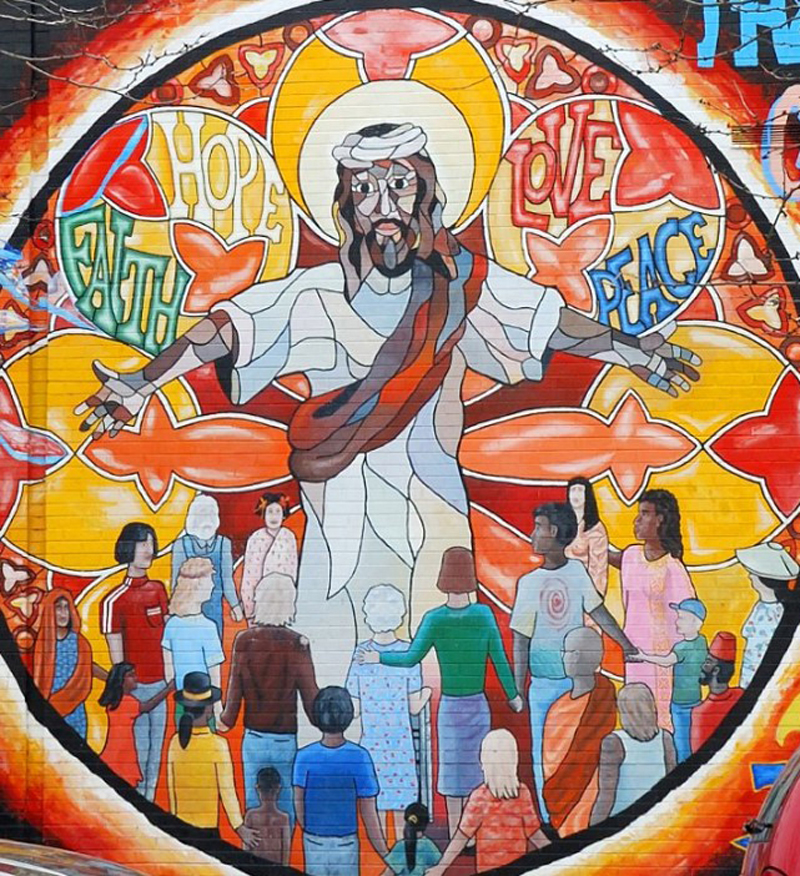
Image Attribution: Jesus Mural of Faith, Hope, Love, and Peace, from Art in the Christian Tradition, a project of the Vanderbilt Divinity Library, Nashville, TN. http://diglib.library.vanderbilt.edu/act-imagelink.pl?RC=56412 [retrieved August 29, 2020]. Original source: https://www.flickr.com/photos/36847973@N00/3342340183.


Time to Be Arrested — Lectionary Reflection for Pentecost 13A (Matthew 16)

Reflection reposted from August 26, 2014
Matthew 16:21-28— New Revised Standard Version (NRSV)

From that time on, Jesus began to show his disciples that he must go to Jerusalem and undergo great suffering at the hands of the elders and chief priests and scribes, and be killed, and on the third day be raised. 22 And Peter took him aside and began to rebuke him, saying, “God forbid it, Lord! This must never happen to you.” 23 But he turned and said to Peter, “Get behind me, Satan! You are a stumbling block to me; for you are setting your mind not on divine things but on human things.”

Then Jesus told his disciples, “If any want to become my followers, let them deny themselves and take up their cross and follow me.25 For those who want to save their life will lose it, and those who lose their life for my sake will find it. 26 For what will it profit them if they gain the whole world but forfeit their life? Or what will they give in return for their life?28 Truly I tell you, there are some standing here who will not taste death before they see the Son of Man coming in his kingdom.”

**********            

Peter had just made the Good Confession.  He had declared Jesus to be the Messiah and the Son of the Living God.  In essence, he was saying:  “You’re the one we’ve been waiting for.”  You’re it; you’re our last hope.  I’ve heard something like that before.  I had just been called to serve as the pastor of a small, struggling congregation (not the one I currently serve).  I was told by one of the members– you’re our last hope.  I should have seen it coming – five years later we were still struggling (though we had as much money in the bank, if not more, than when I arrived) and a group in the church decided it was time to change pastors.  Since we were essentially in the same place as we were when I started there, perhaps there was still time to find another savior for the church.  Alas, that congregation is much smaller today than when I left, but it’s still alive.  Congregations are like that – they can hang on for years, clinging to life, while pastors come and go. As for Jesus’ contemporaries, they too had seen plenty of messiahs come and go.  These figures made promises, gathered followers, and subsequently ended up dead or dispersed, while their vision of hope perished with them. 

When Peter heard Jesus expand on how he envisioned the realm of God and his role in it, Peter was less than happy.  Suffering death didn’t seem like the best way to accomplish the goal of establishing God’s realm on earth.  Surely that’s not what God had in mind for him. Whatever Jesus meant by being raised the third day, sacrificing his life in Jerusalem at the hands of the political and religious elites surely wasn’t part of the plan. 

It’s important to remember in our day that in an earlier age political and religious entities were essentially one and the same.  As much as we might lament the Constantinian embrace, it was probably inevitable that a growing church would become a partner with the state.  Church and state would support each other for the good of the nation.  Monarchs were sacred figures, if not divine.  So, even if Jesus’ kingdom might not be of this world (John 18:36), whatever Jesus had to say about the kingdom of God had political implications.  Caiaphas understood that to be true and so did Pilate.  If God is king, and Jesus is the Son, then that leaves Caesar in a difficult place.

Think for a moment about the meaning of Jesus’ pronouncements against the Temple.  When Jesus spoke against it he wasn’t complaining about the way in which the priests were organizing the worship services.  He was challenging the religiopolitical system of the day.  When he decided to go to Jerusalem, he wasn’t thinking that he would make a better offering than the usual sacrifices.  In going to Jerusalem and preaching the Gospel of the Kingdom, he was challenging the system that included both political and religious components.  The job of the priests, in the eyes of the Roman overlords, was keeping the peace.  Since the time of Constantine, the church has often kept the eyes of the people on the blessings of heaven, so they might forget that they have been exploited by those in power.

Now Peter wasn’t really happy with Jesus’ assessment of the future. If Jesus was the Messiah, and Peter was his right-hand man (he was the rock after all), then Peter did have hopes for a place of importance in the coming realm ().  This assessment must have been even more troubling when Jesus suggested that the same fate would befall his followers.  If you want to be my followers, then pick up the cross.  And if you pick up the cross, you’re probably going to end up on it.  To hinder it, apparently, is satanic.

Dietrich Bonhoeffer notes that Peter’s words of rebuke to Jesus show that “from its very beginning the church has taken offense at the suffering Christ.  It does not want that kind of Lord, and as Christ’s church it does not want to be forced to accept the law of suffering from its Lord.”  Not only that but “this is a way for Satan to enter the church. Satan is trying to pull the church away from the cross of its Lord” [ Discipleship (Dietrich Bonhoeffer Works, Vol. 4), 85].   We who are on the “progressive” side of the Christian spectrum may have trouble with the idea of Satan, but Bonhoeffer’s warning is important to hear.  There is always the temptation of complacency and self-satisfaction.  We can draw within ourselves, comfortable that we’re in good with Jesus even if the world continues to suffer.

What then is the nature of discipleship?  How costly is it? These questions came to mind the other day when I was attending a presentation on community organizing for religious folks – especially clergy  (note – meeting too place in August 2014).  Our presenter, the Rev. Dr. William Barber II, was talking about civil disobedience.  The question was posed — what am I willing to be arrested for?  You see, I’ve been actively involved in community organizing efforts for years.   In this work, I’ve engaged the political forces, but I’ve played it pretty safe.  I’ve not engaged in real civil disobedience.  I’ve not joined Jesus in turning over the tables in the Temples or the Capitol buildings.  I’ve gone to Lansing for rallies, and our organization has sent folks to Lansing to pray in the Capitol rotunda, but no one has gotten arrested (that I know of).   I have friends who have been arrested, but so far I’ve avoided that fate!  But, what am I willing to be arrested for?

As we contemplate that question, we have this word from Jesus who tells the disciples that if they want to save their lives, they have to lose them.  But, there is no value in gaining the world while forfeiting one’s life.  The issue here, it seems, is about the choices we make.  Are we willing to follow Jesus wherever he leads, even if that pathway leads to a cross?  Perhaps we have answered the question by domesticating it.  Jesus dies on the cross.  I’m forgiven.  All is good.  Now I can get on with my life!  As for Jesus, he’s already made his choice.  The question is – how will Peter choose?  The story continues, with the promise of the kingdom always present.  Some of those standing in the midst of Jesus “will not taste death before they see the Son of Man coming in his kingdom” (vs. 28).  When was that?  Could it be the resurrection?  If so, are we living in the midst of the kingdom?  Perhaps not in its fullness, but possibly it is making itself felt already.

Holding Fast to the Good — Lectionary Reflection for Pentecost 13A (Romans 12)

Romans 12:9-21 New Revised Standard Version

**************                

Let love be genuine; hate what is evil, hold fast to what is good; 10 love one another with mutual affection; outdo one another in showing honor. 11 Do not lag in zeal, be ardent in spirit, serve the Lord. 12 Rejoice in hope, be patient in suffering, persevere in prayer. 13 Contribute to the needs of the saints; extend hospitality to strangers. 

14 Bless those who persecute you; bless and do not curse them. 15 Rejoice with those who rejoice, weep with those who weep. 16 Live in harmony with one another; do not be haughty, but associate with the lowly; do not claim to be wiser than you are. 17 Do not repay anyone evil for evil, but take thought for what is noble in the sight of all. 18 If it is possible, so far as it depends on you, live peaceably with all. 19 Beloved, never avenge yourselves, but leave room for the wrath of God; for it is written, “Vengeance is mine, I will repay, says the Lord.” 20 No, “if your enemies are hungry, feed them; if they are thirsty, give them something to drink; for by doing this you will heap burning coals on their heads.” 21 Do not be overcome by evil, but overcome evil with good.

What is the good? According to Paul, it’s rooted in love. This love is meant to be genuine. So hate what is evil, but hold on to what is good. We live in challenging times. All across the globe, the powers of division and hate are on the rise. It often takes on political dimensions, but it runs much deeper. It seems to have taken root in our souls. I notice it in myself. There is anger in the air. While that is true, it’s not the anger that’s the problem. It’s the way we experience it. When I participated in community organizing training, the trainers emphasized the importance of channeling anger against injustice toward change. That is how I read the Black Lives Matter movement. It is a call to channel anger at injustice toward changing the status quo of white supremacy. I affirm this premise, but at the same time, love must guide how we engage the world. It is the love that comes from God that enables us to channel anger against injustice toward transformation. Now, the love that is required here, the love that Paul speaks of in this passage isn’t sentimentality. If we consider the two great commandments, love of God and neighbor go together, and the love of neighbor must involve seeking justice for our neighbor.

If we look back to the reading for the previous week (Romans 12:1-8) and focus on verse 2, we will hear Paul urging us not to be conformed to the patterns of this world or present age. Instead, he urges us to be transformed by the renewing our own minds. What follows in the reading for the thirteenth Sunday after Pentecost is a fuller expression of what this transformed life looks like.

What Paul describes here in verses 9-21 of Romans 12 is rooted in that opening declaration. It is a continuation of his urging of the followers of Jesus to present their lives to God as a living sacrifice, which is our logikos or reasonable worship. What Paul describes here is a different way of living than prescribed by the powers that be. It is a way of living marked by love, by grace, by forbearance. It is a call for hospitality to strangers and compassion for those in need. It’s realistic and yet hopeful.

                It’s realistic in that it recognizes that some will persecute the followers of Jesus, even if at this point there wasn’t any evidence of wide-spread persecution. Some of what Paul addresses here might be more internal than external since we’ve already seen Paul address in chapters 1-11 some of the internal disputes between Jewish and Gentile believers. Who he might have in mind here is not clearly defined, but whoever is being addressed, Paul tells them not to curse their opponents. It offers a realistic picture of life, in that it recognizes that some will do evil. While this is true, we are not to return evil for evil. Instead, live peaceably with one another.

Now when Paul wrote these directives, this emerging community was a powerless minority religious community. They lacked support and sponsorship from the government. They appeared to many in their communities to be a rather strange group. They had the markings of Judaism, and yet they were different. One reason for suspicion was that they failed to observe the religious traditions of their neighbors, which made them look unpatriotic. Offering sacrifices to the local gods was the equivalent of saying the pledge of allegiance. So, it’s no wonder this community faced persecution. They were dangerous. But Paul encourages them to leave things in the hands of God. He draws from Deuteronomy 32:35, in leaving vengeance in the hands of God. He draws as well from Proverbs 25:21-22, in suggesting that if we feed our hungry enemy or give drink to the thirsty enemy, we place burning coals on the enemy’s head. We may find the reference here to vengeance to be unsettling, but we feel that need to set things right. Paul says, leave it in the hands of God.  

               It is a word of hope, hope that is rooted in a community that is defined by love. In fact, Paul encourages the community to outdo each other in showing love for one another. We all enjoy a bit of competitive spirit, so what better way than through being zealous in our service of Christ through the love of one another. If there is to be hope as we move forward through these times, it will require a sense of community, a sense of belonging to something greater than ourselves. Hope is found in the community we call the body of Christ. And this hope is rooted in love, which as Rochelle Stackhouse points out is “energetic and profoundly optimistic, and rather countercultural in nature.” [Feasting on the Word, p. 16].

So, how do we live out these core values in our daily lives, so that we might demonstrate what the love of God revealed in Jesus Christ really looks like? Paul closes this selection with this admonition “Do not be overcome by evil, but overcome evil with good.” Perhaps we can think here in terms of what some call spiritual warfare. As Richard Beck reminds us that if we only think in terms of social justice as an expression of God’s calling, we will miss something deeper. We miss the deeper spiritual dimensions, which is why loves is required. Beck writes that “love is what prevents the political struggle from dehumanizing and demonizing flesh and blood” [Reviving Old Scratch, p. 61]. Thus, following Beck, “Spiritual warfare is putting love where there is no love. It is the action of grace in territory controlled by the devil, being true to love in a world that is cold and lonely and mean. It is the kingdom of God breaking into and interrupting our lives” [Reviving Old Scratch, p. 184]. Therefore, let us hold fast to what is good, as revealed in Jesus.

Heart with Cross, from Art in the Christian Tradition, a project of the Vanderbilt Divinity Library, Nashville, TN. http://diglib.library.vanderbilt.edu/act-imagelink.pl?RC=57557 [retrieved August 22, 2020]. Original source: https://www.flickr.com/photos/29807771@N02/5964131678 – liv4gss.

Transformed, Gifted, and Called to Service – Lectionary Reflection for Pentecost 12A (Romans 12)

Romans 12:1-8 New Revised Standard Version
 
12 I appeal to you therefore, brothers and sisters, by the mercies of God, to present your bodies as a living sacrifice, holy and acceptable to God, which is your spiritual worship. Do not be conformed to this world, but be transformed by the renewing of your minds, so that you may discern what is the will of God—what is good and acceptable and perfect. 
For by the grace given to me I say to everyone among you not to think of yourself more highly than you ought to think, but to think with sober judgment, each according to the measure of faith that God has assigned. For as in one body we have many members, and not all the members have the same function, so we, who are many, are one body in Christ, and individually we are members one of another. We have gifts that differ according to the grace given to us: prophecy, in proportion to faith; ministry, in ministering; the teacher, in teaching; the exhorter, in exhortation; the giver, in generosity; the leader, in diligence; the compassionate, in cheerfulness.
***********

                My friends, if you are followers of Jesus, present your bodies to God as living sacrifices, which is your spiritual worship. Be transformed as well by the renewal of your minds, so you can discern what is good, acceptable, and perfect. This call to offer our bodies and allow for our minds to be renewed includes the word “therefore.” In using this word, Paul seems to be telling us that what is to come is rooted in what he had written previously about God’s grace and righteousness. What is to come is rooted in Paul’s word of assurance to Gentile Christians that in Christ they get to share in the blessings that come with adoption into the family of God. So, now offer yourself to God. Make yourself useful. Think properly of yourself, because in God’s realm there’s no room for narcissism. So, think correctly of yourself and don’t be conformed to the things of this world, for you are numbered among those who have been transformed by the renewing of your minds.

                The way I read the call to offer our bodies as living sacrifices, is that Paul is reminding us that God wants our bodies as well as our minds. There might even be a bit of a warning, reminding these followers of Jesus that they might face persecution and even martyrdom as a result of their decision to follow Jesus. So, what does mean for us, living in the 21st century? How do we offer our bodies to God in a way that is an act of spiritual worship? Whatever the case, for Paul there is no distinction between the body and the Spirit, even as he reminds them and us not to be conformed to this world. As we consider Paul’s message here, it is wise to remember that he not only speaks to individuals, which is the common way for moderns to read texts like this but also to communities. Thus, as Sarah Heaner Lancaster notes, the word Paul offers here applies to the whole community, which “needs to discern and to enact together the will of God” [Lancaster, Romans, p. 206].

                In considering Sarah Lancaster’s word here about the community discerning together the will of God, I’m reminded of the title of David Gushee’s important book about the inclusion of members of the LGBTQ community in our congregations. He deliberately chose the title Changing Our Mind to reflect the corporate nature of this transformative moment.  So, he writes that the reason why he uses the singular “mind” rather than the plural “minds,” “because I believe the question that matters is whether the collective mind of the Church universal can and ought to change. The issue is not whether some Christians as individuals change their minds, but whether the Church universal will or should change its mind collectively. And that takes disciplined reflection together, in community, with all hands on deck making their best contribution” [Gushee, David P. Changing Our Mind: Definitive 3rd Edition of the Landmark Call for Inclusion of LGBTQ Christians with Response to Critics,  Read the Spirit Books, (Kindle Locations 473-476)].

                If Paul is writing not just to individuals, but also to communities as a whole, we can consider together what it means to belong in a community that Paul defines in terms of a body (as he does in 1 Corinthians 12 as well). In this community, there is no room for the ego because God assigns us to our duties through gifts. Know this, that in the body not every member has the same function. To say that doesn’t mean that some functions are more important than others. It simply means that we all have different gifts that enable us to fulfill our roles in the community.

                Paul’s discussion of gifts is much briefer here than in 1 Corinthians 12, but it is sufficient for its purpose. Paul reminds us that in the community we all need each other. As a pastor, I should know this. As the author of a book on spiritual gifts, I should be even more self-aware. However, I too cannot only seem myself as indispensable but act as if everything depends on me. To embrace this message of spiritual gifts is to think “with sober judgment.”

                What is true of congregations, and our place in them, but could this be extended to the church as a whole? Might we look at our diversity in terms of worship and governance and even theology as expressions of how the body is gifted and called? Therefore, we needn’t compete with each other. As one who has embraced an ecumenical vision, this is a welcome idea, for as Rochelle Stackhouse suggests “To apply the words of Paul throughout this passage to each of us n our roles in the body of Christ brings us to a sobering reflection on the dysfunctional body that may impede the enactment of God’s will in the world today. Reflecting on ecumenism within Paul’s framework of body metaphor brings hope and possibility to what too often seems an enterprise fraught with struggle.” [Feasting on the Word, 378].

                Returning to our relationships within a congregation, we can also take from this a reminder that in Paul’s mind to be a follower of Jesus is not a solo activity. We’re supposed to do this thing called Christianity together. I know it’s not easy. Congregations are made up of imperfect human beings. If we look around at the gathered community, to use a different metaphor, from a Christmas TV show, the church may be similar to the “Island of Misfit Toys.” And yet, in God’s grace and wisdom, this unique collection of individuals is incorporated into the one body of Christ, which is empowered by the Spirit. In 1 Corinthians 12, in a lengthier conversation about spiritual gifts, Paul reminds the community that “to each is given the manifestation of the Spirit for the common good” (1 Cor. 12:7). Gifts of the Spirit are not intended for individual use. They have their place in the community, which is called to bring good news to the world.

                So, let’s use the gifts that God has given to the church: if “prophecy, in proportion to faith;  ministry, in ministering; the teacher, in teaching;  the exhorter, in exhortation; the giver, in generosity; the leader, in diligence; the compassionate, in cheerfulness” (Rom 12:6-8). If we include the references in 1 Corinthians 12 and Ephesians 4, we can expand the list. And in my estimation, and as I’ve tried to demonstrate in my book Unfettered Spirit: Spiritual Gifts for the New Great Awakening, even this expanded list doesn’t cover all the possibilities. All of this begins in God’s grace, but for it to fully express itself, we will need to offer ourselves up to God as a living sacrifice. To conclude, to gain a fuller understanding of these gifts and their role (our roles) in the body, I will recommend reading Unfettered Spirit.


God’s Irrevocable Covenant – Lectionary Reflection for Pentecost 11A (Romans 11)

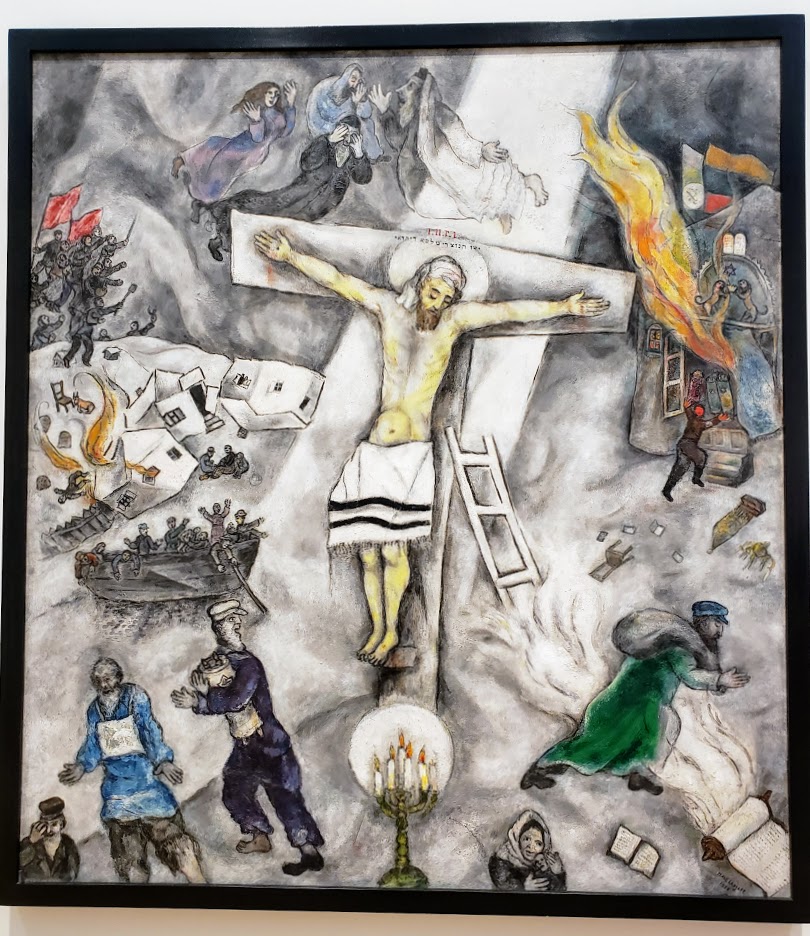
Marc Chagall, White Crucifixion — Art Institute of Chicago


Romans 11:1-2a, 29-32 New Revised Standard Version

11 I ask, then, has God rejected his people? By no means! I myself am an Israelite, a descendant of Abraham, a member of the tribe of Benjamin. 2 God has not rejected his people whom he foreknew.  

29 for the gifts and the calling of God are irrevocable. 30 Just as you were once disobedient to God but have now received mercy because of their disobedience, 31 so they have now been disobedient in order that, by the mercy shown to you, they too may now receive mercy. 32 For God has imprisoned all in disobedience so that he may be merciful to all.

*****************

One of the many stains on Christian history is the ongoing presence of anti-Judaism. I use this term instead of anti-Semitism because this term has racial connotations that are modern in origin. Over the years I’ve become increasingly sensitized to the legacy of anti-Jewish views in the church. We can argue whether this is rooted in the New Testament itself or its interpretation through the ages, the fact is, it continues to be present in our churches, even in scholarly efforts. The readings from Romans 9-11 allow us to reflect on this legacy. That is especially true of this reading from Romans 11, which, in my mind, makes clear that Christianity has not replaced Judaism and that God’s covenant with Judaism continues unabated. Therefore, we must repent of this legacy and seek to do everything we can to change the way we relate to the Jewish community.
In the reading from Romans 9, which we examined earlier, Paul expressed his anguish that his Jewish siblings had not embraced the message of Jesus. Even as he preached the Gospel to Gentiles, he hoped that Jews would join him. That reading can give us the impression that God had dissolved the covenant with Israel, but in today’s reading, we discover that this is a wrong impression. Paul might have wished that all Jews took up the cause of Jesus, as he had, but in the end, he must admit that God has not rejected God’s people Israel. This, Romans 11 is an important witness to God’s commitment to the covenant made first with Abraham and later with Moses.
The lectionary provides us with two excerpts from Romans 11. The first excerpt encompasses the opening verses of the chapter. Paul asks a rhetorical question: “has God rejected his people?” He answers that question in the negative by noting his own relationship to Judaism. God hasn’t rejected him, so God hasn’t rejected Israel. He lays claim to the covenant promise as an Israelite, a descendant of Abraham, and more specifically as a member of the tribe of Benjamin. In other words, he has done his genealogical work. He lays claim to this heritage. So, whatever happened on the road to Damascus, Paul didn’t convert from Judaism to Christianity (Christianity didn’t exist yet as a separate entity). He was a Jew both before and after that encounter with Jesus. If Paul was already intent on converting Gentiles to his vision of God, then what changed out there on the road to Damascus was his understanding of the path Gentiles would take in experiencing salvation. While Paul sees himself tasked with preaching to Gentiles, no doubt he was hoping that both Jews and Gentiles would be found in this newly emerging Jesus community. The issue isn’t whether the Torah has value. The question is whether adherence to aspects of Torah, such as circumcision was necessary for Gentile believers.
When we read Paul’s letters, we discover his dilemma. He wanted to reach Gentiles and draw them into the new community. He seems to have understood that circumcision may have impeded full conversion. So, he set it aside, though not everyone in the community agreed. Thus, in his attempts to defend himself he gave the impression that he had rejected Judaism. While there are mixed messages in his letters, Paul makes it clear in this passage that he was not rejecting his Jewish heritage. Perhaps the problem isn’t with Paul but in the way his later interpreters have read him?
As we drop down to the second part of the reading, verses 29-32, the message that Paul brings is that God’s covenant promises are irrevocable. It can’t be any clearer. That’s a message we need to hold tightly to. We should step back one verse, though to get a true sense of what Paul is doing here. In verse 28 he writes:   As regards the gospel they are enemies of God for your sake; but as regards election they are beloved, for the sake of their ancestors; . . . .” This word comes after Paul has already declared in verse 26 that all Israel will be saved. So, what does Paul mean here? Sarah Heaner Lancaster puts her finger on the issue at hand, pointing out that Israel can be God’s enemy and God’s beloved at the same time, because in “refusing to acknowledge the way God is working in Jesus Christ, Israel does not give honor to God, and so they are ‘enemies’ of God.”  But, because, as we read in verse 29, God’s gifts and calling are irrevocable, “God honors the covenant with the patriarchs. The chosen people have always been and always will be beloved. Although God used their refusal for the sake of the Gentiles, God will not forsake Israel” [Lancaster, Romans, p. 198]. It may seem rather complicated, but God will be faithful to the covenant, even if the rejection of Jesus by a majority of Jews spurred on Paul’s mission, God will stay true to the covenant.
The good news is that Gentiles get to share in the salvation of God. We also (speaking as a Gentile) have been included in the covenant people through Jesus. So, even if we stray or become disobedient, God is merciful and gracious. That might not always sit well with us, any more than it sat well with Paul’s opponents. But that is the way of God who has been revealed to us in and through Jesus.
The lectionary reading ends with verse 32, but as Sarah Heaner Lancaster points out, the verses that follow contain a hymn that celebrates the difference between our ways and God’s ways. Thus, “the grandness of God exceeds anything that we may know, and we are not in a position to understand the mind of God or the ways God achieves God’s purposes. The richness of God is the genuine mystery” [Lancaster, Romans, pp. 199-200]. So, I close with that hymn:

  O the depth of the riches and wisdom and knowledge of God! How unsearchable are his judgments and how inscrutable his ways! 

34 “For who has known the mind of the Lord?
Or who has been his counselor?”
35 “Or who has given a gift to him,
to receive a gift in return?” 

36 For from him and through him and to him are all things. To him be the glory forever. Amen.  (Rom. 11:33-36).


Room for Doubt — Lectionary Reflection for Pentecost 10A (Matthew 14)

Matthew 14:22-33 —New Revised Standard Version

22 Immediately he made the disciples get into the boat and go on ahead to the other side, while he dismissed the crowds. 23 And after he had dismissed the crowds, he went up the mountain by himself to pray. When evening came, he was there alone, 24 but by this time the boat, battered by the waves, was far from the land, for the wind was against them. 25 And early in the morning he came walking toward them on the sea. 26 But when the disciples saw him walking on the sea, they were terrified, saying, “It is a ghost!” And they cried out in fear. 27 But immediately Jesus spoke to them and said, “Take heart, it is I; do not be afraid.”

28 Peter answered him, “Lord, if it is you, command me to come to you on the water.” 29 He said, “Come.” So, Peter got out of the boat, started walking on the water, and came toward Jesus. 30 But when he noticed the strong wind, he became frightened, and beginning to sink, he cried out, “Lord, save me!” 31 Jesus immediately reached out his hand and caught him, saying to him, “You of little faith, why did you doubt?” 32 When they got into the boat, the wind ceased. 33 And those in the boat worshiped him, saying, “Truly you are the Son of God.”

************

Our reading this week from the Gospel of Matthew is one that would have caught the attention of David Hume. Hume was a skeptic. He didn’t trust anything he hadn’t experienced himself or had it on good authority of someone he trusted having a particular experience. He was open to new truths, they just had to be provable. Therefore, he would have had trouble with a story about someone walking on water. He would ask us to consider the likelihood of someone walking on water. Have you either walked on water yourself or seen someone walk on water? No, he didn’t trust the testimony of a two-thousand-year-old book.

So, if you’ve never seen someone walk on water then how can you believe that either Jesus or Peter did so? Now, Hume might agree that in their fear the disciples could have projected an image of Jesus walking on the water, but would that be enough to get Peter, who had never walked on water (assuming that humans don’t walk on water), out of the boat on trying to walk himself? Surely, if he tried, as soon as he put his foot outside the boat he would have sunk. Therefore, Hume would conclude this was all a myth. It might have metaphorical value but not historical value.

 This story is one of the best known in the Gospels. It has permeated our cultural mindset so that when too much is asked of us, we ask why people think we can walk on water. After all, we’re not divine beings (and Hume was skeptical about the existence of divine beings), so why should we be expected to walk on water? Of course, some, less skeptical types, have used the text to beat folks over the head for their lack of faith and unwillingness to “get out of the boat.” Years ago, when I was teaching theology at a bible college in Kansas, this story seemed to be a “favorite” of our chapel speakers. These speakers tended to be youth ministers who appealed to the story to call on the students, (and I suppose, we professors as well) to get out of the boat. Don’t doubt, don’t resist God, but get out of the boat and join me in whatever it is I think is the most important concern at the moment.

                Of the two options above, I’d probably side with Hume. After all, isn’t there a place for a little doubt and even skepticism in the life of faith? So, granting that I’ve never seen anyone walk on water, and thus can’t prove the validity of the story, how might we receive this story? We might start by remembering that in the ancient world the sea was often symbolic of chaos and danger (note the storm that shook even this group full of experienced fishermen). Jesus comes to them as the one who has power over the chaos (walks on the waters) and then calms them. Though fearful at first, once Peter recognizes Jesus, he wants to get out of the boat and join Jesus on the water. It’s true, Peter could be impulsive, but at least for a moment, his faith overcame his fear.

                After Peter got out of the boat, he began to sense the power of the wind whipping around him. At that moment, he forgot he was actually walking on water. With his focus now on the wind, he lost his focus on Jesus and began to sink. How often is this true for us? We begin to focus on the noise around us, get distracted by it, and lose our focus on Jesus.

                Yes, Peter began to have his doubts. I expect given the situation, I would have my doubts. I might act impulsively at first, and then realize I hadn’t thought this thing through. I probably would sink as well.

               So, Peter had his doubts, which leads Jesus to ask him why he had so little faith? I think Jesus might have been a little harsh with him, but the question is a good one for us. How much faith is enough? Is a little faith sufficient? If we are saved, that is made whole, through grace, which we receive through faith, how much do we need? Perhaps the good news here is not whether Peter had enough faith, but whether Jesus is willing to embrace us no matter the level of our faith. Remember that Jesus doesn’t leave Peter floundering in the water. He pulls him up and into the boat. If the waves and the winds of this story represent the challenges of our lives, it’s possible that we will step out on faith, flounder, and require a little help from the one who is present with us by the Spirit and calms the waters of life.

                Do we all experience a bit of doubt in life? Do we lose focus? Do we have questions that require answers? Yes to all of these questions, which are important ones. In the end, the question is not whether we doubt, but whether it causes debilitating injury to our souls. When that happens, we need the salvific healing presence of God, which comes to us, Paul says in confessing Jesus as Lord (Romans 10:9).  As for the disciples who stayed in the boat, once Jesus calmed the waters and joined them, they bowed in worship and confess “Truly you are the Son of God.”

                Perhaps we can hear in this story a reminder that despite the possibility of doubt, we can step out in faith. We can take some risks. We may sink, but Jesus is there to catch us. At this moment when the winds of change are whipping around us, a bit of doubt-filled risk-taking might be needed. So, maybe those impetuous youth ministers who liked this story were on to something!

Picture attribution: Tanner, Henry Ossawa, 1859-1937. Disciples See Christ Walking on the Water, from Art in the Christian Tradition, a project of the Vanderbilt Divinity Library, Nashville, TN. http://diglib.library.vanderbilt.edu/act-imagelink.pl?RC=55904 [retrieved August 5, 2020]. Original source: http://commons.wikimedia.org/wiki/File:Henry_Ossawa_Tanner,_The_Disciples_See_Christ_Walking_on_the_Water,_c._1907.jpg.


Robert Cornwall is the Pastor of Central Woodward Christian Church in Troy, Michigan. He holds the Ph.D. in Historical Theology from Fuller Theological Seminary. He is the author of a number of books including Out of the Office (Energion, 2017), Marriage in Interesting Times (Energion, 2016), and Freedom in Covenant (Wipf and Stock, 2015) and blogs at Ponderings on a Faith Journey.

Proclaiming Good News and Making Confession of Faith – Lectionary Reflection for Pentecost 10A (Romans 10)

Romans 10:5-15 New Revised Standard Version
 

Moses writes concerning the righteousness that comes from the law, that “the person who does these things will live by them.” But the righteousness that comes from faith says, “Do not say in your heart, ‘Who will ascend into heaven?’” (that is, to bring Christ down) “or ‘Who will descend into the abyss?’” (that is, to bring Christ up from the dead). But what does it say? 

“The word is near you,


    on your lips and in your heart” 


(that is, the word of faith that we proclaim); because if you confess with your lips that Jesus is Lord and believe in your heart that God raised him from the dead, you will be saved. 10 For one believes with the heart and so is justified, and one confesses with the mouth and so is saved. 11 The scripture says, “No one who believes in him will be put to shame.” 12 For there is no distinction between Jew and Greek; the same Lord is Lord of all and is generous to all who call on him. 13 For, “Everyone who calls on the name of the Lord shall be saved.” 

14 But how are they to call on one in whom they have not believed? And how are they to believe in one of whom they have never heard? And how are they to hear without someone to proclaim him? 15 And how are they to proclaim him unless they are sent? As it is written, “How beautiful are the feet of those who bring good news!”

***************

                It’s done differently in different faith communities, but if we’re part of a faith community at some point in our lives we’ll be asked to confess our faith. It might be during baptism or confirmation. It might take place weekly in worship as communities recite one of the creeds. Even in non-creedal churches, like mine, we still find ways of confessing our faith in God. It could be in our hymns, our prayers, or in our sharing at the table.

In the reading from Romans 10, which is designated for the Tenth Sunday after Pentecost (Proper 14A), reference is made to both the confession of faith and its proclamation. Both of these actions require, words spoken either in a confession of faith or in the proclamation of that faith. The reading opens with a reference to Moses, righteousness, and the Law. Paul is in the midst of a lengthy section of his letter dealing with the Law, which he contrasts with faith. He’s concerned about the fact the majority of his fellow Jews haven’t had a “come to Jesus” moment. He suggests that they have embraced righteousness that comes through the Law, but he wants them to embrace righteousness that comes through faith.

Paul is focused on a righteousness that comes through faith. That concern leads to this word about confession. He takes up a quotation from Deuteronomy 30:14, as the springboard for what follows: “The word is near you, on your lips and in your heart.” With that reference in mind, I want to move to references here to confession and proclamation. Again, whatever we say here has to stay clear of supersessionism. Paul has concerns about his own people, but we shouldn’t take up that part of Paul’s concerns. For Paul, the righteousness that comes through faith is available to everyone.

With the reference to Deuteronomy 30 that speaks of the word that is on our lips and in our heart, which is the “word of faith that we proclaim,” we hear that if we confess with our lips that Jesus is Lord and believe in our hearts that God raised him from the dead we will be saved. That is the starting point. This confession is a bit more detailed than Peter’s confession in Matthew 16, but it’s similar.

Salvation, according to Paul, requires a heart-felt confession of faith in Jesus. It begins with a public confession of faith in Jesus, whom we proclaim as Lord. Even non-creedal communities make this creedal confession. But, it’s not enough to recite words. We have to take them to heart. He’s not interested in what is called a cultural Christianity that is only skin deep.  Thus, to confess Jesus as Lord is to say that he defines who we are in relationship to God and one another. What does this mean? suggests that for Paul the focus will move from watching the boundaries to living out of the center. She writes:

The Christian faith creates an entirely new geometry. The circle of believers that was once defined by its boundaries, the law, is now defined by its center, Christ. The attention to who is in and who is out is no longer the focus. Rather the focus is on the One who calls and claims, redeems and loves. We are called to start in the center and live as though the circle is infinite—which, of course, it is.  [Martha Highsmith, “Pastoral Perspective,” Feasting on the Word, p. 328].

To live from the center doesn’t make the life of faith any easier than living with an eye to the boundaries, it simply changes the focus.

While Paul is often portrayed as a rather narrow figure, if we pay attention to his words, he is focused not on exclusion but inclusion. Notice that in Christ there is no distinction between Jew and Greek. Those boundaries have been removed so that the two can come together as one body. If we listen closely to this word, we likely will hear voices of dissension within the community. The concern here might be the integration of Jew and Gentile Christians. We know from elsewhere, including Galatians, that Paul is dealing with this challenge. So, he wants to move the focus from the externals to Jesus, whom God raised from the dead.

In our day we continue to struggle with inclusion. Our churches remain segregated along racial/ethnic lines. We remain divided along theological lines as well. The Eucharistic Table, which should be a place of inclusion remains a place where not all Christians are yet able to gather. We’ve discovered that true unity as Christians is difficult to achieve and maintain. It will remain a challenge until we have faced the realities of our world. Until we affirm the premise that Black Lives Matter, we cannot truly say that All Lives Matter. For we who are white and inhabit predominantly white churches, the same is true of our LatinX, Asian, and LGBTQ siblings. Let us then take to heart Paul’s declaration that “Everyone who calls on the name of the Lord shall be saved.”

As we sort out these realities, seeking to live into the center, we hear a call to proclaim the news about Jesus. After all, “how are they to call on one in whom they have not believed? And how are they to believe in one of whom they have never heard?” (Rom 10:14). Then comes word to the church, how will they hear if no one is sent out to proclaim the good news? To top it off, Paul draws a word from Isaiah 52:7, though he edits it for his purposes, to speak of the beauty of the feet of those who proclaim the good news. This leads to a further question, what does mission look like in the twenty-first century? How do we proclaim the good news that focuses more on dialog than conversion, especially when it comes to Jewish Christian relations? Sarah Heaner Lancaster suggests that “dialogue allows Christians to bear witness to faith in Jesus Christ as we explain what we understand to be the significance of Jesus for ourselves and the world, but such witness is made without a feeling of superiority or attempts to coerce belief. Dialogue also requires listening to Jews express their own convictions and insights. It includes being willing to listen as pain and fear from centuries of persecution or personal discrimination are expressed” [Lancaster, Romans, p. 181].  In this, there is good news!

Robert Cornwall is the Pastor of Central Woodward Christian Church in Troy, Michigan. He holds the Ph.D. in Historical Theology from Fuller Theological Seminary. He is the author of a number of books including Out of the Office (Energion, 2017), Marriage in Interesting Times (Energion, 2016), and Freedom in Covenant (Wipf and Stock, 2015) and blogs at Ponderings on a Faith Journey.


A Hidden Abundance — Lectionary Reflection for Pentecost 9A (Matthew 14)

A Hidden Abundance — Lectionary Reflection for Pentecost 9A (Matthew 14)

Lectionary Reflection — reposted from July 29, 2014.

Matthew 14:13-21 New Revised Standard Version (NRSV)

13 Now when Jesus heard this, he withdrew from there in a boat to a deserted place by himself. But when the crowds heard it, they followed him on foot from the towns. 14 When he went ashore, he saw a great crowd; and he had compassion for them and cured their sick. 15 When it was evening, the disciples came to him and said, “This is a deserted place, and the hour is now late; send the crowds away so that they may go into the villages and buy food for themselves.” 16 Jesus said to them, “They need not go away; you give them something to eat.” 17 They replied, “We have nothing here but five loaves and two fish.” 18 And he said, “Bring them here to me.” 19 Then he ordered the crowds to sit down on the grass. Taking the five loaves and the two fish, he looked up to heaven, and blessed and broke the loaves, and gave them to the disciples, and the disciples gave them to the crowds. 20 And all ate and were filled; and they took up what was left over of the broken pieces, twelve baskets full. 21 And those who ate were about five thousand men, besides women and children.

***************

There is only one miracle story that is found in all four gospels, and that is the feeding of the 5,000 – plus the women and children.  Whatever happened that day, it caught the imagination of the Gospel writers.  We can debate over whether an actual – factual – miraculous event occurred in which Jesus multiplied a few loaves of bread and a few fish to feed thousands.   To do so likely misses the point of the story.  As Brian McLaren suggests, when it comes to miracle stories, perhaps we should consider a third alternative viewpoint, which stands apart from the traditional yes and no arguments.  Instead “we could ask another question What happens to us when we imagine miracles happening?”  That is, what does this story do to us now?  How does it challenge our assumptions and imaginations?  Thus:

Perhaps, by challenging us to consider impossible possibilities, these stories can stretch our imagination, and in so doing, can empower us to play a catalytic role in co-creating new possibilities for the world tomorrow. [McLaren, We Make the Road by Walkingp. 97].

Keeping in mind Brian McLaren’s suggestion about a story like this playing a catalytic role in creating new possibilities for the world, what might we hear in this passage for today?  Consider for a moment that in Matthew’s gospel, this story follows immediately after Herod has had John the Baptist executed.  Jesus, knowing that his co-conspirator in proclaiming the realm of God has been killed, wants to get away from the crowds, so he can regroup.  Could he be next?  His attempt to get away – to go on vacation – fails.  Jesus’ inability to get away reminds me of what it must be like to be President.  Stuff just follows after the President.  He can’t let down, even for a moment, or someone will criticize him.  Besides, he takes with him a team of advisors.  I’m reminded too of how President Lincoln found it necessary to get away from the White House just so he could think about what was happening in the war effort.  So it is with Jesus.  He needs to find a quiet place, a place in the wilderness.  He even takes a boat so he can evade the crowds.  But his efforts to find a secluded spot falter.  When he sees them, he has compassion for them, and he begins to heal their sick.

As the day began to wind down, the disciples began to get anxious about the crowd.  They had to be hungry, and a hungry crowd can be an unruly one.  Fear is setting in.  So, they encourage Jesus to bring the healing session to a close and send them off to the surrounding villages, so they can find something to eat.  We can understand their concern.  Anyone who is tasked with logistics understands that you have to make sure things don’t get out of hand.

Jesus, as you might imagine, has other ideas.  Although he had refused to turn stone into bread to feed himself, he was willing to provide nourishment for those who had come to him seeking his blessing.  Doing this was, of course risky.  People can get used to such things – as John reminds us (John 6).  They can get the wrong idea, especially if they think you’re the one who will rescue the nation from its current overlords.  At this moment in time, as Matthew tells the story, Jesus isn’t too worried.  Instead, he tells the disciples to feed the crowd.   Yes, he tells them, you feed them.  They’re flabbergasted.  How does Jesus expect them, twelve guys, who can scrounge up just five loaves of bread and a couple of fish between them, to feed this massive crowd?

Jesus won’t be deterred by their groans (don’t you hear the groans between the lines?).  He simply asks them to give an account of what they have.  They say they have nothing, but they do have something.  They have five loaves of bread and two fish.  Jesus tells them to give what they have to him.  He looks up into the heavens, acknowledging God’s presence, gives thanks, blesses it, and then he gives the disciples this food and invites them to distribute it to the crowd.  With that many people, this would take a bit of time.  When they finish, Jesus asks them how it went.  Did they have enough to feed everyone?  Was it like a typical church potluck, where there’s always more food than people?  Amazingly they had more food after the feeding than before.  How that happened, Matthew doesn’t say.

This story invites us to consider the hidden abundance that is in our midst.  I don’t know how Jesus did it.  Was it a miracle?  Or did Jesus set the example for those who had brought food for themselves, never intending to share, but finding it appropriate to share what they had once Jesus started the distribution?  Again, we’re not told how it happened, only that everyone ate, was filled, and there was more food left over than when they began.

What about us?  What about the hidden abundance that is present in our midst?  Do we feel as if there is nothing in the pantry, or is there enough present to be used by God to bless others?   As I think about this story, I’m reminded of the children who have come to our borders from Central America.  They’re fleeing poverty and violence back home.  Some of the children are as young as six.  They’ve traveled hundreds of miles, often sitting on the top or sides of trains.  They’ve risked death to make it to the Promised Land.  Some hope to be reunited with family.  Others simply hope that their journey will lead to a better life.   What would Jesus say to them?   Would he turn them away or would he say to us on this side of the border – you feed them.  You clothe them.  You house them.  We say, but what about the cost.  We can’t afford it.  There are too many problems here at home.  What would Jesus say to us, as we down a second helping of dessert?   There are no easy solutions to the crisis at the border or to the challenges facing our urban centers and rural heartlands.  There is plenty of poverty here at home – but the challenges of the border don’t prevent us from handling these crises.  We’ve been ignoring them long before these children showed up at the border.

The story of the feeding of the 5000 falls not just after the death of John, but in Matthew’s version, it comes after Matthew has laid out his collection of parables of the kingdom.  He has shown us through Jesus’ words what the kingdom looks like (Matthew 13).  Now, in a series of miracles we see additional signs of the kingdom.  There is healing, there is feeding, there is power.  How do these stories release our imagination?  How do they dislodge the hidden resources so that they can be brought forth and used for the good of the kingdom?

The way in which Jesus goes about feeding the 5000 should evoke in our hearts and minds the image of the Eucharist.  In the story of the Last Supper, Jesus takes bread, blesses it, and gives it to the disciples.  They are told to continue the practice, eating and drinking, in memory of Jesus.  As we share bread with our neighbors, are we not remembering Jesus?  Does not the act of giving serve as an act of thanksgiving?  Should we not begin to see the sacramental table of the Lord being an open one that takes many forms – including the soup kitchen or welcoming the children knocking at our borders?

Picture attribution — Swanson, John August. Loaves and Fishes, from Art in the Christian Tradition, a project of the Vanderbilt Divinity Library, Nashville, TN. http://diglib.library.vanderbilt.edu/act-imagelink.pl?RC=56553 [retrieved July 28, 2020]. Original source: http://www.JohnAugustSwanson.com – copyright 2003 by John August Swanson.


An Elect People — Lectionary Reflection for Pentecost 9A (Romans 9)

Romans 9:1-5 New Revised Standard Version (NRSV)
 

I am speaking the truth in Christ—I am not lying; my conscience confirms it by the Holy Spirit— I have great sorrow and unceasing anguish in my heart. For I could wish that I myself were accursed and cut off from Christ for the sake of my own people, my kindred according to the flesh. They are Israelites, and to them belong the adoption, the glory, the covenants, the giving of the law, the worship, and the promises; to them belong the patriarchs, and from them, according to the flesh, comes the Messiah, who is over all, God blessed forever. Amen.

********************

                This reading from Romans is a bit truncated. It starts with a lament and concludes with a word of thanksgiving, but it feels like something is missing. It feels like there is more to this story than has been revealed in these opening lines of chapter nine. The truth is, there is more to the story. This is the opening paragraph of a conversation about the relationship of the emergent Christianity with its Jewish parentage. It is the kind of reading that lends itself to supersessionism. So, we must tread carefully.

                If we remove verses 1-3, we celebrate Israel’s chosenness. To Israel belongs adoption, glory, covenants, the law, worship, promises patriarchs. Indeed, even the Messiah (the Christ) belongs to Israel, at least according to the flesh. So, blessed be God. If this is true, then why is Paul expressing his great sorrow and anguish? If we follow the story into verse six, we get a sense of why he might be filled with sorrow. Though Israel is the elect of God, not all Israelites belong to Israel. That is, Paul is suggesting that spiritual descent, rather than physical descent is what counts in determining whether one belongs to Israel.  “This means that it is not the children of the flesh who are the children of God, but the children of the promise are counted as descendants” (Rom. 9:8). Here is where the trouble begins, at least for interpreters of Paul’s Roman letter.

                We need to read these verses with the larger context of Romans 9-11 in mind. Paul is grieving because his people, Israel, did not fully embrace Jesus as Messiah. At points in these chapters, it may appear that Paul is suggesting that God has abandoned the original covenant. While he gives that impression at points, in the end, he is clear that the covenant is everlasting (Rom. 11:29). Nevertheless, there is a lot of turmoil yet to be experienced.

Truth be told, these are difficult chapters to interpret, which means there is a lot of room for misinterpretation and misapplication, including support for anti-Judaism and antisemitism. It does appear that the rejection of Jesus as messiah has its consequences, which is why Paul is grieving. Nevertheless, in the end, Israel will be saved. We might start with the premise that while Paul heard the call to proclaim the Gospel to the Gentiles, he hadn’t forgotten Israel. So, he wrestles with the question of where Israel fits into this new work of God. He’s already affirmed in chapter 8 that nothing can separate us from the love of God in Christ Jesus. Certainly, that applies to his fellow Jews (Rom 8:38-39). As Kyle Fedler notes “the key to today’s lectionary text is 9:6, which is really just a restatement of 8:38-39. Indeed, this verse is the key to Romans 9-11: ‘It is not as though the word of God had failed.’” [Feasting on the Word, p. 306]. While the reading ends with verse 5, it is wise to continue reading, to be reminded that while we may be unfaithful, God is always faithful to the covenant. We might want to think in terms here of Paul’s feelings about the reluctance of the majority of Jews to adopt his messianic vision. He believes there are consequences to this rejection of Jesus, though not eternal ones.

                So, what should we make of this reading? It is brief and a bit ambiguous. What message might it have for us? One takeaway that we must avoid is the suggestion that has plagued Jewish-Christian relations for two millennia. That suggestion is that God has rejected the Jews in favor of Christians as the new people of God. God will remain committed to the covenant whether or not the people remain faithful.

                One word we hear in these opening lines is Paul’s sense of solidarity with his people. He wished they would respond as he had, but he doesn’t separate himself from his people. He celebrates the blessings that belong to the Jewish people, including the covenant and the messiah who emerged from within this people to bless the broader world. So, we who are Gentiles can read this as a reminder that the blessings that come to us as followers of Jesus have their origins in the Jewish people, who gave us Jesus the Messiah.

                Might we, following Karl Barth, hear in this a word about the church as being counted as among the elect of God without displacing Israel? Barth suggests in his commentary that in making this statement Paul is reluctantly breaking with the Pharisees. There is a sadness here, but he is part of a new community, the church. But, perhaps the word to us, as the church is that we should not take our place in God’s realm for granted. As Barth puts it: “In so far as ‘God’ is that which we, in the company of all other men, can know and define and worship, the assertion stands. In so far,  however, as God is He that ruleth all things,  there is embedded in the assertion a doubt, nay more, a complaint and an accusation: God does not belong to the Church.” [Barth, Epistle to the Romans, p. 339].

                Perhaps that is the word we should take to heart here, as the Church. God doesn’t belong to us. We don’t possess God. God transcends our grasp. Perhaps that means we don’t get to control access to God. As Grace Ji-Sun Kim puts it: “God remains in control and will accomplish God’s redemptive purposes. The missional life of Christians is expressed by how we live, share, and work for justice with others who are also God’s people” [Preaching God’s TransformingJustice, p. 344]. That, I believe, is a word worth hearing!