Category: Uncategorized

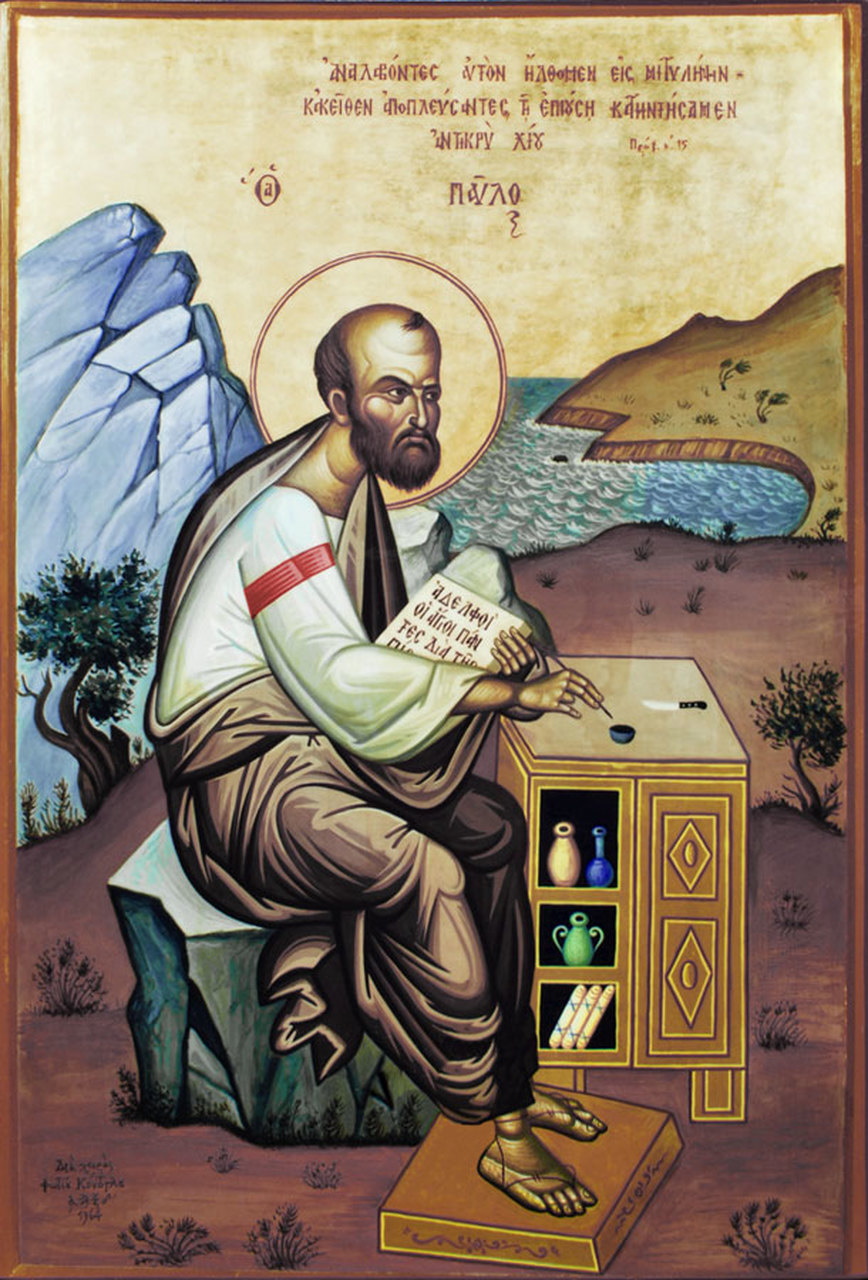
The Crown of Glory – Lectionary Reflection for Pentecost 22A (1 Thessalonians 2)


1 Thessalonians 2:9-20  New Revised Standard Version

9 You remember our labor and toil, brothers and sisters; we worked night and day, so that we might not burden any of you while we proclaimed to you the gospel of God. 10 You are witnesses, and God also, how pure, upright, and blameless our conduct was toward you believers. 11 As you know, we dealt with each one of you like a father with his children, 12 urging and encouraging you and pleading that you lead a life worthy of God, who calls you into his own kingdom and glory.

13 We also constantly give thanks to God for this, that when you received the word of God that you heard from us, you accepted it not as a human word but as what it really is, God’s word, which is also at work in you believers. 14 For you, brothers and sisters, became imitators of the churches of God in Christ Jesus that are in Judea, for you suffered the same things from your own compatriots as they did from the Jews, 15 who killed both the Lord Jesus and the prophets, and drove us out; they displease God and oppose everyone 16 by hindering us from speaking to the Gentiles so that they may be saved. Thus, they have
constantly been filling up the measure of their sins; but God’s wrath has
overtaken them at last.

17 As for us, brothers and sisters, when, for a short time, we were made orphans by being separated from you—in person, not in heart—we longed with great eagerness to see you face to face. 18 For we wanted to come to you—certainly I, Paul, wanted to again and again—but Satan blocked our way. 19 For what is our hope or joy or crown of boasting before our Lord Jesus at his coming? Is it not you? 20 Yes, you are our glory and joy!


****************

                Paul speaks to the Thessalonians as a father speaks to his children (vs. 11). What we are tasked by the Lectionary to read/reflect upon here (vs. 9-13) is a continuation of the reading from the previous week, where Paul revealed that God had entrusted the gospel to them (Paul and companions). Thus, the reading here reinforces the earlier message concerning their mission in Thessalonica and beyond. Paul affirms their being witnesses, along with God, of the diligence with which Paul and his companions proclaimed the Gospel in Thessalonica. As noted in the opening verses of the chapter, Paul reminded them that he and his companions hadn’t proclaimed the gospel with false motives or out of concern for financial gain. They didn’t even take advantage of their rights as apostles (vs. 5-7). In other words, they weren’t hirelings. They were servants of God’s mission in the world.  

                As noted, the Revised Common Lectionary limits the reading for the week to verses 9-13. It’s understandable that verses 14-16 are omitted (there are unfortunate words regarding the Jews), but it seemed to be important to take a look at the remainder of the chapter to better understand Paul’s words here in verses 9-13.

The centerpiece of this week’s reading is the nature of the Gospel proclamation. Paul commends the Thessalonians for receiving their message not as a human word, but as the word of God. In describing their message as a divine rather than human word, Paul isn’t implying that their message was somehow inerrant or infallible (these categories are rather modern and thus not something Paul would have even considered). Rather they were speaking to their belief that God’s word had been made known in Thessalonica through their ministry. In other words, God speaks through human voices and words. There is good news here. The word has been heard and embraced by some (that’s the locus of the selected reading), but there is also opposition (the remainder of the chapter). Both exist and must be addressed. In the end, however, Paul commends them as being his crown when Jesus returns.

                The concept of the “word of God” is problematic. That’s because too often this phrase is applied solely to Scripture, when in fact the phrase is used in multiple ways. First and foremost, the term Word (Gk. Logos) is used in reference to Jesus, who is understood to be the Word (Logos) of God incarnate (Jn.1:1-14). In several places in the Book of Acts, the phrase is used in terms of the proclamation of the Gospel. That is the case here, where Paul has in mind the act of preaching/proclamation. The variety of ways this phrased is used has led me to embrace Karl Barth’s well-known articulation of the principle of the “three-fold Word of God.” As I’ve noted in a book on this question, Barth has proven very helpful in my own theological journey. Barth writes in the first volume of his Church Dogmatics

Proclamation is human speech in and by which God Himself speaks like a king through the mouth of his herald, and which is meant to be heard and accepted as speech in and by which God Himself speaks, and therefore heard and accepted in faith as divine decision concerning life and death, as divine judgment and pardon, eternal Law and eternal Gospel both together. [Church Dogmatics, 1:1:52].

Of course, Barth, and I assume Paul would agree, recognizes that not all preaching reflects God’s message. However, both men recognize that God can speak through human messengers, and thus preaching can be a conduit of God’s word.  

                Having made this clear, speaking as a father to his children, Paul urges the readers to live lives worthy of God, “who calls you into his own kingdom and glory” (vs. 12). This is a good place to pause and note that while Paul places great emphasis on God’s grace received by faith, he is also concerned about conduct (behavior), which might be understood as works. Therefore, he gives thanks that the Thessalonians received their word as the word of God and that this word is at work in their midst.

                Having taken note of this gracious word on Paul’s part, we now must take note of a most problematic word concerning the Jews. In verses 14-16 Paul commends them for being imitators of the churches in Judea who had suffered persecution from “the Jews,” even as they were suffering similarly.  We need to remember that contextually Paul understands his message being directed at reaching Gentiles. He finds any interference in that work problematic (at the very least). This leads to an unfortunate rebuke of his fellow Jews, who had opposed the Churches in Judea and had done the same in Thessalonica. If we remember that this letter was written several decades before the Book of Acts, we might want to take note of Acts 17, where Luke tells us of Paul and Silas’ visit to Thessalonica. In that passage, Paul is said to go and preach in the synagogue concerning Jesus. While some followed Paul, along with devout Greeks and leading women, “the Jews became jealous,” and along with some ruffians in the community attacked Jason for hosting them. That led Paul to head off to Berea and then Athens. This might be what Paul is referring to, but we can’t be certain.

                Living in a post-Shoah world, where the murder of millions of Jews along with others, has forced the church to be attentive to texts that have been and can be used to justify persecution and even murder of Jews. In a sidebar in the Jewish Annotated New Testament, we read this reminder: “These verses present a succinct summary of classical Christian anti-Judaism: the Jews killed Jesus, persecuted his followers, and threw them out of the synagogues; they are xenophobic and sinners, and God has rejected and punished them. The harshness of these words raises questions about Paul’s attitude toward his fellow Jews” [Jewish Annotated New Testament, p. 374].

There have been suggestions among scholars that this sounds less like Paul and more like a later Gentile scribal insertion. While that makes some sense, especially since it doesn’t fit well with what Paul writes in Romans 9-11, where he affirms that God has not rejected the Jewish people. The problem with this suggestion is that there is no textual support for such a conclusion. In any case, whether these are Paul’s words or not, unfortunately, the damage has been done and the passage can be and has been used to justify anti-Jewish views and behavior. It would seem that Paul is trying to encourage his spiritual children to persevere in the face of
opposition and even persecution. Contextually, this might be understandable when one is in a minority position. However, in a different context, when Jews are the minority voice, this can be dangerous.

                Having commended them for hearing and embracing their message as God’s word to them, and having encouraged them as they experience persecution, the chapter closes with Paul letting the community know that he wants to visit them. Unfortunately, Satan had blocked their way time and again. The reference to Satan’s interference reminds us that Paul viewed the world in supernaturalist/apocalyptic terms.  As John Byron notes: “Although Paul does not explain what Satan did to hinder him, he has an acute sense that his freedom of movement was curtailed, and viewing the situation on a supernatural level, determined that Satan was interfering with the seen world.” [Benjamin E. Reynolds. The Jewish Apocalyptic Tradition and the Shaping of New Testament Thought (p. 249). Fortress Press. Kindle Edition]. Despite the supernatural interference (however that transpired), Paul celebrates their faith. They are his hope and joy, and the “crown of boasting before our Lord Jesus at his coming.” That is, when Jesus comes in his glory to judge the living and the dead, Paul can stand before Jesus and point to them as being his crown of glory and joy!  
Entrusted with the Gospel — Lectionary Reflection for Pentecost 21A (1 Thessalonians 2)

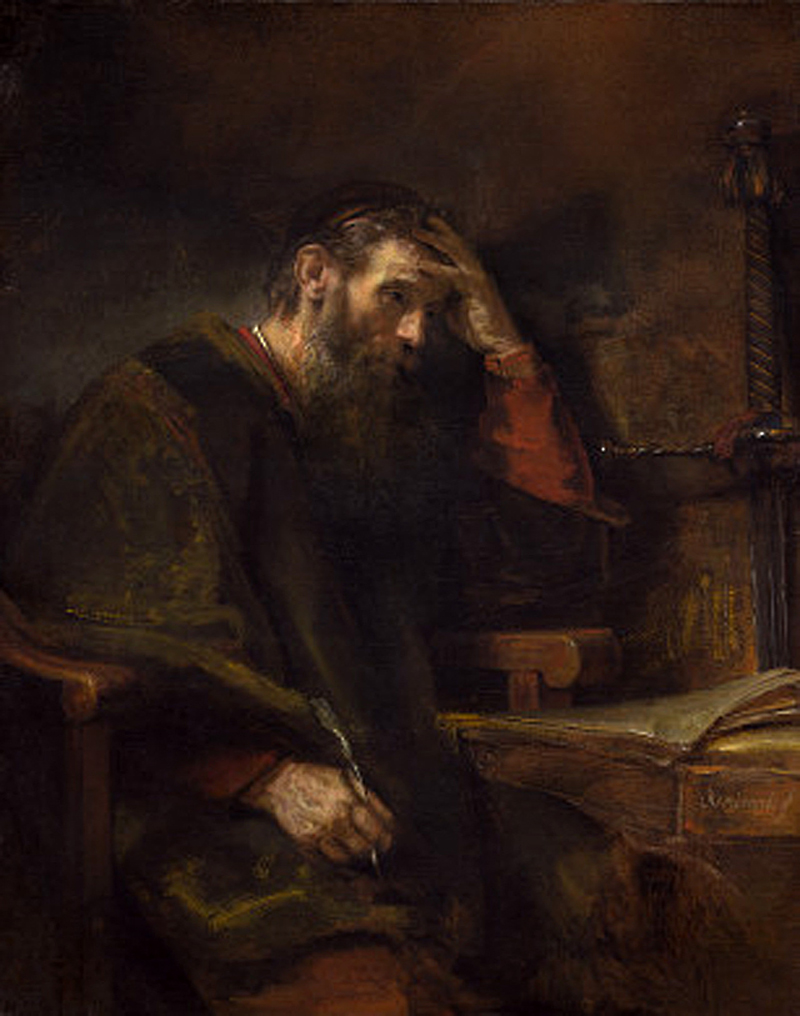
Apostle Paul – Rembrandt

1 Thessalonians 2:1-8 New Revised Standard Version

2 You yourselves know, brothers and sisters, that our coming to you was not in vain, 2 but though we had already suffered and been shamefully mistreated at Philippi, as you know, we had courage in our God to declare to you the gospel of God in spite of great opposition. 3 For our appeal does not spring from deceit or impure motives or trickery, 4 but just as we have been approved by God to be entrusted with the message of the gospel, even so we speak, not to please mortals, but to please God who tests our hearts. 5 As you know and as God is our witness, we never came with words of flattery or with a pretext for greed; 6 nor did we seek praise from mortals, whether from you or from others, 7 though we might have made demands as apostles of Christ. But we were gentle among you, like a nurse tenderly caring for her own children. 8 So deeply do we care for you that we are determined to share with you not only the gospel of God but also our own selves, because you have become very dear to us.

***********

                Having commended the Thessalonians for their receipt of the message of Jesus, as brought to them by Paul and his companions, in chapter one, now Paul speaks of his role in this process in chapter two. He is thankful that the time spent in Thessalonica wasn’t in vain. Even though they had been mistreated at Philippi before they arrived in Thessalonica (see Acts 16 for the report of the imprisonment of Paul and Silas), Paul and his companions courageously (boldly) proclaimed the Gospel in Thessalonica despite great opposition (See Acts 17). Paul makes clear that he and his companions were not deterred by opposition from their task of proclamation.

In this chapter, Paul addresses the question of motives. It’s not clear whether there were questions about his motives, but in any case, he wanted to make it clear that he and his companions hadn’t come to Thessalonica with impure motives or made their appeal for the Gospel through deceit or trickery. Whether or not they had been accused of something, with all the religious/spiritual options that were before the people, surely at least a few of the purveyors of these spiritualities were less than upfront about their motives. Thus, Paul simply wanted to be transparent about who he was and what he and his companions were doing. Thus, Paul wasn’t engaged in people-pleasing religious trickery. He had answered the call of God and was making known the message entrusted to him and his companions by God.

Religion then and now can be a business proposition. Religious organizations offer certain goods in exchange for some form of compensation (after all we take offerings each week and engage in stewardship campaigns). When it comes to compensation provided to religious professionals, I’m not suggesting that we are doing something unethical by receiving salaries or honorariums. Paul himself affirmed the principle in his first Corinthian letter. He might have chosen not to receive financial support from the churches, he noted that the Lord had “commanded that that those who proclaim the gospel should get their living by the gospel (1 Cor. 9:12-14).  Whatever Paul’s reasons for not making use of his rights, the larger point is that money shouldn’t be the motive for ministry.

As we meditate on this passage it might be that what Paul is claiming here is a recognition that he and his companions had been called to act as stewards of the Gospel. They didn’t invent it nor did they possess it. They were simply tasked with making the message of Jesus known to those who were prepared to listen. With this calling in mind, Paul could speak of being apostles. When Paul speaks here of being apostles, he’s not thinking so much in terms of office by in terms of missionary calling. While Paul does at certain points make it clear that he is an apostle in the formal sense, having been visited and called by Jesus (Gal. 1:11-24), that isn’t what he has in mind here. For not only is he given an apostolic calling, but so have Silvanus (Silas) and Timothy.

                Getting back to motives, Paul notes that in engaging in this work, he wasn’t acting out of greed. This wasn’t a financially lucrative career he had undertaken. He and his companions probably traveled on foot. They faced opposition and even imprisonment. He didn’t own a Lear jet or a massive motor home so he and his crew could travel in comfort. As far as I know, this missionary group didn’t live in mansions either. Most of us who have accepted the call to serve in vocational ministry haven’t done this for the money. Now, I will admit to living a decent middle-class life, but like most of my colleagues, I don’t make the big bucks! That was true for Paul as well.

As for methodology in proclaiming the message, Paul notes that he didn’t use flattery. He was straightforward in his messaging. His preaching came with boldness, in large part because he wasn’t seeking human praise. The only audience he sought approval from was God. Thus, his boldness was rooted in his trust in God.

                While Paul claimed to proclaim the message with boldness; when it came to his relationship to the Thessalonian congregation, he spoke to them with gentleness. It should be noted that some manuscripts suggested that the “were infants among you.” That would suggest not just gentleness, but great vulnerability. As noted by Beverly Roberts Gaventa, the “Greek words for ‘infants’ (Gr. nēipoi) and ‘gentle’ (Gr. ēipoi) consists of a single letter so that a scribe might easily confuse the two words” (Gaventa, First and Second Thessalonians, pp. 26-27). While the scholars are not of one mind, and there are arguments on both sides, for my purposes both possibilities offer a sense of Paul’s softer side. We see this in the following statement, where Paul suggests that they tenderly cared for them as a nurse for her children. Here again, there is an intriguing concept. As Gaventa notes, in that era of ancient history it was quite common for wet nurses to be used—not only for the wealthy but even by slaves (so that they wouldn’t be sidelined from their duties). Whatever the case, wet nurses were both common and beloved in that world. With this in mind, Paul’s use of the concept suggests an “image of loving concern.” But note, Paul refers to a nurse “caring for her own children.” While wet nurses might be beloved figures in the ancient world, the relationship between a nursing mother and her own children was even greater. Thus, “verse 8 serves to unpack what is implicit in the nurse metaphor: the apostles regard the Thessalonians as so dear that they share with them their very selves” [Gaventa, First and Second Thessalonians, pp. 27-28].

                The lectionary reading ends with this maternal image, which Paul uses to describe his own relationship to the community. This was unusual for the era, though not without precedent. The use of this maternal imagery is helpful in understanding Paul’s vision of ministry. His view of ministry isn’t rooted in seeking personal fame or fortune. Rather it is one expressed in deep love and care for the community, which in this case, he birthed. After all, this is his congregation, one he founded. Of course, ultimately, Paul knows that they, as children of God, are dependent not on him, but God alone.  

  Rembrandt Harmenszoon van Rijn, 1606-1669. Apostle Paul, from Art in the Christian Tradition, a project of the Vanderbilt Divinity Library, Nashville, TN. http://diglib.library.vanderbilt.edu/act-imagelink.pl?RC=55240 [retrieved October 18, 2020]. Original source: http://www.nga.gov/fcgi-bin/tinfo_f?object=1198.

Joy in Challenging Times – Lectionary Reflection for Pentecost 19A (Philippians 4)


Philippians 4:1-9 New Revised Standard Version

4 1 Therefore, my brothers and sisters, whom I love and long for, my joy and crown, stand firm in the Lord in this way, my beloved.

2 I urge Euodia and I urge Syntyche to be of the same mind in the Lord. 3 Yes, and I ask you also, my loyal companion, help these women, for they have struggled beside me in the work of the gospel, together with Clement and the rest of my co-workers, whose names are in the book of life.

4 Rejoice in the Lord always; again I will say, Rejoice. 5 Let your gentleness be known to everyone. The Lord is near. 6 Do not worry about anything, but in everything by prayer and supplication with thanksgiving let your requests be made known to God. 7 And the peace of God, which surpasses all understanding, will guard your hearts and your minds in Christ Jesus.

8 Finally, beloved, whatever is true, whatever is honorable, whatever is just, whatever is pure, whatever is pleasing, whatever is commendable, if there is any excellence and if there is anything worthy of praise, think about these things. 9 Keep on doing the things that you have learned and received and heard and seen in me, and the God of peace will be with you.

***********

                This is one of the most cherished passages in Scripture. Even if you’re not a fan of Paul, You have to embrace his encouragement to rejoice in the Lord always. Though it might seem odd to heed the call to be joyful in challenging times, like what has imposed itself on the world in 2020. While there is a place for lamentation, Paul seems to believe that there is also room for joy in difficult times. After all, he’s writing this letter from a jail cell (Phil. 1:7). So, here in the concluding chapter of Paul’s Philippian letter, written from prison to a community facing some form of persecution, Paul invites them to rejoice in the Lord always. In fact, he doubles down on that invitation, declaring “again I will say, Rejoice” (vs. 4). So, because the Lord is near (I take that to mean Jesus’ return in glory), “do not worry about anything, but in prayer and supplication with thanksgiving let your requests be made known to God” (vs. 6).

                It’s clear that things aren’t going perfectly in Philippi. There appears to be some conflict going on, but not, it doesn’t seem, at the same level as what we find present in some of Paul’s other letters. Nevertheless, Paul seems to have reason to be concerned, which is why he keeps encouraging these beloved followers of Jesus who formed a church Paul had founded to keep focused on what is true and honorable. As we’ve seen, Paul wants them to keep focused on Jesus, whose humility can be the foundation for their unity (Phil. 2:5-11). He also offers himself as an example (Phil. 3:17).

Here in this concluding chapter, Paul speaks specifically to two women, Euodia and Syntyche, who appear to be at odds. We don’t know the background or nature of the conflict, but Paul wants them to be of the same mind. Therefore, he not only urges them to come together but also asks his unnamed loyal companion—perhaps Epaphroditus, who is mentioned as Paul’s companion and likely member of the Philippian community (Phil 2:25-30)—to help them resolve their differences. I should note that these two women are recognized by Paul as being coworkers with him for the Gospel, so they are important to him. This reality again reinforces the message that whatever Paul has to say about joy and peace in this passage, it is said in the context of challenging times both for him and for the Philippian congregation.

                As noted above, I write this reflection while the world is experiencing its own set of challenges that seem to keep piling on top of each other. First of all, the world is in the midst of a pandemic that has sickened tens of millions and killed hundreds of thousands of those inflicted, with the numbers in the United States outstripping every other country. That same pandemic has forced many of us into forms of isolation we’ve never experienced before. We miss the simple things like going to a restaurant or a movie without fearing the possibility that we might be exposed to the virus. Then there is church, where something as simple and joy-inducing as singing has been put on hold. We are also in the midst of a racial reckoning, that is forcing the nation to wrestle with the implications for our society of the deaths of African Americans at the hands of police (George Floyd and Breonna Taylor, among others) and vigilantes (Ahmaud Arbery). These deaths have led to months of protests that have yet to let up. We’re also in one of the most contentious and dispiriting election seasons most of us have ever seen. Many Americans fear that we are nearing the end of democracy in this nation. So, how do you find joy in moments like this? Where do you find peace? The answer is certainly not to be found in our cultural context.

                Note that Paul invites them to “rejoice in the Lord” and not in their circumstances. He encourages them to exhibit gentleness in their relationships. He tells them not to worry, but to be in prayer. This isn’t Paul’s version of that Bobby McFerrin song: “Don’t worry, Be Happy.” It’s not a call for blissful ignorance, as if there’s nothing to worry about. Instead, it is an encouragement to put one’s trust in God. Let us remember that Paul is writing this from a prison cell. Death is, perhaps, a possibility. There is persecution of some sort going on. Nevertheless, Paul enjoins them to rejoice in the Lord. As Martin Luther declared in a sermon on this passage, “Joy is the natural fruit of faith.” He continues in the sermon, making mention of Paul’s doubling down on the call to rejoice, declaring:

It is essential that we rejoice. Paul, recognizing that we live in the midst of sin and evil, both which things depress, would fortify us with cheer. Thus rejoicing, even if we should sometimes fall into sin, our joy in God will exceed our sorrow in sin. The natural accompaniment of sin truly is fear and a burdened conscience, and we cannot always escape sin. Therefore we should let joy have rule, let Christ be greater than our sins.  [Martin Luther].

This invocation of joy is powerful, but trusting God isn’t always easy, even for those whom we are told are paragons of faith. My Bible Study group is reading the stories in Genesis about Abraham. While he’s held up in Hebrews 11 as a paragon of faith, if you read the Abraham story closely, Abraham doesn’t always exhibit faith in God. Consider that even though God has promised to provide Abraham a son through Sarah (Genesis 17 and18), in Genesis 20 he passes her off as his sister. Only God’s intervention prevents disaster. Nevertheless, Paul encourages the Philippians to rejoice and let the peace of God, which surpasses understanding, guard their hearts and minds.  

                Though Paul encourages them to put their trust in the God who brings peace to their lives, he’s not encouraging them to be passive in their behavior. The reading closes with a call to action. Paul encourages this beloved community to focus their attention on what is honorable, just, pure, pleasing, commendable, excellent, and that which is worthy of praise. From there, he asks that the “keep on doing the things that you have learned and received and heard and seen in me” (vs. 9). In other words, while he commended them to look to Jesus for a model of the Christian life (Phil. 2:5-11), he’s not afraid to offer himself up as a role model. All of this begins in prayer so that the God of peace might be with us. Therefore, let us rejoice in the Lord, always!

Image attribution: Longview Christian Church. Joyful, joyful, we adore thee, from Art in the Christian Tradition, a project of the Vanderbilt Divinity Library, Nashville, TN. http://diglib.library.vanderbilt.edu/act-imagelink.pl?RC=55774 [retrieved October 4, 2020]. Original source: http://www.flickr.com/photos/8328367@N08/2949605288.

Walking Humbly with Jesus – Lectionary Reflection for Pentecost 17A (Philippians 2)

Philippians 2:1-13  New Revised Standard Version

If then there is any encouragement in Christ, any consolation from love, any sharing in the Spirit, any compassion and sympathy, make my joy complete: be of the same mind, having the same love, being in full accord and of one mind. Do nothing from selfish ambition or conceit, but in humility regard others as better than yourselves. Let each of you look not to your own interests, but to the interests of others. Let the same mind be in you that was in Christ Jesus,

who, though he was in the form of God,
    did not regard equality with God
    as something to be exploited,
but emptied himself,
    taking the form of a slave,
    being born in human likeness.
And being found in human form,
    he humbled himself
    and became obedient to the point of death—
    even death on a cross.

Therefore God also highly exalted him
    and gave him the name
    that is above every name,
10 so that at the name of Jesus
    every knee should bend,
    in heaven and on earth and under the earth,
11 and every tongue should confess
    that Jesus Christ is Lord,
    to the glory of God the Father.

12 Therefore, my beloved, just as you have always obeyed me, not only in my presence but much more now in my absence, work out your own salvation with fear and trembling; 13 for it is God who is at work in you, enabling you both to will and to work for his good pleasure.

***********

                As we open chapter two of Paul’s letter the Philippians, what find is a continuation of a thread that begins in verse twenty-seven of chapter one, in which Paul tells his readers to live their lives in a manner worthy of the Gospel. He asked them to stand firm in one spirit and strive together in one mind for the gospel (Phil. 1:27). Now, he takes this word of guidance a step further by offering Jesus as our example of what it means to live a life worthy of the Gospel. In pointing our attention toward Jesus, he calls on the congregation to live humbly. He asks them not to consider themselves better than others. In fact, they should do nothing from selfish conceit. If they follow this word of guidance, they’ll make Paul’s joy complete. By following the example of Jesus they’ll be of the same mind, have the same love, and be in full accord. It is a call to unity in the Spirit of Christ that requires walking humbly with Jesus. This is expressed by looking after the interests of others, rather one’s own.

While we don’t see the same kind of conflict present in this letter as some of the others, there are hints that the community might not always be on the same page. Perhaps it’s due to persecution or some other matter. Later in the letter, Paul refers to Euodia and Syntyche, who are being urged to be of one mind. Paul asks his companion (perhaps the bearer of the letter) to help these women whom Paul acknowledges as having struggled alongside him for the gospel (Phil. 4:2-3). While Paul does give an explicit explanation, the original readers understand. What we do know is that Paul offers Jesus as the model for the Christian life, and that model is one of humility and even self-sacrifice.  

                Just a caveat here. It’s possible to take this too far and not consider one’s own welfare. We need to set boundaries so that we don’t get abused by others. Now, Paul might not agree with that caveat, but we’ve learned the need for a bit of balance lest we burn out or get run over. That being said, we can hear Paul’s word concerning a way of life that imitates Jesus, a word that he inhabits in his imprisonment due to his work on behalf of Jesus.

                Standing at the center of the passage is a hymn, or what looks like a hymn, since most translations lay it out in hymnic form. It’s possible Paul wrote it, but it’s more likely that it’s a well-known hymn in the circles of Paul’s churches. It’s a bit like me quoting from a hymn like “Amazing Grace,” which the congregation will know and love and be able to understand its meaning.

The initial vision presented by the hymn is kenotic. It envisions Jesus being in some form divine, and seemingly pre-existent (this would fit with John’s prologue—John 1:1-14). Nevertheless, despite his original form, he doesn’t exploit this equality with God. Instead, he humbles himself, taking on the form of a human, even that of a slave. That is, Paul envisions Jesus taking the lowest form in society, and from that form revealing God’s vision of salvation. There would be exaltation, but first, there must be the act of taking on human form and identifying with the lowliest members of society. This act of identification with humanity is understood to be an act of obedience that would take him to the cross.

I refer here to the theological word “kenosis” because it is pregnant with meaning. It speaks of emptying oneself of one’s prerogatives, glory, and even divine status. It gives room for divine-human interaction, and in this case for our salvation. Karl Barth suggests that in this act of emptying of himself of his divine glory, Jesus “puts himself in a position where only he himself knows himself in the way that the Father knows him.” Any act of revelation will come from the Father. [Epistle to the Philippians, 63]. The message here to the Philippians is this: If Jesus was in a position of equality with God the Father, and he let go of it so that he might experience human life even to the point of suffering death on a cross, then shouldn’t they be willing to follow suit?

           Of course, this is not the end of the story. What occurs in the first verse of the hymn, the humiliation of Jesus, is reversed in the second verse of the hymn (vs. 9-11), wherein God exalts Jesus by raising him from the dead and seating him at the right hand of God. As he ascends to this exalted status, every knee bends before him and every tongue confesses that he is lord. All of this is to the glory of God, from whom he descended and then ascended. Jesus is exalted, but he doesn’t exalt himself. The same true for us.

           While this passage doesn’t provide us a fully developed trinitarian vision, since such a vision can’t be found in the New Testament, you can see the foundations of such a vision here. While, unlike in John’s prologue, there isn’t a reference to the logos here, the hymn may presuppose some form of preexistence, that later theologians could build upon. But Paul isn’t so much interested in laying out a theological argument on the divine nature of Jesus as he is attempting to provide a foundation for living the Christian life in a way that reflects the person of Jesus who was willing to sacrifice all for others, a sacrifice that led to his exaltation through the resurrection. In other words, leave the work of exaltation to God!          If we take Jesus, who though having equality God, thought it not necessary to hold onto, but emptied himself of that glory, taking on human life, then surely we can follow his example in our lives. As we do, we can work out our salvation with fear and trembling, knowing that it’s God who is at work in us, enabling us to “work for his good pleasure.”

Living the Gospel – Lectionary Reflection for Pentecost 16A (Philippians 1)

Philippians 1:20-30 New Revised Standard Version

20 It is my eager expectation and hope that I will not be put to shame in any way, but that by my speaking with all boldness, Christ will be exalted now as always in my body, whether by life or by death. 21 For to me, living is Christ and dying is gain. 22 If I am to live in the flesh, that means fruitful labor for me; and I do not know which I prefer. 23 I am hard pressed between the two: my desire is to depart and be with Christ, for that is far better; 24 but to remain in the flesh is more necessary for you. 25 Since I am convinced of this, I know that I will remain and continue with all of you for your progress and joy in faith, 26 so that I may share abundantly in your boasting in Christ Jesus when I come to you again.

27 Only, live your life in a manner worthy of the gospel of Christ, so that, whether I come and see you or am absent and hear about you, I will know that you are standing firm in one spirit, striving side by side with one mind for the faith of the gospel, 28 and are in no way intimidated by your opponents. For them this is evidence of their destruction, but of your salvation. And this is God’s doing. 29 For he has graciously granted you the privilege not only of believing in Christ, but of suffering for him as well— 30 since you are having the same struggle that you saw I had and now hear that I still have.

************

                Paul’s Philippian letter was written from prison. We don’t know when and where this imprisonment is taking place, whether early or later in his ministry. Whatever is the case, this letter is written to a community that Paul founded and for which he has great affection. Unlike the Galatian and Corinthian churches, this one doesn’t appear to be conflicted, though it may be experiencing some form of persecution. We turn to Paul’s letter to the Philippians after the lectionary has taken us through a large swath of Paul’s letter to the Romans, a community that unlike the Philippian congregation Paul had no prior connection. As for Philippians, this is the first of four readings from Philippians.

We see the depth of Paul’s connection to the Philippian church in the opening section of the letter, where Paul offers a word of thanksgiving. He writes: “I thank my God every time I remember you, constantly praying with joy in every one of my prayers for all of you, because of your sharing in the gospel from the first day until now” (Phil. 1:3-5). Philippians is often referred to as an epistle of joy. Even though Paul is in prison, he is joyful, in part, because of this community.

                This city that hosts this congregation is found in Macedonia. It’s named after Philip II, father of Alexander the Great, and sits near the northern coast of the Aegean. It is here that Paul met Lydia, who hosted his first church plant in the city (Acts 16:11-15). From whence Paul is writing is unknown, only that he’s in prison. Whatever the case the when and where really doesn’t impact our reading, Paul faced several imprisonments.

                When we come to our reading, we find Paul confessing that whether he lives or dies is in the hands of God. He’s comfortable with his fate, either way, his goal is to proclaim the message of Jesus with boldness in life and death. As he writes to them, if he lives, well, he has lots of work to do. If he dies, he’ll be with the Lord. He doesn’t know which he prefers. He desires to depart and be with God, while that might be better for him, it is better for the church in Philippi that he stays alive. Now that might sound a bit arrogant as if he’s indispensable. It may sound like that, but that’s not the intent. He simply wants them to know that he’s there for them. But, as we see in the opening of the letter, he cares about these people. There is a deep connection between them, and he wishes to encourage them, no matter his situation. His hope then, is that he continues to live so he can be with them once more and share in the joy of their friendship. Then when they reconnect, he can share in their “boasting in Christ Jesus” due to the progress of their faith (vs. 24-25).

                Having expressed his undying commitment to their welfare, he then builds upon that by encouraging them to live their lives in a way that is worthy of the gospel. Therefore, whether he’s able to rejoin them or not, he can hear the word that they remain “firm in one spirit, striving side by side with one mind for the faith of the gospel, and are in no way intimidated by your opponents” (vs. 27-28a). In this statement, it’s clear that this community is experiencing some form of opposition, even persecution. Paul can’t protect them, but he can stand with them.

                Perhaps this is an apt word for the church in these times. Here in the United States, we’re not experiencing overt opposition from the community, unless you don’t like restrictions placed on churches due to the coronavirus (my state hasn’t imposed any restrictions, but many of us have applied them to ourselves). Indeed, some in the community might not appreciate our positions on issues? My congregation has chosen to be “open and affirming,” and has made inclusion a key component of our identity. Occasionally someone will live a message on the phone or Facebook page letting us know that we are not following the Bible. However, no one has prevented us from sharing our message. In other parts of the world, of course, the church does face persecution, and to be a Christian might even risk death.

                I appreciate the word that Mike Graves offers here regarding Paul’s dilemma regarding whether to live or die, Paul makes it clear that no matter where he resides, he ultimately lives in Christ.  The recipients of this letter may reside in Philippi, but they also live in Christ. While it might look like Paul longs for the next life, according to Mike, Paul “is not preoccupied with the next world to the neglect of this one; rather, he lets his firm belief in the next world fuel his living in this one. His hope for the Philippians is that they will do the same” [Feasting on the Wordp. 91]. While there is an apocalyptic dimension to Paul’s message, he is not “so heavenly minded,” that he’s “of no earthly good.”

Paul may long to be in the presence of God, but in the meantime, he focuses on life in this world, encouraging his readers to live their lives in a way that is worthy of the Gospel. This may include suffering for their faith. This has been Paul’s lot in life, and in Paul’s mind, it goes with the territory. Again, we might not suffer for our faith, but Paul would encourage us to take the necessary risks to speak to the concerns of the day even if that approach leads to opposition, imprisonment, and even death. It is good to remember that, according to the Book of Acts, Paul and Silas were arrested and imprisoned after they healed a slave girl of her bondage to a demon, even though that bondage made her master great sums of money, and so following the lead of the Book of Acts, Paul’s readers would know how Paul experienced imprisonment (Acts 16:16-24).

                Here in this reading, by embracing the possibility that death is in front of him, Paul can boldly live his faith. He has a proper confidence, not in himself, but in Christ Jesus, whom he serves. Thus, he can declare that “Christ will be exalted now as always in my body, whether by life or by death” (vs. 20b). In this, there is joy.

Who Am I to Judge? Lectionary Reflection for Pentecost 15A (Romans 14)

Who Am I to Judge? Lectionary Reflection for Pentecost 15A (Romans 14)

Judgment Day – Aaron Douglas
 
Romans 14:1-12 New Revised Standard Version
 

14 Welcome those who are weak in faith, but not for the purpose of quarreling over opinions. Some believe in eating anything, while the weak eat only vegetables. Those who eat must not despise those who abstain, and those who abstain must not pass judgment on those who eat; for God has welcomed them. Who are you to pass judgment on servants of another? It is before their own lord that they stand or fall. And they will be upheld, for the Lord is able to make them stand. 

Some judge one day to be better than another, while others judge all days to be alike. Let all be fully convinced in their own minds. Those who observe the day, observe it in honor of the Lord. Also, those who eat, eat in honor of the Lord, since they give thanks to God; while those who abstain, abstain in honor of the Lord and give thanks to God. 

We do not live to ourselves, and we do not die to ourselves. If we live, we live to the Lord, and if we die, we die to the Lord; so then, whether we live or whether we die, we are the Lord’s. For to this end Christ died and lived again, so that he might be Lord of both the dead and the living. 

10 Why do you pass judgment on your brother or sister? Or you, why do you despise your brother or sister? For we will all stand before the judgment seat of God. 11 For it is written, 

“As I live, says the Lord, every knee shall bow to me,


    and every tongue shall give praise to God.” 


12 So then, each of us will be accountable to God.


***************
 

                Pope Francis raised a few eyebrows when in an impromptu conversation with the press on board his plane in 2013, he responded to a question about his view of homosexuality in the church, he simply said: “Who am I to judge?” Now, the church’s policies haven’t changed all that much, but the answer opened a conversation about who has the responsibility for judgment. Even though he’s the Pope, he declined to excise judgment in this case. For those of us who come from an open and affirming posture, this was pretty groundbreaking. The thing is, it’s to judge other people. We size each other up according to weight, height, education, race, gender, sexual orientation, or religion. When we do so, we often depend on stereotypes. That’s understandable. Stereotypes provide us with categories to judge whether a person is worth getting to know or can be trusted. Unfortunately, too often we both prejudge and misjudge. 


                The topic of judgment comes up as Paul brings his letter the Romans to a close. It’s important to remember that this a congregation that Paul not only didn’t found, but it’s one he’s never visited. This letter is intended as an introduction to the community since Paul is hoping to visit this previously established Christian community. He’s heard reports that there are dissension and division within this community of believers. While we can’t date it with certainty, a date around 57 CE would fit. So, we’re still in the early decades of the Christian community. The church is starting to attract Gentile believers, but it still has a significant Jewish component. And apparently, they’re not always on the same page, especially when it comes to issues like eating or honoring particular days.


One senses from reading the letter that the community is being divided over matters involving their eating habits and the celebration of certain days. If, as some believe, the Jewish and Gentile members of the community are struggling to find a place of unity, then this makes sense. Now, as to the identity of the weak and the strong, that’s uncertain. It’s quite possible that the weak are the rule followers and the strong are the less scrupulous, but we simply don’t know. There are all kinds of issues at play. Jewish Christians might be concerned about kosher rules and thus choose a more vegetarian diet, while some Gentile Christians might feel less constrained and be more likely to eat meat with abandon. Of course, as the conversation in 1 Corinthians suggests, there is the issue of where the meat comes from. Should one worry if the meat comes from a temple? Some would say yes, and others, no. In any case, as a meat-eater, I ask my vegetarian and vegan friends not to judge me too harshly, and I shall try to do the same in return!


Whatever the case, Paul seems to be saying to the community: “who are you to judge?” Leave the judgments in such matters to God. If some eat meat, fine. If some stick with a vegetarian diet, then that’s fine. If some observe certain holy days and others don’t, well that’s okay as well. Of course, this can make for a more complicated community dining experience. In Acts 15, the issue of Table fellowship comes up, in light of the introduction of Gentile believers into the community. The Jerusalem Council gave a word of guidance to these new communities, asking that “they abstain from what has been sacrificed to idols and from blood and from what is strangled” (Acts 15:29). Perhaps that word of guidance has fallen to the wayside as the church expands.  The concern here is finding a way of living together in peace, recognizing that people will have different understandings of certain things like food and ritual. One may fast regularly (my Muslim friend regularly fasts as an expression of his commitment to God), and others (myself numbered among them) rarely fast.


The issue here isn’t tolerance, as if we should agree to disagree. Paul’s concern is centered on the question of unity in Jesus Christ. For Paul, the church is the one body of Christ, so it should exhibit unity of purpose and concern for one another. That doesn’t mean we agree on every issue. But Paul does have in mind a particular temperament. It asks us to delve deeper beneath the rhetoric to the humanity of the person with whom one disagrees. It’s easy to see one’s self as pursuing a righteous cause and believing that the one we disagree with as somehow pursuing something demonic or evil. That doesn’t mean we don’t advocate strongly for our position, but it does mean recognizing the deeper humanity present in the other. Again, a stereotype is easy to make use of, but it can lead us astray. Again, that doesn’t mean we don’t stand for matters of justice. It has to do with the way we view the humanity of others and forget that they too are created in the image of God. Another way of putting this is to approach such actions with humility. As William Greenway puts it:

First and last we argue for the right and struggle for the good, not for the sake of ourselves or our own opinions or identity—or even for the sake of the church, justice, or the good—but because we are moved by love and concern for every particular other, which is to say, because in life and in death we belong to God [Feasting on the Word, p. 66].    


Ultimately, according to Paul, in this letter at least, we are to hold ourselves accountable to God, and God alone. After all, each of us will stand before the judgment seat of God.  Indeed, when it comes to life and death, we are reminded by Paul that we do not live to ourselves, and we do not die to ourselves.” That is because, “whether we live or whether we die, we are the Lord’s.” That is because Christ is Lord of the living and the dead (Rom. 14:7-9). When we think of ourselves as judges of others, our judgments tend to be rooted in self-centeredness, but Paul wants us to understand that we belong to God, in Christ, to “whom every knee will bow” so that “every tongue shall give praise to God” (Rom. 14:11, quoting Isa. 45:23). Thus, we shall be accountable to God, and God alone. Or as Karl Barth puts it:


Uncertain are all our questions concerning the salvation of others, whatever form our questions take; feeble are all attempts to assess the value of another’s relation to God, whether the assessment be conservative or radical. All is subject to the judgment of God. Judge Not is therefore the only possibility. And yet, even this possibility is no possibility, no recipe; it provides no standard of conduct. We have no alternative but to range ourselves under the judgment that awaits us, hoping—without any ground for our hope—for the impossible possibility of the mercy of God. [Barth, Epistle to the Romans, p. 515].


May we place our hope in the mercy of God and cease our attempts at usurping God’s role as judge.


  Image attribution: Douglas, Aaron. Judgment Day, from Art in the Christian Tradition, a project of the Vanderbilt Divinity Library, Nashville, TN. http://diglib.library.vanderbilt.edu/act-imagelink.pl?RC=56259 [retrieved September 7, 2020]. Original source: Anne C. Richardson.
 

Time to Be Arrested — Lectionary Reflection for Pentecost 13A (Matthew 16)

Reflection reposted from August 26, 2014
Matthew 16:21-28— New Revised Standard Version (NRSV)

From that time on, Jesus began to show his disciples that he must go to Jerusalem and undergo great suffering at the hands of the elders and chief priests and scribes, and be killed, and on the third day be raised. 22 And Peter took him aside and began to rebuke him, saying, “God forbid it, Lord! This must never happen to you.” 23 But he turned and said to Peter, “Get behind me, Satan! You are a stumbling block to me; for you are setting your mind not on divine things but on human things.”

Then Jesus told his disciples, “If any want to become my followers, let them deny themselves and take up their cross and follow me.25 For those who want to save their life will lose it, and those who lose their life for my sake will find it. 26 For what will it profit them if they gain the whole world but forfeit their life? Or what will they give in return for their life?28 Truly I tell you, there are some standing here who will not taste death before they see the Son of Man coming in his kingdom.”

**********            

Peter had just made the Good Confession.  He had declared Jesus to be the Messiah and the Son of the Living God.  In essence, he was saying:  “You’re the one we’ve been waiting for.”  You’re it; you’re our last hope.  I’ve heard something like that before.  I had just been called to serve as the pastor of a small, struggling congregation (not the one I currently serve).  I was told by one of the members– you’re our last hope.  I should have seen it coming – five years later we were still struggling (though we had as much money in the bank, if not more, than when I arrived) and a group in the church decided it was time to change pastors.  Since we were essentially in the same place as we were when I started there, perhaps there was still time to find another savior for the church.  Alas, that congregation is much smaller today than when I left, but it’s still alive.  Congregations are like that – they can hang on for years, clinging to life, while pastors come and go. As for Jesus’ contemporaries, they too had seen plenty of messiahs come and go.  These figures made promises, gathered followers, and subsequently ended up dead or dispersed, while their vision of hope perished with them. 

When Peter heard Jesus expand on how he envisioned the realm of God and his role in it, Peter was less than happy.  Suffering death didn’t seem like the best way to accomplish the goal of establishing God’s realm on earth.  Surely that’s not what God had in mind for him. Whatever Jesus meant by being raised the third day, sacrificing his life in Jerusalem at the hands of the political and religious elites surely wasn’t part of the plan. 

It’s important to remember in our day that in an earlier age political and religious entities were essentially one and the same.  As much as we might lament the Constantinian embrace, it was probably inevitable that a growing church would become a partner with the state.  Church and state would support each other for the good of the nation.  Monarchs were sacred figures, if not divine.  So, even if Jesus’ kingdom might not be of this world (John 18:36), whatever Jesus had to say about the kingdom of God had political implications.  Caiaphas understood that to be true and so did Pilate.  If God is king, and Jesus is the Son, then that leaves Caesar in a difficult place.

Think for a moment about the meaning of Jesus’ pronouncements against the Temple.  When Jesus spoke against it he wasn’t complaining about the way in which the priests were organizing the worship services.  He was challenging the religiopolitical system of the day.  When he decided to go to Jerusalem, he wasn’t thinking that he would make a better offering than the usual sacrifices.  In going to Jerusalem and preaching the Gospel of the Kingdom, he was challenging the system that included both political and religious components.  The job of the priests, in the eyes of the Roman overlords, was keeping the peace.  Since the time of Constantine, the church has often kept the eyes of the people on the blessings of heaven, so they might forget that they have been exploited by those in power.

Now Peter wasn’t really happy with Jesus’ assessment of the future. If Jesus was the Messiah, and Peter was his right-hand man (he was the rock after all), then Peter did have hopes for a place of importance in the coming realm ().  This assessment must have been even more troubling when Jesus suggested that the same fate would befall his followers.  If you want to be my followers, then pick up the cross.  And if you pick up the cross, you’re probably going to end up on it.  To hinder it, apparently, is satanic.

Dietrich Bonhoeffer notes that Peter’s words of rebuke to Jesus show that “from its very beginning the church has taken offense at the suffering Christ.  It does not want that kind of Lord, and as Christ’s church it does not want to be forced to accept the law of suffering from its Lord.”  Not only that but “this is a way for Satan to enter the church. Satan is trying to pull the church away from the cross of its Lord” [ Discipleship (Dietrich Bonhoeffer Works, Vol. 4), 85].   We who are on the “progressive” side of the Christian spectrum may have trouble with the idea of Satan, but Bonhoeffer’s warning is important to hear.  There is always the temptation of complacency and self-satisfaction.  We can draw within ourselves, comfortable that we’re in good with Jesus even if the world continues to suffer.

What then is the nature of discipleship?  How costly is it? These questions came to mind the other day when I was attending a presentation on community organizing for religious folks – especially clergy  (note – meeting too place in August 2014).  Our presenter, the Rev. Dr. William Barber II, was talking about civil disobedience.  The question was posed — what am I willing to be arrested for?  You see, I’ve been actively involved in community organizing efforts for years.   In this work, I’ve engaged the political forces, but I’ve played it pretty safe.  I’ve not engaged in real civil disobedience.  I’ve not joined Jesus in turning over the tables in the Temples or the Capitol buildings.  I’ve gone to Lansing for rallies, and our organization has sent folks to Lansing to pray in the Capitol rotunda, but no one has gotten arrested (that I know of).   I have friends who have been arrested, but so far I’ve avoided that fate!  But, what am I willing to be arrested for?

As we contemplate that question, we have this word from Jesus who tells the disciples that if they want to save their lives, they have to lose them.  But, there is no value in gaining the world while forfeiting one’s life.  The issue here, it seems, is about the choices we make.  Are we willing to follow Jesus wherever he leads, even if that pathway leads to a cross?  Perhaps we have answered the question by domesticating it.  Jesus dies on the cross.  I’m forgiven.  All is good.  Now I can get on with my life!  As for Jesus, he’s already made his choice.  The question is – how will Peter choose?  The story continues, with the promise of the kingdom always present.  Some of those standing in the midst of Jesus “will not taste death before they see the Son of Man coming in his kingdom” (vs. 28).  When was that?  Could it be the resurrection?  If so, are we living in the midst of the kingdom?  Perhaps not in its fullness, but possibly it is making itself felt already.

Holding Fast to the Good — Lectionary Reflection for Pentecost 13A (Romans 12)

Romans 12:9-21 New Revised Standard Version

**************                

Let love be genuine; hate what is evil, hold fast to what is good; 10 love one another with mutual affection; outdo one another in showing honor. 11 Do not lag in zeal, be ardent in spirit, serve the Lord. 12 Rejoice in hope, be patient in suffering, persevere in prayer. 13 Contribute to the needs of the saints; extend hospitality to strangers. 

14 Bless those who persecute you; bless and do not curse them. 15 Rejoice with those who rejoice, weep with those who weep. 16 Live in harmony with one another; do not be haughty, but associate with the lowly; do not claim to be wiser than you are. 17 Do not repay anyone evil for evil, but take thought for what is noble in the sight of all. 18 If it is possible, so far as it depends on you, live peaceably with all. 19 Beloved, never avenge yourselves, but leave room for the wrath of God; for it is written, “Vengeance is mine, I will repay, says the Lord.” 20 No, “if your enemies are hungry, feed them; if they are thirsty, give them something to drink; for by doing this you will heap burning coals on their heads.” 21 Do not be overcome by evil, but overcome evil with good.

What is the good? According to Paul, it’s rooted in love. This love is meant to be genuine. So hate what is evil, but hold on to what is good. We live in challenging times. All across the globe, the powers of division and hate are on the rise. It often takes on political dimensions, but it runs much deeper. It seems to have taken root in our souls. I notice it in myself. There is anger in the air. While that is true, it’s not the anger that’s the problem. It’s the way we experience it. When I participated in community organizing training, the trainers emphasized the importance of channeling anger against injustice toward change. That is how I read the Black Lives Matter movement. It is a call to channel anger at injustice toward changing the status quo of white supremacy. I affirm this premise, but at the same time, love must guide how we engage the world. It is the love that comes from God that enables us to channel anger against injustice toward transformation. Now, the love that is required here, the love that Paul speaks of in this passage isn’t sentimentality. If we consider the two great commandments, love of God and neighbor go together, and the love of neighbor must involve seeking justice for our neighbor.

If we look back to the reading for the previous week (Romans 12:1-8) and focus on verse 2, we will hear Paul urging us not to be conformed to the patterns of this world or present age. Instead, he urges us to be transformed by the renewing our own minds. What follows in the reading for the thirteenth Sunday after Pentecost is a fuller expression of what this transformed life looks like.

What Paul describes here in verses 9-21 of Romans 12 is rooted in that opening declaration. It is a continuation of his urging of the followers of Jesus to present their lives to God as a living sacrifice, which is our logikos or reasonable worship. What Paul describes here is a different way of living than prescribed by the powers that be. It is a way of living marked by love, by grace, by forbearance. It is a call for hospitality to strangers and compassion for those in need. It’s realistic and yet hopeful.

                It’s realistic in that it recognizes that some will persecute the followers of Jesus, even if at this point there wasn’t any evidence of wide-spread persecution. Some of what Paul addresses here might be more internal than external since we’ve already seen Paul address in chapters 1-11 some of the internal disputes between Jewish and Gentile believers. Who he might have in mind here is not clearly defined, but whoever is being addressed, Paul tells them not to curse their opponents. It offers a realistic picture of life, in that it recognizes that some will do evil. While this is true, we are not to return evil for evil. Instead, live peaceably with one another.

Now when Paul wrote these directives, this emerging community was a powerless minority religious community. They lacked support and sponsorship from the government. They appeared to many in their communities to be a rather strange group. They had the markings of Judaism, and yet they were different. One reason for suspicion was that they failed to observe the religious traditions of their neighbors, which made them look unpatriotic. Offering sacrifices to the local gods was the equivalent of saying the pledge of allegiance. So, it’s no wonder this community faced persecution. They were dangerous. But Paul encourages them to leave things in the hands of God. He draws from Deuteronomy 32:35, in leaving vengeance in the hands of God. He draws as well from Proverbs 25:21-22, in suggesting that if we feed our hungry enemy or give drink to the thirsty enemy, we place burning coals on the enemy’s head. We may find the reference here to vengeance to be unsettling, but we feel that need to set things right. Paul says, leave it in the hands of God.  

               It is a word of hope, hope that is rooted in a community that is defined by love. In fact, Paul encourages the community to outdo each other in showing love for one another. We all enjoy a bit of competitive spirit, so what better way than through being zealous in our service of Christ through the love of one another. If there is to be hope as we move forward through these times, it will require a sense of community, a sense of belonging to something greater than ourselves. Hope is found in the community we call the body of Christ. And this hope is rooted in love, which as Rochelle Stackhouse points out is “energetic and profoundly optimistic, and rather countercultural in nature.” [Feasting on the Word, p. 16].

So, how do we live out these core values in our daily lives, so that we might demonstrate what the love of God revealed in Jesus Christ really looks like? Paul closes this selection with this admonition “Do not be overcome by evil, but overcome evil with good.” Perhaps we can think here in terms of what some call spiritual warfare. As Richard Beck reminds us that if we only think in terms of social justice as an expression of God’s calling, we will miss something deeper. We miss the deeper spiritual dimensions, which is why loves is required. Beck writes that “love is what prevents the political struggle from dehumanizing and demonizing flesh and blood” [Reviving Old Scratch, p. 61]. Thus, following Beck, “Spiritual warfare is putting love where there is no love. It is the action of grace in territory controlled by the devil, being true to love in a world that is cold and lonely and mean. It is the kingdom of God breaking into and interrupting our lives” [Reviving Old Scratch, p. 184]. Therefore, let us hold fast to what is good, as revealed in Jesus.

Heart with Cross, from Art in the Christian Tradition, a project of the Vanderbilt Divinity Library, Nashville, TN. http://diglib.library.vanderbilt.edu/act-imagelink.pl?RC=57557 [retrieved August 22, 2020]. Original source: https://www.flickr.com/photos/29807771@N02/5964131678 – liv4gss.

Transformed, Gifted, and Called to Service – Lectionary Reflection for Pentecost 12A (Romans 12)

Romans 12:1-8 New Revised Standard Version
 
12 I appeal to you therefore, brothers and sisters, by the mercies of God, to present your bodies as a living sacrifice, holy and acceptable to God, which is your spiritual worship. Do not be conformed to this world, but be transformed by the renewing of your minds, so that you may discern what is the will of God—what is good and acceptable and perfect. 
For by the grace given to me I say to everyone among you not to think of yourself more highly than you ought to think, but to think with sober judgment, each according to the measure of faith that God has assigned. For as in one body we have many members, and not all the members have the same function, so we, who are many, are one body in Christ, and individually we are members one of another. We have gifts that differ according to the grace given to us: prophecy, in proportion to faith; ministry, in ministering; the teacher, in teaching; the exhorter, in exhortation; the giver, in generosity; the leader, in diligence; the compassionate, in cheerfulness.
***********

                My friends, if you are followers of Jesus, present your bodies to God as living sacrifices, which is your spiritual worship. Be transformed as well by the renewal of your minds, so you can discern what is good, acceptable, and perfect. This call to offer our bodies and allow for our minds to be renewed includes the word “therefore.” In using this word, Paul seems to be telling us that what is to come is rooted in what he had written previously about God’s grace and righteousness. What is to come is rooted in Paul’s word of assurance to Gentile Christians that in Christ they get to share in the blessings that come with adoption into the family of God. So, now offer yourself to God. Make yourself useful. Think properly of yourself, because in God’s realm there’s no room for narcissism. So, think correctly of yourself and don’t be conformed to the things of this world, for you are numbered among those who have been transformed by the renewing of your minds.

                The way I read the call to offer our bodies as living sacrifices, is that Paul is reminding us that God wants our bodies as well as our minds. There might even be a bit of a warning, reminding these followers of Jesus that they might face persecution and even martyrdom as a result of their decision to follow Jesus. So, what does mean for us, living in the 21st century? How do we offer our bodies to God in a way that is an act of spiritual worship? Whatever the case, for Paul there is no distinction between the body and the Spirit, even as he reminds them and us not to be conformed to this world. As we consider Paul’s message here, it is wise to remember that he not only speaks to individuals, which is the common way for moderns to read texts like this but also to communities. Thus, as Sarah Heaner Lancaster notes, the word Paul offers here applies to the whole community, which “needs to discern and to enact together the will of God” [Lancaster, Romans, p. 206].

                In considering Sarah Lancaster’s word here about the community discerning together the will of God, I’m reminded of the title of David Gushee’s important book about the inclusion of members of the LGBTQ community in our congregations. He deliberately chose the title Changing Our Mind to reflect the corporate nature of this transformative moment.  So, he writes that the reason why he uses the singular “mind” rather than the plural “minds,” “because I believe the question that matters is whether the collective mind of the Church universal can and ought to change. The issue is not whether some Christians as individuals change their minds, but whether the Church universal will or should change its mind collectively. And that takes disciplined reflection together, in community, with all hands on deck making their best contribution” [Gushee, David P. Changing Our Mind: Definitive 3rd Edition of the Landmark Call for Inclusion of LGBTQ Christians with Response to Critics,  Read the Spirit Books, (Kindle Locations 473-476)].

                If Paul is writing not just to individuals, but also to communities as a whole, we can consider together what it means to belong in a community that Paul defines in terms of a body (as he does in 1 Corinthians 12 as well). In this community, there is no room for the ego because God assigns us to our duties through gifts. Know this, that in the body not every member has the same function. To say that doesn’t mean that some functions are more important than others. It simply means that we all have different gifts that enable us to fulfill our roles in the community.

                Paul’s discussion of gifts is much briefer here than in 1 Corinthians 12, but it is sufficient for its purpose. Paul reminds us that in the community we all need each other. As a pastor, I should know this. As the author of a book on spiritual gifts, I should be even more self-aware. However, I too cannot only seem myself as indispensable but act as if everything depends on me. To embrace this message of spiritual gifts is to think “with sober judgment.”

                What is true of congregations, and our place in them, but could this be extended to the church as a whole? Might we look at our diversity in terms of worship and governance and even theology as expressions of how the body is gifted and called? Therefore, we needn’t compete with each other. As one who has embraced an ecumenical vision, this is a welcome idea, for as Rochelle Stackhouse suggests “To apply the words of Paul throughout this passage to each of us n our roles in the body of Christ brings us to a sobering reflection on the dysfunctional body that may impede the enactment of God’s will in the world today. Reflecting on ecumenism within Paul’s framework of body metaphor brings hope and possibility to what too often seems an enterprise fraught with struggle.” [Feasting on the Word, 378].

                Returning to our relationships within a congregation, we can also take from this a reminder that in Paul’s mind to be a follower of Jesus is not a solo activity. We’re supposed to do this thing called Christianity together. I know it’s not easy. Congregations are made up of imperfect human beings. If we look around at the gathered community, to use a different metaphor, from a Christmas TV show, the church may be similar to the “Island of Misfit Toys.” And yet, in God’s grace and wisdom, this unique collection of individuals is incorporated into the one body of Christ, which is empowered by the Spirit. In 1 Corinthians 12, in a lengthier conversation about spiritual gifts, Paul reminds the community that “to each is given the manifestation of the Spirit for the common good” (1 Cor. 12:7). Gifts of the Spirit are not intended for individual use. They have their place in the community, which is called to bring good news to the world.

                So, let’s use the gifts that God has given to the church: if “prophecy, in proportion to faith;  ministry, in ministering; the teacher, in teaching;  the exhorter, in exhortation; the giver, in generosity; the leader, in diligence; the compassionate, in cheerfulness” (Rom 12:6-8). If we include the references in 1 Corinthians 12 and Ephesians 4, we can expand the list. And in my estimation, and as I’ve tried to demonstrate in my book Unfettered Spirit: Spiritual Gifts for the New Great Awakening, even this expanded list doesn’t cover all the possibilities. All of this begins in God’s grace, but for it to fully express itself, we will need to offer ourselves up to God as a living sacrifice. To conclude, to gain a fuller understanding of these gifts and their role (our roles) in the body, I will recommend reading Unfettered Spirit.


God’s Irrevocable Covenant – Lectionary Reflection for Pentecost 11A (Romans 11)

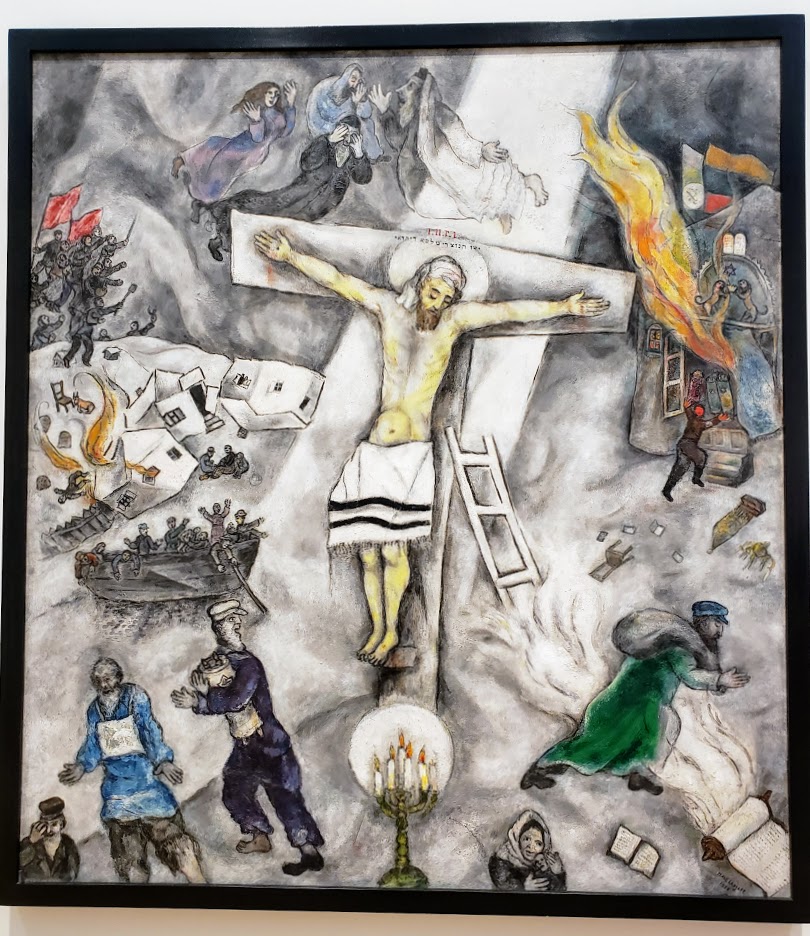
Marc Chagall, White Crucifixion — Art Institute of Chicago


Romans 11:1-2a, 29-32 New Revised Standard Version

11 I ask, then, has God rejected his people? By no means! I myself am an Israelite, a descendant of Abraham, a member of the tribe of Benjamin. 2 God has not rejected his people whom he foreknew.  

29 for the gifts and the calling of God are irrevocable. 30 Just as you were once disobedient to God but have now received mercy because of their disobedience, 31 so they have now been disobedient in order that, by the mercy shown to you, they too may now receive mercy. 32 For God has imprisoned all in disobedience so that he may be merciful to all.

*****************

One of the many stains on Christian history is the ongoing presence of anti-Judaism. I use this term instead of anti-Semitism because this term has racial connotations that are modern in origin. Over the years I’ve become increasingly sensitized to the legacy of anti-Jewish views in the church. We can argue whether this is rooted in the New Testament itself or its interpretation through the ages, the fact is, it continues to be present in our churches, even in scholarly efforts. The readings from Romans 9-11 allow us to reflect on this legacy. That is especially true of this reading from Romans 11, which, in my mind, makes clear that Christianity has not replaced Judaism and that God’s covenant with Judaism continues unabated. Therefore, we must repent of this legacy and seek to do everything we can to change the way we relate to the Jewish community.
In the reading from Romans 9, which we examined earlier, Paul expressed his anguish that his Jewish siblings had not embraced the message of Jesus. Even as he preached the Gospel to Gentiles, he hoped that Jews would join him. That reading can give us the impression that God had dissolved the covenant with Israel, but in today’s reading, we discover that this is a wrong impression. Paul might have wished that all Jews took up the cause of Jesus, as he had, but in the end, he must admit that God has not rejected God’s people Israel. This, Romans 11 is an important witness to God’s commitment to the covenant made first with Abraham and later with Moses.
The lectionary provides us with two excerpts from Romans 11. The first excerpt encompasses the opening verses of the chapter. Paul asks a rhetorical question: “has God rejected his people?” He answers that question in the negative by noting his own relationship to Judaism. God hasn’t rejected him, so God hasn’t rejected Israel. He lays claim to the covenant promise as an Israelite, a descendant of Abraham, and more specifically as a member of the tribe of Benjamin. In other words, he has done his genealogical work. He lays claim to this heritage. So, whatever happened on the road to Damascus, Paul didn’t convert from Judaism to Christianity (Christianity didn’t exist yet as a separate entity). He was a Jew both before and after that encounter with Jesus. If Paul was already intent on converting Gentiles to his vision of God, then what changed out there on the road to Damascus was his understanding of the path Gentiles would take in experiencing salvation. While Paul sees himself tasked with preaching to Gentiles, no doubt he was hoping that both Jews and Gentiles would be found in this newly emerging Jesus community. The issue isn’t whether the Torah has value. The question is whether adherence to aspects of Torah, such as circumcision was necessary for Gentile believers.
When we read Paul’s letters, we discover his dilemma. He wanted to reach Gentiles and draw them into the new community. He seems to have understood that circumcision may have impeded full conversion. So, he set it aside, though not everyone in the community agreed. Thus, in his attempts to defend himself he gave the impression that he had rejected Judaism. While there are mixed messages in his letters, Paul makes it clear in this passage that he was not rejecting his Jewish heritage. Perhaps the problem isn’t with Paul but in the way his later interpreters have read him?
As we drop down to the second part of the reading, verses 29-32, the message that Paul brings is that God’s covenant promises are irrevocable. It can’t be any clearer. That’s a message we need to hold tightly to. We should step back one verse, though to get a true sense of what Paul is doing here. In verse 28 he writes:   As regards the gospel they are enemies of God for your sake; but as regards election they are beloved, for the sake of their ancestors; . . . .” This word comes after Paul has already declared in verse 26 that all Israel will be saved. So, what does Paul mean here? Sarah Heaner Lancaster puts her finger on the issue at hand, pointing out that Israel can be God’s enemy and God’s beloved at the same time, because in “refusing to acknowledge the way God is working in Jesus Christ, Israel does not give honor to God, and so they are ‘enemies’ of God.”  But, because, as we read in verse 29, God’s gifts and calling are irrevocable, “God honors the covenant with the patriarchs. The chosen people have always been and always will be beloved. Although God used their refusal for the sake of the Gentiles, God will not forsake Israel” [Lancaster, Romans, p. 198]. It may seem rather complicated, but God will be faithful to the covenant, even if the rejection of Jesus by a majority of Jews spurred on Paul’s mission, God will stay true to the covenant.
The good news is that Gentiles get to share in the salvation of God. We also (speaking as a Gentile) have been included in the covenant people through Jesus. So, even if we stray or become disobedient, God is merciful and gracious. That might not always sit well with us, any more than it sat well with Paul’s opponents. But that is the way of God who has been revealed to us in and through Jesus.
The lectionary reading ends with verse 32, but as Sarah Heaner Lancaster points out, the verses that follow contain a hymn that celebrates the difference between our ways and God’s ways. Thus, “the grandness of God exceeds anything that we may know, and we are not in a position to understand the mind of God or the ways God achieves God’s purposes. The richness of God is the genuine mystery” [Lancaster, Romans, pp. 199-200]. So, I close with that hymn:

  O the depth of the riches and wisdom and knowledge of God! How unsearchable are his judgments and how inscrutable his ways! 

34 “For who has known the mind of the Lord?
Or who has been his counselor?”
35 “Or who has given a gift to him,
to receive a gift in return?” 

36 For from him and through him and to him are all things. To him be the glory forever. Amen.  (Rom. 11:33-36).