Month: October 2018

Rosa and the General: Pentecost 24

Rosa and the General: Pentecost 24

Narrative Lectionary Reflection

November 4, 2018

Read 2 Kings 5:1-17 (CEB)

Introduction 

British author P.G. Woodehouse wrote a series of books focusing on two characters: Jeeves and Wooster (which was also a popular British television series in the early 90s).  Set in the 1920s, Betrie Wooster is a member of the idle rich. He tends to come off as very immature, a man with no goals other than hanging out with other members of high society.

Wooster was taken care of by Jeeves, his very intelligent and wise servant.  He is the one that gets Wooster out of fixes and keeps Wooster from flying off the handle.

Woodehouse’s stories remind people that the smartest person in the room is not always the one with the position or the big bank account.

Our text today deals with a number of nameless people who work to help the general, Naaman. Naaman was a great military hero,  dealing with a skin tradition. Naaman was clueless as to how to heal his condition, but a Jewish servant is able to point Naaman in the right direction. When Naaman initially refuses Elisha’s command to bathe in the Jordan River, it is another nameless servant that persuades the general to do what was asked of him.

Today, we meet Naaman and Elisha and the forgotten servants who helped Naaman see the light and be healed.

Engaging the Text

When Elisha the man of God heard that Israel’s king had ripped his clothes, he sent word to the king: “Why did you rip your clothes? Let the man come to me. Then he’ll know that there’s a prophet in Israel.”

-2 Kings 5:8

The passage opens with the first character, Naaman.  He is a mighty warrior, not in Israel, but in Aram (what is now modern-day Syria). Notice what is said in verse one about Naaman: “Naaman, a general for the king of Aram, was a great man and highly regarded by his master because through him the Lord had given victory to Aram. (Emphasis mine).  This tells us that God works not just for the Jews, but even those considered outside of the covenant.

Then we learn that Naaman has a skin disease.  Some versions will say he had leprosy, but it is more likely that he has some kind of skin disease that might make him appear like he is dying.  No one wanted to be around a guy who they think is death warmed over.

We also learn in those early passages that Aram goes on out on a raid and captures a young Jewish girl.  She is serving the wife of Naaman and then says that she wishes Naaman could go to the great prophet who lives in Israel.  This is kind of surprising.  This is a young girl that was ripped from her family and is now a servant to a foreign leader.  And yet, she was concerned about this foreigner, who took her away and maybe killed her family.

Naaman takes what the young girl has said and comes before his king who then sends a message to the king of Israel.  The king of Israel is kind of a comic character in that when he gets the letter he tears his garments, a sign of grief.  He thinks this is the end of the world, seemingly forgetting that there is a prophet that can heal Naaman.  While the young slave girl believed that Elisha could heal, the great king of Israel has forgotten that there is a prophet that can heal.

Naaman brings the bling to pay Elisha.  But Elisha isn’t interested in money.  He isn’t interested in fame. He doesn’t even come out to meet with Naaman.  Instead, he sends a messenger to tell Naaman to go out and wash seven times in the Jordan in order to be healed.

Naaman is angry. Elisha doesn’t even bother to show his face to Naaman, he just sends a servant to tell him to go and bath in what is nothing more than a muddy stream. You could also imagine he is angry because it feels like again, people are keeping their distance because of his skin condition. Again, someone that was behind the scenes steps forward to calm Naaman down.  The servant asks, “Our father, if the prophet had told you to do something difficult, wouldn’t you have done it? All he said to you was, ‘Wash and become clean.’”  Naaman is a general and he took orders and obeyed orders.  Isn’t this just one more order to take, one that can heal you?  Naaman takes this to heart and bathes in the Jordan and his skin is healed. Naaman returns to Elisha asking him to accept a gift, which Elisha refused. Not only is Naaman’s skin healed, but he also becomes a believer of the God of the Israelites.
\

Conclusion

I’ve always been fascinated by Rosa Parks.  This was a woman who was a seamstress in Montgomery, Alabama.  She was not a mover or shaker.  She was involved in the civil rights movement, but no one thought a simple seamstress, let alone a black simple seamstress could do anything that could change the world.

And yet, her refusal to give up a seat to white man and sit at the back of the bus as all African Americans were supposed to do, changed the course of history.  It started a movement, launched the career of Martin Luther King and helped the United States live up to its ideals.

I sat in the actual bus where Parks said “no.” It’s located at the Henry Ford Museum in Dearborn, Michigan. I was visiting my parents who lived up the road in Flint.  Here was a simple bus, a bus where the world changed.

In this text, there are the big people, the movers and the shakers, and the small people, the servants who weren’t even named.  But notice who were the ones that changed things.  The young slave girl told Naaman and his wife that there was someone who could heal Naaman.  The unnamed servant helps Naaman to get over himself in order to do what needed to be done to be healed.

This coming weekend is All Saints Sunday.  We tend to think of the big saints, like Francis.  But saints also include the older woman who shows up at mission events, or the developmentally disabled man who always greets you with a smile.  Saints are not necessarily famous people, but they are faithful people.  If it wasn’t for a servant girl and an unnamed servant, Naaman would remained unhealed and not knowing the God of the Israelites.  Sometimes it is the “little people” that can change the world.


Dennis Sanders is the Pastor at First Christian Church of St. Paul in Mahtomedi, Minnesota. He’s written for various outlets including Christian Century.

Your People Are My People – Lectionary Reflection for Pentecost 24B (Ruth 1)

Your People Are My People – Lectionary Reflection for Pentecost 24B (Ruth 1)

Ruth 1:1-18 New Revised Standard Version (NRSV)
In the days when the judges ruled, there was a famine in the land, and a certain man of Bethlehem in Judah went to live in the country of Moab, he and his wife and two sons. The name of the man was Elimelech and the name of his wife Naomi, and the names of his two sons were Mahlon and Chilion; they were Ephrathites from Bethlehem in Judah. They went into the country of Moab and remained there. But Elimelech, the husband of Naomi, died, and she was left with her two sons. These took Moabite wives; the name of the one was Orpah and the name of the other Ruth. When they had lived there about ten years, both Mahlon and Chilion also died, so that the woman was left without her two sons and her husband.
 
Then she started to return with her daughters-in-law from the country of Moab, for she had heard in the country of Moab that the Lord had considered his people and given them food. So she set out from the place where she had been living, she and her two daughters-in-law, and they went on their way to go back to the land of Judah. But Naomi said to her two daughters-in-law, “Go back each of you to your mother’s house. May the Lord deal kindly with you, as you have dealt with the dead and with me. The Lord grant that you may find security, each of you in the house of your husband.” Then she kissed them, and they wept aloud. 10 They said to her, “No, we will return with you to your people.” 11 But Naomi said, “Turn back, my daughters, why will you go with me? Do I still have sons in my womb that they may become your husbands? 12 Turn back, my daughters, go your way, for I am too old to have a husband. Even if I thought there was hope for me, even if I should have a husband tonight and bear sons, 13 would you then wait until they were grown? Would you then refrain from marrying? No, my daughters, it has been far more bitter for me than for you, because the hand of the Lord has turned against me.” 14 Then they wept aloud again. Orpah kissed her mother-in-law, but Ruth clung to her.
 
15 So she said, “See, your sister-in-law has gone back to her people and to her gods; return after your sister-in-law.” 16 But Ruth said,
 
“Do not press me to leave you
or to turn back from following you!
Where you go, I will go;
where you lodge, I will lodge;
your people shall be my people,
and your God my God.
17 Where you die, I will die—
there will I be buried.
May the Lord do thus and so to me,
and more as well,
if even death parts me from you!”
 
18 When Naomi saw that she was determined to go with her, she said no more to her.
*****************
                The story of Ruth and Naomi is powerful. Here are two women, left adrift by the deaths of their husbands. One is from the Hebrew people and the other a Moabite. We shouldn’t overlook a third woman, Orpah, Naomi’s other daughter-in-law. Orpah chose to return home at the urging of Naomi, who was concerned about what the future held. Orpah is sometimes vilified for her choice, but it was probably a good decision, especially considering where the story leads. While we can’t forget Orpah, this is the story of Naomi and Ruth
The story of Ruth begins with an act of migration. A famine has hit the land of Judah, forcing Elimelech, his wife Naomi, and two sons to seek a more secure life in the neighboring land of Moab. Historically Moabites and Israelites were enemies, so this was a difficult decision. But they immigrated to Moab and apparently found enough welcome to make their home in this foreign land. Their story is a story that has been told and retold down through the millennia. As for the family, the two sons took wives from among the Moabites, an act that might have gotten them in trouble back home. But, it appears they were planning on staying put for the long term. Then tragedy strikes. The three men die suddenly, leaving three women without any support. Ruth and Orpah probably made a difficult decision to marry outside the community, and probably cut themselves off from family (just speculating). As for Naomi, she had family back home in Judah, and so she decides to return. But what about the two daughters-in-law?
We see in the text that there is deep affection among the three women. They want to go with Naomi. Naomi is gratified by this show of affection, but she’s not sure that she can provide for them back in Judah. It would be best if they returned home, made amends if necessary, and hopefully find new husbands who could provide for them. At least they would be with their own people. Orpah, tearfully decides to follow this path. Ruth, on the other hand, refuses to return home. She is ready to share Naomi’s fate, come what may.
The reading for this week is the first of two drawn from Ruth. The story might be brief, but it does a message that resonates with our time for it speaks of immigrants and the challenges they face. People migrate for various reasons, but most are hoping to find something better than what was left behind. It might be economic, or it might be fear of violence and persecution. There might be salvation in the foreign land, but one might not find a welcome there. Migrants might contribute to the community, but they might also soil it.
 
As we hear the story of Ruth, perhaps the stories of modern migrants and refugees come to mind. We know people are on the move. There is that caravan moving across Mexico, composed of men, women, and children who have left Central America seeking safety and perhaps a better life in the north. There are the refugees fleeing wars in Iraq and Syria and Yemen. Even people in our own country have been moving from one region to another hoping to find a better life. It’s easy to vilify migrants. It’s commonplace to fear the stranger. Yet, if we look back through our own histories we will probably see evidence of migration. My ancestors came here from various places in Europe. Most came before there were immigration offices and quotas. Did they come legally? In answer, I would say, there was no policy on legal or illegal. They came, they settled, and became part of the fabric of society. If we’re to understand Ruth, we need to keep this in mind.
Naomi was insistent that the two women return to their families. She makes it clear that she couldn’t provide them the security of a husband. Without a husband they would be without stability.  The future was uncertain for Naomi, who wasn’t marriage material. All she could hope for was the mercy of her family, whom she and her husband had left behind years before. She might not receive a warm welcome, and the daughters-in-law even less of one. After all, they were foreigners, about whom they had been warned. Ruth, however, won’t go back. She insists on following her mother-in-law, no matter what happened. She was all in!
Ruth’s response is expressed through song. She sings: “Where you go, I will go; where you lodge, I will lodge.” Whatever the future holds for you, she tells Naomi, I am willing to share it. Not only that, but “your people will be my people.” And where you’re buried, I’ll be buried. Ruth is so committed, she’s willing to sacrifice everything. This is love, that is expressed in spite of the challenges, but also because of her love of her mother-in-law, so she’s willing to come alongside here and share her future. The remainder of the book tells that story.
There are several ways of engaging this passage. We could speak of the relationship between family. Sometimes we make light of in-law relationships, but this one is stronger than most “blood” relations. Considering the times, I hear in it a word about migration and welcoming strangers, who make choices they hope will better their lives. My ancestors did this. They came from Europe, mostly the British Isles, hoping to find a better life. Those who migrate today do so for the same reasons, only we have made the process more difficult (and costlier). The story of Ruth and Naomi might offer us a path forward, so that we might welcome the strangers in our midst. When we hear immigration stories, may we hear with hearts informed by God’s love and grace the difficult choices made along the way. When Ruth tells Naomi “your people will be my people” may we hear in these words a commitment not to assimilate so as to lose one’s identity, but to come a contributing member of the community, as Ruth will do.  Of course, this has important implications for the stories that follow, for Ruth is counted among the ancestors of David and of Jesus. You never know who is in your family tree! They too may have once been strangers in a strange land.

Picture attribution: Chagall, Marc, 1887-1985. Ruth and Naomi, from Art in the Christian Tradition, a project of the Vanderbilt Divinity Library, Nashville, TN. http://diglib.library.vanderbilt.edu/act-imagelink.pl?RC=55328 [retrieved October 29, 2018]. Original source: http://www.flickr.com/photos/clicks2006/4150846200/.

10646937_10204043191333252_4540780665023444969_nRobert Cornwall is the Pastor of Central Woodward Christian Church in Troy, Michigan. He holds the Ph.D. in Historical Theology from Fuller Theological Seminary. He is the author of a number of books including Out of the Office (Energion, 2017), Marriage in Interesting Times (Energion, 2016), and Freedom in Covenant (Wipf and Stock, 2015) and blogs at Ponderings on a Faith Journey.

Solomon the Wise: Pentecost 23

Solomon the Wise: Pentecost 23

Narrative Lectionary Reflection

October 28, 2018

Read 1 Kings 3:1-28 (CEB)

Introduction 

“The Wisdom of Solomon.”

That phrase has been used in our culture as a way of saying that someone needs to have the smarts that Solomon had in order to solve a problem.

Solomon was wise.  But his wisdom was not something that was innate, it was something that came from God.

Solomon is the son of David and succeeds David as king.  Solomon’s rule is a time when the kingdom of Israel was at the height of its power.  Israel was a miniempire.  Solomon started a massive building program which included the building of the temple.  A fleet of ships was sent to far-flung places around the known world to bring back riches.  Solomon met many of the leaders of the day, including the Queen of Sheba.  Solomon brought a sense of cosmopolitan flair to Jerusalem.  Solomon, like President John Kennedy in the US, ushered in a Jewish version of Camelot. Things were good in Israel.

Or were they? As we read the text for today you have to look more closely to see that things are not perfect.  Just like President Kennedy’s time as President wasn’t the Camelot that we tend to think it was, Solomon’s actions carry within them the seeds of destruction not only for Solomon but for the entire nation of Israel as well.  Today, we learn the Wisdom of Solomon, an imperfect king trying to follow God.

Engaging the Text

Now Solomon loved the Lord by walking in the laws of his father David, with the exception that he also sacrificed and burned incense at the shrines.

-1 Kings 3:3

When people think of Solomon, they think of him in two different stages.  The first stage is when he is young and asks for wisdom.  A later version of Solomon is a man who has forgotten who he is.  He has become unfaithful to God, worshipping other gods instead of the God of Israel.  In real life, people are not all good or all bad and they are not all faithful or all not faithful.  As we learn today, Solomon was already making mistakes that would have severe consequences.

Chapter 3 opens with Solomon entering into a “marriage alliance” with the Egyptian Pharaoh. He marries not out of love, but out of politics. Marrying the Pharaoh’s daughter meant an alliance with the regional superpower which made Solomon a player on the world stage.

While aligning Israel to the Egyptian superpower through marriage had its advantages, there were also problems. For one, marrying someone who was not an Israelite was troublesome. Deuteronomy 7:3 notes that Israelites were told to not intermarry.  Why? The reason for this prohibition was that it could lead the Israelites away from God and worshipping foreign gods- which is exactly what happened to Solomon. His Egyptian bride was just the beginning. As he married other women from other nations, he would end up worshipping the gods of his wives.

Starting with verse two, we see that the people are still sacrificing in the high places. These high places were named not because they were in the mountains. In many writings, high places were not portrayed in a good light. Some saw them as a sign of their lack of loyalty to God. There are hints that the high places sometimes were places where people could worship other gods. A future king, Hezekiah, destroyed many of the high places as a way to get back to worshipping God alone. The talk about the high places could also be a foreshadowing of what will happen to Solomon: his worshipping the foreign gods of his wives.

It was at a high place that God came to Solomon in a dream. God’s first words to the king are to make a request. Solomon doesn’t take time to think about this. Instead, he blurts out that he wants wisdom. He asks for a “listening heart” or “understanding mind” to rule the people. The word wisdom in Hebrew is associated with legality and justice. In this time, the King was also the final arbiter of justice, in essence, Solomon was the Supreme Court as well as the President. God is pleased that Solomon chose…well, wisely. The king gets his wish; he has an understanding mind far beyond anyone else.

Solomon paints a portrait of a human faith.  He loves God and seeks to be faithful, and yet he is marrying foreign wives- he’ going against what God had commanded. This is not an excuse to sin, but it is a reminder that when we come to God, we bring all of ourselves, both good and bad.  Solomon wanted to be wise, to be faithful to God, but he is also doing things that will bring him trouble.

We get to see Solomon’s new found wisdom in action when two prostitutes came forward. It is telling that the king of Israel adjudicates a problem between two women on the lowest rungs of society. Both women had children. One mother rolled over during her sleep smothering the child. A mother decides to take her dead baby and switch it with the other baby. The case was about deciding who was the real mother. Solomon offers a shocking judgment: slice the living child in half and give both halves to the mothers. Was this a callous response to the women? We don’t really know. What we do know is that the judge allowed the two women to respond which revealed who was the real mother. The baby’s life is spared and Solomon gets a reputation for a wisdom that comes from God.

King Solomon was obsessed with women. Pharaoh’s daughter was only the first of the many foreign women he loved—Moabite, Ammonite, Edomite, Sidonian, and Hittite. He took them from the surrounding pagan nations of which God had clearly warned Israel, “You must not marry them; they’ll seduce you into infatuations with their gods.” Solomon fell in love with them anyway, refusing to give them up. He had seven hundred royal wives and three hundred concubines—a thousand women in all! And they did seduce him away from God. As Solomon grew older, his wives beguiled him with their alien gods and he became unfaithful—he didn’t stay true to his God as his father David had done. Solomon took up with Ashtoreth, the whore goddess of the Sidonians, and Molech, the horrible god of the Ammonites.

-1 Kings 11:1-5

1 Kings 3 is not a simple story of Solomon getting wisdom. There are hints of a downfall, one that is revealed in chapter 11. “King Solomon was obsessed with women,” says the Scripture. He started worshipping the gods of his wives and he built altars to these foreign gods.

Solomon’s choice to worship these foreign gods had consequences. 1 Kings 11 notes that like his father, God would judge him for his sins:

God said to Solomon, “Since this is the way it is with you, that you have no intention of keeping faith with me and doing what I have commanded, I’m going to rip the kingdom from you and hand it over to someone else. But out of respect for your father David I won’t do it in your lifetime. It’s your son who will pay—I’ll rip it right out of his grasp. Even then I won’t take it all; I’ll leave him one tribe in honor of my servant David and out of respect for my chosen city Jerusalem.”

Looking at chapter 11, chapter 3 is cast in a more tragic light. Chapter 3 shows a king that wanted to follow God and sought God for help. If we could stay just at chapter 3 this would be a wonderful story of someone seeking to follow and rely on God. Instead, it becomes a harbinger of things to come.
\

Conclusion

Solomon was an imperfect leader.  He sought to follow God, but he also did things that harmed his faith in God.  Not so different from those of us who aren’t leaders.

Solomon asked for wisdom.  In the wider culture, we tend to think wisdom is something we can earn.  Wisdom is something that comes with time, from learning life’s lessons and so on.  But in Solomon’s time, wisdom is something that came from God.  Only God could make someone wise, not us.

What does it mean in our day and age to seek wisdom from God?  We won’t be asked to settle complaints like Solomon, but wisdom can be used as we live our lives in our churches, jobs, and neighborhoods.  What does wisdom look like to you?

But Solomon’s wisdom did not last.  Solomon’s story is truly a tragedy. Solomon took Israel to the apex of its power, but that all ended because of his choices.  He was the last king of a unified Israel. After his death, the kingdom would be split in two.

In Solomon’s dream, he was offered riches, but forsook them for wisdom from God.  This was odd, since there are examples in the Bible where material wealth was a sign of God’s blessing. Jesus picks up this theme of forgoing wealth in the Sermon on the Mount.  Matthew 6:25-34 has Jesus telling the people to not worry about eating or drinking because God would care for them.  Jesus even references Solomon in his talk:

27 Who among you by worrying can add a single moment to your life? 28 And why do you worry about clothes? Notice how the lilies in the field grow. They don’t wear themselves out with work, and they don’t spin cloth. 29 But I say to you that even Solomon in all of his splendor wasn’t dressed like one of these. 30 If God dresses grass in the field so beautifully, even though it’s alive today and tomorrow it’s thrown into the furnace, won’t God do much more for you, you people of weak faith?

-Matthew 6:27-30


Solomon is both a model to follow and a model of how not to do something. King Solomon has feet of clay.  But if there is any gospel to be drawn from this it’s that God used Solomon even though he was imperfect.  If God can use flawed Solomon, then God can use us.  We can have the wisdom of Solomon if we rely on God.


Dennis Sanders is the Pastor at First Christian Church of St. Paul in Mahtomedi, Minnesota. He’s written for various outlets including Christian Century.

Is Everything Back to Normal? – Lectionary Reflection for Pentecost 23B (Job 42)

Is Everything Back to Normal? – Lectionary Reflection for Pentecost 23B (Job 42)

William Blake – Job and his daughters
 
42 Then Job answered the Lord:
“I know that you can do all things,
and that no purpose of yours can be thwarted.
‘Who is this that hides counsel without knowledge?’
Therefore I have uttered what I did not understand,
things too wonderful for me, which I did not know.
‘Hear, and I will speak;
I will question you, and you declare to me.’
I had heard of you by the hearing of the ear,
but now my eye sees you;
therefore I despise myself,
and repent in dust and ashes.”
 
 ******************
10 And the Lord restored the fortunes of Job when he had prayed for his friends; and the Lord gave Job twice as much as he had before. 11 Then there came to him all his brothers and sisters and all who had known him before, and they ate bread with him in his house; they showed him sympathy and comforted him for all the evil that the Lord had brought upon him; and each of them gave him a piece of money and a gold ring. 12 The Lord blessed the latter days of Job more than his beginning; and he had fourteen thousand sheep, six thousand camels, a thousand yoke of oxen, and a thousand donkeys. 13 He also had seven sons and three daughters. 14 He named the first Jemimah, the second Keziah, and the third Keren-happuch. 15 In all the land there were no women so beautiful as Job’s daughters; and their father gave them an inheritance along with their brothers. 16 After this Job lived one hundred and forty years, and saw his children, and his children’s children, four generations. 17 And Job died, old and full of days.
*****************
                It seems that all it took was a bit of humility, a word of repentance, and a recognition on Job’s part that he didn’t know what he was talking about to get his life back. The ending of Job has always given people pause. After all the speeches on the part of the “friends,” urging Job to repent, which he rebutted, and the back and forth between Job and God as to why Job suffering (he may have cursed his own life, but Job never cursed God) in the end Job gives in. Maybe God just wore him down. Starting in chapter 38, God began assailing Job with questions. There is a brief response on Job’s part in chapter 40, but it’s a brief respite, as God starts right back up and continues the diatribe on through chapter 41. The message appears to be that there’s a lot that Job doesn’t know, and thus he needs to be careful with his responses. Job seems to agree, at least that’s what it looks like here in chapter 42. After that gets cleared up, everything returns to normal. Isn’t that the way we like things? Don’t happy endings make for a good story? After all, who doesn’t want to live happily ever after, as is always the case in a Disney story?
                This reading from Chapter 42 is the fourth lectionary choice, and it brings the story of Job to a close. It might not have been the way we would have expected it to end, considering how things started, but maybe ending on a high note is for the best. The lectionary creators, as is their penchant, do a bit of editing to the chapter, excising verses 7-9. In these verses we find God giving the “friends” a tongue-lashing. It’s a bit harsh and may not fit the intentions of the lectionary creators, but this omission is unfortunate because it essentially justifies Job’s complaint. Consider this word: “After the Lord had spoken these words to Job, he said to Eliphaz from Teman, ‘I’m angry at you and your two friends because you haven’t spoken about me correctly as did my servant Job.’” (Job 42:7 CEB). Yes, Job is in the right, and the friends are not.
Before we get to this excised response on God’s part, we must first attend to Job’s response to God’s diatribe. Job had asked plenty of questions of God, but in the end, he admits that when it came to God’s questions, he simply doesn’t have any answers. After all, God, seems to know everything and whose plans can’t be thwarted. In seems as if Job is defeated by God’ outburst, and yet there is a sense of vindication in that God deals directly with Job. In Job’s response, we hear him say that whereas before he had only heard God’s voice, now, having encountered the whirlwind, Job has seen God with his own eyes. With that, all Job can do is repent with dust and ashes. I wonder, is he repenting of his questions or simply affirming his lack of knowledge and understanding. Job recognizes that he is not God. With that, I prefer the latter explanation. Job isn’t repenting of us questions, just his lack of understanding. This is good news, as I appreciate the questions.
Job’s response, which might have been the original ending of the book, gives way in verse 7 to God’s response to the three friends, who learn that their response was incorrect.  They simply didn’t know what they were talking about. Job, on the other hand, while there might be much that he doesn’t understand or have knowledge of—after all, he wasn’t there to witness many of these things first hand—he was right in this—Job’s “misfortunes” were not the result of unrighteousness or sin. God directs the three friends to atone for their mistake by offering seven bulls and seven rams as a burnt offering, asking Job to offer a prayer of forgiveness. It wasn’t God who was to receive this offering, it was Job, the righteous one.  It’s unfortunate that this is missing because God does admit that Job was correct all along (though God doesn’t repent for putting Job in this predicament).
When we return to the text chosen by the lectionary in verse ten, it seems as if everything has gotten back to normal. It was a series of unfortunate events, that cost him family, land, his own skin (suffering on his part), but now everything is good. After Job prayed for his “friends,” God restored everything that was lost, only this time he is doubly blessed. He was faithful, and therefore he was rewarded. I know this doesn’t seem to fit with the rest of the book. Wasn’t the prior message that Job’s misfortunes had nothing to do with a lack of faithfulness, so how could this act of blessing be a sign of faithfulness?  In any case, standing at the center of this blessing is the provision of children, specifically three daughters, as well as seven sons. The sons aren’t named, but interestingly the daughters are—Jemimah, Keziah, and Keren-Happuch. Of these three daughters, the author of Job declares “in all the land there were no women so beautiful as Job’s daughters.” They even received an inheritance, along with their brothers—that mention is made of this suggests that this is unusual. But perhaps the message here is that even as Job is blessed, so are his children. After all, as we learn in chapter one of Job, he had always taken good care of his children, offering sacrifices for them so that if they had fallen short of righteousness they were covered. Of course, faithfulness and blessing involve a long life—one hundred and forty more years to be exact, so that the one who lost his original family was able to see four generations of children born. Interestingly enough, no mention is made of Job’s wife. I wonder why? Has something happened to her? Why is she not sharing in the blessings, at least not by name?
When we read Job, I’m not sure we encounter a God we wish to embrace. Here is a God who makes wagers, and seems to be a sort of bully, pummeling Job with unanswerable questions. But maybe this isn’t about God, it’s about our own understandings of righteous and relationship. After all, in the section omitted by the lectionary creators, God does affirm one thing about Job. He was right, and the friends wrong about the cause of misfortune. Deanna Thompson spends a good deal of time with Job in her book Glimpsing Resurrection. She explores the question of trauma in light of the Job story, and she concludes:

And perhaps most important, the book of Job models a relationship with the Divine that allows for anger, grief, complaint, and protest, a relationship that may not yield clear answers regarding the reason for suffering but one that can move between tragedy and joy, and one that dares to include laughter even when the risks of living are intimately understood. [Glimpsing Resurrection, p. 99].

Perhaps that is the message of Job for us. This isn’t really a theodicy. It doesn’t give a full answer to our questions concerning God and suffering, especially if we wish to insert love into the equation. After all, God seems to respect Job, but not necessarily express this in terms of love. The message appears to be that when it comes to suffering and trauma, there are no clear or easy answers. We may want clear answers, bit they always seem elusive. With that the story might have ended, but the creators of this story have chosen to end on a high note. Job is blessed at the end, but not everyone is so fortunate. Sometimes all we can do is end with where things stand at the end of verse 6. We may need to simply kneel before God in sack cloth and ashes and repent, even as we continue to ask why.

10646937_10204043191333252_4540780665023444969_nRobert Cornwall is the Pastor of Central Woodward Christian Church in Troy, Michigan. He holds the Ph.D. in Historical Theology from Fuller Theological Seminary. He is the author of a number of books including Out of the Office (Energion, 2017), Marriage in Interesting Times (Energion, 2016), and Freedom in Covenant (Wipf and Stock, 2015) and blogs at Ponderings on a Faith Journey.

One Thing Leads to Another: Pentecost 22

One Thing Leads to Another: Pentecost 22

Narrative Lectionary Reflection

October 21, 2018

Introduction 

The news is about a congressman or senator or maybe a governor.  This elected official is expected to go far, maybe even to the White House. We hear about an affair with a woman.  The elected official goes before the cameras with their wives in hand wearing a plastered smile that hides the fury she is feeling.  The hope the official had in running for president is gone.  The official resigns their office, wondering that maybe someday he could run again- this time with a chastened heart.

Today, we move from Joshua to David, Israel’s most famous king.  He considered a man after God’s own heart, but even someone as faithful as David could fall into a scandal which is what happens in today’s text.

Today, we look at David, Bathsheba and a king’s attempt to cover up a grave sin.

Engaging the Text

David got very angry at the man, and he said to Nathan, “As surely as the Lordlives, the one who did this is demonic![g] He must restore the ewe lamb seven times over[h] because he did this and because he had no compassion.”

“You are that man!” Nathan told David. “This is what the Lord God of Israel says: I anointed you king over Israel and delivered you from Saul’s power.

-Joshua 12:5-7

The story opens with David in Jerusalem.  The text notes that it’s springtime.  War usually did not take place during the winter, so spring indicates that wars are starting up again. The text notes that kings go off to war during the spring and yet David remains in Jerusalem.

Why did David stay behind?  The text doesn’t say.  What we do know is that the primary function of a king during this period was to be a military leader. Saul was made king because of the threat from the Philistines.  Since David had assumed the role of king he was expected to go to battle, but he didn’t.  Staying behind communicated that David wasn’t acting like a king.

He sees Bathsheba bathing on the roof.  Why is she doing this?  Verse 4 seems to say she was bathing for ritual purification purposes.

David is captivated by her beauty.  He learns that this is Bathsheba the wife of Uriah.   So, David knew he was fooling with a married woman. He sends for her and she arrives at the palace.  Verse 4 in chapter 11 say that David “took” her.  What does took mean.? Was David forcibly taking Bathsheba?  The text doesn’t really say. We know that David wanted he and if we look at the verbs being used: it is apparent that David was the actor, while Bathsheba was being acted upon. 

One other, sometimes David and Bathsheba have been considered a passionate love affair, but in reality, it was at the very least one-night stand.

Sometime after the encounter, Bathsheba sends word to David that she is pregnant.  This is the only time in the passage that Bathsheba speaks.  David is in trouble and this leads to the next part of this passage.

It is important to note that Uriah was not a Jew, but a Hittite. So Uriah was an immigrant as was Bathsheba.  Did David’s actions with Bathsheba and his attempts to kill Uriah happen because they were immigrants?  We don’t know, but it is interesting that the Scripture highlights Uriah’s ethnicity.

David now has to cover up his dalliances with Bathsheba.  He recalls Uriah in the hope that he would have sex with his wife and obscure the fact that David is the father of Bathsheba’s child, not Uriah. David might have forgotten that warriors took an oath to abstain from sexual relations while in battle.  Uriah, the Hittite, was faithful to his oath.  David, the Jewish king was not faithful.

David ordered Joab, his commander-in-chief, to put Uriah at on the front lines. This action took Uriah’s life, as well as the life of several other soldiers.  The coverup was as worse as the crime.

The death of Uriah by David allowed him to marry Bathsheba and no one would know who the child’s father was. David probably thought that was the end of Uriah and the end of his problems.  

Then we read verse 27 where it says, “But what David had done was evil in the Lord’s eyes.”  David might have thought he had gotten away with literally murder, but it didn’t escape God.

Nathan was one of the court prophets.  He was one of the few people who had the authority to speak out against the king.

Nathan doesn’t directly accuse David.  Instead, he tells the parable of a man and his lamb. 

Why did Nathan use a parable?  Why didn’t Nathan accuse David directly?

The Intervarsity Commentary explains it this way:

The purpose of the parable was not only to induce David to condemn himself, but also to portray vividly the realities of the situation. Kings, if they were greedy, had the power to grab anything they wanted, and ordinary citizens were helpless. Nathan went on to point [p. 327] out how greedy David had been. In addition to his wives, he had apparently taken Saul’s concubines (8) as a symbol that he had taken over royal control from Saul. 1

David’s indiscretion and murder will have consequences for him and his family. Verse 9 notes“You have put Uriah the Hittite to death with the sword, and have taken his wife to be your wife; you have put him to death with the sword of the children of Ammon.” Bloodshed within his family would follow in the coming years and it would cause David grief.

David repents and Psalm 51 is the result of Nathan’s accusation. Nathan also says the child that was born would die, which is what happens.

While David had sinned and had to face the consequences, God did not forget Israel or David. David and Bathsheba have another child, named Solomon who would later succeed his father as king. God was able to bring good out of a bad situation.
\

Conclusion

“For all have sinned and fallen short of the glory of God,” is what Romans 3:23 says describing humanity’s common lot.  David was considered a man after God’s own heart. He was considered faithful to God. Because of his faithfulness, Israel prospered.  And yet, this man sinned. Big time.

The story of David and Bathsheba is important to us for at least two reasons.  The first is that this story reminds us that we are people who sin, who sometimes wander off, that we fall short of the goal again and again.  That’s not something we like to hear, but we can’t understand God’s grace unless we understand that we are not okay.  Nathan’s parable is a story that shines a bright light on David’s sins. He has to face the music, he has to realize that he isn’t all that and a bag of chips.  He has sinned. Maybe our sin isn’t adultery, but we have all sinned and will sin in the future. A church is a meeting place of sinners, or at least it should be.  We come to church to join with other sinners to experience grace and healing. A church should be a hospital for sinners, a place where we can be made whole.

The second thing to remember is that God still uses us for God’s work in the world.  We feel God’s grace, the love that won’t let you go even when we fall short. None this means we should go and sin, but it is nice to know that we are loved even when we mess up which at least in my life is rather often.

I can’t say that I would never sin.  Neither can you. I’m human. None of us are above sin. We are capable of doing terrible things. But God has not given up on us.  There is judgment, but there is also grace.

Dennis Sanders is the Pastor at First Christian Church of St. Paul in Mahtomedi, Minnesota. He’s written for various outlets including Christian Century.

Who Do You Think You Are? – Lectionary Reading for Pentecost 22B (Job 38)

Who Do You Think You Are? – Lectionary Reading for Pentecost 22B (Job 38)

“The Lord Answering Job out of the Whirlwind,” William Blake
Job 38:1-7 New Revised Standard Version (NRSV)
 
38 Then the Lord answered Job out of the whirlwind:
“Who is this that darkens counsel by words without knowledge?
Gird up your loins like a man,
I will question you, and you shall declare to me.
“Where were you when I laid the foundation of the earth?
Tell me, if you have understanding.
Who determined its measurements—surely you know!
Or who stretched the line upon it?
On what were its bases sunk,
or who laid its cornerstone
when the morning stars sang together
and all the heavenly beings shouted for joy?
**************
                As we learned in chapter 2 of Job, the central character in this story (Job) is the victim of a wager made by God with Satan regarding the nature of Job’s righteousness. Despite being tortured, Job refuses to curse God, though it might have been the best thing for both him and his wife had he done so. As Jonathan Walton points out Job isn’t the only one suffering here. His wife had to watch as ten of her children died, the family fortune disappeared, and now she is left to care for her husband’s deteriorating body and spirit. He concludes: “When we look at the situation through her eyes, we might have more sympathy for this woman who looked upon her dying husband’s body and declared, “Please, honey. Just curse God and die” [Walton, A Lens of Love, p. 74].
The reading for this week from the Hebrew Bible is the third of four excerpts from Job. The first reading was the aforementioned excerpt from chapter 2. In the reading for last Sunday (Job 23), we find Job complaining bitterly about his situation. He doesn’t curse God, who appears to be the cause of his afflictions, but he does complain that God has chosen to be absent. This response on Job’s part followed a less than satisfying set of conversations with three friends who are also frustrated, though for them it’s Job who is the problem. If only Job would confess his unrighteousness things would get better. For his part, Job won’t give in. This will lead to another set of conversations with the friends, which leads to an angry response from a younger observer named Elihu, who is angry with Job for not admitting his guilt and with the three friends for not finding an answer. Elihu has his own set of defenses of God’s righteousness that extends from Job 32 through Job 38, where God jumps in and seemingly piles on.
 
                You must feel sorry for Job (and as noted, his wife as well). Not only is he the victim of this wager between God and Satan, but he must endure the critiques of his so-called friends as well. The reading from Job 38 brings God back into the picture. In fact, this is the first time God is going to speak since the early chapters. Throughout all this discussion between Job and his friends, he has been silent. In fact, Job bitterly complains of God’s absence (Job 23). Now God appears in the form of a whirlwind and seemingly demands to know why Job has the temerity to raise questions with God without having adequate knowledge. Before we get to God’s engagement with Job, I should take note of the reference to the whirlwind, which is a form of a theophany. It is a way of depicting God’s power and authority—storms always pack a lot of power!
Appearing in the whirlwind, God seemingly taunts Job: “Gird up your loins like a man.” If you think you know so much about life, let me ask you a few questions! Thus, begins the inquisition of Job. The lectionary spares us a bit by suggesting we read just the first seven verses of chapter 38. You can, if you wish, drop down to verse 34 and read from there to verse 41. I’m not sure it adds much to the conversation. Seven verses might be enough. Of course, God doesn’t bring this inquiry to a close in verse 41. No, the questioning goes on until in verse 2 of chapter 40, God asks Job: “Shall a faultfinder contend with the Almighty? Anyone who argues with God must respond.” Job meekly responds: “See, I am of small account; what shall I answer you? I lay my hand on my mouth. I have spoken once, and I will not answer; twice, but will proceed no further.” (Job 40:4-5).  With that response by Job, God picks things up and continues on until the end of chapter 41. Next week we get to hear Job’s answer, brief though it might be, in chapter 42.
 
                In the meantime, we have before us God’s questioning of Job. The questions start at the very beginning of the biblical story: “Where were you when I laid the foundation of the earth?” (Job 38:4a). Were you there when the creation of the earth commenced? If not, then you can’t know the full story of reality. Much of chapter 38 focuses on God’s act of creation, as well as God’s provision. It’s a bit unfair of God, don’t you think? What is Job to say in response? Of course, Job wasn’t there. Of course, Job can’t issue “an order to the clouds so their abundant waters cover you?” (vs. 34 CEB). And on it goes. Job isn’t suggesting he’s God. He’s just claiming to be righteous and faithful. I don’t know about you, but I think God “doth protest too much!” Or, maybe, as Ron Allen and Clark Williamson suggest, it’s possible that God’s rhetoric is not angry but ironic. Drawing from their former colleague Gerald Janzen, they suggest that what God does here is “prompt Job to realize that God approves of Job’s questions.” At the same time, they note that Carol Newson suggests that God’s speech is a reminder that we “should honor the boundaries of our own knowledge and figure out how to live creatively within them.” [Preaching the Old Testament, p. 159]. Thus, what looks like God shutting down the conversation is simply a redirection of it. Keep asking questions, even if there are no final answers to be found.
 
                Tone is always difficult to discern. It seems as if God is ignoring Jobs complaints and shutting things down, when God might be doing something else. Perhaps God is suggesting that the entire discussion of retributive justice that marked the prior thirty-five chapters or so might not be the correct conversation piece. Perhaps God is really rebuking the friends and not Job. As for Job, perhaps the answer is that somethings are simply unknowable. So, we must come to life’s situations with humility, asking questions, knowing that answers might not be forthcoming.
 
                We might not have been there “when the morning stars sang together and all the heavenly beings shouted for joy?” but it is good to know that there was joy at the beginning (vs. 7). J.S. Randolph Harris notes that in this response to Job and his “friends” God reminds Job and us that this “is God’s world, and not ours. Sometimes we need to hear that word.” [Feasting on the Word, p. 173]. But, even so, despite the vastness of the cosmos, all of which belong to God, Job 38 reminds us that God chose to speak to Job. Harris writes: “For all of our seeming inconsequence, we are the ones to whom God has spoken, the ones to whom God holds out the promise of conversation about the design of creation.” God doesn’t dismiss Job, but simply reorients his vision. [Feasting on the Word, p. 175]. This is valuable knowledge. Job might not have been there at the beginning, but he is part of that divine creation.


Robert Cornwall is the Pastor of Central Woodward Christian Church in Troy, Michigan. He 10646937_10204043191333252_4540780665023444969_nholds the Ph.D. in Historical Theology from Fuller Theological Seminary. He is the author of a number of books including Out of the Office (Energion, 2017), Marriage in Interesting Times (Energion, 2016), and Freedom in Covenant (Wipf and Stock, 2015) and blogs at Ponderings on a Faith Journey.

You Gotta Serve Somebody: Pentecost 21

You Gotta Serve Somebody: Pentecost 21

Narrative Lectionary Reflection

October 14, 2018

Read Joshua 24:1-25 (CEB)

Introduction 

Joshua was the successor to Moses.  He had led the people across the Jordan River to begin taking the land.  Now, the land was theirs and Joshua, now an old man, wants the people to recommit to God again.

God had defeated the Egyptians, allowing for their escape. God was with them as the warred with the people living on the land promised for them.  But now as the land has been subdued, the people are being challenged.  Meeting other cultures, meant meeting other gods.  As Joshua is getting ready to pass from the scene, he wants the people to take stock of their lives and choose who they would worship or serve: the gods of their neighbors or the God that led them out of slavery? 

Today we study the farewell speech Joshua and the people of Israel’s response.

Engaging the Text

 I sent the hornetb]”>[b] before you. It drove them out before you and did the same to the two kings of the Amorites. It wasn’t your sword or bow that did this. 13 I gave you land on which you hadn’t toiled and cities that you hadn’t built. You settled in them and are enjoying produce from vineyards and olive groves that you didn’t plant.

-Joshua 24:12-13

Joshua 24 includes some of the last words of Joshua.  He was a protégé of Moses, and when Moses died, Joshua took over.  He is speaking to the people after they wandered in the desert for 40 years, after they crossed the Jordan into the Promised land, after the people had battled the inhabitants of Canaan, and after they had set up the beginnings of a nation.  It took decades, but the Israelites had arrived in more ways than one.

Instead of kicking back and enjoying their new life, God is calling them to enter into covenant with God.  Joshua gives a final speech that is in three parts: recalling God’s mighty acts, discussion the covenant and then solemnizing the covenant.  When he speaks it is in the first person, meaning that it was not simply him speaking, he was speaking with divine authority.

It’s important to note that when the Israelites conquered the different nations, that meant coming into contact with foreign gods. Joshua’s talk is a reminder to make a choice to follow God, and sometimes that choice has to made daily.

Joshua starts by recounts the story of the Israelites, showing what God had done for them; the calling of Abraham and giving he and Sarah a son named Issac.  Issac had Jacob and Esau. Leading the Israelites out of Egypt, the destruction of Pharoah’s Army, and God being with them as they battled differing nations.  God even reminds them that they were given land they didn’t toil  and living in homes they didn’t build, reminding them they didn’t do this on their own. 

Everything that the Israelites had done; winning battles against the different nations, the vineyards they planted, the cities they lived in, the fields they farmed were not done by them alone.  Joshua reminds the people that all the good things they had at this moment, came from God. It was God that brought them to this moment. And because God got them to this point, they should give thanks to God.  Joshua wasn’t saying that they should just say thanks and move on, no, they were to give thanks to God’s goodness by serving God.

This concept that God is the one who is at work in our lives is something that is hard for our modern society to understand.  For good or for ill, modern society is focused on the self. It doesn’t matter what your political orientation is, we all tend to look at our achievements as solely the result of our hard work.  In Joshua’s speech, God is continually saying that it was Yahweh that did so much for the people.  Yahweh brought Israel into being and then led them out of Egypt. It was Yahweh that defeated all the enemies of the Israelites.  Joshua tells the people they are free to worship other gods. In verse 15 God says that a choice has to be made: “then choose today whom you will serve. Choose the gods whom your ancestors served beyond the Euphrates or the gods of the Amorites in whose land you live. But my family and I will serve the Lord.”

This is a call to choosing to follow God and it is also a call to live a life of gratitude. One of my Old Testament professors at Seminary shared his view on how people take communion and how that has changed over time.  In the past, the congregants would come to the communion table in fear and trembling. They didn’t even take the bread, but opened their mouths and the pastor would place it on their tongues like a mother bird to her chicks.  In modern times, people come joyfully to the table, take the bread and wine and had back to their seats almost skipping.

In the future, the professor envisioned church members stomping down the aisle to the communion table.  The pastor shakes in fear. These members grab their bread and wine and then stomp back to their pew.

His little tale brought a few laughs in the room, but there was some seriousness about it.  It showed how one can go from having a grateful and humble heart to thinking that they don’t really need God and in fact, God should be honored they are doing this. We can go from gratitude to a sense of entitlement, thinking God didn’t do anything for us.

Joshua was trying to remind his people that their lives are not simply their own.  The Israelites were part of something bigger than themselves. They were part of God’s salvation story, God’s attempt to redeem creation from the bondage of sin.  

At the end of the passage, the people recommit to following Yahweh. Of course, the Israelites would forget what God had done in their lives.  Joshua knew this. But at that moment, the Israelites get it. They will strive to live the life of a servant.

In some ways, this reminds us that we say “yes” to God day after day.  It isn’t just a “one and done” debate. People in recovery usually say that the road to sobriety is one day at a time.

Conclusion

I heard a phrase a lot when I was growing up.  It’s phrase you hear a lot in the black church.  “God woke me up this morning and started me on my way.”  When I was a kid, I had a hard time understanding this. Was God sitting next to my bed and maybe nudging me to wake up?  

As I got older, I began to understand what that meant; it means that our lives are not are own.  God has done wonderous things for us and our response is a life of service to God and to our sisters and brothers.  It’s to enter into God’s continuing salvation story and see how we can model and show what it means to be a disciple of Jesus.

Do we see that the God that demanded allegiance to the Israelites long ago, also demands our allegiance?  We are being asked who we will serve.  We can choose the ways of the world that leads to “death” or will we choose the one who brought us salvation through Jesus Christ.

Choose this day who you will serve. Who will you serve? As singer  Bob Dylan says, “you gotta serve somebody.”

Dennis Sanders is the Pastor at First Christian Church of St. Paul in Mahtomedi, Minnesota. He’s written for various outlets including Christian Century.

A Bitter Complaint – A Lectionary Reflection for Pentecost 21B (Job 23)

A Bitter Complaint – A Lectionary Reflection for Pentecost 21B (Job 23)


Job Talks to God
 
23 Then Job answered:
“Today also my complaint is bitter;
his hand is heavy despite my groaning.
Oh, that I knew where I might find him,
that I might come even to his dwelling!
I would lay my case before him,
and fill my mouth with arguments.
I would learn what he would answer me,
and understand what he would say to me.
Would he contend with me in the greatness of his power?
No; but he would give heed to me.
There an upright person could reason with him,
and I should be acquitted forever by my judge.
“If I go forward, he is not there;
or backward, I cannot perceive him;
on the left he hides, and I cannot behold him;
I turn to the right, but I cannot see him.
10 But he knows the way that I take;
when he has tested me, I shall come out like gold.
11 My foot has held fast to his steps;
I have kept his way and have not turned aside.
12 I have not departed from the commandment of his lips;
I have treasured in my bosom the words of his mouth.
13 But he stands alone and who can dissuade him?
What he desires, that he does.
14 For he will complete what he appoints for me;
and many such things are in his mind.
15 Therefore I am terrified at his presence;
when I consider, I am in dread of him.
16 God has made my heart faint;
the Almighty has terrified me;
17 If only I could vanish in darkness,
and thick darkness would cover my face!
 
***************
                The story of Job is revealing. It speaks to our human concerns regarding the nature of God and God’s relationship with creation. It addresses the perennial question of the existence or presence of God amidst human suffering. If God is truly loving, then why does God allow suffering? The easiest answer is that we get what we deserve. If you are suffering you must have done something to deserve it. The poor experience poverty because of their failures. Women are assaulted and raped because of the way they dress. You have heard the message time and again. But reality is never that easy. I don’t know that there are any easy answers and solutions, at least not ones that assume God’s omnipotence. It is in the context of questions like these that Job often speaks. Here is the righteous person, who has done everything he can to keep himself holy, and he makes sure that he pays any debts owed to God by his family. He’s the kind of person you want on your church board. He’s honest, faithful, hard working. As we learned in the first reading last week, the reading from Job 2, God is impressed by his righteousness. But, then God goes and messes with the paradigm by engaging in a wager with Satan that allows Job to be put through a living hell. Despite his suffering, Job clings to his sense of righteousness, and despite the encouragement to do otherwise refuses to curse God.
                In this second reading from Job, we hear Job complain bitterly about his situation. He may not curse God, but he would like to have a word with a God who appears to be absent. His bitterness is compounded by the conversations he has had with his so-called friends. In the intervening chapters, which we have skipped over, Job’s friends, who at first came to comfort him, have in turn urged him to confess his sins so he might be saved from his torment. His friends embrace a vision of reality, Job likely once held, that sin leads to suffering. We call this retributive justice—we get what we deserve. Having heard Job claim innocence, Job’s friends rebuke him. Their interpretation of Job’s plight starts with the suffering and works back to the “cause,” which must be Job’s sins. Again, this is easy to do. Bad things happen to bad people. We have been seeing it influencing our politics as we eat away at the safety net, threaten to take funds from under-performing schools (rather than providing more resources, we take them away), and turn away refugees fleeing from humanitarian disasters. There is, of course, the flip side to this. If you are rich or successful, you must be righteous.
Job has been responding to these arguments with a series of rants, complaining to whoever listen, that he is innocent. He resists the arguments of his “friends,” who are offended by his ongoing confession of innocence. However Job may feel about things, his defenses do not mesh with their theological system. He has upset their religious and cultural values. Yes, he’s unorthodox. I expect that Job wants to agree with his friends, having embraced their theology, but it no longer works. It doesn’t fit his experience of life. Therefore, there must be a different answer. As that answer doesn’t seem to be forthcoming, he cries out in bitter complaint. If you’ve read the first couple of chapters, you know that Job has a reason to be bitter. You would be too! He could go along with his friends’ advice and confess to sins he doesn’t believe he’s committed, but he’s not going to do so. In the omitted verses you get a hint that Job is hopeful that he will be vindicated. God might be absent, but things will work out. In any case, God will do what God wants (see verses 10-15).
                Many of us were taught that it was not appropriate to argue with God. God knows best, so don’t protest. Just take it in. Fortunately, Scripture offers us a counter view. Many of us have found encouragement in Job’s rebellious response to God. Now Job doesn’t curse God or give up faith in God, but Job is willing to lay it on the line with God. If only I could find God, I would give God a piece of my mind—something like that.  Job speaks to the times in our lives when we feel we are suffering unjustly. He speaks here of his sense of God’s absence. We all have felt the same. Yes, we know that God is always and everywhere present (it’s an article of faith—we call it omnipresence), but that doesn’t mean we don’t feel otherwise. We see similar complaints in the Psalms, and this is in its own way a Psalm.
                Job understands that his traditional views don’t work, but how will he respond? In verse 17 we read Job’s response: “If only I could vanish in darkness, and thick darkness would cover my face!” (NRSV). Or is it? The New International Version offers a different take: “Yet I am not silenced by the darkness, by the thick darkness that covers my face.” The NRSV offers a Job in despair. The NIV offers a in the words of Mark Throntveit, “defiant, feisty Job, more intent than ever to press his case” [Feasting on the Word, p. 151]. Both are possible translations, but they offer different versions of Job. Personally, I prefer the defiant, feisty Job, though I understand the one who lives with despair. Throntveit does suggest that the NIV reading connects well to the word we read in verse 2, where Job declares that his complaint is bitter! Throntveit comments: that by connecting verse 17 with verse 2, the author offers a “smoother transition to chapter 24,” where we find Job’s “scathing indictment of what God’s absence means in a world where the wicked run roughshod over the weak.”
Does this not speak to where we find ourselves at this moment in time? Churches are trying to be faithful, but they’re struggling. They see other churches thriving and wonder why they can’t. It does seem as if we’re wandering around in the dark. The choices seem to be living in despair or fighting on. So, here we are, in the dark, making our case. We cry out—where are you God? At one level this doesn’t preach. We want a message of success. We want to hear about light. That is not the message for this week, at least from Job. But, maybe, just maybe, we’ll find solace here. If we persist, perhaps God will hear us. At least that’s Job’s hope.

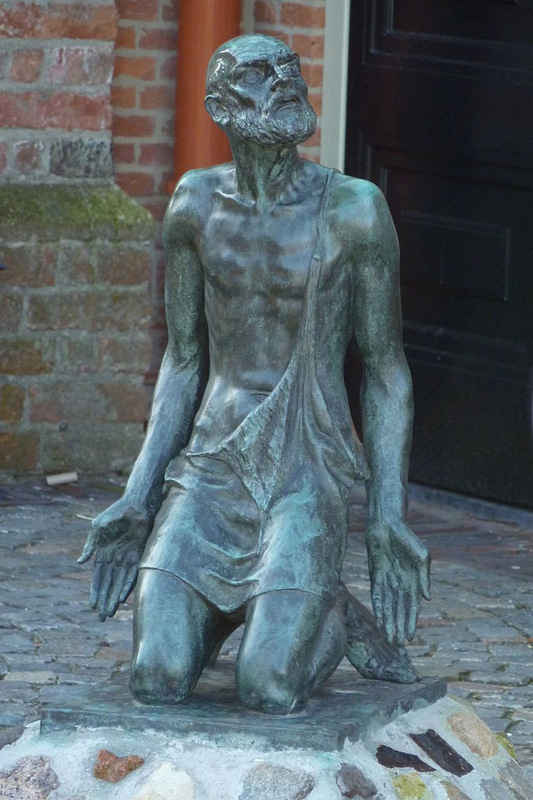
Job Talks to God, from Art in the Christian Tradition, a project of the Vanderbilt Divinity Library, Nashville, TN. http://diglib.library.vanderbilt.edu/act-imagelink.pl?RC=55467 [retrieved October 8, 2018]. Original source: http://commons.wikimedia.org/wiki/File:Noordwijk_Sint-Jeroenskerk_beeld.jpg.

10646937_10204043191333252_4540780665023444969_nRobert Cornwall is the Pastor of Central Woodward Christian Church in Troy, Michigan. He holds the Ph.D. in Historical Theology from Fuller Theological Seminary. He is the author of a number of books including Out of the Office (Energion, 2017), Marriage in Interesting Times (Energion, 2016), and Freedom in Covenant (Wipf and Stock, 2015) and blogs at Ponderings on a Faith Journey.


Ten Words from God: Pentecost 20

Ten Words from God: Pentecost 20

Narrative Lectionary Reflection

September 30, 2018

Introduction 

In the waning days of the Roman Empire, a monk named Benedict wrote a document that would direct how his fellow monks would live.  Used by Benedictine monks for 15 centuries, the Rule of St. Benedict laidout how monks were to live in a communal environment.  The rule provides order as well as helping the monks foster a sense of the relational nature of humans.

The Israelites crossed the sea and are now  “safe” on the other side.  Pharaoh and his army are gone. No more Egyptians to worry about.  But now they were out in the wilderness where they faced many unexpected challenges. In Egypt,  they followed Egyptian laws, but they weren’t in Egypt anymore.  They were now out in the wilderness. Rules were needed to help everyone get along outside the structure of Egyptian society and law. Common expectations and community norms were needed. The needed a rule, like the the Rule of St. Benedict.

As the people journey together, Moses presents them with a new Law from God.   The core of God’s Law for the Israelites is the Ten Commandments. Received by Moses and delivered to God’s people, these laws became important not only among the Israelites but also to many cultures and governments around the world.  In our own nation today, the Ten Commandments are widely accepted as social and spiritual norms.

It is important to note that the Ten Commandments were given to the Jews (actually the male Jewish head of households) and were not intended for universal use.  That said, we they can help us understand how we should live as Christians, what God expects from us and how following rules can be seen as an act of grace.

Engaging the Text

The Lord called to him from the mountain, “This is what you should say to Jacob’s household and declare to the Israelites: You saw what I did to the Egyptians, and how I lifted you up on eagles’ wings and brought you to me. So now, if you faithfully obey me and stay true to my covenant, you will be my most precious possession out of all the peoples, since the whole earth belongs to me.

-Exodus 19:3-5

It’s easy to see the Ten Commandments as rules to be on God’s good side.  But that’s not really what they are about.  In fact that aren’t really about us at all.  Theologian Rolf Jacobson notes that there are two things the Ten Commandments don’t do; they aren’t a pathway to salvation and they aren’t there to make you a better you.  Jacobson says the following:

The first is that God does not give the law as a means to salvation. To use the law to earn salvation, to win your soul’s way into heaven, is like trying to build a faster-than-the-speed-of-light spaceship or a time-travel machine out of plywood. It’s not possible. And neither is it possible to earn salvation through the law. God does not give the law as a way to establish relationship with the people. God establishes the relationship and then gives the law.

That leads to the second point about the law. It isn’t about “us,”per se. God does not give you and me the law in order to perfect us or even to make us a better “you”or a better “me.”The law is not about us — it is about our neighbors. God gives you the law, not so that you can get more spiritual or have your best life now, but so that your neighbor can have her best life now.1

The Ten Commandments are for our neighbor and for God.  How do we relate to our neighbors?  How do we relate to God?  We aren’t blessed when we do good, but when we do good to the other and the other does good to us.

The first four commandments deal with our relationship to God.  The next four deal with our relationship to others and the last two deals with the desires of the heart.

We will look briefly at each commandment starting with the first one.

You shall have no other God’s before me. Don’t put anything or anyone ahead of God.  We are to pledge sole alligence to God. When we fail to love God, our neighbor is affected. As Jacobson notes, “When we center our lives around things other than God — whether it be money, fame, power, pleasure, beauty, even religion, or anything else — our neighbors will pay.”

 Don’t make yourself an idol. God is supposed to come first over everything.  It is easy to think we could love God and something else, but God commands that there are to be no idols.

 Don’t use the name of God wrongly.We call upon God to forgive us when we sin, to offer praise, to seek healing. God’s name is powerful so we should use it with care.

Take the Sabbath off.    The Sabbath is a day to worship God, but more importantly, it is usually about rest and fairness. This commandment gives the poor a day of rest. It is also a reminder that in Egypt, the Israelites had to work without a day off. Now they are free from having to work all the time, so take the time to rest.

Relating to Others.The next four focus on who we take care of our neighbors.  That includes are parents. The first one of these commandments, honoring your parents is about loving the other, our neighbors.  In a more modern tone, we are to care for the elderly in our midst.  We are also not to take the life of another (again, to murder is to not care for the other), not stealing and not having sex with a person’s spouse.  Again, we don’t do these things to get on God’s good side, but we do it for the benefit of the neighbor.

State of the Heart. The last two commandments deal with the heart.  Don’t bear false witness against a neighbor and don’t covet anything of the neighbor.

An aside about how Jews might see the Ten Commandments. Protestant Christians tend to look at law and gospel or grace differently than Jews.  Starting with Martin Luther, we emphasize grace and sometimes see the law as something that is archaic and has nothing to do with our faith.

Jews, however, see this differently.  They see the law as a response to God’s goodness.  Theologian Geoff McElroy explains: 

At first glance the Decalogue seems to be a list of regulations, and that’s what we assume they are, a list of do nots.  But maybe they are more like a framework through which life, specifically life with God, is interpreted.

Jewish tradition about the Decalogue gets this in a way that post-Pauline Christianity has seemed to have lost.  For many Christians, the Ten Words are “law” vis-à-vis the gospel or good news of God revealed in Jesus and even though we’ll still think following them is a good thing, they are seen as something distinct from the concept of God’s grace, as things that we as humans have failed to live up to and thus we need saving.

But in Jewish tradition, the Ten Words are a response to grace.  The Jews traditionally order their commandments differently; what the Jews regard as the first commandment or word, many Christians just dismiss as a prologue or introduction to the commandments.  But in Jewish tradition, the first commandment is not to have “no other gods before me,” but is instead: “I am the LORD your God, who brought you out of the  land of Egypt, out of the house of slavery”  (Exo 20:2).

In other words, the first word of life with God is to, “Remember what God has done for you!” 2

Conclusion

As Christians, especially  Protestants, it’s easy to look at the Ten Commandments as rules to follow or rules that weigh us down, take away our fun.  Because we are all children of the Reformation, Protestants tend to believe in grace over law.  That we are saved by grace is the central message that reformers like Luther and Calvin.

However, these passages were originally written by and for Jews,  so we need to see how Jews responded to these Commandments.  Jews tend to see the Ten Commandments or Ten Words as a response to grace.  The Ten Commandments are a response to grace.   The law is the vehicle for grace.  

It’s important to realize that the first commandment in the Jewish tradition is not You should haven’t other gods before God.  Instead, the first commandment is “I am the LORD your God, who brought you out of the  land of Egypt, out of the house of slavery.”

It’s these sentences that the rest of the commandment flows from.  The rules that follow are not God keeping tabs as it is a response to what God has done.  If God has shown mercy to you, then you are to not make idols to other Gods.  If God has led you out of Egypt, then you are to care for the elderly.  If God has loosed the bonds of slavery, then you are to not steal or covet anything your neighbor has.

Theologian Thomas Long has likened following the Ten Commandments to a dance.  He writes:

The Decalogue begins with the good news of what the liberating God has done and then describes the shape of the freedom that results. If we want to symbolize the presence of the Ten Commandments among us, we would do well to hold a dance. The good news of the God who set people free is the music; the commandments are the dance steps of those who hear it playing. The commandments are not weights, but wings that enable our hearts to catch the wind of God’s Spirit and to soar.3

Like the Ten Commandments,  Communion reminds us of God’s wondrous acts of freedom through Jesus Christ.  How will we respond?  If God has freed us, then we should take the bread and wine with great joy, learning to follow God’s ways in joyous response.  We will fail at times, but God forgives us and we are reminded again of God’s love.  

  1. Rolf Jacobson, Working Preacher, June 15, 2014.
  2. Geoff McElroy, Desert Scribblings, 2008 (http://gmcelroy.typepad.com/desertscribblings/)
  3. Thomas G. Long, Christian Century, March 7, 2006, p.17.


Dennis Sanders is the Pastor at First Christian Church of St. Paul in Mahtomedi, Minnesota. He’s written for various outlets including Christian Century.

Saving Our Skins? A Lectionary Reflection for Pentecost 20B (Job 2)

Saving Our Skins? A Lectionary Reflection for Pentecost 20B (Job 2)

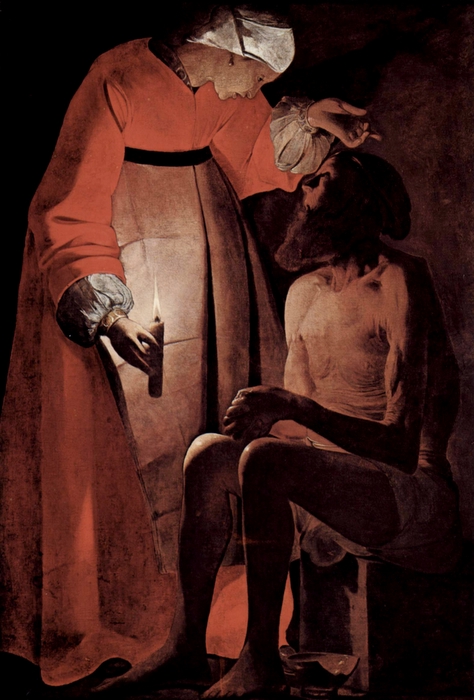
Job & his wife – La Tour
1:1 There was once a man in the land of Uz whose name was Job. That man was blameless and upright, one who feared God and turned away from evil.
2:1 One day the heavenly beings came to present themselves before the Lord, and Satan also came among them to present himself before the Lord. 2 The Lord said to Satan, “Where have you come from?” Satan answered the Lord, “From going to and fro on the earth, and from walking up and down on it.” 3 The Lord said to Satan, “Have you considered my servant Job? There is no one like him on the earth, a blameless and upright man who fears God and turns away from evil. He still persists in his integrity, although you incited me against him, to destroy him for no reason.” 4 Then Satan answered the Lord, “Skin for skin! All that people have they will give to save their lives. 5 But stretch out your hand now and touch his bone and his flesh, and he will curse you to your face.” 6 The Lord said to Satan, “Very well, he is in your power; only spare his life.” 
7 So Satan went out from the presence of the Lord, and inflicted loathsome sores on Job from the sole of his foot to the crown of his head. 8 Job took a potsherd with which to scrape himself, and sat among the ashes. 
9 Then his wife said to him, “Do you still persist in your integrity? Curse God, and die.” 10 But he said to her, “You speak as any foolish woman would speak. Shall we receive the good at the hand of God, and not receive the bad?” In all this Job did not sin with his lips.
******************
                Job was a righteous man from the land of Uz (wherever that is), whom Satan dared God to torment, to test his faith. God agreed to the wager, and as a result Job’s children were killed by raiding parties and his property destroyed. It was a sad day for Job, but he remained firm in his righteousness. He grieved but didn’t curse God. That’s the essence of chapter one of Job, though the lectionary includes only the introductory verse in the selection for Pentecost 20B. That’s because the focus is on chapter two and a second wager, this time involving Job’s own body. Will Job remain faithful with this twist in the story.
                As in chapter one, in chapter two of Job, the heavenly council gathers with Yahweh presiding. Satan appears once again before Yahweh, who once again asks Satan what he’s been up to. The answer is, “I’ve been traveling around the earth, checking things out, seeing what people are doing.” Once again, Yahweh asks Satan, what he thinks of Job. After all, “there is no one like him on the earth, a blameless and upright man who fears God and turns away from evil. He still persists in his integrity, although you incited me against him, to destroy him for no reason.” Did you notice God’s response? Job remained blameless and upright, even though Satan had “incited me against him, to destroy him for no reason.” God is rather proud of this man, whom God had allowed to be tested.
                I have always been intrigued by the story of Job. It invites us to think through our understanding of God, including God’s relationship to the world. In my theology, God is love, and a God who is love doesn’t go around messing people’s lives. Yet, that is the story, which should cause us to pause before embracing a literalist interpretation. In this picture of God, God is rather petty. God play games with a man’s life, by letting his children be murdered and his property destroyed, just to see if Job will stay firm in his faith. Job does, despite everything that is thrown at him. Job is righteous, but what about God? Is God so thin-skinned that God can be manipulated by Satan? It’s a question we must face, if we’re to hear this story.
                If we’re to read Job in a way that informs us theologically, we need to affirm at the very beginning that this fiction. The first clue ought to be Job’s homeland. Where is Uz? It could be Edom, but who knows. The picture of the heavenly court is also a clue, though it gives evidence of its rootedness in a pre-monotheist Israel. Whatever its origins, the book raises questions about our understanding of God, the nature of faith, and the challenge posed to that faith by human suffering. With that is our opening point, we need to also address this important character who appears in the early chapters, and that is the person of Satan. The character of Satan as depicted here is not the devil of human imagination. This is no figure with red skin, horns, and a pitchfork. This figure is more an informant, sent out by God, as would a king, to keep watch for rebellious activities. In this set of exchanges, Satan raises questions about Job’s piety. Is it based on living the good life, and if that good life is taken away, the piety would go away as well? It’s a good question, and whether we like the way the question is set up, it does speak to our own realities.
                In chapter two, when God asks Satan what he thinks of Job’s response to misfortune, Satan responds that this is to be expected. It’s one thing to lose your family and property. It’s another thing to have your own body afflicted. Isn’t it human nature to do whatever we can to save our own skins, even at the expense of those closest to us? That’s just the way things are. Jesus knew that. In the Gospel of John, we hear him say: “No one has greater love than this, to lay down one’s life for one’s friends” (John 15:13). Jesus will do that for his friends, but what about us? When push comes to shove, won’t we save our own skins? That’s the wager. So, God goes along with the wager, allowing Job to be afflicted, but not killed. Pushed to the limit, will he curse God?  That’s the question.
                Satan went and cursed Job, causing sores to appear on his body running from the soles of his feet to the crown of his head. In other words, the totality of his body was covered with “loathsome sores.” He was miserable. He probably wished to die. But he remained firm in his faith. He did so, even when his wife suggested that he curse God, so he might die. Curse God and get it over with. That was her advice. But he refused. He remained firm in his faith, despite everything.
                Satan was wrong. Job didn’t save his own skin by cursing God, though Job’s wife encouraged him to do so. He told his wife that one should expect both the good and the bad from the hand of God. That isn’t a comforting word on Job’s part. It doesn’t fit with my own theology. It’s not that I plan on cursing God, but I am troubled by the idea that God would authorize the bad. God might allow something bad to occur, or maybe, just maybe, there are things God simply cannot do. Through it all, however, Job remains firm in his faith.
This response on Job’s part, his decision to accept his fate and not curse God sets up the next phase of the story, his encounter with his “friends,” who at first seek to comfort him and then as time passes, and Job won’t confess his sins, raise questions about Job’s righteousness. After all, isn’t suffering the result of wrong doing? So far, however, Job does nothing to warrant his suffering, if suffering results from wrongdoing. His suffering comes from a divine directive.
                The questions raised by the Book of Job are important ones. In some ways the Book challenges another strain of Wisdom Literature that presumes that blessing is a sing of righteousness and suffering is a sign of unrighteousness. It also invites us to consider the we view the divine-human relationship. Marvin Sweeney, a Jewish scholar of the Hebrew Bible (and my son’s professor) at a Protestant seminary, offers these words of insight:

The book of Job deliberately presents the model of a righteous man who suffers with no apparent moral justification in an effort to force critical reflection on the issue. The arguments posed by Job’s friends concerning the meaning of human suffering and their assertions of divine righteousness even in the face of evil and Job’s responses to each of them are in fact the key issues of the book. The book of Job is intended to question the standard theological premises of the Torah and the Prophets, viz., is it really the case that observance of the divine will leads to success and peace in life? Is it really the case that the wicked suffer— and not the righteous? Is it really the case that G-d is just? Indeed, the final episode in which G-d affirms Job’s demands for an explanation for his suffering— even though G-d never provides such explanation— indicates that such a critical agenda is in fact the purpose of the book. In the end, the book of Job affirms divine presence and it appears to affirm divine righteousness, but the book also affirms the right and obligation of human beings to ask such questions of G-d. In this respect, Job points to and affirms a model of a human being in critical dialog with G-d.  [Sweeney, Marvin A. Tanak: A Theological and Critical Introduction to The Jewish Bible (Kindle Locations 11439-11447). Fortress Press. Kindle Edition.]

                The door is open. Are willing to walk through? Are willing to enter a critical dialog with God, as Sweeney proposes? The lectionary moves quickly, jumping from chapter two to chapter twenty-three. We don’t get to see the dialog with the friends, but we do experience Job’s complaint, which is set up by this attack on Job’s skin.

Picture attribution: La Tour, Georges du Mesnil de, 1593-1652. Job and his Wife, from Art in the Christian Tradition, a project of the Vanderbilt Divinity Library, Nashville, TN. http://diglib.library.vanderbilt.edu/act-imagelink.pl?RC=46621 [retrieved October 1, 2018]. Original source: http://www.yorckproject.de.

10646937_10204043191333252_4540780665023444969_nRobert Cornwall is the Pastor of Central Woodward Christian Church in Troy, Michigan. He holds the Ph.D. in Historical Theology from Fuller Theological Seminary. He is the author of a number of books including Out of the Office (Energion, 2017), Marriage in Interesting Times (Energion, 2016), and Freedom in Covenant (Wipf and Stock, 2015) and blogs at Ponderings on a Faith Journey.