Month: January 2020

Keeping Up Appearances: Third Sunday After Epiphany(Narrative Lectionary)

Keeping Up Appearances: Third Sunday After Epiphany(Narrative Lectionary)

Narrative Lectionary Reflection

February 2, 2020

Read: Mark 5:21-43


Reflection


I recently read a news item about a small congregation and how the pastor was able to connect the church to the wider community bringing in more people to the congregation.

I really hate those stories.

It’s not that I want these churches to fail. I am glad to see how declining churches can be rejuvenated.  But serving a small church for the last few years, I’m jealous. We have done what we can to connect to the wider community and we aren’t getting an influx of visitors.

We never hear it much, but I think there are a lot of pastors that feel like a failure.  Many of us try to do what we can to put our congregation on a new footing. We plan events for the community where only a few people show up, or maybe no one shows up at all.

We don’t hear much because most pastors aren’t willing to share their shortcomings.  They want to appear like they are in charge.

So many of us try to keep up appearances.  I am remembered of the British television show of the same name where the lead character tries to show herself and her family as better than what they really are.  

But the text today in Mark has a number of people that can’t keep up appearances.  They can’t pretend things are fine.  They can’t put up a fake smile in hopes that they can fake it until they make it.  The woman dealing with gynecological problems can’t hide her illness. It’s probably very visible and very embarrassing.  She is considered unclean, which must have felt shameful to her.  The woman didn’t even want to face Jesus, she had faith that if she just touched his clothing then maybe something would happen.  She touches Jesus’ clothing and she knew at that moment that she is healed.  Jesus marvels at her faith in spite of all the circumstances.

Jarius was a high religious official.  Most of the religious leaders viewed Jesus with disdain, but Jarius falls at the feet of Jesus begging that his daughter be healed.  We don’t know what Jarius thought about Jesus beforehand, but we know now that Jesus was his last chance. He threw all decorum to the side and cast his hope on Jesus.

Sometimes we want to appear that we have it all together.  Most times though, we don’t have things all together.  More often than not, we are barely holding things up.  But we don’t want to show this to others, mostly because we feel failures and want to keep that part of ourselves hidden.  But Jesus has a way of having us rip off our false faces to reveal ourselves. When the mask slips and crashes to the ground, Jesus is there waiting to heal us, waiting to forgive us. We don’t have to pretend everything is okay.

At the beginning of Mark, Jesus tells religious leaders that the healthy don’t need a doctor, it is the sick.  Jesus tells us to stop keeping up appearances and let Jesus come and heal us.


Dennis Sanders is the Pastor at First Christian Church of St. Paul in Mahtomedi, Minnesota. He’s written for various outlets including Christian Century.

The Foolishness of God – Lectionary Reflection for Epiphany 4A (1 Corinthians 1:18-31

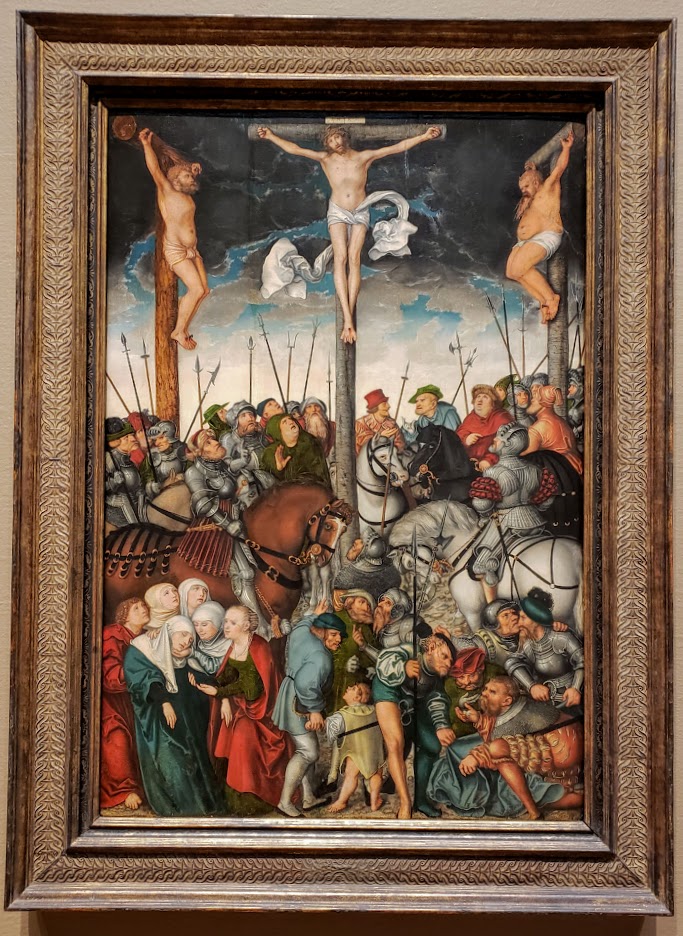
Lucas Cranach – Chicago Institute of Art
1 Corinthians 1:18-31 New Revised Standard Version (NRSV)
 

18 For the message about the cross is foolishness to those who are perishing, but to us who are being saved it is the power of God. 19 For it is written, 

“I will destroy the wisdom of the wise,

    and the discernment of the discerning I will thwart.”

20 Where is the one who is wise? Where is the scribe? Where is the debater of this age? Has not God made foolish the wisdom of the world? 21 For since, in the wisdom of God, the world did not know God through wisdom, God decided, through the foolishness of our proclamation, to save those who believe. 22 For Jews demand signs and Greeks desire wisdom, 23 but we proclaim Christ crucified, a stumbling block to Jews and foolishness to Gentiles, 24 but to those who are the called, both Jews and Greeks, Christ the power of God and the wisdom of God. 25 For God’s foolishness is wiser than human wisdom, and God’s weakness is stronger than human strength. 

26 Consider your own call, brothers and sisters: not many of you were wise by human standards, not many were powerful, not many were of noble birth. 27 But God chose what is foolish in the world to shame the wise; God chose what is weak in the world to shame the strong; 28 God chose what is low and despised in the world, things that are not, to reduce to nothing things that are, 29 so that no one might boast in the presence of God. 30 He is the source of your life in Christ Jesus, who became for us wisdom from God, and righteousness and sanctification and redemption, 31 in order that, as it is written, “Let the one who boasts, boast in the Lord.”

*************

                “God’s foolishness is wiser than human wisdom.” How do you read that statement? We might reply, yes, God’s thoughts are greater than ours but is that what Paul had in mind? Paul makes this statement in connection to his proclamation of the cross, which both Jew and Greek see as foolishness. Why would anyone think it wise to follow someone who was crucified? Yet, that is what Paul preached. He even takes note of the fact that those who answered the call to follow the crucified one weren’t considered wise by human standards. They weren’t powerful people or of noble birth. They were the kind of people who might be considered fools by those who thought of themselves as being wise by human standards. That may be true, but who really wants to be considered a fool?

                When I read this passage, I have to wonder what Paul has in mind. Might a message like this even be counterproductive in an age where growing numbers of our fellow citizens are rejecting expertise as elitism. Is Paul, in making this statement, giving license to Christian anti-intellectualism? I hope not, but I can see it being read that way. There has always been a strain of anti-intellectualism within the Christian tradition. Years ago, Mark Noll, a leading Evangelical historian wrote a book titled The Scandal of the Evangelical Mind. In that book, he addressed the presence of anti-intellectualism in the evangelical movement (as signified by ideologies such as young-earth creationism). So, what do we make of this?

When Paul declares: “Where is the one who is wise? Where is the scribe? Where is the debater of this age? Has not God made foolish the wisdom of the world?” does this mean that there is no place for instruction or expertise in the religious world? We might want to start our reflection by remembering that Paul was confronting a congregation that was divided into factions that seem to be centered around specific teachers. Might there be those arguing against making the cross a centerpiece of the message, suggesting that this would look foolish to those who think of themselves as being wise? There is a tendency to tailor the message to the audience. Consider Friedrich Schleiermacher’s On Religion: Speeches to its Cultured Despisers. Paul knew about the cultured despisers who seemed to reject the message of the cross.  


In making the case that the cross is the center of his message, Paul is arguing that human wisdom won’t lead you to God. You can’t study your way to a crucified messiah. It just will never make sense. It is something we take by faith. We look at Jesus on the cross and we see a different way of being. In the companion reading from Micah 6, we’re reminded that what God desires is justice, loving-kindness, and humility. The cross is a sign of humility and it is also a witness to justice, especially in light of the resurrection, which is God’s no to Rome’s act of condemnation. The cross is foolishness to those who cannot see God present in that moment, but it offers a different way of being, one that human wisdom can never discern.

If we can grant this premise, then we can address the other question, and that concerns the role of wisdom in the path of faith. I’m assuming that we still want physicians and our surgeons to be well qualified, though we seem less open to the possibility that the conclusions of the majority of climate scientists are correct. We seem, at times, to be impressed with our own observations, which we attribute to “common sense.” What comes to our religious teachers, should we expect a bit of knowledge and instruction? I understand that Jesus didn’t go to seminary, but Paul was rather well educated. In the Philippian letter he claimed as his religious heritage descent from the tribe of Benjamin, he was circumcised on the eighth day, and he was a Pharisee. As a Pharisee, he would have had significant religious training. There is even the suggestion that he had been a disciple of the famed Rabbi Gamaliel. But according to Paul, none of this mattered to him in relation to his position in Christ (Phil 3:1-11). He could brag if he needed to, but he considered this to be foolishness. That might be true, but Paul was still a rather well-educated person, as demonstrated by his letters.   


                So, when Paul speaks here of God’s foolishness and the foolishness of the cross, when he speaks of God destroying the wisdom of the wise, I don’t believe he is embracing anti-intellectualism. We don’t have to check our brains at the entrance to the church, but Paul makes it clear that human wisdom will not get you to the cross and thus to Jesus. He’s making it clear that following Jesus won’t make you respectable in the eyes of the world. Then again, when it comes to the message of salvation, God is willing to look foolish. St. Francis of Assisi was willing to be considered a Holy Fool for God. The question is, am I willing to be a Holy Fool? Am I willing to embrace God’s foolishness rather than seek salvation through human wisdom?       


Unity in the Power of the Cross – Lectionary Reflection for Epiphany 3A (1 Corinthians 1:10-18)

1 Corinthians 1:10-18 New Revised Standard Version (NRSV)

10 Now I appeal to you, brothers and sisters, by the name of our Lord Jesus Christ, that all of you be in agreement and that there be no divisions among you, but that you be united in the same mind and the same purpose. 11 For it has been reported to me by Chloe’s people that there are quarrels among you, my brothers and sisters. 12 What I mean is that each of you says, “I belong to Paul,” or “I belong to Apollos,” or “I belong to Cephas,” or “I belong to Christ.” 13 Has Christ been divided? Was Paul crucified for you? Or were you baptized in the name of Paul? 14 I thank God that I baptized none of you except Crispus and Gaius, 15 so that no one can say that you were baptized in my name. 16 (I did baptize also the household of Stephanas; beyond that, I do not know whether I baptized anyone else.) 17 For Christ did not send me to baptize but to proclaim the gospel, and not with eloquent wisdom, so that the cross of Christ might not be emptied of its power.

18 For the message about the cross is foolishness to those who are perishing, but to us who are being saved it is the power of God.

***************
 

                When Paul wrote his first letter to the Corinthian Church, he called them saints (1 Cor. 1:2). That might have been a more aspirational than descriptive statement, as we quickly discover when coming to the Second Reading for the Third Sunday after Epiphany. This reading follows the previous week’s reading which didn’t hint at problems, but it’s clear from this passage that this was a divided people. It seems that Paul, who had helped found the Corinthian congregation, had received word from a number of sources, including Chloe’s people, that the Corinthian saints were quarreling. Factions had developed, and they seem to have been dividing up according to allegiances. Some claimed to be followers of Paul, and some Cephas (Peter), and others Apollos. Then there might have been another group, who stand out for their claim to follow Christ.

I especially like that last grouping, the one that claimed to follow Christ. You see, I’m part of a denominational tradition that prides itself on its non-sectarian name. We’re “Disciples of Christ” and one of our Movement’s favorite slogans is “We’re not the only Christians, but we’re Christians only.” Yes, we’re Disciples of Christ and we wear that title proudly. So, take that Methodists, Presbyterians, Lutherans, Episcopalians, and Baptists. Why don’t you get with the program? For some reason, I don’t think Paul would appreciate this attempt to portray our movement as holier than others because we claim to follow Jesus and not a later leader or form of church government. After all, as Paul asks, “Has Christ been divided?” Paul’s point is that the church shouldn’t be divided. It doesn’t matter how you define yourselves, be of one mind and purpose. In other words, remember your calling.  


                Paul’s call for the Corinthians to be of one mind and one purpose, with no divisions among them, appeals to me. Things ecumenical stir my passions. That may be due in part to my own denominationally diverse background, but I have longed to the followers of Jesus united. At the same time, as a historian, I know that unity that is coerced, often by governmental decree, doesn’t honor the one whom Christians claim to follow. In many ways, Christian unity is more aspirational than practical, especially as the “church” has expanded across the globe. Besides, it’s difficult to let go of beliefs and practices that have been embraced over time. Sometimes it’s just the way we organize ourselves that stands in the way of unity.

Nevertheless, unity might be difficult to achieve, but that doesn’t mean we should give up on it. But unity needs to find its path in ways that honor our diversity in doctrine, practices, and governance. Since Paul mentions baptism here, we might think of our differences with regard to baptism. There isn’t just one way that Christians baptize. We’ve been arguing about it for centuries. I have embraced a particular form of baptism as my own, but I understand why others have embraced a different view. In Paul’s context, it may have been a question not of form or even doctrine, but the person who baptized a particular person. Paul responds to this problem, by downplaying his own participation in the baptism of members of the Corinthian Church. He goes so far as suggesting that his calling involved preaching the Gospel not baptizing people. Now that claim might get him in trouble in certain circles of my tradition. It might even get you fired from your post as a theology professor. since some in the broader tradition of which I’m a member believe that baptism is essential for salvation (and by baptism, I mean immersion for the remission of sins on the basis of an informed confession of faith). Baptism is, in my mind, an important element of the Christian faith, but fighting over it does nothing to further the message of God’s realm.

Rather than focus on who baptizes whom, Paul wants to focus on the cross of Jesus, which is itself rather scandalous. Paul says that it is foolishness to those who are perishing, but for those who are being saved, it is the power of God. We might struggle with Paul’s statement regarding salvation, but his point is clear, the gospel is revealed in the cross, which to Jew and Gentile was scandalous. In our day much of the scandal of the cross has dissipated. We wear the cross as jewelry, with no thought to its original use. In other words, what was once scandalous has been domesticated.

          The arguments that were dividing the Corinthian community had to do with power and influence. That’s why Paul put his focus on the cross in all its foolishness. There in the cross, one would find the power of God, and not in the eloquence of a preacher. Paul felt called to preach the gospel, but he was concerned about those who put an emphasis on eloquence. It’s possible that some in Corinth didn’t think much of his preaching, but that didn’t really matter to him. He might not be the best preacher in the realm, but he knew what his calling was. It’s probably useful to remember that in his day there were those who studied rhetoric so they could be professional speakers. To be eloquent, was to have power. As for Paul, whether he was a good preacher or not, his focus was on the cross, lest it lose its power. He didn’t want to get in the way of the gospel, which is rooted in the cross of Christ. It’s a temptation that is as prevalent today as it was in the first century. There is a desire within all of us to be admired, but when that desire gets in the way of the gospel then it’s a problem. It’s not that preachers ought not to give attention to their craft, they just need to keep things in perspective. As a preacher, I try to do my best to offer something worth hearing, but in the end, it shouldn’t be about me (or any preacher, even the most eloquent of preachers).

            Now those who claimed to be of Christ rather than Paul, Apollos, or Cephas, were on the right track, but perhaps for the wrong reason. We should be about Christ in the church, but if we use that claim as a way of holding ourselves over others then we’ve defeated the purpose of our identification with Jesus. So, even though the cross seems to be a foolish place to center ourselves, that’s where Paul puts the focus. Not his eloquence. Not his prowess as a baptizer. No, it’s the cross of Jesus that matters.  Whatever unity was to be had in the Christian community would come in terms of the cross, which may seem like a rather foolish idea—Why would one want to find unity in a method of execution that emphasized humiliation? —but it is the way of Jesus (and Paul).        


Lacking No Spiritual Gifts – A Lectionary Reflection for Epiphany 2A (1 Corinthians 1)

1 Corinthians 1:1-9 New Revised Standard Version (NRSV)

Paul, called to be an apostle of Christ Jesus by the will of God, and our brother Sosthenes, 

To the church of God that is in Corinth, to those who are sanctified in Christ Jesus, called to be saints, together with all those who in every place call on the name of our Lord Jesus Christ, both their Lord and ours:

Grace to you and peace from God our Father and the Lord Jesus Christ.

I give thanks to my God always for you because of the grace of God that has been given you in Christ Jesus, for in every way you have been enriched in him, in speech and knowledge of every kind— just as the testimony of Christ has been strengthened among you— so that you are not lacking in any spiritual gift as you wait for the revealing of our Lord Jesus Christ. He will also strengthen you to the end, so that you may be blameless on the day of our Lord Jesus Christ. God is faithful; by him you were called into the fellowship of his Son, Jesus Christ our Lord.

***************

                Paul’s first letter to the Corinthian Church is one of the best reminders that there never was a Christian Golden Age that we might seek to restore. In this letter we encounter a church that is, to put it mildly, dysfunctional. Here in 1 Corinthians, we find a church that is divided and conflicted. There is evidence of sexual indiscretions, marriage problems, concerns about social inequality, and much more. If you are looking for a model church this is not it, and yet despite the many problems facing the congregation, it is also a congregation that is truly gifted. So, there are things we can learn from them that can enhance life in the modern church—just not the conflicts.

                This reading from 1 Corinthians doesn’t reveal the problems present in the congregation. Paul addresses them as a community that is sanctified in Christ Jesus. In fact, he calls them saints. In fact, Paul gives thanks to God for them, and he does so always. He might be frustrated with them at times, but he seems to have great affection for this community, which he helped launch. He will address the problems that are presenting themselves as the letter proceeds, but he doesn’t start out by taking them behind the woodshed. While the appellation of saints might be more aspirational than descriptive, this is the way he wishes to them. They may have their problems, but they still are part of the body of Christ.

                Because I am deeply interested in matters relating to spiritual gifts (see my book Unfettered Spirit: Spiritual Gifts for the New Great Awakening), Paul’s statement in verse 7, where he gives thanks that they’re not lacking in any spiritual gift (charismata), stood out to me. Of course, it is here in 1 Corinthians that Paul devotes the greatest amount of space to spiritual gifts, but here he gives us a hint of what is to come. He commends them for their giftedness, and he couches this statement in eschatological language. He notes that they don’t lack any spiritual gift as they “wait for the revealing of our Lord Jesus Christ.” 


                This word about the revealing of Jesus fits well into the context of Epiphany. At this point in the liturgical year, we are supposed to be looking for those signs that God is present, those moments of divine revealing. The Spirit is the one who does the revealing, and who empowers the church to bear witness to that revealing, as we await the day when Jesus returns. The expectation is that when this day arrives we will be found blameless.    


                Unlike with Paul’s greeting to the Roman Church, in this case, Paul is quite familiar with the community to which he writes. This is a congregation (likely a collection of house churches) that he founded. These are his people, his congregation. As we discover as we read further, Paul uses this letter to answer queries from members of the congregation. His responses are meant to get them back on track. One would assume that when he left, he had some confidence that they were ready to go out on their own. Perhaps that confidence was unwarranted. The reading ends in verse 9, but verses 10 through 17, suggest that there is significant division in the church. This is not what Paul desires. He appeals for unity. He asks that they would be “united in the same mind and the same purpose” (1 Cor. 1:10).  


Among the points of division in the congregation is the matter of these spiritual gifts, which the congregation is not lacking. They have gifts aplenty, but not a come sense of purpose as to their use. When we get to chapters 12 and 14, we discover that this is a congregation that prizes spiritual things and spiritual experiences. They understand these spiritualities in very individualistic ways. They appear to have ranked the gifts and desire to possess the most spectacular of the gifts. The one that seems to be prized the most is this ability to speak in tongues. Instead of seeking gifts that enhance one’s own stature, Paul encourages them to pursue gifts that build up the church (1 Cor. 14:12).

                As I noted earlier, Paul sets this conversation in a context of expectation. There is a high level of concern in this community as to the return of Christ. The conversation in chapter seven about marriage is evidence of this, as is the discussion of the resurrection in chapter fifteen. It might be that this eschatological fervor created a sense of anxiety that led to some of the problems present in the congregation. This spiritual anxiety might help explain why they seemed to embrace a rather individualistic spirituality. Paul addresses that anxiety, while also pointing them toward gifts that will benefit the community. Thus, while the body of Christ has many members, no one member stands on her or his own. Therefore, there should be no divisions. After all, there is no lack of gifts in the congregation. They simply need to be affirmed. The good news is that “God is faithful; by him you were called into the fellowship of his Son, Jesus Christ our Lord.”


All Is Forgiven: Baptism of our Lord (Narrative Lectionary)

All Is Forgiven: Baptism of our Lord (Narrative Lectionary)

Narrative Lectionary Reflection

January 12, 2020

Read: Mark 2:1-22


Reflection

I’ve been preparing for the sermon for this coming Sunday and I’ve been reading and thinking about the text: Mark 2:1-22. The very first story is the story of the four men who went up to the roof and lowered their friend down to where Jesus was healing. Everyone always focuses on the extreme faith and love on the part of those four friends. What makes no sense, is when Jesus sees the man being lowered and not immediately make this man walk. I mean it was as plain as the nose on one’s faith. Why did Jesus feel the need to say this man’s sins are forgiven?

Maybe it was because the man himself wondered if his predicament was because of the result of sin. Does it mean that he sinned and became a paralytic as a result? Probably not. But think about this man’s situation for a moment. We don’t know if this has been his condition since birth or it happened later, but you can wonder why you are in this predicament. In John 9, Jesus meets a blind man and his disciples wonder if he sinned or did the man’s parents sin to make this man blind. Jesus says neither. But when you are in this condition, you might be more aware of your sin than other times in one’s life.

What matters is that Jesus saw this man, saw the awesome faith of his friends and told the man what he needed to hear: that he was forgiven, that the burden that he carried was no longer his.

There are lots of people in our midst who are weighed down with guilt, sin, and sadness. The question for us today is not that we can forgive their sins, but can we bring them to Jesus in the same way that this man’s friend did? They were willing to help their friend even if it meant tearing up a roof to get their friend to be healed by Jesus.

As Christians, we are called to share the love of God with our friends and neighbors. A friend recently said that in many cases, the people that we meet are longing for forgiveness. Bring them to Jesus can help them realize a sense of grace in a world that is graceless.

Now, that might sound odd to some because especially in mainline Protestantism, there has been a move away from forgiveness towards justice. There is a need to focus on justice issues, but there is also a spiritual side of life where people just want to feel a sense of grace, to know they are forgiven. Sometimes that is even more important to people than physical healing.

So as we prepare for Sunday and we meet our friends, know they are carrying burdens. How can we bring them to have an encounter with Christ? How can they experience forgiveness from Jesus?

Sometimes forgiveness feels more important than healing.


Dennis Sanders is the Pastor at First Christian Church of St. Paul in Mahtomedi, Minnesota. He’s written for various outlets including Christian Century.

No Partiality – A Lectionary Reflection for Baptism of Jesus Sunday (Acts 10)

No Partiality – A Lectionary Reflection for Baptism of Jesus Sunday (Acts 10)

Acts 10:34-43 New Revised Standard Version (NRSV)

34 Then Peter began to speak to them: “I truly understand that God shows no partiality, 35 but in every nation anyone who fears him and does what is right is acceptable to him. 36 You know the message he sent to the people of Israel, preaching peace by Jesus Christ—he is Lord of all. 37 That message spread throughout Judea, beginning in Galilee after the baptism that John announced: 38 how God anointed Jesus of Nazareth with the Holy Spirit and with power; how he went about doing good and healing all who were oppressed by the devil, for God was with him. 39 We are witnesses to all that he did both in Judea and in Jerusalem. They put him to death by hanging him on a tree; 40 but God raised him on the third day and allowed him to appear, 41 not to all the people but to us who were chosen by God as witnesses, and who ate and drank with him after he rose from the dead. 42 He commanded us to preach to the people and to testify that he is the one ordained by God as judge of the living and the dead. 43 All the prophets testify about him that everyone who believes in him receives forgiveness of sins through his name.”

************

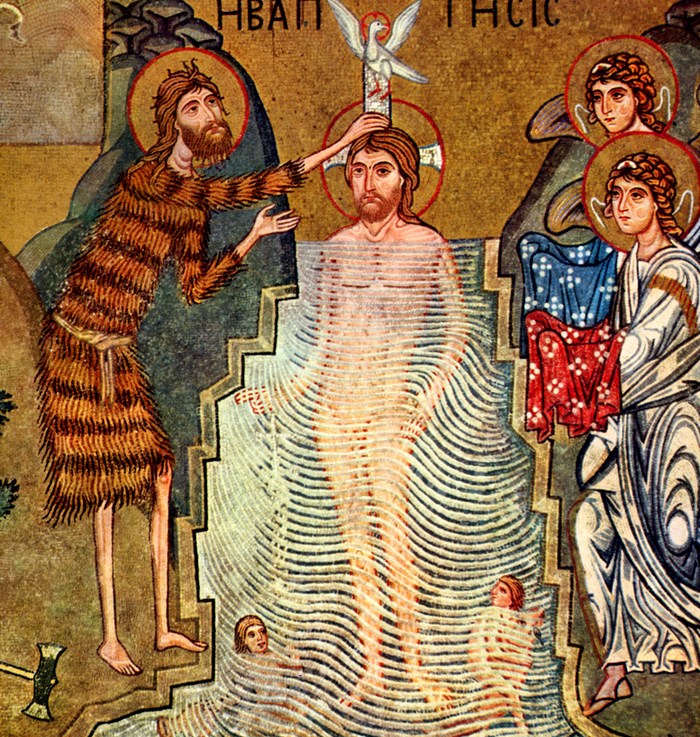
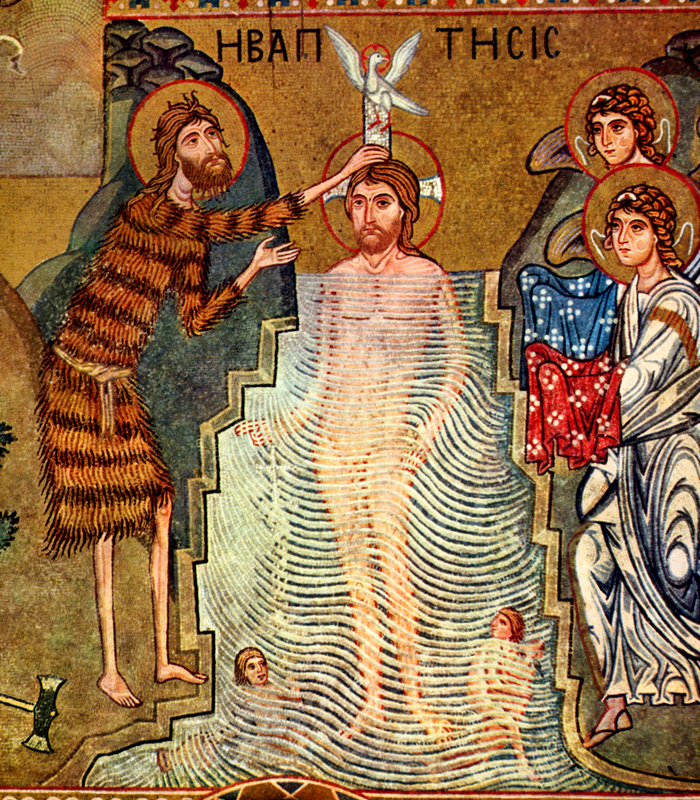
                Christmas and Epiphany have come and gone. It’s time for the story of Jesus’ birth and childhood to give way to the beginning of his ministry. On this first Sunday after Epiphany, we celebrate the baptism of Jesus. This baptismal event at the hands of John, which took place in the Jordan, marks the point at which God claimed Jesus as beloved Son. With that, after spending time in the wilderness, Jesus began his earthly ministry. As Matthew, and other Gospels, tell it, at the moment of his baptism the heavens opened, and God claimed him as God’s Son, the beloved (Mt. 3:13-17). Baptism of Jesus Sunday often serves as an opportunity for modern followers of Jesus to reaffirm their baptismal vows and renew their vision of ministry.  


If the Gospel reading from Matthew 3 invites us to join Jesus at the Jordan, the Second Reading, which normally is drawn from one of the epistles, takes us to the Book of Acts. Contextually, we find ourselves at the home of Cornelius, a Gentile Centurion, who has summoned Peter to share with the household something about Jesus. At this point in the story, as told in the book of Acts, Peter’s focus has been on the ministry to those Jews who might be open to the message of Jesus, although the ministry of Philip had opened the mission to the Samaritans. But things are about to change because Peter has discerned through a vision that God might be opening the circle a little wider. Maybe, that circle could be drawn to include not only Jews and Samaritans but Gentiles as well. The connecting tissue linking this reading from Acts 10 to the aforementioned baptism of Jesus, is the reference to God anointing Jesus, perhaps through the aforementioned baptism of John, “with the Holy Spirit and with power.” As the reading for today speaks of John’s Baptism and suggests that Jesus might have experienced that baptism, we have another element of background information to interpret this passage and the message Peter wants to deliver to Cornelius’ household. Since this is a Sunday in which so many reaffirm their baptisms, it’s appropriate to note that before Peter gets too far into his sermon the Spirit falls on Cornelius and his household, which leads Peter to decide that there is nothing stopping them from being baptized themselves.


In this excerpt from the longer story that takes up chapters 10 and 11 of the Book of Acts, Peter’s gospel preaching begins with Jesus’ anointing with the Holy Spirit in the aftermath of John’s baptism. He notes that Jesus traveled the countryside doing good things, including offering to heal to those oppressed by the devil (exorcism). He notes that he was a witness to all that Jesus said and did, including his death and resurrection. He also notes that God appointed Jesus to the position of judge over the living and the dead. All of this took place as revealed by the prophets, so that “everyone who believes in him receives forgiveness of sins through his name” (Acts 10:43 CEB). As for Peter, he was a witness to all of this.


                While Luke records Peter’s stump speech, what stands out is Peter’s declaration that he has learned that God doesn’t show partiality to any one group of people. We need to be careful here so that we don’t take an anti-Jewish step. This could involve the suggestion that Jews are Christ-killers (“they hung him on a tree”). We also need to be careful not to suggest that what Peter is doing here offers Jesus as a replacement for Judaism. Peter is saying, however, that while God may have chosen Israel and continues to treasure Israel, God ultimately shows no partiality to any specific group. This may seem contradictory, but I think God can hold things into tension. The message that Peter heard in his vision and he shares now is that in Christ all are welcome. God may have chosen Israel, but that doesn’t exclude Gentiles from enjoying the blessings of God’s realm.


                If we can remove any possible taint of anti-Semitism from this statement, then we get to what I think is the core message here, and that is God welcomes everyone into the family. The criteria we often use to exclude have no standing here. In the case of Cornelius, Peter may have in mind his Gentile status. He might also have been concerned about Cornelius’ military career. But, apparently, none of this matters to God.  


                Now, this moment has been coming for some time. It would seem to be rooted in the call to take the Gospel to the ends of the earth (Acts 1:8). That could have been simply a call to minister to the diaspora, but even the Gospel of Luke there are hints that Jesus has other things in mind. Eventually, Paul’s mission to the Gentiles will take center stage, but not quite yet. It’s actually Peter who gets the first honor of breaking down the wall of separation. Again, we need to be careful not to cast Jews in a negative light. There were degrees of welcome in Judaism of the first century and earlier, just as there have been degrees of welcome within the Christian community toward those who have lived outside the circle.


                The context for hearing this message is the celebration of the baptism of Jesus, which inaugurates his ministry. The context of the passage is a different baptism, but one that marks a transitional moment in the life of the church. Paul will be the lead person in the Gentile mission, but Peter is the one who takes the first step. That’s appropriate. He was, it seems, Jesus’ closest companion. He was the leader of the church. Whatever decision he made in a situation like this set the parameters for what would come later.


                The sermon he preaches to Cornelius’ household occurs only because Peter had already experienced conversion through the vision in which God reminded him that he should not declare unclean what God had declared clean. Now that part of the story isn’t mentioned here, but it’s the context. We wouldn’t be here without that vision.


                So, what does Peter’s declaration that God shows no partiality mean for the 21st-century Christian community? After all, our churches remain largely segregated according to ethnicity/race. Some of this is cultural and some of it has to do with comfort level. But it also to do with the fact that many of us in the White Christian community has not yet made peace with our complicity in the suppression/oppression of minority communities. Then there is the church’s relationship to those who make up the LBTQ community, which itself is not monolithic. The church as a whole has been largely hostile to this community, to everyone’s detriment. The story that we find in Acts 10 and 11 has proven to be an important piece in my own journey to welcoming fully my LGBTQ brothers and sisters. The Spirit moves as the Spirit moves!  


                Regarding the question of Partiality, I appreciate this word from Matthew Skinner:

A God who “shows no partiality” is not politically neutral or aloof; the expression in this context indicates God’s active concern for all humanity. Peter would have already known this from Jewish scriptural traditions, but he sees it coming to pass now in an unexpected way, with old boundaries passing away and new solidarity and fellowship springing into being, sealed by the Holy Spirit. If God shows this kind of impartiality, so should God’s people. [Connections, Kindle Edition].

Boundaries are difficult to let go of, but as Peter discovered in his encounter with Cornelius, it’s possible. It’s just a matter of flowing with the Spirit. So, what about our boundaries and barriers? What needs to go so that God’s inclusive love might be made known to the world? Since this is Baptism of Jesus Sunday, how does such a concern relate to our understanding of baptism?