Month: June 2020

Why Do I Do These Things? — Lectionary Reflection for Pentecost 5A (Romans 7)

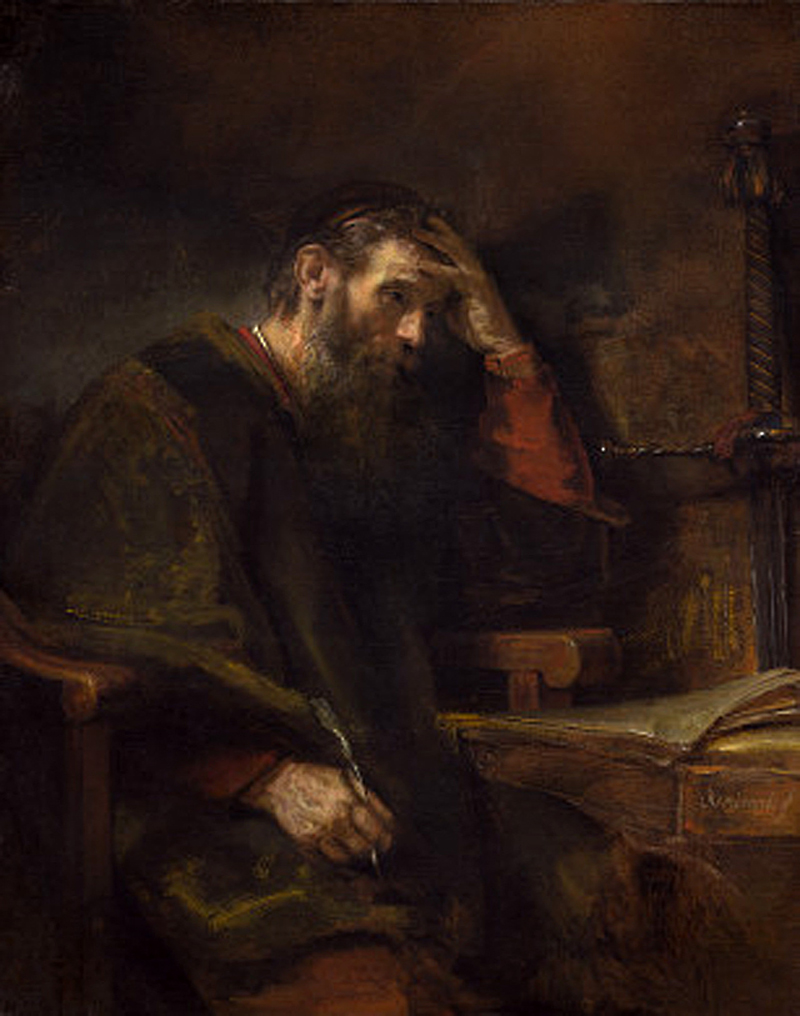
Rembrandt, Apostle Paul
Romans 7:15-25a  New Revised Standard Version (NRSV)
 

15 I do not understand my own actions. For I do not do what I want, but I do the very thing I hate. 16 Now if I do what I do not want, I agree that the law is good. 17 But in fact it is no longer I that do it, but sin that dwells within me. 18 For I know that nothing good dwells within me, that is, in my flesh. I can will what is right, but I cannot do it. 19 For I do not do the good I want, but the evil I do not want is what I do. 20 Now if I do what I do not want, it is no longer I that do it, but sin that dwells within me. 

21 So I find it to be a law that when I want to do what is good, evil lies close at hand. 22 For I delight in the law of God in my inmost self, 23 but I see in my members another law at war with the law of my mind, making me captive to the law of sin that dwells in my members. 24 Wretched man that I am! Who will rescue me from this body of death? 25 Thanks be to God through Jesus Christ our Lord!

*****************

                Why do I do these things? Why can’t I seem to do what is right? Right now the issue of racism is raging across the globe as we reckon with continuing reports about profiling and police violence against people of color, especially people who are black. Names such as George Floyd, Breonna Taylor, Elijah McClain have become part of our consciousness. While we speak of “Black Lives Matter,” we also are facing the issue of whiteness as an ideology. That is, the ideology that white Euro-American culture is superior to other cultures, and that white people are genetically superior as well. It is in this context that we hear Paul ask why he does that which he hates. He attributes it to the sin that dwells within him.

                We can debate whether sin is genetically or socially determined, but whichever choice we make, it does seem that Paul is correct that sin is a problem. Living under the dominion of sin is, Paul noted in chapter six, deadly. However, to live under Christ’s dominion leads to life (Rom 6:23). The promise of baptism is freedom from sin, but Paul recognizes that even he struggles with the power of sin. He’s no Vulcan who has learned to suppress his passions with logic. These passions that drive behavior live too close to the surface and are difficult to control.

                To affirm the premise that sin exerts power over our lives, even when we resist, doesn’t mean we’re totally depraved or unable to do anything good. As Sarah Heaner Lancaster notes, this is about human nature. Instead, it is a question of where sin resides and exercises control. That is the self. It is like a virus that has taken root in our lives, driving our behavior in ways that are contrary to our nature. In fact, as Lancaster points out, for Paul sin resides closer than the good, which is why it has so much power. [Romans, pp. 127-128].

                In his discussions of law, the problem isn’t with Jewish law. There’s nothing inherently wrong with it. The problem is with the will not being strong enough to live according to these instructions. Concerning the definition of sin, it’s not really about breaking rules. Instead, it is a distortion of our relationship with God. It is a turning from centering our lives in God to centering our lives in ourselves. Thus, as Harold Masback writes: “The very turn to self-assertion unleashes a ‘fleshliness,’ the self’s insatiable desire to secure its own acceptability through acquisition and possession rather than through trust in God’s love” [Masback, Feasting on the Word, p. 209]. As Paul reflects on his situation in life, he confesses to being conflicted. He would like to do otherwise but seems unable to do so. Now, if we’re not inclined to do what is right, then there is no conflict. The conflict comes into play when we desire to do what is right and find sin overpowering that desire. The only way out is grace. It is grace that overcomes the power of sin so that we might live into God’s desires for us.

                In our day we are beginning to recognize that sin is not only personal it can be systemic. Racism is systemic. We’re not born racist, but the system quickly forms us. Before we know the difference between ourselves and others, the virus has begun to spread. Thus, as Sarah Lancaster points out “recognizing this problem helps us see how deeply conflicted we really are and how thoroughly dependent on grace we must be.” [Romans, p. 130].

                The title of Kerry Connelly’s book speaks to the dilemma we’re facing as believers. The book is titled Good White Racist? How can I be a racist and be a good person? Connelly writes that “We hid from our own shadow side, unable to hold the paradox that as generally good people, we can do incredibly bad things” [Good White Racist? p. 11]. That’s the point Paul is making. Good people can do bad things. This is true even when we want to be different. I look at myself. I am committed to being anti-racist. My denomination provides anti-racism training, which I’ve taken. As chair of our Commission on Ministry, I require it of my colleagues, both new and old. I know better, and yet I see evidence that racism is lurking just under the surface. It’s present in the form of implicit bias. It’s present in the sense of white superiority. It’s present in white privilege.

                Paul’s discussion of sin has long been problematic for liberal Protestant Christians. We want to believe that if we educate ourselves, we will reach that utopian place of justice and peace. It’s enticing. I want to affirm it, but then I hear a voice like that of Reinhold Niebuhr, who pulls the rug out from my illusions. In Moral Man inImmoral Society, Niebuhr writes that “while it is possible for intelligence to increase the range of benevolent impulse, and thus prompt a human being to consider the needs and rights of other than those to whom he is bound by organic and physical relationship, there are definite limits in the capacity of ordinary mortals which makes it impossible to grant to others what they claim for themselves” [Niebuhr, Moral Man in Immoral Society, p. 3].  He notes that educators have “given themselves to the fond illusion that justice through voluntary co-operation waited only upon a more universal or a more adequate educational enterprise.” [Niebuhr, p. 3]. But, there’s no evidence that this true. Instead, he suggests that the only way forward is through some form of coercion. That goes against the grain of my own theology, which suggests that divine love if it is truly love, is non-coercive. It does put me in a bind.

                Paul has put his finger on our dilemma. He raises questions that I’ve yet to fully find answers to. Perhaps the place to start is to recognize that the challenges we face are rooted in spiritual realities. We find it difficult to tackle the problems of our age because we believe that with a bit of education, we can overcome them. The fact is, literacy and education are universal in the United States, but we still can’t figure out how to overcome racism or provide for the common welfare of all residents. So, maybe we need to look at this from a spiritual perspective. In other words, perhaps the issue isn’t the law, it’s our personal and corporate enslavement to the power of sin, which has taken root in our lives. We claim for ourselves freedom, but are we truly free? So, perhaps racism is itself an inherently spiritual issue. Perhaps the very systems in which we live are spiritually compromised. It’s in that context that together with Paul we can cry out: “Wretched man that I am! Who will rescue me from this body of death?” (vs. 24). Perhaps the answer is to be found in that declaration of thanksgiving that Paul provides us: “Thanks be to God through Jesus Christ our Lord!” (vs. 25a). This is a recognition on Paul’s part that he can’t save himself. He needs help, and Jesus is there to provide it. Just reach out and take hold of the promise. That may seem like a copout, but perhaps it is the starting point for change. As they say in Twelve-Step programs change begins when we admit we have a problem we can’t solve on our own.


Picture attribution: Rembrandt Harmenszoon van Rijn, 1606-1669. Apostle Paul, from Art in the Christian Tradition, a project of the Vanderbilt Divinity Library, Nashville, TN. http://diglib.library.vanderbilt.edu/act-imagelink.pl?RC=55240 [retrieved June 28, 2020]. Original source: http://www.nga.gov/fcgi-bin/tinfo_f?object=1198.


What Has Dominion in Your Life? – A Lectionary Reflection for Pentecost 4A (Romans 6)


12 Therefore, do not let sin exercise dominion in your mortal bodies, to make you obey their passions. 13 No longer present your members to sin as instruments of wickedness, but present yourselves to God as those who have been brought from death to life, and present your members to God as instruments of righteousness. 14 For sin will have no dominion over you, since you are not under law but under grace. 

15 What then? Should we sin because we are not under law but under grace? By no means! 16 Do you not know that if you present yourselves to anyone as obedient slaves, you are slaves of the one whom you obey, either of sin, which leads to death, or of obedience, which leads to righteousness? 17 But thanks be to God that you, having once been slaves of sin, have become obedient from the heart to the form of teaching to which you were entrusted, 18 and that you, having been set free from sin, have become slaves of righteousness. 19 I am speaking in human terms because of your natural limitations. For just as you once presented your members as slaves to impurity and to greater and greater iniquity, so now present your members as slaves to righteousness for sanctification. 

20 When you were slaves of sin, you were free in regard to righteousness. 21 So what advantage did you then get from the things of which you now are ashamed? The end of those things is death. 22 But now that you have been freed from sin and enslaved to God, the advantage you get is sanctification. The end is eternal life. 23 For the wages of sin is death, but the free gift of God is eternal life in Christ Jesus our Lord.

********

                Whenever the words slave or slavery appear in Scripture, we should wince. We must be careful not to do anything with these words that would justify North American slavery and its legacy because that legacy is still with us. We do not live in a post-racial society. The election of a black man didn’t suddenly change our nation. To say that “all lives matter” is to miss the point. Racism is still alive and well in America. So, anything that might justify or rationalize the servitude of a particular people is simply unacceptable. It’s with this warning that I venture into this reading from Paul’s letter to the Romans, which speaks of being a slave either to sin or to God.  


We need to remember that at the time when Paul wrote this letter slavery was a dominant form of life in the First Century Roman world, with as many as two-thirds of the residents of the empire being slaves. Not all forms of slavery the same. One could be a slave and work in the salt mines or one could be a tutor to a wealthy family. Some slaves were forced into this life and others sold themselves into slavery. We should also remember that a significant number of early Christians were themselves, slaves. So, at least some of the recipients of this letter were slaves. So, it’s not surprising that Paul used this image to present his message of dominion.  


                This reading for the Fourth Sunday after Pentecost continues the discussion of the power of sin that Paul has been working with in previous verses and chapters. He has told the Roman church that “all have sinned and fall short of the glory of God” (Rom. 3:23). He wants them to know that the Law can reveal their sin, but not free them from it. Their only hope is Christ. In the opening eleven verses of Romans 6, Paul makes it clear that to be in Christ is to die to sin. He uses baptism to illustrate his message. He tells the Roman Christians that when they were baptized, they died to sin, even as Jesus buried. Then as they rise from the waters of baptism, they share in the resurrection of Jesus. Thus, in baptism, they move from death to life. To be baptized is to be dead to sin. That is, to be in Christ is to be dead in sin and alive to God.

As we turn to verse twelve of chapter six, Paul changes metaphors. Now the question is—who or what has dominion over our mortal bodies. Paul tells the readers that now that they are dead to sin and alive to God they shouldn’t “let sin exercise dominion over your mortal bodies. It’s here that turns to the metaphor of slavery but notice that it is assumed that one has the freedom to choose the nature of one’s slavery.

                Here is where things get tricky. There were different forms of slavery in the First Century, none of which were race-based. Slaves might be prisoners of war or the spoils of war. These were not voluntary forms of slavery, but one could sell oneself into slavery either for economic purposes or to advance one’s social status by serving someone of importance. This was common for tutors and other scholars. Nevertheless, to be a slave was to lose one’s freedom, even if entered into voluntarily. Thus, Sarah Heaner Lancaster writes that “all the restrictions and dangers of being someone else’s property apply as equally to the willing slave as to someone enslaved by force. Just so, misusing the freedom that grace provides by voluntarily obeying sin makes one no less a slave to sin” [Lancaster, Romans, p. 114].

                Instead of turning yourself over to sin, to let it have dominion over your life, turn yourself over to God so that your bodies might be instruments of righteousness. There is the freedom to choose, but it’s the freedom to choose the nature of one’s slavery. It is either being a slave to sin or a slave to God. It’s a question of allegiance in many ways—sin or God.  So, what is the advantage of giving dominion over to God rather than sin? Truth be told, sin often seems more attractive, but Paul suggests that the domain of sin leads to shame. In other words, Paul is drawing on the cultural understanding of honor/shame to define sin’s hold. Of course, to enter Christ’s domain means leaving behind a world that defined honor to join one that in the eyes of the broader culture might connote shame. Paul just turns things upside down and suggests that by choosing God’s dominion, one chooses the long-term gain over the short term. When one lived under the dominion of sin, one may have done things and behaved in certain ways that they now would be embarrassed about, even if those items were perfectly legitimate in the previous life.

Paul wants them to know that the choice is theirs. They can choose to let sin have dominion, but it will lead to death. Or, they could let God have dominion, and that leads to life. Or as Paul puts it in another well-worn verse: “For the wages of sin is death, but the free gift of God is eternal life in Christ Jesus our Lord” (Rom. 6:23).   


Dead to Sin, Alive to God — Lectionary Reflection for Pentecost 3A (Romans 6)

What then are we to say? Should we continue in sin in order that grace may abound? By no means! How can we who died to sin go on living in it? Do you not know that all of us who have been baptized into Christ Jesus were baptized into his death? Therefore we have been buried with him by baptism into death, so that, just as Christ was raised from the dead by the glory of the Father, so we too might walk in newness of life. 

For if we have been united with him in a death like his, we will certainly be united with him in a resurrection like his. We know that our old self was crucified with him so that the body of sin might be destroyed, and we might no longer be enslaved to sin. For whoever has died is freed from sin. But if we have died with Christ, we believe that we will also live with him. We know that Christ, being raised from the dead, will never die again; death no longer has dominion over him. 10 The death he died, he died to sin, once for all; but the life he lives, he lives to God. 11 So you also must consider yourselves dead to sin and alive to God in Christ Jesus.

***********

                When I play Monopoly it’s always helpful to obtain at some point a “Get Out of Jail Free” card. You never know when you’ll need it. When it comes to spiritual things, sometimes we treat grace similarly. Maybe you’ve seen the bumper sticker: “I’m not perfect, just forgiven.” That may be true, but it’s a sentiment easily abused (usually by the person driving the car, who cuts you off almost causing an accident). That’s why Paul told the Corinthians that while all things are lawful, not all things are beneficial (1 Cor. 6:14). Here in Paul’s letter to the Romans, we read about the power of sin and the power of grace. Paul makes it clear that we have been justified by faith through the grace obtained through the death of Jesus. Death, Paul writes in Romans 5, came to humanity through sin, but life comes through Christ, who overcomes sin through his own death. But if grace is so powerful that it overcomes death, why not sin all the more so that grace has an opportunity to work its magic in our lives. As Luther declared: “sin boldly” (I don’t think Luther had libertinism here, though).   


                Grace is not, in Paul’s mind, a license to sin. It is instead an invitation to restart our lives by moving from one realm (sin) into another (grace). Paul isn’t naïve. He understands the power of sin to gain dominion over our lives. He may not have used the term systemic in relation to sin, but he understood that sin was a power that was present in the broader culture/society. Think here of racism. Why is it so prevalent in our society? Why do we find it so difficult to break free of its hold? If it was just a knowledge thing, we could break free so easily, but it runs so much deeper than that. To be in Christ means dying to that old realm where a system, like racism, continues to reign. Grace is the starting point, but it’s not the endpoint. So, to be in Christ means dying to the old realm and being resurrected into a new life that is under the dominion of Christ. Of course, if we open the door to let it sin back in, it will make its home in our lives once again. So, no, we should sin so that grace might have greater opportunity to display itself.

This leads us to baptism as that point wherein we die to sin and are raised to new life in Christ. It is the point at which we exchange allegiances. As Sarah Heaner Lancaster notes: “Exchanging one dominion for another requires a change of allegiances. To continue in sin would show that one has not changed allegiances” [Lancaster, Romans, p. 107]. In other words, to rise to new life in Christ means that you can’t live as you once did. That old life marked by sin, by rebellion against God’s rule, has been left behind.

This change of identity is embodied in the practice of believer baptism by immersion. By being buried in the waters of baptism, we die to the old life. As we rise from the waters of baptism, we leave the old life behind. In the ancient church, baptism followed a lengthy period of teaching (Hippolytus in his Apostolic Tradition spoke of a three-year process), after which one was baptized. In those services, in which one often stripped off one’s old clothes before entering the baptismal pool, one would be asked to renounce Satan, before being buried in the waters of baptism and then given new clothes upon the exit from the baptistry. Our processes are not nearly as intensive as was true in the early years of the church, but the imagery remains powerful. In baptism we are buried with Christ, leaving behind the old life of sin, before being raised to new life, again with Christ, so that we might share in his resurrection.     


                We can’t sin so that grace might abound because if we’ve been baptized into Christ, we have died to sin and raised to new life. Therefore, neither sin nor death has dominion over our lives. Yet, we know, that in real life sin keeps tugging at us. It’s why churches often provide prayers of confession. It seems we need to die to sin anew each day. I know this is true of my own life. In part, this is because even if I have given allegiance to Christ in baptism, I still live in this world where sin rules. Karl Barth recognizes this challenge to our continued engagement with sin. He writes that “because and so long as I live in the body, I remain the old man, and am wholly and indissolubly one with him. Therefore the death of the old man and dissolution of my identity with him also involves the doing away of my union with this body. As the new man, I live no longer in it: as determined by time and things and men, I exist no longer” [Barth, Romans, p. 199]. We may have changed our allegiance, but as long as we experience this body of ours, we will be subject to sin. We can move toward that new life, as we change our allegiance, but truth be told, we will continue to wrestle with sin. We might not be as beholden as we were in the past, but it’s still there. The difference, is we struggle with sin, but no longer do we live in bondage to it.

                To quote another bumper sticker that is also easily abused, “please be patient, God isn’t finished with me yet.” That is true. Sanctification is a process, a movement toward the full embodiment of God’s grace. That being said, imperfection is not an excuse for sin, including racism and homophobia. In the end, we are called to consider ourselves dead to sin and alive to God in Christ. Thus, if we live by faith, then as Barth notes: “faith means seeing what God sees, knowing what God knows, reckoning as God reckons” (Romans, p. 206). This is the new life in Christ.  


Image attribution:  Baptism in the River Jordan during pilgrimage, from Art in the Christian Tradition, a project of the Vanderbilt Divinity Library, Nashville, TN. http://diglib.library.vanderbilt.edu/act-imagelink.pl?RC=55206 [retrieved June 14, 2020]. Original source: http://commons.wikimedia.org/wiki/File:Flickr_-_Israel_Defense_Forces_-_Christian_Pilgrims_Celebrate_the_Epiphany_in_the_Jordan_Valley,_Jan_2011_(1).jpg.


Peace With God – Lectionary Reflection for Pentecost 2A (Romans 5)

Romans 5:1-8 New Revised Standard Version (NRSV)

Therefore, since we are justified by faith, we have peace with God through our Lord Jesus Christ, through whom we have obtained access to this grace in which we stand; and we boast in our hope of sharing the glory of God. And not only that, but we also boast in our sufferings, knowing that suffering produces endurance, and endurance produces character, and character produces hope, and hope does not disappoint us, because God’s love has been poured into our hearts through the Holy Spirit that has been given to us. 

For while we were still weak, at the right time Christ died for the ungodly. Indeed, rarely will anyone die for a righteous person—though perhaps for a good person someone might actually dare to die. But God proves his love for us in that while we still were sinners Christ died for us.

*********                

We have passed through Pentecost and Trinity Sunday, which means the long post-Pentecost season has begun. Some call this ordinary time, but there’s nothing ordinary about this time in history. We’ve been feeling the stresses of a pandemic for the past three months. Though it may be easing, at least in some places across the world, the threat hasn’t gone away. People are still getting sick and dying. This pandemic, which has affected the global economy as well as our physical and mental health, has been compounded by several killings of black men and women, often at the hands of police.  Sheltering in place has given way to protest marches (I’ve participated in one of them here in Troy). Church life has taken on new forms since we’ve been unable to gather in person. For some this has been a season of true suffering. For others of us, the suffering has been less physical and more mental and emotional. In the midst of all of these challenges, which include suffering for at some among us, we are reminded by Paul that having been justified by faith in Christ, we can now have peace with God.  

               Paul begins chapter 5 of Romans with the word “therefore,” which means that what we have before us is rooted in what came before. In chapter 4 of Romans, Paul speaks of the promise made to Abraham, that his descendants would inherit the world, a promise Paul suggests requires faith. That faith comes to fruition in the death and resurrection of Jesus. This is the foundation of our justification, our righteousness before God. Through faith in God, which results in justification, we have peace with God. Any enmity or division that results from sin, is set aside as we receive grace through Christ. Regarding this faith that justifies, Karl Barth writes that “by faith we attain the status of those who have been declared righteous before God. By faith we are what we are not” [Barth, Romans, p. 149]. In Christ, we become a new person, and this not of our own doing, but God’s. As such we are becoming that new person who can share in God’s glory. It is in essence a matter of grace.

                Regarding this peace with God that comes through God’s justifying grace, I again to Barth. Barth writes that this peace is “effected by a God-given transformation of man’s whole disposition, through which the proper relation between the Creator and the creature is re-established, and by means of which also the only true and proper love towards God is brought into being—the love which has its beginning in fear (v. 5)” [Barth, Romans, p. 151].  For Paul, peace results not from our initiative but by God’s. That might not suit some who feel the need to start the process without God first engaging with us. One might not appreciate Barth’s vision of revelation, in which one cannot have any knowledge of God outside what God chooses to reveal, but that vision does seem to be rooted here in Paul’s letter to the Romans. The key here is Paul’s declaration that all of this comes to fruition in Christ our Lord.

                As we take this journey through “ordinary time,” the goal is reaching that moment we call Christ the King Sunday. There is an eschatological dimension to this story. We are moving toward that moment when we share in the hope of glory. While that is the goal, Paul reveals that the path may start with suffering, but that suffering can produce endurance, and endurance, character, and character can produce hope. This hope doesn’t disappoint. That is because the love of God is poured into our hearts through the Holy Spirit. Again, Paul tells us that God is at the forefront of this work of transformation. While God is leading, that doesn’t mean we remain passive. We receive this grace through faith so that it can begin its work in us.  

If we look more closely at this process, it begins in a recognition that suffering, while not something that we should pursue, can provide a setting where our lives can be changed. The problem, of course, is that passages like this have been used to rationalize suffering as if it has redemptive value. That is not how to read this, but it’s been used that way. Perhaps we can think here in terms of testing. I’m not much of an athlete, and I’ve not put my body to the test as some do, but I know anecdotally, that endurance requires one to push the body. You don’t just go out and run a marathon without training. So maybe that’s how we should read this but do so spiritually. As we push ourselves, taking risks, we grow. We build spiritual endurance, which leads to tested character, and finally to hope. All along the way, we find ourselves being tested. This path to glory isn’t rooted in what Dietrich Bonhoeffer calls “cheap grace.” The grace that gives us hope is costly. It’s costly to us, but even more so to God.

  The good news that Paul wants to share with us is that God in Christ intervened while we were still weak, providing the means by which we, who are estranged from God, might return to God. I want to draw attention to that word weak. It is often said by critics of religion, that it is a crutch for the weak. In a culture like the one I live in, weakness or meekness, are not qualities to be respected. In fact, we live in the age of the strong man, where qualities like compassion and empathy are considered unmanly. What is true today was true in the first century. The Romans respected virility. Thus, by dying on a cross Jesus demonstrated weakness. So not only did he die when we were weak, burdened by sin, but he because weak so that we might be empowered. Thus, “at the right time Christ died for the ungodly.” This, Paul says, is how God showed love for we who are sinners—that Christ died for us.

                As we hear that Jesus died for us, we need to be careful with how we interpret these words. Numerous atonement theories have emerged over time. Some suggest that Jesus died as our substitute, facing God’s wrath on our behalf. That’s called penal substitution, which is a version of Anselm’s satisfaction theory, which is rooted in feudal understandings of honor. The point here, as I read it, is that God in Christ has taken steps to reconcile us with God. Note here that this is an expression of God’s love, not God’s wrath. It is true that in verse 9, Paul does speak of being saved from God’s wrath through Christ’s blood, but we need to be cautious here. We might be best served simply to see that God, in God’s love, demonstrated in the cross, has led to reconciliation. This means becoming the new human. As Barth puts it:

The glory of God (v. 2), which is presupposed in the death of Christ, is not merely a new object; it requires a new subject. And this new subject—only by faith identical with me, a sinner!—is the new man, who with unquenchable certainty knows himself in Christ to be beloved of God. [Barth, Romans, p. 162].  

As the beloved of God, we can taste the glory of God, for in Christ we are united with God. That is the gift of grace. Therein is peace with God!

Triune Blessing — Lectionary Reflection for Trinity Sunday (2 Corinthians 13)

Perichoresis by Faithdance 
2 Corinthians 13:11-13 New Revised Standard Version (NRSV)
 

11 Finally, brothers and sisters, farewell. Put things in order, listen to my appeal, agree with one another, live in peace; and the God of love and peace will be with you. 12 Greet one another with a holy kiss. All the saints greet you. 

13 The grace of the Lord Jesus Christ, the love of God, and the communion of the Holy Spirit be with all of you.

***************

        Trinity Sunday offers a challenge, especially to non-creedal churches that don’t prescribe its observance or even require a trinitarian understanding of God. That is true for me, as a minister within the Christian Church (Disciples of Christ). Although I affirm the doctrine of the Trinity, there has always been a certain uneasiness with the doctrine within the denomination. Alexander Campbell, for example, had what looks like a trinitarian understanding of God’s nature, but refused to identify himself as trinitarian or use the word Trinity to speak of God. While I’ve written a small book on the Trinity for my denomination, I know that a significant number of my colleagues would disagree with my assessments and suggestions. Nevertheless, I will persist in my advocacy of the value of the doctrine of the Trinity for the church.

If we look only to Scripture for guidance on this matter, we are left with hints and intriguing formulas, like the one found in the final verse of 2 Corinthians 13, but we won’t find a fully developed trinitarian doctrine present in Scripture. But, as Karl Barth notes the Church Fathers and Reformers knew that to be true, but they also recognized the doctrine to be present in the words of Scripture. In other words, it is a reflection of good interpretation of Scripture [Church Dogmatics 1/1 309-310].

Here in 2 Corinthians 13, Paul concludes a letter that deals with difficult issues within this community. Now that he’s bringing the letter to a close, he appeals to them, asking that they agree with each other and live in peace, reflecting the presence of the God of land peace. The suggestion that they greet each other with a holy kiss is probably not appropriate at the moment I write this reflection, as we are being encouraged strongly to keep physically separate from each other due to the COVID-19 pandemic. But a warm greeting, even at a six-foot distance, is appropriate. Good interpretation here doesn’t require us to agree on every matter of doctrine or even practice, but it does ask that we be of one mind when it comes to the center of our faith, that would be Jesus as the Christ.

I would like to use this reflection to consider the concept of the Trinity as the Christian way of understanding the nature of God. Augustine wrote at length on the Trinity, and in his treatise On Christian Doctrine, he writes this classic statement:

The Trinity, one God, of whom are all things, through whom are all things, in whom are all things. Thus the Father and the Son and the Holy Spirit, and each of these by Himself, is God, and at the same time they are all one God; and each of them by Himself is a complete substance, and yet they are all one substance. The Father is not the Son nor the Holy Spirit; the Son is not the Father nor the Holy Spirit; the Holy Spirit is not the Father nor the Son: but the Father is only Father, the Son is only Son, and the Holy Spirit is only Holy Spirit. To all three belong the same eternity, the same unchangeableness, the same majesty, the same power. In the Father is unity, in the Son equality, in the Holy Spirit the harmony of unity and equality; and these three attributes are all one because of the Father, all equal because of the Son, and all harmonious because of the Holy Spirit.  [Saint Augustine. OnChristian Doctrine (With Active Table of Contents). Kindle Edition.]

There was for a time a sense that the Trinity was an outmoded doctrine. It seemed to make God rather complicated, and besides preachers and even professors have had a difficult time explaining it. Then along came Karl Barth who reaffirmed its importance and value to the church. For Barth and those he influenced, directly and indirectly, the conversation centers around the confession that Jesus is the Christ, and by that he means the Word of God incarnate. This is not the place for a full-blown discussion of the Trinity. On that, I suggest reading my brief treatise The Triune Nature of God: Conversations Regarding the Trinity by a Disciples of ChristPastor/Theologian (Energion, 2019).

                For our purposes, especially at this moment in time, I’d like to highlight the relational nature of the Trinity as expressed in the doctrine of the social Trinity. While this perspective risks a slide into tri-theism, it is worth the risk to think in terms of God’s nature as relational. Thus, human relationships reflect the internal relationships that is God. Jürgen Moltmann is one of the most influential theologians to advance the idea of the social Trinity. He makes use of the doctrine of perichoresis. He writes here of the interrelationship of the three persons of the Trinity:

An eternal life process takes place in the triune God through the exchange of energies. The Father exists in the Son, the Son in the Father, and both of them in the Spirit, just as the Spirit exists in both the Father and the Son. By virtue of their eternal love they live in one another to such an extent, and dwell in one another to such an extent, that they are one. It is a process of most perfect and intense empathy. [Jurgen Moltmann. The Trinity and the Kingdom (Kindle Locations 2544-2548). Kindle Edition.]

As I reflect on Paul’s closing statement, there is a relational quality that reflects the concept of the social Trinity. Note how Paul uses the words grace, love, and communion. These are all relational terms. The idea of the social Trinity suggests that human relationships reflect the relationship that exists within the Godhead. What is key is the affirmation that this relationship of Father, Son, and Holy Spirit is eternal. Traditionally, it is assumed that each member of the Trinity is always present together, though as Moltmann suggests, this is to be understood in terms of perichoresis. Some theologians have envisioned this as a dance in which the three persons are engaged with each other. Catherine Mowry LaCugna notes that while the philological evidence for this idea of dance is not great, it is an effective metaphor. She writes:


Choreography suggests the partnership of movement, symmetrical but not redundant as each dancer expresses and at the same time fulfills him/herself towards the other. In interaction and inter-course, the dancers (and the observers) experience one fluid motion of encircling, encompassing, permeating, enveloping, outstretching. There are neither leaders nor followers in the divine dance, only an eternal movement of reciprocal giving and receiving, giving again and receiving again [LaCugna, God for Us, pp. 271-272].

While there might be questions concerning this metaphor for understanding the internal relationship within the Godhead, and as to whether the Triune God wishes to invite creation into the dance, as for me, without being overly dogmatic, I can envision this description of God’s nature. I can also envision God inviting humanity/creation into the dance.

          Thee key for us is not only in relationship to God’s internal nature, but how we can understand ourselves within this conversation. Might we, if we exist as the image of God, reflect God’s relationality in our own human relationships? LaCugna writes that “mutuality rooted in communion among persons is a non-negotiable truth about our existence, the highest value and ideal of the Christian life, because for God mutual love among persons is supreme” [LaCugna, God for Us, p. 399]. To live the trinitarian life is to live “together in harmony and communion with every other creature in the common household of God ‘doing all things to the praise and glory of God’” [LaCugna, p. 401].

                While the doctrine of the Trinity is not an easy concept to digest, and it can easily end up leading dwelling in abstractions, it can also serve as the foundation for living together in the church and beyond. It is a vision of God’s nature, one that envisions God being in communication with creation, bringing wholeness and healing to broken people and communities. Considering we livin in a moment of brokenness, when the nation is more divided than we’ve seen in years, when a pandemic and the continuing challenge of racism and its presence in all parts of the community, including the police, we need to hear a word like this.  So, may “the grace of the Lord Jesus Christ, the love of God, and the communion of the Holy Spirit be with all of you” (2 Cor. 13:13).