Month: October 2020

The Crown of Glory – Lectionary Reflection for Pentecost 22A (1 Thessalonians 2)


1 Thessalonians 2:9-20  New Revised Standard Version

9 You remember our labor and toil, brothers and sisters; we worked night and day, so that we might not burden any of you while we proclaimed to you the gospel of God. 10 You are witnesses, and God also, how pure, upright, and blameless our conduct was toward you believers. 11 As you know, we dealt with each one of you like a father with his children, 12 urging and encouraging you and pleading that you lead a life worthy of God, who calls you into his own kingdom and glory.

13 We also constantly give thanks to God for this, that when you received the word of God that you heard from us, you accepted it not as a human word but as what it really is, God’s word, which is also at work in you believers. 14 For you, brothers and sisters, became imitators of the churches of God in Christ Jesus that are in Judea, for you suffered the same things from your own compatriots as they did from the Jews, 15 who killed both the Lord Jesus and the prophets, and drove us out; they displease God and oppose everyone 16 by hindering us from speaking to the Gentiles so that they may be saved. Thus, they have
constantly been filling up the measure of their sins; but God’s wrath has
overtaken them at last.

17 As for us, brothers and sisters, when, for a short time, we were made orphans by being separated from you—in person, not in heart—we longed with great eagerness to see you face to face. 18 For we wanted to come to you—certainly I, Paul, wanted to again and again—but Satan blocked our way. 19 For what is our hope or joy or crown of boasting before our Lord Jesus at his coming? Is it not you? 20 Yes, you are our glory and joy!


****************

                Paul speaks to the Thessalonians as a father speaks to his children (vs. 11). What we are tasked by the Lectionary to read/reflect upon here (vs. 9-13) is a continuation of the reading from the previous week, where Paul revealed that God had entrusted the gospel to them (Paul and companions). Thus, the reading here reinforces the earlier message concerning their mission in Thessalonica and beyond. Paul affirms their being witnesses, along with God, of the diligence with which Paul and his companions proclaimed the Gospel in Thessalonica. As noted in the opening verses of the chapter, Paul reminded them that he and his companions hadn’t proclaimed the gospel with false motives or out of concern for financial gain. They didn’t even take advantage of their rights as apostles (vs. 5-7). In other words, they weren’t hirelings. They were servants of God’s mission in the world.  

                As noted, the Revised Common Lectionary limits the reading for the week to verses 9-13. It’s understandable that verses 14-16 are omitted (there are unfortunate words regarding the Jews), but it seemed to be important to take a look at the remainder of the chapter to better understand Paul’s words here in verses 9-13.

The centerpiece of this week’s reading is the nature of the Gospel proclamation. Paul commends the Thessalonians for receiving their message not as a human word, but as the word of God. In describing their message as a divine rather than human word, Paul isn’t implying that their message was somehow inerrant or infallible (these categories are rather modern and thus not something Paul would have even considered). Rather they were speaking to their belief that God’s word had been made known in Thessalonica through their ministry. In other words, God speaks through human voices and words. There is good news here. The word has been heard and embraced by some (that’s the locus of the selected reading), but there is also opposition (the remainder of the chapter). Both exist and must be addressed. In the end, however, Paul commends them as being his crown when Jesus returns.

                The concept of the “word of God” is problematic. That’s because too often this phrase is applied solely to Scripture, when in fact the phrase is used in multiple ways. First and foremost, the term Word (Gk. Logos) is used in reference to Jesus, who is understood to be the Word (Logos) of God incarnate (Jn.1:1-14). In several places in the Book of Acts, the phrase is used in terms of the proclamation of the Gospel. That is the case here, where Paul has in mind the act of preaching/proclamation. The variety of ways this phrased is used has led me to embrace Karl Barth’s well-known articulation of the principle of the “three-fold Word of God.” As I’ve noted in a book on this question, Barth has proven very helpful in my own theological journey. Barth writes in the first volume of his Church Dogmatics

Proclamation is human speech in and by which God Himself speaks like a king through the mouth of his herald, and which is meant to be heard and accepted as speech in and by which God Himself speaks, and therefore heard and accepted in faith as divine decision concerning life and death, as divine judgment and pardon, eternal Law and eternal Gospel both together. [Church Dogmatics, 1:1:52].

Of course, Barth, and I assume Paul would agree, recognizes that not all preaching reflects God’s message. However, both men recognize that God can speak through human messengers, and thus preaching can be a conduit of God’s word.  

                Having made this clear, speaking as a father to his children, Paul urges the readers to live lives worthy of God, “who calls you into his own kingdom and glory” (vs. 12). This is a good place to pause and note that while Paul places great emphasis on God’s grace received by faith, he is also concerned about conduct (behavior), which might be understood as works. Therefore, he gives thanks that the Thessalonians received their word as the word of God and that this word is at work in their midst.

                Having taken note of this gracious word on Paul’s part, we now must take note of a most problematic word concerning the Jews. In verses 14-16 Paul commends them for being imitators of the churches in Judea who had suffered persecution from “the Jews,” even as they were suffering similarly.  We need to remember that contextually Paul understands his message being directed at reaching Gentiles. He finds any interference in that work problematic (at the very least). This leads to an unfortunate rebuke of his fellow Jews, who had opposed the Churches in Judea and had done the same in Thessalonica. If we remember that this letter was written several decades before the Book of Acts, we might want to take note of Acts 17, where Luke tells us of Paul and Silas’ visit to Thessalonica. In that passage, Paul is said to go and preach in the synagogue concerning Jesus. While some followed Paul, along with devout Greeks and leading women, “the Jews became jealous,” and along with some ruffians in the community attacked Jason for hosting them. That led Paul to head off to Berea and then Athens. This might be what Paul is referring to, but we can’t be certain.

                Living in a post-Shoah world, where the murder of millions of Jews along with others, has forced the church to be attentive to texts that have been and can be used to justify persecution and even murder of Jews. In a sidebar in the Jewish Annotated New Testament, we read this reminder: “These verses present a succinct summary of classical Christian anti-Judaism: the Jews killed Jesus, persecuted his followers, and threw them out of the synagogues; they are xenophobic and sinners, and God has rejected and punished them. The harshness of these words raises questions about Paul’s attitude toward his fellow Jews” [Jewish Annotated New Testament, p. 374].

There have been suggestions among scholars that this sounds less like Paul and more like a later Gentile scribal insertion. While that makes some sense, especially since it doesn’t fit well with what Paul writes in Romans 9-11, where he affirms that God has not rejected the Jewish people. The problem with this suggestion is that there is no textual support for such a conclusion. In any case, whether these are Paul’s words or not, unfortunately, the damage has been done and the passage can be and has been used to justify anti-Jewish views and behavior. It would seem that Paul is trying to encourage his spiritual children to persevere in the face of
opposition and even persecution. Contextually, this might be understandable when one is in a minority position. However, in a different context, when Jews are the minority voice, this can be dangerous.

                Having commended them for hearing and embracing their message as God’s word to them, and having encouraged them as they experience persecution, the chapter closes with Paul letting the community know that he wants to visit them. Unfortunately, Satan had blocked their way time and again. The reference to Satan’s interference reminds us that Paul viewed the world in supernaturalist/apocalyptic terms.  As John Byron notes: “Although Paul does not explain what Satan did to hinder him, he has an acute sense that his freedom of movement was curtailed, and viewing the situation on a supernatural level, determined that Satan was interfering with the seen world.” [Benjamin E. Reynolds. The Jewish Apocalyptic Tradition and the Shaping of New Testament Thought (p. 249). Fortress Press. Kindle Edition]. Despite the supernatural interference (however that transpired), Paul celebrates their faith. They are his hope and joy, and the “crown of boasting before our Lord Jesus at his coming.” That is, when Jesus comes in his glory to judge the living and the dead, Paul can stand before Jesus and point to them as being his crown of glory and joy!  

When God Builds A House…: Twenty-First Sunday After Pentecost (Narrative Lectionary)

When God Builds A House…: Twenty-First Sunday After Pentecost (Narrative Lectionary)

Narrative Lectionary Reflection

October 25, 2020

Read: 2 Samuel 7:1-16

Reflection

I’ve always had an interest in design.  I love looking at buildings and seeing who made them and what style of architecture it belongs to.  Where I live in Twin Cities is probably one the best places to see both old and new architecture. The IDS Center in Minneapolis was designed by the famous architect Philip Johnson and that building exemplifies a postmodern style and his use of glass in many of his buildings like the IDS or the Glass House, which was his residence. The Wells Fargo Center was built as the Norwest Center in 1988.  It is built  in a modern art deco style the preferred style of architect Cesar Pelli, who also designed the Central Library in Minneapolis.

Then there is the Weisman Art Museum on the campus of the University of Minnesota. Frank Gehry designed this building and Gehry is known for his radical design and if you have seen the Weisman, you know it is a bold design with curves and straight lines in places where they shouldn’t be.

Architecture and design can capture a certain mood or feeling.  The buildings designed by the late Oscar Niemeyer for the planned capital city of Brazil, Brasilia, showed a nation looking towards the future.  The Greek and Roman style of many of the buildings in Washington, DC tries to tie America to the proto-democracies of Greece and the Roman Republic.  A more negative example is the work of German architect Albert Speer, who design buildings during the Third Reich.  He and Hitler came up with plans to rebuild Berlin with wide avenues and very large buildings, one planned stadium was supposed to accommodate 400,000 people.  The plan was to make buildings that could aesthetically pleasing ruins that would be a testament to the greatness of Nazi Germany.  

Great architects tend to make buildings that make some kind of statement.  It might be a message they want to make or to reflect the community’s wishes.  They can talk about the future or harken back to the past.

David is now king of Israel.   The nation is united and at peace.  Not having to lead an army or worry about getting killed, he had some time on his hands to think.  He tells Nathan, the prophet that he is bothered that he is living in this stunning palace made of cedar, while the ark of God sits in a tent.  

Nathan didn’t need to hear anymore to understand.  He realized that David wanted to build a temple that could house the ark of God.  He then gives David permission to build.  That night Nathan has a dream where God is speaking about David. God tells Nathan to tell David that God doesn’t need a house. God reminds David that God never, ever asked for a temple.  

We know that David wanted to build a temple.  We know he wasn’t happy that the ark of God was in a tent.  But why does David really wants to build a temple.  Is God building this out of gratitude for what God has done?  Is it a way to get on God’s good side?  Does he think this is some sort of spiritual quid pro quo, if he does something for God, God will do something for him? We aren’t sure why David wants to build a temple. What we do know is that David wanted to do something for God, and God thought David didn’t understand what grace was all about.  

David wanted to do something for God.  David had big plans to make a beautiful temple that would honor God.  But God has to remind David that God is the one that calls the shots, not David.  We aren’t any different, we have big plans to serve God.  But in thinking we can pursue these grand plans, we forget that this is God’s story, not ours.  God is the one in control, not us. God didn’t want David to start to think he was all that because he built this big temple for God.  He wanted David to be a man who saw that God was the one that helped him, not the other way around.  In short, God wanted David to learn about grace and gratitude.

God then turns the table around.  Instead of David building a house for God, God was going to build a house for David. God tells David that a dynasty would be established.  His son would rise up succeed him as king and the House of David would rule forever.

God then turns the table around.  Instead of David building a house for God, God was going to build a house for David. God tells David that a dynasty would be established.  His son would rise up succeed him as king and the House of David would rule forever.

That was important for people hearing this story. 2 Samuel was written probably a century after these events happened.  It was written when Israel was in exile and the king Zedekiah a descendant of David, was deposed by the Babylonians.  So, this was a passage talking about the eternal dynasty of David written after the last of the dynasty ruled Israel. 

God’s faithfulness doesn’t always come in the way we expect.  David probably thought the kingdom and the dynasty would last forever and it would, just not in the way he expected.  For the people living in exile, this passage was a reminder that God has always been with them and is with them now even if it seems that king and kingdom are no more.  For Christians, we know that this point forward to another king, a descendant of David. Jesus would be the king that would allow the House of David to rule forever.

As a community of faith that is called by God, we are called to be thankful.  Being thankful means that we understand that this is God’s Story and not our own.  It means learning to remember what God has done and be thankful.  David’s son Solomon would end up building the temple, but it would be on God’s terms not the king’s.  Being thankful was a way of realizing who was in charge, who was the king.  

Jesus was the king that rule forever, allowing the dynasty to continue and that would have implications down the road.  In the New Testament, Israel is under the control of the Roman Empire.  It was not unknown for people to worship the Emperor as a god.  When people said that Jesus was Lord, they were challenging who was the leader, which meant challenging the Empire.  For the nascent church, it was important to respect the government, but at the end of the day, Jesus was Lord (or king) and Caesar was not.

This is an important thing to remember in this election year.  As we do our civic duty and vote for our leaders, including president, we who are followers of the great king are called to thankful and faithful and remind ourselves that no matter who we support, Jesus is Lord, Jesus is the king, the king established long ago by God.  God is building a house, but it isn’t a house of stone or wood, but a house of people, a kingdom that is not of this world.  For that we give thanks. 

Photo by João Marcelo Martins on Unsplash


Dennis Sanders is the Pastor at First Christian Church of St. Paul in Mahtomedi, Minnesota. He’s written for various outlets including Christian Century.

Finals Week – Lectionary Reflection for Pentecost 21A (Matthew 22)

Matthew22:34-46 New Revised Standard Version (NRSV) 

34 When the Pharisees heard that he had silenced the Sadducees, they
gathered together, 35 and one of them, a lawyer, asked him a question to test him. 36 “Teacher, which commandment in the law is the greatest?” 37 He said to him, “‘You shall love the Lord your God with all your heart, and with all your soul, and with all your mind.’ 38 This is the greatest and first commandment. 39 And a second is like it: ‘You shall love your neighbor as yourself.’ 40 On these two commandments hang all the law and the prophets.” 
 
Now while the Pharisees were gathered together, Jesus asked them this question: 
 
42 “What do you think of the Messiah? Whose son is he?” They said to him, “The son of David.” 43 He said to them, “How is it then that David by the Spirit calls him Lord, saying, 
 
44 ‘The Lord said to my Lord,
“Sit at my right hand,
until I put your enemies under your feet”’? 
 

45 If David thus calls him Lord, how can he be his son?” 46 No one was able to give him an answer, nor from that day did anyone dare to ask him any more questions.
 
***************
            If you’ve been to college, or even experienced high school, you likely know the meaning of the words “Final’s Week.”  That’s the dreaded week that papers are due and major tests are given. If you’re lucky your professor won’t give a comprehensive test, but only one that covers the material presented since the last test. Looking back to the tests I gave as a professor, I didn’t put greater wait on the final that the other tests.  I did, however, require students to take and pass the final in order to pass the class. 
 
As Matthew’s story nears its end the tension has risen. Jesus is now teaching in Jerusalem, and his opponents are close at hand. In other words, it’s “Final’s Week” and lots of tests are being given.  Interestingly enough, while his political and religious opponents are putting him to the test, Jesus turns the tables on them and gives them tests as well.  You might say this has become a “test of wills.”  As the stories pile up, it seems that Jesus is coming out better in his tests than his opponents in theirs. 
 
            The passage for the week begins with  an acknowledgment that the Sadducees had failed in their attempt to flunk Jesus. Now it was the Pharisees’ turn. They send a lawyer to Jesus, and the lawyer asks him to name the greatest commandment. Which commandment is the most important?  You would think that the lawyer would come up with a more difficult question because every Jew knew the answer, and so as a good Jew Jesus would have to know the answer.  The answer is found in the Shema, which declares that there is only one God (a declaration omitted in Matthew) and that one should love God with one’s heart, soul, and might (Deuteronomy 6:4-5).  It shouldn’t surprise us that Jesus was fast with his answer – though in Matthew might is replaced by mind, following the Septuagint.    
 
Then he adds a second commandment – one that had not traditionally been linked to the Shema – “you shall love your neighbor as yourself.” This second commandment draws from Leviticus 19:18.  Jesus declares that upon these two laws, which he raises to near equal status, are the basis for everything else found in the Law (Torah) and the Prophets. In other words, this is the essential message of Judaism as Jesus understood it:  You should love God with your entire being, and your neighbor as yourself.  There is both the vertical and the horizontal axis upon which faith is founded. Thus, Jesus heard the question and answered appropriately, passing his final. 
 
            Digging deeper it is appropriate to ponder the relationship between the two commands.  It seems clear that the two commands organize the Ten Words or Commandments.  The first table focuses on the relationship with God and the second table the relationship within the community.  Whatever we read in the Ten simply expand what we read in the Two.  You might even call them commentary.   But then this wasn’t really a new insight.  Jesus was simply showing he understood the Torah!  If he understands the message, what about you and me?
 
            I have long seen the two commandments as being two dimensions of the Gospel message.  As noted above there is the vertical — the relationship one has with God – and the horizontal – the relationship one has first with the church and then with the larger world.  Both dimensions are needed – the vertical and the horizontal.  They provide balance.  Focusing on only the vertical makes us “so heavenly minded that we’re of no earthly good.” Focusing on the horizontal, our relationships with one another, cuts us off from the power source that allows us to go deeper into the relationship and expand outward into the community.  To fully be a follower of Jesus we need both. 
 
            Having answered their question, Jesus has a question of his own for his inquisitors.  This question is a tough one. It requires significant theological reflection to answer.
 
Remember how Jesus had been hailed as Son of David as he entered the city (Palm Sunday)?  Not everyone was pleased. In fact, that event led his opponents to up their opposition, lest Jesus bring the wrath of their Roman overlords down on them. It was clear that Jesus was a threat to the status quo. To hail him as Son of David or Messiah had political implications. The people were calling for him to take over the country – to reinstate the Davidic kingdom that had come to an end with the exile centuries before.  But is this how Jesus understood his mission?
 
            In posing question, Jesus asks the questioners to define the true identity of the Messiah?  In other words, whose son is he really?  Is there a one to one connection between the Messiah, the one whose coming many awaited, and David?  What Jesus was doing was asking them to consider what kind of person the Messiah would be?  If the Son of David, would he be a warrior king who would drive out the Romans and set up an earthy kingdom?  It’s clear that many hoped that Jesus was that one, but his message didn’t fit that scenario.  In posing his question, Jesus sets the stage by quoting from the Psalmist and noting that the Psalmist, who is presumed to be David, calls the Messiah Lord.  If, therefore, the Messiah is Lord of David, how can he be David’s son (Psalm110:1)?  It’s just not logical.  It’s not the way things are done. So maybe the Messiah is David’s son, but someone else’s?
 
It is important to remember that Matthew starts the Gospel with the statement that Jesus, the Messiah, is the Son of David and the Son of Abraham.  Is Matthew contradicting himself, but having Jesus set aside the relationship to David?  Or is he expanding the notion of Messiah by looking further back to Abraham (Matt. 1:1)?  How would the mission change if Jesus understands himself to be the son of Abraham?  As the son of David, the nature of his messianic realm is that of an earthly kingdom composed of Jews, but as the son of Abraham he is the bearer of blessings to the nations – that is, he brings hope not just to Jews but to Gentiles as well (Genesis 12:1-3)?  In posing his question Jesus is expanding their understanding of the Messiah, by demilitarizing it.  Many messianic pretenders took up arms against Rome. They would all fail – and in the end – Jerusalem itself would be destroyed as a result. But Jesus’ realm transcends these attempts to simply restore an earthly kingdom.  That doesn’t depoliticize it; it simply changes the nature of politics. It’s not about gaining political power over one’s enemies, but rather learning to love one’s neighbor as one’s self.
 

So there is for us a final test question.  It has to do with our own sense of vision of God’s realm. How narrow or how expansive do we envision it to be?  Is it simply about gaining power?  Or is it about bringing the blessings of God – that is reconciliation – to all?  It is important to keep in mind that Jesus achieves his mission, not by staging a military coup but by going to the cross and in doing so conquers the very powers of death that are arrayed against us all.


Wooden Love Sign, from Art in the Christian Tradition, a project of the Vanderbilt Divinity Library, Nashville, TN. http://diglib.library.vanderbilt.edu/act-imagelink.pl?RC=57756 [retrieved October 6, 2020]. Original source: https://www.flickr.com/photos/mastababa/2398441001/.

Entrusted with the Gospel — Lectionary Reflection for Pentecost 21A (1 Thessalonians 2)

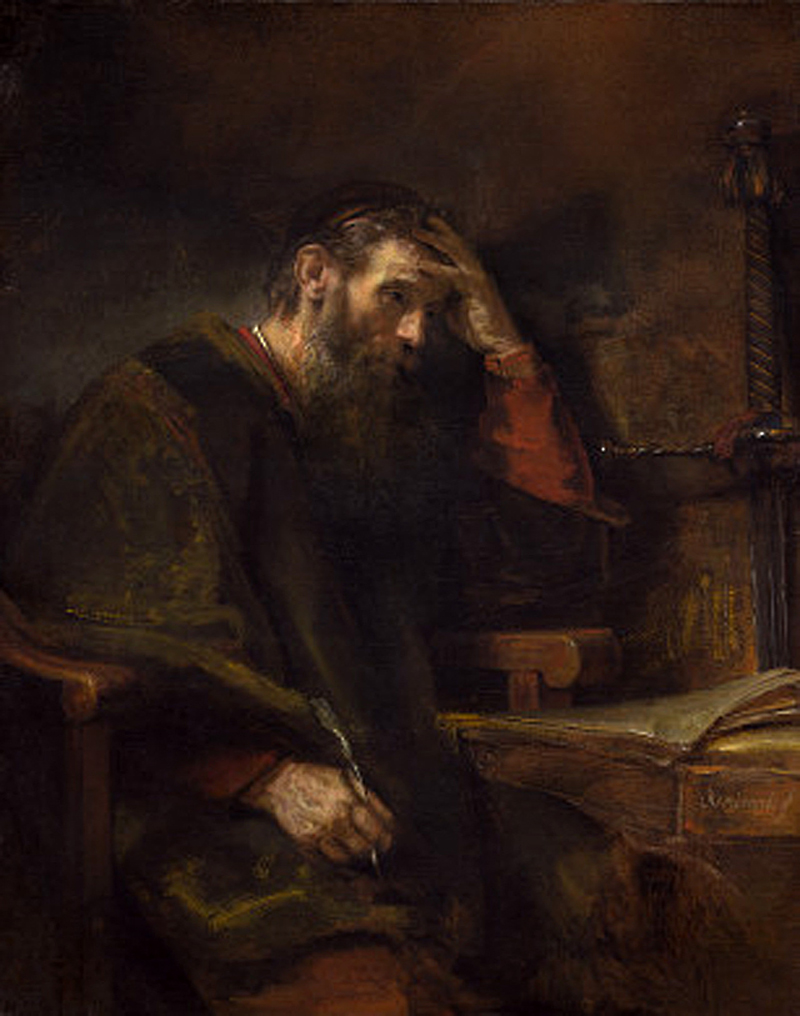
Apostle Paul – Rembrandt

1 Thessalonians 2:1-8 New Revised Standard Version

2 You yourselves know, brothers and sisters, that our coming to you was not in vain, 2 but though we had already suffered and been shamefully mistreated at Philippi, as you know, we had courage in our God to declare to you the gospel of God in spite of great opposition. 3 For our appeal does not spring from deceit or impure motives or trickery, 4 but just as we have been approved by God to be entrusted with the message of the gospel, even so we speak, not to please mortals, but to please God who tests our hearts. 5 As you know and as God is our witness, we never came with words of flattery or with a pretext for greed; 6 nor did we seek praise from mortals, whether from you or from others, 7 though we might have made demands as apostles of Christ. But we were gentle among you, like a nurse tenderly caring for her own children. 8 So deeply do we care for you that we are determined to share with you not only the gospel of God but also our own selves, because you have become very dear to us.

***********

                Having commended the Thessalonians for their receipt of the message of Jesus, as brought to them by Paul and his companions, in chapter one, now Paul speaks of his role in this process in chapter two. He is thankful that the time spent in Thessalonica wasn’t in vain. Even though they had been mistreated at Philippi before they arrived in Thessalonica (see Acts 16 for the report of the imprisonment of Paul and Silas), Paul and his companions courageously (boldly) proclaimed the Gospel in Thessalonica despite great opposition (See Acts 17). Paul makes clear that he and his companions were not deterred by opposition from their task of proclamation.

In this chapter, Paul addresses the question of motives. It’s not clear whether there were questions about his motives, but in any case, he wanted to make it clear that he and his companions hadn’t come to Thessalonica with impure motives or made their appeal for the Gospel through deceit or trickery. Whether or not they had been accused of something, with all the religious/spiritual options that were before the people, surely at least a few of the purveyors of these spiritualities were less than upfront about their motives. Thus, Paul simply wanted to be transparent about who he was and what he and his companions were doing. Thus, Paul wasn’t engaged in people-pleasing religious trickery. He had answered the call of God and was making known the message entrusted to him and his companions by God.

Religion then and now can be a business proposition. Religious organizations offer certain goods in exchange for some form of compensation (after all we take offerings each week and engage in stewardship campaigns). When it comes to compensation provided to religious professionals, I’m not suggesting that we are doing something unethical by receiving salaries or honorariums. Paul himself affirmed the principle in his first Corinthian letter. He might have chosen not to receive financial support from the churches, he noted that the Lord had “commanded that that those who proclaim the gospel should get their living by the gospel (1 Cor. 9:12-14).  Whatever Paul’s reasons for not making use of his rights, the larger point is that money shouldn’t be the motive for ministry.

As we meditate on this passage it might be that what Paul is claiming here is a recognition that he and his companions had been called to act as stewards of the Gospel. They didn’t invent it nor did they possess it. They were simply tasked with making the message of Jesus known to those who were prepared to listen. With this calling in mind, Paul could speak of being apostles. When Paul speaks here of being apostles, he’s not thinking so much in terms of office by in terms of missionary calling. While Paul does at certain points make it clear that he is an apostle in the formal sense, having been visited and called by Jesus (Gal. 1:11-24), that isn’t what he has in mind here. For not only is he given an apostolic calling, but so have Silvanus (Silas) and Timothy.

                Getting back to motives, Paul notes that in engaging in this work, he wasn’t acting out of greed. This wasn’t a financially lucrative career he had undertaken. He and his companions probably traveled on foot. They faced opposition and even imprisonment. He didn’t own a Lear jet or a massive motor home so he and his crew could travel in comfort. As far as I know, this missionary group didn’t live in mansions either. Most of us who have accepted the call to serve in vocational ministry haven’t done this for the money. Now, I will admit to living a decent middle-class life, but like most of my colleagues, I don’t make the big bucks! That was true for Paul as well.

As for methodology in proclaiming the message, Paul notes that he didn’t use flattery. He was straightforward in his messaging. His preaching came with boldness, in large part because he wasn’t seeking human praise. The only audience he sought approval from was God. Thus, his boldness was rooted in his trust in God.

                While Paul claimed to proclaim the message with boldness; when it came to his relationship to the Thessalonian congregation, he spoke to them with gentleness. It should be noted that some manuscripts suggested that the “were infants among you.” That would suggest not just gentleness, but great vulnerability. As noted by Beverly Roberts Gaventa, the “Greek words for ‘infants’ (Gr. nēipoi) and ‘gentle’ (Gr. ēipoi) consists of a single letter so that a scribe might easily confuse the two words” (Gaventa, First and Second Thessalonians, pp. 26-27). While the scholars are not of one mind, and there are arguments on both sides, for my purposes both possibilities offer a sense of Paul’s softer side. We see this in the following statement, where Paul suggests that they tenderly cared for them as a nurse for her children. Here again, there is an intriguing concept. As Gaventa notes, in that era of ancient history it was quite common for wet nurses to be used—not only for the wealthy but even by slaves (so that they wouldn’t be sidelined from their duties). Whatever the case, wet nurses were both common and beloved in that world. With this in mind, Paul’s use of the concept suggests an “image of loving concern.” But note, Paul refers to a nurse “caring for her own children.” While wet nurses might be beloved figures in the ancient world, the relationship between a nursing mother and her own children was even greater. Thus, “verse 8 serves to unpack what is implicit in the nurse metaphor: the apostles regard the Thessalonians as so dear that they share with them their very selves” [Gaventa, First and Second Thessalonians, pp. 27-28].

                The lectionary reading ends with this maternal image, which Paul uses to describe his own relationship to the community. This was unusual for the era, though not without precedent. The use of this maternal imagery is helpful in understanding Paul’s vision of ministry. His view of ministry isn’t rooted in seeking personal fame or fortune. Rather it is one expressed in deep love and care for the community, which in this case, he birthed. After all, this is his congregation, one he founded. Of course, ultimately, Paul knows that they, as children of God, are dependent not on him, but God alone.  

  Rembrandt Harmenszoon van Rijn, 1606-1669. Apostle Paul, from Art in the Christian Tradition, a project of the Vanderbilt Divinity Library, Nashville, TN. http://diglib.library.vanderbilt.edu/act-imagelink.pl?RC=55240 [retrieved October 18, 2020]. Original source: http://www.nga.gov/fcgi-bin/tinfo_f?object=1198.

Anxious Days: Twentieth Sunday After Pentecost (Narrative Lectionary)

Anxious Days: Twentieth Sunday After Pentecost (Narrative Lectionary)

Narrative Lectionary Reflection

October 18, 2020

Read: I Samuel 1:4-20 and 2:1-10

Reflection

I’ve dealt with Obssessive Compulsive Disorder for years.  It’s not as bad is once was thanks to medication.  Actually,  discovered that I had OCD when I was treated for depression.  OCD is something that makes you do thinkings repeatedly because of the fear something is undone.  Or it can be unwanted thoughts that can frighten you.  I can remember when I was in my late 20s trying to get some sleep during the evening and how hard that could be.  I would either wash my hands several times or, more often than not, I would get up and check to see if the dish towel that hung on the door handle was too close to the stove.  I would keep getting up over and over.  I knew this was silly, but there was this anxiety that tells you that you might be making a mistake.  You might have put that dishtowel on the stovetop. 

As I said, my OCD is under control now mostly because of medication, and also because I’ve learned to trust that things are not so out of control as I fear they are.  But you still have the anxiety that something somewhere is going to get you or that you forgot something that will hurt others or even yourself.

But you don’t have to have OCD to be anxious.  We live in an anxious times. We are in the middle of a once-in-a-century pandemic which sparked a recession that has shed millions of jobs.  We are in a contentious race for President. Racial and ethnic animosities are being stirred up bring about ugly results.  These are anxious days.

Our text this week opens with a man named Elkanah who has two wives: Pennianah and Hannah. Penninah gives Elkanah several children, including sons.  Hannah is not able to have children.  Elkanah loved Hannah more than Penninah, so he tries to do the right things.  He gives her a double portion for her to sacrifice.  He even tries to cheer her up.  “I’m more worth more than 10 sons!” he said.  But those words didn’t make Hannah better.  She wanted a child and it was important that she have a child. You have to understand that in ancient Israel, the value of a woman was measured in how many children she had especially boys.  Also, children were an insurance policy for the future.  They were the ones who took care of an elderly parent or made sure the woman didn’t end up on the street.  Because Hannah had no sons, she was in big trouble.  If Elkanah were to die at the point, the inheritance would go Penninah’s sons who would then decide if they wanted to support Hannah.  Since Penninah was a bully to Hannah, she was sure that Penninah would persuade her sons to send Hannah packing. 

So, Hannah was anxious.  She had every reason to be.  She decides to deal with her anxiety by praying to God.  She asks God to give her a child and after Eli, the priest, who thought she was drunk initially , tells her he prays God will give what she asked.

We know she has a child, but it’s interesting in her prayer that she didn’t just ask for a child- she wants to give the child back to God.  Her anxiety gave way to urgency- she knows any gift from God is a gift and she wants to treat it care.  

That sense of urgency, that sense that God is at work is the basis of Hannah’s song in chapter 2.  She is able to sing outloud about the goodness of God, the one who is her rock, the one that remembered her.  She sings of the God who shatters the bows of warriors, a reminder that no earthly power can stack up to God.

Hannah’s song echoes another woman who will start singing about the mighty being brought down and the lowly lifted up.  Mary sings a song which is now called the Magnificat, about an urgent God that rules over all creation and no one could challenge God’s power.

 We live in anxious times.  But God calls us out of anxiety into urgency. The God we serve is one that is at work in the world and is working to set the world to rights.  Our anxieties can block our God-given sense of urgency.  Hannah understood that God was at work in the world, so her prayer was not just about having a son, but about devoting her son to be about God’s work.  The son she had was named Samuel, who became the last Judge of Israel.  Judges were temporary leaders that were called to lead the people in times of crisis.  Samuel would become one of these Judges who would later annoint a young boy in Bethlehem named David to be king over Israel.  Hannah knew if this prayer was granted it was because of God and it made sense to give her gift back to God to bring salvation to the world.

God is still a God of urgency. God wants to share the gospel with others, to feed the hungry, to welcome the outcast.  We are called to join God in this urgency, but too often we are trapped in anxiety; how will the church pay its bills?  How will we pay the pastor?  Will we be around in 10 years or so?

But we also need to be a people or urgency.  Yes, we have challenges.  But like the person with OCD, we have to get out of being frozen and move forward in faith.  Hannah had no idea what would become of Samuel, but she was willing to trust God and so do we.

We will always be anxious, that’s just part of being human.  But we can stop going in circles.  We can’t stop being frozen.  We can know that we can carry our anxieties to God, who will help give us a sense of urgency to help a hurting world.

Photo by Finn on Unsplash


Dennis Sanders is the Pastor at First Christian Church of St. Paul in Mahtomedi, Minnesota. He’s written for various outlets including Christian Century.

Turning from Idols to Serve God – Lectionary Reflection for Pentecost 20A (1 Thessalonians 1)


Statue of Jupiter-Germanicus’ Tomb – Ashmolean

1 Thessalonians 1:1-10 New Revised Standard Version

1 Paul, Silvanus, and Timothy,

To the church of the Thessalonians in God the Father and the
Lord Jesus Christ:

Grace to you and peace.

We always give thanks to God for all of you and mention you in our prayers, constantly remembering before our God and Father your work of faith and labor of love and steadfastness of hope in our Lord Jesus Christ. For we know, brothers and sisters beloved by God, that he has chosen you, because our message of the gospel came to you not in word only, but also in power and in the Holy Spirit and with full conviction; just as you know what kind of persons we proved to be among you for your sake. And you became imitators of us and of the Lord, for in spite of persecution you received the word with joy inspired by the Holy Spirit, so that you became an example to all the believers in Macedonia and in Achaia. For the word of the Lord has sounded forth from you not only in Macedonia and Achaia, but in every place your faith in God has become known, so that we have no need to speak about it. For the people of those regions report about us what kind of welcome we had among you, and how you turned to God from idols, to serve a living and true God, 10 and to wait for his Son from heaven, whom he raised from the dead—Jesus, who rescues us from the wrath that is coming.


************

                The ancient Greco-Roman World offered many religious options. Gods were plentiful, and the people indulged in serving them. Jews were a peculiar people since they only worshiped one God, considering all others to be mere idols. The Jesus movement, which was rooted in Judaism, embraced the same view of the many religious options present in their world. That made them rather peculiar as well. The difference between the two was the Jesus Movement was more assertive in its outreach to their Gentile neighbors. Over time that would cause problems for them. When we open Paul’s first letter to the Thessalonian church, we’re taken back to the earliest days of the Jesus Movement. It is the consensus view that this is Paul’s earliest letter, making it the earliest book in the New Testament. If, as is likely, it was written from Corinth around 50 or 51 CE, we are within two decades of Jesus’ death in Jerusalem and subsequent birth of the church on Pentecost. As we know, Paul made Gentiles the focus of his ministry. He might go first to the synagogue, but he was more interested in spreading the gospel to those outside the Jewish community. That of course, led to some conflict between those who embraced the message of Jesus and those who didn’t.

                In these opening lines of Paul’s letter, we hear a word of commendation and encouragement to people who have embraced the message of Jesus as delivered by Paul. They have even become known for their commitment to this message. As for the letter itself, it is written by Paul, together with his companions Silvanus (Silas) and Timothy. The mention made here of Silas is a clue that this was written after the Jerusalem Council (Acts 15) when Silas replaced Barnabas as Paul’s companion.  As he often does, Paul writes that he always gives thanks for them in his prayers. These are his people, and he cares about them. Paul also records that they had received a Gospel message that came not only in words but also in the power of the Holy Spirit. He also notes that their reception of the Gospel was due to have been chosen by God. For Paul, conversion always begins with God’s initiative. That doesn’t require some form of predestination, only God’s initiative. Regarding the role of the Spirit, what he has in mind here isn’t clear but suggests that their preaching was accompanied by signs and wonders. 

                The church to whom the letter was written inhabited a major Roman city situated in the province of Macedonia. Thessalonica served as the capital of the province and was a port city, making it not only a governmental center but also a commercial center. Thus, like Corinth, Thessalonica was quite cosmopolitan, drawing residents from across the empire and beyond. It was also a city that was known for its many religious options, including the imperial cult (it was a Roman colony after all), along with Egyptian gods, as well as the cult of Cabrius. This figure supposedly had died and had risen from the dead, which sounds a lot like Jesus. Thus, as William Brosend notes, “when Paul praises the addresses for ‘how you turned to God from idols, to serve the living and true God’ (1 Thess. 1:9), he knew that they had made a choice with many alternatives” [Preacher’sBible Handbook, p. 302]. That reality may explain much that goes on in our reading.

                Paul commends them for their steadfastness in faith and for imitating him, as well as his companions, along with the Lord. He speaks of them joyfully receiving the message as inspired by the Holy Spirit so that the “word of the Lord has sounded forth from you not only in Macedonia and Achaia,” as well as every place their faith had been made known. This despite facing persecution. Though the persecution they were facing probably wasn’t legal or violent but entailed resistance to the message. What is clear from the letter as a whole, that it has an overtly eschatological feel. It’s not as prominent here in this first chapter, but as one moves into the letter it gets stronger. He writes with the presumption that Christ should be returning at any moment, and because they had received the word of God, Jesus would rescue them from the “wrath to come.”

                Getting back to their reception of the Gospel message, it seems apparent that the audience of Paul’s letter was a community largely made up of Gentile Christians. Although Paul had begun his ministry in Thessalonica in the synagogue (Acts 17:1-9), it appears from Acts that Paul didn’t get a very positive reception there. Evidence that the community was largely Gentile Christians is revealed in verse nine, where Paul commends them for having “turned to God from idols.” This isn’t something that Paul would have said to Jewish Christians but would make sense when applied to converts from a pagan context. As noted above, Thessalonica offered many religious options for them to choose from. As for them, they had chosen to “serve the true and living God.” Now, they await the coming of the Son of the true and living God, who is coming from heaven (the eschatological dimension), and whom the true and living God raised from the dead. This Jesus rescues the believer from the wrath to come (judgment day). As Fred Craddock and Eugene Boring note, this message represents the “traditional Jewish missionary message of the one God over against pagan idols, the God whose ethical seriousness is manifest in that he will bring all human beings to a final judgment.” They also note that the Jewish monotheistic message attractive to many in the Hellenistic world. As for the Christian proclamation, rooted in this Jewish message, “the living God is the one definitively manifest in Jesus, the God who raised Jesus from the dead, the one through whom God saves at the final judgment.” [People’s New Testament Commentary, p. 639]. While in the modern era, the idea of judgment along with the wrath of God is not well received, this message does make clear the power of an ethical message that insists humans will be held accountable. 

                While the reading ends with the word wrath, the message is one of joy because God has provided a new way of living that is rooted in Jesus rather than dead idols. He commends them for the way they have embodied the message of Jesus so that all of Macedonia and Achaea has heard the message. 

                As we attend to this word from Paul, what is its message for us? If we hear in this a call to turn from idols to God, what idols might we contend with? What is it that we worship instead of God? How does serving these idols affect our relationships with one another and with creation itself? To whom or to what do I give my allegiance? Is it my whiteness? My economic situation? Is it a particular politician or political party (this is election season after all)? What about my being a citizen of the United States? In asking that question, I’m glad I am a citizen of the United States, but does it have the ultimate claim on my life? I wrote a book on the Lord’s Prayer that I titled Ultimate Allegiance because I believe that this prayer repeated by Christians around the globe is itself a pledge of allegiance to God and God’s realm. Whatever I give allegiance to rather than to God and God’s realm, then that becomes my idol. May we join with the Thessalonian believers and turn from our idols and serve the true and living God.


Who Is He And What Is He To You: Nineteenth Sunday After Pentecost (Narrative Lectionary)

Who Is He And What Is He To You: Nineteenth Sunday After Pentecost (Narrative Lectionary)

Narrative Lectionary Reflection

October 11, 2020

Read: Exodus 32:1-14

Reflection

What does God look like to us?  For some people, God is an old white guy with a long beard and a flowing robe.  The famous book, The Shack, has God coming down to earth in the form of an African American woman. The Chinese artist He Chi, frequently paints Jesus in his context as a Chinese man, which means Jesus looks more Asian, than what I’ve called “the Swedish Jesus.”  


Maybe one of the most controversial depiction of God or Jesus is the statue Christa.  It was created by British artist Edwina Sandys, who happened to be the granddaughter of Winston Churchill in 1975. It is what you think it is, a picture of Jesus on the cross, but as a woman.  It was displayed at St. John the Divine Church in New York during Easter of 1984 where it had people talking, both words of praise and outrage.  It is now back at the St. John the Divine permanently, but the work has been interpreted as depicting the inclusion of women in the work of Christian faith and also about the suffering of women.  For some, it might seemed problematic to see Jesus as a woman. We all have an image of God in our minds and it can be hard at times to see God in a different viewpoint. It is why people can take issue with calling God , Mother .  Many people have an image of who God is and it is difficult to switch and see that there might be another way of looking at God.


For the people of Israel, God was a bit of a mystery.  They had seen God’s actions in the parting of the Red Sea and in the provision of manna and quail, but God seemed somewhat distant to the Israelites.  That was especially the case when Moses left them to head up a mountain and commune with God for well over a month.  Where was Moses?  Moses was at least someone that they could relate to.  Moses was sort of an intermediary between the people and God, and not having Moses around led the people to become a bit restless.  They could look up towards the top of the mountain seeing it covered in smoke and fire wondering if this was God. Alas, there was no one around them to tell them if this was God.  

Aaron decides to have the people collect all the gold among the people.  He is able to fashion a golden calf.  He decides to make an altar for the Lord and the people see this as a representation of the one that brought them out of Egypt.

Notice that this golden calf was not necessarily an alternate god. Instead, this is an image of the same God that led them out of Egypt.  The Hebrew uses the same word they use for God, YHWH. But the Israelites had spent years with the Egyptians and mingled with other cultures that had physical representations of their gods, so they thought that’s what they needed to do here.  This was their version of God.  But the problem is that they contained God in this form.  God was not the free being that was enveloped in mystery, but this golden cow.  That’s what is wrong here, not that they worshipped an idol as much as it was that they fell in love with false version of God.  They wanted a god that would live among them, and the calf was a way for God to be with them.

But it was the wrong way for so many reasons.  First it was initiated by humans and not God.  Second the humans decided to describe God instead of God. Third, and this is most important is that God was working on a place, a tabernacle where God would dwell with the Israelites.  God was making plans to be closer to the people if they just had the patience to wait. “Let them construct a Sanctuary for me so that I can live among them,” God tells Moses in chapter 25.  From Exodus 25 until chapter 31 we have God giving Moses instructions on what this tabernacle would look like.  The people were nervous and worried and created an “avatar” a representation of God and all the while God was at work finding a way to live among the people. If they had only been patient and waited.

We aren’t that different from the people of Israel.  Too often we want to define God instead of entering the mystery of God.  We want to be able to define God, to make God palatable to our own tastes.  A Methodist pastor friend of mine consistantly talks about how modern Christians in America try to make the faith fit our ideology.  This is why Christians on the political left and right tend to fashion a god that is acceptable to them.  We want a god that supports universal health care.  We want a god that is anti-abortion.  Instead of wanting to encounter a God that is a mystery, one that we are constantly getting to know, people make a god that is easy to understand and surprisingly agrees with us.

As I’ve said before, I have a thing for R&B songs from the 1970s.  It comes from being a toddler in the basement of my childhood home back in Flint, as my Dad listened to the soul songs of that era. There is a song by the artist Bill Withers that is called “Who Is He and What Is He To You.”  It’s really a song about a man who discovers that his wife or girlfirend might not be so faithful to him.  The man in the starts to ask questions about the role this man has in her life. 

Here are some of the lyrics:

Something in my heart and in your eye
Tells me he’s not someone just passing by
And when you cleared your throat
Was that your cue
Dadgummit
Who is he, and what is he to you

God was pretty much saying the same thing to the Israelites as well as to us today.  That thing, that image of God that we have; just what role does it have in our lives?  As the song says, we are too much for one God, but not enough for two.


Dennis Sanders is the Pastor at First Christian Church of St. Paul in Mahtomedi, Minnesota. He’s written for various outlets including Christian Century.

Joy in Challenging Times – Lectionary Reflection for Pentecost 19A (Philippians 4)


Philippians 4:1-9 New Revised Standard Version

4 1 Therefore, my brothers and sisters, whom I love and long for, my joy and crown, stand firm in the Lord in this way, my beloved.

2 I urge Euodia and I urge Syntyche to be of the same mind in the Lord. 3 Yes, and I ask you also, my loyal companion, help these women, for they have struggled beside me in the work of the gospel, together with Clement and the rest of my co-workers, whose names are in the book of life.

4 Rejoice in the Lord always; again I will say, Rejoice. 5 Let your gentleness be known to everyone. The Lord is near. 6 Do not worry about anything, but in everything by prayer and supplication with thanksgiving let your requests be made known to God. 7 And the peace of God, which surpasses all understanding, will guard your hearts and your minds in Christ Jesus.

8 Finally, beloved, whatever is true, whatever is honorable, whatever is just, whatever is pure, whatever is pleasing, whatever is commendable, if there is any excellence and if there is anything worthy of praise, think about these things. 9 Keep on doing the things that you have learned and received and heard and seen in me, and the God of peace will be with you.

***********

                This is one of the most cherished passages in Scripture. Even if you’re not a fan of Paul, You have to embrace his encouragement to rejoice in the Lord always. Though it might seem odd to heed the call to be joyful in challenging times, like what has imposed itself on the world in 2020. While there is a place for lamentation, Paul seems to believe that there is also room for joy in difficult times. After all, he’s writing this letter from a jail cell (Phil. 1:7). So, here in the concluding chapter of Paul’s Philippian letter, written from prison to a community facing some form of persecution, Paul invites them to rejoice in the Lord always. In fact, he doubles down on that invitation, declaring “again I will say, Rejoice” (vs. 4). So, because the Lord is near (I take that to mean Jesus’ return in glory), “do not worry about anything, but in prayer and supplication with thanksgiving let your requests be made known to God” (vs. 6).

                It’s clear that things aren’t going perfectly in Philippi. There appears to be some conflict going on, but not, it doesn’t seem, at the same level as what we find present in some of Paul’s other letters. Nevertheless, Paul seems to have reason to be concerned, which is why he keeps encouraging these beloved followers of Jesus who formed a church Paul had founded to keep focused on what is true and honorable. As we’ve seen, Paul wants them to keep focused on Jesus, whose humility can be the foundation for their unity (Phil. 2:5-11). He also offers himself as an example (Phil. 3:17).

Here in this concluding chapter, Paul speaks specifically to two women, Euodia and Syntyche, who appear to be at odds. We don’t know the background or nature of the conflict, but Paul wants them to be of the same mind. Therefore, he not only urges them to come together but also asks his unnamed loyal companion—perhaps Epaphroditus, who is mentioned as Paul’s companion and likely member of the Philippian community (Phil 2:25-30)—to help them resolve their differences. I should note that these two women are recognized by Paul as being coworkers with him for the Gospel, so they are important to him. This reality again reinforces the message that whatever Paul has to say about joy and peace in this passage, it is said in the context of challenging times both for him and for the Philippian congregation.

                As noted above, I write this reflection while the world is experiencing its own set of challenges that seem to keep piling on top of each other. First of all, the world is in the midst of a pandemic that has sickened tens of millions and killed hundreds of thousands of those inflicted, with the numbers in the United States outstripping every other country. That same pandemic has forced many of us into forms of isolation we’ve never experienced before. We miss the simple things like going to a restaurant or a movie without fearing the possibility that we might be exposed to the virus. Then there is church, where something as simple and joy-inducing as singing has been put on hold. We are also in the midst of a racial reckoning, that is forcing the nation to wrestle with the implications for our society of the deaths of African Americans at the hands of police (George Floyd and Breonna Taylor, among others) and vigilantes (Ahmaud Arbery). These deaths have led to months of protests that have yet to let up. We’re also in one of the most contentious and dispiriting election seasons most of us have ever seen. Many Americans fear that we are nearing the end of democracy in this nation. So, how do you find joy in moments like this? Where do you find peace? The answer is certainly not to be found in our cultural context.

                Note that Paul invites them to “rejoice in the Lord” and not in their circumstances. He encourages them to exhibit gentleness in their relationships. He tells them not to worry, but to be in prayer. This isn’t Paul’s version of that Bobby McFerrin song: “Don’t worry, Be Happy.” It’s not a call for blissful ignorance, as if there’s nothing to worry about. Instead, it is an encouragement to put one’s trust in God. Let us remember that Paul is writing this from a prison cell. Death is, perhaps, a possibility. There is persecution of some sort going on. Nevertheless, Paul enjoins them to rejoice in the Lord. As Martin Luther declared in a sermon on this passage, “Joy is the natural fruit of faith.” He continues in the sermon, making mention of Paul’s doubling down on the call to rejoice, declaring:

It is essential that we rejoice. Paul, recognizing that we live in the midst of sin and evil, both which things depress, would fortify us with cheer. Thus rejoicing, even if we should sometimes fall into sin, our joy in God will exceed our sorrow in sin. The natural accompaniment of sin truly is fear and a burdened conscience, and we cannot always escape sin. Therefore we should let joy have rule, let Christ be greater than our sins.  [Martin Luther].

This invocation of joy is powerful, but trusting God isn’t always easy, even for those whom we are told are paragons of faith. My Bible Study group is reading the stories in Genesis about Abraham. While he’s held up in Hebrews 11 as a paragon of faith, if you read the Abraham story closely, Abraham doesn’t always exhibit faith in God. Consider that even though God has promised to provide Abraham a son through Sarah (Genesis 17 and18), in Genesis 20 he passes her off as his sister. Only God’s intervention prevents disaster. Nevertheless, Paul encourages the Philippians to rejoice and let the peace of God, which surpasses understanding, guard their hearts and minds.  

                Though Paul encourages them to put their trust in the God who brings peace to their lives, he’s not encouraging them to be passive in their behavior. The reading closes with a call to action. Paul encourages this beloved community to focus their attention on what is honorable, just, pure, pleasing, commendable, excellent, and that which is worthy of praise. From there, he asks that the “keep on doing the things that you have learned and received and heard and seen in me” (vs. 9). In other words, while he commended them to look to Jesus for a model of the Christian life (Phil. 2:5-11), he’s not afraid to offer himself up as a role model. All of this begins in prayer so that the God of peace might be with us. Therefore, let us rejoice in the Lord, always!

Image attribution: Longview Christian Church. Joyful, joyful, we adore thee, from Art in the Christian Tradition, a project of the Vanderbilt Divinity Library, Nashville, TN. http://diglib.library.vanderbilt.edu/act-imagelink.pl?RC=55774 [retrieved October 4, 2020]. Original source: http://www.flickr.com/photos/8328367@N08/2949605288.