Month: July 2021

No More Dividing Walls – Lectionary Reflection for Pentecost 8B (Ephesians 2)

Ephesians 2:11-22 New Revised Standard Version


11 So then, remember that at one time you Gentiles by birth, called “the uncircumcision” by those who are called “the circumcision”—a physical circumcision made in the flesh by human hands— 12 remember that you were at that time without Christ, being aliens from the commonwealth of Israel, and strangers to the covenants of promise, having no hope and without God in the world. 13 But now in Christ Jesus you who once were far off have been brought near by the blood of Christ. 14 For he is our peace; in his flesh he has made both groups into one and has broken down the dividing wall, that is, the hostility between us. 15 He has abolished the law with its commandments and ordinances, that he might create in himself one new humanity in place of the two, thus making peace, 16 and might reconcile both groups to God in one body through the cross, thus putting to death that hostility through it. 17 So he came and proclaimed peace to you who were far off and peace to those who were near; 18 for through him both of us have access in one Spirit to the Father. 19 So then you are no longer strangers and aliens, but you are citizens with the saints and also members of the household of God, 20 built upon the foundation of the apostles and prophets, with Christ Jesus himself as the cornerstone. 21 In him the whole structure is joined together and grows into a holy temple in the Lord; 22 in whom you also are built together spiritually into a dwelling place for God.

***********

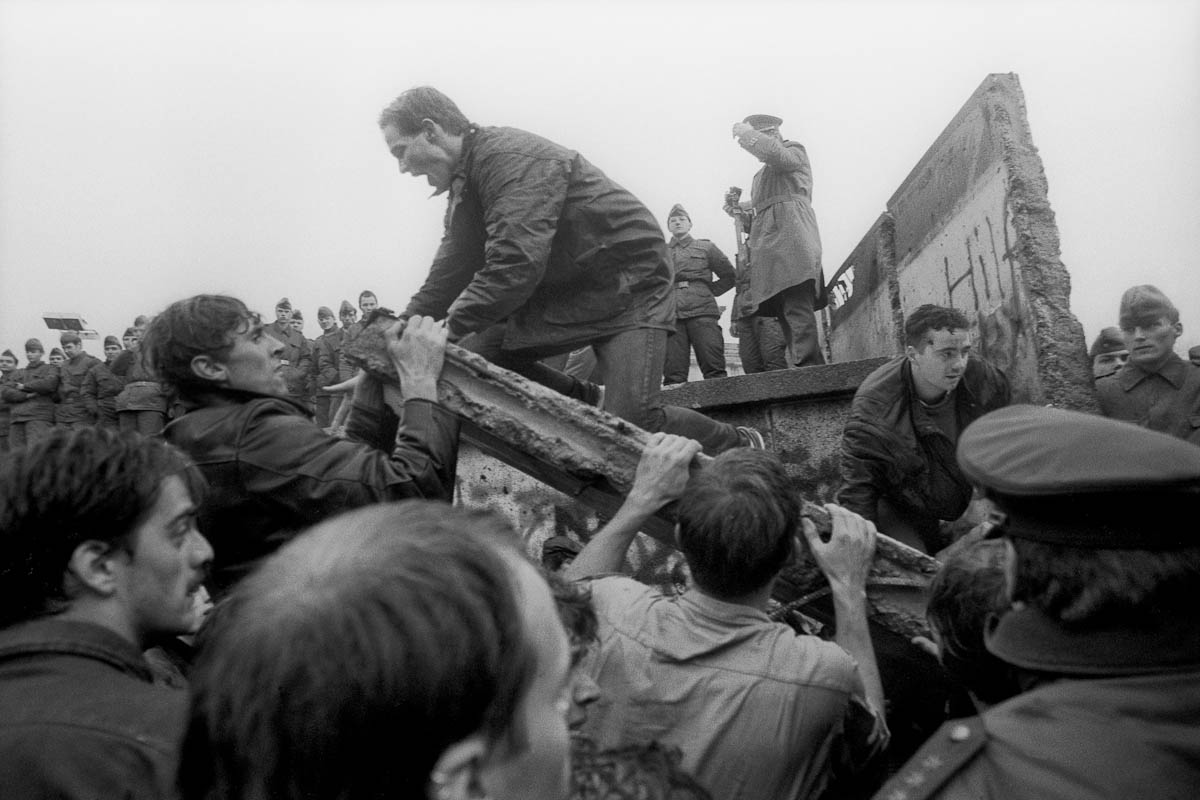
                It’s been decades now since Ronald Reagan stood at the wall in West Berlin and declared: “Mr. Gorbachev, tear down this wall.” Well, Mr. Gorbachev didn’t actually tear down the wall, but in 1989, while the world watched (I watched) residents of East and West Berlin mounted the wall and began to tear it down, uniting the divided city. Before too long, the wall of separation that divided East and West Germany came down as well, allowing the two parts of the country to come back together. It was an amazing sight that for a moment gave the illusion that a new age in world history had begun. Unfortunately, many dividing walls remain in place across the globe, including in many of our communities. There is a wall running through Palestine dividing Israel from the Palestinian territories. There is the wall that runs across the southern border of the United States that has become a focus of attention in the United States. These are literal walls, but there are other walls that are spiritual/cultural/ethic that continue to divide persons and communities from one another.

                The lectionary takes us back to the Ephesian letter for the Eighth Sunday after Pentecost. In this letter, the author, whom we will again refer to as Paul even though the authorship of the letter remains contested, speaks to a concern present in the early church. That concern is the ongoing tension existing between Jewish and Gentile believers. If, as many scholars believe, this letter was written in Paul’s name after his death, we are reading a letter written as  Gentiles had begun to be the dominant group within the church. It would appear that the wall of separation that we witness in the Galatian letter was still present within the church. The letter is, it would appear, written to Gentile believers because Paul reminds them that once they were strangers and aliens (xenoi) and therefore far off from God’s people. That is, they are part of the household of God that is built on the foundation of the apostles and prophets, with Christ as the cornerstone. Therefore, while the Gentiles were once a people without hope because they were without God, now they are no longer Gentiles but they have become citizens in the Israel of God. Now that they have embraced the message of Jesus there is no distinction between Jew and Gentile for all make up the one people of God in Christ.  Therefore, now Jew and Gentile were one people in Christ.

                In fact, in Christ, God has created a new humanity, reconciling both Jew and Gentile to God through the cross, “putting to death that hostility through it” so that there might be peace (vss. 15-16). That dividing wall has been broken down, just like the Berlin Wall. In the process of doing this, we’re told that Christ has abolished the law, with its commandments and ordinances. Most likely, the author has in mind the ordinance of circumcision not God’s moral commands, like the commandment against murder. What is abolished is the requirement to fulfill certain observances that had once divided Jew and Gentile from each other and had created hostility between the two. Note that in verse 11, Paul acknowledges that the Gentiles had once been known as the “uncircumcised” by the “circumcised.” Thus, for the citizens of God’s realm, circumcision had been the marker, the documentation, of their citizenship (at least for males). The hostility that had existed between those inside the household of God and those outside based on circumcision as proper documentation of citizenship would have to go if the church was going to move forward with both Jewish and Gentile members.

                The dividing wall was demolished through the cross. Sammy Alfaro puts it this way:

In the one act of the cross, those who were far off and those who were near were reconciled unto God. No special shortcut treatment for the chosen nation and no back-of-the-line stiff-arm status for Gentiles. Hearkening to the Trinitarian blessings of God in the first chapter of the letter, access to God takes on Trinitarian form: the Son provides the means and the Spirit the avenue for reconciliation with the Father (v. 18) [Connections, p. 172].

To be in Christ is to become part of the Temple of God, the place where God meets God’s people. The means of access to God has been opened up to all through Christ. While there was, in the Jerusalem Temple, a “Court of the Gentiles,” access to the Holy of Holies had been denied to them. Now, even that was open to Gentiles through Christ, who is the fulfillment of the Law.

                So, what do we make of this word to the church? Do any walls of hostility still exist within the church? By church, I don’t simply mean local congregations or even denominations, I mean the church at large. The answer, of course, is yes, walls still exist. Some are doctrinal, others are ethnic. Some churches fully welcome LGBTQ persons, affirming their personhood so that there are no barriers to their participation. They are, in Christ, fully citizens of the realm. There are other churches that either won’t allow LGBTQ folk in the church or at the very least limit how they are present (“don’t ask, don’t tell”). Some churches ordain women and churches that don’t allow women to speak in the church (at least not when men are present). I think you get the picture. We may say we are one in Christ, but we remain divided. Thus, this word to the church given centuries before must continually be revisited. What walls must come down today? How is the Spirit at work breaking down these walls?

For more on this passage see my book: Ephesians: A Participatory Study Guide, Energion Publications, p. 23-33].
Chosen for Blessings – Lectionary Reflection for Pentecost 7B (Ephesians 1)


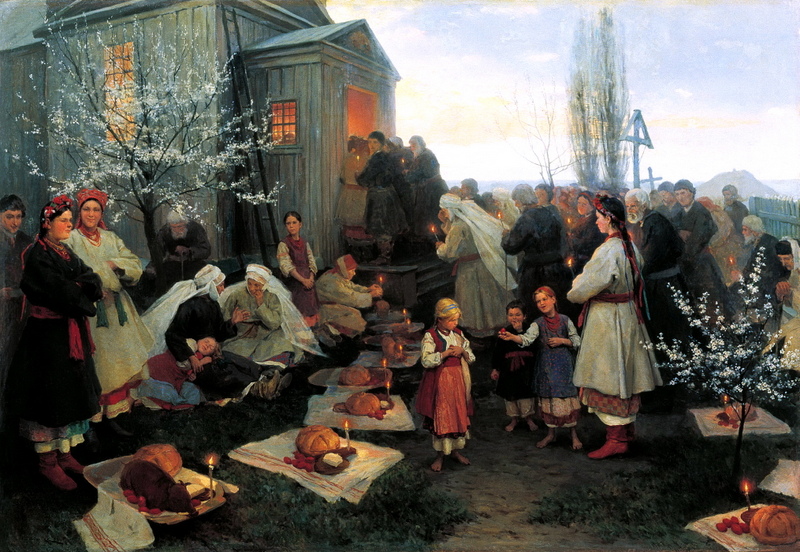
Waiting for the Blessing —  Pymonenko, Mykola


Ephesians 1:3-14 – New Revised Standard Edition


Blessed be the God and Father of our Lord Jesus Christ, who has blessed us in Christ with every spiritual blessing in the heavenly places, just as he chose us in Christ before the foundation of the world to be holy and blameless before him in love. He destined us for adoption as his children through Jesus Christ, according to the good pleasure of his will, to the praise of his glorious grace that he freely bestowed on us in the Beloved. In him we have redemption through his blood, the forgiveness of our trespasses, according to the riches of his grace that he lavished on us. With all wisdom and insight he has made known to us the mystery of his will, according to his good pleasure that he set forth in Christ, 10 as a plan for the fullness of time, to gather up all things in him, things in heaven and things on earth. 11 In Christ we have also obtained an inheritance, having been destined according to the purpose of him who accomplishes all things according to his counsel and will, 12 so that we, who were the first to set our hope on Christ, might live for the praise of his glory. 13 In him you also, when you had heard the word of truth, the gospel of your salvation, and had believed in him, were marked with the seal of the promised Holy Spirit; 14 this is the pledge of our inheritance toward redemption as God’s own people, to the praise of his glory.


********

                Every professional team sport has a draft in which teams chose athletes to stock the team. If the team has the first pick in the draft, the choices are limited only by the number of athletes available. It’s a coveted position to be in, though the pick comes with a caveat. The team with the first pick normally is the one with the worst record in the league. That is, they are a bad team. The hope is that by giving the worst team in the league the first pick, they can begin improving themselves (as long as they choose wisely).

                The opening chapter of the Ephesian letter takes up the question of being chosen by God to be part of God’s team. In a sense, everyone is a first-round pick. At least that’s one way of reading the passage before us. Just a note, the passage is also featured in the lectionary for the Second Sunday after Christmas. Liturgically, the context is somewhat different. Instead of a Christmas message, we find ourselves situated on the Seventh Sunday after Pentecost (Year B). The reading is the first of several that will take us through the letter until we reach chapter six.

                When it comes to conversations about the Ephesian letter, the identity of the author always comes up. There is no consensus, with some scholars accepting the traditional view that Paul is the author. After all, the letter opens by identifying the author as the Apostle Paul (Eph. 1:1). Others argue that based on the theology, the style of writing, and other markers, it must be the product of a later author. I address some of this in my Participatory Study Guide on Ephesians, though I don’t take a position on the question of identity. For our purposes, I’m not sure it matters whether it is Paul or someone writing in Paul’s name (according to ancient practice this doesn’t make it a fake letter if Paul didn’t write it). What seems clear is that the author is a Jewish Christian/Christian Jew, and the audience is predominantly Gentile. Note that Paul uses the word “we” in verse 12 and “you” in verse 13. The we who were the first to set their hope in Christ would have been Jewish believers in Jesus. Nevertheless, as verse 13 spells out, “you” (Gentiles) are also included in this act of adoption since they had heard the word of truth and believed in Christ and had received the seal of their salvation, the Holy Spirit. If we keep all of this in mind, then we can for the sake of simplicity call the author Paul.

                “Paul” begins by affirming the many spiritual blessings God has poured out upon God’s people, doing this in Christ.  Having declared that God is the giver of spiritual blessings in and through Christ, Paul speaks of God choosing “us” before creation to be holy and blameless, predestining us according to God’s plan. If we understand the author to be of Jewish descent and most of the audience is Gentile Christians, then the “us” includes both Jewish and Gentile Christians, creating the bridge that the author wishes to build between the two communities.

                Now, words like choose and predestine found here tend to be problematic for some audiences. Indeed, it is a problem for me. So, what does it mean for God to have chosen “us” from before God began to create? How does that affect our own ability to choose? For those of us who embrace an “open and relational” view of God, which assumes that the future is open how might God predestine us for adoption as God’s child? Don’t we have a choice in the matter? As we ponder these questions, we can return to the opening line of the passage, which calls on us to offer blessings to God who has blessed us in Christ with every spiritual blessing.

                It is, in my opinion, best if we do not read these words about predestination in an individualistic manner. It’s not that God has predestined each of us individually for salvation (or damnation for that matter), rather God has chosen Jesus to be the agent of reconciliation. Thus, Jesus provides the means by which we are adopted as children of God. According to our reading, this involves the blood of Christ. Paul doesn’t go into graphic detail here. He doesn’t refer to the cross, only that in some way the blood of Jesus is the means by which we receive forgiveness of sins and receive God’s grace. Whatever the means, this act of grace is costly and should not be taken for granted.

                As the passage continues, Paul takes up the matter of our inheritance as one’s adopted as children of God. When it comes to adoption, the New International Version uses the word “sonship,” which is rather gender-specific but would reflect the way inheritances were understood in the ancient world, as an inheritance generally went to a son and not to a daughter. Thus, the choice made by the NRSV translators is likely a better one for a modern Christian audience. Now, when it comes to the heirs of God in Christ, note that the author speaks of all things being gathered up, both in heaven and on earth. Thus, in Christ we receive an inheritance. This reference to all things being gathered up is intriguing because it is suggestive while not being definitive that God has an eye toward universal reconciliation/redemption (vs. 10). While this word includes heaven, it also speaks of God’s care for the creation.

                This is a passage rich in meaning. It raises difficult questions that might not be resolvable in a sermon, but what it does say is that God is concerned about the creation, so much so that God has chosen a way of redeeming that which is broken. This comes as an act of grace in Christ and through the Holy Spirit (there is a Trinitarian feel in this passage). What it does, however, is invite gratitude to God on our part for the decision to choose us in Christ to be the recipient of God’s blessings. This need not require of us a belief that God determines all things. It does suggest that God has chosen to act on our behalf to bless us in Christ. In that way God is sovereign—not as a tyrant or despot but as one who acts graciously on our behalf, inviting us to become part of the family of God. That is not something we earn but which we receive as a divine gift in Christ our savior.   

For more on this passage see my book on Ephesians in Energion Publication’s Participatory Study Guide series.      

Image attribution: Pymonenko, Mykola. Waiting for the Blessing, from Art in the Christian Tradition, a project of the Vanderbilt Divinity Library, Nashville, TN. https://diglib.library.vanderbilt.edu/act-imagelink.pl?RC=55788 [retrieved July 4, 2021]. Original source: http://commons.wikimedia.org/wiki/File:PimonenkoNK_PashalZautrRYB.jpg.