Author: Robert Cornwall

A Word About Salvation – A Lectionary Reflection for Easter 4B

A Word About Salvation – A Lectionary Reflection for Easter 4B

Acts 4:5-12 New Revised Standard Version (NRSV)

5 The next day their rulers, elders, and scribes assembled in Jerusalem, 6 with Annas the high priest, Caiaphas, John, and Alexander, and all who were of the high-priestly family. 7 When they had made the prisoners stand in their midst, they inquired, “By what power or by what name did you do this?” 8 Then Peter, filled with the Holy Spirit, said to them, “Rulers of the people and elders, 9 if we are questioned today because of a good deed done to someone who was sick and are asked how this man has been healed, 10 let it be known to all of you, and to all the people of Israel, that this man is standing before you in good health by the name of Jesus Christ of Nazareth, whom you crucified, whom God raised from the dead. 11 This Jesus is

‘the stone that was rejected by you, the builders;

it has become the cornerstone.’

12 There is salvation in no one else, for there is no other name under heaven given among mortals by which we must be saved.”

**************

A healing leads to preaching, and preaching leads to arrest, which leads to a trial, and a trial gives an opportunity for preaching. At least that’s the way things seem to work for Peter and John here in chapters three and four of the Book of Acts. Peter had been preaching to a large crowd in Solomon’s Portico, after healing the man who was disabled at the gate to the Temple. In other words, an act of power opens an opportunity to explain the source of power, which of course leads to the message of the cross and the resurrection. While you might think that it would be the cross that stirs the pot here, it is really the message of the resurrection. It appears from the opening verses of chapter four that it was the message of resurrection of the dead that got the attention of the religious leaders, who order them arrested. That is the background story for Peter’s next sermon, this time delivered in front of the religious leaders who have gathered to pronounce judgment on Peter and John.

Unfortunately for the leaders, Peter takes advantage of this appearance to speak once again about the resurrection. Peter begins his defense with an acknowledgment that it seems they had been arrested for doing something good, that is, bringing healing to a man who had suffered for years. The question was—how did they do this? The answer is simple—they acted in the power of the one whom the religious leaders had crucified, but whom God vindicated by raising him from the dead. If you want to know how this happened, well that’s the answer—Jesus! Yes, this Jesus whom God has raised is the source of healing, which means they have been arrested for doing a good deed in the power of the risen one!

This is all boiler-plate apostolic preaching. We hear this message time and again, whether on the lips of Peter or Paul. Central to the message is that of the resurrection, which divides Sadducees and Pharisees. While the two parties aren’t named in this selection, according to Luke, the arresting party included priests and Sadducees. In this scene the Pharisees are absent, so Peter can’t divide and conquer like Paul will do in a later scene. Since the opposition in this scene are Sadducees, for whom the resurrection doesn’t fit into their theology, you can understand their consternation at hearing Peter preach about the resurrection in their presence. For Peter and the early church, as was true of the Pharisees, the resurrection was the key to their theology. It was the revelation of God’s power present in Jesus. Since this is the Easter season, this passage offers the preacher and the church an opportunity to again reflect upon and celebrate the Resurrection.

Where this passage becomes controversial in modern contexts, is the wording of verse 12. This verse is often used as a proof text to defend the premise that one cannot be saved without confessing faith in Jesus, for “there is no other name under heaven given among mortals by which we must be saved.” In other words, it is a foundational text for an exclusivist vision of salvation. A question that might be asked of Peter concerns what he means by salvation and how Jesus is the name by which one is saved. Is Peter setting up a point of division? Is this a red line, at which Peter is asking his accusers (and anyone else) to dare to cross? That is, one’s eternal destiny hangs on how one responds to the message of Jesus. That is how it has often been read, but is this how Peter means it to be heard? Is it how Jesus would have us hear it? Or, could we read it in a more inclusive way?

We might want to start by remembering Peter’s audience, which is comprised of fellow Jews. It’s important that we remember that Peter was a Jew before he met Jesus, and that he remained a Jew after he met Jesus, and he remained a Jew even as he stands before the Sanhedrin, accusing them of their complicity in the death of the one by whom he has engaged in healing ministry. So, once again this is an intra-family debate, with Peter inviting the religious leaders to affirm God’s work in and through Jesus. Yes, they had participated in his death, but God overturned that deed in the resurrection. Of course, the court here is composed of a group of leaders who deny the resurrection of the dead, and so they would be reticent to accept Peter’s message of vindication. In their minds, Jesus is dead and remains dead, and therefore is unavailable to empower Peter and John. Nonetheless, this is Peter’s testimony, and apparently some 5000 people had stepped forward to follow Jesus through his ministry. In other words, Peter and his partner John were stirring the religious pot, undermining the authority of the religious leaders, who were charged with keeping order by the Roman occupiers. Nonetheless, Peter remains firm: “the stone that was rejected by you, the builders; it has become the cornerstone.” There is salvation in no other name.

When we hear the word salvation (Greek: soteria), it is good to remember that this word has a variety of nuances and meanings. Context is important if we’re going to understand its meaning. When it comes to Acts 4:12, almost all translations offer up “salvation.” However, we could translate this word as healing, which makes sense in this context. After all, they are under arrest, at least in their own minds, for healing someone in the name of Jesus. There are other ways of rendering the word, including rescue and spiritual wholeness. In other words, Peter might have something in mind other than getting to heaven. In fact, there is nothing in this passage that hints at salvation being the means of gaining heaven. So, he might be speaking in very terrestrial terms.

I find wisdom in the reading of the passage by Fred Craddock and Eugene Boring, who point out that “Luke is not here addressing the theoretical issue of the eternal destiny of people in distant centuries and countries who have not heard the Christian message.” In context, he is expressing his belief that the God of Israel has acted in Jesus, who was crucified, but was raised by God, and it is in Jesus that the power of God is being revealed in the healing of this man who had been disabled, but who is now running around proclaiming his healing. Craddock and Boring also remind us that Luke’s theology of salvation is not reflected either in the view that “the Christian way is only one of ‘many roads to God,’” nor are we being “encouraged to believe that only confessing Christians are finally accepted by God.” As we ponder this passage, we would be wise to heed our commentators and affirm that “on the basis of this text, Christians ought to say neither than only Christians shall ultimately be saved nor that people can be saved through a variety of saviors. Christians should confess their faith that the God revealed in Christ is the only Savior, without claiming that only those who respond in faith will be saved” [The People’s New Testament Commentary, (WJK Press, 2009), p. 378].

As we continue the Easter journey, may we ponder together the power of Jesus name, by which God brings healing and salvation. For Peter, the risen Jesus was the only means by which the God of Israel acted to bring healing, wholeness, and salvation. In him God’s power was let loose.Peter invites us to embrace the Risen One, as we walk in God’s wholeness.

10646937_10204043191333252_4540780665023444969_nRobert Cornwall is the Pastor of Central Woodward Christian Church in Troy, Michigan. He holds the Ph.D. in Historical Theology from Fuller Theological Seminary. He is the author of a number of books including Out of the Office (Energion, 2017), Marriage in Interesting Times (Energion, 2016), and Freedom in Covenant (Wipf and Stock, 2015) and blogs at Ponderings on a Faith Journey.


Turn Back to God – A Lectionary Reflection for Easter 3B

comesundayfbActs 3:12-19 Common English Bible (CEB)

12 Seeing this, Peter addressed the people: “You Israelites, why are you amazed at this? Why are you staring at us as if we made him walk by our own power or piety? 13 The God of Abraham, Isaac, and Jacob—the God of our ancestors—has glorified his servant Jesus. This is the one you handed over and denied in Pilate’s presence, even though he had already decided to release him. 14 You rejected the holy and righteous one, and asked that a murderer be released to you instead. 15 You killed the author of life, the very one whom God raised from the dead. We are witnesses of this. 16 His name itself has made this man strong. That is, because of faith in Jesus’ name, God has strengthened this man whom you see and know. The faith that comes through Jesus gave him complete health right before your eyes.

17 “Brothers and sisters, I know you acted in ignorance. So did your rulers. 18 But this is how God fulfilled what he foretold through all the prophets: that his Christ would suffer. 19 Change your hearts and lives! Turn back to God so that your sins may be wiped away.
***********

Note: During the season of Easter the First Reading from the Revised Common Lectionary is drawn not from the Hebrew Bible, but from the Book of Acts.

John the Baptist and Jesus had a common message: Repent. Turn back to God. Stop your rebellion. In the post-resurrection age, Peter picked right up with their message. He proclaimed to any who would listen: turn from your sins and embrace the realm of God. For Peter this messaging included reminding his audience that the religious and political leaders conspired to kill Jesus, the author of life. So, “turn back to God so that your sins may be wiped away.” Preaching a message of repentance so soon after Easter Sunday is probably a bit radio-active. After all, shouldn’t we be celebrating the coming of spring. For those of us who live in colder winter climates, spring is something is to be celebrated. So, why talk about sin and repentance? Perhaps, in Peter’s mind (and Luke’s), repentance and resurrection are related. After all, it was the conspiracy to have Jesus executed, because of his message of repentance, that led to his death and then resurrection.

The lectionary reading begins with Peter’s message to the people, but who are these people Peter is addressing, and why is he speaking? Acts 3 begins with a beggar sitting at the gate to the Temple. Luke tells us that he is crippled, and that he depends on alms shared by those who go to the Temple to worship. It’s a good plan. Surely worshipers will be generous. Among those worshipers are Peter and John, who apparently go up to the Temple in Jerusalem to worship three times a day. If they have been through this gate with any frequency, and I’m assuming they had, they would have run into this man. They know his message. Maybe they have thrown a few coins his way. In any case, as they walk by on their way to worship, the man calls out to them, asking for alms. The two apostles stop and face the man. He wants money, but they decide to give something else. There is a song, that I sang years ago in Bible study and at camps. It tells the story of this encounter:

Silver and gold have I none, but such as I have give I thee,
In the name of Jesus Christ of Nazareth, rise up and walk.
He went walking and leaping and praising God,
Walking and leaping and praising God,
In the name of Jesus Christ of Nazareth, rise up and walk.

When the people see the man walking and leaping, they want to know what happened. How can this man, who sat begging alms, perhaps for years, now be jumping around and praising God?

This eruption of praise and the attending questions, gave Peter his opening. It is now sermon time. A crowd gathers, eager to hear from these workers of miracles, who once walked with Jesus. Now, remember, Luke only gives summaries of sermons, not the full text. But the text as given starts with a rebuke. He’s asking them why they needed to ask the question. Didn’t they realize that the power of healing was with Jesus, whom, according to the apostles, they conspired to kill by delivering Jesus to Pilate. Peter gives a witness to Jesus. You conspired with Pilate, but God raised him instead.

Once again, we must be careful how we read a passage like this. It can and has been used as fuel for anti-Jewish and anti-Semitic exclusion and violence. Even today, there are those who accuse Jews of being Christ-killers. Let us remember that Peter and John and Jesus and John the Baptist, were all Jews. The religious leadership, who derived power from Rome, as was so of the case, turned Jesus over (at least that’s how Luke tells the story). Most likely they did this, because Rome didn’t like people challenging its authority. You could believe whatever you wished, but just don’t challenge Rome’s authority. So, let us be careful how we read this passage. In this particular case, we have before us an in-house conversation. Peter is addressing his own community and reminding them of what has happened in the past. Jesus, like earlier prophets of God was struck down by the powers that be, but God turned the tables and his raised him from the dead. So, turn back. Choose a different path.

When we read a passage like this from the lectionary, we’re not only asking what it meant back then. We’re asking, what does it mean for us today? So, the message is this: “Turn back to God.” Repent of your sins, and God will forgive, wiping away your sins. Perhaps the way to read this today is ask the question of our own complicity in deeds of destruction. How have we rejected God’s messengers?

The healing of the man that brought Peter and John to the attention of the people is a sign that life reigns victorious. Willie James Jennings writes:

The man healed is now a sign of the man resurrected from the dead, the author of life itself. Now the actions of the One confront the wayward propensities of the many. If peoples are often seduced by the power of violence and take up the weapons of death, here is Jesus the Messiah who has overcome the effects of violence and the pull of death. If peoples are prone to choose against their own well-being and life, here is the Messiah who heals, restores, and gives life. [Jennings, Acts, Belief: A Theological Commentary on the Bible, (WJK Press, 2017), p. 43].

Peter and John stand before their neighbors, who like them have come to worship the God of Israel. The apostles proclaim the message that the Messiah of God, the one who was rejected, has been accepted by God, and brings life, even in the midst of death. So, will you join with God, and turn away from the path of destruction? Will you join the movement for the common good of all?

Robert Cornwall is the Pastor of Central Woodward Christian Church in Troy, Michigan. He holds the Ph.D. in Historical Theology from Fuller Theological Seminary. He is the author of a number of books including Out of the Office (Energion, 2017), Marriage in Interesting Times (Energion, 2016), and Freedom in Covenant (Wipf and Stock, 2015) and blogs at Ponderings on a Faith Journey.
Christian Community in the Shadow of the Resurrection

comesundayfb

Acts 4:32-37 New Revised Standard Version (NRSV)
32 Now the whole group of those who believed were of one heart and soul, and no one claimed private ownership of any possessions, but everything they owned was held in common. 33 With great power the apostles gave their testimony to the resurrection of the Lord Jesus, and great grace was upon them all. 34 There was not a needy person among them, for as many as owned lands or houses sold them and brought the proceeds of what was sold. 35 They laid it at the apostles’ feet, and it was distributed to each as any had need. 36 There was a Levite, a native of Cyprus, Joseph, to whom the apostles gave the name Barnabas (which means “son of encouragement”). 37 He sold a field that belonged to him, then brought the money, and laid it at the apostles’ feet.

******************

During the Easter season, the first reading in the Revised Common Lectionary comes from the Book of Acts (as opposed to the Hebrew Bible). As we move through this season of post resurrection visitations on the part of Jesus, we hear words about life in the early church. On this Sunday we hear a word about a community that has chosen to live the common life. When I was teaching a college class on the book of Acts years ago, I liked to tell the students, who were from a conservative Christian background, that this was evidence that the early Christians were communists—long before Karl Marx came around. I’m not sure they appreciated my making note of this, after all communism is a dirty word in some circles. but it was a good conversation starter.

Throughout the history of the church, there have been attempts to approximate this model of Christian life, but it never became the dominant form of Christian community. We don’t even know how long this form of community existed in Jerusalem. But, even if it did not last more than a year or two, what might we take from the message that they were all “of one heart and soul?” At one level there appears to have been a concern for the welfare of the entire Christian community. They shared equally of their resources so that no one was in need. Gustavo Gutierrez, who is one of the founders of Latin American Liberation Theology, writes in his seminal text that this act on the part of the Jerusalem church “was not a question of erecting poverty as an ideal, but rather seeing to it that there were no poor…. The meaning of the community of goods is clear: to eliminate poverty because of love of the poor person” [A Theology of Liberation, (Orbis)1973), p. 301].

We’re told that the members of the community sold their property and brought the proceeds, laying them at the feet of the Apostles, who then distributed the goods among the people. One member in the community stood out as an exemplar, and that was Barnabas. Barnabas is an intriguing figure in the history of the church. We are told that he came from Cyprus and that he was by descent a Levite. Thus, he was of the priestly caste. He seems to have been a person of some means, as he is held out as an example of one who sold all so that the community might thrive (as opposed to Ananias and Sapphira in Acts 5). Barnabas will go on to become a leader in the church at Antioch, and a partner in ministry with Paul on Paul’s missionary journey. Luke likely mentions Barnabas and his example because he was known to the readers, at least by name and story.

One of the messages of this passage is that standing at the heart of the Gospel is compassion for the other. One of the attractions to the early Christian church was the welcome given to people on all socio-economic levels. It wasn’t always easy, as we discover when reading 1 Corinthians. Despite the challenges, the Christian community was one of the most economically diverse religious communities of its day. That commitment, which was always difficult to put into practice, helped spread the faith throughout the Roman Empire.

The reading for the second Sunday of Easter has a stewardship element to it, connecting as it does money to discipleship. Willie James Jennings, in his theological commentary on the Book of Acts, writes that “money matters are inescapable. They are at the heart of discipleship, but they are not the heart of discipleship.” Our relationship to money says a lot about us. There is no joy to be found in poverty, despite St. Francis of Assisi’s claims. At the same time, money doesn’t necessarily make a person happy (there a lot of unhappy rich people). People who give, however, tend to be happier people. So, there does seem to be a benefit of giving, even if we don’t sell everything and give it to the church (that’s not a stewardship message that will go over well). Back to the insight into this matter from Willie James Jennings:

“Money here will be used to destroy what money normally is used to create: distance and boundaries between people. Distance and boundary is not merely between the haves and have-nots, but also between the needy and the comfortable, and between those who testify to Jesus and those who, like Jesus, help those with little or nothing” [Jennings, Acts: Belief, (WJK Press, 2018), p. 50].

Ultimately, this is not only the story of giving, but as Jennings points out, it is about the joining together that comes because of these acts.

The message of community expressed here was not new, at least not to the Jewish community. The principles of sabbath and jubilee were strongly implanted within Judaism, even if these principles might not have been fully embraced or developed. The principle of Jubilee, with its plan of redistributing land back to the original owners after fifty years, was designed to prevent monopolies of land or money. Thus, this is part of an overarching theme of justice that marks the biblical story.

As we attend to this passage today, in an age of increasing gaps between rich and poor, between management and worker, what message do we hear? How is Jesus speaking to the church on matters of income inequality? We need not go as far as this community, but what is it that we hear in this reading? To put it differently, what does it mean to be a disciple of Jesus? For American Christians, who tend to grow up with an individualistic world view, what do we hear in this passage? Even if the model espoused here is not perfectly adaptable to our community, and may have been quickly abandoned, what does it mean for us to be “of one heart and soul?” How might we better exhibit God’s compassion for the poor in our own lives. It’s possible that some reading this are struggling financially, while others are blessed. How might this speak to both situations?

These are all important questions that for us are being raised in the shadow of Easter. So, the further question concerns the connection of resurrection to community, and how it is lived out in a world that often devalues human life. As Gutierrez prophetically writes:

“The ‘poor’ person today is the oppressed one, the one marginated from society, the member of the proletariat struggling for his most basic rights; he is the exploited and plundered social class, the country struggling for its liberation” [A Theology of Liberation, p. 301].

What then is the message of resurrection in this context?

10646937_10204043191333252_4540780665023444969_nRobert Cornwall is the Pastor of Central Woodward Christian Church in Troy, Michigan. He holds the Ph.D. in Historical Theology from Fuller Theological Seminary. He is the author of a number of books including Out of the Office (Energion, 2017), Marriage in Interesting Times (Energion, 2016), and Freedom in Covenant (Wipf and Stock, 2015) and blogs at Ponderings on a Faith Journey.

Death Has Been Swallowed Up Forever – Lectionary Reflection for Easter B – Isaiah 25

Isaiah 25:6-9 New Revised Standard Version (NRSV)

On this mountain the Lord of hosts will make for all peoples
    a feast of rich food, a feast of well-aged wines,
    of rich food filled with marrow, of well-aged wines strained clear.
And he will destroy on this mountain
    the shroud that is cast over all peoples,
    the sheet that is spread over all nations;
    he will swallow up death forever.
Then the Lord God will wipe away the tears from all faces,
    and the disgrace of his people he will take away from all the earth,
    for the Lord has spoken.
It will be said on that day,
    Lo, this is our God; we have waited for him, so that he might save us.
    This is the Lord for whom we have waited;
    let us be glad and rejoice in his salvation.

*********************

                Easter celebrates the victory of life over death. We gather on Easter morning to declare in song and prayer: “Christ the Lord is Risen today.” We joyfully sing: “The strife is o’er, the battle done, the victory of life is won, the song of triumph has begun. Alleluia!” Easter is a glorious moment in the Christian year, for it celebrates resurrection—God’s victory over death. As Paul reminds us, our resurrection is rooted in the resurrection of Jesus. (1 Corinthians15:20)
                The Gospel reading for this cycle of texts comes from either Mark 16 or John 20. Mark 16 gives us a rather abbreviated version of the Easter story. It may leave us wanting more, which is why many will turn instead to John 20, which invites us to encounter the risen Jesus through the witness of Mary Magdalene.

Continue reading “Death Has Been Swallowed Up Forever – Lectionary Reflection for Easter B – Isaiah 25”

God the Vindicator — Reflection for Passion Sunday (Isaiah 50)

comesundayfb

Isaiah 50:4-9 New Revised Standard Version (NRSV)
4 The Lord God has given me
the tongue of a teacher,
that I may know how to sustain
the weary with a word.
Morning by morning he wakens—
wakens my ear
to listen as those who are taught.
5 The Lord God has opened my ear,
and I was not rebellious,
I did not turn backward.
6 I gave my back to those who struck me,
and my cheeks to those who pulled out the beard;
I did not hide my face
from insult and spitting.
7 The Lord God helps me;
therefore I have not been disgraced;
therefore I have set my face like flint,
and I know that I shall not be put to shame;
8 he who vindicates me is near.
Who will contend with me?
Let us stand up together.
Who are my adversaries?
Let them confront me.
9a It is the Lord God who helps me;
who will declare me guilty?
*****************
We have reached the penultimate moment in the Lenten journey. Christians, at least in the West, will be observing Palm Sunday, or perhaps Passion Sunday. I have always approached Palm Sunday with a bit of unease. After all, the triumphal nature of the day is fleeting. So, perhaps focusing on the Passion is more appropriate, even if we might regather on Friday to hear again the passion story. The reading from Isaiah 50, which forms the third Servant Song, has been read by Christians, along with the other Servant Songs, down the centuries as descriptions of the suffering Jesus experienced as he went to the cross. While the fourth Servant Song is the most revelatory when it comes to the Servant’s suffering (Isa. 52:13-53:12), this Song offers insight into his experience as one who was struck and bruised, but vindicated. In this reading for Passion Sunday, we hear this promise of vindication, making clear that the attacks on the servant are not the last word.
The prophet declares that God has given him the “tongue of a teacher.” That is his calling, but he is also a teacher who listens to the one who wakens him. The one who speaks is a teachable teacher, and this is important because the audience is not always receptive to the message. Therefore, the prophet tells us: “I did not turn backward. I gave my back to those who struck me, and my cheeks to those who pulled out the beard; I did not hide my face from insult and spitting” (vs. 5b-6). You can understand why the church has applied this passage, and other similar texts from Isaiah’s servant songs to Jesus. He was a teacher whose message was not well received by everyone. His opponents struck him, pulled at his beard, and faced insult and spitting.”
As we hear this message to the church in preparation for Holy Week, we should go behind the text to the original audience. That audience was likely the Judean exiles. Sometimes Judah itself is the Suffering Servant. In this case, it could be the prophet. The question is, should we focus on the suffering or the vindication? Christopher Seitz notes, following Claus Westermann, that this poem, and it is a poem/song, should not be read as a lament, but rather as a “psalm of confidence.” There is no complaint offered. Suffering is acknowledged, but it leads to a statement of confidence in the God who vindicates [“Isaiah 40-66,” New Interpreter’s Bible, (Abingdon Press), 6:436].
The prophet declares with confidence in verse 7: “The Lord God helps me; therefore, I have not been disgraced; therefore, I have set my face like flint, and I know that I shall not be put to shame.” The prophet, who has been called to teach the people, and has listened to the voice of God, has faced challenges, but because God is the helper, the prophet will not be disgraced or put to shame. Rather than be disgraced or shamed, the prophet is vindicated by God.
When read within the context of Passion Sunday, the reading from Isaiah is a reminder that despite the suffering that Jesus experienced, God vindicated him through the resurrection. For Israel, despite the suffering it had experienced in the Exile, it would be reconstituted. Israel would be resurrected. Taken together, Israel/Jesus are vindicated by God. Teresa Lockhart Stricklen notes that the while the Servant Community looks weak and defeated, “the power of the unseen God is at work to reconstitute that community and thereby reveal the power and purposes of the God of Israel.” Christians look to “Jesus on the cross, like Israel in exile, appeared to be weak and defeated, but God raised Jesus from the dead, thus again affirming God’s power and life-giving purposes” [Preaching God’s Transforming Justice, (WJK Press), p. 185]. The resurrection, like the reconstitution of Israel is God’s vindication. So, who can contend with those whom God vindicates and helps? If God helps, then who can declare Israel/the Prophet/Jesus guilty?
We can take this passage a step further. Rather than focus on the question of the identity of the Suffering Servant, we can ask the question of what it means for us to be servants of God, even in the face of resistance and persecution. How might we be the teachers who are awakened by God, so that we might share the God News, knowing that God helps and vindicates? Jon Berquist points us in that direction. He notes that when reading this in our Lenten context, we hear a word concerning our own calling.
Lent has emphasized confession, repentance, humility, submission to God’s will, and the desire to recommit one’s self to the work of God in the world. With these concerns framing our approach to the text, we understand Isaiah’s call to be servants and teachers, to sustain others while realizing that we are still learners ourselves, to live out our own vulnerabilities, to recognize that only God will save us from the persecutions and rejections of the world that will inevitably result from our commitment to God’s purposes, and to know that God’s salvation will come only through our persistence in the work of serving and teaching in the face mounting opposition. [Feasting on the Word, (WJK Press), p. 163].
Jesus faced his own tormenters, putting his face forward like flint. Israel did the same. Shall we follow their lead? The good news here is that we can go forth into Holy Week with confidence, knowing that God is our help. God is our vindicator. No one can stand against God, so let us stand together and move forward with boldness on the path set before us by Jesus.

Covenant of the Heart – Lectionary Reflection for Lent 5B

comesundayfb

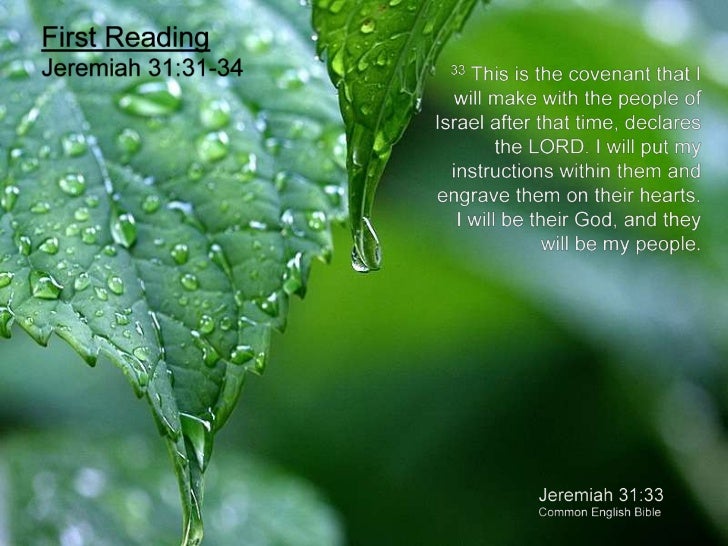
31 The days are surely coming, says the Lord, when I will make a new covenant with the house of Israel and the house of Judah. 32 It will not be like the covenant that I made with their ancestors when I took them by the hand to bring them out of the land of Egypt—a covenant that they broke, though I was their husband, says the Lord. 33 But this is the covenant that I will make with the house of Israel after those days, says the Lord: I will put my law within them, and I will write it on their hearts; and I will be their God, and they shall be my people. 34 No longer shall they teach one another, or say to each other, “Know the Lord,” for they shall all know me, from the least of them to the greatest, says the Lord; for I will forgive their iniquity, and remember their sin no more.

******************
                Jeremiah speaks of a new covenant that God will make with Israel and Judah. It won’t be a covenant written on stone. It will be a covenant written on the heart. Christians have embraced Jeremiah’s message of the New Covenant, believing that this promise was fulfilled in the life, death, and resurrection of Jesus. In Paul’s account of the institution of the Lord’s Supper (the earliest version of that institution), we hear Jesus declare: “This cup is the new covenant in my blood. Do this, as often as you drink it, in remembrance of me” (1 Cor. 11:25; see Lk. 22:20).  In the Book of Hebrews, which interprets the ministry of Jesus in the light of Jewish precedent, we see several references to the New Covenant, with the emphasis being on the way in which this new covenant replaces the earlier covenant. So, consider this word: “For this reason he is the mediator of a new covenant, so that those who are called may receive the promised eternal inheritance, because a death has occurred that redeems them from the transgressions under the first covenant.  Where a will is involved, the death of the one who made it must be established” (Heb. 9:15-16). It is this reference in 1 Corinthians and the accompanying references in Hebrews that lead to the labeling of the Christian-specific portion of the Bible as the “New Testament.” It is within the pages of the Christian portion of the Bible, that Christians have seen themselves encountering the one who writes the new covenant on hearts rather than stone.

Continue reading “Covenant of the Heart – Lectionary Reflection for Lent 5B”

Patience—Or a Loss of It – Lectionary Reflection for Lent 4B

comesundayfb

Numbers 21:4-9 New Revised Standard Version (NRSV)

From Mount Hor they set out by the way to the Red Sea, to go around the land of Edom; but the people became impatient on the way. The people spoke against God and against Moses, “Why have you brought us up out of Egypt to die in the wilderness? For there is no food and no water, and we detest this miserable food.” Then the Lord sent poisonous serpents among the people, and they bit the people, so that many Israelites died. The people came to Moses and said, “We have sinned by speaking against the Lord and against you; pray to the Lord to take away the serpents from us.” So Moses prayed for the people. And the Lord said to Moses, “Make a poisonous serpent, and set it on a pole; and everyone who is bitten shall look at it and live.” So Moses made a serpent of bronze, and put it upon a pole; and whenever a serpent bit someone, that person would look at the serpent of bronze and live.

*******

By the fourth week, the Lenten journey could be getting old, especially if you’re fasting (I’m not). Many churches try out things they don’t normally do during the season (we’re using a prayer of confession and words of assurance in worship), which means that some in the church might be ready to get back to the status quo or move on to the next thing. After all, by now the stores are filling up with Easter paraphernalia.

In the previous three Lenten readings from the Hebrew Bible, we have explored God’s covenants—first with Noah, then Abraham and Sarah, and finally with Moses and Israel at Sinai. Now we’re moving on from the initiation of covenants to living in the covenant. The reading for the Fourth Sunday of Lent places us on the road toward the Promised Land. The people of Israel have arrived at Mount Hor, a mountain in the desert near the border of Edom, one of Israel’s traditional enemies. Although the journey from Egypt to the Promise Land should only take a few weeks at most, the people of Israel have been wandering in the desert for months and maybe years, making little progress. It is true that they have received the keys to the covenant and established the priesthood, with Aaron as the first chief priest, but they’re still wandering in the wilderness.

Having arrived at Mount Hor, change is setting in. When they arrive at this point in the journey, Aaron dies, and the priesthood passed on to his son Eleazar (Num. 20:22-29). Moses has lost his closest confidant, and a person whom the people gravitate toward. Aaron is a buffer, but he’s gone. The journey has been long. The people are tired. There is no end in sight. Do you ever feel that way? Do you feel like you are wandering in the desert with no end in sight?

Having buried Aaron at Mount Hor, the people of Israel head out again on their ever-lengthening journey. They again begin complaining about God’s provision and Moses’ leadership. They’re anxious and afraid. They fear dying in the desert of thirst and starvation. While there is manna, it is detestable. Now, they are told they will take another detour, even if it is a smart decision, so they can avoid traveling through Edom. More wandering. More time. More suffering. It’s no wonder that the people of Israel got anxious and impatient! In their frustration they challenged Moses’ authority, and even that of God. After all, hadn’t Moses promised them that Yahweh would liberate them. Instead of liberation, all they seemed to experience was death (symbolized by that of Aaron).

As we all know, either from our own childhood memories or as a parent, a long trip can wear on you. The longer the trip, the more likely that our patience grows thin and we begin to complain about everything. In this case it’s the lack of food and water, and the detestable nature of the food they have (I’m assuming we’re talking manna here). In other words, Israel is ungrateful. Of course, this is the first time we read of Israel murmuring. This is the fifth and final such episode. Now, we’re supposed to side with Moses and God in this matter, but I can sympathize with Israel. If I had been on a journey like this, one that was filled with obstacles and never seemed to end (did they know there was a shorter road to the Promised Land than the one they were taking?). Even Egypt might start looking good if they didn’t get to their destination soon.

This is all a backstory to God’s decision to punish Israel because their continued complaints. Perhaps in a fit of divine impatience, God sends poisonous snakes into the camp to kill off members of the community. Yes, many were bit, and many died. It sounds horrific, but apparently it got the people’s attention, because they went to Moses and confessed their sins against God and Moses. They asked Moses to intervene and ask God to get rid of the snakes. So, Moses prayed for them, and God provided a remedy. God told Moses to create a totem of sorts that featured a poisonous snake. So, Moses fashioned a bronze serpent and placed on a pole, and if a snake bit a person, Moses would have the person look at the bronze serpent and the person would live.

This is quite interesting. After all, images were prohibited in the commandments (though Numbers doesn’t have the story of the giving of the Ten Commandments. Still, this is odd. Of course, this passage might raise other questions in our minds. First, there is the question of whether this is magic. Then there is the picture of God it presents. Once again, we see God act somewhat petulantly. The people complain, and God sends snakes to kill them. What kind of God is this? Moses seems to have more patience with the people than Yahweh. But then God does seem at times to be short-tempered. Remember how Abraham had to talk God down from destroying Sodom with Lot still present? Is this the God we worship? We could try an age-old tactic and separate Jesus from the Old Testament God, but that leads in a dangerous direction. Yahweh becomes Marcion’s demiurge, the evil creator god who is overcome by the loving God of Jesus. We should stay away from such views, but this is a good reminder why we should not read Scripture flatly, as if everything is the same. Both testaments speak of God in ways that we likely will find problematic, at the very least.

A deeper question has to do with the message of this passage for our Lenten journey. The reading from the Gospel of John designated for this Sunday equates Moses’ serpent to Jesus on the cross: “And just as Moses lifted up the serpent in the wilderness, so must the Son of Man be lifted up, that whoever believed in him may have eternal life” (John 3:14-16). In John’s Gospel the serpent of Numbers 21 is a precursor to Jesus. By looking at the serpent, the people lived. They were healed. They were saved. By believing in Jesus, who was lifted up on the cross, we receive eternal life. It is not magic. The cross is not a totem, but both the bronze serpent and the cross of Jesus are signs of healing. Note that in both cases, life is the result. In one case it’s physical and the other is eternal, but both bring healing, wholeness, and life itself. So, we lift our eyes to the cross, and we see our salvation. In him, we are healed. In him, we find the source of patience in the midst of challenging times.

Robert D. Cornwall is pastor of Central Woodward Christian Church (Disciples of Christ) in Troy, MI. He holds a Ph.D. in Historical Theology from Fuller Theological Seminary. The author of a number of books, his most recent books include Out of the Office: A Theology of Ministry (Energion Publications, 2017), Marriage in Interesting Times (Energion, 2016), and Freedom in Covenant (Wipf and Stock, 2015).  He blogs at Ponderings on a Faith Journey. 

Freedom amid Divine Expectations – Reflection for Lent 3B

comesundayfb

Exodus 20:1-17 New Revised Standard Version (NRSV)

20 Then God spoke all these words:

I am the Lord your God, who brought you out of the land of Egypt, out of the house of slavery; you shall have no other gods before me.

You shall not make for yourself an idol, whether in the form of anything that is in heaven above, or that is on the earth beneath, or that is in the water under the earth. You shall not bow down to them or worship them; for I the Lord your God am a jealous God, punishing children for the iniquity of parents, to the third and the fourth generation of those who reject me, but showing steadfast love to the thousandth generation of those who love me and keep my commandments.

You shall not make wrongful use of the name of the Lord your God, for the Lord will not acquit anyone who misuses his name.

Remember the sabbath day, and keep it holy. Six days you shall labor and do all your work. 10 But the seventh day is a sabbath to the Lord your God; you shall not do any work—you, your son or your daughter, your male or female slave, your livestock, or the alien resident in your towns. 11 For in six days the Lord made heaven and earth, the sea, and all that is in them, but rested the seventh day; therefore the Lord blessed the sabbath day and consecrated it.

12 Honor your father and your mother, so that your days may be long in the land that the Lord your God is giving you.

13 You shall not murder.

14 You shall not commit adultery.

15 You shall not steal.

16 You shall not bear false witness against your neighbor.

17 You shall not covet your neighbor’s house; you shall not covet your neighbor’s wife, or male or female slave, or ox, or donkey, or anything that belongs to your neighbor.

*****

We serve a covenant-making God. In the reading from Exodus 20, we encounter the third covenant-making event in this our Lenten journey. In the reading from Genesis 9 for the for the First Sunday of Lent, we read of God’s covenant promise to Noah. Never again, will God cleanse the earth with water. In the reading for the Second Sunday of Lent from Genesis 17, we hear again God’s covenant promise to Abraham and Sarah. They’re promised a multitude of descendants, who will inhabit the Land as part of an everlasting covenant. Now, we come to the third covenant, the one God makes Israel through the mediation of Moses. God has called Moses up to the mountain top so Moses might receive a set of covenant stipulations that will define relationship between Israel and its God.

We call the covenant stipulations revealed to Moses in Sinai the Ten Commandments. They are, we’re told, inscribed by God on stone tablets (Exodus 31:18-19). It should be noted that when Moses came down from the mountain with the tablets laying out the covenant and discovered that the people were dancing around the golden calf, he threw them on the ground, breaking them (Exod. 32:19). Now, God did provide a second copy, so the people would have guidelines. With this second set, God renewed the covenant in preparation from the move from Sinai into the Promised Land (Exod. 34).

These stipulations that were intended to mark God’s covenant with Israel, have entered the public domain. We treat them today as if they were a legal code for American cultural life. Attempts have been made to put them in schools and court houses. In other words, we have secularized them, forgetting that they define a relationship with God. To forget their origin and turn them into rules diminishes their power to engender true freedom as a gift of God.

It is easy to miss, but these ten words begin with God’s declaration: “I am the Lord your God, who brought you out of the land of Egypt, out of the house of slavery.” This is an important word, because it defines God and God’s relationship with God’s people. In Jewish tradition, this is the first command. The second command prohibits worship of other gods and of making images of those gods. Thus, the opening statement is not a self-introduction. It is a command or word from God. Regarding this self-revelation of God’s identity, Rabbi Barry Schwartz writes: “

Note that while God could have been introduced as the creator of the world, God is instead presented as liberator of the people. The Torah is surely reminding us that the demanding and commanding God is first and foremost the liberating God. Concurrently, the text is also teaching us that there cannot be revelation without liberation. [Barry Schwartz, Path of the Prophets, ( Jewish Publication Society, 2017), p. 33].

What might appear to be rules and regulations are the foundations of freedom. True freedom comes from being in relationship with the one God, of whom no image can be created, a God who invites us to rest from one’s labors. While Sabbath laws often became burdensome, consider their origins. A people was enslaved. They had no rest from their labors, but now, they were free, and so Sabbath rest was theirs as a gift of God. Where once they had been in servitude to Pharaoh (who considered himself a god), now they are servants of Yahweh, and in this service, they find freedom.

We tend to equate freedom with an absence of rules, but to live in relationship with the covenant-making God, who is also the liberating God, is to recognize that true freedom is not anarchy. Again, I turn to Rabbi Barry Schwartz, who writes that “freedom is not simply the opportunity to act with impunity—it requires responsibility. The Exodus, after all, is not an end in and of itself. The Exodus culminates in Sinai—liberation is capped by Revelation. The mission is predicated on a covenant, and covenant implies obligation.” In this view, “responsible freedom leads to blessing” [Schwartz, Path of the Prophets, p. 36]. If we look back from this covenant to the one God initiated with Abraham and Sarah, it’s purpose is one of blessing. That promise of blessing continues through this covenant relationship.

While it may be true that these Commands form a basis for Western legal traditions, and that these words hold value for human life, it is important that we first see them in the context of God’s covenant purposes. These are, after all, not just any laws, these are a gift of God.

The commands provide a foundation for the relationships within the community for relationships with God and with neighbor. The first Table speaks specifically to one’s relationship with God. That is, love God with your entire being (Deut. 6:4-5). So, don’t worship other gods, don’t create images, don’t take oaths, and observe sacred time (Sabbath). When it comes to the second command, to love one’s neighbor, the remaining statements come into view (Lev.  19:18). Words that address such basic principles of life as not killing and stealing, seem uncontroversial, though we can obfuscate on the meaning of such words. But what about bearing false witness and coveting. How often do we break these two commands, which can often lead to breaking the others? In many ways the final command about coveting stands at the foundation of the entire law concerning one’s neighbor. Stealing, lying, killing, they all start with coveting.

When we speak of the two commands to love God and neighbor, we speak of a calling more fully delineated in the Ten Words, and further delineated in the 613 Mitzvot that make up the Law. If we fulfill the two, we fulfill the 613. Thus, Jesus affirms and fulfills these covenant stipulations, in calling for his followers to love God and love neighbor (Matt. 22:34-35).

We hear these words anew in the context of our Lenten journey find true freedom in service to God. Since this is a season of contemplation and reflection, may the Ten Teachings, as laid out in Exodus 17, help us discern our place in God’s covenant people. As we use these words to look at our lives and how we are living them, if there are some areas needing adjustment, may we take the opportunity to do just that. As we take time to repent, we get back in the groove, for it is followed by words of assurance of forgiveness.

Dr. Robert Cornwall, Pastor of Central Woodward Christian Church of Troy, MI and author of several books including Out of the Office (Energion, 2017) and Freedom in Covenant (Wipf and Stock, 2015).