Author: Dennis

Blasphemous Rumors- Narrative Lectionary, Pentecost 24

comesundayfb

Narrative Lectionary Reflection

November 19, 2017

Introduction

You get the phone call from your sister in law. She and your brother are pregnant and will have a little baby.  From then on, as the baby inside of her grows and grows, everyone waits expectantly.  Your sister-in-law shares sonogram photos of the baby, as the child slowly develops. And then the day comes.  You get to hold your new niece for the first time as she naps.

The promise of a child is in many ways a symbol of hope.  It is a sign of new life arising.  In today’s text we learn about a promised birth that will change things for the better in Judah, the Southern Kingdom.  They learn that even in the darkest times, hope is always there springing to life.

Today, we hear the words from the prophet Isaiah.

Engaging the Text

The people who walked in darkness
    have seen a great light;
those who lived in a land of deep darkness—
    on them light has shined.

Isaiah 9:2 

This passage is one of the most well known in the Bible.  If you have every heard Handel’s Messiah, you have heard this passage.  Handel wrote the Messiah with Jesus in mind.  But the writer had someone else in mind. So let’s dig in.

Sometimes one of the best ways to understand a passage is by reading what is not there.  That’s the case in chapter 9.  What is not written in this passage is the diplomatic intrigue that is taking place among the many nations.

The ruler of the Southern Kingdom around the time of this writing was Ahaz who is considered one of the worst kings that ever ruled Judah. During his reign the great empire of Assyria was moving westward.  The Northren Kingdom and Syria entered into an alliance and invaded Judah.  Ahaz made his first mistake by appealing to the king of Assyria. Instead of trusting in God, he trusted in power, in this case the power of Assyria.  Israel and Syria were destroyed, but now the Southern Kingdom was basically a vassal state, meaning Assyria now truly controlled the kingdom.

It was during this time that God is judging the two kingdoms of the Israelites.  In 9:1 we hear that ” God cursed the land of Zebulun and the land of Naphtali.”  This means that God has throughly judged Israel.  There is no more chances for repentance.

The Southern Kingdom, Judah was also going to be judged, but God still has hope.  In 9:2 this is where we hear about the people in darkneness, Judah who have seen a great light.

Verses 3 and 4 talk about the end of some kind of military oppression. It could be about Assyria, but it could also be about the Syrian-Israelite coalition. When they invaded Judah, the not only took spoil, but some 200,000 people to Samaria.

The harbinger of this prophecy is found in verse 6 where a child is to be born.  Most people believe the writer was referring to the son of Ahaz; Hezekiah. This child is a sign of God being with the people of Israel, Emmanuel.  Hezekiah was a good king and brought about various reforms.

However, Hezekiah was only human, which meant he would fall short of the prophecy about him. Eventually, Judah will be defeated by Babylon and the majority of the population sent into exile.  At that point, the prophecy changes to a future king that will being deliverance.

In chapter 7 we are told that the promised one is going to be named Immanuel or God With Us. For the people of Israel, it was a reminder that God would not forsake them even during exile.  For Christians, we have come to understand Immanuel as Jesus who comes to bring light to a dark world.

Conclusion

I don’t want to start any blasphemous rumours
But I think that God’s got a sick sense of humor
And when I die I expect to find Him laughing
-Blasphemous Rumors, Depeche Mode, 1984

Those are the lyrics of a song called “Blasphemous Rumors” by the British New Wave band Depeche Mode.  It’s an interesting song, because it takes on the topic of suffering and where faith intersects.  In the song, we hear of a young girl trying to commit suicide, failing at first and then succeeding and another girl who became a committed Christian only to end up in a accident that left her on life support until the decision was made to turn the machine off.

At first glance this song seems to denounce God for not stopping the evil that overtook these two women. But maybe this song is a song of complaint and questioning.  Why does evil exist in this world?  How can a good God allow such bad things to happen?

Ahaz is worried about the Northern Kingdom of Israel and Syria who are threatening Judah.  God tells Ahaz to not worry.  God even offers a sign, a woman would give birth to a child and by the time that kid could eat solid food, the two agressive kingdoms would be gone.  This baby would have a name, Immanuel, or God With Us.  Now that’s a sign.  God will be with Ahaz in this dark time.  It’s wonderful, except Ahaz didn’t think so.  Instead of believing that God was with him, he sought an alliance with Assyria.  The result wasn’t so good, because Judah ended up being a vassal state of Assyria.  

We sometimes wonder if we are alone in the world.  These passages remind us that we are never alone: God is with us all the time.

That’s a message of hope the world needs to hear.  Those facing the loss of a loved one through death, those dealing with a cancer diagnosis, the town that hears the factory is closing leaving many people without jobs in the coming year, all of these people need to hear that God is with them. That oppression will end. 

This passage is usually heard on Christmas Eve and it makes sense, since in the passage we talk about light and darkness and the winter solstice will have just taken place.

The wider culture sees Christmas as a time to buy presents and maybe have a party.  But that’s not what Christmas is all about.  It is about the coming of God into the world, our world.  It’s when God dares to get involved in this world, full of pain and chaos and offer grace, redemption and hope.  Christmas is about God being with us.

Christmas has to give an answer to those dealing with pain and unhappiness.  It has to tell everyone that God is here, with us, in the good times and in the bad times.

Dennis Sanders is the Pastor at First Christian Church of St. Paul in Mahtomedi, Minnesota. He’s written for various outlets including Christian Century and the Federalist.


Crossing the River – Common Lectionary Reflection, Pentecost 21

cropped-comesundaylogov2.png

Joshua 3:7-17 New Revised Standard Version (NRSV)

The Lord said to Joshua, “This day I will begin to exalt you in the sight of all Israel, so that they may know that I will be with you as I was with Moses. You are the one who shall command the priests who bear the ark of the covenant, ‘When you come to the edge of the waters of the Jordan, you shall stand still in the Jordan.’” Joshua then said to the Israelites, “Draw near and hear the words of the Lord your God.” 10 Joshua said, “By this you shall know that among you is the living God who without fail will drive out from before you the Canaanites, Hittites, Hivites, Perizzites, Girgashites, Amorites, and Jebusites: 11 the ark of the covenant of the Lord of all the earth is going to pass before you into the Jordan. 12 So now select twelve men from the tribes of Israel, one from each tribe. 13 When the soles of the feet of the priests who bear the ark of the Lord, the Lord of all the earth, rest in the waters of the Jordan, the waters of the Jordan flowing from above shall be cut off; they shall stand in a single heap.”

14 When the people set out from their tents to cross over the Jordan, the priests bearing the ark of the covenant were in front of the people. 15 Now the Jordan overflows all its banks throughout the time of harvest. So when those who bore the ark had come to the Jordan, and the feet of the priests bearing the ark were dipped in the edge of the water, 16 the waters flowing from above stood still, rising up in a single heap far off at Adam, the city that is beside Zarethan, while those flowing toward the sea of the Arabah, the Dead Sea, were wholly cut off. Then the people crossed over opposite Jericho. 17 While all Israel were crossing over on dry ground, the priests who bore the ark of the covenant of the Lord stood on dry ground in the middle of the Jordan, until the entire nation finished crossing over the Jordan.

*****

Rivers and other bodies of water play a significant role in the biblical story. Crossing rivers often signifies an important transition in the life of God’s people.  Jacob had his wrestling match with the angel of God at the ford of the Jabbok River, an encounter with the divine on the eve of his reunion with Esau, a reunion that required the crossing of a river (Gen. 32-33). A body of water needed to be crossed so that the people of Israel, led by Moses, could escape slavery (Exodus 14). Each of these stories play a role in God’s ongoing covenant relationship with Israel. The same is true in many ways with the prophets Elijah and Elisha, who called for Israel to remain true to its calling. A crossing of the river plays a role in the passing of the prophetic mantle from Elijah to Elisha (2 Kings 2).


The people of Israel, now led by Joshua, must cross the Jordan to inhabit the land that was given to them by God so that the people could fulfill their covenant responsibilities. As we saw in the preceding reading from Deuteronomy 34, God allowed Moses to climb the mountain and look into the Promised Land. He had led the people across Sinai and served as the mediator between the people and God, as God formed them into a new people, one that was no longer defined by slavery. He did his job, often under significant duress. It would have been nice to cross over into the Promised Land, but that would not be his destiny. Instead, that the responsibility and opportunity to lead the people across the river and into the Promised Land was given to Joshua, Moses’ protégé.

Yahweh said to Joshua “This day I will begin to exalt you in the sight of all Israel, so that they may know that I will be with you as I was with Moses.”  God makes clear to Joshua, that there would be an unmistakable sign of God’s intentions, so that the people would know that Joshua was God’s chosen leader for the people as they entered the land of promise.

I find this passage to be intriguing. When taken together with Deuteronomy 34, it serves as an opportunity to reflect on times of transition, including pastoral transitions. Perhaps it is because that I’m getting closer to retirement age, that this passage speaks to me. There are times when we fill the role of Moses, and other times we take up the role of Joshua. Moses is the one who leads the people to the river, but does not cross over. Joshua, on the other hand, gets to take the community across river and into new opportunities. My sense is that many of us will fulfill both roles at some point in our lives, and so these two readings, one from Deuteronomy 34 and one from Joshua 3  speak to our own experiences with God and the communities we are part of.

While Joshua offers an important word to those moments of transition that we all experience, it also comes to us with a shadow hovering over it. I would be remiss if I did not take note of the implications of the conquest of Canaan, undertaken at God’s behest, under Joshua’s leadership. In this very passage we have a word about ethnic cleansing. God will go before the people of Israel and drive out the inhabitants, so that Israel can take possession of the land. Yes, this may be the land of promise for Israel, but it is not uninhabited land. Here is the biblical foundation for Manifest Destiny. This land which I call home has been depicted as a Promised Land, the inhabitants of which would need to be driven out so that the chosen ones—primarily Europeans—could take possession. We need to acknowledge this reality, and reject it as coming from God. Ethnic cleansing is not to be celebrated, and it cannot be justified on the basis of scripture. Yes, it’s there, clear as daylight, in Joshua, but we must say no to it, and embrace a different vision, one that welcomes the stranger and lives in harmony with the other. That’s in scripture as well. So, as much as I like the basic story of liberation and restoration that we find present in Deuteronomy and Joshua, this part of the story needs to be acknowledged and rejected, so that we do not feel justified in doing the same.

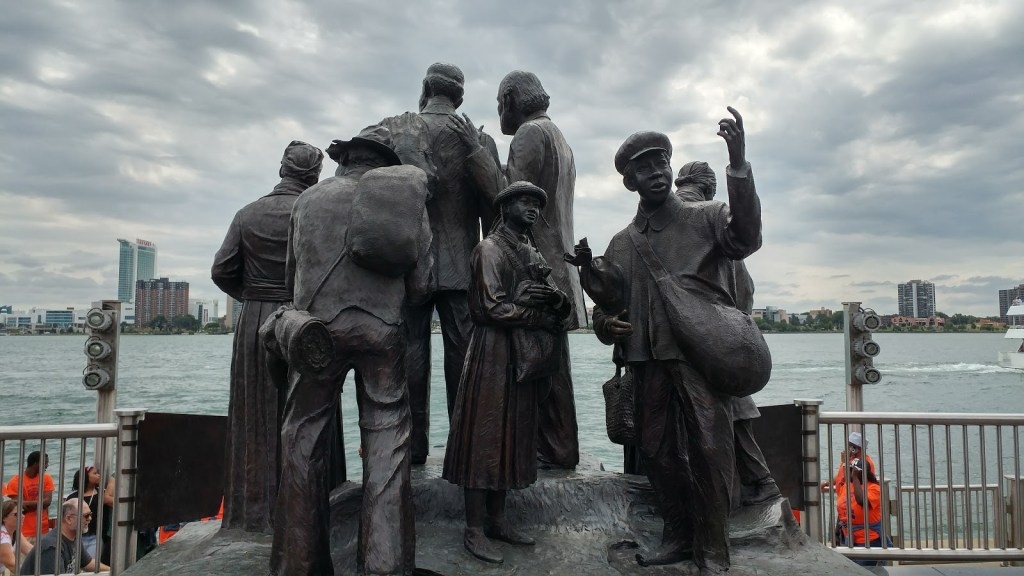
Gateway to Freedom monument – Detroit River

Having acknowledged the shadow that hangs over this passage, what word do we hear that speaks to us? Crossing the river is an act of faith. The people of Israel are camped at the edge of the river. They can see across to the other side. They may have heard stories of dangers ahead, but they’ve also heard that the land is theirs for the taking (Josh. 2:22-24). The one who stands before them as their leader is young and untested. Moses is dead and buried. To cross the river under the leadership of Joshua is an act of faith, but God promises a sign.

Joshua gathers the people to the edge of the river and gives them instructions, as received from Yahweh. They’re to select representatives, one from each tribe, perhaps to serve as a council of elders, as they cross into the new land of promise. They will join Joshua in leadership. Then, Joshua commands the priests to take the Ark of the Covenant and walk ahead of the people. When the priests bearing this Ark reach the water’s edge they are to step into the river. As they do this the waters will part, just as at the sea when the people of Israel escaped slavery in Egypt, so that the people can cross over on dry land. So, at the direction of Joshua, the priests move into the center of the river and stay there until everyone passes through the waters and into the Promised Land.

The symbolism of the Ark of the Covenant is important. It serves as a tangible sign of the presence of God who goes with them. Remember that in the Exodus story, Aaron created a golden calf as a representation of Yahweh. This was not acceptable. The Ark, on the other hand, was not seen as a graven image. It did not provide a physical representation of Yahweh. However, it did serve as a sign of God’s presence in their midst. It was a symbol of God’s leadership, and thus of Joshua’s as well. As they took the journey into the land, they needed to know that they did not go alone.  With this we may sing the third stanza of “Guide Me, O Thou Great Jehovah” (William Williams, 1745).

When I tread the verge of Jordan,

bid my anxious fears subside;

                Bear me through the swelling current;

land me safe on Canaan’s side;

                Songs of praises, songs of praises,

I will ever give to thee, I will ever give to thee.

bobcornwall

Robert Cornwall is the Pastor of Central Woodward Christian Church in Troy, Michigan and is the author of a number of books including Marriage in Interesting Times (Energion, 2016) and Freedom in Covenant (Wipf and Stock, 2015).

On The Run- Narrative Lectionary, Pentecost 22

comesundayfb

Narrative Lectionary Reflection

November 5, 2017


Introduction

A few years ago, the Walker Art Center in Minneapolis, held the first annual cat video festival.  They hosted the event in the Sculpture Garden near the museum and for several hours showed nothing but YouTube videos of cats.  Believe it or not, 10,000 people showed up on an August evening to watch these videos.  The whole event event got a write-up in the New York Times.

The winner of that event went a video featuring Henri the cat. Henri is a cat with ennui.

In video, Henri who is a tuxedo cat, look longingly into the camera while depressing piano music plays in the background.  The films are in black and white and Henri speaks in French with subtitles showing up on the bottom of the screen.  Henri asks existential questions on the meaning of life, quoting Camus whenever the need arises.  He drops angst filled phrases like, “The 15 hours a day I sleep have no effect. I awake to the same tedium.”  He learns some important things as he questions his existence: things like the whipped cream in the bathroom isn’t whipped cream and that sometimes the cat door is closed.

It’s funny because the last being that you’d think to have an existential crisis would be a house cat.

Today’s text is also an existential journey.  That said, the person asking the existential question isn’t the main character, Elijah, but God.  

Today, we talk about the prophet Elijah, on the run.

Engaging the Text

Ahab told Jezebel all that Elijah had done, how he had killed all Baal’s prophets with the sword. 2 Jezebel sent a messenger to Elijah with this message: “May the gods do whatever they want to me if by this time tomorrow I haven’t made your life like the life of one of them.”

1 Kings 19:1-2


A little background here.  We have moved from Solomon to King Ahab.  In between, the kingdom of Israel split into a Northern and a Southern Kingdom.  Today’s text takes place in the Northern Kingdom.

King Ahab is considered one of the worst kings in both kingdoms.  He marries Jezebel,  a Phoenician princess. Ahab had a temple built for Baal and other places were set up for people to worship this new god. Jezebel worked to make sure the prophets of Yahweh were persecuted.

In chapter 18, there is a showdown between the prophets of Baal, and Elijah. Elijah decides to challenge King Ahab to prove whose God is bigger.  First up, the prophets of Baal pray for their god to send fire on their offering.  Nothing happens.  Then it was Elijah’s turn.  He prays to God and God answers, powerfully burning the offering, including the altar. Elijah is then able to persuade the people to capture the false prophets have them killed.  When Jezebel hears of this, she swears vengeance against Elijah. 

Now, after such a dramatic event, one that he won, you would think Elijah would have been confident in God.  He would be able to stand up to Ahab and Jezebel, telling them to do their worse.

Instead, he takes his servant and high tails it out of town.

Why does Elijah run? He won the argument, Baal’s prophets were dead, he was the winner. What made him able to face Ahab, but flee when Jezebel threatens him?

It’s important to note that Jezebel is a true believer.  After all that has happened to shake her faith, she still swears by here gods in 19:2.  Elijah wasn’t prepared for this. He is shocked and instead of thinking theologically, he responds emotionally. In short, Elijah faces a crisis of faith. 

Elijah’s flight is reminiscent of Jonah’s attempt to flee away from God.  There were differences though. Jonah hated the Ninevites, the people he was called by God to preach to.  Elijah basically gets scared.  But in both cases, God has to bring God’s prophets back on the path of faithfulness.

Elijah walks in the desert until he sat under a tree hoping to die.  But instead of death, a messenger comes and tells him to eat some food that had been mysteriously prepared for him. This happens one more time. The gift of food is a reminder of what God had done for the Israelites in the past.  It was a reminder that just as God fed the Israelites in the desert with quail and manna, God would take care of Elijah.  Elijah needed the food not just to fill his belly but to remember who God is and what God has done.  Remembering the past is a way to remember who he was and what he needed to do.

Afterwards Elijah starts on a journey; he keeps walking and walking and walking. When he finally stops, God asks him an odd question: Why are you here, Elijah?

What’s even stranger is that Elijah never answer God’s question.  Instead,  Elijah talks about how vigilant he was and how he is the last prophet and his life is threatened.  Then God tells him that God is about to pass by. He sees an earthquake,wind and fire, but the passage notes that God was not in any of these events. God comes to Elijah in what is called a “slight whispering sound” or “still small voice” (rsv). Why did God come in this way? A number of scholars think that God deliberately rejected storms because it s association with the Baal which happens to be a god of rain. In a time when the Israelites have divided loyalties between Baal and God and the small voice is a way of stating who God is; not in the loud sounds but in the quiet.

It is in the quiet that God asks again: why are you here? Elijah responds by saying the following:

 “I’ve been very passionate for the Lord God of heavenly forces because the Israelites have abandoned your covenant. They have torn down your altars, and they have murdered your prophets with the sword. I’m the only one left, and now they want to take my life too.”

-1 Kings 19:14

Elijah thinks he is alone.  All of the other prophets were killed by Jezebel.  But God responds:

15 The Lord said to him, “Go back through the desert to Damascus and anoint Hazael as king of Aram. 16 Also anoint Jehu, Nimshi’s son, as king of Israel; and anoint Elisha from Abel-meholah, Shaphat’s son, to succeed you as prophet. 17 Whoever escapes from the sword of Hazael, Jehu will kill. Whoever escapes from the sword of Jehu, Elisha will kill. 18 But I have preserved those who remain in Israel, totaling seven thousand—all those whose knees haven’t bowed down to Baal and whose mouths haven’t kissed him.”

-1 Kings 19:15-18

Elijah thought he was alone and he feared he would be next.  But God does two things. First, God gives him a task to do: to go and anoint the next king of Israel (Northern Kingdom). He is also to anoint Elisha to be his successor as prophet (which was an unusual thing; prophets anointed kings not prophets).  Finally, God tells Elijah that there are 7,000 prophets that haven’t bowed to Baal.  

Conclusion

Why are you here?  This is a question that is asked again and again in everyone’s life.  You can  hear it when you are laid off from our job.  Or when your baby boy dies after being born premature.  It’s heard when you get the cancer diagnosis or when our loved one decides to leave you.  Why are you here? We hear that question and feel it hanging in midair.  We try to search for an answer, but more often than not, we don’t have an answer.

God sustains God’s saints.  In a time of despair where Elijah just wants to die, God comes to offer food, drink and a new mission. We have to acknowledge and trust that our power comes from God and not from our own work.

To follow God means that you will suffer in some way because life on this side of heaven is always a challenge.  But it is in God that we can keep moving forward. Saints are people who are empowered by God to do God’s work.

Theologian Garrett Galvin shows that God is present for God’s disciples in their time of need:

God sends unexpected help to Elijah during his time of great vulnerability. Elijah is able to overcome his great sadness through the care of the angels and the nourishment of their food. This story invites us to see how the Lord has been present to us in difficult moments. It also invites us to view our problems through a lens able to see God’s divine presence in the world. Just as God is clearly present to Elijah in order to help him overcome his travails, we must have the same confidence that God is present and will be present in our lives. We know the whole of the Elijah story and can see this as just a blip in the story. We must also have the awareness that our travails and troubles are far from the whole of our story. Just as God has been present in our past, we must persevere in the hope that God will be present in our future.2


Dennis Sanders is the Pastor at First Christian Church of St. Paul in Mahtomedi, Minnesota. He’s written for various outlets including Christian Century and the Federalist.
Indulge?- Pentecost 21

comesundayfb

Narrative Lectionary Reflection

October 29, 2017


Introduction

The football stadium sits at the edge of downtown and is ready for the upcoming Superbowl in a few months.  Tens of thousands will cheer for their team, while nearly a billion people worldwide will tune in from their television and computer screens.

The building is impressive. You can’t miss it because it’s a huge edifice and because of it’s advant-garde design. The building is a jewel in the city’s crown, paid for in part by the citizens of the state. Will the people who come to enjoy the game realize who helped pay for the stadium, let alone the people who worked through the cold winters to make the stadium a reality?

Today we talk about Solomon, David’s son who becomes king after David.  David wanted to build a temple to God, but it never happened while he was king.  Solomon is able to do so, but it comes with a cost.

Today we talk about Solomon and the Temple.

Engaging the Text

Now the boy Samuel was serving the Lord under Eli. The Lord’s word was rare at that time, and visions weren’t widely known. (1 Samuel 3:3)

  A little background here.  Last week we talked about the annointing of David. Between then and this week, there was a civil war between Saul and David, David becoming officially king, his scandal with Bathsheba and the killing of her husband, David’s death and his son Solomon becoming king.

The building of the Temple for God is usually presented as a good thing and in many ways it was.  But Solomon’s leadership, while exemplary, also contained a lot of ambiguities.  The building of the temple and his rule in general had weak spots and we see it here in very stark detail.

When we start with today’s text, the nation of Israel is at the height of its powers.  Solomon controls a small empire with lands from the Euphrates River (modern day Iraq) to Egypt.

Solomon was also a rich man. He had many chariots and many horses and a lot of other stuff.  All of his subjects had to pay tribute (read tax) to him.

Why are we talking about the size of Israel and tax policy and what does this have to do with the opening of the Temple? For one, it is important to note that while Solomon is considered someone that follows God, he had flaws.  He lived high on the hog and most of his wealth was supported by taxes and it was something that was ultimately frowned upon. Deuteronomy 17 lays down the law for kings:

14 Once you have entered the land the Lord your God is giving you and you have taken possession of it and settled down in it, you might say: “Let’s appoint a king over us, as all our neighboring nations have done.” 15 You can indeed appoint over you a king that the Lord your God selects. You can appoint over you a king who is one of your fellow Israelites. You are not allowed to appoint over you a foreigner who is not one of your fellow Israelites. 16 That granted, the king must not acquire too many horses, and he must not return the people to Egypt in order to acquire more horses, because the Lord told you: “You will never go back by that road again.” 17 The king must not take numerous wives so that his heart doesn’t go astray. Nor can the king acquire too much silver and gold. 18 Instead, when he sits on his royal throne, he himself must write a copy of this Instruction on a scroll in the presence of the levitical priests. 19 That Instruction must remain with him, and he must read in it every day of his life so that he learns to revere the Lord his God by keeping all the words of this Instruction and these regulations, by doing them, 20 by not being overbearing toward his fellow Israelites, and by not deviating even a bit from the commandment. If the king does all that, he will ensure lasting rule in Israel for himself and for his successors.

Common English Bible. (2011). (Dt 17:14–20). Nashville, TN: Common English Bible.

(Deuteronomy 17:14-20)

Take for example the differences between building the Temple for God and Solomon’s own temple.  It took seven years to build the Temple, but it took thirteen years to build his own house.  Does that show that he cared more about his own house, than about God’s house?  A house was also built for his Egyptian wife. Deuteronomy and other laws warned against taking foreign wives because it meant that foreign gods find their way into Israelite life, which is what happened.

It’s also important to know that the people building the temple weren’t always doing it as part of a job. Brent Strawn notes that the temple was built in a way that should have given Solomon pause:

The first is that Solomon instates an immense “work gang” (CEB) to carry out the labor in Lebanon (5:15). The term that is used for this workforce in Hebrew (mas) occurs elsewhere of Israelite workers only in Exodus 1:11, where the Israelites are subject to a brutal and tyrannical pharaoh and his taskmasters (see also Exodus 5:10-14). It is thus very hard to not see in the use of this particular term an extremely negative judgment on the labor in question as well as on how Solomon’s has gone about his temple building project. This suspicion is confirmed later, when the nation divides immediately after Solomon’s death: clearly, the Israelites were not pleased with this forced labor and with their “supervisors” (1 Kings 12:18; 2 Chronicles 10:18). It all seemed a bit too Egyptian, if you asked them.1

There are some good things to focus on when it comes to the temple. A word about the temple itself and a sign of God.  There are two pillars in the temple that are superfluous, they don’t hold anything up. It was a symbol; that God holds the world up, which means the world is secure.

Looking from the pillars, there was a large basin filled with water. Practically, this is where ceremonial cleansing took place.  But it had another purpose.  For the ancient Middle East, the sea held threatening power.  The water in the basin was a way of saying that the power of the sea is under God’s power; in essence another sign of the goodness of God.

Towards the end of the passage in chapter 8, we are told that a cloud fills the temple.  A cloud was a way of acknowledging God’s presence.  It was a cloud that led the people of Israel as they traveled to the Promised Land.  The cloud shows God is present among the people.

Is the temple a place where God lives?  No, because God is everywhere.  But the temple is a reminder that God is present. John Goldingjay explains why:

So why is Solomon building one? He speaks of building a house for God’s name. It is a way the Old Testament often seeks to square the circle of affirming that God was really present in the midst of Israel while recognizing that this was an unsophisticated idea. The name of a person stands for the person.

Conclusion

Solomon’s temple is considered a great achievement. It comes when the nation is at the height of its powers and it is part of the unfinished dream of David.  But this splendor comes at a cost, not only to Solomon, but to the whole nation.  What did it mean that people were taxed for the temple?  What about the fact that the temple was probably built with slave labor?

The final point to remember is this: God never asked for a temple.  What does it mean that a temple is built for God, that God never asked for?  Is the temple more for Solomon than it is for God?


  1. Strawn, Brett. WorkingPreacher.com, October 29, 2017.
  2. Goldingay, J. (2011). 1 and 2 Kings for Everyone (p. 25). Louisville, KY; London: Westminster John Knox Press; Society for Promoting Christian Knowledge.

Dennis Sanders is the Pastor at First Christian Church of St. Paul in Mahtomedi, Minnesota. He’s written for various outlets including Christian Century and the Federalist.

Bad News Samuel- Pentecost 18

comesundayfb

Narrative Lectionary Reflection

October 15, 2017


Introduction

We like to use the word prophet enough that we might have lost its true meaning.  We love hearing someone who spouts judgements against your political opponents and the first thing someone will say is that this person is prophetic.

But the problem with that definition of prophetic is that it is hearing things that the listeners agree with.  If you read the Bible, you get a very different impression of a prophet.  Most of the time we learn that prophets say things that people don’t like, sometimes even among the prophets themselves.  Prophets say hard words that can be difficult to hear. No one likes hearing words that tell you how bad you are.  No one wants to be the bearer of bad news.

In today’s text, we see young Samuel hearing the voice of God and Samuel ready to take on his first assignment as a prophet.  It is a message he didn’t want to talk about with his mentor, Eli.

What does it mean to be called by God?  What does it mean to act in a prophetic way?

Today, we look at the call of Samuel.

Engaging the Text

Now the boy Samuel was serving the Lord under Eli. The Lord’s word was rare at that time, and visions weren’t widely known. (1 Samuel 3:3)

  A little background here.  Samuel is the son of Hannah.  Hannah was a woman who was barren and wasn’t able to give her husband Elkanah, a son.  She prays to God and God answers, giving her and Elkanah a son named Samuel.  (You can read about Samuel in the October 16, 2016 edition of the Story of God.)

Samuel is now a teen or young adults working as an apprentice for the chief priest, Eli.  Eli is an interesting character that is both sympathetic and pathetic at the same time. Eli is described in verse 2 as being blind or with impaired vision, but it can also describe the state of his soul as well.  He was blind to the problems around him, problems that would lead to his downfall. Eli has a problem with his sons, who were also priests.  The story of the sons of Eli is found in chapter 2 and when they are first described, they viewed as “despicable” men.  What made them so despicable? It was simple greed.  Priests were not paid in money, because there was no money.  They couldn’t work in the fields, but the law made it possible for the priest and his family to live: they were allowed to take a part of the sacrificial animals.  After God’s portion was burnt up, then what was left over could be given to the priest.

The problem with Eli’s sons is that they took more of the meat than was allowed. Here is is how the Bible depicts their theft:


12 Now Eli’s sons were despicable men who didn’t know the Lord. 13 This was how the priest was supposed to act with the people: Whenever anyone made a sacrifice, while the meat was boiling, the priest’s assistant would come with a three-pronged fork in hand. 14 He would thrust it into the cauldron or the pot.[c] Whatever the fork brought up, the priest would take for himself. This is how it was done for all the Israelites who came to Shiloh.

15 But with Eli’s sons,[d] even before the fat was burned, the priest’s assistant would come and say to the person offering the sacrifice, “Give the priest some meat to roast. He won’t accept boiled meat from you.”[e] 16 If anyone said, “Let the fat be burned off first, as usual, then take whatever you like for yourself,” the assistant would reply, “No, hand it over now. If not, I’ll take it by force.” 17 The sin of these priestly assistants was very serious in the Lord’s sight because they were disrespecting the Lord’s own offering.

(1 Samuel 2:12-17)

The sons weren’t just guilty of gluttony. They had sex with the women who worked at the temple.  The two men were drunk with power and used it in ways that hurt others and robbed God.

Eli is aware of his son’s dealings and pleads for them to stop, which they  do not.  In the end, Eli and his sons will be punished.  So, why was Eli punished?  It doesn’t seem that Eli was turning a blind eye or didn’t care. He did urge his sons to stop their abuses, but it seems that simply saying something wasn’t enough.  It could be that Eli was passive in his life and not open to listening to God.  Eli’s weakness allowed his sons to continue their corruption and the end is that they will be judged harshly by God.

When we start chapter 3, Samuel is sleeping in the temple, with Eli nearby. He is basically an intern, learning the ropes.  As he is trying to sleep, he hears a voice calling him.  Each time he comes to Eli thinking this is who was calling him. 

Eli didn’t realize at first that this might be God.  Maybe this is why we learn in verse one that the Lord’s words were rare.  Was this for a reason? Was it because of Eli and his sons?  We don’t know. What we do know is that God’s word was not familiar to the people, including Samuel. This explains why Samuel didn’t recognized God’s voice.  When God calls again, Samuel then is able to say that he is open to receive God’s word.

It’s then that Samuel hears the word of God and what a word it is. He gets the message of Eli and his sons’ sin and their upcoming downfall.  After hearing God, he wasn’t able to sleep.  He got up the next morning and attended to his morning duties in order to avoid Eli.  How could he tell his boss that he was going to be punished by God which meant his death?

Finally, Eli asks that Samuel tell him what God said to Samuel and he obliged.  Eli understood what God was saying and accepted it. It is at this moment that the center of gravity shifts.  Eli and his sons still are in power on paper.  But God had chosen Samuel and people would now pay attention to him.

Conclusion

What does it mean to be called? There is a temptation to see it only in the context of the church; being asked to serve as as an usher or something within the walls of the church (this is confusing “call” with “gifts”).  The other misunderstanding is to see it as something that gives you meaning and fulfillment, but call is about something deeper:

there is something odd that has happened over the years to the way we talk in terms of calling and vocation in connection with ministry. Speaking with students often suggests to me that we think of ministry as something that enables us to find fulfillment, as it makes it possible for us to give expression to the gifts God has given us. Discernment thus begins as our seeking to perceive what our gifts are and how we may express them. There’s none of this way of thinking in the Old Testament or the New Testament. Samuel is not called because this will be the way he finds fulfillment (neither is Paul). Given that the connotations of the word “call” have changed, we might do better to use the word “summons” rather than “call” to describe what happens to Samuel or Paul.1

The summoning of Samuel is not about what will give Samuel meaning, it is about God. Does that mean our own desires never filter in?  Probably not.  But God’s call is not conducive to what we desire, but what will fulfill God’s will in the world. 

Another thought is about listening for God.  Today, we can hear folk saying God spoke to them about something as if it were a best friend.  But how are we sure that God is calling?  When can we realize when God is speaking? Eli comes into this by helping Samuel realize that it was God calling.  We listen to God’s voice through a community of faith.  Samuel needed help in discerning God’s voice and Eli stepped in an helped him.

How do we listen to God’s voice today?  How do our churches help us to hear God today?


  1. Goldingay, J. (2011). 1 and 2 Samuel for Everyone: A Theological Commentary on the Bible (p. 31). Louisville, KY; London: Westminster John Knox Press; Society for Promoting Christian Knowledge.

2. Kruse, Michael. Economic Fallacies: “No Scarcity”, krusekronicle.com, February 26, 2008.

Dennis Sanders is the Pastor at First Christian Church of St. Paul in Mahtomedi, Minnesota. He’s written for various outlets including Christian Century and the Federalist.

Our Daily Bread- Pentecost 17

comesundayfb

Narrative Lectionary Reflection

October 8, 2017


Introduction

When I was a child, I loved fairy tales.  One that held my attention was the Ant and the Grasshopper.  The Ant was a hard worker and he made sure that when the weather was still good, to store up food for the coming winter.  The Grasshopper was kind of lazy and would much rather play than prepare for winter.  Most of us know how this ends.  When the snow comes, the Ant is warm and cozy, with a kitchen filled with food, while the Grasshopper was literally left out in the cold.

I can remember looking in our kitchen pantry to make sure that we had enough food for the winter.  I can remember my mom trying to button my coat and me telling her we should make sure we are ready for the winter, which left her with a quizical look on her face.

In our world, we are told to prepare. Prepare for retirement. Prepare for old age. Prepare for death.

In today’s text, the Israelites are free from Egyptian oppression, but they are not happy.  They are thirsty and hungry.  God is able to provide but it is with a provision to not prepare for lean times.  What does it mean to trust that what God gives is enough?

Let’s look at the Israelites and the sending of quail and manna.

Engaging the Text

The Israelites said to them, “Oh, how we wish that the Lord had just put us to death while we were still in the land of Egypt. There we could sit by the pots cooking meat and eat our fill of bread. Instead, you’ve brought us out into this desert to starve this whole assembly to death.” (Exodus 16:3)

  A little background here.  Last week, God meets Moses at the burning bush.  After this, there was the showdown between Moses and Pharaoh with the ten plagues culminating in the Passover.  Pharaoh finally lets the Israelites go, but after a while Pharaoh changes his minds and sends his army after the Israelites. The newly freed are at the Red Sea (or Reed Sea) worried about the advancing army.  God parts the sea and they cross to the other side, while destroying Pharaoh and his army.

It’s important to note that when a challenge is faced and passed, there is a temptation to think that things will be easy for that point onward. When God defeats the Egyptians, there might have been a temptation that there would be no more challenges facing them.  But as we all know, life usually gives us more challenges not less.

The Israelites have been in traveling now for about a month and they begin complaining.  In chapter 15, they complain of thirst and God through Moses is able to find water that they can drink.

22 Then Moses had Israel leave the Reed Sea[c] and go out into the Shur desert. They traveled for three days in the desert and found no water. 23 When they came to Marah, they couldn’t drink Marah’s water because it was bitter. That’s why it was called Marah.[d] 24 The people complained against Moses, “What will we drink?”25 Moses cried out to the Lord, and the Lord pointed out a tree to him. He threw it into the water, and the water became sweet. (Exodus 15:22-25)

Now we come to the main text. At some point, they start to complain about food. They have been out in the wilderness for a month and they are free from slavery.  When they become hungry, the complaint is shocking: “Oh, how we wish that the Lord had just put us to death while we were still in the land of Egypt. There we could sit by the pots cooking meat and eat our fill of bread. Instead, you’ve brought us out into this desert to starve this whole assembly to death.” (Exodus 16:3) The past has already become nostalgic and the Israelites are remembering just the “good” parts and not the bad parts.

When the Israelites complained of thirst, Moses went to God.  This time, we hear God talking (we don’t know if Moses went to God). God tells the Israelites that they will receive bread from heaven.  In addition, quail will be available in the evening.  In both situations, God tells Moses that this is a test to see if the Israelites will follow the instructions.  God feeds the Israelites for two main reasons: first to show God’s power and second to see if they would rely and trust in God and not themselves.

They are specific instructions with the food.  They are to gather enough food for their family each day and they are allowed to gather twice as much on Friday to have enough food for the Sabbath.  Moses warned the people to not gather more than was needed, but some of the Israelites did try to gather more than what was needed for their daily sustanence. But when that happened, the manna would spoil.  Again a stark reminder that they were to trust God for their daily bread and not themselves. e covenant, but he wasn’t as committed to it in the way his grandfather Abraham did. This was a guy that wanted to go hunting, not sit and understand this relationship with God.

A quick note about manna.  In Hebrew manna means “what is it?”  Is was a flaky and granular substance that could be milled into bread.

The Israelites were fed with manna throughout their 40 year journey.  When they eat the first produce grown in the Promised Land of Cannan, the mana stopped. God supplied the manna only when it was needed.


Conclusion

It is human nature to prepare for things to not have to worry about the need for something when it is too late.  If you were traveling through the desert, you wouldn’t go without any water and a full tank of gas.  It is easy to look at the Israelites as they try to gather as much manna as possible as foolish.  But think about it: you are in the desert where water and food are scarce.  It is hard to trust in God when your senses tell you there is nothing there to help you- except their trust from God.

What does this mean in our everyday lives?  Should we not worry about where food will come from or how we will take care of ourselves in our retirement?  In the field of economics, there is a concept called scarcity.  Scarcity is about limitations, meaning that there are limited resources available to meet unlimited wants.  This means find ways to best allocated these limited resources.  Some theologians tend to dismiss the concept of scarcity, believing that God provides abundance.

Listen to what theologian Juliana Claassens says about scarcity quoting Walter Bruggeman:


In his provocative contribution, “The Truth of Abundance: Relearning Dayenu,” Walter Brueggemann takes on the “myth of scarcity” that one sees in the greed and the hoarding practices of the imperial policies of the Pharaoh of Egypt that is reminiscent of the economic monopoly of contemporary superpowers that one is seeing play out in, for example, “greedy CEO salaries,” in “so-called welfare reform,” and one may add tax reform, which all speak of “the drive to privatize wealth away from care for the public good.”3

In contrast, Brueggemann challenges us to relearn the “lyric of abundance” that believes that there is more than enough food to go around in God’s good creation. However, vitally important for this vision of dayenu — translated as “there is enough in God’s goodness” — is that each and every one of us must make sure that all members of the community take just what they need.4 No more, no less. The manna story in Exodus 16 warns against hoarding, against greed that capitalizes on this “myth of scarcity.” Instead it encourages sharing that is exemplified also in the stories that tell of Jesus taking five loaves and two fishes, and after he had blessed the food, he broke it and gave it to feed a multitude of hungry people (Mark 6:30-44; Mark 8:1-9; John 6:1-14).1

Economist and lay Presbyterian Michael Kruse has written that while we live in a resource rich planet made by God, it isn’t enough to say that there is just abundance and no such thing as scarcity:

It is true that God created and placed us in a world of abundant resources. But very few resources exist in a state usable by human beings. Energy, technology, and intelligence must be applied to resources to transform them from less useful states into more useful states. Houses, appliances, clothes, cars, and nearly everything else we use do not exist in such a way we can just go pick them off trees. Most of our food production requires careful management of soil and the application of farming techniques in order to produce an abundance of food. This is part and parcel of the biblical notion of stewardship as God placed Adam in the garden to work it so that if might produce abundance.

At the core of the “no scarcity” fallacy is blindness to issue of production. It views economics purely in terms of distribution of goods and just assumes material goods exist. If material goods just hung from trees for our picking, then maybe the case could be made for communal ownership and sharing with each other (but even then it won’t work as we will see below.) But the reality is that there are a set number of human beings, energy resources, and technological tools to be used on any given day for any given society. How should these scarce resources be employed at this moment?2

What does this text mean?  It makes more sense to say that we live in a world of scarcity and it makes sense to plan.  That said, we rely on God daily, for the food we eat, the clothes we wear and the homes we live in.  We trust that God will do all of this even if it happens through the sweat of our brow or from others.  God acts to provide, the Israelites and us today, within and without or economic systems.

1. Caassens, Juliana. Commentary on Exodus 16:1-18, WorkingPreacher.com, October 8, 2017.

2. Kruse, Michael. Economic Fallacies: “No Scarcity”, krusekronicle.com, February 26, 2008.

Dennis Sanders is the Pastor at First Christian Church of St. Paul in Mahtomedi, Minnesota. He’s written for various outlets including Christian Century and the Federalist.

All In the Family- Pentecost 16

comesundayfb

1669620_704691989608711_9073102302507615052_oNarrative Lectionary Reflection

September 24, 2017


Introduction

Years ago, I was attending a dinner with a family at a local restaurant in Virginia suburbs of Washington, DC.  The mother and father were present along with their two elementary age children.  Out of nowhere, the older brother hit his younger brother.  I was surprised.  What happened? I thought.

The father looked at me and said this is something that comes with having siblings.  I was still shocked and if I am honest, it still strikes me as odd today. Being an only child makes understanding sibling rivalry hard to understand.  The relations between siblings can be hectic.  Things that were long in the past, are resurrected, past hurts are brought to the fore.

Today, we look at a sibling rivalry, parents that had favorites and how God worked through all of this to create a chosen people or salvation of the world.

Let’s look at the Blessing of Jacob.

Engaging the Text

21 Isaac said to Jacob, “Come here and let me touch you, my son. Are you my son Esau or not?” 22 So Jacob approached his father Isaac, and Isaac touched him and said, “The voice is Jacob’s voice, but the arms are Esau’s arms.” 23 Isaac didn’t recognize him because his arms were hairy like Esau’s arms, so he blessed him. (Genesis 27:21-23)

  Before we head into today’s text, it’s important to get some background.  Issac as we learned last week, is the promised son of Abraham.  He later marries a woman named Rebekah.  In chapter 25, we learn that Rebekah is “barren” and unable to conceive.  In this pre-scientific world, it was believed that the woman only received the “seed” from the man.  If it didn’t take root, she was blamed for it.  So, it was important for Rebekah to have a child.  She is blessed with not one, but twins.  However, the pregnancy was difficult.  Genesis 25:22 says that the twins struggled within her and she wondered if she was going to survive.  During this difficult time, she prays to God and is given a glimpse of the future: the two children represent two nations. One nation will be stronger than the other and the “elder” twin would serve the “younger” one. In essence, the older twin named Esau, would end up serving the younger one, named Jacob. This reversal of fortune is not simply the result of Jacob’s deceit, but is part of God’s plan.  It is through Jacob, that the people of Israel will arise.

It’s also important to note something about the nature of the two sons. Esau became a hunter, a “man’s man.” Jacob was different, he was more quiet and lived near the tents.  The parents had their favorites: Issac loved Esau and Rebekah loved Jacob. Since Esau was the firstborn, he was entitled to all the privileges that belong to being a firstborn.

But Esau was interesting.  He was aware of the covenant, but he wasn’t as committed to it in the way his grandfather Abraham did. This was a guy that wanted to go hunting, not sit and understand this relationship with God.

Jacob, was different. He did take the covenant seriously and was open to scheming to get the birthright. Rebekah also thought Jacob deserved the birthright and schemed to make sure he got it.  In a patriarchal culture, women didn’t have much power.  But she could work behind scenes to get what she wanted, or to be more precise what God had promised her. She knew that Jacob was the more spiritual of the two and was the real successor to the Abraham.  Because of her scheming ways, she is the shaker and mover in this story.  When Esau is out hunting, Rebekah finds his clothes, finds some goat skin to put on Jacob and then cook a delicious meal in order to fool Issac who at this time was blind.

In last week’s texts, you see Issac as a victim.  This week’s texts has Issac as the victim once again.  He is old, blind and near death.  Now was the time to give Esau his blessing. Jacob and Rebekah use this to their advantage to fool him.

But was Issac really fooled? He wondered why “Esau” sounded like Jacob, but still blessed “Esau” anyway. Some scholars think Issac was in on the charade and played along. Why? It could be that even though he wanted to bless Esau, he saw God at work in this deceit. He could see that God wanted Jacob, not Esau to get the blessing.  His giving the blessing also allowed him to avoid blame in hurting Esau.

A word or two about the blessing.  When we think of a blessing today, we think of someone praying over us or in the context of marriage, of asking “permission” to marry someone.  They might be meaningful words, but they don’t carry weight.  It’s not a binding contract of any sort.

In the ancient world, a blessing was wish for a good life, but it was also so much more.  The words of the blessing itself carried a force of their own; it was a guarantee that what was wished for will happen.  It was so powerful that any blessing or curse couldn’t be retracted.  This is what made Rebekah and Jacob plot and scheme and this is what made Esau so mad.  Esau lost out on what was to be something very meaningful and real in his own life. Theologian W. Sibley Towner explains how important the blessing was in that society and it’s importance to Jacob:

Blessing in ancient Israel was not some vague and wordy spiritual concept. It revolved around the very practical notion of material welfare—the sort of thing people have in mind today when they say, “We have been blessed.” However, the mere fact that a parent touches and kisses a child and pronounces words of positive hope over the child adds a true spiritual dimension to even such a material blessing. Naomi Rosenblatt captures this abiding sense of blessing: “By internalizing the blessing of our parents’ love, we acquire self-esteem, self-confidence, and a deep sense of security. Their blessing tells us we matter, that we are valued. All his life Jacob yearns for the genuine blessing he never got from his father Isaac” (quoted in Moyers, 265). One might quarrel with that last sentence, in the light of the blessing without any deceit involved that is later given by Isaac to Jacob (28:3–4). But we can certainly affirm that blessing is intended to give physical and emotional empowerment.1

Esau is not happy when he learns of the treachery.  He wants to kill Jacob, and that forces Jacob to flee for his life.

During the evening when he has nothing but a rock for a pillow, he has a dream of angels going up and down a ladder or staircase.  It’s a sign of heaven taking place on earth. During the dream God finally speaks in the story. God repeats the promise God made with Abraham.  Jacob might have tricked his father and brother of the blessing, God confirms the blessing on Jacob.  What God promised to Rebekah all those years ago, became a reality: the covenant would continue.


Conclusion

In someway we don’t see people at their best in this story.  Jacob is not the most upstanding person.  He continues his trickery after this story. Rebekah was also a trickster, going against her husband and son to make sure her favorite son got the blessing?  None of this is something we should emulate, but God does work through these less than perfect people.  Miguel de la Torre talks about women as trickster in Genesis:

(Rebekah) She follows the path of other tricksters, such as Abraham and Isaac claiming before sovereign leaders that their wives are their sisters, and will be followed by many more tricksters, like Laban switching wives on Jacob, Joseph’s brothers showing Jacob the bloody coat to prove Joseph’s demise, Rachel sitting on her father’s idol while stating she is menstruating, or Tamar playing the prostitute with Judah. At first glance, deception seems morally questionable. How can a blessing conferring a divine preferential option be obtained through trickery? Such a proposition offends the moral sensitivities of many Euro-American Christians who normally discount deceit as a sin. Yet for the marginalized the trickster can very well provide an ethical methodology for those within oppressive social structures who have no other option for obtaining liberation from disenfranchisement.2

Deception is wrong even when used for good, but God is able to work through this sin.  Rebekah believed in the promise enough that she was willing to do anything to make sure Jacob got the blessing that was promised.

In the gospels, we hear how Jesus tends to turn the tables where those who were considered on top in society we pushed down to make room for the lowly and excluded.  We see an early example of God’s upside-down kingdom where God chooses the younger son, going against what society said was the way things were done.

What does this sermon mean to you?  What does it say about our walk with God today?


1. Towner, W. S. (2001). Genesis. (P. D. Miller & D. L. Bartlett, Eds.) (p. 206). Louisville, KY; London; Leiden: Westminster John Knox Press.

2. De La Torre, M. A. (2011). Genesis. (A. P. Pauw & W. C. Placher, Eds.) (p. 252). Louisville, KY: Westminster John Knox Press.

Dennis Sanders is the Pastor at First Christian Church of St. Paul in Mahtomedi, Minnesota. He’s written for various outlets including Christian Century and the Federalist.

Just Following Orders- Pentecost 15

comesundayfb

10306175_10204951716065105_1944324567124155317_n (1)Narrative Lectionary Reflection

September 17, 2017

Genesis 21:1-3; 22:1-14


Introduction

Today’s text has to be one the hardest passages in all of Scripture.  Great thinkers like Soren Kierkegaard have tried to understand the passage of the binding of Issac to no avail.  Some of have tried putting a meaning to it that makes sense, but any meaning seems feeble because the truth of the matter is:God asked Abraham to sacrifice his own son

In this study, we will not as much try to explain the text as much as sit with the text and the uncomfortable feelings it brings.  Why would God do this?  Why was Abraham willing to do this?  Are there limits to being faithful to God?

Today we look at the binding of Issac. 

Engaging the Text

God said, “Take your son, your only son whom you love, Isaac, and go to the land of Moriah. Offer him up as an entirely burned offering there on one of the mountains that I will show you.” (Genesis 22:2)

  God had long promised Abraham that he would be the father of a new nation.  He and his wife Sarah didn’t immediately have children.  The wait was so long, Sarah told Abraham to have a child with her servant Hagar.  Ishmael is the result of the paring.  But this is not the child God promised.  After a time, Issac the true promised child is born. After what seemed like forever, this child is now here.  

But God tells Abraham that he is to sacrifice his son “your only son whom you love,” God says to make the point clear.  It seems that God was asking Abraham to throw away the future.

But it’s important to notice here that the word “tested” is being used.  It will be used later when the Israelites recieve manna in the desert. God wanted total reliance, the and Israelites pretty much fail the test.

Notice that Abraham is quiet in response to God.  In earlier times, he was able to question God such as when he establishes that covenant with God (Genesis 17) or when he pleads for the life of his nephew, Lot (Genesis 18).  But here, where he is asked to sacrifice his only son, there is silence and acquiescence.

In verse 7, we hear Issac finally speak, seeing everything for the sacrifice except the animal. Abraham responds that God would provide.  What does that mean?  We know that God did provide, but did Abraham know this?  Or was it some kind of deception? Theologian Miguel de la Torre believes that this phrase doesn’t show Abraham’s trust in God as much as it was lying to his son:

As they approach the spot, Isaac notices that the sacrificial lamb is missing, prompting him to ask his father where they will obtain one. Abraham responds by both naming and providing insight into the character of God: ’elohim yir’eh, “God will provide,” for Abraham’s God is a God who provides. The reassurance to the boy that God will provide teaches the reader something new about God, while providing Abraham with a way of prolonging Isaac’s deception until the very last moment.

But trusting that God would not break God’s promise, Abraham could have believed that God would keep God’s word.  Theologian Terrance Fretheim writes that Abraham trusting in God could also be seen as a test of God:

Abraham trusts that God will find a way to fulfill the promises. At least by v. 8, his trust has taken the form that God will provide. His public confession of trust to Isaac constitutes a new situation with which God must work. This ups the ante for God. This has now become a test for God; it no longer involves simply Abraham’s trust, it is a matter of God’s providing as well. As Westermann puts it, “He throws the ball back into God’s court.”8 Will Abraham’s trust in God be in vain? Is God free to ignore Abraham’s trust? If God does not provide, that would constitute another kind of test for Abraham, a test at a much deeper level than the one that initiated this journey. If God tests within relationship to determine loyalty, then can God ignore the expression of such loyalty and remain faithful? Given God’s previous commitments (especially in chap. 15), God has bound himself to stay with a trusting Abraham. Now, in swearing by himself, God lays the divine life on the line, putting the very divine self behind the promise.

In verse 12, God stops Abraham from killing his son. “I now know that you revere God and didn’t hold back your son, your only son, from me,” God says. God then provides a ram as a substitute for Issac.  The promise is saved.

So, what was the point of this exercise? In James 2:18-24, James credits Abraham for proving his faith in the work of sacrificing Issac.

If we set aside the fact that Abraham was only a second from killing his son, there is something to be said about what it means to put God first in our lives.  Could Abraham put the promise of Issac ahead of trusting in God.

It is one way to find something in the text.  Christians have long held that the substitution of the ram for Issac mirrors Christ’s death on the cross.

But we are still left with a story that is unsettling.  Was God guilty of child abuse as some scholars believe? What we do know is that in this instance, we learn more about the faithfulness of God.  God did provide as Abraham hoped.

But de la Torres wonder why Issac was spared, but not the daughter of Jephthah’sin the book of Judges:

The same God who spares Isaac is silent when another father offers his daughter as a human sacrifice. God provides a ram and saves Abraham’s beloved son, but what about Jephthah’s unnamed daughter (Judg. 11:29–40)? When her father lays the faithful innocent virgin of Gilead on the sacrificial altar to fulfill a foolish vow that he made, there is no angel dispatched to save the young woman. There is no ram to take her place. Where then is the God of life? Is she dispensable because she is not a son? To read the story of Jephthah’s unnamed daughter in the light of Isaac’s salvation leaves us with very uncomfortable questions.

There is a point to be made that God spares a son, but not a daughter, but there are also big differences in the story. Abraham was asked by God to sacrifice his son, whereas Jephtaha made a foolish and costly vow to God.  But there are questions as to why God didn’t intervene in the same way.

Conclusion

So, what does this all mean?  As was said at the beginning, this is a text that one has to sit with instead of thinking how to apply it to our own lives.  We have to ask, what does it mean to be faithful?  We learn that Abraham is faithful, but we learn he will go too far in fulfilling his fealty to God.  God is faithful to Abraham in providing a ram for sacrifice, but we are left wondering why God would tell Abraham to do this.

That said, put aside the shock of Abraham doing something so horrible and think about this in terms of faith.  Religion, our life with God is based on faith.  How far are we willing to go follow God?  This doesn’t mean we would as far as killing someone, but it could mean taking a bolder step without knowing what is ahead of us.  I am reminded of some young people who worked at the campus ministry I was involved in.  They would move hundreds of miles to embark on this new journey and they had to raise their own salary.  It was a big step of faith for them to take up a new job with no promise of a steady salary.

Abraham was willing to lose it all because of his faith and trust in God.  It makes no sense and it seems like sheer madness, but then sometimes following God does look like that even when it doesn’t involve child sacrifice.

As I said before, none of this lessens the shock of the act, but as we look at Scripture we have to ask why something like this was placed in Scripture.  And the reason might be what I just talked about. 

How would you respond? Do you think there is something to be learned from such a shocking text?


Dennis Sanders is the Pastor at First Christian Church of St. Paul in Mahtomedi, Minnesota. He’s written for various outlets including Christian Century and the Federalist.

In the Beginning- Pentecost 14

comesundayfb

Narrative Lectionary Reflection

September 10, 2017

Genesis 1:1-2:4


Introduction

Every few years, you will hear a story about creation versus evolution.  Some school district somewhere will have an argument between a local church and a school board and the questions are flying? Which one is true? Did we evolve from apes or were we created?  Was the world developed over millions of years or was it done in six days? Can you believe God created the world and also believe in evolution?

The creation story is one of the most well-known parts of scripture.  Why does it matter that God created the world?  Does it relate to science and how?

We will focus at the beginning of the Bible and wonder what it meant to the first readers of this text and what it means for us today.

Engaging the Text

There are actually two stories of creation. The first one is today’s text.  The other one is found in the second chapter of Genesis.  For times sake, we will focus on the first story, but remember the first story is in more detail and longer and the second story seems more like a summary of God’s act.  Both are important for different reasons.

  In the book, the Magigian’s Nephew, author C.S. Lewis provides an example of what God’s creative act was all about.  Aslan, the lion god-like character would sing the world into being.  In some way, Genesis 1 is describing something like that.   God sees the world a formless void and begins speaking.  With each utterance, the world began to appear. Light. Darkness. Day. Night.  Every time God would speak and create, God would finally say that the creation was good. 

The creation as mentioned in the Bible is not looked at scientifically, but through the eyes of an artist. The poet James Weldon Johnson posits God as an artist in his poem The CreationHere is how Johnson describes the making of the sun:

Then God reached out and took the light in His hands,
And God rolled the light around in His hands
Until He made the sun;
And He set that sun a-blazing in the heavens.
And the light that was left from making the sun
God gathered it up in a shining ball
And flung it against the darkness,
Spangling the night with the moon and stars.
Then down between
The darkness and the light
He hurled the world;
And God said, “That’s good!”

So, God sees all of creation in the way we see a work of art, a thing of beauty, something that is good. Why did God have to say things were good all of the time?

Having God call the creation good over and over was a way to tell people that the created order, the material world, was good.  The sun, moon, stars, our pets, you and I are all deemed good, a gift from God.

What does it mean when we see the world around us and know that all of it, even us is considered a gift of God?  How then we do we respond to creation, to the care of others?

Why did God create in six days?  God spoke things into being, meaning God could have created everything all at once.  The early theologian Augustine believed the creation event was just that- done all at once.

The move for God to take time in creating the world could mean that in God’s eyes creation is a process instead of a product.  It is a process that is ongoing, meaning it didn’t stop on the day God rested.

The clues to being a process are found in several verses (see Genesis 1:11 and 22)where God allows creation to “put forth.”  This means creation itself is creating. For God to enter our time, to take time to create, means that the divine life enters into our time.  You, I, the trees and the sky are part of the divine life.

When God rests on the seventh day, it is not yet called Sabbath.  But what does happen is that God is able to take “time off” and allow creation to keep on creating, to allow them to be.  That is also part of the divine life.

Theologian Terrance Fretheim explains the importance of this divine life and what it means for all of us:

To speak of creation as coming into being along a genuine timeline lifts up creation as dynamic process, and not simply as divine product. God chooses to take time in creating and endows creatures with creative capacities. God determines not to do the creating alone; God, working interdependently and over time, involves the creatures themselves in creational developments. What creatures do actually counts in the ongoing becoming of the world.

All of this tells us that the creation is not a one off.  It is something that keeps happening, even today.  The artist is still painting.


Dennis Sanders is the Pastor at First Christian Church of St. Paul in Mahtomedi, Minnesota. He’s written for various outlets including Christian Century and the Federalist.

Dry Bones and the Breath of Life – Lectionary Reflection for Lent 5A (Ezekiel)

cropped-comesundaylogov2.png

Ezekiel 37:1-14 New Revised Standard Version (NRSV)

37 The hand of the Lord came upon me, and he brought me out by the spirit of the Lord and set me down in the middle of a valley; it was full of bones. He led me all around them; there were very many lying in the valley, and they were very dry. He said to me, “Mortal, can these bones live?” I answered, “O Lord God, you know.” Then he said to me, “Prophesy to these bones, and say to them: O dry bones, hear the word of the Lord. Thus says the Lord God to these bones: I will cause breath to enter you, and you shall live. I will lay sinews on you, and will cause flesh to come upon you, and cover you with skin, and put breath in you, and you shall live; and you shall know that I am the Lord.” So I prophesied as I had been commanded; and as I prophesied, suddenly there was a noise, a rattling, and the bones came together, bone to its bone. I looked, and there were sinews on them, and flesh had come upon them, and skin had covered them; but there was no breath in them. Then he said to me, “Prophesy to the breath, prophesy, mortal, and say to the breath: Thus says the Lord God: Come from the four winds, O breath, and breathe upon these slain, that they may live.” 10 I prophesied as he commanded me, and the breath came into them, and they lived, and stood on their feet, a vast multitude. 11 Then he said to me, “Mortal, these bones are the whole house of Israel. They say, ‘Our bones are dried up, and our hope is lost; we are cut off completely.’ 12 Therefore prophesy, and say to them, Thus says the Lord God: I am going to open your graves, and bring you up from your graves, O my people; and I will bring you back to the land of Israel. 13 And you shall know that I am the Lord, when I open your graves, and bring you up from your graves, O my people. 14 I will put my spirit within you, and you shall live, and I will place you on your own soil; then you shall know that I, the Lord, have spoken and will act, says the Lord.”

********

   The Babylonian exile was a tragic, and yet fruitful event in the life of the people of Israel. It was tragic, because the nation was torn apart. Yet, the exile also gave Judah an opportunity to rediscover its identity as a people. Much of what we know as the Old Testament emerged in the context of the exile. While, it was a challenging time for the people of Judah, who found it difficult to live in hope of a new and better day.


Ezekiel was a prophet who arose in the context of the exile, and he spoke words that chided the people when they were unfaithful, but he also shared words that offed hope of a new day, when the people of Israel would experience restoration. One of the most powerful words of hope to be found in Ezekiel, if not all of scripture, is this passage from Ezekiel 37. Can dry bones live? That is the question of the hour. It is the question that YHWH asked of the prophet after delivering him to a plain covered with dry, lifeless bones. Can these bones live? All that Ezekiel can answer is: “you know.” That is, Ezekiel has no idea how dry, lifeless bones could ever be restored to life. Only God knows, and it’s possible that as the conversation started, Ezekiel had his doubts.

If Ezekiel has doubts, God has a plan. There’s a reason why God brought Ezekiel out to this plain covered with dry bones. God wanted Ezekiel to better understand his prophetic calling. God wanted him to preach, to share the word, so that Israel might once again live. This is the word given to Ezekiel: “say to the bones: “hear the word of the Lord.” I think we should let that phrase sink into our hearts and minds. “Hear the Word of the Lord.” Remember the message of John’s prologue, which declared that the Word (Logos) was in the beginning with God and was God, and that all things came into being through him, and “in him was life” (Jn. 1:1-4). The Word of the Lord is life, and if Ezekiel will preach to the bones, then God will breathe life into them, so that the bones will know who the LORD is.

Ezekiel does as God asks, and then witnesses God’s fulfillment of the promise made to Ezekiel. The bones begin to rattle and come together to form skeletons (we could use a bit of Disney animation here). On these skeletons flesh appears. But, the text of Ezekiel says that to this point “there was no breath in them.” It would be fitting to go back to Genesis 2, the second creation story, where God forms the first human from the dust of the earth. The basic building blocks are there, but life isn’t yet present. Life awaits the breath of God. As we read in Genesis, God “breathed into his nostrils the breath of life; and the man became a living being” (Gen. 2:7). In Ezekiel, God tells the prophet to “prophesy to the breath, saying: “Thus says the Lord God: Come from the four winds, O breath, and breathe upon these slain, that they may live” (Ez. 37:9). When Ezekiel complied, the winds came forth, and filled the lifeless bodies with breath. Of course, the Hebrew word, like the Greek word, for breath is also the word for Spirit (ruach/pneuma). In the biblical story, life isn’t separate from the presence of God’s spirit.

It is important that we recognize that Ezekiel isn’t speaking about individuals. He has in mind a people, the people of Israel, who have experienced the devastation of conquest and the humiliation of exile. Not everyone in the nation of Judah found themselves in Babylon, but whether in Babylon or in the land of Israel, the people of Judah had lost their sense of identity. It was as if they had died.  The Spirit of God seemed absent from the people. Now, it needs to be said that the Spirit of God wasn’t truly absent, but the people seemed disconnected from the life-giving Spirit of God. The presence of the Spirit can be seen in the work of the prophets, including Ezekiel.

This is a well-known passage of scripture. It’s vivid in its descriptiveness. The valley of dry bones coming back to life; it’s a powerful image. But what does it have to do with us? What word does God have for the church in the 21st century, a church that is beginning to see itself in terms of exile. We seem to be a collection of dry, lifeless bones scattered across the plain. I hear it all the time. I hear it from colleagues who bemoan what appears to be the prolonged death of the church. I hear it from church members, who remember the glory days, when Sunday was marked by church attendance. Churches were full. The congregation I now serve is relatively small, but once it was a grand and powerful congregation. Its pastor was nationally recognized (he served as President of the Federal Council of Churches). The church sat on Detroit’s “Piety Row.” Times changed, the church began a slow decline, and it eventually moved to the suburbs. For a long time, it clung to its former heritage, but the reality is that the congregation had gone into exile. This congregation isn’t alone in this, even if a congregation hasn’t moved from its original space. The promise here, of course, is that the exiles will return to the Land, to the soil, upon which the people had once been a nation of some importance. It’s not likely that our congregations will return to their original glory, but the spirit of exile can give way to a new spirit of hope and service. We can take root in our new realities, and be witnesses to God’s gracious presence. The dry bones can hear the Word of God and come to life, filled with the Spirit, so as to become signs of God’s presence in the world.

Perhaps the key to restoration is attending to the Word of God. I speak here to my more “progressive/liberal” colleagues, who often struggle with Scripture. Yes, Scripture can be difficult to navigate. It says things that we may find problematic. After all, it emerged in a very different world, and yet it does have something powerful to say, if we’re willing to listen. While critical scholarship is essential to getting the context straight, if we begin and end there, we may end up missing a Word from God. Walter Brueggemann suggests that we would be better of moving on from focusing our attention on questions of historicity, and focus more on the overarching narrative that is Scripture. He speaks of the Exodus story here, but I think it holds for other conversations. Of the biblical narrative, he writes that we might see it as “a script that is waiting to be performed; it is always being given new performance, even in our own time . . .” [Rebuilding the Foundations, p. 193]. With that in mind we can get a sense of the overarching message of this narrative. Kelton Cobb writes that “at the core of the biblical narrative is the story of displacement—of having wandered a long way from home, and longing to return. This is the underlying plot of being cast out of Eden, of being foreigners in Egypt, of the journey to the promised land, of the long of exiles in Babylon to return to the land of their fathers” [Feasting on the Word, 126].

It is this narrative of exile and return that defines our own realities, including as churches. When we feel as if we’re in exile, we long to return home. That might be why there is such interest in genealogies. We want to know where we belong, so we can return to our homeland. When I went to England, during my sabbatical, I had this feeling of connecting to my roots.  This was my homeland. When I went to Christ Church Cathedral and experienced Evensong, it was as if I had come home. So, I understand this longing for home. It is a longing that defines salvation. As Augustine wrote in The Confessions, the restless heart will not find rest until it rests in God. Is this not our own desire? Do we not want to find our homeland? For Judah, it was the Land, for us, it is the realm of God.

So, what do we make of this powerful story? What word does it have for us? At one level this might be a good word about the power of preaching, even if our culture doesn’t seem to value preaching in the same way it once did, there is her a call to bring the Word so that the Spirit might move. When we hear the word “prophesy,” a number images might come to mind, most of which don’t seem to apply to those of us who enter pulpits to preach. But, in many ways that is what we’re called to do. We’re asked to bring a Word from God to a community. Ron Allen and Clark Williamson write that “preaching her is the means of restoration. Through preaching the breath of God enters the bones. An implication is that pastorally sensitive prophetic preaching can play a key role in revitalizing community” [Preaching the Old Testament, p. 37].


This is the word given to Israel, and by extension to the Church: “I will put my spirit within you, and you shall live, and I will place you on your own soil; then you shall know that I, the LORD, have spoken and will act, says the LORD.” The church in the West is experiencing a reality that it hasn’t faced in centuries. No longer supported by government or even cultural establishment, it must fend for itself, or depend on the Spirit of God. Many congregations feel as if their bones are “very dry.” They feel as life has been drained from them, but here is a word of hope. Say to the bones – Live. Call for the wind of the Spirit to breathe life into the bones of our congregations. We may be in exile, but the realm of God is there in front of us.
Picture attribution: Elkan, Benno, 1877-1960. Ezekiel in the Valley of the Dry Bones, from Art in the Christian Tradition, a project of the Vanderbilt Divinity Library, Nashville, TN. http://diglib.library.vanderbilt.edu/act-imagelink.pl?RC=55841 [retrieved March 27, 2017]. Original source: http://commons.wikimedia.org/wiki/File:Collantes,_Francisco_-_The_Vision_of_Ezekiel_-_1630.jpg.

bobcornwall

Robert Cornwall is the Pastor of Central Woodward Christian Church in Troy, Michigan and is the author of a number of books including Marriage in Interesting Times (Energion, 2016) and Freedom in Covenant (Wipf and Stock, 2015).