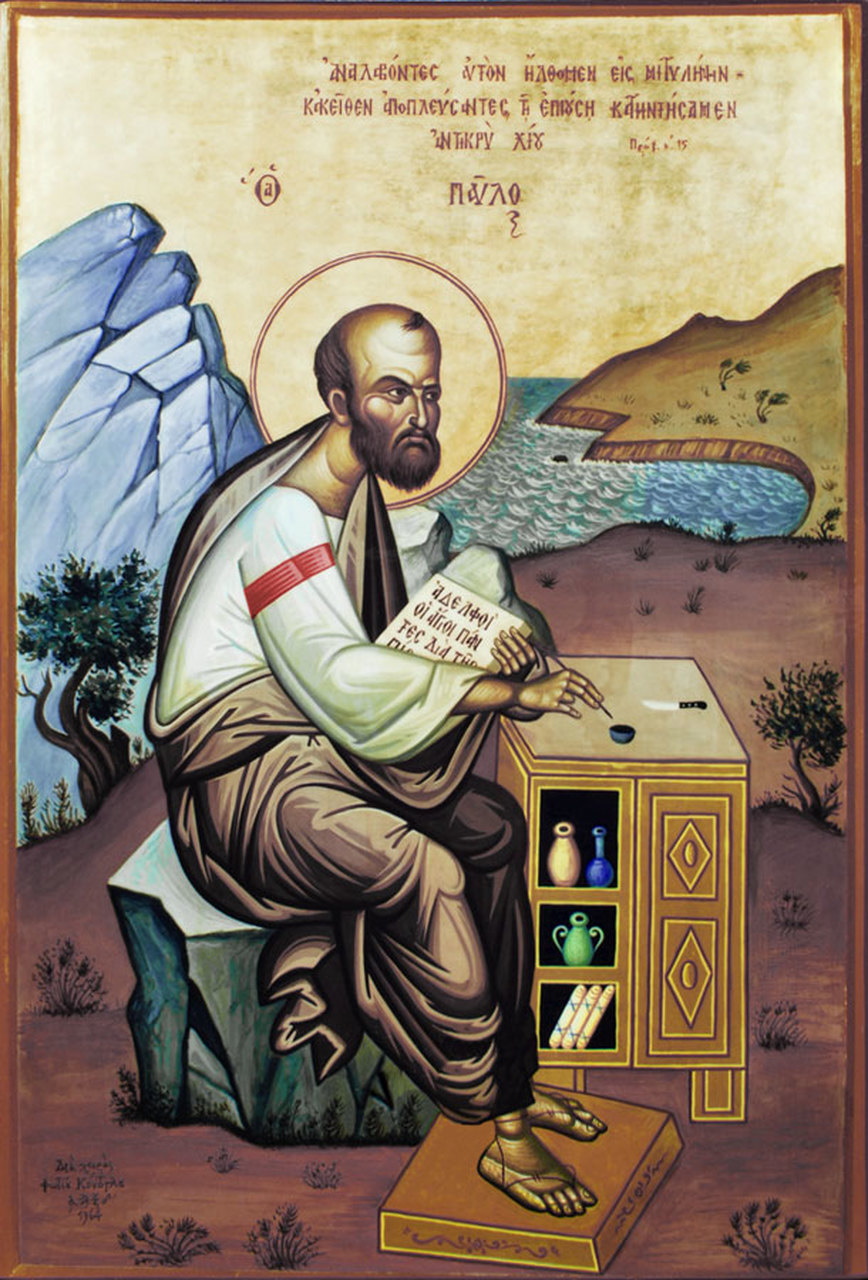
Category: come sunday

The Crown of Glory – Lectionary Reflection for Pentecost 22A (1 Thessalonians 2)


1 Thessalonians 2:9-20  New Revised Standard Version

9 You remember our labor and toil, brothers and sisters; we worked night and day, so that we might not burden any of you while we proclaimed to you the gospel of God. 10 You are witnesses, and God also, how pure, upright, and blameless our conduct was toward you believers. 11 As you know, we dealt with each one of you like a father with his children, 12 urging and encouraging you and pleading that you lead a life worthy of God, who calls you into his own kingdom and glory.

13 We also constantly give thanks to God for this, that when you received the word of God that you heard from us, you accepted it not as a human word but as what it really is, God’s word, which is also at work in you believers. 14 For you, brothers and sisters, became imitators of the churches of God in Christ Jesus that are in Judea, for you suffered the same things from your own compatriots as they did from the Jews, 15 who killed both the Lord Jesus and the prophets, and drove us out; they displease God and oppose everyone 16 by hindering us from speaking to the Gentiles so that they may be saved. Thus, they have
constantly been filling up the measure of their sins; but God’s wrath has
overtaken them at last.

17 As for us, brothers and sisters, when, for a short time, we were made orphans by being separated from you—in person, not in heart—we longed with great eagerness to see you face to face. 18 For we wanted to come to you—certainly I, Paul, wanted to again and again—but Satan blocked our way. 19 For what is our hope or joy or crown of boasting before our Lord Jesus at his coming? Is it not you? 20 Yes, you are our glory and joy!


****************

                Paul speaks to the Thessalonians as a father speaks to his children (vs. 11). What we are tasked by the Lectionary to read/reflect upon here (vs. 9-13) is a continuation of the reading from the previous week, where Paul revealed that God had entrusted the gospel to them (Paul and companions). Thus, the reading here reinforces the earlier message concerning their mission in Thessalonica and beyond. Paul affirms their being witnesses, along with God, of the diligence with which Paul and his companions proclaimed the Gospel in Thessalonica. As noted in the opening verses of the chapter, Paul reminded them that he and his companions hadn’t proclaimed the gospel with false motives or out of concern for financial gain. They didn’t even take advantage of their rights as apostles (vs. 5-7). In other words, they weren’t hirelings. They were servants of God’s mission in the world.  

                As noted, the Revised Common Lectionary limits the reading for the week to verses 9-13. It’s understandable that verses 14-16 are omitted (there are unfortunate words regarding the Jews), but it seemed to be important to take a look at the remainder of the chapter to better understand Paul’s words here in verses 9-13.

The centerpiece of this week’s reading is the nature of the Gospel proclamation. Paul commends the Thessalonians for receiving their message not as a human word, but as the word of God. In describing their message as a divine rather than human word, Paul isn’t implying that their message was somehow inerrant or infallible (these categories are rather modern and thus not something Paul would have even considered). Rather they were speaking to their belief that God’s word had been made known in Thessalonica through their ministry. In other words, God speaks through human voices and words. There is good news here. The word has been heard and embraced by some (that’s the locus of the selected reading), but there is also opposition (the remainder of the chapter). Both exist and must be addressed. In the end, however, Paul commends them as being his crown when Jesus returns.

                The concept of the “word of God” is problematic. That’s because too often this phrase is applied solely to Scripture, when in fact the phrase is used in multiple ways. First and foremost, the term Word (Gk. Logos) is used in reference to Jesus, who is understood to be the Word (Logos) of God incarnate (Jn.1:1-14). In several places in the Book of Acts, the phrase is used in terms of the proclamation of the Gospel. That is the case here, where Paul has in mind the act of preaching/proclamation. The variety of ways this phrased is used has led me to embrace Karl Barth’s well-known articulation of the principle of the “three-fold Word of God.” As I’ve noted in a book on this question, Barth has proven very helpful in my own theological journey. Barth writes in the first volume of his Church Dogmatics

Proclamation is human speech in and by which God Himself speaks like a king through the mouth of his herald, and which is meant to be heard and accepted as speech in and by which God Himself speaks, and therefore heard and accepted in faith as divine decision concerning life and death, as divine judgment and pardon, eternal Law and eternal Gospel both together. [Church Dogmatics, 1:1:52].

Of course, Barth, and I assume Paul would agree, recognizes that not all preaching reflects God’s message. However, both men recognize that God can speak through human messengers, and thus preaching can be a conduit of God’s word.  

                Having made this clear, speaking as a father to his children, Paul urges the readers to live lives worthy of God, “who calls you into his own kingdom and glory” (vs. 12). This is a good place to pause and note that while Paul places great emphasis on God’s grace received by faith, he is also concerned about conduct (behavior), which might be understood as works. Therefore, he gives thanks that the Thessalonians received their word as the word of God and that this word is at work in their midst.

                Having taken note of this gracious word on Paul’s part, we now must take note of a most problematic word concerning the Jews. In verses 14-16 Paul commends them for being imitators of the churches in Judea who had suffered persecution from “the Jews,” even as they were suffering similarly.  We need to remember that contextually Paul understands his message being directed at reaching Gentiles. He finds any interference in that work problematic (at the very least). This leads to an unfortunate rebuke of his fellow Jews, who had opposed the Churches in Judea and had done the same in Thessalonica. If we remember that this letter was written several decades before the Book of Acts, we might want to take note of Acts 17, where Luke tells us of Paul and Silas’ visit to Thessalonica. In that passage, Paul is said to go and preach in the synagogue concerning Jesus. While some followed Paul, along with devout Greeks and leading women, “the Jews became jealous,” and along with some ruffians in the community attacked Jason for hosting them. That led Paul to head off to Berea and then Athens. This might be what Paul is referring to, but we can’t be certain.

                Living in a post-Shoah world, where the murder of millions of Jews along with others, has forced the church to be attentive to texts that have been and can be used to justify persecution and even murder of Jews. In a sidebar in the Jewish Annotated New Testament, we read this reminder: “These verses present a succinct summary of classical Christian anti-Judaism: the Jews killed Jesus, persecuted his followers, and threw them out of the synagogues; they are xenophobic and sinners, and God has rejected and punished them. The harshness of these words raises questions about Paul’s attitude toward his fellow Jews” [Jewish Annotated New Testament, p. 374].

There have been suggestions among scholars that this sounds less like Paul and more like a later Gentile scribal insertion. While that makes some sense, especially since it doesn’t fit well with what Paul writes in Romans 9-11, where he affirms that God has not rejected the Jewish people. The problem with this suggestion is that there is no textual support for such a conclusion. In any case, whether these are Paul’s words or not, unfortunately, the damage has been done and the passage can be and has been used to justify anti-Jewish views and behavior. It would seem that Paul is trying to encourage his spiritual children to persevere in the face of
opposition and even persecution. Contextually, this might be understandable when one is in a minority position. However, in a different context, when Jews are the minority voice, this can be dangerous.

                Having commended them for hearing and embracing their message as God’s word to them, and having encouraged them as they experience persecution, the chapter closes with Paul letting the community know that he wants to visit them. Unfortunately, Satan had blocked their way time and again. The reference to Satan’s interference reminds us that Paul viewed the world in supernaturalist/apocalyptic terms.  As John Byron notes: “Although Paul does not explain what Satan did to hinder him, he has an acute sense that his freedom of movement was curtailed, and viewing the situation on a supernatural level, determined that Satan was interfering with the seen world.” [Benjamin E. Reynolds. The Jewish Apocalyptic Tradition and the Shaping of New Testament Thought (p. 249). Fortress Press. Kindle Edition]. Despite the supernatural interference (however that transpired), Paul celebrates their faith. They are his hope and joy, and the “crown of boasting before our Lord Jesus at his coming.” That is, when Jesus comes in his glory to judge the living and the dead, Paul can stand before Jesus and point to them as being his crown of glory and joy!  

Turning from Idols to Serve God – Lectionary Reflection for Pentecost 20A (1 Thessalonians 1)


Statue of Jupiter-Germanicus’ Tomb – Ashmolean

1 Thessalonians 1:1-10 New Revised Standard Version

1 Paul, Silvanus, and Timothy,

To the church of the Thessalonians in God the Father and the
Lord Jesus Christ:

Grace to you and peace.

We always give thanks to God for all of you and mention you in our prayers, constantly remembering before our God and Father your work of faith and labor of love and steadfastness of hope in our Lord Jesus Christ. For we know, brothers and sisters beloved by God, that he has chosen you, because our message of the gospel came to you not in word only, but also in power and in the Holy Spirit and with full conviction; just as you know what kind of persons we proved to be among you for your sake. And you became imitators of us and of the Lord, for in spite of persecution you received the word with joy inspired by the Holy Spirit, so that you became an example to all the believers in Macedonia and in Achaia. For the word of the Lord has sounded forth from you not only in Macedonia and Achaia, but in every place your faith in God has become known, so that we have no need to speak about it. For the people of those regions report about us what kind of welcome we had among you, and how you turned to God from idols, to serve a living and true God, 10 and to wait for his Son from heaven, whom he raised from the dead—Jesus, who rescues us from the wrath that is coming.


************

                The ancient Greco-Roman World offered many religious options. Gods were plentiful, and the people indulged in serving them. Jews were a peculiar people since they only worshiped one God, considering all others to be mere idols. The Jesus movement, which was rooted in Judaism, embraced the same view of the many religious options present in their world. That made them rather peculiar as well. The difference between the two was the Jesus Movement was more assertive in its outreach to their Gentile neighbors. Over time that would cause problems for them. When we open Paul’s first letter to the Thessalonian church, we’re taken back to the earliest days of the Jesus Movement. It is the consensus view that this is Paul’s earliest letter, making it the earliest book in the New Testament. If, as is likely, it was written from Corinth around 50 or 51 CE, we are within two decades of Jesus’ death in Jerusalem and subsequent birth of the church on Pentecost. As we know, Paul made Gentiles the focus of his ministry. He might go first to the synagogue, but he was more interested in spreading the gospel to those outside the Jewish community. That of course, led to some conflict between those who embraced the message of Jesus and those who didn’t.

                In these opening lines of Paul’s letter, we hear a word of commendation and encouragement to people who have embraced the message of Jesus as delivered by Paul. They have even become known for their commitment to this message. As for the letter itself, it is written by Paul, together with his companions Silvanus (Silas) and Timothy. The mention made here of Silas is a clue that this was written after the Jerusalem Council (Acts 15) when Silas replaced Barnabas as Paul’s companion.  As he often does, Paul writes that he always gives thanks for them in his prayers. These are his people, and he cares about them. Paul also records that they had received a Gospel message that came not only in words but also in the power of the Holy Spirit. He also notes that their reception of the Gospel was due to have been chosen by God. For Paul, conversion always begins with God’s initiative. That doesn’t require some form of predestination, only God’s initiative. Regarding the role of the Spirit, what he has in mind here isn’t clear but suggests that their preaching was accompanied by signs and wonders. 

                The church to whom the letter was written inhabited a major Roman city situated in the province of Macedonia. Thessalonica served as the capital of the province and was a port city, making it not only a governmental center but also a commercial center. Thus, like Corinth, Thessalonica was quite cosmopolitan, drawing residents from across the empire and beyond. It was also a city that was known for its many religious options, including the imperial cult (it was a Roman colony after all), along with Egyptian gods, as well as the cult of Cabrius. This figure supposedly had died and had risen from the dead, which sounds a lot like Jesus. Thus, as William Brosend notes, “when Paul praises the addresses for ‘how you turned to God from idols, to serve the living and true God’ (1 Thess. 1:9), he knew that they had made a choice with many alternatives” [Preacher’sBible Handbook, p. 302]. That reality may explain much that goes on in our reading.

                Paul commends them for their steadfastness in faith and for imitating him, as well as his companions, along with the Lord. He speaks of them joyfully receiving the message as inspired by the Holy Spirit so that the “word of the Lord has sounded forth from you not only in Macedonia and Achaia,” as well as every place their faith had been made known. This despite facing persecution. Though the persecution they were facing probably wasn’t legal or violent but entailed resistance to the message. What is clear from the letter as a whole, that it has an overtly eschatological feel. It’s not as prominent here in this first chapter, but as one moves into the letter it gets stronger. He writes with the presumption that Christ should be returning at any moment, and because they had received the word of God, Jesus would rescue them from the “wrath to come.”

                Getting back to their reception of the Gospel message, it seems apparent that the audience of Paul’s letter was a community largely made up of Gentile Christians. Although Paul had begun his ministry in Thessalonica in the synagogue (Acts 17:1-9), it appears from Acts that Paul didn’t get a very positive reception there. Evidence that the community was largely Gentile Christians is revealed in verse nine, where Paul commends them for having “turned to God from idols.” This isn’t something that Paul would have said to Jewish Christians but would make sense when applied to converts from a pagan context. As noted above, Thessalonica offered many religious options for them to choose from. As for them, they had chosen to “serve the true and living God.” Now, they await the coming of the Son of the true and living God, who is coming from heaven (the eschatological dimension), and whom the true and living God raised from the dead. This Jesus rescues the believer from the wrath to come (judgment day). As Fred Craddock and Eugene Boring note, this message represents the “traditional Jewish missionary message of the one God over against pagan idols, the God whose ethical seriousness is manifest in that he will bring all human beings to a final judgment.” They also note that the Jewish monotheistic message attractive to many in the Hellenistic world. As for the Christian proclamation, rooted in this Jewish message, “the living God is the one definitively manifest in Jesus, the God who raised Jesus from the dead, the one through whom God saves at the final judgment.” [People’s New Testament Commentary, p. 639]. While in the modern era, the idea of judgment along with the wrath of God is not well received, this message does make clear the power of an ethical message that insists humans will be held accountable. 

                While the reading ends with the word wrath, the message is one of joy because God has provided a new way of living that is rooted in Jesus rather than dead idols. He commends them for the way they have embodied the message of Jesus so that all of Macedonia and Achaea has heard the message. 

                As we attend to this word from Paul, what is its message for us? If we hear in this a call to turn from idols to God, what idols might we contend with? What is it that we worship instead of God? How does serving these idols affect our relationships with one another and with creation itself? To whom or to what do I give my allegiance? Is it my whiteness? My economic situation? Is it a particular politician or political party (this is election season after all)? What about my being a citizen of the United States? In asking that question, I’m glad I am a citizen of the United States, but does it have the ultimate claim on my life? I wrote a book on the Lord’s Prayer that I titled Ultimate Allegiance because I believe that this prayer repeated by Christians around the globe is itself a pledge of allegiance to God and God’s realm. Whatever I give allegiance to rather than to God and God’s realm, then that becomes my idol. May we join with the Thessalonian believers and turn from our idols and serve the true and living God.


Proper Confidence – A Lectionary Reflection for Pentecost 18A (Philippians 3)

4b If anyone else has reason to be confident in the flesh, I have more: 5 circumcised on the eighth day, a member of the people of Israel, of the tribe of Benjamin, a Hebrew born of Hebrews; as to the law, a Pharisee; 6 as to zeal, a persecutor of the church; as to righteousness under the law, blameless.

7 Yet whatever gains I had, these I have come to regard as loss because of Christ. 8 More than that, I regard everything as loss because of the surpassing value of knowing Christ Jesus my Lord. For his sake I have suffered the loss of all things, and I regard them as rubbish, in order that I may gain Christ 9 and be found in him, not having a righteousness of my own that comes from the law, but one that comes through faith in Christ, the righteousness from God based on faith. 10 I want to know Christ and the power of his resurrection and the sharing of his sufferings by becoming like him in his death, 11 if somehow I may attain the resurrection from the dead.

12 Not that I have already obtained this or have already reached the goal; but I press on to make it my own, because Christ Jesus has made me his own. 13 Beloved, I do not consider that I have made it my own; but this one thing I do: forgetting what lies behind and straining forward to what lies ahead, 14 I press on toward the goal for the prize of the heavenly call of God in Christ Jesus.

Philippians 3:4b-14 New Revised Standard Version

*************

                When we read this passage, it is good to remember that Paul is in prison and that he’s already comfortable with the possibility of his death. “To live is Christ, to die is gain” (Phil. 1:21 KJV). Nevertheless, he believes that it is right for him to go on living for the sake of the beloved community. So, status means nothing to him, or so it seems. To further ground that sentiment, Paul has made it clear that the way of Christ requires humility, for Christ, though in the form of God, thought it not necessary to hold on to that status, but instead took human form and died on the cross (Phil. 2:6-8). Nevertheless, no matter what happens to him, he holds on to the promise of resurrection, which is expressed in the hymn of praise to Christ, whom God exalted (Phil. 2:9-11). Whether alive or dead, what matters most is the gospel. In fact, Paul has made it clear that his current predicament (imprisonment) has helped spread the gospel (Phil. 1:12). Therefore, Paul has asked his readers to live lives worthy of the Gospel (Phil. 1:27).

Having made it clear that living for Jesus in a way that manifests the gospel is his greatest concern, Paul now moves on to the goal of life, and that would be the “heavenly call of God in Christ Jesus” (Phil. 3:14). I titled this reflection “Proper Confidence,” because Paul makes it clear where he puts his confidence.  Right at the beginning of the letter, Paul declares: “I am confident of this, that the one who began a good work among you will bring it to completion by the day of Jesus Christ” (Phil. 1:6). Here Paul follows his exposition of the hymn to Christ in Philippians 2 but revealing the status he is willing to let go of to be a follower of Jesus. He puts no confidence in the flesh, or markers on the flesh, including circumcision (and he has been circumcised). He has the right to put his confidence in the flesh. After all, he can claim to have been circumcised on the eighth day, is a member of the nation of Israel, and more specifically the tribe of Benjamin. He’s a Hebrews of Hebrews. When it comes to the law, he’s a Pharisee. When it comes to zeal, he was a persecutor of the church. Not only is he a Pharisee when it comes to the law, but regarding the law he’s blameless. I take that to mean that he follows it closely.  But, apparently, none of that matters to him now because he has found rest for his soul (to borrow a bit from Augustine) in Christ his Lord. In fact, that is all that matters to him, for in Christ Paul has found the culmination of the covenant promises that go back through Moses to Abraham.  

                In chapter 2, Paul broaches the concept of kenosis (emptying). Now, it appears that just as Jesus emptied himself of his divine prerogatives, Paul is doing the same concerning his own status as a Hebrew among Hebrews in the cause of Christ. Though he’s ready to give up these symbols of his status as a Jew, that doesn’t mean he’s rejecting his origins or the covenant promises that are embedded in Judaism. Rather, he no longer puts his confidence in these identity markers. Thus, he lives by faith not by law, for his confidence is placed in Christ and not in his religious affiliations.

                When we read a passage like this, it ought to cause us to examine our search for status. Paul has given up all the status markers that he had inherited and earned. What are mine—My education? My ordination? My gender? My race?  My American citizenship? Here’s the thing, society accredits to me a certain status because I am a White male. That is true as well of my American citizenship. Then there’s my education and ordination. Letting go of these markers of status is not easy. Some of these markers are the accident of birth—my race and gender. Other markers are earned (education and ordination). However, if I understand Paul’s message here, none of that matters. I needn’t feel bad about my identity. I don’t have to reject or diminish my identity. However, in the end, what matters is Christ. He defines who I am as a human being.

That being said, I must add the caveat, because gender and my Whiteness do accrue to me certain benefits. I can try to let go of them, but because they are so rooted in systems, I will still be accorded benefits that persons are not White or male will not be automatically accorded. In other words, I don’t have to worry about being pulled over by the police simply because of race. So, to put it bluntly, while I can put my hope in the heavenly call of God, here on earth, I must acknowledge that all lives will not matter until Black lives matter.

That leads us back to Paul’s proper confidence, which he places in Christ, who is the hope of his own resurrection. He can let go of his privileges because he knows that he is alive in Christ. So, the hope of the resurrection defines his identity. But wait a minute, notice the way Paul phrases his declaration. He uses athletic imagery. He’s pressing forward, like a runner (I’d suggest a long-distance runner rather than a sprinter) in pursuit of the prize. The fact is, to be a good athlete one must make sacrifices. One has to train, and that means giving up certain things. Paul also understands that one cannot rest until the race is over. Thus, as John Chrysostom suggests:

Thus too we should act, we should forget our successes, and throw them behind us. For the runner reckons not up how many circuits he hath finished, but how many are left. We too should reckon up, not how far we are advanced in virtue, but how much remains for us. For what doth that which is finished profit us, when that which is deficient is not added?”

 [John Chrysostom, “Homily XII,” NPNF]  

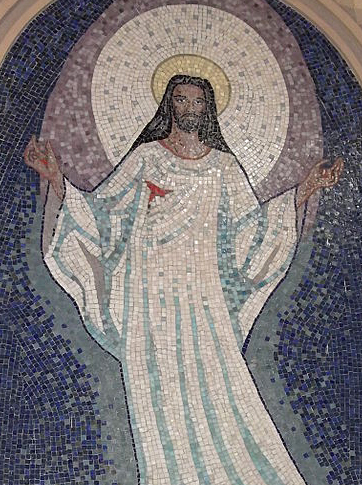
Image attribution: Resurrection of Christ, from Art in the Christian Tradition, a project of the Vanderbilt Divinity Library, Nashville, TN. http://diglib.library.vanderbilt.edu/act-imagelink.pl?RC=56588 [retrieved September 27, 2020]. Original source: https://commons.wikimedia.org/wiki/File:0000_Mosaics_of_Resurrection_of_Christ.JPG – Eugenio Hansen, OFS.

God’s Irrevocable Covenant – Lectionary Reflection for Pentecost 11A (Romans 11)

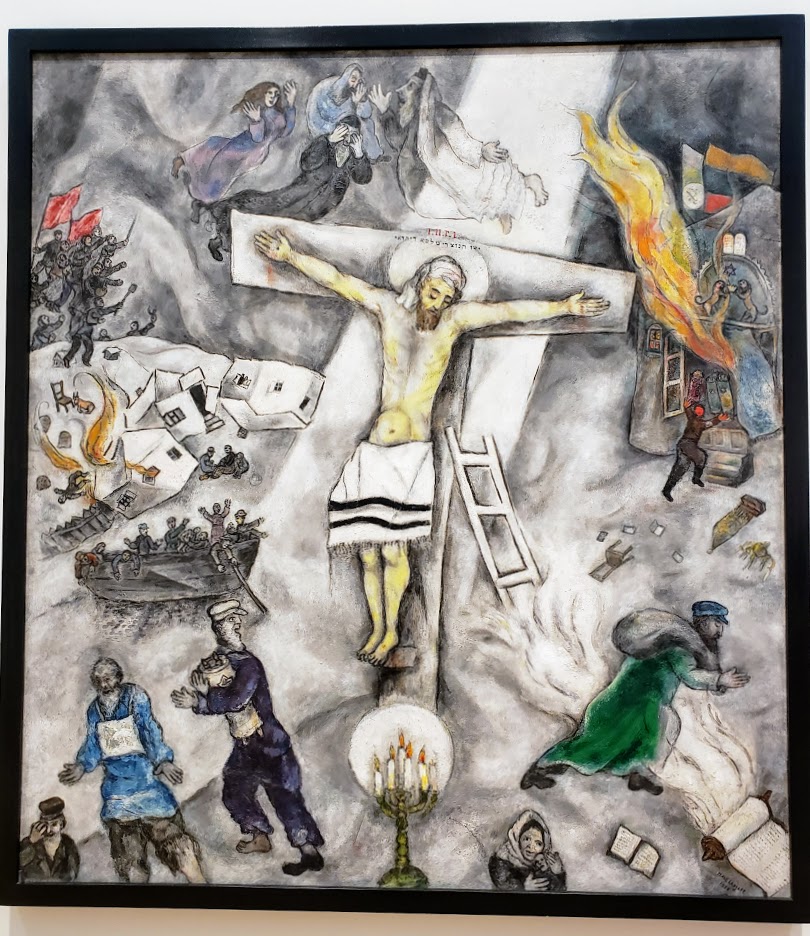
Marc Chagall, White Crucifixion — Art Institute of Chicago


Romans 11:1-2a, 29-32 New Revised Standard Version

11 I ask, then, has God rejected his people? By no means! I myself am an Israelite, a descendant of Abraham, a member of the tribe of Benjamin. 2 God has not rejected his people whom he foreknew.  

29 for the gifts and the calling of God are irrevocable. 30 Just as you were once disobedient to God but have now received mercy because of their disobedience, 31 so they have now been disobedient in order that, by the mercy shown to you, they too may now receive mercy. 32 For God has imprisoned all in disobedience so that he may be merciful to all.

*****************

One of the many stains on Christian history is the ongoing presence of anti-Judaism. I use this term instead of anti-Semitism because this term has racial connotations that are modern in origin. Over the years I’ve become increasingly sensitized to the legacy of anti-Jewish views in the church. We can argue whether this is rooted in the New Testament itself or its interpretation through the ages, the fact is, it continues to be present in our churches, even in scholarly efforts. The readings from Romans 9-11 allow us to reflect on this legacy. That is especially true of this reading from Romans 11, which, in my mind, makes clear that Christianity has not replaced Judaism and that God’s covenant with Judaism continues unabated. Therefore, we must repent of this legacy and seek to do everything we can to change the way we relate to the Jewish community.
In the reading from Romans 9, which we examined earlier, Paul expressed his anguish that his Jewish siblings had not embraced the message of Jesus. Even as he preached the Gospel to Gentiles, he hoped that Jews would join him. That reading can give us the impression that God had dissolved the covenant with Israel, but in today’s reading, we discover that this is a wrong impression. Paul might have wished that all Jews took up the cause of Jesus, as he had, but in the end, he must admit that God has not rejected God’s people Israel. This, Romans 11 is an important witness to God’s commitment to the covenant made first with Abraham and later with Moses.
The lectionary provides us with two excerpts from Romans 11. The first excerpt encompasses the opening verses of the chapter. Paul asks a rhetorical question: “has God rejected his people?” He answers that question in the negative by noting his own relationship to Judaism. God hasn’t rejected him, so God hasn’t rejected Israel. He lays claim to the covenant promise as an Israelite, a descendant of Abraham, and more specifically as a member of the tribe of Benjamin. In other words, he has done his genealogical work. He lays claim to this heritage. So, whatever happened on the road to Damascus, Paul didn’t convert from Judaism to Christianity (Christianity didn’t exist yet as a separate entity). He was a Jew both before and after that encounter with Jesus. If Paul was already intent on converting Gentiles to his vision of God, then what changed out there on the road to Damascus was his understanding of the path Gentiles would take in experiencing salvation. While Paul sees himself tasked with preaching to Gentiles, no doubt he was hoping that both Jews and Gentiles would be found in this newly emerging Jesus community. The issue isn’t whether the Torah has value. The question is whether adherence to aspects of Torah, such as circumcision was necessary for Gentile believers.
When we read Paul’s letters, we discover his dilemma. He wanted to reach Gentiles and draw them into the new community. He seems to have understood that circumcision may have impeded full conversion. So, he set it aside, though not everyone in the community agreed. Thus, in his attempts to defend himself he gave the impression that he had rejected Judaism. While there are mixed messages in his letters, Paul makes it clear in this passage that he was not rejecting his Jewish heritage. Perhaps the problem isn’t with Paul but in the way his later interpreters have read him?
As we drop down to the second part of the reading, verses 29-32, the message that Paul brings is that God’s covenant promises are irrevocable. It can’t be any clearer. That’s a message we need to hold tightly to. We should step back one verse, though to get a true sense of what Paul is doing here. In verse 28 he writes:   As regards the gospel they are enemies of God for your sake; but as regards election they are beloved, for the sake of their ancestors; . . . .” This word comes after Paul has already declared in verse 26 that all Israel will be saved. So, what does Paul mean here? Sarah Heaner Lancaster puts her finger on the issue at hand, pointing out that Israel can be God’s enemy and God’s beloved at the same time, because in “refusing to acknowledge the way God is working in Jesus Christ, Israel does not give honor to God, and so they are ‘enemies’ of God.”  But, because, as we read in verse 29, God’s gifts and calling are irrevocable, “God honors the covenant with the patriarchs. The chosen people have always been and always will be beloved. Although God used their refusal for the sake of the Gentiles, God will not forsake Israel” [Lancaster, Romans, p. 198]. It may seem rather complicated, but God will be faithful to the covenant, even if the rejection of Jesus by a majority of Jews spurred on Paul’s mission, God will stay true to the covenant.
The good news is that Gentiles get to share in the salvation of God. We also (speaking as a Gentile) have been included in the covenant people through Jesus. So, even if we stray or become disobedient, God is merciful and gracious. That might not always sit well with us, any more than it sat well with Paul’s opponents. But that is the way of God who has been revealed to us in and through Jesus.
The lectionary reading ends with verse 32, but as Sarah Heaner Lancaster points out, the verses that follow contain a hymn that celebrates the difference between our ways and God’s ways. Thus, “the grandness of God exceeds anything that we may know, and we are not in a position to understand the mind of God or the ways God achieves God’s purposes. The richness of God is the genuine mystery” [Lancaster, Romans, pp. 199-200]. So, I close with that hymn:

  O the depth of the riches and wisdom and knowledge of God! How unsearchable are his judgments and how inscrutable his ways! 

34 “For who has known the mind of the Lord?
Or who has been his counselor?”
35 “Or who has given a gift to him,
to receive a gift in return?” 

36 For from him and through him and to him are all things. To him be the glory forever. Amen.  (Rom. 11:33-36).


Room for Doubt — Lectionary Reflection for Pentecost 10A (Matthew 14)

Matthew 14:22-33 —New Revised Standard Version

22 Immediately he made the disciples get into the boat and go on ahead to the other side, while he dismissed the crowds. 23 And after he had dismissed the crowds, he went up the mountain by himself to pray. When evening came, he was there alone, 24 but by this time the boat, battered by the waves, was far from the land, for the wind was against them. 25 And early in the morning he came walking toward them on the sea. 26 But when the disciples saw him walking on the sea, they were terrified, saying, “It is a ghost!” And they cried out in fear. 27 But immediately Jesus spoke to them and said, “Take heart, it is I; do not be afraid.”

28 Peter answered him, “Lord, if it is you, command me to come to you on the water.” 29 He said, “Come.” So, Peter got out of the boat, started walking on the water, and came toward Jesus. 30 But when he noticed the strong wind, he became frightened, and beginning to sink, he cried out, “Lord, save me!” 31 Jesus immediately reached out his hand and caught him, saying to him, “You of little faith, why did you doubt?” 32 When they got into the boat, the wind ceased. 33 And those in the boat worshiped him, saying, “Truly you are the Son of God.”

************

Our reading this week from the Gospel of Matthew is one that would have caught the attention of David Hume. Hume was a skeptic. He didn’t trust anything he hadn’t experienced himself or had it on good authority of someone he trusted having a particular experience. He was open to new truths, they just had to be provable. Therefore, he would have had trouble with a story about someone walking on water. He would ask us to consider the likelihood of someone walking on water. Have you either walked on water yourself or seen someone walk on water? No, he didn’t trust the testimony of a two-thousand-year-old book.

So, if you’ve never seen someone walk on water then how can you believe that either Jesus or Peter did so? Now, Hume might agree that in their fear the disciples could have projected an image of Jesus walking on the water, but would that be enough to get Peter, who had never walked on water (assuming that humans don’t walk on water), out of the boat on trying to walk himself? Surely, if he tried, as soon as he put his foot outside the boat he would have sunk. Therefore, Hume would conclude this was all a myth. It might have metaphorical value but not historical value.

 This story is one of the best known in the Gospels. It has permeated our cultural mindset so that when too much is asked of us, we ask why people think we can walk on water. After all, we’re not divine beings (and Hume was skeptical about the existence of divine beings), so why should we be expected to walk on water? Of course, some, less skeptical types, have used the text to beat folks over the head for their lack of faith and unwillingness to “get out of the boat.” Years ago, when I was teaching theology at a bible college in Kansas, this story seemed to be a “favorite” of our chapel speakers. These speakers tended to be youth ministers who appealed to the story to call on the students, (and I suppose, we professors as well) to get out of the boat. Don’t doubt, don’t resist God, but get out of the boat and join me in whatever it is I think is the most important concern at the moment.

                Of the two options above, I’d probably side with Hume. After all, isn’t there a place for a little doubt and even skepticism in the life of faith? So, granting that I’ve never seen anyone walk on water, and thus can’t prove the validity of the story, how might we receive this story? We might start by remembering that in the ancient world the sea was often symbolic of chaos and danger (note the storm that shook even this group full of experienced fishermen). Jesus comes to them as the one who has power over the chaos (walks on the waters) and then calms them. Though fearful at first, once Peter recognizes Jesus, he wants to get out of the boat and join Jesus on the water. It’s true, Peter could be impulsive, but at least for a moment, his faith overcame his fear.

                After Peter got out of the boat, he began to sense the power of the wind whipping around him. At that moment, he forgot he was actually walking on water. With his focus now on the wind, he lost his focus on Jesus and began to sink. How often is this true for us? We begin to focus on the noise around us, get distracted by it, and lose our focus on Jesus.

                Yes, Peter began to have his doubts. I expect given the situation, I would have my doubts. I might act impulsively at first, and then realize I hadn’t thought this thing through. I probably would sink as well.

               So, Peter had his doubts, which leads Jesus to ask him why he had so little faith? I think Jesus might have been a little harsh with him, but the question is a good one for us. How much faith is enough? Is a little faith sufficient? If we are saved, that is made whole, through grace, which we receive through faith, how much do we need? Perhaps the good news here is not whether Peter had enough faith, but whether Jesus is willing to embrace us no matter the level of our faith. Remember that Jesus doesn’t leave Peter floundering in the water. He pulls him up and into the boat. If the waves and the winds of this story represent the challenges of our lives, it’s possible that we will step out on faith, flounder, and require a little help from the one who is present with us by the Spirit and calms the waters of life.

                Do we all experience a bit of doubt in life? Do we lose focus? Do we have questions that require answers? Yes to all of these questions, which are important ones. In the end, the question is not whether we doubt, but whether it causes debilitating injury to our souls. When that happens, we need the salvific healing presence of God, which comes to us, Paul says in confessing Jesus as Lord (Romans 10:9).  As for the disciples who stayed in the boat, once Jesus calmed the waters and joined them, they bowed in worship and confess “Truly you are the Son of God.”

                Perhaps we can hear in this story a reminder that despite the possibility of doubt, we can step out in faith. We can take some risks. We may sink, but Jesus is there to catch us. At this moment when the winds of change are whipping around us, a bit of doubt-filled risk-taking might be needed. So, maybe those impetuous youth ministers who liked this story were on to something!

Picture attribution: Tanner, Henry Ossawa, 1859-1937. Disciples See Christ Walking on the Water, from Art in the Christian Tradition, a project of the Vanderbilt Divinity Library, Nashville, TN. http://diglib.library.vanderbilt.edu/act-imagelink.pl?RC=55904 [retrieved August 5, 2020]. Original source: http://commons.wikimedia.org/wiki/File:Henry_Ossawa_Tanner,_The_Disciples_See_Christ_Walking_on_the_Water,_c._1907.jpg.


Robert Cornwall is the Pastor of Central Woodward Christian Church in Troy, Michigan. He holds the Ph.D. in Historical Theology from Fuller Theological Seminary. He is the author of a number of books including Out of the Office (Energion, 2017), Marriage in Interesting Times (Energion, 2016), and Freedom in Covenant (Wipf and Stock, 2015) and blogs at Ponderings on a Faith Journey.

Claiming Our Inheritance – Lectionary Reflection for Pentecost 7A – Romans 8

Claiming Our Inheritance – Lectionary Reflection for Pentecost 7A – Romans 8

Romans 8:12-25 New Revised Standard Version (NRSV)

12 So then, brothers and sisters, we are debtors, not to the flesh, to live according to the flesh— 13 for if you live according to the flesh, you will die; but if by the Spirit you put to death the deeds of the body, you will live. 14 For all who are led by the Spirit of God are children of God. 15 For you did not receive a spirit of slavery to fall back into fear, but you have received a spirit of adoption. When we cry, “Abba! Father!” 16 it is that very Spirit bearing witness with our spirit that we are children of God, 17 and if children, then heirs, heirs of God and joint-heirs with Christ—if, in fact, we suffer with him so that we may also be glorified with him. 

18 I consider that the sufferings of this present time are not worth comparing with the glory about to be revealed to us. 19 For the creation waits with eager longing for the revealing of the children of God; 20 for the creation was subjected to futility, not of its own will but by the will of the one who subjected it, in hope 21 that the creation itself will be set free from its bondage to decay and will obtain the freedom of the glory of the children of God. 22 We know that the whole creation has been groaning in labor pains until now; 23 and not only the creation, but we ourselves, who have the first fruits of the Spirit, groan inwardly while we wait for adoption, the redemption of our bodies. 24 For in hope we were saved. Now hope that is seen is not hope. For who hopes for what is seen? 25 But if we hope for what we do not see, we wait for it with patience.

**************

                In movies and TV dramas, the reading of the will is always a moment of tension. What will I get? Will I be included or excluded? If you saw the recent movie Knives Out, the drama is centered on the inheritance (spoiler alert—people get murdered because of the inheritance). Of course, an inheritance can lead to blessing, if it’s shared. But the reading of the will does suggest a moment of transition. Whatever the outcome, one’s life will be different!

                Here in Romans 8, Paul speaks in near-apocalyptic terms of the prospect of moving from the present age into the future age. While the current age involves suffering, the coming age will provide freedom from suffering—both for the children of God and for creation itself. That future hope, in Paul’s terms, involves glory. This is the inheritance promised to God’s children.

According to Paul, if we are in Christ, something he’s been developing throughout the letter to the Romans, then we are children of God. Here in the reading for the seventh Sunday after Pentecost, we continue our reading of Romans 8. Paul begins by contrasting the way of the flesh and the way of the Spirit, which he had explored in the opening verses of the chapter. Paul is concerned that his readers embrace the way of the Spirit, rather than the flesh. If we live according to the Spirit, then we will experience life and not death. Here in our reading, Paul reaffirms the relationship of the Christian to the Spirit. If we are led by the Spirit, then we are children of God, literally sons of God (in verses 14-15, whereas Paul switches to the inclusive tekna in verses 16-17). It is a status that we share with Jesus the Son of God (Rom. 8:3). As such, we are no longer slaves to fear, for we are children of God by adoption.

                That word adoption is key here. In the Roman world, adoption was a common method of passing on an inheritance. Julius Caesar adopted Octavian (Augustus) as his heir, and Octavian used that adoption as the foundation for his claim to leadership in Rome. The same was true of Tiberius, who was adopted by Augustus (and on it goes). And, one could be adopted out of slavery (remember Ben Hur?). The reader would have understood the importance of adoption. So, having been adopted into the family of God, we can call out “Abba! Father!” This we do through the witness of the Spirit of God.

Since we have been adopted by God as God’s children, that makes us heirs of God, together with Jesus, whom we confess to be the Son of God. Note that Paul reminds the reader that if we are joint-heirs with Jesus, we shall likely share in his suffering. In making this point, Paul reminds us that to be in Christ does not free us from suffering, for Jesus himself suffered. Karen Chakoian writes that suffering is not to be seen as divine punishment or a sign of divine absence (something to remember in this time of pandemic). Thus, “suffering in no way negates the glory, truth, and promise of the resurrection. Rather, suffering offers evidence that these Christians are in fact already united with Christ” [Feasting on the Word, p. 259]. With this in mind, they can affirm that the inheritance (glory/salvation) is greater than the suffering.  So, while once we were enslaved, now we are children of God through adoption, and therefore, we are heirs of God and joint-heirs with Christ. Here is how Karl Barth describes this reality, in relationship to Abraham.

Like Abraham (iv.13), we are heirs of the promise, heirs of the world which God has blessed and made good, heirs of the eternal life and being and having and doing of God Himself, which, because of sin, had become invisible and indescribable, unreal and impossible. Living in the flesh, we await and hope for resurrection, we await our body with its new predicates. Of this hope our present life is the reflection, impress, and witness. Pledged to hope, our life finds there its goal. [Barth, Epistle to the Romans, p. 300].


Therefore, let us claim our inheritance, as heirs of God, and joint-heirs with Jesus, and live accordingly.

                As heirs with Jesus, we know that living with and for him, may include suffering. But this suffering, Paul suggests does not compare with the future glory that awaits us as we inherit eternal life. But we are not alone in awaiting the fruit of our inheritance. According to Paul, creation itself awaits the opening and reading of the will (to use my opening analogy). Creation, Paul tells us, “waits with eager longing for the revealing of the children of God” (Rom. 8:19). Indeed, creation, which has been subjected to futility is groaning in anticipation of its liberation. In other words, even as we are redeemed, so will creation be redeemed. In this age of debate over climate change and its related environmental challenges, it is a good reminder that God is concerned not only about humans, but creation itself. This suggests a symbiotic relationship between us as children of God and the broader created order.

                When we read Paul here, we need to use our imagination so we can envision the cosmic nature of God’s relationship with creation. Yes, God is concerned about us, and about the world we live in, but as our minds stretch to take in the larger universe, we need to consider how God might embrace the universe as a whole. I’m enough of a science fiction fan to consider the possibility that we’re not alone in the universe. So, how might the larger universe await the revealing of the children of God? In this regard, what is the expectation for the future? How might the hope of glory be revealed, which includes, according to Paul, the redemption of our bodies? It is in this spirit that we wait, patiently, for the reading of the will so we can claim our inheritance.


Picture Attribution: Fowler, John. Rising Star, Milky Way, from Art in the Christian Tradition, a project of the Vanderbilt Divinity Library, Nashville, TN. http://diglib.library.vanderbilt.edu/act-imagelink.pl?RC=56313 [retrieved July 12, 2020]. Original source: https://commons.wikimedia.org/wiki/File:Milky_Way_-_28_June_2014.jpg.

Freedom in the Spirit – Lectionary Reflection for Pentecost 6A (Romans 8)

Romans 8:1-11 New Revised Standard Version (NRSV)
There is therefore now no condemnation for those who are in Christ Jesus. For the law of the Spirit of life in Christ Jesus has set you free from the law of sin and of death. For God has done what the law, weakened by the flesh, could not do: by sending his own Son in the likeness of sinful flesh, and to deal with sin, he condemned sin in the flesh, so that the just requirement of the law might be fulfilled in us, who walk not according to the flesh but according to the Spirit. For those who live according to the flesh set their minds on the things of the flesh, but those who live according to the Spirit set their minds on the things of the Spirit. To set the mind on the flesh is death, but to set the mind on the Spirit is life and peace. For this reason the mind that is set on the flesh is hostile to God; it does not submit to God’s law—indeed it cannot, and those who are in the flesh cannot please God. 


But you are not in the flesh; you are in the Spirit, since the Spirit of God dwells in you. Anyone who does not have the Spirit of Christ does not belong to him. 10 But if Christ is in you, though the body is dead because of sin, the Spirit is life because of righteousness. 11 If the Spirit of him who raised Jesus from the dead dwells in you, he who raised Christ from the dead will give life to your mortal bodies also through his Spirit that dwells in you.


******

                The Second Reading for the Sixth Sunday after Pentecost is something of a reprise of the reading for the Fifth Sunday of Lent. That reading focused only on verses 6-11, so when we visited that reading we didn’t hear the opening word of the chapter, which pronounced a not guilty verdict on those who are in Christ Jesus. That is, there is no condemnation for those who are in Christ Jesus. The slate has been wiped clean. This is good news. It suggests we get to start life anew. That is because, in Christ, the Spirit of life has set us free from the spirit of sin and death. But, we need to be careful with what we do with this pronouncement. It’s not a perpetual get of jail card that we can use to do as we please. That would involve giving free rein to our own worst instincts, which is something Paul or Jesus would want us to do.

                When I wrote my reflection on Romans 8:6-11 for Lent, we were in the early stages of a pandemic that continues to this day. It appeared on March 24th. We knew that something big was happening, but we didn’t know what the future held. We hoped that we could be back to full strength for Easter Sunday. That was not to be, and as we pass the 4th of July weekend, cases are surging once again across the country. As we face this ongoing reality, what word might Paul have for us?

While Paul doesn’t directly address the pandemic, he does suggest that there is a path that leads to life and one that leads to death. We can think in spiritual terms only, but I think we might miss something if we only think in terms of the afterlife.  It’s good to know that when we stand before the judgment seat of God we can turn in our not guilty card. But what about the life and death issues that face us each day during this pandemic? When I consider this question, I need to confess that I live a fairly sheltered life. I live in a suburban community that has a low number of cases and deaths. But the city of Detroit, which lies just ten miles to the south from my house, has been hit hard, with African Americans suffering the greatest numbers of cases and deaths.

As I ponder these realities, I wonder about the choices we face. Like I said, I can live my life fairly safely. I can control my interactions with the public, unlike my brother who works in a grocery store or the folks that work in hospitals, nursing homes, and other similar places of work. Then there all the first responders, who also put themselves in danger. They have fewer choices because their jobs are risky. But whatever situation we find ourselves, we can consider the choice between the Spirit of life and the spirit of death. Paul speaks of either having a mindset on the flesh or one set on the Spirit. The choice is ours. I think it’s interesting that the Common English Bible uses the word selfishness where the NRSV uses flesh. While I don’t want to press this too far, could we be indulging the flesh if we refuse to wear masks and keep our distance from one another? On the other hand, might we exhibit our connection to the Spirit of life when we wear masks as a sign of our love of neighbor? Again, I realize I’m reading something into the text, but there are times when we simply need to take every opportunity to address the challenges of our day.

Even as we come to terms with the pandemic, we are also facing the reality that our nation’s history has a very problematic underside that is rooted in white supremacy and racism, which is America’s original sin. So, I want to add into the mix here this word I encountered reading James Baldwin for the first time. In a letter to his nephew, Baldwin writes:

 This innocent country set you down in a ghetto in which, in fact, it intended that you should perish. Let me spell out precisely what I mean by that, for the heart of the matter is here, and the root of my dispute with my country. You were born where you were born and faced the future that you faced because you were black and for no other reason. The limits of your ambition were, thus, expected to be set forever. You were born into a society which spelled out with brutal clarity, and in as many ways as possible, that you were a worthless human being. You were not expected to aspire to excellence: you were expected to make peace with mediocrity. [Baldwin, The Fire Next Time (p. 7). Knopf Doubleday Publishing Group. Kindle Edition.]

So, what might Paul have to say to us about the lingering legacy of slavery in the United States? How is it an expression of the law of sin and death, which we’ve been able to eradicate from our land? Paul does suggest that Jesus came into the world to deal sin and death a blow, by taking on sinful flesh. This is the good news. The bad news is that Christians, including me, find it difficult to live into that good news.

                It should be noted, that when Paul speaks here of the Law, he doesn’t have the Torah in mind. He’s speaking more generally of the values that are expressions of the spirit of death. To be in Christ is to have broken free of that law, but we have take hold of that offer so that we might participate in Jesus’ act of taking on sinful flesh so that sin might be dealt its own death blow.

                The call here is to live according to the Spirit, who brings life. Paul invites us to set our minds on the things of the Spirit and not the things of the flesh (and flesh he doesn’t mean the body, but the passions that lead us away from the things of God). So, what are we talking about here? We might think in terms of arrogance, narcissism, and similar passions. These are rooted in living our lives outside of a relationship with God. In fact, the flesh is hostile to God and the things of God. If we define God in terms of love, then it’s hostility to the love of God and others. So, getting back to the pandemic, might we think of wearing a mask as an act of love that reflects our relationship with the Living God. After all, we know that wearing a mask can deter the spread of the virus. So why do many people, including Christians vociferously object to wearing a mask? This includes preachers! Since this is true, it should not surprise us that churches that have flouted the rules have spread the virus. All this has been done in the name of “religious freedom,” though I think this is more about flesh (selfishness—CEB) than the Spirit. This is especially true since this can lead not only to spiritual death but physical death.

             When it comes to freedom, there is a sense of limits. As we consider this message from Paul, to whom do we owe our allegiance? Who/what has dominion in our lives? The choice is ours. We can give our allegiance to the Spirit or the flesh. One way leads to life and the other to death. May live in the Spirit who raised Jesus from the dead, and gives life to our mortal bodies. That is true freedom!

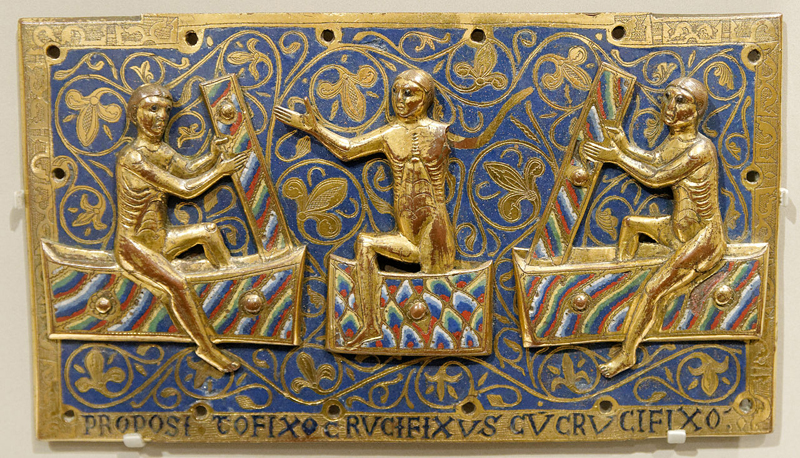
Resurrection of the Dead, from Art in the Christian Tradition, a project of the Vanderbilt Divinity Library, Nashville, TN. http://diglib.library.vanderbilt.edu/act-imagelink.pl?RC=57310 [retrieved July 5, 2020]. Original source: https://commons.wikimedia.org/wiki/File:Plaque_resurrection_dead_VandA_M.104-1945.jpg.


The Righteous Branch—A Lectionary Reflection for Reign of Christ Sunday (Jeremiah 23)

The Crucifixion – Lucas Cranach the Elder, Art Institute of Chicago
 
Jeremiah 23:1-6 New Revised Standard Version (NRSV)
 

23 Woe to the shepherds who destroy and scatter the sheep of my pasture! says the Lord. 2 Therefore thus says the Lord, the God of Israel, concerning the shepherds who shepherd my people: It is you who have scattered my flock, and have driven them away, and you have not attended to them. So I will attend to you for your evil doings, says the Lord. 3 Then I myself will gather the remnant of my flock out of all the lands where I have driven them, and I will bring them back to their fold, and they shall be fruitful and multiply. 4 I will raise up shepherds over them who will shepherd them, and they shall not fear any longer, or be dismayed, nor shall any be missing, says the Lord. 

5 The days are surely coming, says the Lord, when I will raise up for David a righteous Branch, and he shall reign as king and deal wisely, and shall execute justice and righteousness in the land. 6 In his days Judah will be saved and Israel will live in safety. And this is the name by which he will be called: “The Lord is our righteousness.”

*************************
 

                We begin the Christian year on the first Sunday of Advent, and in year C it begins with a word from Jeremiah 33. The reading for that Sunday declares: “The days are surely coming, says the Lord, when I will fulfill the promise I made to the house of Israel and the house of Judah. In those days and at that time I will cause a righteous Branch to spring up for David; and he shall execute justice and righteousness in the land. In those days Judah will be saved and Jerusalem will live in safety. And this is the name by which it will be called: “The Lord is our righteousness.” (Jer. 33:14-16). The promise of this passage is the coming of the righteous branch who springs forth for David, and who will “execute justice and righteousness in the land.” This is a word of hope offered by a prophet who offers few such words. Year C of the Christian year concludes with another word from Jeremiah, this time from ten chapters earlier. In Jeremiah 23, we again hear a word about the “Righteous Branch” who will be raised up for David. From beginning to end, we hear the promise of God that righteousness and justice will be served and that God will provide the means by which this occurs. This word of hope that comes on the day we call Reign of Christ (Christ the King) Sunday comes with a caveat. There is first a word of judgment on shepherds who have served the people poorly.


                The reading from Jeremiah 23 with a word of woe to “the shepherds who destroy and scatter the sheep of my pasture” (vs. 1). This word of judgment is laid upon the leaders of Judah, the monarchs, the ruling elite, and the religious leadership. This word comes to Judah just prior or perhaps in the midst of the Babylonian conquest that will destroy Jerusalem, the Temple, and lead to the captivity of its leading citizens. During this period of Jeremiah’s prophetic work, Judah had been led by three rather disappointing kings, Jehoiakim, Jehoiachin, and Zedekiah. All three of these kings contributed to the chaos that led to the destruction of Judah and the subsequent exile. 


Into this debacle on the part of the leadership, God is going to step in and be the shepherd Israel needs. God is going to gather the remnant from the lands into which they are scattered. God will then provide shepherds who will lead with righteousness and judgment. That is the Righteous Branch” who will reign as king over the people. In Jeremiah words of judgment are brought together with words of restoration. Judah may suffer defeat and exile, but this is not the last word. There will be a time of restoration when justice and righteousness will prevail.


                We hear this word on Christ the King or Reign of Christ Sunday. This concluding Sunday of the year is designed to focus our attention on the coming reign of Christ over Creation. We can see this envisioned in the iconography of the Eastern churches that picture Christ as Pantocrator or the ruler of the universe. It is a vision that is revealed in the Book of Revelation and in the Gospels, but the reading from the Gospels that is paired with this text speaks of Christ on the Cross. It may not be the vision that we would expect here, but it reminds us that visions of God are not all the same. Justice and righteousness, they are central to the day’s message, but the means could be one of apparent weakness. In the reading from the Gospel of Luke (Lk.23:33-43), the picture of the Christ who reigns is the one named “king of the Jews” by the Roman authorities, who seek to mock the claim. 


                The word we hear from Jeremiah is one that is relevant to our times when it seems as if the world is in disarray. People are frustrated with their leaders. In many parts of the world, including here in the United States, many have embraced populist voices that promise to turn everything upside down. Many of them fulfill the promise, but not for the good, not for justice and righteousness. These shepherds are the kinds of leaders Jeremiah condemned for leading the people astray. But all is not lost. There is hope. God will provide for shepherds who will bring justice and righteousness.


                Perhaps this is a good moment for the church to consider what is required of a good leader, and how we as the people of God can create and promote such leaders. How might the church speak out against bad leaders and policies? Here’s the thing, how do we do this without becoming enmeshed with partisanship, so that we exchange one set of bad leaders for another? As we ponder these questions, it is appropriate to take note that this word is directed not at the bad leaders, but at their victims, those who suffer under such leaders. God promises to stand with them and provide leadership that is different from what has been experienced. Here’s the thing, as Carlton J. “Cobbie” Palm notes:

The plan for a new future is in God’s hands always, but we must understand that it will never be God’s accomplishment alone. In the unfolding story of God’s work throughout history we see a pattern. God creates and restores on our behalf, but always, and without exception, gives the work back to us to carry forward. This is what Jeremiah is saying when he concludes with the words of God, “I will raise up for David, a righteous branch” (v. 5). This is pointing to us, calling us out of droopiness to prepare for the handover to continue and sustain the work that God has begun. We are the righteous branch. We are the participants in God’s unfolding restoration. [Connections, p. 499].

How is this to be heard on Christ the King Sunday? Can we not hear this in connection with Paul’s description of the church as the Body of Christ? As Christ’s body, might we engage in the work that leads to justice and righteousness in the world? And in this regard, may we sing:

 
Jesus shall reign where’er the sun
does its successive journeys run,
his kingdom stretch from shore to shore,
till moons shall wax and wane no more.
 
Blessings abound where’er he reigns:
the prisoners leap to lose their chains,
the weary find eternal rest,
and all who suffer want are blest.
 
Let every creature rise and bring
the highest honors to our King,
angels descend with songs again,
and earth repeat the loud amen. 
                                Isaac Watts


Bloom Where You’re Planted — Lectionary Reflection for Pentecost 18C (Jeremiah 29)

Amsterdam
 

29 These are the words of the letter that the prophet Jeremiah sent from Jerusalem to the remaining elders among the exiles, and to the priests, the prophets, and all the people, whom Nebuchadnezzar had taken into exile from Jerusalem to Babylon. This was after King Jeconiah, and the queen mother, the court officials, the leaders of Judah and Jerusalem, the artisans, and the smiths had departed from Jerusalem. The letter was sent by the hand of Elasah son of Shaphan and Gemariah son of Hilkiah, whom King Zedekiah of Judah sent to Babylon to King Nebuchadnezzar of Babylon. It said: Thus says the Lord of hosts, the God of Israel, to all the exiles whom I have sent into exile from Jerusalem to Babylon: Build houses and live in them; plant gardens and eat what they produce. Take wives and have sons and daughters; take wives for your sons, and give your daughters in marriage, that they may bear sons and daughters; multiply there, and do not decrease. But seek the welfare of the city where I have sent you into exile, and pray to the Lord on its behalf, for in its welfare you will find your welfare.

***************

                The Word of the Lord was delivered by letter to the exiles living in Babylon. The mediator of this word was the prophet Jeremiah, who remained, at the time, in Jerusalem. Verse 2 tells us that this letter was written to the first wave of exiles, who were taken by the Babylonians along with King Jeconiah and the queen mother. It was before the revolt under Zedekiah led to the razing of the city, along with the Temple, but this word is a reminder to the exiles that they would be living in their new locale for a very long time. So, as the slogan that dates back to the 1960s declares: “Bloom where you are planted.”

                You can imagine how these exiled might have felt as they took up residence in a foreign land. They might have been wondering if their God had traveled with them. Did Yahweh dwell only in Judea and Israel? Were they in foreign territory, where different gods had control? Yes, this could be and probably was a rather depressing situation for the exiles. It’s good to remember that in the ancient world “church and state” were inextricably linked. So, had their god been overthrown? So, how might the exiles have heard Jeremiah’s word to them?

                I can imagine some of them hearing this word as permission to blend into the culture. When in Rome, does as the Romans do. Right? Now that they were in Babylon, why not simply become one of the Babylonians? If they worshiped Yahweh in Jerusalem, might they want to go to services at the Temple of Marduk? I don’t think this is what Jeremiah has in mind. The words we hear about settling in for the long haul by building houses, getting married, and having kids, doesn’t involve abandoning their calling as children of Abraham, Moses, and David. The monarchy might be teetering on the edge of collapse (remember that Zedekiah was simply a vassal placed on the throne by Nebuchadnezzar’s regime). For all intents and purposes, the monarchy had come to an end. 


                Blooming where you’re planted could involve blending into the surrounding culture. It is an enticement that is readily available in every generation, including the one we are inhabiting. The lure of power and influence, on one hand, can be intoxicating, of course, but so can the cultural benefits of blending in. Why not eat, drink, and be merry like everyone else? Could there be another way?

                The word of the Lord as delivered by Jeremiah seems to offer that third way. In counseling them to settle in by building homes, getting married, and having kids, Jeremiah is telling the exiles not to get depressed by their situation. Don’t despair. Make the best of things, but most of all remain faithful to their covenant relationship with God. While they may have once put their faith in a royal ideology centered on the monarchy, that was gone. So, a new vision is required for their engagement with the future. As Song Mi Suzie Park notes, “in the face of this religious upheaval, Jeremiah encourages the community to continue to have faith in God’s larger plan—a plan that seems utterly impossible, but which Jeremiah hints is possible for God. They are to hope and know that God can and will bring God’s promises to pass” [Connections, p. 377]. At this point, the Temple still stands, but soon that will be gone as well. Things have changed. There is need for a new covenant, and in time Jeremiah will reveal that covenant (Jeremiah 31). I should note that it is the promise of a new covenant that will give birth to the Christian movement. That is, in Christ we will be drawn into the covenant work of God that is no longer (if ever it was) tethered to the monarchy.

                The key to this passage is found in verse 7. It’s a verse that I find powerfully relevant for today, especially for those of us who live in large urban/suburban metroplexes. Jeremiah counsels the exiles to “seek the welfare of the city where I have sent you into exile, and pray to the LORD on its behalf, for in its welfare you will find your welfare.”

Here is where blooming where you’re planted comes in. This is not a call for separatism? This is not a call for the people to go out into the desert and plant a colony that is faithful to God but not infected by engagement with the surrounding culture. No, this is a call to engage the community, without letting the ways of the world determining the nature of that work. This engagement can come in a variety of ways. I will admit to finding the idea of God transforming culture attractive. I have engaged in community activism. For instance, I’m a police chaplain, and in that guise and simply as a pastor I’ve offered prayers at community events. I’ve tried to call on our better angels and call for doing what is right and not simply blessing the status quo, but I’m sure some might hope for a more “patriotic” form of prayer, while others might question why I participate in such events. In seeking the welfare of the city, we might want to make use of our rights as citizens (if we are citizens) to register and vote not only in national elections but local ones. We might even go further in that, but it is important to keep watch on our motives. There are other ways in which we might engage. Faith-based community organizing is an important contributor to the welfare of the city (and other spaces/places). The same could be said of faith-based community renewal organizations. My congregation supports two such entities, one in Detroit and another in nearby Pontiac. These entities have their roots in the faith community, but they are making the welfare of the community as a whole their primary purpose.

The promise here is that if we pursue the welfare of the city—the place where we have been planted—then we will be blessed as well. In fact, our welfare is tied in with the welfare of the larger community. The point is not engagement, but the form that this engagement takes. Is it defined by notions of worldly power or by the power of faith? Are we engaged in this work because we believe it is of God, or because we desire power?

We might want to sing Eric Routley’s hymn “All Who Love and Serve Your City” as we contemplate Jeremiah’s words, the second verse of which offers us a word of invitation: “In your day of loss and sorrow, in your day of helpless strife, honor, peace and love retreating, seek the Lord, who is your life.” We might feel as if this is a time of sorrow and strife and wonder if God is present in the midst of this moment. The counsel of the hymn, and I think Jeremiah, is to seek the Lord, “who is your life.” Regarding the city in specifics, the hymn ends with this word of promise:

 
Risen Lord! Shall yet the city be the city of despair?
Come today, our Joy, our Glory: be its name, “the Lord is here.”   

“The Lord is here.” Even in Babylon. That is good news. It doesn’t relieve us of responsibility for the city. Instead, it reminds us that we are not alone in this work, and the way we engage in this work out to reflect the relationship we have with the Living God who is present not only in Jerusalem but also in Babylon and beyond.

             This word is sent to exiles, refugees (perhaps?). From a North American Christian perspective, I have tended to read this as a word to how I should engage the city/culture around me. That is, I identify with the exiles. But, what if I’m not part of the exile community? What if I’m a citizen of the land in which the exiles are sent? What if this word is sent to exiles/refugees/immigrants who have made a home in my backyard? What if my welfare is entangled with their welfare? It is good to remember as Miguel De La Torre notes, Jeremiah isn’t asking the exiles to forsake their identity or heritage or their God. This isn’t a counsel of assimilation.

Jeremiah does not call the exiles to stop being Jewish or worshipping their God. Rather, as foreigners, we are to work for the common good of all who also inhabit the land where we find ourselves. Foreigners should be willing to learn from the land’s inhabitants, in the same way that the natives of the land can learn from the stranger in their midst. [Preaching God’s Transforming Justice, pp. 427-428].

                I have tended to read the passage from the perspective of the exiles, but what if I’m the host? Can we be both guest and host at the same time, and thus be equally blessed?    


It’s a Ghost Town – A Lectionary Reflection for Pentecost 17C (Lamentations 1)

 
How lonely sits the city
that once was full of people!
How like a widow she has become,
she that was great among the nations!
She that was a princess among the provinces
has become a vassal.
She weeps bitterly in the night,
with tears on her cheeks;
among all her lovers
she has no one to comfort her;
all her friends have dealt treacherously with her,
they have become her enemies.
Judah has gone into exile with suffering
and hard servitude;
she lives now among the nations,
and finds no resting place;
her pursuers have all overtaken her
in the midst of her distress.
The roads to Zion mourn,
for no one comes to the festivals;
all her gates are desolate,
her priests groan;
her young girls grieve,
and her lot is bitter.
Her foes have become the masters,
her enemies prosper,
because the Lord has made her suffer
for the multitude of her transgressions;
her children have gone away,
captives before the foe.
From daughter Zion has departed
all her majesty.
Her princes have become like stags
that find no pasture;
they fled without strength
before the pursuer.
 
 
***********

                My first thought when reading this took me back to my childhood visits to “Ghost Towns” like Virginia City, Nevada. All through the American West one will find “Ghost Towns,” towns that are now abandoned or largely abandoned that once thrived on Gold and Silver strikes. Virginia City today is a tourist site, but once it was a thriving metropolis with mansions, saloons, and even a couple of churches, serving a fairly large population. Other such towns haven’t had the same luck as Virginia City in becoming a tourist mecca, but the image seems appropriate. Jerusalem has become a Ghost Town. What was once a thriving city, full of people, commerce, and glory, is now abandoned.

The words that begin the Book of Lamentations, words that are traditionally attributed to the prophet Jeremiah, invite us to consider the fate of Jerusalem as it experienced destruction, desolation, and the exile of its leading people. It is unlikely that Jeremiah is the author (while it follows Jeremiah in the Christian canon, in the Hebrew Bible it is found in the third section, The Writings (Kethuvim). Most likely the poet/prophet who wrote these powerful words was reflecting on the exile of Judah and grieving the destruction of the city and state.

The book begins with the words “How lonely sits the city” (NRSV). In the Tanakh (JPS) the phrase is “Alas! Lonely sits the city.” That word “alas” might be more powerful than “how.” It carries a sense of grief and mourning. The tone is that of a sigh. Yes, “alas! Lonely sits the city.” Ron Allen and Clark Williamson note that the Hebrew eka “is frequently used in laments to signal a tragic change of circumstance from joy to sorrow.” [Preaching the Old Testament, p. 275]. With this opening word we get drawn into the grief of the moment. We might even begin to connect it with our own moments of tragedy and grief. Might we think of the events of September 11, 2001, and all that has followed? Is this not a moment where the word “alas” fits? Have we not experienced a fall from glory and a season of exile that seems unending? Do we not still sing the laments, liturgies of grief on anniversaries or as we ponder the unending wars in Afghanistan and Iraq, which likely spawned the war in Syria. “Alas! Lonely sits the city.”

In the words of the poet, Jerusalem is a princess who has become a widow who weeps bitterly in the night. Not only does she weep, but there is no one there to comfort her. All her lovers, her allies, have abandoned her. She is all alone in this city once filled with people. She feels betrayed by former friends who have betrayed her. In other words, her allies have turned against her and sided with her enemy—Babylon.

Now that she is in exile, living among the nations, finding no rest, with her pursuers overtaking here, she cries out in anguish. Indeed, we’re told that “Zion’s roads are in mourning, Empty of festival pilgrims; all her gates are deserted” [Lam. 1:4 Tanakh]. Allen and Williamson comment that the poet is reflecting here “an ancient Jewish view that nature itself was animated, ‘the roads to Zion mourn’ because the Temple is destroyed and people no longer come for the major religious observances.” Thus, “the priests groan not only because of the loss of vocation but because they depended upon the Temple offerings for food and livelihood.”  Even the young women grieve. [Allen and Williamson, p. 275]. It’s good to remember that Jerusalem was not only a political center—Judah’s capital—but it was a sacred site. It was the center of the universe, where God’s Temple could be found, and thus God could be encountered in tangible ways. All of this is now gone, and those who sing the lament do so wondering why. What sins had transpired that led to this situation where the sacred city is now ruled by its enemies. The answer must be that the Lord “has afflicted her for her many transgressions” (Lam. 1:5 Tanakh).


Our passage doesn’t end on a positive note. After all, this is a lament. It is meant to give voice to one’s grief, confusion, and possibly repentance. The future now lives in exile and its “young male rulers have become like stags without pasture, that is, without sources to sustain fullness of life and procreation (1:6)” [Allen and Williamson, p. 275]. We conclude with this sense that the future is uncertain at best. So, what do we make of our situation?

Laments like this are generally used in times of national crisis, and lectionary wise that situation might not always coincide. So, as we ponder the text, we might use this as an opportunity to reflect on grief and how we deal with it in personal and corporate ways. On the other hand, we may find ourselves in times where lament seems to be the appropriate response to the situation we find ourselves in. As I write this reflection, the United States has entered a period of uncertainty as the House of Representatives begins impeachment proceedings against the President. No matter how you feel about the President there is nothing about this situation that should give one glee. Indeed, this is a moment of lament for the nation. We might cry out that “gone from Fair Zion are all that were her glory.” The challenges of gun violence, whether mass shootings at schools and places of worship or simply random violence in cities and towns across the nation—these could give rise to laments. What of climate change and the continuing extinction of species? Yes, there is much to lament.

The lament begins: “How lonely sits the city that once was full of people! How like a widow she has become, she that was great among the nations!” My first thought upon reading these words was the ghost towns I visited as a youth—towns like Virginia City—but these are symbolic of other cities. We might see this word as an invitation to consider the way we process grief, and that would be a worthy effort. We can turn to Lamentations as an invitation to lament national tragedies, whether a mass shooting at a school or a shopping center or a moment of national despair when it seems as if our government is failing. These would be good, but the lament begins with a word about the city.

If my first thought was the ghost towns of my youth, my second thought when I read this was the great cities of this country that are struggling today, as well as the great cities of the world that are facing myriads of challenges, including the devastation of war. Think of Aleppo in Syria or Kabul in Afghanistan. Closer to home, I’m reminded of the challenges faced by the city of Detroit, a city that once had nearly two million residents and now has less than 700,000. It’s not a ghost town, but vast swathes of the city are abandoned. Detroit is not alone. Flint to the north has lost half its population. I think of my own hometown of Klamath Falls. The population has remained somewhat constant but the lumber mills are gone along with most of the major employers of my youth. I’ve not been back in over a dozen years, but everyone says it’s not the same. I hear the laments for once was a great city.

We ask why? Why has Detroit lost so many people? We know that one reason for Detroit’s slide was “white flight” that began in the late 1950s and picked up steam in the 1960s and 1970s. As the city declined, the suburbs flourished. Yet, we lament. The church I serve as pastor had its glory years in the city of Detroit, but like most predominantly white congregations in the city, it eventually followed its people to the suburbs, but not without a great deal of grief. Whether it is Detroit, Youngstown, Klamath Falls, or Aleppo, the laments continue. We ask why? Could it be as William McClain suggests: “When people are oppressed, desolation comes. Those who should be prospering have been betrayed by corrupt political systems and have become slaves of the very system that should give them hope. But God speaks to us in exile, and God has not abandoned the city. The city is the place where the temple of God has always been—the center of things, at the heart of the people.” [Preaching God’s Transforming Justice, p. 412].

How do we find hope in the lament? Although Jeremiah isn’t like the author of this lament, we might find a word of hope and purpose in Jeremiah’s word of guidance to the exiles in Babylon, whom he called upon to “seek the welfare of the city where I have sent you into exile, and pray to the Lord on its behalf, for in its welfare you will find your welfare” (Jer. 29:7). Thus, William McClain writes:

When we begin to understand that our future is tied to the future of the city, we will welcome the strangers (foreigners, visitors) and invite them to gather with us around a common table, a community bound by a common Creator, Redeemer, and Host! And the table will be the “Welcome Table” that my grandmother believed in and sang about. In these in-between times, it is a table where all of God’s children can gather around in one Communion, at a common earthly meal aw a rehearsal for the eschatological banquet. [Preaching God’s Transforming Justice, pp. 412-413].

It is good and right to grieve what has been lost, but it is also important to embrace the present and future by praying for the city and thus gather together at the welcome table of restoration.


Picture attribution:   Circle of Juan de la Corte, 1580-1663. Burning of Jerusalem by Nebuchadnezzar’s Army, from Art in the Christian Tradition, a project of the Vanderbilt Divinity Library, Nashville, TN. http://diglib.library.vanderbilt.edu/act-imagelink.pl?RC=55724 [retrieved September 27, 2019]. Original source: http://commons.wikimedia.org/wiki/File:Circle_of_Juan_de_la_Corte_-_The_Burning_of_Jerusalem_by_Nebuchadnezzar%E2%80%99s_Army_-_Google_Art_Project.jpg.