Category: Lectionary

A Joyous Homecoming – Lectionary reflection for Advent 3C (Zephaniah 3)

Zephaniah (18th century Russian icon) 

Zephaniah 3:14-20 New Revised Standard Version (NRSV)

14 Sing aloud, O daughter Zion;
shout, O Israel!
Rejoice and exult with all your heart,
O daughter Jerusalem!
15 The Lord has taken away the judgments against you,
he has turned away your enemies.
The king of Israel, the Lord, is in your midst;
you shall fear disaster no more.
16 On that day it shall be said to Jerusalem:
Do not fear, O Zion;
do not let your hands grow weak.
17 The Lord, your God, is in your midst,
a warrior who gives victory;
he will rejoice over you with gladness,
he will renew you in his love;
he will exult over you with loud singing
18 as on a day of festival.
I will remove disaster from you,
so that you will not bear reproach for it.
19 I will deal with all your oppressors
at that time.
And I will save the lame
and gather the outcast,
and I will change their shame into praise
and renown in all the earth.
20 At that time I will bring you home,
at the time when I gather you;
for I will make you renowned and praised
among all the peoples of the earth,
when I restore your fortunes
before your eyes, says the Lord.

*****************

When you read this Psalm you almost get the sense that Zephaniah has Judah’s return from exile in Babylon, but Zephaniah’s ministry dates to the time of Josiah in the seventh century BCE, just prior to the exile in Babylon. While it’s possible that this song dates from the post-exilic period and was added to the earlier words of Zephaniah, it fits the earlier period just as well. Whether a celebration of a return from exile or national revival, it invites us to rejoice that God’s judgments have been removed and God is ready to renew the people in love. So, let us rejoice and be glad in the Lord our God!
We hear these words from Zephaniah as we continue our journey through Advent to the revealing of the Christ Child on Christmas Eve. The opening season of the Christian year, Advent serves as a reminder that God is faithful to the promises made. Thus, as we gather for Advent worship, we take hold of those promises that inspire and encourage us along the way. Advent is, of course, an eschatological season. It looks forward to the ways in which God will act on behalf of the people—thus the warrior imagery here.
For a nation like Judah, which stood on the road connecting the powers of Egypt and Mesopotamia, it often “hosted” armies seeking to expand their domains at Israel’s expense. Thus, they must entrust themselves to God’s care. There is a word here in verse 19 that declares that God the liberator will deal with oppressors, save the lame, and gather the outcast. Those on the margins will “change their shame into praise.” Of course, it should be noted that much of the book of Zephaniah is a rebuke to Judah, but not here. At least, here Zephaniah, looking forward, perhaps with Joshua’s reforms in mind, envisions a different, purified nation, that will celebrate God’s presence. In the verses just prior to the song, we hear the prophet speak of the remnant of Israel that will seek refuge in the name of the Lord and will “do no wrong and utter no lies, nor shall a deceitful tongue be found in their mouths. Then they will pasture and lie down, and no one shall make them afraid” (Zeph. 3:12-13).
Taken by itself, upon reading this song of joy, you would never know that Zephaniah had pronounced judgment on Judah. There is the reference to judgments rescinded, but the nature of the crimes isn’t laid out. More likely we take hold of the opening lines, which invites us to sing the Lord, with songs of joy and exultation. Perhaps the song celebrates a new reality, in which Judah has heeded the call of the prophet and reformed its ways. Thus, it would appear, that Judah has taken steps to change their ways. They’ve heard the pronouncements and have reformed their ways. Thus, we can see the connection to the reforms of Josiah that returned appropriate forms of worship and decorum to the Temple, and proper behavior among the people. This leads naturally to a call to rejoice in the Lord. Even as we see signs that behavior changed, there is also the recognition that God is acting on behalf of the people. Again, it is good to remember that Judah was a small nation that sat between dueling empires, thus this little kingdom was a valued vassal, not for its treasures, but for its strategic location. The nation was constantly needing to shift loyalties, but for Zephaniah, there is only one loyalty to be considered, that is the loyalty to God, the protector, the warrior.
Placing this song into the season of Advent, we can see how it connects with the day of joy. So, Zephaniah joins Paul with a song of joy, as Paul invites the Philippians to “rejoice in the Lord always” (Phil. 4:4). Though in Luke, John the Baptist is warning the crowds to be baptized, so maybe he is where Zephaniah was before the song was written! (Luke 3:7-18). There is, therefore, a connection in the season of Advent between the call for repentance and change and the invitation to rejoice in God’s presence.
So, what does Zephaniah have to say to us? How might we move into a position of joy? It would seem that this would require accepting God’s judgment, if we are to move into God’s new vision. If we fail to heed those calls to change our behavior, we will make the call to rejoice rather shallow. So, we might want to hear this reading with the caravan at the border in mind. Why, we would be wise to ask, have thousands of Central Americans lined up at the border seeking asylum? What might be the cause of the disruptions of life in Honduras and Nicaragua. How might situations on the northern side of the border, have contributed to the frustrations and distress, where parents fear the power of gangs that originated in the United States. Perhaps, we can start, as Seth Moland-Kovash suggests, by praying “in solidarity with our sisters and brothers around the world who do experience the world in ways much more like the experience of Zephaniah’s hearers. We pray for an end to all disasters and conflicts, and we trust in God’s promise for restoration” [Feasting on the Word, p. 55]. When we pray in solidarity, then it’s possible for us, whose situation is very different, to experience God’s restoration in our own situations. At the same time, it’s important to remember that this word of judgment is issued within a broader offer of mercy. Remember that Zephaniah sings that God has taken away the judgments placed on Judah. The same would be true for us.
When we are burdened with guilt, feeling that we must clean ourselves up first, before we come to God, will leave us in the dust. Yes, John called out the “the brood of vipers” for their hypocrisy, he also offered them an opportunity to start afresh in baptism. It is God’s offer of forgiveness that leads to joy. As Alan Gregory notes, “though God has not taken back a word of the condemnation, God’s grace exceeds the condemnation in the healing powers of renewal” [Connections, p. 36]. This encounter, both now and in the future, will not leave us unchanged, but instead will allow us to move forward in God’s grace into a new reality, one of renewal, and thus a joyous homecoming. So “Rejoice and exult with all your heart, O daughter Jerusalem!” (Zeph. 3:14b).

Robert Cornwall is the Pastor of Central Woodward Christian Church in Troy, Michigan. He holds the Ph.D. in Historical Theology from Fuller Theological Seminary. He is the author of a number of books including Out of the Office (Energion, 2017), Marriage in Interesting Times (Energion, 2016), and Freedom in Covenant (Wipf and Stock, 2015) and blogs at Ponderings on a Faith Journey.

God’s Righteousness Revealed – Lectionary Reflection for Advent 1C – Jeremiah 33

Jeremiah 33:14-16 New Revised Standard Version (NRSV)
 

14 The days are surely coming, says the Lord, when I will fulfill the promise I made to the house of Israel and the house of Judah. 15 In those days and at that time I will cause a righteous Branch to spring up for David; and he shall execute justice and righteousness in the land. 16 In those days Judah will be saved and Jerusalem will live in safety. And this is the name by which it will be called: “The Lord is our righteousness.”

 
*********************
                It is the First Sunday of Advent and a new liturgical year begins. This first Sunday in the Christian year is designated “Hope Sunday,” which is a good place to begin a journey. Advent has an eschatological dimension to it, in that it invites us to look forward to God acting on our behalf not only in the present but in the future. It invites us to put our trust in the God who makes and fulfills covenant promises. Many congregations, including my own, begin the journey singing the medieval hymn “O come, O come Emmanuel, and ransom captive Israel.” While the hymn references the exile of Israel, it also invites us to look longingly toward the coming of the Christ child.  But it doesn’t end with the coming of the Christ child. That is a past event, and Advent continues to point us forward into the future. So, with this first Sunday we begin a journey that will takes us from anticipation to fulfillment in the coming of the Christ child, and then from there through the ministry of Jesus, his death, resurrection, on to the planting of a church that will bear the message of Jesus until that time when Christ reigns all in all.
                The word of the Lord as recorded in the first testament comes to us from the prophet Jeremiah. We can assume that this word is addressed to exiles living in Babylon. Although this word is addressed to both the people of Israel and Judah, Israel had long since disappeared from history, having been rooted out by the Assyrians in the eighth century. Jeremiah offers words of encouragement, reminding the people that God fulfills God’s promises, and the promise that is put before us concerns the time when “a righteous Branch” will “spring up for David.” As one might expect among a community of exiles who have watched as their nation has lost everything, including its leadership, there is the hope that life will return to normal. That things will go back to the way things were when the nation was at least theoretically independent. The only way for that to occur would be to see a member of the royal family restored to the throne of Judah. That is, there is an expectation that a member of the Davidic line will emerge, take the throne, and in that role will “execute justice and righteousness in the land.” This would be good news!
                The Gospel reading for the first Sunday of Advent in Year C is taken from Luke 21. In this reading we hear Jesus speaking in apocalyptic terms of the day God’s reign will be fully revealed. In this reading Jesus calls on the hearer to “be on guard so that your hearts are not weighted down with dissipation and drunkenness and the worries of this life, and that day does not catch you unexpectedly, like a trap” (Lk. 21:34-35). The message of Advent is always one of being prepared and being alert for the day of the Lord is ever at hand. That was Jesus’ message, and it was Jeremiah’s. Neither Jesus nor Jeremiah offer a timetable, only a promise that the realm will come, and with it will come justice.  
 
                As we read Jeremiah today, in what some call a post-Christian age, when the church’s cultural dominance is diminished, what word do we hear? There are some who seek to “make the church great again,” by reclaiming cultural dominance. We see this in practice during this Advent/Christmas season by the demand made that retailers great customers with “Merry Christmas,” as well as demands that city halls place creche scenes on their front lawns. During other months of the year, we hear calls for restoring prayer and bible reading in schools. Some even want to make the McGuffey Reader of the 19th century the standard educational curriculum. Is this what Jeremiah has in mind for us? Is this the day when the Lord will be our righteousness? While, it’s true that the exiles desired to return to life as it was before exile, is this God’s vision? When we read books like Ezra and Nehemiah, we see attempts made in the post-exilic period to return to normal, by rebuilding Temple and city walls, while attempts are made to keep the community pure (Ezra’s call to put aside foreign wives—Ezra 9). While Zerubbabel was a Davidic descendant and the center of hopes of David restoration, he served only as a governor appointed by a Persian king (Haggai1). I’m not sure that either Zerubbabel or any other governor fulfilled the promise, but the promise remained.
The Christian community has taken it up, affirming that Jesus is the true son of David, and thus the righteous branch, who will bring justice and righteousness to the land. This is the vision that drives the Christian message. Jeremiah likely had a return to the land of the ancestors in mind, when he spoke these words. Jesus, on the other hand, at least in Christian theology, has a larger frame of reference that a return to the land of the ancestors. For Jesus the vision of the future involves the revelation and inauguration of the realm of God. This eschatological realm is marked by God’s justice and righteousness. As we gather for worship in Advent, we are confronted by this larger vision of God’s realm. Out of that vision comes the question of how we, the people of God, called together in the name of Jesus, can embody the justice and righteousness of God. This embodiment can take a variety of forms, but all reflect God’s love for all creation. This might involve both those first responses, taking care of immediate needs, like providing food and shelter, but ultimately it involves pursuing systemic change, so that the vision might be fulfilled.
With this invitation in mind, we begin the journey of Advent, moving toward the celebration of the birth of a child who was, at least temporarily, a homeless refugee.    

Picture attribution: Tree of Jesse, a Bavarian ivory panel., from Art in the Christian Tradition, a project of the Vanderbilt Divinity Library, Nashville, TN. http://diglib.library.vanderbilt.edu/act-imagelink.pl?RC=27238 [retrieved November 26, 2018]. Original source: Wikimedia.

Robert Cornwall is the Pastor of Central Woodward Christian Church in Troy, Michigan. He holds the Ph.D. in Historical Theology from Fuller Theological Seminary. He is the author of a number of books including Out of the Office (Energion, 2017), Marriage in Interesting Times (Energion, 2016), and Freedom in Covenant (Wipf and Stock, 2015) and blogs at Ponderings on a Faith Journey.

A Soul Poured Out -Lectionary Reflection for Pentecost 26B (1 Samuel 1)

1 Samuel 1:4-20 New Revised Standard Version (NRSV)
On the day when Elkanah sacrificed, he would give portions to his wife Peninnah and to all her sons and daughters; but to Hannah he gave a double portion, because he loved her, though the Lord had closed her womb. Her rival used to provoke her severely, to irritate her, because the Lord had closed her womb. So it went on year by year; as often as she went up to the house of the Lord, she used to provoke her. Therefore Hannah wept and would not eat. Her husband Elkanah said to her, “Hannah, why do you weep? Why do you not eat? Why is your heart sad? Am I not more to you than ten sons?” 
After they had eaten and drunk at Shiloh, Hannah rose and presented herself before the Lord. Now Eli the priest was sitting on the seat beside the doorpost of the temple of the Lord. 10 She was deeply distressed and prayed to the Lord, and wept bitterly. 11 She made this vow: “O Lord of hosts, if only you will look on the misery of your servant, and remember me, and not forget your servant, but will give to your servant a male child, then I will set him before you as a nazirite until the day of his death. He shall drink neither wine nor intoxicants, and no razor shall touch his head.”


12 As she continued praying before the Lord, Eli observed her mouth. 13 Hannah was praying silently; only her lips moved, but her voice was not heard; therefore Eli thought she was drunk. 14 So Eli said to her, “How long will you make a drunken spectacle of yourself? Put away your wine.” 15 But Hannah answered, “No, my lord, I am a woman deeply troubled; I have drunk neither wine nor strong drink, but I have been pouring out my soul before the Lord. 16 Do not regard your servant as a worthless woman, for I have been speaking out of my great anxiety and vexation all this time.” 17 Then Eli answered, “Go in peace; the God of Israel grant the petition you have made to him.” 18 And she said, “Let your servant find favor in your sight.” Then the woman went to her quarters, ate and drank with her husband, and her countenance was sad no longer. 

19 They rose early in the morning and worshiped before the Lord; then they went back to their house at Ramah. Elkanah knew his wife Hannah, and the Lord remembered her. 20 In due time Hannah conceived and bore a son. She named him Samuel, for she said, “I have asked him of the Lord.”

*****************
                The Revised Common Lectionary takes us from the story of Ruth, the Moabite woman, who would be ancestor to King David (and by Christian extension ancestor of Jesus) to the story of Samuel, who would anoint Saul and then David as kings of Israel, after serving a lifetime as priest and judge in Israel. One story line that runs through Scripture is that God has a special concern for the one who is for whatever reason marginalized. That includes women who are unable to conceive in cultures that prize a woman’s ability to bear children. To be barren was considered cursed, or at very least a subject of shame. We see this with Sarah, Rachel, and Hannah. Moving into the New Testament there is Elizabeth, mother of John the Baptist. In each of these stories, God intervenes, and takes away a woman’s “shame” as a child is born who will be used by God to further the biblical story.  But what about those women who do not share in this relief?
                Here in 1 Samuel 1, we encounter Hannah, the second wife of Elkanah (remember that there is no one biblical marriage pattern and that polygamy was common), who is beloved of her husband, but who suffers the ignominy of experiencing the reality that in the words of Scripture, “the Lord closed her womb.” Despite her husband providing her a double portion of his Temple offerings during their annual pilgrimage to the Temple at Shiloh, because he loved her, that doesn’t seem enough. This is due in part to the fact that Elkanah’s other wife, Peninnah, would constantly provoke her, causing Hannah great irritation, and no doubt deep pain, reminding her of her shame as one who was considered barren. While Hannah’s story might differ from many modern versions of infertility, it might resonate with those who struggle with difficulties conceiving. As Rich Voelz notes in his book Tending the Tree of Life, a book on preaching emerging out of the struggles he and his wife had at conceiving a child, the church often struggles to provide words of comfort and encouragement in the face of infertility and reproductive loss. In his book he seeks to break up “the silences and unhelpful practices that make people like me feel as if we are the shadows of faith communities, and to begin moving individuals, families, and communities of faith toward better understanding, healing, wholeness, and faithfulness” [Voelz, p. 8.].  
 
                In our day, a couple might go to stead of going to a fertility specialist, but Hannah goes to the Temple at Shiloh to pray. We’re told that “she was deeply distressed and prayed to the Lord, and wept bitterly.” Note that she not only cried out to God in prayer, but her prayers were accompanied by bitterness. There is frustration inherent in this prayer. There is a feeling of injustice. She wants vindication. That vindication, in her mind, involves conceiving and bearing a son who would redeem her in the eyes of her rival and perhaps her husband (even though he professes his deepest love, she is not ready to accept this reassurance). Here is her prayer:

“O Lord of hosts, if only you will look on the misery of your servant, and remember me, and not forget your servant, but will give to your servant a male child, then I will set him before you as a nazirite until the day of his death. He shall drink neither wine nor intoxicants, and no razor shall touch his head.” (1 Sam. 1:11).

If God will remember her, she will offer her son up to God as a nazirite; as one who is wholly committed to God. He will not drink intoxicating beverages and he won’t cut his hair. Paul once took a vow like this, but only for a time, not for a life. Hannah promises that her son would take such a vow over a lifetime. I know parents like to live out their dreams through their children, but this might be taking things a bit too far, but her prayers are heard and affirmed.
                As she prays in the temple, Eli the priest overhears her prayers, but he thinks she’s drunk. Remember she’s crying out to God bitterly. So, what’s he to do with this hysterical woman. But she’s not hysterical, she’s in the midst of negotiating with God. She wants to make a deal with God. If God will answer her prayer, she’ll bring her son to the temple to be raised (I expect she made this promise before checking with Eli). It is a great sacrifice on her part, but in her mind her shame would be removed. As we see, her prayer is answered. Eli assures her, once he understands the situation, that she has been heard and that she will receive what she has asked for. The narrator tells us: “Then the woman went to her quarters, ate and drank with her husband, and her countenance was sad no longer.” Yes, she went home, had a party with her husband, and she moved from sadness and bitterness to joy.
Once she returns home, we’re told that Elkanah knew his wife, which means they had sex. One thing leads to another, and she conceives. Why? Because God remembered. Yes, God kept God’s side of the bargain. As for Hannah, she names her child Samuel, which means “I have asked him of the Lord.”  The lectionary reading ends there, but the lectionary writers have assumed that we know that if God kept God’s side of the bargain, Hannah would do the same, and she does.  
 
As to what happens next, Rich Voelz notes:

The relationship between Hannah, Samuel, and Eli might be called a type of “open adoption.” Hannah is never fully out of contact with Samuel, bringing him a handmade robe every year when she returned to Shiloh to offer her yearly sacrifice (1 Samuel 2: 19). Samuel becomes the one who is the mouthpiece of God for Israel and the one who oversees the establishment of Israel’s monarchy.  [Richard Voelz, Tending the Tree of Life, p. 80.]

Samuel will prove to be an important figure in the life of the people of Israel, thus the prayer of Hannah was fortuitous. While this birth will prove to be a blessing to Israel, we should not forget the challenge in life faced by Hannah, whose infertility placed a stigma on her. Having that stigma removed was important.
                As we ponder this passage, it is worth noting that the stigma can still be present in our day.  How might we as church break the hold of silence, so that persons, couples, families, who face infertility or reproductive loss know that God hears and responds? Eli was insensitive at first, and might not have been the greatest parent, but he does ultimately provide true pastoral care for Hannah.

Picture attribution: Malnazar and Aghap’ir. Hannah before Eli the High Priest, from Art in the Christian Tradition, a project of the Vanderbilt Divinity Library, Nashville, TN. http://diglib.library.vanderbilt.edu/act-imagelink.pl?RC=56672 [retrieved November 12, 2018]. Original source: https://commons.wikimedia.org/wiki/File:Malnazar_-_Hannah_before_Eli_the_High_Priest_-_Google_Art_Project.jpg. 

Robert Cornwall is the Pastor of Central Woodward Christian Church in Troy, Michigan. He holds the Ph.D. in Historical Theology from Fuller Theological Seminary. He is the author of a number of books including Out of the Office (Energion, 2017), Marriage in Interesting Times (Energion, 2016), and Freedom in Covenant (Wipf and Stock, 2015) and blogs at Ponderings on a Faith Journey.


Who Do You Think You Are? – Lectionary Reading for Pentecost 22B (Job 38)

Who Do You Think You Are? – Lectionary Reading for Pentecost 22B (Job 38)

“The Lord Answering Job out of the Whirlwind,” William Blake
Job 38:1-7 New Revised Standard Version (NRSV)
 
38 Then the Lord answered Job out of the whirlwind:
“Who is this that darkens counsel by words without knowledge?
Gird up your loins like a man,
I will question you, and you shall declare to me.
“Where were you when I laid the foundation of the earth?
Tell me, if you have understanding.
Who determined its measurements—surely you know!
Or who stretched the line upon it?
On what were its bases sunk,
or who laid its cornerstone
when the morning stars sang together
and all the heavenly beings shouted for joy?
**************
                As we learned in chapter 2 of Job, the central character in this story (Job) is the victim of a wager made by God with Satan regarding the nature of Job’s righteousness. Despite being tortured, Job refuses to curse God, though it might have been the best thing for both him and his wife had he done so. As Jonathan Walton points out Job isn’t the only one suffering here. His wife had to watch as ten of her children died, the family fortune disappeared, and now she is left to care for her husband’s deteriorating body and spirit. He concludes: “When we look at the situation through her eyes, we might have more sympathy for this woman who looked upon her dying husband’s body and declared, “Please, honey. Just curse God and die” [Walton, A Lens of Love, p. 74].
The reading for this week from the Hebrew Bible is the third of four excerpts from Job. The first reading was the aforementioned excerpt from chapter 2. In the reading for last Sunday (Job 23), we find Job complaining bitterly about his situation. He doesn’t curse God, who appears to be the cause of his afflictions, but he does complain that God has chosen to be absent. This response on Job’s part followed a less than satisfying set of conversations with three friends who are also frustrated, though for them it’s Job who is the problem. If only Job would confess his unrighteousness things would get better. For his part, Job won’t give in. This will lead to another set of conversations with the friends, which leads to an angry response from a younger observer named Elihu, who is angry with Job for not admitting his guilt and with the three friends for not finding an answer. Elihu has his own set of defenses of God’s righteousness that extends from Job 32 through Job 38, where God jumps in and seemingly piles on.
 
                You must feel sorry for Job (and as noted, his wife as well). Not only is he the victim of this wager between God and Satan, but he must endure the critiques of his so-called friends as well. The reading from Job 38 brings God back into the picture. In fact, this is the first time God is going to speak since the early chapters. Throughout all this discussion between Job and his friends, he has been silent. In fact, Job bitterly complains of God’s absence (Job 23). Now God appears in the form of a whirlwind and seemingly demands to know why Job has the temerity to raise questions with God without having adequate knowledge. Before we get to God’s engagement with Job, I should take note of the reference to the whirlwind, which is a form of a theophany. It is a way of depicting God’s power and authority—storms always pack a lot of power!
Appearing in the whirlwind, God seemingly taunts Job: “Gird up your loins like a man.” If you think you know so much about life, let me ask you a few questions! Thus, begins the inquisition of Job. The lectionary spares us a bit by suggesting we read just the first seven verses of chapter 38. You can, if you wish, drop down to verse 34 and read from there to verse 41. I’m not sure it adds much to the conversation. Seven verses might be enough. Of course, God doesn’t bring this inquiry to a close in verse 41. No, the questioning goes on until in verse 2 of chapter 40, God asks Job: “Shall a faultfinder contend with the Almighty? Anyone who argues with God must respond.” Job meekly responds: “See, I am of small account; what shall I answer you? I lay my hand on my mouth. I have spoken once, and I will not answer; twice, but will proceed no further.” (Job 40:4-5).  With that response by Job, God picks things up and continues on until the end of chapter 41. Next week we get to hear Job’s answer, brief though it might be, in chapter 42.
 
                In the meantime, we have before us God’s questioning of Job. The questions start at the very beginning of the biblical story: “Where were you when I laid the foundation of the earth?” (Job 38:4a). Were you there when the creation of the earth commenced? If not, then you can’t know the full story of reality. Much of chapter 38 focuses on God’s act of creation, as well as God’s provision. It’s a bit unfair of God, don’t you think? What is Job to say in response? Of course, Job wasn’t there. Of course, Job can’t issue “an order to the clouds so their abundant waters cover you?” (vs. 34 CEB). And on it goes. Job isn’t suggesting he’s God. He’s just claiming to be righteous and faithful. I don’t know about you, but I think God “doth protest too much!” Or, maybe, as Ron Allen and Clark Williamson suggest, it’s possible that God’s rhetoric is not angry but ironic. Drawing from their former colleague Gerald Janzen, they suggest that what God does here is “prompt Job to realize that God approves of Job’s questions.” At the same time, they note that Carol Newson suggests that God’s speech is a reminder that we “should honor the boundaries of our own knowledge and figure out how to live creatively within them.” [Preaching the Old Testament, p. 159]. Thus, what looks like God shutting down the conversation is simply a redirection of it. Keep asking questions, even if there are no final answers to be found.
 
                Tone is always difficult to discern. It seems as if God is ignoring Jobs complaints and shutting things down, when God might be doing something else. Perhaps God is suggesting that the entire discussion of retributive justice that marked the prior thirty-five chapters or so might not be the correct conversation piece. Perhaps God is really rebuking the friends and not Job. As for Job, perhaps the answer is that somethings are simply unknowable. So, we must come to life’s situations with humility, asking questions, knowing that answers might not be forthcoming.
 
                We might not have been there “when the morning stars sang together and all the heavenly beings shouted for joy?” but it is good to know that there was joy at the beginning (vs. 7). J.S. Randolph Harris notes that in this response to Job and his “friends” God reminds Job and us that this “is God’s world, and not ours. Sometimes we need to hear that word.” [Feasting on the Word, p. 173]. But, even so, despite the vastness of the cosmos, all of which belong to God, Job 38 reminds us that God chose to speak to Job. Harris writes: “For all of our seeming inconsequence, we are the ones to whom God has spoken, the ones to whom God holds out the promise of conversation about the design of creation.” God doesn’t dismiss Job, but simply reorients his vision. [Feasting on the Word, p. 175]. This is valuable knowledge. Job might not have been there at the beginning, but he is part of that divine creation.


Robert Cornwall is the Pastor of Central Woodward Christian Church in Troy, Michigan. He 10646937_10204043191333252_4540780665023444969_nholds the Ph.D. in Historical Theology from Fuller Theological Seminary. He is the author of a number of books including Out of the Office (Energion, 2017), Marriage in Interesting Times (Energion, 2016), and Freedom in Covenant (Wipf and Stock, 2015) and blogs at Ponderings on a Faith Journey.

Saving Our Skins? A Lectionary Reflection for Pentecost 20B (Job 2)

Saving Our Skins? A Lectionary Reflection for Pentecost 20B (Job 2)

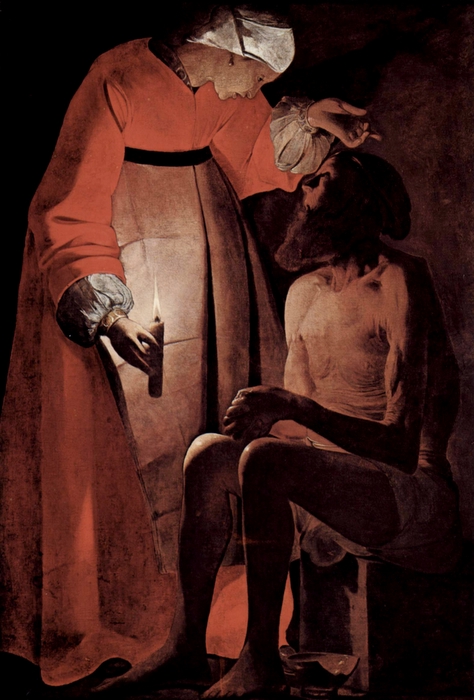
Job & his wife – La Tour
1:1 There was once a man in the land of Uz whose name was Job. That man was blameless and upright, one who feared God and turned away from evil.
2:1 One day the heavenly beings came to present themselves before the Lord, and Satan also came among them to present himself before the Lord. 2 The Lord said to Satan, “Where have you come from?” Satan answered the Lord, “From going to and fro on the earth, and from walking up and down on it.” 3 The Lord said to Satan, “Have you considered my servant Job? There is no one like him on the earth, a blameless and upright man who fears God and turns away from evil. He still persists in his integrity, although you incited me against him, to destroy him for no reason.” 4 Then Satan answered the Lord, “Skin for skin! All that people have they will give to save their lives. 5 But stretch out your hand now and touch his bone and his flesh, and he will curse you to your face.” 6 The Lord said to Satan, “Very well, he is in your power; only spare his life.” 
7 So Satan went out from the presence of the Lord, and inflicted loathsome sores on Job from the sole of his foot to the crown of his head. 8 Job took a potsherd with which to scrape himself, and sat among the ashes. 
9 Then his wife said to him, “Do you still persist in your integrity? Curse God, and die.” 10 But he said to her, “You speak as any foolish woman would speak. Shall we receive the good at the hand of God, and not receive the bad?” In all this Job did not sin with his lips.
******************
                Job was a righteous man from the land of Uz (wherever that is), whom Satan dared God to torment, to test his faith. God agreed to the wager, and as a result Job’s children were killed by raiding parties and his property destroyed. It was a sad day for Job, but he remained firm in his righteousness. He grieved but didn’t curse God. That’s the essence of chapter one of Job, though the lectionary includes only the introductory verse in the selection for Pentecost 20B. That’s because the focus is on chapter two and a second wager, this time involving Job’s own body. Will Job remain faithful with this twist in the story.
                As in chapter one, in chapter two of Job, the heavenly council gathers with Yahweh presiding. Satan appears once again before Yahweh, who once again asks Satan what he’s been up to. The answer is, “I’ve been traveling around the earth, checking things out, seeing what people are doing.” Once again, Yahweh asks Satan, what he thinks of Job. After all, “there is no one like him on the earth, a blameless and upright man who fears God and turns away from evil. He still persists in his integrity, although you incited me against him, to destroy him for no reason.” Did you notice God’s response? Job remained blameless and upright, even though Satan had “incited me against him, to destroy him for no reason.” God is rather proud of this man, whom God had allowed to be tested.
                I have always been intrigued by the story of Job. It invites us to think through our understanding of God, including God’s relationship to the world. In my theology, God is love, and a God who is love doesn’t go around messing people’s lives. Yet, that is the story, which should cause us to pause before embracing a literalist interpretation. In this picture of God, God is rather petty. God play games with a man’s life, by letting his children be murdered and his property destroyed, just to see if Job will stay firm in his faith. Job does, despite everything that is thrown at him. Job is righteous, but what about God? Is God so thin-skinned that God can be manipulated by Satan? It’s a question we must face, if we’re to hear this story.
                If we’re to read Job in a way that informs us theologically, we need to affirm at the very beginning that this fiction. The first clue ought to be Job’s homeland. Where is Uz? It could be Edom, but who knows. The picture of the heavenly court is also a clue, though it gives evidence of its rootedness in a pre-monotheist Israel. Whatever its origins, the book raises questions about our understanding of God, the nature of faith, and the challenge posed to that faith by human suffering. With that is our opening point, we need to also address this important character who appears in the early chapters, and that is the person of Satan. The character of Satan as depicted here is not the devil of human imagination. This is no figure with red skin, horns, and a pitchfork. This figure is more an informant, sent out by God, as would a king, to keep watch for rebellious activities. In this set of exchanges, Satan raises questions about Job’s piety. Is it based on living the good life, and if that good life is taken away, the piety would go away as well? It’s a good question, and whether we like the way the question is set up, it does speak to our own realities.
                In chapter two, when God asks Satan what he thinks of Job’s response to misfortune, Satan responds that this is to be expected. It’s one thing to lose your family and property. It’s another thing to have your own body afflicted. Isn’t it human nature to do whatever we can to save our own skins, even at the expense of those closest to us? That’s just the way things are. Jesus knew that. In the Gospel of John, we hear him say: “No one has greater love than this, to lay down one’s life for one’s friends” (John 15:13). Jesus will do that for his friends, but what about us? When push comes to shove, won’t we save our own skins? That’s the wager. So, God goes along with the wager, allowing Job to be afflicted, but not killed. Pushed to the limit, will he curse God?  That’s the question.
                Satan went and cursed Job, causing sores to appear on his body running from the soles of his feet to the crown of his head. In other words, the totality of his body was covered with “loathsome sores.” He was miserable. He probably wished to die. But he remained firm in his faith. He did so, even when his wife suggested that he curse God, so he might die. Curse God and get it over with. That was her advice. But he refused. He remained firm in his faith, despite everything.
                Satan was wrong. Job didn’t save his own skin by cursing God, though Job’s wife encouraged him to do so. He told his wife that one should expect both the good and the bad from the hand of God. That isn’t a comforting word on Job’s part. It doesn’t fit with my own theology. It’s not that I plan on cursing God, but I am troubled by the idea that God would authorize the bad. God might allow something bad to occur, or maybe, just maybe, there are things God simply cannot do. Through it all, however, Job remains firm in his faith.
This response on Job’s part, his decision to accept his fate and not curse God sets up the next phase of the story, his encounter with his “friends,” who at first seek to comfort him and then as time passes, and Job won’t confess his sins, raise questions about Job’s righteousness. After all, isn’t suffering the result of wrong doing? So far, however, Job does nothing to warrant his suffering, if suffering results from wrongdoing. His suffering comes from a divine directive.
                The questions raised by the Book of Job are important ones. In some ways the Book challenges another strain of Wisdom Literature that presumes that blessing is a sing of righteousness and suffering is a sign of unrighteousness. It also invites us to consider the we view the divine-human relationship. Marvin Sweeney, a Jewish scholar of the Hebrew Bible (and my son’s professor) at a Protestant seminary, offers these words of insight:

The book of Job deliberately presents the model of a righteous man who suffers with no apparent moral justification in an effort to force critical reflection on the issue. The arguments posed by Job’s friends concerning the meaning of human suffering and their assertions of divine righteousness even in the face of evil and Job’s responses to each of them are in fact the key issues of the book. The book of Job is intended to question the standard theological premises of the Torah and the Prophets, viz., is it really the case that observance of the divine will leads to success and peace in life? Is it really the case that the wicked suffer— and not the righteous? Is it really the case that G-d is just? Indeed, the final episode in which G-d affirms Job’s demands for an explanation for his suffering— even though G-d never provides such explanation— indicates that such a critical agenda is in fact the purpose of the book. In the end, the book of Job affirms divine presence and it appears to affirm divine righteousness, but the book also affirms the right and obligation of human beings to ask such questions of G-d. In this respect, Job points to and affirms a model of a human being in critical dialog with G-d.  [Sweeney, Marvin A. Tanak: A Theological and Critical Introduction to The Jewish Bible (Kindle Locations 11439-11447). Fortress Press. Kindle Edition.]

                The door is open. Are willing to walk through? Are willing to enter a critical dialog with God, as Sweeney proposes? The lectionary moves quickly, jumping from chapter two to chapter twenty-three. We don’t get to see the dialog with the friends, but we do experience Job’s complaint, which is set up by this attack on Job’s skin.

Picture attribution: La Tour, Georges du Mesnil de, 1593-1652. Job and his Wife, from Art in the Christian Tradition, a project of the Vanderbilt Divinity Library, Nashville, TN. http://diglib.library.vanderbilt.edu/act-imagelink.pl?RC=46621 [retrieved October 1, 2018]. Original source: http://www.yorckproject.de.

10646937_10204043191333252_4540780665023444969_nRobert Cornwall is the Pastor of Central Woodward Christian Church in Troy, Michigan. He holds the Ph.D. in Historical Theology from Fuller Theological Seminary. He is the author of a number of books including Out of the Office (Energion, 2017), Marriage in Interesting Times (Energion, 2016), and Freedom in Covenant (Wipf and Stock, 2015) and blogs at Ponderings on a Faith Journey.

Dancing before the Lord – A Lectionary Reflection for Pentecost 8B (2 Samuel 6)

Dancing before the Lord – A Lectionary Reflection for Pentecost 8B (2 Samuel 6)

2 Samuel 6:1-5, 12b-19 New Revised Standard Version (NRSV)
6 David again gathered all the chosen men of Israel, thirty thousand. 2 David and all the people with him set out and went from Baale-judah, to bring up from there the ark of God, which is called by the name of the Lord of hosts who is enthroned on the cherubim. 3 They carried the ark of God on a new cart, and brought it out of the house of Abinadab, which was on the hill. Uzzah and Ahio, the sons of Abinadab, were driving the new cart 4 with the ark of God; and Ahio went in front of the ark. 5 David and all the house of Israel were dancing before the Lord with all their might, with songs and lyres and harps and tambourines and castanets and cymbals. 
12b So David went and brought up the ark of God from the house of Obed-edom to the city of David with rejoicing; 13 and when those who bore the ark of the Lord had gone six paces, he sacrificed an ox and a fatling. 14 David danced before the Lord with all his might; David was girded with a linen ephod. 15 So David and all the house of Israel brought up the ark of the Lord with shouting, and with the sound of the trumpet.
16 As the ark of the Lord came into the city of David, Michal daughter of Saul looked out of the window, and saw King David leaping and dancing before the Lord; and she despised him in her heart. 
17 They brought in the ark of the Lord, and set it in its place, inside the tent that David had pitched for it; and David offered burnt offerings and offerings of well-being before the Lord. 18 When David had finished offering the burnt offerings and the offerings of well-being, he blessed the people in the name of the Lord of hosts, 19 and distributed food among all the people, the whole multitude of Israel, both men and women, to each a cake of bread, a portion of meat, and a cake of raisins. Then all the people went back to their homes.
********************
                If you’ve seen Raiders of the Lost Ark, you know that you must handle it with great care. Terrible things happen when you don’t show proper reverence, or you handle it with malevolent purposes (as in Raiders). It’s possible that Stephen Spielberg was inspired by reading from this passage of 2 Samuel 6. The “scary” part of the passage, of course, has been excised by the lectionary creators. It’s not very worshipful to hear how God got peeved with Uzzah, when Uzzah reached out to try and steady the ark. He meant well, but God didn’t take kindly to the help, and struck him dead. Apparently, David got a bit skittish about bringing the Ark any further. While he wanted to bring the Ark, which represented the presence of God, into the city, cementing his role as king over the entirety of Israel, he decided to leave the Ark at the home of Obed-Edom. There it sat until David got enough courage to bring it the rest of the way to Jerusalem, so he could set it up in its new home—the Tabernacle. It’s always good to remember that Solomon, not David, gets to build the Temple, so during David’s reign it sat in a tent.
                The reading from 2 Samuel is divided into two sections. Section one is the initial attempt to retrieve the Ark, so it can be set in the city. The Ark had been lost during a battle with the Philistines during the reign of Saul.  Apparently, the Philistines decided that the Ark caused more trouble than it was worth, so they let Israel have it back. Now, it could be placed in an appropriate place in David’s capital. At least that’s what David hoped would happen, when he went out with 30,000 soldiers to retrieve and transport the Ark to Jerusalem. Unfortunately, as noted above, the first attempt went badly—cue Raiders.
 
The second section tells the story of David’s decision to go and retrieve the Ark from the home of Obed-Edom. After all, during this intervening period when the Ark rested at there, Obed-Edom and his family were being blessed (that part is excised as well). When David hears this news, he decides he needed he bring the Ark in the city, so he could be blessed. This time David took more precautions so that nothing could go wrong during the transport of the Ark. There would be no ox-cart this time. Instead it would be carried to the city. The procession would include sacrifices, dancing, trumpets, and shouts of praise. David not only accompanied the Ark, it appears he the dances as the train of people made their way to the city. And all went well. David and the Ark arrived in the city. They safely placed the Ark in its new home—a tent that David erected. Everyone went home. Now blessings could flow David’s way.
                Everyone in the city seemed to be excited. Restoring national treasures is something to celebrate. David was happy. He had his Ark. Perhaps God was happy. But when he returned home, he discovered that not everyone was happy with the recent events. David was met at the door by his wife Michal, who was the daughter of Saul. She was scandalized by David’s dancing, believing he had revealed to much of himself before his “servant’s maids.” The thought is that the linen ephod, which was similar to what the priests wore, that David was wearing left very little to the imagination. Again, the lectionary selection ends before we get the full story.  and that he may have exposed himself to the populace. That embarrassed his wife, who was also daughter of Saul. Once they were in love, but time had passed. David had added to has harem. Michal was put off to the side. She gets a bad rap. After all, David was simply dancing before the Lord. But maybe we’ve been too harsh. Maybe Michal has a right to be concerned. The story goes on beyond what is set for this Sunday’s reading. Perhaps Michal needs our support. After all, her family is gone. She has been largely abandoned by her husband, whom she loved, but perhaps with an unrequited love. We usually give David a pass on his behavior. Yes, he could be a bit boorish, but he was close to God. Unfortunately, too many of those close to him, including Michal, suffered.
                The reason this passage is chosen for inclusion in the lectionary is that it celebrates God’s presence among the people. The Ark symbolizes this presence, which brings blessing to homes and cities. David had reason to be exuberant in his joy, but perhaps he didn’t consider the feelings of everyone involved. To David, the Ark had been placed in its appropriate spot. It gave him legitimacy and the city legitimacy. It was a sign of unification of a loosely connected community. David had religious motives, but political ones as well. As we ponder the text it might be worth considering which of these two motives held the greatest sway in his life. Granted in the ancient world church and state were more thoroughly integrated than today, but still, was David more influenced by his relationship with God or by his search for power. That question then gets posed to us. Are we Christians first or Americans first?
                As we ponder this passage, we might think about the symbols that speak to us. Which symbols do we consider sacred? The Communion Table and its elements are possible signs of God’s presence in Jesus. The cross can be a sign. The question is, when push comes to shove do we put greater emphasis on these sacred signs or on alternative signs like the American flag?
One further note, it might be worth noting that while the creators of the lectionary have omitted the section detailing how Uzzah gets zapped by God, we would be wise to make clear that such a vision of God is not healthy. If, as at least some of us Christians proclaim, God is love, then surely this act is not representative of God. That is not to say that we need to so soften God’s image that anger and wrath are no longer part of God’s personality is wise, it’s just that we need to be careful in how we depict God, because such depictions can influence our own actions.
Passages like this seem so distant from our lives. Yet, they are expressions of human experience. David was happy. His people were happy. They celebrated the presence of God. The question as always comes down to motive. We might rather explore a passage from the Gospels, but let us not forget that even passages like this can speak. It might even serve as an invitation to dance before the Lord (with all due modesty taken into consideration).
 10646937_10204043191333252_4540780665023444969_nRobert Cornwall is the Pastor of Central Woodward Christian Church in Troy, Michigan. He holds the Ph.D. in Historical Theology from Fuller Theological Seminary. He is the author of a number of books including Out of the Office (Energion, 2017), Marriage in Interesting Times (Energion, 2016), and Freedom in Covenant (Wipf and Stock, 2015) and blogs at Ponderings on a Faith Journey.
Picture attribution: Salviati, Francesco, 1510-1563. David with Ark of the Covenant, from Art in the Christian Tradition, a project of the Vanderbilt Divinity Library, Nashville, TN. http://diglib.library.vanderbilt.edu/act-imagelink.pl?RC=47899 [retrieved July 9, 2018]. Original source: http://www.yorckproject.de.


A Prophetic Calling — Reflection on 1 Samuel 3

Now the boy Samuel was ministering to the Lord under Eli. The word of the Lord was rare in those days; visions were not widespread. 

At that time Eli, whose eyesight had begun to grow dim so that he could not see, was lying down in his room; the lamp of God had not yet gone out, and Samuel was lying down in the temple of the Lord, where the ark of God was. Then the Lord called, “Samuel! Samuel!” and he said, “Here I am!” and ran to Eli, and said, “Here I am, for you called me.” But he said, “I did not call; lie down again.” So he went and lay down. The Lord called again, “Samuel!” Samuel got up and went to Eli, and said, “Here I am, for you called me.” But he said, “I did not call, my son; lie down again.” Now Samuel did not yet know the Lord, and the word of the Lord had not yet been revealed to him. The Lord called Samuel again, a third time. And he got up and went to Eli, and said, “Here I am, for you called me.” Then Eli perceived that the Lord was calling the boy. Therefore Eli said to Samuel, “Go, lie down; and if he calls you, you shall say, ‘Speak, Lord, for your servant is listening.’” So Samuel went and lay down in his place. 

10 Now the Lord came and stood there, calling as before, “Samuel! Samuel!” And Samuel said, “Speak, for your servant is listening.” 

****************
                In a few weeks I will celebrate the thirty-third anniversary of my ordination to ministry in the Christian Church (Disciples of Christ). I have an ordination certificate to remind me of the time and place at which the event occurred. I do remember that day, which followed a day after I received my M.Div. degree at Fuller Seminary. What I can’t remember is the exact moment or time at which I sensed a call to ministry. I can’t say that I had an extraordinary experience of God speaking directly to me, issuing a call to ministry. But, at some point along my life path I found myself moving toward that Sunday afternoon in June of 1985, when a gathering of elders from Temple City Christian Church and other clergy, both Disciples and non-Disciples, laid their hands on me and offered a prayer of consecration, setting me apart for ministry in the church. I will admit that at the time, I didn’t expect to spend my future years as an actual pastor. I assumed I would be a professor of some type. I would go on from there to pursue further education to support that dream. Here I am, some thirty-three years later, having spent the past twenty years serving as pastor of three different congregations.
When did the call really come? Could seeds have been planted back when I was a child, serving as an acolyte at St. Barnabas Episcopal Church in Dunsmuir, California (now in Mount Shasta)? Was it when I was asked to become a lay-reader as a teenager, because Fr. Green felt that I had the voice to lead portions of the liturgy?  Whenever the call came, I find myself in this position of service in the church. My story is probably like many others, including the possibility that seeds were planted in childhood.
                The prophetic call stories in the Hebrew Bible are intriguing. They are all somewhat different. In many of them, the one being called is reticent to say yes. As we saw in the reading from Isaiah 6 for Trinity Sunday, Isaiah confessed that he was “a man of unclean lips,” and therefore unworthy of being able to face God, let alone hear a call from God. In the end, however, his lips were purified when a seraph touched his lips with a live coal taken from the altar in the Temple. After this act of purification, Isaiah answered “here am I, send me.” Jeremiah responded to God’s call, including God’s declaration that God had formed him in the womb for this purpose, by telling God that he was a mere a child and didn’t know how to speak. God responded to Jeremiah’s resistance by touching his mouth and putting words in Jeremiah’s mouth so that God’s word might be proclaimed (Jer.1:4-10). This leads us to the story of the call of the prophet/judge Samuel. Samuel is living with the aged priest Eli. He’s helping to serve in the Temple at Shiloh. It was there that the Ark of the Covenant was being kept. It is in this context that Samuel receives his call from God.
                The background story to Samuel’s call to prophetic ministry parallels that of John the Baptist. Both prophets were born to older mothers who were considered barren, and therefore felt the shame of the community, but then by divine intervention their mothers conceived and bore sons who would grow up to be prophets. It is worth noting that in the ancient world, as well as some parts of our contemporary world, to not bear a child was considered a sign of divine judgment. Thus, the prayer of Hannah was for a child to be born, not so she could fulfill some maternal dream, but so her shame might be removed. This might not be our cultural dynamic, but it was true in the days of yore. So, when the desired child was old enough, Hannah brought her child to the Temple in fulfillment of a promise made to God. Again, this might not be our way of thinking, but it was the way things were. That is how Samuel came to live with an elderly priest whose sons were less than honorable. It is the reason why Samuel is in this position to hear the call of God while sleeping in the Temple.
                The call of Samuel is set up by the declaration that “the word of the Lord was rare in those days.” What might this mean? Could it be that the people were not in a frame of mind to hear that word? Could the reference to Eli’s eyesight—perhaps blindness—have a spiritual reference point? Could this be due to spiritual complacency? Could it be that there is no word, because no one is ready to hear it? That leads to the question: Is Samuel different? Is he, as the miracle child, the one person who is in a position to hear God’s voice?  

                As we ponder these questions we find Samuel asleep in the temple at Shiloh. As he sleeps, he hears a voice calling his name. Considering his job description, he is likely sleeping near the Ark of the Covenant. For those of us who have been influenced by Raiders of the Lost Ark, it’s probably easier to envision a voice speaking from the Ark. But, this isn’t Raiders of the Lost Ark, this is the Bible. When Samuel hears this voice, he goes to Eli and asks the priest what he wanted, at which time he’s sent back to bed. Just a child’s vivid imagination! After all, the word of God was rare in those days. This will happen two more times before Eli decides that something is up. Eli may not be the most faithful priest, but he knew that God could speak. So, after the third time, Eli tells Samuel to answer the voice with the words: “Speak, for your servant is listening.” As one reads further along in the story, we discover that Samuel has heard God’s voice and Samuel will speak for God to the people. He will even anoint kings.
                That Samuel could respond to this calling, serves as a reminder that God is not without witnesses, even when things look difficult. After all, the “lamp of God had not yet gone out.” There was hope that the flame of God would be carried on to the next generation through the call of Samuel.
                So, what might this say to us? Could it be that we should help young people, including small children listen for God’s voice? If so, how might we do this? For me, it might have been serving as an acolyte and then as a lay reader. For who knows when a call will come?

Bob Cornwall is a Disciples of Christ pastor, church historian, and author. He currently serves as Pastor of Central Woodward Christian Church (Disciples of Christ) of Troy, Michigan. He holds a Ph.D. in Historical Theology from Fuller Theological Seminary, along with an M.Div. from Fuller and a B.S. degree from Northwest Christian University in Eugene, OR. Bob has authored several books, as well as numerous articles and book reviews. He currently edits Sharing the Practice (Academy of Parish Clergy) and among the books already published, he has a number of books that have appeared with Energion Publications — Marriage in Interesting Times: A Participatory Study Guide, Unfettered Spirit: Spiritual Gifts for a New Great Awakening, Worshiping with Charles Darwin, Ultimate Allegiance: The Subversive Nature of the Lord’s Prayer and Ephesians: A Participatory Study Guide, and Faith in the Public Square (2012). He’s also the author of Freedom in Covenant (Wipf and Stock, 2015). For more on my books, see my Amazon Author Page: amazon.com/author/robertcornwall.

Turn Back to God – A Lectionary Reflection for Easter 3B

comesundayfbActs 3:12-19 Common English Bible (CEB)

12 Seeing this, Peter addressed the people: “You Israelites, why are you amazed at this? Why are you staring at us as if we made him walk by our own power or piety? 13 The God of Abraham, Isaac, and Jacob—the God of our ancestors—has glorified his servant Jesus. This is the one you handed over and denied in Pilate’s presence, even though he had already decided to release him. 14 You rejected the holy and righteous one, and asked that a murderer be released to you instead. 15 You killed the author of life, the very one whom God raised from the dead. We are witnesses of this. 16 His name itself has made this man strong. That is, because of faith in Jesus’ name, God has strengthened this man whom you see and know. The faith that comes through Jesus gave him complete health right before your eyes.

17 “Brothers and sisters, I know you acted in ignorance. So did your rulers. 18 But this is how God fulfilled what he foretold through all the prophets: that his Christ would suffer. 19 Change your hearts and lives! Turn back to God so that your sins may be wiped away.
***********

Note: During the season of Easter the First Reading from the Revised Common Lectionary is drawn not from the Hebrew Bible, but from the Book of Acts.

John the Baptist and Jesus had a common message: Repent. Turn back to God. Stop your rebellion. In the post-resurrection age, Peter picked right up with their message. He proclaimed to any who would listen: turn from your sins and embrace the realm of God. For Peter this messaging included reminding his audience that the religious and political leaders conspired to kill Jesus, the author of life. So, “turn back to God so that your sins may be wiped away.” Preaching a message of repentance so soon after Easter Sunday is probably a bit radio-active. After all, shouldn’t we be celebrating the coming of spring. For those of us who live in colder winter climates, spring is something is to be celebrated. So, why talk about sin and repentance? Perhaps, in Peter’s mind (and Luke’s), repentance and resurrection are related. After all, it was the conspiracy to have Jesus executed, because of his message of repentance, that led to his death and then resurrection.

The lectionary reading begins with Peter’s message to the people, but who are these people Peter is addressing, and why is he speaking? Acts 3 begins with a beggar sitting at the gate to the Temple. Luke tells us that he is crippled, and that he depends on alms shared by those who go to the Temple to worship. It’s a good plan. Surely worshipers will be generous. Among those worshipers are Peter and John, who apparently go up to the Temple in Jerusalem to worship three times a day. If they have been through this gate with any frequency, and I’m assuming they had, they would have run into this man. They know his message. Maybe they have thrown a few coins his way. In any case, as they walk by on their way to worship, the man calls out to them, asking for alms. The two apostles stop and face the man. He wants money, but they decide to give something else. There is a song, that I sang years ago in Bible study and at camps. It tells the story of this encounter:

Silver and gold have I none, but such as I have give I thee,
In the name of Jesus Christ of Nazareth, rise up and walk.
He went walking and leaping and praising God,
Walking and leaping and praising God,
In the name of Jesus Christ of Nazareth, rise up and walk.

When the people see the man walking and leaping, they want to know what happened. How can this man, who sat begging alms, perhaps for years, now be jumping around and praising God?

This eruption of praise and the attending questions, gave Peter his opening. It is now sermon time. A crowd gathers, eager to hear from these workers of miracles, who once walked with Jesus. Now, remember, Luke only gives summaries of sermons, not the full text. But the text as given starts with a rebuke. He’s asking them why they needed to ask the question. Didn’t they realize that the power of healing was with Jesus, whom, according to the apostles, they conspired to kill by delivering Jesus to Pilate. Peter gives a witness to Jesus. You conspired with Pilate, but God raised him instead.

Once again, we must be careful how we read a passage like this. It can and has been used as fuel for anti-Jewish and anti-Semitic exclusion and violence. Even today, there are those who accuse Jews of being Christ-killers. Let us remember that Peter and John and Jesus and John the Baptist, were all Jews. The religious leadership, who derived power from Rome, as was so of the case, turned Jesus over (at least that’s how Luke tells the story). Most likely they did this, because Rome didn’t like people challenging its authority. You could believe whatever you wished, but just don’t challenge Rome’s authority. So, let us be careful how we read this passage. In this particular case, we have before us an in-house conversation. Peter is addressing his own community and reminding them of what has happened in the past. Jesus, like earlier prophets of God was struck down by the powers that be, but God turned the tables and his raised him from the dead. So, turn back. Choose a different path.

When we read a passage like this from the lectionary, we’re not only asking what it meant back then. We’re asking, what does it mean for us today? So, the message is this: “Turn back to God.” Repent of your sins, and God will forgive, wiping away your sins. Perhaps the way to read this today is ask the question of our own complicity in deeds of destruction. How have we rejected God’s messengers?

The healing of the man that brought Peter and John to the attention of the people is a sign that life reigns victorious. Willie James Jennings writes:

The man healed is now a sign of the man resurrected from the dead, the author of life itself. Now the actions of the One confront the wayward propensities of the many. If peoples are often seduced by the power of violence and take up the weapons of death, here is Jesus the Messiah who has overcome the effects of violence and the pull of death. If peoples are prone to choose against their own well-being and life, here is the Messiah who heals, restores, and gives life. [Jennings, Acts, Belief: A Theological Commentary on the Bible, (WJK Press, 2017), p. 43].

Peter and John stand before their neighbors, who like them have come to worship the God of Israel. The apostles proclaim the message that the Messiah of God, the one who was rejected, has been accepted by God, and brings life, even in the midst of death. So, will you join with God, and turn away from the path of destruction? Will you join the movement for the common good of all?

Robert Cornwall is the Pastor of Central Woodward Christian Church in Troy, Michigan. He holds the Ph.D. in Historical Theology from Fuller Theological Seminary. He is the author of a number of books including Out of the Office (Energion, 2017), Marriage in Interesting Times (Energion, 2016), and Freedom in Covenant (Wipf and Stock, 2015) and blogs at Ponderings on a Faith Journey.

Christian Community in the Shadow of the Resurrection

comesundayfb

Acts 4:32-37 New Revised Standard Version (NRSV)
32 Now the whole group of those who believed were of one heart and soul, and no one claimed private ownership of any possessions, but everything they owned was held in common. 33 With great power the apostles gave their testimony to the resurrection of the Lord Jesus, and great grace was upon them all. 34 There was not a needy person among them, for as many as owned lands or houses sold them and brought the proceeds of what was sold. 35 They laid it at the apostles’ feet, and it was distributed to each as any had need. 36 There was a Levite, a native of Cyprus, Joseph, to whom the apostles gave the name Barnabas (which means “son of encouragement”). 37 He sold a field that belonged to him, then brought the money, and laid it at the apostles’ feet.

******************

During the Easter season, the first reading in the Revised Common Lectionary comes from the Book of Acts (as opposed to the Hebrew Bible). As we move through this season of post resurrection visitations on the part of Jesus, we hear words about life in the early church. On this Sunday we hear a word about a community that has chosen to live the common life. When I was teaching a college class on the book of Acts years ago, I liked to tell the students, who were from a conservative Christian background, that this was evidence that the early Christians were communists—long before Karl Marx came around. I’m not sure they appreciated my making note of this, after all communism is a dirty word in some circles. but it was a good conversation starter.

Throughout the history of the church, there have been attempts to approximate this model of Christian life, but it never became the dominant form of Christian community. We don’t even know how long this form of community existed in Jerusalem. But, even if it did not last more than a year or two, what might we take from the message that they were all “of one heart and soul?” At one level there appears to have been a concern for the welfare of the entire Christian community. They shared equally of their resources so that no one was in need. Gustavo Gutierrez, who is one of the founders of Latin American Liberation Theology, writes in his seminal text that this act on the part of the Jerusalem church “was not a question of erecting poverty as an ideal, but rather seeing to it that there were no poor…. The meaning of the community of goods is clear: to eliminate poverty because of love of the poor person” [A Theology of Liberation, (Orbis)1973), p. 301].

We’re told that the members of the community sold their property and brought the proceeds, laying them at the feet of the Apostles, who then distributed the goods among the people. One member in the community stood out as an exemplar, and that was Barnabas. Barnabas is an intriguing figure in the history of the church. We are told that he came from Cyprus and that he was by descent a Levite. Thus, he was of the priestly caste. He seems to have been a person of some means, as he is held out as an example of one who sold all so that the community might thrive (as opposed to Ananias and Sapphira in Acts 5). Barnabas will go on to become a leader in the church at Antioch, and a partner in ministry with Paul on Paul’s missionary journey. Luke likely mentions Barnabas and his example because he was known to the readers, at least by name and story.

One of the messages of this passage is that standing at the heart of the Gospel is compassion for the other. One of the attractions to the early Christian church was the welcome given to people on all socio-economic levels. It wasn’t always easy, as we discover when reading 1 Corinthians. Despite the challenges, the Christian community was one of the most economically diverse religious communities of its day. That commitment, which was always difficult to put into practice, helped spread the faith throughout the Roman Empire.

The reading for the second Sunday of Easter has a stewardship element to it, connecting as it does money to discipleship. Willie James Jennings, in his theological commentary on the Book of Acts, writes that “money matters are inescapable. They are at the heart of discipleship, but they are not the heart of discipleship.” Our relationship to money says a lot about us. There is no joy to be found in poverty, despite St. Francis of Assisi’s claims. At the same time, money doesn’t necessarily make a person happy (there a lot of unhappy rich people). People who give, however, tend to be happier people. So, there does seem to be a benefit of giving, even if we don’t sell everything and give it to the church (that’s not a stewardship message that will go over well). Back to the insight into this matter from Willie James Jennings:

“Money here will be used to destroy what money normally is used to create: distance and boundaries between people. Distance and boundary is not merely between the haves and have-nots, but also between the needy and the comfortable, and between those who testify to Jesus and those who, like Jesus, help those with little or nothing” [Jennings, Acts: Belief, (WJK Press, 2018), p. 50].

Ultimately, this is not only the story of giving, but as Jennings points out, it is about the joining together that comes because of these acts.

The message of community expressed here was not new, at least not to the Jewish community. The principles of sabbath and jubilee were strongly implanted within Judaism, even if these principles might not have been fully embraced or developed. The principle of Jubilee, with its plan of redistributing land back to the original owners after fifty years, was designed to prevent monopolies of land or money. Thus, this is part of an overarching theme of justice that marks the biblical story.

As we attend to this passage today, in an age of increasing gaps between rich and poor, between management and worker, what message do we hear? How is Jesus speaking to the church on matters of income inequality? We need not go as far as this community, but what is it that we hear in this reading? To put it differently, what does it mean to be a disciple of Jesus? For American Christians, who tend to grow up with an individualistic world view, what do we hear in this passage? Even if the model espoused here is not perfectly adaptable to our community, and may have been quickly abandoned, what does it mean for us to be “of one heart and soul?” How might we better exhibit God’s compassion for the poor in our own lives. It’s possible that some reading this are struggling financially, while others are blessed. How might this speak to both situations?

These are all important questions that for us are being raised in the shadow of Easter. So, the further question concerns the connection of resurrection to community, and how it is lived out in a world that often devalues human life. As Gutierrez prophetically writes:

“The ‘poor’ person today is the oppressed one, the one marginated from society, the member of the proletariat struggling for his most basic rights; he is the exploited and plundered social class, the country struggling for its liberation” [A Theology of Liberation, p. 301].

What then is the message of resurrection in this context?

10646937_10204043191333252_4540780665023444969_nRobert Cornwall is the Pastor of Central Woodward Christian Church in Troy, Michigan. He holds the Ph.D. in Historical Theology from Fuller Theological Seminary. He is the author of a number of books including Out of the Office (Energion, 2017), Marriage in Interesting Times (Energion, 2016), and Freedom in Covenant (Wipf and Stock, 2015) and blogs at Ponderings on a Faith Journey.

Death Has Been Swallowed Up Forever – Lectionary Reflection for Easter B – Isaiah 25

Isaiah 25:6-9 New Revised Standard Version (NRSV)

On this mountain the Lord of hosts will make for all peoples
    a feast of rich food, a feast of well-aged wines,
    of rich food filled with marrow, of well-aged wines strained clear.
And he will destroy on this mountain
    the shroud that is cast over all peoples,
    the sheet that is spread over all nations;
    he will swallow up death forever.
Then the Lord God will wipe away the tears from all faces,
    and the disgrace of his people he will take away from all the earth,
    for the Lord has spoken.
It will be said on that day,
    Lo, this is our God; we have waited for him, so that he might save us.
    This is the Lord for whom we have waited;
    let us be glad and rejoice in his salvation.

*********************

                Easter celebrates the victory of life over death. We gather on Easter morning to declare in song and prayer: “Christ the Lord is Risen today.” We joyfully sing: “The strife is o’er, the battle done, the victory of life is won, the song of triumph has begun. Alleluia!” Easter is a glorious moment in the Christian year, for it celebrates resurrection—God’s victory over death. As Paul reminds us, our resurrection is rooted in the resurrection of Jesus. (1 Corinthians15:20)
                The Gospel reading for this cycle of texts comes from either Mark 16 or John 20. Mark 16 gives us a rather abbreviated version of the Easter story. It may leave us wanting more, which is why many will turn instead to John 20, which invites us to encounter the risen Jesus through the witness of Mary Magdalene.

Continue reading “Death Has Been Swallowed Up Forever – Lectionary Reflection for Easter B – Isaiah 25”