Category: Ordinary Time

Arise My Love – Lectionary Reflection for Pentecost 15B (Song of Solomon)

Arise My Love – Lectionary Reflection for Pentecost 15B (Song of Solomon)

Song of Solomon 2:8-13 New Revised Standard Version (NRSV)


The voice of my beloved!
Look, he comes,
leaping upon the mountains,
bounding over the hills.
My beloved is like a gazelle
or a young stag.
Look, there he stands
behind our wall,
gazing in at the windows,
looking through the lattice.
10 My beloved speaks and says to me:
“Arise, my love, my fair one,
and come away;
11 for now the winter is past,
the rain is over and gone.
12 The flowers appear on the earth;
the time of singing has come,
and the voice of the turtledove
is heard in our land.
13 The fig tree puts forth its figs,
and the vines are in blossom;
they give forth fragrance.
Arise, my love, my fair one,
and come away.


*********************

            The Pentecost journey through the Hebrew Bible, at least the pathway I’ve chosen, leads us to this selection from the Song of Solomon. The prior week’s reading invited us to consider Solomon’s prayer at the dedication of the Temple. Solomon was renowned for his wisdom, at least that is the word we hear from Scripture. Therefore, with the story of Solomon’s wisdom providing the background, we turn to readings attributed to Solomon. He might not have written the Song of Solomon or the Book of Proverbs (the lectionary takes us to the book of Proverbs over the next few weeks). These readings come from the section of the Hebrew Bible that we call “The Writings,” and contain much of the Wisdom literature of the Bible.
 
The Song of Solomon, also known as Song of Songs and Canticles, has a distinctly erotic element, that is often softened in Christian readings by way of allegory. Perhaps it is due to Solomon’s reputation as one who had hundreds of wives and concubines, so that he would understand the power of erotic love, that this song is attributed to him. Due to his own experience, he could write authoritatively about human relationships and human sexuality. When one reads from the Song of Songs, with its powerful erotic imagery, it is understandable, that early Christians sought to allegorize it. Thus, while on the surface this is a song sung by two lovers, it is often read allegorically to describe the relationship of Christ and Church.
 
While it is doubtful that the original author of this song envisioned it being applied to Christ and Church, allegory and midrash are interpretative schemes that are not determined by the original intent but are meant to speak to the current situation. As to the gender of the author, while it is attributed to Solomon, a man, Renita Weems suggests the possibility that the author is a woman, due to “the preponderance of female speakers and experiences in the book.” Based on the language used in the song, she suggests that “it is not farfetched to imagine that the lyrics were inspired by someone (a woman) from an elite class who, at least modestly educated, was familiar with the Hebrew lyrical heritage and aware of prevailing assumptions about the role of women and the prohibitions against marriages crossing class and ethnic lines” [“Song of Songs,” NIB, 5:365].
 
            In my book Marriage in Interesting Times, I have a chapter that looks at chapters 7-8 of the Song of Solomon, exploring the Bible’s witness to the importance of sexual intimacy in relationship to marriage. In that chapter I note that while the allegorical reading is possible, we should not miss the witness of the song to the “beauty of embodied human love” (Marriage in Interesting Times, p. 47).  Read straight this is a portion of a love song sung by the one who awaits her lover, who is bounding across the mountains toward her. The invitation that goes out is simple: “Arise, my love, my fair one, and come away.”
 
            The voice of the one who sings this song about the beloved would appear to be a woman, awaiting her beloved to come and get her. Her lover “is like a gazelle or a young stag.” He bounds over hills to come to her and call her to him. The winter is past. The rains have come and gone. The flowers have broken forth across the land. The fig trees are beginning to bear fruit. It is spring time in the land, and therefore it’s time to go on a journey. It’s possible that this is a forbidden union, which requires her beloved to come to her with stealth. This a song of passionate love that overcomes, it would seem, barriers being erected to keep the two lovers apart (Romeo and Juliet without the tragic ending?).  
 
            What should we, the modern Christian reader, take from this passage? Why does it appear in the lectionary? What does it say about intimacy—with God? Within a relationship of love? We often speak of the relationship of God and humanity using the Greek word agape. It is the central term used in the New Testament to describe the relationship between God and humanity. But what role, spiritually, might eros play in our relationship with God? How might God be, as Augustine and others suggested, be the beloved suitor? Renita Weems writes that “the poet uses the language and imagery of a rustic, semi-pastoral culture to evoke passion and desire” [Weems, NIB, 5:395].
 
            While the word eros doesn’t appear in the New Testament, with Paul preferring agape, Tom Oord suggests that Paul “uses language that has eros meanings.” By that he means that Paul speaks of striving for that which is good and beautiful, just and honorable. In fact, in 1 Corinthians 14:1, Paul speaks of pursuing love, which Tom believes is an expression of eros without using the word [Nature of Love, pp. 49-50]. The value of a text like Song of Solomon is that it allows us to broaden our vision of life in the presence of God. For one thing, it celebrates romantic love, an idea I have explored in my biblical study of marriage. Such love is warranted by God. It is a good and perfect gift of God to humanity, not only for perpetuation of the species, but to build relationships between two people, sometimes, as it seems here, crossing those societal walls. It also invites us to consider the possibility of the pursuit of God. Sometimes we are led to believe that only God pursues, that we are passive in the relationship with God. But such is not the vision expressed here. It is a mutual pursuit. 
 
The word that appears twice in this passage is the invitation to “arise, my love, my fair one, and come away.” As we ponder this passage and its meaning for us, might we see this, admittedly allegorically, as an invitation on the part of God to join with God in the journey of faith? Winter is in the past and spring is at hand. This could be seen as an invitation to enjoy God’s grace that transforms. Susan Henry-Crowe interprets the interplay between the two persons in terms of playfulness. Transformation is the product of “playful grace.” Thus, she writes: “Whether the Song is read as a love story between two people or as an allegory about God’s love for all creation, its beauty is that it invites all humankind to play as if life and love depended upon it (as they do)” [Feasting on the Word, p. 6]. Let us, therefore, arise and go away with the one who calls our names, and enjoy the blessings of God’s grace (and human intimacy as well!).
Robert Cornwall is the Pastor of Central Woodward Christian Church in Troy, Michigan. He holds the Ph.D. in Historical Theology from Fuller Theological Seminary. He is the author of a number of books including Out of the Office (Energion, 2017), Marriage in Interesting Times (Energion, 2016), and Freedom in Covenant (Wipf and Stock, 2015) and blogs at Ponderings on a Faith Journey.           


God’s Dwelling Place – A Lectionary Reflection for Pentecost 14B

God’s Dwelling Place – A Lectionary Reflection for Pentecost 14B

1 Kings 8:22-30,41-43 New Revised Standard Version (NRSV)
22 Then Solomon stood before the altar of the Lord in the presence of all the assembly of Israel, and spread out his hands to heaven. 23 He said, “O Lord, God of Israel, there is no God like you in heaven above or on earth beneath, keeping covenant and steadfast love for your servants who walk before you with all their heart, 24 the covenant that you kept for your servant my father David as you declared to him; you promised with your mouth and have this day fulfilled with your hand. 25 Therefore, O Lord, God of Israel, keep for your servant my father David that which you promised him, saying, ‘There shall never fail you a successor before me to sit on the throne of Israel, if only your children look to their way, to walk before me as you have walked before me.’ 26 Therefore, O God of Israel, let your word be confirmed, which you promised to your servant my father David.
27 “But will God indeed dwell on the earth? Even heaven and the highest heaven cannot contain you, much less this house that I have built! 28 Regard your servant’s prayer and his plea, O Lord my God, heeding the cry and the prayer that your servant prays to you today; 29 that your eyes may be open night and day toward this house, the place of which you said, ‘My name shall be there,’ that you may heed the prayer that your servant prays toward this place. 30 Hear the plea of your servant and of your people Israel when they pray toward this place; O hear in heaven your dwelling place; heed and forgive.
41 “Likewise when a foreigner, who is not of your people Israel, comes from a distant land because of your name 42 —for they shall hear of your great name, your mighty hand, and your outstretched arm—when a foreigner comes and prays toward this house, 43 then hear in heaven your dwelling place, and do according to all that the foreigner calls to you, so that all the peoples of the earth may know your name and fear you, as do your people Israel, and so that they may know that your name has been invoked on this house that I have built.
**********************
                God is everywhere. God is above us, around us, perhaps below us. Whether we feel that presence or not, we confess by faith that God is there. We call it omnipresence. If God is omnipresent, then why bother with buildings? Why not worship out in nature? Many people claim to do just that. In the story of Israel, it is said that God moved around with the people, dwelling in a tent. When the people finally settled down, David wanted to build a more permanent house for God. After all, David had a nice house. Shouldn’t God have one also? The word sent to David through Nathan the prophet was that no such request had ever been made by God (2 Samuel 7).  God was fine with the tent! But, the Ark of the Covenant wouldn’t rest a tent forever. According to the story-line, the job of house-building would fall to his heir. Here in 1 Kings 8, David’s son and heir Solomon gets to dedicate that house, the temple of God. Apparently, God gave into the need of the people to have a more permanent space to approach God. Nonetheless, the question is, does God need a house?
                When Solomon builds this house for God, Solomon is quite aware that God is bigger than any house, no matter how grand. In fact, heaven itself cannot contain God. Nonetheless, the Temple is built, and it serves as a sign of God’s presence with the people. The first lesson from the lectionary, continues the story of Solomon, the successor to David (his son by Bathsheba). In the previous week’s reading, Solomon succeeds his father, consolidates his power, and famously prays for wisdom— “Give your servant therefore an understanding mind to govern your people, able to discern between good and evil; for who can govern this your great people?” God responds positively to this request (1 Kings 3:3-14). Having established his rule, Solomon has turned to building a house for God, the house promised to David, but which David would not build.
 
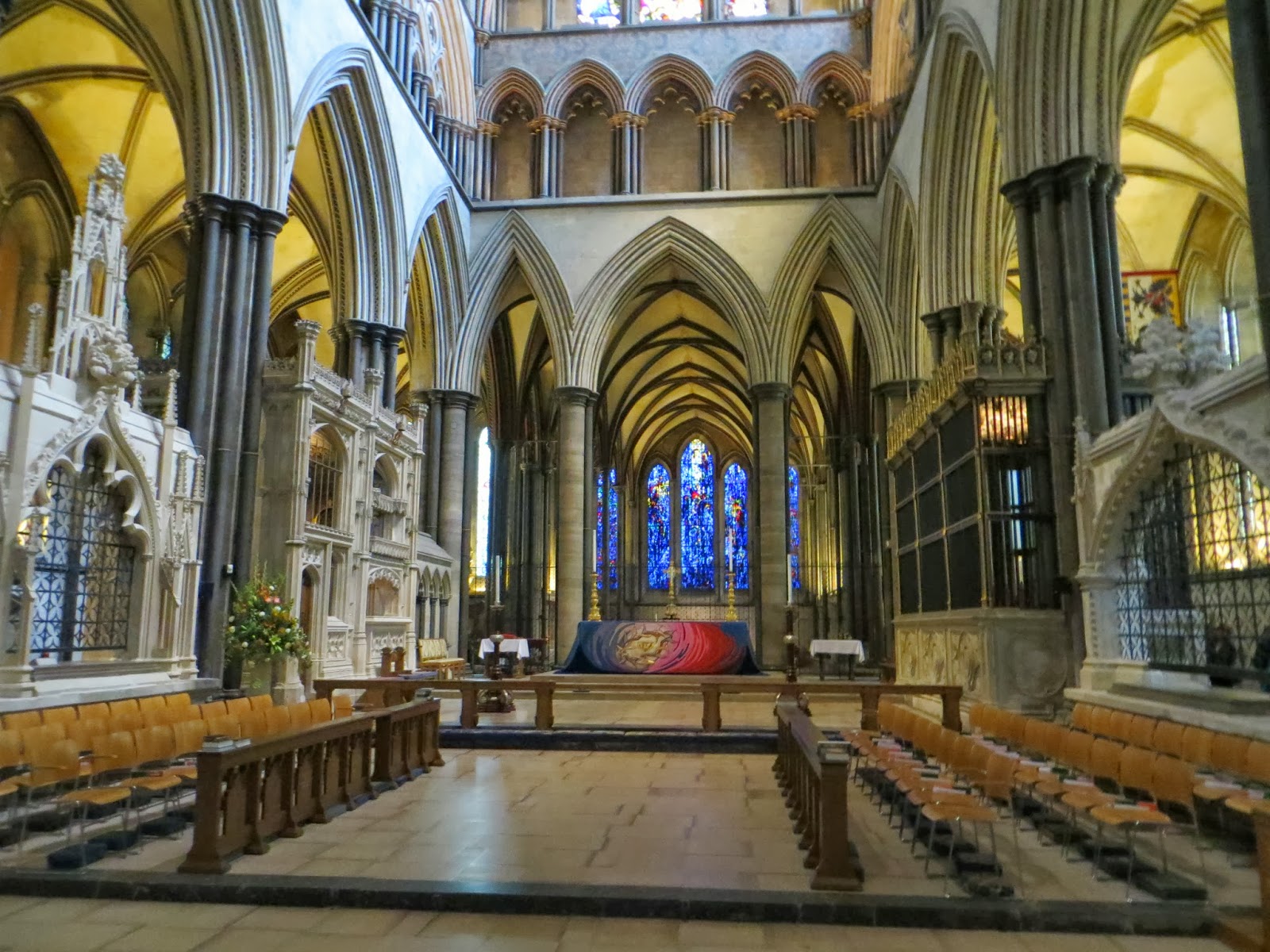
                The question for us concerns not only the process of building Solomon’s Temple, but its meaning for today. There is a debate underway as to the spiritual value of church buildings. Why expend money on something like a building when that money could be used for other things. After all, many church buildings are used only a few days a week at most. Then there are debates as to the form of a building. What is its purpose? Is it designed to reflect the sacred, the sacramental, or is it more utilitarian? In the medieval period, churches great and small were built to remind the people of the sacred. Visit a cathedral in Europe, and you might stand in awe. These churches were often built, not in a day but over several centuries. I am in the process of writing a chapter of a book on sacred architecture during the seventeenth and eighteenth centuries. Reading about these buildings, and the design purpose is illuminating. They were often designed both to tell stories and to reflect the tastes of their patrons. Then again, there are those plain style churches that marked New England, buildings that were designed not for sacraments but for preaching.  The same is true today. Some build auditoriums that are no different than a concert hall. Perhaps lacking any symbolism, even a cross. Others may still desire to build sanctuaries that cry out the sacramental and the sacred. Preaching may be still central, but so might the Table.  Still, the question remains as to whether God requires a building so that we might encounter God?
 
                In Solomon’s prayer dedicating the Temple, he recognizes that God is bigger than the building. However, he also understands the power of the Temple as a sign of that presence. Solomon prays that God will be attentive to the prayers either offered within the Temple, or toward the Temple. Why? Because God has placed God’s name on that Temple. The name of God, in ancient Judaism, was sacred. It is why one should not take God’s name in vain (that means more than cussing). Jesus spoke of this—don’t swear by the Temple, which should give us pause about using the Bible as a device upon which we swear to tell the truth or fulfill an office (Matt. 5:33-37). So, be careful how you speak and pray, so that you do not take God’s name in vain.
                Returning to Solomon’s prayer and the way in which we approach the sacred, what role does the building play? What role the furnishings? There is a move today for preachers to abandon the pulpit or replace the wooden or stone pulpit with a clear plastic one. It is said that such a move makes one more transparent or real. I wonder, however, if this move makes the preacher the focus rather than the word delivered. In other words, is not the pulpit more than a stand upon which we put our notes? Could it be that it is a reminder that the word spoken is not just that of the preacher, but is a sacred word? Thus, the pulpit is a sacred symbol. The same could be said about the Table. I’m all for understanding the Table as a gathering place rather than an altar. I believe that fits with Jesus’ institution. But it too provides a symbol of God’s presence. That does seem to fit with Solomon’s prayer. Solomon asks that God heed the prayers offered in or toward the Temple, for ours is a faith that has a material element to it. In fact, isn’t that the core Christian message? That the Word of God became incarnate, dwelling among us.
                While the building doesn’t contain God, the building has a message to send. It may speak of the sacred. Or, it might suggest that church is more like a community gathering, with music and speaker. It’s religious, but not necessarily “sacred.”
 
                We don’t have all of 1 Kings in front of us. Once again, the lectionary creators have abridged the conversation, with the focus on Solomon’s prayer. While not all the prayer is included, it is appropriate to note that the “foreigner” is mentioned. That word is especially poignant right now, when a nativist spirit has taken hold in the United States. Even Christians have embraced the fear of the other. Yet, here we have a prayer that offers welcome to the foreigner. This is a prayer asking God to bless the foreigner who comes to Jerusalem to pray. Heed this prayer, the people pray. God responds positively!
 
                The question here is whether God needs a house. It appears that God may not need a house, but God has chosen to put God’s name on a house so that the people might have a tangential reminder of their connection with God. Thus, it helps us spiritually to have that tangible reminder, that a church building provides, especially one that is not completely utilitarian!

Robert Cornwall is the Pastor of Central Woodward Christian Church in Troy, Michigan. He holds the Ph.D. in Historical Theology from Fuller Theological Seminary. He is the author of a number of books including Out of the Office (Energion, 2017), Marriage in Interesting Times (Energion, 2016), and Freedom in Covenant (Wipf and Stock, 2015) and blogs at Ponderings on a Faith Journey.

Rebellion in the Household – a Lectionary Reflection for Pentecost 12B (2 Samuel 18)

2 Samuel 18:5-9, 15,31-33 New Revised Standard Version (NRSV)

5 The king ordered Joab and Abishai and Ittai, saying, “Deal gently for my sake with the young man Absalom.” And all the people heard when the king gave orders to all the commanders concerning Absalom.

6 So the army went out into the field against Israel; and the battle was fought in the forest of Ephraim. 7 The men of Israel were defeated there by the servants of David, and the slaughter there was great on that day, twenty thousand men. 8 The battle spread over the face of all the country; and the forest claimed more victims that day than the sword.

9 Absalom happened to meet the servants of David. Absalom was riding on his mule, and the mule went under the thick branches of a great oak. His head caught fast in the oak, and he was left hanging between heaven and earth, while the mule that was under him went on. 

15 And ten young men, Joab’s armor-bearers, surrounded Absalom and struck him, and killed him.

31 Then the Cushite came; and the Cushite said, “Good tidings for my lord the king! For the Lord has vindicated you this day, delivering you from the power of all who rose up against you.” 32 The king said to the Cushite, “Is it well with the young man Absalom?” The Cushite answered, “May the enemies of my lord the king, and all who rise up to do you harm, be like that young man.”

33 The king was deeply moved, and went up to the chamber over the gate, and wept; and as he went, he said, “O my son Absalom, my son, my son Absalom! Would I had died instead of you, O Absalom, my son, my son!”

********************************
                When Nathan the Prophet appeared before David, after he took Bathsheba, bedded her, and had her husband killed, the prophet told the king that things would go badly for him. He might not die, but there would be consequences. Such is the rest of the story. First one of his sons raped a half-sister (the sister of Absalom). This led to Absalom gaining revenge on Amnon, by having him killed. That led to Absalom’s exile, and later rebellion. I fact, Absalom at first gained the upper hand, getting himself crowned as Israel’s king in place of his father David, who ended up fleeing Jerusalem. That leads us to this week’s reading from 2 Samuel.  
 
Many of us learned, as we grew up, that David was a man after God’s heart. We think of him as a righteous man, whose rightful successor (as Christians) is Jesus. If we attend to the story in 2 Samuel, we see a man who is not a great husband, father, and at times ruler. Perhaps the image of David the harp-playing song writer that has formed our opinion of him. It might be best to simply acknowledge that David was a complicated man—as we are also complicated human beings. There is light and there is darkness in each of us. Hopefully the good outweighs the bad, and perhaps it did with David, but we must admit that he might not be the best role model for our children.  

Among those who came to believe that David was not only an unfit father, but an unfit ruler, was his son Absalom. Like his father Absalom was a beloved figure—handsome and strong, a true leader. He advisors, some of whom had advised David, who pushed him toward rebellion.  Civil war has broken out between the tribes of Israel who have been persuaded that Absalom is a better choice than David. For his part, David raised an army led by three generals. In our passage for the week David’s forces defeat Absalom’s forces in battle.
The lectionary creators, as they often do, has chosen to abridge the reading, but we have enough to put things together. We have before us a reading composed of three parts—verses 5-9, verse 15, and verses 31-33. 

        The first part, verses 5-9, begins with David’s request that his generals deal gently with Absalom, that is, if they manage to defeat Absalom’s army. They are in fact successful in their battle. David’s army defeats Absalom’s army that was gathered from the tribes of Israel (remember that David had originally ruled only the tribe of Judah, only later, after Saul’s death, did he control the entire country), putting to flight Absalom and his troops that were not slaughtered in battle. The first section ends with Absalom, who was trying to escape through the forest, getting caught up in the branches of a tree. The passage isn’t clear as to what happened, but it is possible that his hair got caught up in the branches of a tree as he was quickly moving through the forest on his mule, which left him behind, hanging between heaven and earth.  
 
        Part two is but one verse, verse 15. We are told that Joab’s guard, Joab being David’s leading general, caught up with Absalom and found him hanging from the tree. Instead of being gentle with him, as David requested, Joab’s men choose to strike and kill him (this occurs after verse 14 suggests that Joab put three spears into Absalom’s heart, raising questions as to how there was enough life in him for the guards to kill). Thus, the rebellion is brought to a conclusion. Absalom met the fate that one would expect of the leader of a failed rebellion. David should be happy, correct? Perhaps not.
 
        This leads us to the final section, verses 31-33. We’re told that a Cushite, one of Joab’s men, went to David to announce the “good news.” The Cushite declares: “the Lord has vindicated you this day, delivering you from the power of all who rose up against you.” That a man from Cush, in Africa, was part of Joab’s entourage, suggests that David’s army was made up of mercenaries. Of course, sending this man to deliver what Joab knew would be bad news, might have been a ploy to protect someone higher up, who would normally report David. After all, David has not always responded well to bad news. In any case, it is in his response to this news that we see the side of David we have come to love. He inquired as to the situation of his son Absalom. While the messenger joyously declares that Absalom is dead, David responds not with joy, but with grief.
 
         When David heard the fate of his son, the one who had usurped his throne and rebelled against him, driving him from Jerusalem, he went away and wept. The words are moving: “O my son Absalom, my son, my son Absalom! Would I had died instead of you, O Absalom, my son, my son!” These are words that touch the hearts of parents. While not all parents would respond as did David, parents will grieve the death of a child, even a child who has chosen to disobey or rebel. This is flesh of one’s flesh, and bone of one’s bone. If we’re able, we can hear the pain present in David’s heart. Perhaps we have experienced something similar, and we can identify with him. Even if this isn’t our experience, we who are parents can feel the loss.
 
       At the same time, the story does diminish David. As Arthur Van Seters notes, “in the overall story David is a leader of war; domestically he is a disaster.” This leads to the question of approach. Do we focus on the failed leader, whose army can win battles, but whose rule is problematic, or do we focus on “the domestic perspective of a persistent parental love even for a wayward offspring?” (Preaching God’s Transforming Justice, p. 353). At the end we must admit that this is a rather unsettling story, as much of 2 Samuel is unsettling. As we give attention to the passage, we ought to reflection the militarization of our society. While I’m not a pacifist, I am deeply concerned about the way in which we seem quick to turn to violence to further our aims, both in the country of my citizenship and elsewhere in the world. Here again, there is the importance of grief, as a response to the tragedy of war.
            As this reading is paired in the lectionary with Psalm 130, we can hear David crying out from the depths: “Lord, hear my voice! Let your ears be attentive to the voice of my supplications!” This cry of the heart is rooted in the hope that God’s steadfast love will redeem and sustain the one who cries out to God.

Picture attribution: Chagall, Marc, 1887-1985. David weeps for Absalom, from Art in the Christian Tradition, a project of the Vanderbilt Divinity Library, Nashville, TN. http://diglib.library.vanderbilt.edu/act-imagelink.pl?RC=55329 [retrieved August 6, 2018]. Original source: http://www.flickr.com/photos/clicks2006/4150086667/.

Robert Cornwall is the Pastor of Central Woodward Christian Church in Troy, Michigan. He holds the Ph.D. in Historical Theology from Fuller Theological Seminary. He is the author of a number of books including Out of the Office (Energion, 2017), Marriage in Interesting Times (Energion, 2016), and Freedom in Covenant (Wipf and Stock, 2015) and blogs at Ponderings on a Faith Journey.

I Have Sinned!  A Lectionary Reflection for Pentecost 11B — 2 Samuel 11-12

I Have Sinned! A Lectionary Reflection for Pentecost 11B — 2 Samuel 11-12

2 Samuel 11:26-12:13 New Revised Standard Version (NRSV)

26 When the wife of Uriah heard that her husband was dead, she made lamentation for him. 27 When the mourning was over, David sent and brought her to his house, and she became his wife, and bore him a son. 

But the thing that David had done displeased the Lord, 12 and the Lord sent Nathan to David. He came to him, and said to him, “There were two men in a certain city, the one rich and the other poor. The rich man had very many flocks and herds; but the poor man had nothing but one little ewe lamb, which he had bought. He brought it up, and it grew up with him and with his children; it used to eat of his meager fare, and drink from his cup, and lie in his bosom, and it was like a daughter to him. Now there came a traveler to the rich man, and he was loath to take one of his own flock or herd to prepare for the wayfarer who had come to him, but he took the poor man’s lamb, and prepared that for the guest who had come to him.” Then David’s anger was greatly kindled against the man. He said to Nathan, “As the Lord lives, the man who has done this deserves to die; he shall restore the lamb fourfold, because he did this thing, and because he had no pity.” 

Nathan said to David, “You are the man! Thus, says the Lord, the God of Israel: I anointed you king over Israel, and I rescued you from the hand of Saul; I gave you your master’s house, and your master’s wives into your bosom, and gave you the house of Israel and of Judah; and if that had been too little, I would have added as much more. Why have you despised the word of the Lord, to do what is evil in his sight? You have struck down Uriah the Hittite with the sword, and have taken his wife to be your wife, and have killed him with the sword of the Ammonites. 10 Now therefore the sword shall never depart from your house, for you have despised me, and have taken the wife of Uriah the Hittite to be your wife. 11 Thus says the Lord: I will raise up trouble against you from within your own house; and I will take your wives before your eyes, and give them to your neighbor, and he shall lie with your wives in the sight of this very sun. 12 For you did it secretly; but I will do this thing before all Israel, and before the sun.” 13 David said to Nathan, “I have sinned against the Lord.”

******************
                “It’s good to be the king!” Those are the words of Louis XVI as portrayed by Mel Brooks in History of the World, Part One. King David may have had similar thoughts when he spied Bathsheba bathing, while his army was off fighting his battles. When the king calls, you come. That’s just the way things work when a person has absolute power, or at least thinks that she or he has absolute power. David was king. He held absolute power, in part because no one in the inner circle would speak up. His closest associates, either out of devotion or out of fear, would keep silent. In other words, they were enablers of his darkest side. In the verses prior David had commanded the wife of Uriah (she is not yet named) be brought to him so he could engage in a sexual relationship with her. He saw some “thing” (I use thing here purposely), coveted it, and his aides made it happen. The question here is not whether the relationship was consensual, because in a situation like this the power differential is too great for anything to be called consensual. Bathsheba was not in a position to refuse David’s demands. As Grace Ji-Sun Kim points out “the passage plays on the dynamics between rich and poor, the powerful and the powerless, and the intimacy of husband and wife versus sexual domination by a powerful man.” [Preaching God’s Transforming  Justice, p. 343]
David’s problem here is that things happened that led to a cover up, and the cover up led to discovery. What happened here is that the wife of Uriah got pregnant, while her husband was at the front fighting David’s battles. David had a problem on his hands. Bathsheba was pregnant, her husband was away at the front and thus wasn’t in the position to be the father, and David figured that fingers would point at him. So, he came up with a plan designed to protect his power. And he was king, and when in power you do what you must do to maintain that power. His first attempt was to bring Uriah home, hoping he would share his wife’s bed. That way, when she child was born, everyone would think it was Uriah’s child (and no one would be the wiser). Unfortunately, David’s plan didn’t work. Uriah was a man of honor, and if his men were at the front putting their lives on the line, he wasn’t going to enjoy the comforts of home. So, when David’s first plan didn’t work, he had Uriah put into a position at the front where he would surely be killed. Again, when you’re the king, you get your way. Uriah was sent into a situation where David could be sure he wouldn’t survive.  Thus, David’s problem was solved. Only his inner circle knew of the situation. He could then move on with life. Since Uriah was out of the situation, David felt safe to bring Bathsheba into his household, which included several other wives, including Michel, the daughter of Saul, and Abigail, the former wife of Nabal—who had insulted David and was struck down by God, allowing David to take her into his household (1 Samuel 25).
                As so often happens in life, bad decisions catch up with us. When no one else was willing to challenge David, who was known to be a man with a heart for God, God, who was displeased, broke the silence by sending Nathan the prophet to confront David. Nathan doesn’t challenge David directly. He uses a parable to get David to frame himself. The parable, which has become famous over time, speaks of a man who was raising a beloved lamb, treating the lamb as if it was his own daughter. Pet owners can understand. Then one day, a traveler stopped by to see this rich man—a neighbor of the owner of this beloved lamb. As a good host, he needed to provide the traveler with a meal, but the rich man didn’t want to slaughter one of his own animals to serve the traveler. Why should he when his much poorer neighbor had a lamb he could take and slaughter. If it is good to be a king, apparently, it’s good to be a rich man as well. This is what the rich man did. He took this beloved lamb and slaughtered it and had it served to the traveler. He had done his job of being a good host, and it didn’t cost him any of his own animals. Note here the power/wealth differential.
                When Nathan finished his story, David got indignant. How could the rich man do such a thing? If he had a great flock of animals to choose from, why take from the man with only one lamb? David immediately pronounced judgment. Off with his head!! How could he do such a thing? Then comes the famous punch line. Nathan turns to David and pronounces judgment: “Thou art the man.” Yes, in taking Bathsheba, the wife of one of his officers, bedded her (likely raping her), and then covering up the act by having her husband—who faithfully served him as an officer in his army—put in harm’s way, David was like the rich man in the parable. If the man in the parable deserved death, then surely David deserved the same.
                David’s deed was revealed. He deserved the punishment he believed the rich man in the parable deserved. David’s response is clear and direct: “I have sinned!” In other words, you caught me. He would be spared the death sentence, but his family, including the infant child, would suffer as a consequence. Psalm 51 is often paired with this story, suggesting that it is David’s confession of sin and desire to receive God’s forgiveness:
10Create in me a clean heart, O God,
and put a new and right spirit within me.
11 Do not cast me away from your presence,
and do not take your holy spirit from me.
12 Restore to me the joy of your salvation,
and sustain in me a willing spirit.
(Psalm 51:10-12)
  
                      The story is one of discovery, of repentance, and conditional forgiveness. It’s conditional in the sense that there are still consequences to be paid. David’s family life would get more complicated.  A son would rape his half-sister, leading to the sister’s brother taking revenge, and then that same brother revolting against David, and suffering an inglorious death. We celebrate David as a man of God, and yet he was a complicated figure.  The man who would be credited with writing many of the Psalms and the model for the later messiah, even Jesus himself, was a sinner, and a sinner who broke several important commands.
                As I read this, and considered David’s actions, I thought of the Ten Commandments. When you read this story as a whole it becomes clear that David was truly a lawbreaker (and thus a sinner). The first commandment broken by David was the last of the ten, the one that spoke of coveting the neighbor’s wife. We may find this commandment to be disagreeable, for it treats women as something to be owned. Thus, we might want to read this in a different way. David coveted someone who was in a committed relationship to another. Having broken the law against coveting, David began to break other laws. The next in line was adultery, in taking Bathsheba and perhaps raping her, he entered an adulterous relationship. Finally, to cover up the previous sin, he conspired to commit murder. David can’t plead innocence because he didn’t pull the trigger. He set the who thing up, and so he is ultimately responsible. David was a sinner and a lawbreaker. Ironically, perhaps, there are Christians justifying the behavior of a certain President by pointing to David’s own behavior. I’m not sure that works well.
So, it may be good to be the king, but that doesn’t make one honorable or just because one is king or queen or any other position of authority. Power can and does corrupt when it is absolute. The best way to prevent misuse is to distribute it, but not only distribute it (as in the three branches of government in the United States), but to empower the poor. It also requires empowering those traditionally standing outside of power, especially women. As Grace Kim notes, “in a patriarchal society men have more power than women, who are sometimes viewed as little more than sexual objects.” To illustrate this point, she points out that women are often casualties of war, when they are sexually molested or raped. As a Korean, she knows the stories well of the Korean women who, during World War II, were forced to serve as “comfort women” to service Japanese soldiers. She writes that “sexual sins against women continue worldwide, and congregations and denominations need to bring these issues to public awareness so that they can be addressed” [Preaching God’s Transforming Justice, p. 344].  Such is the story of David, the one who coveted his neighbor’s wife, committed adultery by raping her, and then murdering her husband to cover up his deed.  This could occur because he possessed unquestioned power. Only the intervention of God, speaking through Nathan the Prophet, could overturn this misuse of power.

Triqueti, Henri Joseph François, baron de, 1804-1874. Thou shalt not commit adultery (Nathan confronts David), from Art in the Christian Tradition, a project of the Vanderbilt Divinity Library, Nashville, TN. http://diglib.library.vanderbilt.edu/act-imagelink.pl?RC=55139[retrieved July 28, 2018]. Original source: http://commons.wikimedia.org/wiki/File:Nathan_and_David.jpg.

10646937_10204043191333252_4540780665023444969_nRobert Cornwall is the Pastor of Central Woodward Christian Church in Troy, Michigan. He holds the Ph.D. in Historical Theology from Fuller Theological Seminary. He is the author of a number of books including Out of the Office (Energion, 2017), Marriage in Interesting Times (Energion, 2016), and Freedom in Covenant (Wipf and Stock, 2015) and blogs at Ponderings on a Faith Journey.

A House for the Lord – A Lectionary Reflection for Pentecost 9B (2 Samuel 7)

A House for the Lord – A Lectionary Reflection for Pentecost 9B (2 Samuel 7)

2 Samuel7:1-16 New Revised Standard Version (NRSV)
 
Now when the king was settled in his house, and the Lord had given him rest from all his enemies around him, the king said to the prophet Nathan, “See now, I am living in a house of cedar, but the ark of God stays in a tent.” Nathan said to the king, “Go, do all that you have in mind; for the Lord is with you.”


But that same night the word of the Lord came to Nathan: Go and tell my servant David: Thus says the Lord: Are you the one to build me a house to live in? I have not lived in a house since the day I brought up the people of Israel from Egypt to this day, but I have been moving about in a tent and a tabernacle. Wherever I have moved about among all the people of Israel, did I ever speak a word with any of the tribal leaders of Israel, whom I commanded to shepherd my people Israel, saying, “Why have you not built me a house of cedar?” Now therefore thus you shall say to my servant David: Thus says the Lord of hosts: I took you from the pasture, from following the sheep to be prince over my people Israel; and I have been with you wherever you went, and have cut off all your enemies from before you; and I will make for you a great name, like the name of the great ones of the earth. 10 And I will appoint a place for my people Israel and will plant them, so that they may live in their own place, and be disturbed no more; and evildoers shall afflict them no more, as formerly, 11 from the time that I appointed judges over my people Israel; and I will give you rest from all your enemies. Moreover the Lord declares to you that the Lord will make you a house. 12 When your days are fulfilled and you lie down with your ancestors, I will raise up your offspring after you, who shall come forth from your body, and I will establish his kingdom. 13 He shall build a house for my name, and I will establish the throne of his kingdom forever. 14 I will be a father to him, and he shall be a son to me. When he commits iniquity, I will punish him with a rod such as mortals use, with blows inflicted by human beings. 15 But I will not take my steadfast love from him, as I took it from Saul, whom I put away from before you. 16 Your house and your kingdom shall be made sure forever before me; your throne shall be established forever.


*******************
                As we have moved through 2 Samuel, we have seen David consolidate power. He had mourned over Saul, but willingly took control of the nation, though that took time. Remember he reigned over Judah for seven years at Hebron, before making Jerusalem his capital. As we arrive at chapter 7, David has reached the peak of power. Now, he has time to ponder the future. He looks around, sees he has a palace made of cedar, but the Ark still resides in a tent.  It’s time to build something more permanent, something grander. He confesses his desire to build a home for God to the prophet Nathan, who initially gives the okay. But, as we will see as we read further, God has other ideas.
                Nathan thought that David was on to something. Now that the kingdom of Israel had stabilized under David’s leadership, with a permanent capital, allowing David to build a nice palace out of cedar, surely it was time for God to settle down and have a permanent domain. Israel’s days of being a nomadic people seemed to be over. Later, after Nathan returned home, God spoke to him and suggested that Nathan had been a little hasty in agreeing to David’s plans.
                The message God sent to David through Nathan wasn’t quite a rebuke, but a reminder that God was not bound by a particular place. God had been moving with the people, living in tents, since Israel left Egypt. In fact, Yahweh had never had a permanent shrine (God apparently forgot about the shrine at Shiloh, where Eli presided, and Samuel apprenticed). In this word given to David through Nathan, Yahweh wanted David to know that no request for a permanent home had ever been made by God. Yahweh was perfectly happy, living in the Tent, following the people wherever they went. In other words, God isn’t tied to a particular place. David’s successor might build a Temple, but the Temple is of less importance here. Instead, we have the establishment of a new covenant relationship. God promises to make David a house for God by establishing forever David’s lineage.
                This chapter marks an important sea change in the Deuteronomic history of Israel. Here we have the establishment of a Davidic theology, that will stand alongside the covenant theology that has provided a foundation for Israel’s life. Remember that earlier in 1 Samuel, God gave in to Israel’s demand for a king. Now, the promise is given to David that his lineage will go on forever. God doesn’t need a Temple to dwell in, if God is going to dwell within David and his line.
                The lectionary creators end the passage in verse 14, where God promises to be the father to David’s successor, and he will be a son to God. That has a certain messianic feel. For Christians Jesus is the son, and God is the father. That might be the reason why we stop here, but the passage goes on to say that God might punish David’s successor, but unlike God dealt with Saul, “Your house and your kingdom shall be made sure forever before me; your throne shall be established forever” (vs. 16).  If, as we suppose, the final form of this book was written during the exile, this promise would provide important encouragement to a people who lived without Temple and king. If God is faithful to God’s promises, then the nation will continue. There will be a lasting legacy built upon the promise made to David. A king will arise. Now, moving forward no Davidic king would emerge. After the exile ended, a Temple was built, but no Davidic king arose. This, of course, gave room for messianic theologies, including the one that Jesus took hold of, to emerge.
                For Christians reading this passage, which appears as well in the season of Advent (2 Sam. 1-11, 16 is designated for Advent 4B), this passage undergirds the promise of incarnation. It supports Mary’s song, where she declares that “He will be made great, and will be called the Son of the Most High” (Lk 1:31-33). Bruce Birch writes of this promise, “To read God’s enduring promise to David in this text today is to be reminded of the roots and challenge of our own messianic hope. To trust in God’s promise to David and to claim Jesus has having been born into the line of that promise is to understand God’s work as being endlessly engaged with the issues of justice and power that must be faced to establish God’s kingdom in every age. In the light of this biblical promise, the church must understand its own faith as being endlessly engaged with these same realities” [Bruce Birch, “1 & 2 Samuel,” NIB, 2:1259-12-60].
                We can read this passage with disinterest, seeing it as little more than annals of the history of a long dead kingdom, or we can read it as a promise of incarnation. God needs no building to achieve God’s promises, because God is present in the line of David, which for Christians leads to Jesus, the Christ (messiah).  As Joni Sanken notes, regarding the church, “as Christ’s body here and now, is called to be a dwelling place for God and to acknowledge all God’s people. Our congregations must work to be spaces where everyone can be ‘someone’ and all can feel at home—even those whom society renders invisible” [Preaching God’s Transforming Justice, p. 333]. In other words, the messianic movement is a continuation (not a replacement) of the promise made to David, that God would be with David forever.

Picture attribution: Leighton of Stretton, Frederic Leighton, Baron, 1830-1896. David, from Art in the Christian Tradition, a project of the Vanderbilt Divinity Library, Nashville, TN. http://diglib.library.vanderbilt.edu/act-imagelink.pl?RC=55615 [retrieved July 16, 2018]. Original source: http://commons.wikimedia.org/wiki/File:Frederick_Leighton_-_David.jpg.

                 10646937_10204043191333252_4540780665023444969_n Robert Cornwall is the Pastor of Central Woodward Christian Church in Troy, Michigan. He holds the Ph.D. in Historical Theology from Fuller Theological Seminary. He is the author of a number of books including Out of the Office (Energion, 2017), Marriage in Interesting Times (Energion, 2016), and Freedom in Covenant (Wipf and Stock, 2015) and blogs at Ponderings on a Faith Journey.


Dancing before the Lord – A Lectionary Reflection for Pentecost 8B (2 Samuel 6)

Dancing before the Lord – A Lectionary Reflection for Pentecost 8B (2 Samuel 6)

2 Samuel 6:1-5, 12b-19 New Revised Standard Version (NRSV)
6 David again gathered all the chosen men of Israel, thirty thousand. 2 David and all the people with him set out and went from Baale-judah, to bring up from there the ark of God, which is called by the name of the Lord of hosts who is enthroned on the cherubim. 3 They carried the ark of God on a new cart, and brought it out of the house of Abinadab, which was on the hill. Uzzah and Ahio, the sons of Abinadab, were driving the new cart 4 with the ark of God; and Ahio went in front of the ark. 5 David and all the house of Israel were dancing before the Lord with all their might, with songs and lyres and harps and tambourines and castanets and cymbals. 
12b So David went and brought up the ark of God from the house of Obed-edom to the city of David with rejoicing; 13 and when those who bore the ark of the Lord had gone six paces, he sacrificed an ox and a fatling. 14 David danced before the Lord with all his might; David was girded with a linen ephod. 15 So David and all the house of Israel brought up the ark of the Lord with shouting, and with the sound of the trumpet.
16 As the ark of the Lord came into the city of David, Michal daughter of Saul looked out of the window, and saw King David leaping and dancing before the Lord; and she despised him in her heart. 
17 They brought in the ark of the Lord, and set it in its place, inside the tent that David had pitched for it; and David offered burnt offerings and offerings of well-being before the Lord. 18 When David had finished offering the burnt offerings and the offerings of well-being, he blessed the people in the name of the Lord of hosts, 19 and distributed food among all the people, the whole multitude of Israel, both men and women, to each a cake of bread, a portion of meat, and a cake of raisins. Then all the people went back to their homes.
********************
                If you’ve seen Raiders of the Lost Ark, you know that you must handle it with great care. Terrible things happen when you don’t show proper reverence, or you handle it with malevolent purposes (as in Raiders). It’s possible that Stephen Spielberg was inspired by reading from this passage of 2 Samuel 6. The “scary” part of the passage, of course, has been excised by the lectionary creators. It’s not very worshipful to hear how God got peeved with Uzzah, when Uzzah reached out to try and steady the ark. He meant well, but God didn’t take kindly to the help, and struck him dead. Apparently, David got a bit skittish about bringing the Ark any further. While he wanted to bring the Ark, which represented the presence of God, into the city, cementing his role as king over the entirety of Israel, he decided to leave the Ark at the home of Obed-Edom. There it sat until David got enough courage to bring it the rest of the way to Jerusalem, so he could set it up in its new home—the Tabernacle. It’s always good to remember that Solomon, not David, gets to build the Temple, so during David’s reign it sat in a tent.
                The reading from 2 Samuel is divided into two sections. Section one is the initial attempt to retrieve the Ark, so it can be set in the city. The Ark had been lost during a battle with the Philistines during the reign of Saul.  Apparently, the Philistines decided that the Ark caused more trouble than it was worth, so they let Israel have it back. Now, it could be placed in an appropriate place in David’s capital. At least that’s what David hoped would happen, when he went out with 30,000 soldiers to retrieve and transport the Ark to Jerusalem. Unfortunately, as noted above, the first attempt went badly—cue Raiders.
 
The second section tells the story of David’s decision to go and retrieve the Ark from the home of Obed-Edom. After all, during this intervening period when the Ark rested at there, Obed-Edom and his family were being blessed (that part is excised as well). When David hears this news, he decides he needed he bring the Ark in the city, so he could be blessed. This time David took more precautions so that nothing could go wrong during the transport of the Ark. There would be no ox-cart this time. Instead it would be carried to the city. The procession would include sacrifices, dancing, trumpets, and shouts of praise. David not only accompanied the Ark, it appears he the dances as the train of people made their way to the city. And all went well. David and the Ark arrived in the city. They safely placed the Ark in its new home—a tent that David erected. Everyone went home. Now blessings could flow David’s way.
                Everyone in the city seemed to be excited. Restoring national treasures is something to celebrate. David was happy. He had his Ark. Perhaps God was happy. But when he returned home, he discovered that not everyone was happy with the recent events. David was met at the door by his wife Michal, who was the daughter of Saul. She was scandalized by David’s dancing, believing he had revealed to much of himself before his “servant’s maids.” The thought is that the linen ephod, which was similar to what the priests wore, that David was wearing left very little to the imagination. Again, the lectionary selection ends before we get the full story.  and that he may have exposed himself to the populace. That embarrassed his wife, who was also daughter of Saul. Once they were in love, but time had passed. David had added to has harem. Michal was put off to the side. She gets a bad rap. After all, David was simply dancing before the Lord. But maybe we’ve been too harsh. Maybe Michal has a right to be concerned. The story goes on beyond what is set for this Sunday’s reading. Perhaps Michal needs our support. After all, her family is gone. She has been largely abandoned by her husband, whom she loved, but perhaps with an unrequited love. We usually give David a pass on his behavior. Yes, he could be a bit boorish, but he was close to God. Unfortunately, too many of those close to him, including Michal, suffered.
                The reason this passage is chosen for inclusion in the lectionary is that it celebrates God’s presence among the people. The Ark symbolizes this presence, which brings blessing to homes and cities. David had reason to be exuberant in his joy, but perhaps he didn’t consider the feelings of everyone involved. To David, the Ark had been placed in its appropriate spot. It gave him legitimacy and the city legitimacy. It was a sign of unification of a loosely connected community. David had religious motives, but political ones as well. As we ponder the text it might be worth considering which of these two motives held the greatest sway in his life. Granted in the ancient world church and state were more thoroughly integrated than today, but still, was David more influenced by his relationship with God or by his search for power. That question then gets posed to us. Are we Christians first or Americans first?
                As we ponder this passage, we might think about the symbols that speak to us. Which symbols do we consider sacred? The Communion Table and its elements are possible signs of God’s presence in Jesus. The cross can be a sign. The question is, when push comes to shove do we put greater emphasis on these sacred signs or on alternative signs like the American flag?
One further note, it might be worth noting that while the creators of the lectionary have omitted the section detailing how Uzzah gets zapped by God, we would be wise to make clear that such a vision of God is not healthy. If, as at least some of us Christians proclaim, God is love, then surely this act is not representative of God. That is not to say that we need to so soften God’s image that anger and wrath are no longer part of God’s personality is wise, it’s just that we need to be careful in how we depict God, because such depictions can influence our own actions.
Passages like this seem so distant from our lives. Yet, they are expressions of human experience. David was happy. His people were happy. They celebrated the presence of God. The question as always comes down to motive. We might rather explore a passage from the Gospels, but let us not forget that even passages like this can speak. It might even serve as an invitation to dance before the Lord (with all due modesty taken into consideration).
 10646937_10204043191333252_4540780665023444969_nRobert Cornwall is the Pastor of Central Woodward Christian Church in Troy, Michigan. He holds the Ph.D. in Historical Theology from Fuller Theological Seminary. He is the author of a number of books including Out of the Office (Energion, 2017), Marriage in Interesting Times (Energion, 2016), and Freedom in Covenant (Wipf and Stock, 2015) and blogs at Ponderings on a Faith Journey.

Picture attribution: Salviati, Francesco, 1510-1563. David with Ark of the Covenant, from Art in the Christian Tradition, a project of the Vanderbilt Divinity Library, Nashville, TN. http://diglib.library.vanderbilt.edu/act-imagelink.pl?RC=47899 [retrieved July 9, 2018]. Original source: http://www.yorckproject.de.


Shepherd of Israel – Lectionary Reflection for Pentecost 7B (2 Samuel 5)

Shepherd of Israel – Lectionary Reflection for Pentecost 7B (2 Samuel 5)

2 Samuel 5:1-10 New Revised Standard Version (NRSV)
Then all the tribes of Israel came to David at Hebron, and said, “Look, we are your bone and flesh. For some time, while Saul was king over us, it was you who led out Israel and brought it in. The Lord said to you: It is you who shall be shepherd of my people Israel, you who shall be ruler over Israel.” So all the elders of Israel came to the king at Hebron; and King David made a covenant with them at Hebron before the Lord, and they anointed David king over Israel. David was thirty years old when he began to reign, and he reigned forty years. At Hebron he reigned over Judah seven years and six months; and at Jerusalem he reigned over all Israel and Judah thirty-three years. 


The king and his men marched to Jerusalem against the Jebusites, the inhabitants of the land, who said to David, “You will not come in here, even the blind and the lame will turn you back”—thinking, “David cannot come in here.” Nevertheless David took the stronghold of Zion, which is now the city of David. David had said on that day, “Whoever would strike down the Jebusites, let him get up the water shaft to attack the lame and the blind, those whom David hates.” Therefore it is said, “The blind and the lame shall not come into the house.” David occupied the stronghold, and named it the city of David. David built the city all around from the Millo inward. 10 And David became greater and greater, for the Lord, the God of hosts, was with him.
******************
                The story we read in 2 Samuel tells of the reign of David, Israel’s second and perhaps greatest king. A millennium later, when Jesus entered the city of Jerusalem, he was hailed the son of David, the assumption being that he would restore the glories of David’s kingdom. The question for any preacher who approaches a passage like this, is how will it preach? What message besides the historical (of course using that term for an ancient text carries its own baggage) does the passage offer?
To get to the contemporary question, we must address the original story, the one we find present in 2 Samuel. When last we met David in 2 Samuel 1, he was at Ziklag. Having received news of the death of Saul and Jonathan, he composed a song of lament. The stage was set for him to become Saul’s successor, but remember this is a federation of tribes. David may have a power base but is he ready to take over the whole nation? In chapter 2, David is made king of Judah, his own tribe. He sets up his capital at Hebron, but he only reigns over part of the tribal federation. It is only here in chapter 5 that David can consolidate his power. There at Hebron, where he had reigned for seven years as king of Judah, the representatives of the rest of the tribes of Israel come to David and ask that he be their king as well, reminding him that they are ultimately the same family. He agrees, and they crown him as the king of the entire nation of Israel. Now he is king of Judah and Israel. If we remember that this was written after the fall of the two kingdoms, which for most of their existence were separated into two kingdoms, this makes sense to speak this way.
                David might be king of all the tribes, but his capital was linked to Judah. Maybe he should think about getting a different capital, one that isn’t connected with any of the tribes. Why not the citadel of Zion, which belonged to the Jebusites? While I have included the complete text running from verse 1-10, the creators of the lectionary omit verses 6-8, which describe David’s capture of Jerusalem from the Jebusites. It would be nice to think that David moved from Hebron, his original capital, into an unoccupied stronghold. But such is not the case. Warfare in the ancient world often led to the slaughter of the defeated, so imagine David doing just that. Yes, David was a king with blood on his hands. We prefer, most likely, to think of him in terms of the shepherd boy but remember that he felled Goliath and many others. You might think of David as a warlord who happened to rise to the top of the heap. I know that doesn’t make David sound like a man after God’s heart, but maybe a warrior could be a man after God’s heart. When the people in Jerusalem in the first century CE hailed Jesus as the son of David, they were hoping for a warrior. He might be the prince of peace, but peace comes through strength, or so we’ve been told.
                One of the things that confounds modern readers of the bible is the violence that is present found in its pages. The lectionary creators do their best to avoid much of the blood and guts of the Bible, but maybe we should face the facts that these texts emerged out of a violent world. Then again, we live in a violent world. Why would we expect the ancient world to be any different? As we read Scripture we find passages that reflect the human aggression, sometimes attributing such attitudes to God. For a nation that was at the crossroads where empires often clashed, is it any surprise that the people of Israel would ask God to bless their attempts to defend their territory and to carve out a bit of space to make a home? At the same time, we find passages that express hope that peace will one day reign. Thus, God is both peacemaker and warrior.
David was a warrior king. He had made a name for himself on the battlefield, and this is what the people of Israel desired. They wanted a king who would fight their battles. Saul had been the first choice, but he didn’t bring the peace that was hoped for and he died in battle. Now, Israel would turn to David, hoping that by uniting with Judah they could find that desired space of peace and prosperity. The word we hear in 2 Samuel is this: “And David became greater and greater, for the Lord, God of hosts, was with him.”
If Jesus is the Son of David, in what way is this true? Some Christian interpreters are embarrassed by the depiction of Yahweh as a warrior and have followed Marcion by distancing Jesus from that God. Unfortunately for modern Marcionites, Jesus’ Bible was the Old Testament. What I’m reminded of here is that the Bible, both testaments, shouldn’t be read flatly. As we approach this story, we can acknowledge David’s gifts and calling, and that God was with him as the people of Israel found their bearings, without embracing the entirety of the story. With Jesus we can center our attention on those passages that speak of peace and justice. It is also important to remember that while Jesus may have redefined what it means to be the son of David, he doesn’t reject the title.
Perhaps the word we should take from this reading is that David’s greatness comes because God is with him. It as God’s anointed that he is Israel’s shepherd. It is not due to any special qualities on his part, except that David tried to follow God’s paths. Of course, David didn’t perfectly follow them. If we follow David’s story we discover his many imperfections. Then again, David is, like us, a human being. At the same time, God was with him. God is with us as well.


10646937_10204043191333252_4540780665023444969_nRobert Cornwall is the Pastor of Central Woodward Christian Church in Troy, Michigan. He holds the Ph.D. in Historical Theology from Fuller Theological Seminary. He is the author of a number of books including Out of the Office (Energion, 2017), Marriage in Interesting Times (Energion, 2016), and Freedom in Covenant (Wipf and Stock, 2015) and blogs at Ponderings on a Faith Journey.

How the Mighty have Fallen – Reflection for Pentecost 6B (2 Samuel 1)

2 Samuel 1:1, 17-27 New Revised Standard Version (NRSV)

1 After the death of Saul, when David had returned from defeating the Amalekites, David remained two days in Ziklag. 

17 David intoned this lamentation over Saul and his son Jonathan. 18 (He ordered that The Song of the Bow be taught to the people of Judah; it is written in the Book of Jashar.) He said: 

19 Your glory, O Israel, lies slain upon your high places!
    How the mighty have fallen!
20 Tell it not in Gath,
    proclaim it not in the streets of Ashkelon;
or the daughters of the Philistines will rejoice,
    the daughters of the uncircumcised will exult.
21 You mountains of Gilboa,
    let there be no dew or rain upon you,
    nor bounteous fields!
For there the shield of the mighty was defiled,
    the shield of Saul, anointed with oil no more.
22 From the blood of the slain,
    from the fat of the mighty,
the bow of Jonathan did not turn back,
    nor the sword of Saul return empty.
23 Saul and Jonathan, beloved and lovely!
    In life and in death they were not divided;
they were swifter than eagles,
    they were stronger than lions.
24 O daughters of Israel, weep over Saul,
    who clothed you with crimson, in luxury,
    who put ornaments of gold on your apparel.
25 How the mighty have fallen
    in the midst of the battle!
Jonathan lies slain upon your high places.
26     I am distressed for you, my brother Jonathan;
greatly beloved were you to me;
    your love to me was wonderful,
    passing the love of women.
27 How the mighty have fallen,
    and the weapons of war perished!

*********************
                “How the mighty have fallen.” That is the refrain in David’s lament at the death of King Saul and his son Jonathan in battle. Israel had demanded a king to fight its battles. God heard their request and directed Samuel to provide a king. The one Samuel selected at God’s direction was Saul. Saul proved to be a good warrior, but a less than competent king. God tired of him and directed Samuel to anoint another king in his place. Samuel found David among the sons of Jesse, though David was the youngest of Jesse’s sons, and anointed him king. This anointing came even though David was a mere shepherd. Although Samuel anointed David, David made no claim on the throne as long as Saul lived. David initially remained at home, continuing his previous work. His brothers would go off and join Saul’s army, but David was too young. Finally, as the story goes, David appears at Saul’s camp, at the very moment that the Philistine champion Goliath was challenging Israel to one-on-one, winner-take-all battle. When no one stepped forward to take on the challenger, David volunteered, bringing down Goliath with a stone fired from a sling. David would go on to join Saul’s army, become a leader of that army, marry Saul’s daughter Michel, befriend Saul’s son, and at some point, become estranged from an increasingly despondent Saul. Remember that Saul had lost the Spirit, if not his throne, when David was anointed by Samuel. 1 Samuel ends with Saul’s death, along with three of his sons, including Jonathan, David’s closest friend. David wasn’t with Saul at the time, for he was in exile. While he wouldn’t fight against Israel, he did fight battles for the Philistines against other enemies, until the Philistines tired of him. At the time of Saul’s death, David was fighting the Amalekites, who had sacked Ziklag, where David had set up residence. It was while he was at Ziklag that David heard the news of Saul’s death.   

2 Samuel is the story of David’s reign, from the time of Saul’s death to his own. It begins with David returning from his victories over the Amalekites. Despite being estranged from Saul, and despite knowing he had long before been anointed Israel’s king, David too the news of Saul’s death hard. It is said that “David rent his clothes and wept for Saul and for Jonathan. Much of the story of David hearing the news is omitted from the lectionary reading. It picks up in verse 17 with the narrator’s note that David cried out in lamentation, his song being called “The Song of the Bow.” It was a song all in Judah were to be taught.
The song begins: “Your glory, O Israel, lies slain upon your high places!” What is the glory spoken of her? It is, Saul, the king, the one who was understood to be anointed by God and thus reflecting the glory of God. Then comes that refrain: “How the might have fallen!” David laments that this story will be told in foreign lands, as the Philistines gloat their victory. David wants Saul and Jonathan not to be remembered in defeat, but in their victories. The people need to remember that “the bow of Jonathan did not turn back, nor the sword of Saul return empty.”
Saul and David were estranged in life, which put a great strain on David’s relationship with his beloved friend Jonathan. Yet, David remembers them both fondly. Here the words he uses to describe both men, one who ended up seeking to kill him, declaring them to be “beloved and lovely!” The mighty have fallen, but they should not be remembered as being defeated. Yes, David is distressed at the death of his beloved friend.
There is a passage here that speaks of deep friendship. Questions have been raised as to the depth of that friendship. David sings out concerning Jonathan: “greatly beloved were you to me; your love to me was wonderful, passing the love of women.” The question raised concerns whether this is a reference to a homoerotic relationship. The truth is, no one knows. The wording is intriguing, but it proves nothing. Our interest in that phrase may say more about our hyper-sexualized world than about the relationship of Jonathan and David. Could it not be that they forged a friendship so deep that, without it become sexualized, was more intimate than any other form of friendship. Concerning Jonathan, Pablo Jiménez, writes that he was a “man of integrity, trapped between his loyalty to his father and his loyalty to his friend. Ultimately, he sacrifices his life fighting a losing battle at his father’s side. Jonathan thus evokes another young man who loved his friends to the point of sacrifice, hanging on a cross” [Preaching Transforming Justice, p. 307]. If we focus on Jonathan, we see a celebration of a life lived for others. He was loyal to his father to the end, and the same was true of his loyalty and friendship with David. He was caught in the middle, but he did not forsake either man. Thus, David seems to celebrate this dimension of his friend’s life.
There is a second consideration as we ponder this song and its implications for our lives. The song emerges out of war. Saul, Jonathan, and David are all warriors. Whether in victory or defeat they are hailed as heroes. At one level the song reminds us of the costs of war, but it can also glorify war. Looking back to the death of Saul and Jonathan, this was a great loss for the people of Israel. Death has consequences. It’s messy. Lives are lost. Even though the United States has been at war in Afghanistan and Iraq for nearly twenty years, it’s easy to forget the cost. This isn’t like World War II, when everyone felt the burden of war. This isn’t even like Vietnam, where most families at least faced the possibility of sons being drafted (women were not yet subject to the draft). These most recent wars are being fought be an all-volunteer army, and so an increasingly smaller number of families feel the consequences. We don’t feel the pain in the same way as before.
At the same time the song could be seen as glorifying war. This leads to a question that churches struggle with: how do we honor those who have died in war without romanticizing war? I know that those who served in Vietnam returned home to a deeply divided nation that had long since come to detest the war, and the returning Vets were often seen as symbols of that war. As symbols, they were often treated with disrespect. Could the same happen today with the latest returnees? What’s interesting is that in the United States soldiers and veterans are about the only group still respected.
This song invites all manner of questions, among them is the question of our own human fragmentation. At a time in my nation’s history when we are being driven further and further apart, where there seems to be no center, no place of respect for the other, might David’s relationship with Saul offer us a different perspective. Saul, who by the end was suffering mental anguish had become David’s enemy, but David chose not to directly oppose Saul. He refused to fight against him. He tried to remain close to Jonathan. It was difficult, and yet David persisted. How might we persist in the pursuit of what is right and just without creating unnecessary barriers? Remember that even though Saul had become David’s enemy, David grieved his death. There is compassion here that we might take note of in our own day, even as we become numb to the lives of those with whom we disagree.
It is worth considering how this passage might speak to those living in the United States on the Sunday prior to Independence Day. How might this song speak to this national celebration? Yes, and “how have the mighty fallen?”

Robert Cornwall is the Pastor of Central Woodward Christian Church in Troy, Michigan. He holds the Ph.D. in Historical Theology from Fuller Theological Seminary. He is the author of a number of books including Out of the Office (Energion, 2017), Marriage in Interesting Times (Energion, 2016), and Freedom in Covenant (Wipf and Stock, 2015) and blogs at Ponderings on a Faith Journey.


The Bigger They Are, the Harder They Fall – Lectionary Reflection for Pentecost 5B (1 Samuel 17)

 32 David said to Saul, “Let no one’s heart fail because of him; your servant will go and fight with this Philistine.” 33 Saul said to David, “You are not able to go against this Philistine to fight with him; for you are just a boy, and he has been a warrior from his youth.” 34 But David said to Saul, “Your servant used to keep sheep for his father; and whenever a lion or a bear came, and took a lamb from the flock, 35 I went after it and struck it down, rescuing the lamb from its mouth; and if it turned against me, I would catch it by the jaw, strike it down, and kill it. 36 Your servant has killed both lions and bears; and this uncircumcised Philistine shall be like one of them, since he has defied the armies of the living God.” 37 David said, “The Lord, who saved me from the paw of the lion and from the paw of the bear, will save me from the hand of this Philistine.” So Saul said to David, “Go, and may the Lord be with you!”\
38 Saul clothed David with his armor; he put a bronze helmet on his head and clothed him with a coat of mail. 39 David strapped Saul’s sword over the armor, and he tried in vain to walk, for he was not used to them. Then David said to Saul, “I cannot walk with these; for I am not used to them.” So David removed them. 40 Then he took his staff in his hand, and chose five smooth stones from the wadi, and put them in his shepherd’s bag, in the pouch; his sling was in his hand, and he drew near to the Philistine.
41 The Philistine came on and drew near to David, with his shield-bearer in front of him. 42 When the Philistine looked and saw David, he disdained him, for he was only a youth, ruddy and handsome in appearance. 43 The Philistine said to David, “Am I a dog, that you come to me with sticks?” And the Philistine cursed David by his gods. 44 The Philistine said to David, “Come to me, and I will give your flesh to the birds of the air and to the wild animals of the field.” 45 But David said to the Philistine, “You come to me with sword and spear and javelin; but I come to you in the name of the Lord of hosts, the God of the armies of Israel, whom you have defied. 46 This very day the Lord will deliver you into my hand, and I will strike you down and cut off your head; and I will give the dead bodies of the Philistine army this very day to the birds of the air and to the wild animals of the earth, so that all the earth may know that there is a God in Israel, 47 and that all this assembly may know that the Lord does not save by sword and spear; for the battle is the Lord’s and he will give you into our hand.”
48 When the Philistine drew nearer to meet David, David ran quickly toward the battle line to meet the Philistine. 49 David put his hand in his bag, took out a stone, slung it, and struck the Philistine on his forehead; the stone sank into his forehead, and he fell face down on the ground.
****************************

                Most of us who grew up going to Sunday School heard the story of David and Goliath. It’s an action-packed story, that features a teenage boy armed only with a sling and five smooth stones taking on the Philistine champion, who is described as a giant. Here was a man who was so strong that an entire army couldn’t defeat him. While 1 Samuel suggests that Goliath is six cubits and a span in height, which is about ten feet tall (the Septuagint has four cubits and a span, which is around 6’6”), which is big, we are often given this picture of an even bigger man. While the author of 1 Samuel might be exaggerating Goliath’s height for effect, we have generally bought into that portrait. In fact, many pictures envision Goliath as being even bigger than the ten feet mentioned in 1 Samuel. It’s all very exciting, which is why we all seem to remember it. It is a story that is so memorable that it continues to be retold and reused year after year. There are, as one might expect, numerous animated videos and action figures. If you’re preaching on this passage, or teaching it in Sunday School, you might as well let the video tell the story.

                The lectionary invites us to focus on verses 32-49, though one might start with verse 1 to get the complete sense of the story. Saul and the Israelite army is engaged in battle with the Philistines. They can’t seem to achieve victory because the Philistines have this secret weapon, a huge warrior who is undefeatable (think the Incredible Hulk only bigger). This warrior, named Goliath, issues a challenge. Choose a champion to fight me. The side that loses will be the servant of the winner (Goliath is sure he will win, and the Israelites aren’t in disagreement). Saul asks for a champion, but no one steps forward. David happened to be in camp when Goliath issued his challenge, having been sent by his father to bring supplies to his older brothers who were serving in Saul’s army. David couldn’t go with them because he was too young and inexperienced (even though Samuel had already anointed him as king). David heard the taunts, saw that no one was stepping up to take on the Philistine champion, and so he offered to take on Goliath himself. Most assuredly this is the foolishness of youth, right? When we’re young we think we can take on the world and achieve victory. Only with time do we become more circumspect. In any case, Saul gets wind of David’s willingness to take on Goliath. I’m sure Saul wasn’t too thrilled about this volunteer, but no one else was willing to fight Goliath. Maybe the fact that this boy, who was too young to serve in his army, volunteered, might shame others into stepping forward. As for David, he is cock sure of himself. He has no fear of Goliath, for he has fought off lions and bears as he watched over the sheep. Goliath isn’t any different. Since no one else volunteers, Saul agrees to send the young sheepherder out to fight the greatest warrior of the day.   


                There is a critical point being made here. David volunteers to face Goliath, but not on Goliath’s terms. We see this in David’s decision not to wear Saul’s armor. While Goliath comes into battle armed with sword and lance, David chooses a sling and stones. This doesn’t seem to be a fair match, but this is the way David wants to approach the battle. Where does David’s confidence come from? It comes from God.

                When the two champions face each other. Goliath feels a bit insulted. Standing before him is this boy. He may be ruddy and handsome, but he’s not a warrior. Goliath taunts David, letting him know that the champion will feed him to the birds before too long. As for David, he responds with a confession of faith: “You have come to me with sword and spear and javelin: but I come to you in the name of the Lord of Hosts, the God of the armies of Israel, whom you have defied” (1 Sam. 17:45). David has his own secret weapon, and that is the Lord of Hosts. Sure enough, as the story goes, David’s aim is true, and Goliath falls dead. Now the reader knows something that neither Saul nor Goliath knows—David has been anointed Saul’s successor. So how can he fail? David might be the little guy, but he is destined to win, even as the biggie falls, whether that be Goliath or Saul.

                So, what should we make of this story? It is often used to illustrate the idea that just because something is big, doesn’t mean it can’t be tackled. There is a secular side to this principle. Just put your mind to it, and you can succeed. You might find support for this in David’s claim to have fought off lions and bears, and so Goliath is no different. You just have to have the right attitude and tools. There is the religious version of the principle, which suggests that no problem is too big to be handled, if you have God on your side. My sense is that this is truer to the text, but it presents its own set of problems. There is a further issue and that has to do with how we use stories tinged with violence. I am uncomfortable with the suggestion that Yahweh is a warrior God, as there is a tendency to divide Yahweh from the God of Jesus (Marcionism).

Perhaps we should be content with the concept that no problem is too big when we walk with God.  As Alphonetta Wines puts it: “The world loves the David and Goliath story and any victory when the longshot wins. What an awesome reminder that with God, we can be victorious, even in the most difficult situations.” Perhaps she is correct. We love the story because it offers encouragement to us when we face challenges that seem overwhelming. As for David, he had already experienced that presence as a shepherd, facing down lions and bears. Goliath might be bigger and better armed, but the situation isn’t all that different. We’re led to sing: “How firm a foundation, ye saints of the Lord, is laid for your faith in God’s excellent word!”

Robert Cornwall is the Pastor of Central Woodward Christian Church in Troy, Michigan. He holds the Ph.D. in Historical Theology from Fuller Theological Seminary. He is the author of a number of books including Out of the Office (Energion, 2017), Marriage in Interesting Times (Energion, 2016), and Freedom in Covenant (Wipf and Stock, 2015) and blogs at Ponderings on a Faith Journey. 

Do-Over Anointing — Lectionary Reflection (1 Samuel)

1 Samuel 15:34-16:13 New Revised Standard Version (NRSV)

34 Then Samuel went to Ramah; and Saul went up to his house in Gibeah of Saul. 35 Samuel did not see Saul again until the day of his death, but Samuel grieved over Saul. And the Lord was sorry that he had made Saul king over Israel. 
16 The Lord said to Samuel, “How long will you grieve over Saul? I have rejected him from being king over Israel. Fill your horn with oil and set out; I will send you to Jesse the Bethlehemite, for I have provided for myself a king among his sons.” Samuel said, “How can I go? If Saul hears of it, he will kill me.” And the Lord said, “Take a heifer with you, and say, ‘I have come to sacrifice to the Lord.’ Invite Jesse to the sacrifice, and I will show you what you shall do; and you shall anoint for me the one whom I name to you.” Samuel did what the Lord commanded, and came to Bethlehem. The elders of the city came to meet him trembling, and said, “Do you come peaceably?” He said, “Peaceably; I have come to sacrifice to the Lord; sanctify yourselves and come with me to the sacrifice.” And he sanctified Jesse and his sons and invited them to the sacrifice. 
When they came, he looked on Eliab and thought, “Surely the Lord’s anointed is now before the Lord.” But the Lord said to Samuel, “Do not look on his appearance or on the height of his stature, because I have rejected him; for the Lord does not see as mortals see; they look on the outward appearance, but the Lord looks on the heart.” Then Jesse called Abinadab, and made him pass before Samuel. He said, “Neither has the Lord chosen this one.” Then Jesse made Shammah pass by. And he said, “Neither has the Lord chosen this one.” 10 Jesse made seven of his sons pass before Samuel, and Samuel said to Jesse, “The Lord has not chosen any of these.” 11 Samuel said to Jesse, “Are all your sons here?” And he said, “There remains yet the youngest, but he is keeping the sheep.” And Samuel said to Jesse, “Send and bring him; for we will not sit down until he comes here.” 12 He sent and brought him in. Now he was ruddy, and had beautiful eyes, and was handsome. The Lord said, “Rise and anoint him; for this is the one.” 13 Then Samuel took the horn of oil, and anointed him in the presence of his brothers; and the spirit of the Lord came mightily upon David from that day forward. Samuel then set out and went to Ramah.
**************
                Israel wanted a king, just like all the other nations. They got their wish in the person of Saul. Apparently, Saul looked like a king, but ultimately the job was too big for him, and he was rejected by God. When God decided to start fresh, with a new king, God sent Samuel on a trek to find the right person to fill the job. If at first you don’t succeed, try, try again!
Before we move on to the next king, whom Samuel will anoint, we need to address God’s rejection of Saul. There were a couple of occasions where God, speaking through Samuel, was not happy with Saul’s leadership of the people. In the verses just prior to this week’s reading, God rejects Saul, because Saul spared the king of the Amalekites (and some sheep), even though God told Saul to exterminate them all (Samuel finishes the job by hewing Agag into pieces). Because Saul didn’t do as he was told, though he told Samuel he saved the sheep for a sacrifice, he was rejected, for God desires obedience not sacrifice! (1 Samuel 15).
I must confess, first, that the story of the Amalekite genocide has always bothered me, and it should bother all Christians and Jews. This is not representative of my theology. I must also confess that I have always felt sorry for Saul. Yeah, he made mistakes, but he’s human. He was also put into tricky situations. He seems to have been a successful general, especially with the help of his son Jonathan leading the troops. I don’t think that God was fair with him, especially after God abandons him, leaving him open to his own demons (as the story reveals going forward). Perhaps Saul wasn’t up to the job, but on whose shoulders does responsibility fall? After all, Samuel anointed him—at God’s direction. In any case, God regrets the choice, and wants to start fresh.
With this expression of regret, God sends Samuel out to look for a replacement. In fact, God reprimands Samuel for grieving over Saul. The deed is done, so move on. God has moved on, so Samuel needs to get moving. Samuel is sent to Bethlehem, to the house of Jesse. There he is supposed to find the person with the right stuff, someone different from Saul. Since Samuel was afraid that Saul might find out and kill him, God suggested a ruse. Take a heifer and go to Bethlehem, pretending you’re on your way to offer sacrifice, and invite Jesse and his sons to join you. Who knew that Yahweh was so good at deception. So, with that cover, Samuel headed to Bethlehem to find Jesse.
Samuel must have had a bad reputation with the people, because when he arrived in Bethlehem the people were not happy. In fact, they were afraid of him.   The word here is: “The elders of the city came to meet him trembling, and said, ‘Do you come peaceably?’” (1 Sam. 16:4, emphasis mine). Samuel assures them that he comes peaceably, and with that approaches Jesse.
The story that follows is well known. Samuel asks Jesse to gather his sons, so he can bless them. He goes down the line, blessing each one, but none of the seven sons of Jesse gets God’s approval. Samuel was impressed with Eliab, the oldest, but Yahweh simply told Samuel not to look on the outside appearance, for “the Lord does not see as mortals see; they look on the outward appearance, but the Lord looks on the heart.” Might Samuel wonder why God didn’t use this criterion the first time with Saul? After all, Saul looked like a king, but didn’t have a heart from God (or so it seemed). With seven sons rejected, Samuel must have been getting a bit concerned. So, he asks Jesse if he has any other sons not present. Jesse responds that there is one more, the youngest, who is out taking care of the sheep. One must assume that Jesse hadn’t thought about sending for the youngest son, when he had seven older sons who should have filled the bill. Why the youngest? Yes, we know, God often worked that way—think Jacob and Esau. God’s criteria might be different from ours.
When David arrives from the fields, smelling like sheep (I’m assuming), God reveals that this is the one. I find it interesting that while God told Samuel not to look on the outside, Samuel is impressed with his externals! We’re told that David was “ruddy, and had beautiful eyes, and was handsome.” He’s a good-looking kid, and he will grow up into a handsome man, whom women and men are attracted to. When God gives the okay, Samuel takes out the oil and anoints David the future king. We’re told that “the spirit of the Lord came mightily upon David from that day forward.” As for Saul, in verse 14 of chapter 16, we’re told that the Spirit left Saul. Stephen Chapman notes that these two verses suggest that the Spirit can “rest upon one leader at a time, that God’s investment of the spirit in David cannot occur without the removal of that spirit from Saul, an action resulting in bitter consequences” [Chapman, 1 Samuel as Christian Scripture, pp. 145-146].
               
This is a complicated story, because it raises uncomfortable questions about God. It is no help to simply chock this up to its being part of the Old Testament. As we’re often told, the New Testament vision is different. That is a Marcionite view of God and the two testaments, for it breaks Jesus from his context. There aren’t two Gods, one in the Old Testament and another in the New. There is but one God, who is understood in diverse ways—including within the first testament. So, it raises questions that need to be addressed regarding God’s character.
It also raises questions about how we look at leadership. I think we still look on the outside. Good looks. Charisma. They’re still important. Even if David has good looks, it’s not the reason for his being chosen. There is something inside him that makes him an appropriate choice. David seems to have the inherent capacity to be king, unlike his predecessor. I appreciate this word from Carolynne Hitter Brown regarding God’s way of raising up leaders:

God raises leaders from unexpected places. What better example is there than the quiet, middle-aged seamstress named Rosa Parks? Parks’s refusal to relinquish her bus seat to a Eurocentric person was the spark that led to the Montgomery bus boycott. Later she was deemed the “mother of the civil rights movement.” Her resolve to maintain dignity and resist unjust treatment set off a chain of events that altered race relations permanently. [Preaching God’s Transforming Justice, p. 283]

The fact that Rosa Parks was an activist doesn’t change the fact that her courage to take on the powers. She was raised up for this purpose, even as David unexpectedly was lifted up for this calling, and like Rosa Parks changed history.
   As for Samuel, having completed his work, he heads off to Ramah, while David goes back to his chores. It’s not time for the revelation of David’s anointing. Only the family knows—if that.  We will have to wait to see David take up the mantle of monarchy. He has the spirit, just not the throne. He has to be patient and wise, good qualities to have if one wishes to be a good leader. So, he bides his time, until he can take his place as the “do-over anointed” king of Israel. David makes his share of mistakes, but is remembered as one whose heart was close to God, and thus the right person for the job.


Robert Cornwall is the Pastor of Central Woodward Christian Church in Troy, Michigan. He holds the Ph.D. in Historical Theology from Fuller Theological Seminary. He is the author of a number of books including Out of the Office (Energion, 2017), Marriage in Interesting Times (Energion, 2016), and Freedom in Covenant (Wipf and Stock, 2015) and blogs at Ponderings on a Faith Journey.