Category: revised common lectionary

Is Everything Back to Normal? – Lectionary Reflection for Pentecost 23B (Job 42)

Is Everything Back to Normal? – Lectionary Reflection for Pentecost 23B (Job 42)

William Blake – Job and his daughters
 
42 Then Job answered the Lord:
“I know that you can do all things,
and that no purpose of yours can be thwarted.
‘Who is this that hides counsel without knowledge?’
Therefore I have uttered what I did not understand,
things too wonderful for me, which I did not know.
‘Hear, and I will speak;
I will question you, and you declare to me.’
I had heard of you by the hearing of the ear,
but now my eye sees you;
therefore I despise myself,
and repent in dust and ashes.”
 
 ******************
10 And the Lord restored the fortunes of Job when he had prayed for his friends; and the Lord gave Job twice as much as he had before. 11 Then there came to him all his brothers and sisters and all who had known him before, and they ate bread with him in his house; they showed him sympathy and comforted him for all the evil that the Lord had brought upon him; and each of them gave him a piece of money and a gold ring. 12 The Lord blessed the latter days of Job more than his beginning; and he had fourteen thousand sheep, six thousand camels, a thousand yoke of oxen, and a thousand donkeys. 13 He also had seven sons and three daughters. 14 He named the first Jemimah, the second Keziah, and the third Keren-happuch. 15 In all the land there were no women so beautiful as Job’s daughters; and their father gave them an inheritance along with their brothers. 16 After this Job lived one hundred and forty years, and saw his children, and his children’s children, four generations. 17 And Job died, old and full of days.
*****************
                It seems that all it took was a bit of humility, a word of repentance, and a recognition on Job’s part that he didn’t know what he was talking about to get his life back. The ending of Job has always given people pause. After all the speeches on the part of the “friends,” urging Job to repent, which he rebutted, and the back and forth between Job and God as to why Job suffering (he may have cursed his own life, but Job never cursed God) in the end Job gives in. Maybe God just wore him down. Starting in chapter 38, God began assailing Job with questions. There is a brief response on Job’s part in chapter 40, but it’s a brief respite, as God starts right back up and continues the diatribe on through chapter 41. The message appears to be that there’s a lot that Job doesn’t know, and thus he needs to be careful with his responses. Job seems to agree, at least that’s what it looks like here in chapter 42. After that gets cleared up, everything returns to normal. Isn’t that the way we like things? Don’t happy endings make for a good story? After all, who doesn’t want to live happily ever after, as is always the case in a Disney story?
                This reading from Chapter 42 is the fourth lectionary choice, and it brings the story of Job to a close. It might not have been the way we would have expected it to end, considering how things started, but maybe ending on a high note is for the best. The lectionary creators, as is their penchant, do a bit of editing to the chapter, excising verses 7-9. In these verses we find God giving the “friends” a tongue-lashing. It’s a bit harsh and may not fit the intentions of the lectionary creators, but this omission is unfortunate because it essentially justifies Job’s complaint. Consider this word: “After the Lord had spoken these words to Job, he said to Eliphaz from Teman, ‘I’m angry at you and your two friends because you haven’t spoken about me correctly as did my servant Job.’” (Job 42:7 CEB). Yes, Job is in the right, and the friends are not.
Before we get to this excised response on God’s part, we must first attend to Job’s response to God’s diatribe. Job had asked plenty of questions of God, but in the end, he admits that when it came to God’s questions, he simply doesn’t have any answers. After all, God, seems to know everything and whose plans can’t be thwarted. In seems as if Job is defeated by God’ outburst, and yet there is a sense of vindication in that God deals directly with Job. In Job’s response, we hear him say that whereas before he had only heard God’s voice, now, having encountered the whirlwind, Job has seen God with his own eyes. With that, all Job can do is repent with dust and ashes. I wonder, is he repenting of his questions or simply affirming his lack of knowledge and understanding. Job recognizes that he is not God. With that, I prefer the latter explanation. Job isn’t repenting of us questions, just his lack of understanding. This is good news, as I appreciate the questions.
Job’s response, which might have been the original ending of the book, gives way in verse 7 to God’s response to the three friends, who learn that their response was incorrect.  They simply didn’t know what they were talking about. Job, on the other hand, while there might be much that he doesn’t understand or have knowledge of—after all, he wasn’t there to witness many of these things first hand—he was right in this—Job’s “misfortunes” were not the result of unrighteousness or sin. God directs the three friends to atone for their mistake by offering seven bulls and seven rams as a burnt offering, asking Job to offer a prayer of forgiveness. It wasn’t God who was to receive this offering, it was Job, the righteous one.  It’s unfortunate that this is missing because God does admit that Job was correct all along (though God doesn’t repent for putting Job in this predicament).
When we return to the text chosen by the lectionary in verse ten, it seems as if everything has gotten back to normal. It was a series of unfortunate events, that cost him family, land, his own skin (suffering on his part), but now everything is good. After Job prayed for his “friends,” God restored everything that was lost, only this time he is doubly blessed. He was faithful, and therefore he was rewarded. I know this doesn’t seem to fit with the rest of the book. Wasn’t the prior message that Job’s misfortunes had nothing to do with a lack of faithfulness, so how could this act of blessing be a sign of faithfulness?  In any case, standing at the center of this blessing is the provision of children, specifically three daughters, as well as seven sons. The sons aren’t named, but interestingly the daughters are—Jemimah, Keziah, and Keren-Happuch. Of these three daughters, the author of Job declares “in all the land there were no women so beautiful as Job’s daughters.” They even received an inheritance, along with their brothers—that mention is made of this suggests that this is unusual. But perhaps the message here is that even as Job is blessed, so are his children. After all, as we learn in chapter one of Job, he had always taken good care of his children, offering sacrifices for them so that if they had fallen short of righteousness they were covered. Of course, faithfulness and blessing involve a long life—one hundred and forty more years to be exact, so that the one who lost his original family was able to see four generations of children born. Interestingly enough, no mention is made of Job’s wife. I wonder why? Has something happened to her? Why is she not sharing in the blessings, at least not by name?
When we read Job, I’m not sure we encounter a God we wish to embrace. Here is a God who makes wagers, and seems to be a sort of bully, pummeling Job with unanswerable questions. But maybe this isn’t about God, it’s about our own understandings of righteous and relationship. After all, in the section omitted by the lectionary creators, God does affirm one thing about Job. He was right, and the friends wrong about the cause of misfortune. Deanna Thompson spends a good deal of time with Job in her book Glimpsing Resurrection. She explores the question of trauma in light of the Job story, and she concludes:

And perhaps most important, the book of Job models a relationship with the Divine that allows for anger, grief, complaint, and protest, a relationship that may not yield clear answers regarding the reason for suffering but one that can move between tragedy and joy, and one that dares to include laughter even when the risks of living are intimately understood. [Glimpsing Resurrection, p. 99].

Perhaps that is the message of Job for us. This isn’t really a theodicy. It doesn’t give a full answer to our questions concerning God and suffering, especially if we wish to insert love into the equation. After all, God seems to respect Job, but not necessarily express this in terms of love. The message appears to be that when it comes to suffering and trauma, there are no clear or easy answers. We may want clear answers, bit they always seem elusive. With that the story might have ended, but the creators of this story have chosen to end on a high note. Job is blessed at the end, but not everyone is so fortunate. Sometimes all we can do is end with where things stand at the end of verse 6. We may need to simply kneel before God in sack cloth and ashes and repent, even as we continue to ask why.

10646937_10204043191333252_4540780665023444969_nRobert Cornwall is the Pastor of Central Woodward Christian Church in Troy, Michigan. He holds the Ph.D. in Historical Theology from Fuller Theological Seminary. He is the author of a number of books including Out of the Office (Energion, 2017), Marriage in Interesting Times (Energion, 2016), and Freedom in Covenant (Wipf and Stock, 2015) and blogs at Ponderings on a Faith Journey.

Who Do You Think You Are? – Lectionary Reading for Pentecost 22B (Job 38)

Who Do You Think You Are? – Lectionary Reading for Pentecost 22B (Job 38)

“The Lord Answering Job out of the Whirlwind,” William Blake
Job 38:1-7 New Revised Standard Version (NRSV)
 
38 Then the Lord answered Job out of the whirlwind:
“Who is this that darkens counsel by words without knowledge?
Gird up your loins like a man,
I will question you, and you shall declare to me.
“Where were you when I laid the foundation of the earth?
Tell me, if you have understanding.
Who determined its measurements—surely you know!
Or who stretched the line upon it?
On what were its bases sunk,
or who laid its cornerstone
when the morning stars sang together
and all the heavenly beings shouted for joy?
**************
                As we learned in chapter 2 of Job, the central character in this story (Job) is the victim of a wager made by God with Satan regarding the nature of Job’s righteousness. Despite being tortured, Job refuses to curse God, though it might have been the best thing for both him and his wife had he done so. As Jonathan Walton points out Job isn’t the only one suffering here. His wife had to watch as ten of her children died, the family fortune disappeared, and now she is left to care for her husband’s deteriorating body and spirit. He concludes: “When we look at the situation through her eyes, we might have more sympathy for this woman who looked upon her dying husband’s body and declared, “Please, honey. Just curse God and die” [Walton, A Lens of Love, p. 74].
The reading for this week from the Hebrew Bible is the third of four excerpts from Job. The first reading was the aforementioned excerpt from chapter 2. In the reading for last Sunday (Job 23), we find Job complaining bitterly about his situation. He doesn’t curse God, who appears to be the cause of his afflictions, but he does complain that God has chosen to be absent. This response on Job’s part followed a less than satisfying set of conversations with three friends who are also frustrated, though for them it’s Job who is the problem. If only Job would confess his unrighteousness things would get better. For his part, Job won’t give in. This will lead to another set of conversations with the friends, which leads to an angry response from a younger observer named Elihu, who is angry with Job for not admitting his guilt and with the three friends for not finding an answer. Elihu has his own set of defenses of God’s righteousness that extends from Job 32 through Job 38, where God jumps in and seemingly piles on.
 
                You must feel sorry for Job (and as noted, his wife as well). Not only is he the victim of this wager between God and Satan, but he must endure the critiques of his so-called friends as well. The reading from Job 38 brings God back into the picture. In fact, this is the first time God is going to speak since the early chapters. Throughout all this discussion between Job and his friends, he has been silent. In fact, Job bitterly complains of God’s absence (Job 23). Now God appears in the form of a whirlwind and seemingly demands to know why Job has the temerity to raise questions with God without having adequate knowledge. Before we get to God’s engagement with Job, I should take note of the reference to the whirlwind, which is a form of a theophany. It is a way of depicting God’s power and authority—storms always pack a lot of power!
Appearing in the whirlwind, God seemingly taunts Job: “Gird up your loins like a man.” If you think you know so much about life, let me ask you a few questions! Thus, begins the inquisition of Job. The lectionary spares us a bit by suggesting we read just the first seven verses of chapter 38. You can, if you wish, drop down to verse 34 and read from there to verse 41. I’m not sure it adds much to the conversation. Seven verses might be enough. Of course, God doesn’t bring this inquiry to a close in verse 41. No, the questioning goes on until in verse 2 of chapter 40, God asks Job: “Shall a faultfinder contend with the Almighty? Anyone who argues with God must respond.” Job meekly responds: “See, I am of small account; what shall I answer you? I lay my hand on my mouth. I have spoken once, and I will not answer; twice, but will proceed no further.” (Job 40:4-5).  With that response by Job, God picks things up and continues on until the end of chapter 41. Next week we get to hear Job’s answer, brief though it might be, in chapter 42.
 
                In the meantime, we have before us God’s questioning of Job. The questions start at the very beginning of the biblical story: “Where were you when I laid the foundation of the earth?” (Job 38:4a). Were you there when the creation of the earth commenced? If not, then you can’t know the full story of reality. Much of chapter 38 focuses on God’s act of creation, as well as God’s provision. It’s a bit unfair of God, don’t you think? What is Job to say in response? Of course, Job wasn’t there. Of course, Job can’t issue “an order to the clouds so their abundant waters cover you?” (vs. 34 CEB). And on it goes. Job isn’t suggesting he’s God. He’s just claiming to be righteous and faithful. I don’t know about you, but I think God “doth protest too much!” Or, maybe, as Ron Allen and Clark Williamson suggest, it’s possible that God’s rhetoric is not angry but ironic. Drawing from their former colleague Gerald Janzen, they suggest that what God does here is “prompt Job to realize that God approves of Job’s questions.” At the same time, they note that Carol Newson suggests that God’s speech is a reminder that we “should honor the boundaries of our own knowledge and figure out how to live creatively within them.” [Preaching the Old Testament, p. 159]. Thus, what looks like God shutting down the conversation is simply a redirection of it. Keep asking questions, even if there are no final answers to be found.
 
                Tone is always difficult to discern. It seems as if God is ignoring Jobs complaints and shutting things down, when God might be doing something else. Perhaps God is suggesting that the entire discussion of retributive justice that marked the prior thirty-five chapters or so might not be the correct conversation piece. Perhaps God is really rebuking the friends and not Job. As for Job, perhaps the answer is that somethings are simply unknowable. So, we must come to life’s situations with humility, asking questions, knowing that answers might not be forthcoming.
 
                We might not have been there “when the morning stars sang together and all the heavenly beings shouted for joy?” but it is good to know that there was joy at the beginning (vs. 7). J.S. Randolph Harris notes that in this response to Job and his “friends” God reminds Job and us that this “is God’s world, and not ours. Sometimes we need to hear that word.” [Feasting on the Word, p. 173]. But, even so, despite the vastness of the cosmos, all of which belong to God, Job 38 reminds us that God chose to speak to Job. Harris writes: “For all of our seeming inconsequence, we are the ones to whom God has spoken, the ones to whom God holds out the promise of conversation about the design of creation.” God doesn’t dismiss Job, but simply reorients his vision. [Feasting on the Word, p. 175]. This is valuable knowledge. Job might not have been there at the beginning, but he is part of that divine creation.


Robert Cornwall is the Pastor of Central Woodward Christian Church in Troy, Michigan. He 10646937_10204043191333252_4540780665023444969_nholds the Ph.D. in Historical Theology from Fuller Theological Seminary. He is the author of a number of books including Out of the Office (Energion, 2017), Marriage in Interesting Times (Energion, 2016), and Freedom in Covenant (Wipf and Stock, 2015) and blogs at Ponderings on a Faith Journey.

A Bitter Complaint – A Lectionary Reflection for Pentecost 21B (Job 23)

A Bitter Complaint – A Lectionary Reflection for Pentecost 21B (Job 23)


Job Talks to God
 
23 Then Job answered:
“Today also my complaint is bitter;
his hand is heavy despite my groaning.
Oh, that I knew where I might find him,
that I might come even to his dwelling!
I would lay my case before him,
and fill my mouth with arguments.
I would learn what he would answer me,
and understand what he would say to me.
Would he contend with me in the greatness of his power?
No; but he would give heed to me.
There an upright person could reason with him,
and I should be acquitted forever by my judge.
“If I go forward, he is not there;
or backward, I cannot perceive him;
on the left he hides, and I cannot behold him;
I turn to the right, but I cannot see him.
10 But he knows the way that I take;
when he has tested me, I shall come out like gold.
11 My foot has held fast to his steps;
I have kept his way and have not turned aside.
12 I have not departed from the commandment of his lips;
I have treasured in my bosom the words of his mouth.
13 But he stands alone and who can dissuade him?
What he desires, that he does.
14 For he will complete what he appoints for me;
and many such things are in his mind.
15 Therefore I am terrified at his presence;
when I consider, I am in dread of him.
16 God has made my heart faint;
the Almighty has terrified me;
17 If only I could vanish in darkness,
and thick darkness would cover my face!
 
***************
                The story of Job is revealing. It speaks to our human concerns regarding the nature of God and God’s relationship with creation. It addresses the perennial question of the existence or presence of God amidst human suffering. If God is truly loving, then why does God allow suffering? The easiest answer is that we get what we deserve. If you are suffering you must have done something to deserve it. The poor experience poverty because of their failures. Women are assaulted and raped because of the way they dress. You have heard the message time and again. But reality is never that easy. I don’t know that there are any easy answers and solutions, at least not ones that assume God’s omnipotence. It is in the context of questions like these that Job often speaks. Here is the righteous person, who has done everything he can to keep himself holy, and he makes sure that he pays any debts owed to God by his family. He’s the kind of person you want on your church board. He’s honest, faithful, hard working. As we learned in the first reading last week, the reading from Job 2, God is impressed by his righteousness. But, then God goes and messes with the paradigm by engaging in a wager with Satan that allows Job to be put through a living hell. Despite his suffering, Job clings to his sense of righteousness, and despite the encouragement to do otherwise refuses to curse God.
                In this second reading from Job, we hear Job complain bitterly about his situation. He may not curse God, but he would like to have a word with a God who appears to be absent. His bitterness is compounded by the conversations he has had with his so-called friends. In the intervening chapters, which we have skipped over, Job’s friends, who at first came to comfort him, have in turn urged him to confess his sins so he might be saved from his torment. His friends embrace a vision of reality, Job likely once held, that sin leads to suffering. We call this retributive justice—we get what we deserve. Having heard Job claim innocence, Job’s friends rebuke him. Their interpretation of Job’s plight starts with the suffering and works back to the “cause,” which must be Job’s sins. Again, this is easy to do. Bad things happen to bad people. We have been seeing it influencing our politics as we eat away at the safety net, threaten to take funds from under-performing schools (rather than providing more resources, we take them away), and turn away refugees fleeing from humanitarian disasters. There is, of course, the flip side to this. If you are rich or successful, you must be righteous.
Job has been responding to these arguments with a series of rants, complaining to whoever listen, that he is innocent. He resists the arguments of his “friends,” who are offended by his ongoing confession of innocence. However Job may feel about things, his defenses do not mesh with their theological system. He has upset their religious and cultural values. Yes, he’s unorthodox. I expect that Job wants to agree with his friends, having embraced their theology, but it no longer works. It doesn’t fit his experience of life. Therefore, there must be a different answer. As that answer doesn’t seem to be forthcoming, he cries out in bitter complaint. If you’ve read the first couple of chapters, you know that Job has a reason to be bitter. You would be too! He could go along with his friends’ advice and confess to sins he doesn’t believe he’s committed, but he’s not going to do so. In the omitted verses you get a hint that Job is hopeful that he will be vindicated. God might be absent, but things will work out. In any case, God will do what God wants (see verses 10-15).
                Many of us were taught that it was not appropriate to argue with God. God knows best, so don’t protest. Just take it in. Fortunately, Scripture offers us a counter view. Many of us have found encouragement in Job’s rebellious response to God. Now Job doesn’t curse God or give up faith in God, but Job is willing to lay it on the line with God. If only I could find God, I would give God a piece of my mind—something like that.  Job speaks to the times in our lives when we feel we are suffering unjustly. He speaks here of his sense of God’s absence. We all have felt the same. Yes, we know that God is always and everywhere present (it’s an article of faith—we call it omnipresence), but that doesn’t mean we don’t feel otherwise. We see similar complaints in the Psalms, and this is in its own way a Psalm.
                Job understands that his traditional views don’t work, but how will he respond? In verse 17 we read Job’s response: “If only I could vanish in darkness, and thick darkness would cover my face!” (NRSV). Or is it? The New International Version offers a different take: “Yet I am not silenced by the darkness, by the thick darkness that covers my face.” The NRSV offers a Job in despair. The NIV offers a in the words of Mark Throntveit, “defiant, feisty Job, more intent than ever to press his case” [Feasting on the Word, p. 151]. Both are possible translations, but they offer different versions of Job. Personally, I prefer the defiant, feisty Job, though I understand the one who lives with despair. Throntveit does suggest that the NIV reading connects well to the word we read in verse 2, where Job declares that his complaint is bitter! Throntveit comments: that by connecting verse 17 with verse 2, the author offers a “smoother transition to chapter 24,” where we find Job’s “scathing indictment of what God’s absence means in a world where the wicked run roughshod over the weak.”
Does this not speak to where we find ourselves at this moment in time? Churches are trying to be faithful, but they’re struggling. They see other churches thriving and wonder why they can’t. It does seem as if we’re wandering around in the dark. The choices seem to be living in despair or fighting on. So, here we are, in the dark, making our case. We cry out—where are you God? At one level this doesn’t preach. We want a message of success. We want to hear about light. That is not the message for this week, at least from Job. But, maybe, just maybe, we’ll find solace here. If we persist, perhaps God will hear us. At least that’s Job’s hope.

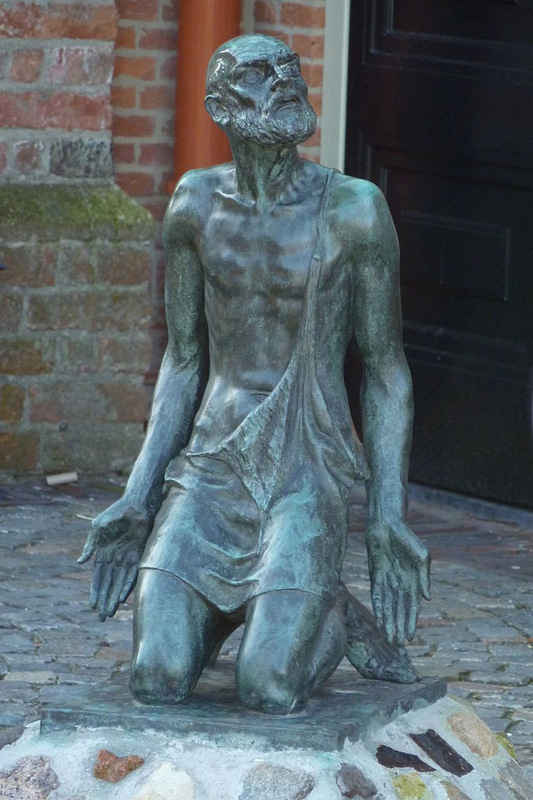
Job Talks to God, from Art in the Christian Tradition, a project of the Vanderbilt Divinity Library, Nashville, TN. http://diglib.library.vanderbilt.edu/act-imagelink.pl?RC=55467 [retrieved October 8, 2018]. Original source: http://commons.wikimedia.org/wiki/File:Noordwijk_Sint-Jeroenskerk_beeld.jpg.

10646937_10204043191333252_4540780665023444969_nRobert Cornwall is the Pastor of Central Woodward Christian Church in Troy, Michigan. He holds the Ph.D. in Historical Theology from Fuller Theological Seminary. He is the author of a number of books including Out of the Office (Energion, 2017), Marriage in Interesting Times (Energion, 2016), and Freedom in Covenant (Wipf and Stock, 2015) and blogs at Ponderings on a Faith Journey.

Saving Our Skins? A Lectionary Reflection for Pentecost 20B (Job 2)

Saving Our Skins? A Lectionary Reflection for Pentecost 20B (Job 2)

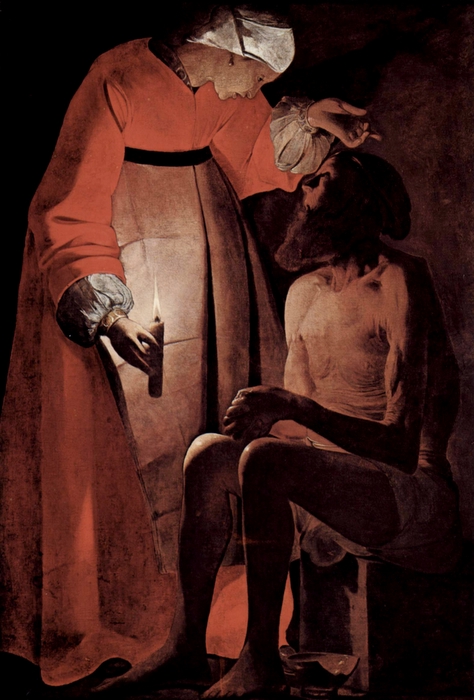
Job & his wife – La Tour
1:1 There was once a man in the land of Uz whose name was Job. That man was blameless and upright, one who feared God and turned away from evil.
2:1 One day the heavenly beings came to present themselves before the Lord, and Satan also came among them to present himself before the Lord. 2 The Lord said to Satan, “Where have you come from?” Satan answered the Lord, “From going to and fro on the earth, and from walking up and down on it.” 3 The Lord said to Satan, “Have you considered my servant Job? There is no one like him on the earth, a blameless and upright man who fears God and turns away from evil. He still persists in his integrity, although you incited me against him, to destroy him for no reason.” 4 Then Satan answered the Lord, “Skin for skin! All that people have they will give to save their lives. 5 But stretch out your hand now and touch his bone and his flesh, and he will curse you to your face.” 6 The Lord said to Satan, “Very well, he is in your power; only spare his life.” 
7 So Satan went out from the presence of the Lord, and inflicted loathsome sores on Job from the sole of his foot to the crown of his head. 8 Job took a potsherd with which to scrape himself, and sat among the ashes. 
9 Then his wife said to him, “Do you still persist in your integrity? Curse God, and die.” 10 But he said to her, “You speak as any foolish woman would speak. Shall we receive the good at the hand of God, and not receive the bad?” In all this Job did not sin with his lips.
******************
                Job was a righteous man from the land of Uz (wherever that is), whom Satan dared God to torment, to test his faith. God agreed to the wager, and as a result Job’s children were killed by raiding parties and his property destroyed. It was a sad day for Job, but he remained firm in his righteousness. He grieved but didn’t curse God. That’s the essence of chapter one of Job, though the lectionary includes only the introductory verse in the selection for Pentecost 20B. That’s because the focus is on chapter two and a second wager, this time involving Job’s own body. Will Job remain faithful with this twist in the story.
                As in chapter one, in chapter two of Job, the heavenly council gathers with Yahweh presiding. Satan appears once again before Yahweh, who once again asks Satan what he’s been up to. The answer is, “I’ve been traveling around the earth, checking things out, seeing what people are doing.” Once again, Yahweh asks Satan, what he thinks of Job. After all, “there is no one like him on the earth, a blameless and upright man who fears God and turns away from evil. He still persists in his integrity, although you incited me against him, to destroy him for no reason.” Did you notice God’s response? Job remained blameless and upright, even though Satan had “incited me against him, to destroy him for no reason.” God is rather proud of this man, whom God had allowed to be tested.
                I have always been intrigued by the story of Job. It invites us to think through our understanding of God, including God’s relationship to the world. In my theology, God is love, and a God who is love doesn’t go around messing people’s lives. Yet, that is the story, which should cause us to pause before embracing a literalist interpretation. In this picture of God, God is rather petty. God play games with a man’s life, by letting his children be murdered and his property destroyed, just to see if Job will stay firm in his faith. Job does, despite everything that is thrown at him. Job is righteous, but what about God? Is God so thin-skinned that God can be manipulated by Satan? It’s a question we must face, if we’re to hear this story.
                If we’re to read Job in a way that informs us theologically, we need to affirm at the very beginning that this fiction. The first clue ought to be Job’s homeland. Where is Uz? It could be Edom, but who knows. The picture of the heavenly court is also a clue, though it gives evidence of its rootedness in a pre-monotheist Israel. Whatever its origins, the book raises questions about our understanding of God, the nature of faith, and the challenge posed to that faith by human suffering. With that is our opening point, we need to also address this important character who appears in the early chapters, and that is the person of Satan. The character of Satan as depicted here is not the devil of human imagination. This is no figure with red skin, horns, and a pitchfork. This figure is more an informant, sent out by God, as would a king, to keep watch for rebellious activities. In this set of exchanges, Satan raises questions about Job’s piety. Is it based on living the good life, and if that good life is taken away, the piety would go away as well? It’s a good question, and whether we like the way the question is set up, it does speak to our own realities.
                In chapter two, when God asks Satan what he thinks of Job’s response to misfortune, Satan responds that this is to be expected. It’s one thing to lose your family and property. It’s another thing to have your own body afflicted. Isn’t it human nature to do whatever we can to save our own skins, even at the expense of those closest to us? That’s just the way things are. Jesus knew that. In the Gospel of John, we hear him say: “No one has greater love than this, to lay down one’s life for one’s friends” (John 15:13). Jesus will do that for his friends, but what about us? When push comes to shove, won’t we save our own skins? That’s the wager. So, God goes along with the wager, allowing Job to be afflicted, but not killed. Pushed to the limit, will he curse God?  That’s the question.
                Satan went and cursed Job, causing sores to appear on his body running from the soles of his feet to the crown of his head. In other words, the totality of his body was covered with “loathsome sores.” He was miserable. He probably wished to die. But he remained firm in his faith. He did so, even when his wife suggested that he curse God, so he might die. Curse God and get it over with. That was her advice. But he refused. He remained firm in his faith, despite everything.
                Satan was wrong. Job didn’t save his own skin by cursing God, though Job’s wife encouraged him to do so. He told his wife that one should expect both the good and the bad from the hand of God. That isn’t a comforting word on Job’s part. It doesn’t fit with my own theology. It’s not that I plan on cursing God, but I am troubled by the idea that God would authorize the bad. God might allow something bad to occur, or maybe, just maybe, there are things God simply cannot do. Through it all, however, Job remains firm in his faith.
This response on Job’s part, his decision to accept his fate and not curse God sets up the next phase of the story, his encounter with his “friends,” who at first seek to comfort him and then as time passes, and Job won’t confess his sins, raise questions about Job’s righteousness. After all, isn’t suffering the result of wrong doing? So far, however, Job does nothing to warrant his suffering, if suffering results from wrongdoing. His suffering comes from a divine directive.
                The questions raised by the Book of Job are important ones. In some ways the Book challenges another strain of Wisdom Literature that presumes that blessing is a sing of righteousness and suffering is a sign of unrighteousness. It also invites us to consider the we view the divine-human relationship. Marvin Sweeney, a Jewish scholar of the Hebrew Bible (and my son’s professor) at a Protestant seminary, offers these words of insight:

The book of Job deliberately presents the model of a righteous man who suffers with no apparent moral justification in an effort to force critical reflection on the issue. The arguments posed by Job’s friends concerning the meaning of human suffering and their assertions of divine righteousness even in the face of evil and Job’s responses to each of them are in fact the key issues of the book. The book of Job is intended to question the standard theological premises of the Torah and the Prophets, viz., is it really the case that observance of the divine will leads to success and peace in life? Is it really the case that the wicked suffer— and not the righteous? Is it really the case that G-d is just? Indeed, the final episode in which G-d affirms Job’s demands for an explanation for his suffering— even though G-d never provides such explanation— indicates that such a critical agenda is in fact the purpose of the book. In the end, the book of Job affirms divine presence and it appears to affirm divine righteousness, but the book also affirms the right and obligation of human beings to ask such questions of G-d. In this respect, Job points to and affirms a model of a human being in critical dialog with G-d.  [Sweeney, Marvin A. Tanak: A Theological and Critical Introduction to The Jewish Bible (Kindle Locations 11439-11447). Fortress Press. Kindle Edition.]

                The door is open. Are willing to walk through? Are willing to enter a critical dialog with God, as Sweeney proposes? The lectionary moves quickly, jumping from chapter two to chapter twenty-three. We don’t get to see the dialog with the friends, but we do experience Job’s complaint, which is set up by this attack on Job’s skin.

Picture attribution: La Tour, Georges du Mesnil de, 1593-1652. Job and his Wife, from Art in the Christian Tradition, a project of the Vanderbilt Divinity Library, Nashville, TN. http://diglib.library.vanderbilt.edu/act-imagelink.pl?RC=46621 [retrieved October 1, 2018]. Original source: http://www.yorckproject.de.

10646937_10204043191333252_4540780665023444969_nRobert Cornwall is the Pastor of Central Woodward Christian Church in Troy, Michigan. He holds the Ph.D. in Historical Theology from Fuller Theological Seminary. He is the author of a number of books including Out of the Office (Energion, 2017), Marriage in Interesting Times (Energion, 2016), and Freedom in Covenant (Wipf and Stock, 2015) and blogs at Ponderings on a Faith Journey.

A Reversal of Fortunes – Lectionary Commentary for Pentecost 19B (Esther)

A Reversal of Fortunes – Lectionary Commentary for Pentecost 19B (Esther)

Esther 7:1-10; 9:20-22 New Revised Standard Version (NRSV)

7:1 So the king and Haman went in to feast with Queen Esther. 2 On the second day, as they were drinking wine, the king again said to Esther, “What is your petition, Queen Esther? It shall be granted you. And what is your request? Even to the half of my kingdom, it shall be fulfilled.” 3 Then Queen Esther answered, “If I have won your favor, O king, and if it pleases the king, let my life be given me—that is my petition—and the lives of my people—that is my request. 4 For we have been sold, I and my people, to be destroyed, to be killed, and to be annihilated. If we had been sold merely as slaves, men and women, I would have held my peace; but no enemy can compensate for this damage to the king.” 5 Then King Ahasuerus said to Queen Esther, “Who is he, and where is he, who has presumed to do this?” 6 Esther said, “A foe and enemy, this wicked Haman!” Then Haman was terrified before the king and the queen. 7 The king rose from the feast in wrath and went into the palace garden, but Haman stayed to beg his life from Queen Esther, for he saw that the king had determined to destroy him. 8 When the king returned from the palace garden to the banquet hall, Haman had thrown himself on the couch where Esther was reclining; and the king said, “Will he even assault the queen in my presence, in my own house?” As the words left the mouth of the king, they covered Haman’s face. 9 Then Harbona, one of the eunuchs in attendance on the king, said, “Look, the very gallows that Haman has prepared for Mordecai, whose word saved the king, stands at Haman’s house, fifty cubits high.” And the king said, “Hang him on that.” 10 So they hanged Haman on the gallows that he had prepared for Mordecai. Then the anger of the king abated. 
9:20 Mordecai recorded these things, and sent letters to all the Jews who were in all the provinces of King Ahasuerus, both near and far, 21 enjoining them that they should keep the fourteenth day of the month Adar and also the fifteenth day of the same month, year by year, 22 as the days on which the Jews gained relief from their enemies, and as the month that had been turned for them from sorrow into gladness and from mourning into a holiday; that they should make them days of feasting and gladness, days for sending gifts of food to one another and presents to the poor.   [note: verses 8-9 are omitted from the Revised Common Lectionary]

********

The lectionary invites us to make a quick stop in the Book of Esther. This is the only lectionary stop, which means a lot of context is lost. We would need to reconstruct the context to fully appreciate the message, but perhaps the lectionary creators would have us consider the origins of the Jewish festival of Purim, which is rooted here in Esther. There’s not time or space here to fully reconstruct, but it’s worth noting that this story is somewhat unique in that it never mention’s the name of God. In fact, God is not really an actor in this story. It is the human participants who do what they need to do to survive. We can, if we wish, read between the lines, filling in the white space with a theological component. Of course, the fact that God isn’t mentioned made this a good book to use to learn Hebrew (thus, we used this book when I took Hebrew many years ago). This is a rather untheological book (which is why we used it to learn Hebrew in seminary).
To give a brief foundation to our story, Esther is set in the post-exilic period, after the Persians had displaced the Babylonian Empire, and the exile had been ended. This story features two Jews who remain behind in the Persian capital. One of the figures is perhaps a minor official in the king’s service, a man named Mordecai. The second person is Mordecai’s cousin and adopted daughter, who is named Esther. In the course of the story, Esther becomes queen of Persia, putting her in a position to help her people when under threat. Esther becomes queen of Persia after the former queen, Vashti was dethroned, because she refused to dance for husband’s friends. As time passed, the king was feeling lonely and regretting ridding himself of Vashti, so his servants suggested finding another queen. That led to an empire-wide search, a beauty pageant, and the selection of Esther as the new queen (apparently with some help from Mordecai, who saw this as an opportunity to protect himself and his people should a threat arise. Remember, for the Jewish people survival was always in doubt).
There are two other figures to take note of here. The first is the king, Ahasuerus [possibly Xerxes (486-465 BCE)]. The second figure is Haman, the king’s first minister, who became annoyed when Mordecai refused to bow to him. In response, Haman devised a plot to get rid of Mordecai, along with Mordecai’s people. In other words, Haman threatened genocide. Fortunately, Mordecai gets wind of the plot and calls upon his adopted daughter, now the queen, to intervene. It will take some convincing, because even queens must be invited into the presence of the king. So, she must devise a plan to get him in her presence, so she can make the big reveal. That leads to a series of banquets. One of things you’ll notice in Esther is that there are lots of banquets and feasts. Some of them last for lengthy period. They like their wine and food!
That is where we pick up the story in chapter seven of Esther. The Queen and Mordecai have conceived a plot to out Haman. To do this, she has scheduled a more intimate dinner party, inviting both the king, who in this story is easily manipulated, and his chief minister, Haman. Of course, Haman is excited to have been invited to dine with the queen and her husband. Apparently, to this point Haman has connected Esther and Mordecai (why we’re not told, except that Mordecai had made sure that Esther not reveal her true ethnic identity). He’s just excited about the party. As for the king, he likes to party. Then there’s Esther, who must be careful, for Haman is an important and respected servant of the king (if a bit arrogant). Will the king believe her? Will she, in revealing her identity, cause the king problems? This was a risky venture, but Mordecai had assured her that this is why she had become queen. It was for a time like this, when she could protect her people.
When the passage begins, the king and Haman have arrived at the party and are having a great time, until Esther decides to rock the boat and bring up a rather unsavory topic. That topic was a plot to destroy her people, and her with it. Now, this got the king’s attention because he was very attracted to Esther. But that’s not all, she was savvy, and she suggested that if she and her people were to be destroyed, this would dishonor the king. With that, she has the upper hand. She has manipulated both the king and the henchman who sought the destruction of her people. When asked who the culprit was, she pointed her finger at the king’s chief minister, Haman, who was jealous of Mordecai. The king gets angry and storms out of the room, only to return to find his chief minister throwing himself on the queen. Verses 8-9, which describe Haman throwing himself on the queen, not to assault her, as the king thought, but to beg for his life, are omitted in the Revised Common Lectionary. While verses 8-9 might not be included in the lectionary reading, they are helpful in truly understanding the fullness of the king’s anger.
Whatever Haman thought he might accomplish by begging for his life was now impossible. The king might have spared him before, but not now. At this the king’s sermon points to the gallows being built outside for Mordecai, suggesting that they might now be used to execute Haman. It is worth noting that Harbona, the servant, reminds the king that it was Mordecai who warned the king of the plot against his life. Thus, Haman is executed, and the king’s anger subsides.
It’s all a rather exciting story that might even be useful in our day, as the question of sexual assault and harassment has become an important conversation. Of course, the situations are very different, as is the cultural context. The king might be more concerned about an assault on someone who is his property than her safety. In any case, the sight of Haman near his wife only compounded the situation revealed by the Queen.
With this story revealed, we jump down into chapter 9, where we find Mordecai writing a letter to all the Jews in the Empire, asking that they gather for an annual festival on the fourteenth and fifteenth days of Adar, to celebrate the moment when the Jews gained relief from their enemies, and as the month that had been turned for them from sorrow into gladness and from mourning into a holiday.” The festival so-noted is Purim.
As we read this passage, which describes a reversal of fortunes, we might want to do so in contrast to other passages of scripture, where God is the primary actor. Why did a book like this make it into the canon since God is not mentioned? I appreciate the interpretation given by Noelle Damico. She comments on the passage, noting that the book offers us “vulnerable characters who are unafraid to handle power and who view their future as something for which they, not a monarch or even God is responsible.” This is the story of human agency in defense of their own personhood. Since Damico’s comments on Esther are found in a lectionary commentary addressing justice, she addresses our own times:

In our own day it’s not only political leaders that hold the fate of whole peoples in their hand, but corporations and international agreements as well as economic, political, and social systems. How is the church working together with vulnerable people to analyze and alter those forces that treat people as expendable? [Preaching God’s Transforming Justice, p. 416].

What might we learn from the story of Esther and Mordecai? Might we discern that God has empowered us to take on the powers that be? We have been equipped for this task. Mordecai and Esther were from a small and marginal people, and yet they stood toe to toe with a mighty empire and not only survived but stood tall in the world. And as Mordecai reminded his people, this was something to celebrate!
One other suggestion, if one is preaching the text, it might be worth encouraging the congregation to read the entire story.

Picture Attribution: Victors, Jan, 1619-1676. Esther and Haman before Ahasuerus, from Art in the Christian Tradition, a project of the Vanderbilt Divinity Library, Nashville, TN. http://diglib.library.vanderbilt.edu/act-imagelink.pl?RC=54179 [retrieved September 24, 2018]. Original source: http://commons.wikimedia.org/wiki/File:Jan_Victors_-_Esther_en_Haman_voor_Ahasverus.jpg.

10646937_10204043191333252_4540780665023444969_nRobert Cornwall is the Pastor of Central Woodward Christian Church in Troy, Michigan. He holds the Ph.D. in Historical Theology from Fuller Theological Seminary. He is the author of a number of books including Out of the Office (Energion, 2017), Marriage in Interesting Times (Energion, 2016), and Freedom in Covenant (Wipf and Stock, 2015) and blogs at Ponderings on a Faith Journey.


The Warrior-Like Woman of Wisdom – Lectionary Reflection for Pentecost 18B (Proverbs 31)

The Warrior-Like Woman of Wisdom – Lectionary Reflection for Pentecost 18B (Proverbs 31)

Proverbs 31:10-31 New Revised Standard Version (NRSV)
 
10 A capable wife who can find?
She is far more precious than jewels.
11 The heart of her husband trusts in her,
and he will have no lack of gain.
12 She does him good, and not harm,
all the days of her life.
13 She seeks wool and flax,
and works with willing hands.
14 She is like the ships of the merchant,
she brings her food from far away.
15 She rises while it is still night
and provides food for her household
and tasks for her servant-girls.
16 She considers a field and buys it;
with the fruit of her hands she plants a vineyard.
17 She girds herself with strength,
and makes her arms strong.
18 She perceives that her merchandise is profitable.
Her lamp does not go out at night.
19 She puts her hands to the distaff,
and her hands hold the spindle.
20 She opens her hand to the poor,
and reaches out her hands to the needy.
21 She is not afraid for her household when it snows,
for all her household are clothed in crimson.
22 She makes herself coverings;
her clothing is fine linen and purple.
23 Her husband is known in the city gates,
taking his seat among the elders of the land.
24 She makes linen garments and sells them;
she supplies the merchant with sashes.
25 Strength and dignity are her clothing,
and she laughs at the time to come.
26 She opens her mouth with wisdom,
and the teaching of kindness is on her tongue.
27 She looks well to the ways of her household,
and does not eat the bread of idleness.
28 Her children rise up and call her happy;
her husband too, and he praises her:
29 “Many women have done excellently,
but you surpass them all.”
30 Charm is deceitful, and beauty is vain,
but a woman who fears the Lord is to be praised.
31 Give her a share in the fruit of her hands,
and let her works praise her in the city gates.
 
******************
 
            As a preacher in the twenty-first century, I might choose to pass by this passage that closes out the Book of Proverbs. Here is a woman who works from sun up to sun down so her husband can sit at the city gates and talk politics with the other men in town. A wife like the one described here is truly worth far more than precious jewels. She is indispensable. She gets up early, does all the work of the family, is a business woman, and a purveyor of wisdom. As she engages in all this work, her husband enjoys a life of leisure. I know that the passage has been used as the basis of many a Mother’s Day sermon. The preacher probably thinks he (it will be a he) is honoring the mothers in the room for their hard work. All I can say is that if you use this on Mother’s Day, be careful, because the message conveyed might be that to be a good wife and mother, one must be Superwoman. As a man, I’d rather not have that message returned to me—that is, I hope I don’t have to be a superhero to be a good husband and father.
                The NRSV opens with the words “a capable wife who can find?” The message here might be one of usefulness. When we read through the passage, it’s clear that it emphasizes the capable wife’s industriousness and her leadership abilities. This allows her husband to put his trust in her. That is all well and good, and yet it may hold up an impossible ideal, especially if in a patriarchal context a wife/woman is expected to be someone no man would be expected to be. I can imagine many a woman looking at this list, perhaps feeling inspired (at first) but then overwhelmed by the expectations.
                So, maybe there is a different message inherent in this passage. Maybe the utilitarianism of the NRSV translation leads us astray. Kathleen O’Connor suggests that the NRSV translation isn’t strong enough. Better is the translation a “strong woman;” or even better is “warriorlike woman.” Now we are moving in a new direction. This warrior-like woman could be, and I think is, Lady Wisdom (Gk. Sophia). O’Connor writes that “she is a mysterious figure who greatly rewards anyone who settles down to live in her household” [Feasting on the Word, p. 75]. Since this is the closing chapter of the Book of Proverbs, which personifies Wisdom as a woman, it makes sense that this passage would have wisdom in mind. Thus, O’Connor writes that “her behavior summarizes the virtues of wise living promulgated by the book and enjoyed by anyone who follows her call” [p. 75]. In other words, this “capable wife” is a model not just for mothers and wives, but for all of us. This is the ideal of wisdom personified.
                If we adopt the translation here “warrior-like woman,” then perhaps we can discern the power of Wisdom to form our lives as we live in the world. The path of Wisdom does good, not harm. It is industrious. It is productive. It is discerning. As we have seen before, for the writer of Proverbs, Wisdom is concerned about those who are poor and living on the margins. It is not self-serving.
                Yes, the “ode” is written in a patriarchal culture and expresses patriarchal elements, but the point here is not whether marriage is egalitarian or inegalitarian, concepts likely unknown to the culture that produced this word. While this is true, I do think we can take something important from the passage regarding the role of women in society. At the very least the writer of this song recognizes and acknowledges that women can be wise, industrious, and capable. In other words, it counters the lie that has been told, often in Christian circles that women are inferior to men, can’t engage in business, or serve as leaders. That the author could conceive of women operating in these roles should be the final nail in the coffin that limits women’s place in church and society. We need not expect any woman or any person to embody all these traits. We simply need to affirm the possibility that women are as capable as men to live a life of wisdom.
                If we can affirm the place of women in society, and acknowledge that women can be powerful persons, that is “warrior-like” then we can better envision Wisdom as our path of life. As Kenneth Carter puts it:

Wisdom maybe defined as a life well lived, a life that matters. Wisdom in the Bible is not enlightenment. Rather, wisdom is a lifetime of obedience to God, discipline honed in daily decisions. . .. In scripture wisdom is a way of life that includes justice, righteousness, humility, compassion and fairness” [Feasting on the Word, p. 76].

The woman portrayed here embodies these traits, and we are encouraged to follow in her footsteps. It may be more aspirational than descriptive, but it is a goal toward which we might move.
10646937_10204043191333252_4540780665023444969_nRobert Cornwall is the Pastor of Central Woodward Christian Church in Troy, Michigan. He holds the Ph.D. in Historical Theology from Fuller Theological Seminary. He is the author of a number of books including Out of the Office (Energion, 2017), Marriage in Interesting Times (Energion, 2016), and Freedom in Covenant (Wipf and Stock, 2015) and blogs at Ponderings on a Faith Journey.


Wisdom Calls – A Lectionary Reflection for Pentecost 17B (Proverbs 1)

Wisdom Calls – A Lectionary Reflection for Pentecost 17B (Proverbs 1)

 
Proverbs 1:20-33 New Revised Standard Version (NRSV)
 
20 Wisdom cries out in the street;
in the squares she raises her voice.
21 At the busiest corner she cries out;
at the entrance of the city gates she speaks:
22 “How long, O simple ones, will you love being simple?
How long will scoffers delight in their scoffing
and fools hate knowledge?
23 Give heed to my reproof;
I will pour out my thoughts to you;
I will make my words known to you.
24 Because I have called and you refused,
have stretched out my hand and no one heeded,
25 and because you have ignored all my counsel
and would have none of my reproof,
26 I also will laugh at your calamity;
I will mock when panic strikes you,
27 when panic strikes you like a storm,
and your calamity comes like a whirlwind,
when distress and anguish come upon you.
28 Then they will call upon me, but I will not answer;
they will seek me diligently, but will not find me.
29 Because they hated knowledge
and did not choose the fear of the Lord,
30 would have none of my counsel,
and despised all my reproof,
31 therefore they shall eat the fruit of their way
and be sated with their own devices.
32 For waywardness kills the simple,
and the complacency of fools destroys them;
33 but those who listen to me will be secure
and will live at ease, without dread of disaster.”
                        ********
    How long before Wisdom’s call will be answered? The failure to heed the call of wisdom has important consequences. Should we hate knowledge, should we choose not to “fear the Lord” disaster awaits us. The word we hear in this passage is not encouraging. That it is found in the first chapter of Proverbs should serve as a warning. Ignore Wisdom to your own detriment. So, wake up. Look around. Pay attention. Give heed to knowledge. Don’t bury your head in the sand. Wisdom has taken her place in the streets, on the street corners, crying out at anyone who will listen and heed her warnings? Perhaps like the preacher who stands and the corner and shouts at the passersby, we ignore her words. The word here is that we do so at our own peril?
It’s easy to ignore the sidewalk preacher. We scoff at the message and the messenger, and yet perhaps there is a word that needs to be heard. We live at a time when people are uncertain about the future. We are skeptical of our leaders. We don’t trust them. We’re willing to entrust our government to inexperienced hands, and even hands that might be dangerous. Only time will tell, but are we listening to Wisdom’s counsel? Or are we simply wandering around in a daze, heading off a cliff?
What should we make of this word? As I ponder this word from Wisdom herself, there are many situations that come to mind. Having lived through the hottest summer on record, I’m ready to heed the warning that climate change is at work. In my homeland of California and Oregon, fire season is getting longer and more devastating. Why? Heat, drought. Climate. Of course, not everyone agrees with the science, nor, apparently, their eyes and ears. But Wisdom warns us—ignorance is not bliss. We ignore the warnings at our peril.She tells us that if we give heed to her words, she will pour out her wisdom. If ignore them. Well . . .
There is good news. If we heed the words of Wisdom, we will dwell secure. That offer of blessing might be a bit premature, but it is a reminder that in most cases, when we pay attention to the facts we will be better off. Not in every case, of course, but normally. Whenever I read the Book of Proverbs, I keep in mind the counter voice of Job. He was righteous. He did was right. Bad things still happened to him. Bad things do happen to good people. But, while that is true, we can, should we choose to heed Wisdom’s warnings, work against those bad things, and perhaps turn things in a different direction.
Life is filled with choices. We can heed the warnings, or we can ignore them. It is true that if we tune Wisdom out, Wisdom may cease calling out to us. Again, that is at our peril. We don’t to wait until its too late to listen. Listening is best done in community. J.B. Blue writes: “Life is lived in community, and we who seek to live wisely bear responsibility to consider the consequences of personal and social choices.” We must listen for those consequences in every area of our lives. [Preaching God’s Transforming Justice, p. 396].
Wisdom calls out to us. Wisdom warns us of danger. Wisdom points us in the right direction. Will we heed the call?

Picture Attribution:  Lamp of Wisdom, from Art in the Christian Tradition, a project of the Vanderbilt Divinity Library, Nashville, TN. http://diglib.library.vanderbilt.edu/act-imagelink.pl?RC=54977 [retrieved September 8, 2018]. Original source: http://www.flickr.com/photos/rowanbank/5815103193/.

10646937_10204043191333252_4540780665023444969_nRobert Cornwall is the Pastor of Central Woodward Christian Church in Troy, Michigan. He holds the Ph.D. in Historical Theology from Fuller Theological Seminary. He is the author of a number of books including Out of the Office (Energion, 2017), Marriage in Interesting Times (Energion, 2016), and Freedom in Covenant (Wipf and Stock, 2015) and blogs at Ponderings on a Faith Journey.


The Wisdom of Justice – Lectionary Reflection for Pentecost 16B (Proverbs 22)

The Wisdom of Justice – Lectionary Reflection for Pentecost 16B (Proverbs 22)

South American Potluck – Emily Schaefer
Proverbs 22:1-2, 8-9, 22-23 New Revised Standard Version (NRSV)
 
22 A good name is to be chosen rather than great riches,
    and favor is better than silver or gold.
2 The rich and the poor have this in common:
    the Lord is the maker of them all. 

8 Whoever sows injustice will reap calamity,
    and the rod of anger will fail.
9 Those who are generous are blessed,
    for they share their bread with the poor. 

22 Do not rob the poor because they are poor,
    or crush the afflicted at the gate;
23 for the Lord pleads their cause
    and despoils of life those who despoil them.
****************
                It is said that you can prove just about anything from Scripture. There is some truth to this, as people have been from time immemorial scouring scripture for proof-texts to support all manner of positions, from the support of slavery to the suppression of women. When it comes to the Book of Proverbs, there are texts that seem to support the premise that wealth is a sign of divine blessing, and that poverty is a sign of divine judgment. Consider a word like this: “I walk in the way of righteousness, along the paths of justice, endowing with wealth those who love me, and filling their treasuries” (Prov. 8:20-21). Such a vision can lead to what is known as the “retribution dogma.” It is a dogma that has ancient roots and continues to be popular. It is used to support the idea of a prosperity doctrine, but it is also used as support for the idea that the poor are to blame for their poverty. While it is true that in some cases poverty is the result of bad choices, this is not always true. It might not be true in most cases. But you have heard it said, perhaps even from the pulpit, that if you are poor, it must be because you are lazy or spend your money on things you shouldn’t. The corresponding message is that if you really wanted to rise out of poverty, you would take the necessary steps to get yourself out of your poverty. After all, doesn’t scripture say that “God helps those who help themselves?” Just a reminder—there is no such biblical passage.
                The reading from Proverbs 22 offers a counter proposal, suggesting that whether we are rich or poor, we are all created by God. Whatever the reason for one’s poverty or wealth, we are all created by God, and therefore bear God’s image. This means as those created by God (and as Genesis 1 reminds us, we’re created in the image of God), are equal in the sight of God. As for riches, well a good name is better!
                You might say that these passages are an expression of the social gospel, suggesting that justice for the poor is a mark of wisdom. Consider for a moment the message of verse 8: “Whoever sows injustice will reap calamity, and the rod of anger will fail.” Now there is a word of judgment here, but it is directed at those who engage in injustice. They will suffer the judgment of God.  If those who are unjust will experience judgment, in verse 9 we read that “those who are generous are blessed, for they share their bread with the poor.” Some might read this to suggest that all that is needed is charity. Bread is enough. There is no need for the church to get involved in advocating for policies on the part of the government that would alleviate poverty. I do not believe that this is the case. This is the baseline. We should care for those in need, but that doesn’t mean we leave the conditions that lead to poverty untouched. That would, in my mind, involve sowing injustice.
                The third set of verses (22-23), makes this much clearer. First, we hear the word: “Do not rob the poor because they are poor, or crush the afflicted at the gate.” Here, I’m reminded of the parable that Nathan told David, after David took Bathsheba, sexually assaulted her, and then had her husband killed—something about a lamb (2 Sam. 12:1-14). The poor are often poor because they are defenseless. They are easily exploited. As it is said, the rich get richer and the poor get poorer. Some might bring in the principles of “social Darwinism” (not to be confused with biological evolution, which this idea seeks to emulate socially)—those who are the fittest will survive and be successful.
                The word that follows speaks of God’s role in all of this. In verse 23 we hear the that “the Lord pleads their cause and despoils of life those who despoil them.” Could this be a foundational text for the principle of God’s “preferential option for the poor”? In a passage from the New Testament, the Letter of James warns against showing partiality to the rich over the poor. Indeed, James writes to the people of God: “Has not God chosen the poor in the world to be rich in faith and to be heirs of the kingdom that he has promised to those who love him?” (James 2:5B). In fact, James suggests that his readers might want to remember that it is the rich not the poor who oppress them. The lectionary invites us to consider the words of James and the writer of Proverbs, recognizing that if there is a place for favoritism, it is on behalf of the poor.
                As we consider the message of these verses from Proverbs 22, we should take into consideration the overall ambivalence present in Proverbs concerning wealth and poverty. We should not forget that here, in chapter 22, we have a word that declares that “The reward for humility and fear of the Lord is riches and honor and life” (vs. 4). When we read a word like this, it is natural for us to take the next step and assume that poverty is the mark of arrogance and rejection of God’s authority. Thus, as Julia O’Brien suggests:

The wise interpreter, then, will find a way to honor this ambiguity as well as to honor the insistence of Proverbs on integrity, wisdom, and justice. One way to do so is to recognize how a given claim to truth resonates differently in different life contexts; another is to listen to the life stories and life truths of others. [Feasting on the Word, p. 31].

This is a wise word to us. Let us listen to the stories of others before making rash judgments. There are wealthy people who are righteous, and wealthy people who are unjust. The same can be said for those on the other end of the spectrum. For this week, however, let us hear the word of wisdom that God is truly concerned about the lives of those who are poor, and as the people of God, we should share that concern.

Picture Attribution: Emily Schaffer. South American Potluck, from Art in the Christian Tradition, a project of the Vanderbilt Divinity Library, Nashville, TN. http://diglib.library.vanderbilt.edu/act-imagelink.pl?RC=54157 [retrieved September 3, 2018]. Original source: Emily Schaffer.

Robert Cornwall is the Pastor of Central Woodward Christian Church in Troy, Michigan. He holds the Ph.D. in Historical Theology from Fuller Theological Seminary. He is the author of a number of books including Out of the Office (Energion, 2017), Marriage in Interesting Times (Energion, 2016), and Freedom in Covenant (Wipf and Stock, 2015) and blogs at Ponderings on a Faith Journey.


Arise My Love – Lectionary Reflection for Pentecost 15B (Song of Solomon)

Arise My Love – Lectionary Reflection for Pentecost 15B (Song of Solomon)

Song of Solomon 2:8-13 New Revised Standard Version (NRSV)


The voice of my beloved!
Look, he comes,
leaping upon the mountains,
bounding over the hills.
My beloved is like a gazelle
or a young stag.
Look, there he stands
behind our wall,
gazing in at the windows,
looking through the lattice.
10 My beloved speaks and says to me:
“Arise, my love, my fair one,
and come away;
11 for now the winter is past,
the rain is over and gone.
12 The flowers appear on the earth;
the time of singing has come,
and the voice of the turtledove
is heard in our land.
13 The fig tree puts forth its figs,
and the vines are in blossom;
they give forth fragrance.
Arise, my love, my fair one,
and come away.


*********************

            The Pentecost journey through the Hebrew Bible, at least the pathway I’ve chosen, leads us to this selection from the Song of Solomon. The prior week’s reading invited us to consider Solomon’s prayer at the dedication of the Temple. Solomon was renowned for his wisdom, at least that is the word we hear from Scripture. Therefore, with the story of Solomon’s wisdom providing the background, we turn to readings attributed to Solomon. He might not have written the Song of Solomon or the Book of Proverbs (the lectionary takes us to the book of Proverbs over the next few weeks). These readings come from the section of the Hebrew Bible that we call “The Writings,” and contain much of the Wisdom literature of the Bible.
 
The Song of Solomon, also known as Song of Songs and Canticles, has a distinctly erotic element, that is often softened in Christian readings by way of allegory. Perhaps it is due to Solomon’s reputation as one who had hundreds of wives and concubines, so that he would understand the power of erotic love, that this song is attributed to him. Due to his own experience, he could write authoritatively about human relationships and human sexuality. When one reads from the Song of Songs, with its powerful erotic imagery, it is understandable, that early Christians sought to allegorize it. Thus, while on the surface this is a song sung by two lovers, it is often read allegorically to describe the relationship of Christ and Church.
 
While it is doubtful that the original author of this song envisioned it being applied to Christ and Church, allegory and midrash are interpretative schemes that are not determined by the original intent but are meant to speak to the current situation. As to the gender of the author, while it is attributed to Solomon, a man, Renita Weems suggests the possibility that the author is a woman, due to “the preponderance of female speakers and experiences in the book.” Based on the language used in the song, she suggests that “it is not farfetched to imagine that the lyrics were inspired by someone (a woman) from an elite class who, at least modestly educated, was familiar with the Hebrew lyrical heritage and aware of prevailing assumptions about the role of women and the prohibitions against marriages crossing class and ethnic lines” [“Song of Songs,” NIB, 5:365].
 
            In my book Marriage in Interesting Times, I have a chapter that looks at chapters 7-8 of the Song of Solomon, exploring the Bible’s witness to the importance of sexual intimacy in relationship to marriage. In that chapter I note that while the allegorical reading is possible, we should not miss the witness of the song to the “beauty of embodied human love” (Marriage in Interesting Times, p. 47).  Read straight this is a portion of a love song sung by the one who awaits her lover, who is bounding across the mountains toward her. The invitation that goes out is simple: “Arise, my love, my fair one, and come away.”
 
            The voice of the one who sings this song about the beloved would appear to be a woman, awaiting her beloved to come and get her. Her lover “is like a gazelle or a young stag.” He bounds over hills to come to her and call her to him. The winter is past. The rains have come and gone. The flowers have broken forth across the land. The fig trees are beginning to bear fruit. It is spring time in the land, and therefore it’s time to go on a journey. It’s possible that this is a forbidden union, which requires her beloved to come to her with stealth. This a song of passionate love that overcomes, it would seem, barriers being erected to keep the two lovers apart (Romeo and Juliet without the tragic ending?).  
 
            What should we, the modern Christian reader, take from this passage? Why does it appear in the lectionary? What does it say about intimacy—with God? Within a relationship of love? We often speak of the relationship of God and humanity using the Greek word agape. It is the central term used in the New Testament to describe the relationship between God and humanity. But what role, spiritually, might eros play in our relationship with God? How might God be, as Augustine and others suggested, be the beloved suitor? Renita Weems writes that “the poet uses the language and imagery of a rustic, semi-pastoral culture to evoke passion and desire” [Weems, NIB, 5:395].
 
            While the word eros doesn’t appear in the New Testament, with Paul preferring agape, Tom Oord suggests that Paul “uses language that has eros meanings.” By that he means that Paul speaks of striving for that which is good and beautiful, just and honorable. In fact, in 1 Corinthians 14:1, Paul speaks of pursuing love, which Tom believes is an expression of eros without using the word [Nature of Love, pp. 49-50]. The value of a text like Song of Solomon is that it allows us to broaden our vision of life in the presence of God. For one thing, it celebrates romantic love, an idea I have explored in my biblical study of marriage. Such love is warranted by God. It is a good and perfect gift of God to humanity, not only for perpetuation of the species, but to build relationships between two people, sometimes, as it seems here, crossing those societal walls. It also invites us to consider the possibility of the pursuit of God. Sometimes we are led to believe that only God pursues, that we are passive in the relationship with God. But such is not the vision expressed here. It is a mutual pursuit. 
 
The word that appears twice in this passage is the invitation to “arise, my love, my fair one, and come away.” As we ponder this passage and its meaning for us, might we see this, admittedly allegorically, as an invitation on the part of God to join with God in the journey of faith? Winter is in the past and spring is at hand. This could be seen as an invitation to enjoy God’s grace that transforms. Susan Henry-Crowe interprets the interplay between the two persons in terms of playfulness. Transformation is the product of “playful grace.” Thus, she writes: “Whether the Song is read as a love story between two people or as an allegory about God’s love for all creation, its beauty is that it invites all humankind to play as if life and love depended upon it (as they do)” [Feasting on the Word, p. 6]. Let us, therefore, arise and go away with the one who calls our names, and enjoy the blessings of God’s grace (and human intimacy as well!).
Robert Cornwall is the Pastor of Central Woodward Christian Church in Troy, Michigan. He holds the Ph.D. in Historical Theology from Fuller Theological Seminary. He is the author of a number of books including Out of the Office (Energion, 2017), Marriage in Interesting Times (Energion, 2016), and Freedom in Covenant (Wipf and Stock, 2015) and blogs at Ponderings on a Faith Journey.           

 

God’s Dwelling Place – A Lectionary Reflection for Pentecost 14B

God’s Dwelling Place – A Lectionary Reflection for Pentecost 14B

1 Kings 8:22-30,41-43 New Revised Standard Version (NRSV)
22 Then Solomon stood before the altar of the Lord in the presence of all the assembly of Israel, and spread out his hands to heaven. 23 He said, “O Lord, God of Israel, there is no God like you in heaven above or on earth beneath, keeping covenant and steadfast love for your servants who walk before you with all their heart, 24 the covenant that you kept for your servant my father David as you declared to him; you promised with your mouth and have this day fulfilled with your hand. 25 Therefore, O Lord, God of Israel, keep for your servant my father David that which you promised him, saying, ‘There shall never fail you a successor before me to sit on the throne of Israel, if only your children look to their way, to walk before me as you have walked before me.’ 26 Therefore, O God of Israel, let your word be confirmed, which you promised to your servant my father David.
27 “But will God indeed dwell on the earth? Even heaven and the highest heaven cannot contain you, much less this house that I have built! 28 Regard your servant’s prayer and his plea, O Lord my God, heeding the cry and the prayer that your servant prays to you today; 29 that your eyes may be open night and day toward this house, the place of which you said, ‘My name shall be there,’ that you may heed the prayer that your servant prays toward this place. 30 Hear the plea of your servant and of your people Israel when they pray toward this place; O hear in heaven your dwelling place; heed and forgive.
41 “Likewise when a foreigner, who is not of your people Israel, comes from a distant land because of your name 42 —for they shall hear of your great name, your mighty hand, and your outstretched arm—when a foreigner comes and prays toward this house, 43 then hear in heaven your dwelling place, and do according to all that the foreigner calls to you, so that all the peoples of the earth may know your name and fear you, as do your people Israel, and so that they may know that your name has been invoked on this house that I have built.
**********************
                God is everywhere. God is above us, around us, perhaps below us. Whether we feel that presence or not, we confess by faith that God is there. We call it omnipresence. If God is omnipresent, then why bother with buildings? Why not worship out in nature? Many people claim to do just that. In the story of Israel, it is said that God moved around with the people, dwelling in a tent. When the people finally settled down, David wanted to build a more permanent house for God. After all, David had a nice house. Shouldn’t God have one also? The word sent to David through Nathan the prophet was that no such request had ever been made by God (2 Samuel 7).  God was fine with the tent! But, the Ark of the Covenant wouldn’t rest a tent forever. According to the story-line, the job of house-building would fall to his heir. Here in 1 Kings 8, David’s son and heir Solomon gets to dedicate that house, the temple of God. Apparently, God gave into the need of the people to have a more permanent space to approach God. Nonetheless, the question is, does God need a house?
                When Solomon builds this house for God, Solomon is quite aware that God is bigger than any house, no matter how grand. In fact, heaven itself cannot contain God. Nonetheless, the Temple is built, and it serves as a sign of God’s presence with the people. The first lesson from the lectionary, continues the story of Solomon, the successor to David (his son by Bathsheba). In the previous week’s reading, Solomon succeeds his father, consolidates his power, and famously prays for wisdom— “Give your servant therefore an understanding mind to govern your people, able to discern between good and evil; for who can govern this your great people?” God responds positively to this request (1 Kings 3:3-14). Having established his rule, Solomon has turned to building a house for God, the house promised to David, but which David would not build.
 
                The question for us concerns not only the process of building Solomon’s Temple, but its meaning for today. There is a debate underway as to the spiritual value of church buildings. Why expend money on something like a building when that money could be used for other things. After all, many church buildings are used only a few days a week at most. Then there are debates as to the form of a building. What is its purpose? Is it designed to reflect the sacred, the sacramental, or is it more utilitarian? In the medieval period, churches great and small were built to remind the people of the sacred. Visit a cathedral in Europe, and you might stand in awe. These churches were often built, not in a day but over several centuries. I am in the process of writing a chapter of a book on sacred architecture during the seventeenth and eighteenth centuries. Reading about these buildings, and the design purpose is illuminating. They were often designed both to tell stories and to reflect the tastes of their patrons. Then again, there are those plain style churches that marked New England, buildings that were designed not for sacraments but for preaching.  The same is true today. Some build auditoriums that are no different than a concert hall. Perhaps lacking any symbolism, even a cross. Others may still desire to build sanctuaries that cry out the sacramental and the sacred. Preaching may be still central, but so might the Table.  Still, the question remains as to whether God requires a building so that we might encounter God?
 
                In Solomon’s prayer dedicating the Temple, he recognizes that God is bigger than the building. However, he also understands the power of the Temple as a sign of that presence. Solomon prays that God will be attentive to the prayers either offered within the Temple, or toward the Temple. Why? Because God has placed God’s name on that Temple. The name of God, in ancient Judaism, was sacred. It is why one should not take God’s name in vain (that means more than cussing). Jesus spoke of this—don’t swear by the Temple, which should give us pause about using the Bible as a device upon which we swear to tell the truth or fulfill an office (Matt. 5:33-37). So, be careful how you speak and pray, so that you do not take God’s name in vain.
                Returning to Solomon’s prayer and the way in which we approach the sacred, what role does the building play? What role the furnishings? There is a move today for preachers to abandon the pulpit or replace the wooden or stone pulpit with a clear plastic one. It is said that such a move makes one more transparent or real. I wonder, however, if this move makes the preacher the focus rather than the word delivered. In other words, is not the pulpit more than a stand upon which we put our notes? Could it be that it is a reminder that the word spoken is not just that of the preacher, but is a sacred word? Thus, the pulpit is a sacred symbol. The same could be said about the Table. I’m all for understanding the Table as a gathering place rather than an altar. I believe that fits with Jesus’ institution. But it too provides a symbol of God’s presence. That does seem to fit with Solomon’s prayer. Solomon asks that God heed the prayers offered in or toward the Temple, for ours is a faith that has a material element to it. In fact, isn’t that the core Christian message? That the Word of God became incarnate, dwelling among us.
                While the building doesn’t contain God, the building has a message to send. It may speak of the sacred. Or, it might suggest that church is more like a community gathering, with music and speaker. It’s religious, but not necessarily “sacred.”
 
                We don’t have all of 1 Kings in front of us. Once again, the lectionary creators have abridged the conversation, with the focus on Solomon’s prayer. While not all the prayer is included, it is appropriate to note that the “foreigner” is mentioned. That word is especially poignant right now, when a nativist spirit has taken hold in the United States. Even Christians have embraced the fear of the other. Yet, here we have a prayer that offers welcome to the foreigner. This is a prayer asking God to bless the foreigner who comes to Jerusalem to pray. Heed this prayer, the people pray. God responds positively!
 
                The question here is whether God needs a house. It appears that God may not need a house, but God has chosen to put God’s name on a house so that the people might have a tangential reminder of their connection with God. Thus, it helps us spiritually to have that tangible reminder, that a church building provides, especially one that is not completely utilitarian!

Robert Cornwall is the Pastor of Central Woodward Christian Church in Troy, Michigan. He holds the Ph.D. in Historical Theology from Fuller Theological Seminary. He is the author of a number of books including Out of the Office (Energion, 2017), Marriage in Interesting Times (Energion, 2016), and Freedom in Covenant (Wipf and Stock, 2015) and blogs at Ponderings on a Faith Journey.