Category: revised common lectionary

Covenant of the Heart – Lectionary Reflection for Lent 5B

comesundayfb

31 The days are surely coming, says the Lord, when I will make a new covenant with the house of Israel and the house of Judah. 32 It will not be like the covenant that I made with their ancestors when I took them by the hand to bring them out of the land of Egypt—a covenant that they broke, though I was their husband, says the Lord. 33 But this is the covenant that I will make with the house of Israel after those days, says the Lord: I will put my law within them, and I will write it on their hearts; and I will be their God, and they shall be my people. 34 No longer shall they teach one another, or say to each other, “Know the Lord,” for they shall all know me, from the least of them to the greatest, says the Lord; for I will forgive their iniquity, and remember their sin no more.

******************
                Jeremiah speaks of a new covenant that God will make with Israel and Judah. It won’t be a covenant written on stone. It will be a covenant written on the heart. Christians have embraced Jeremiah’s message of the New Covenant, believing that this promise was fulfilled in the life, death, and resurrection of Jesus. In Paul’s account of the institution of the Lord’s Supper (the earliest version of that institution), we hear Jesus declare: “This cup is the new covenant in my blood. Do this, as often as you drink it, in remembrance of me” (1 Cor. 11:25; see Lk. 22:20).  In the Book of Hebrews, which interprets the ministry of Jesus in the light of Jewish precedent, we see several references to the New Covenant, with the emphasis being on the way in which this new covenant replaces the earlier covenant. So, consider this word: “For this reason he is the mediator of a new covenant, so that those who are called may receive the promised eternal inheritance, because a death has occurred that redeems them from the transgressions under the first covenant.  Where a will is involved, the death of the one who made it must be established” (Heb. 9:15-16). It is this reference in 1 Corinthians and the accompanying references in Hebrews that lead to the labeling of the Christian-specific portion of the Bible as the “New Testament.” It is within the pages of the Christian portion of the Bible, that Christians have seen themselves encountering the one who writes the new covenant on hearts rather than stone.

Continue reading “Covenant of the Heart – Lectionary Reflection for Lent 5B”

Patience—Or a Loss of It – Lectionary Reflection for Lent 4B

comesundayfb

Numbers 21:4-9 New Revised Standard Version (NRSV)

From Mount Hor they set out by the way to the Red Sea, to go around the land of Edom; but the people became impatient on the way. The people spoke against God and against Moses, “Why have you brought us up out of Egypt to die in the wilderness? For there is no food and no water, and we detest this miserable food.” Then the Lord sent poisonous serpents among the people, and they bit the people, so that many Israelites died. The people came to Moses and said, “We have sinned by speaking against the Lord and against you; pray to the Lord to take away the serpents from us.” So Moses prayed for the people. And the Lord said to Moses, “Make a poisonous serpent, and set it on a pole; and everyone who is bitten shall look at it and live.” So Moses made a serpent of bronze, and put it upon a pole; and whenever a serpent bit someone, that person would look at the serpent of bronze and live.

*******

By the fourth week, the Lenten journey could be getting old, especially if you’re fasting (I’m not). Many churches try out things they don’t normally do during the season (we’re using a prayer of confession and words of assurance in worship), which means that some in the church might be ready to get back to the status quo or move on to the next thing. After all, by now the stores are filling up with Easter paraphernalia.

In the previous three Lenten readings from the Hebrew Bible, we have explored God’s covenants—first with Noah, then Abraham and Sarah, and finally with Moses and Israel at Sinai. Now we’re moving on from the initiation of covenants to living in the covenant. The reading for the Fourth Sunday of Lent places us on the road toward the Promised Land. The people of Israel have arrived at Mount Hor, a mountain in the desert near the border of Edom, one of Israel’s traditional enemies. Although the journey from Egypt to the Promise Land should only take a few weeks at most, the people of Israel have been wandering in the desert for months and maybe years, making little progress. It is true that they have received the keys to the covenant and established the priesthood, with Aaron as the first chief priest, but they’re still wandering in the wilderness.

Having arrived at Mount Hor, change is setting in. When they arrive at this point in the journey, Aaron dies, and the priesthood passed on to his son Eleazar (Num. 20:22-29). Moses has lost his closest confidant, and a person whom the people gravitate toward. Aaron is a buffer, but he’s gone. The journey has been long. The people are tired. There is no end in sight. Do you ever feel that way? Do you feel like you are wandering in the desert with no end in sight?

Having buried Aaron at Mount Hor, the people of Israel head out again on their ever-lengthening journey. They again begin complaining about God’s provision and Moses’ leadership. They’re anxious and afraid. They fear dying in the desert of thirst and starvation. While there is manna, it is detestable. Now, they are told they will take another detour, even if it is a smart decision, so they can avoid traveling through Edom. More wandering. More time. More suffering. It’s no wonder that the people of Israel got anxious and impatient! In their frustration they challenged Moses’ authority, and even that of God. After all, hadn’t Moses promised them that Yahweh would liberate them. Instead of liberation, all they seemed to experience was death (symbolized by that of Aaron).

As we all know, either from our own childhood memories or as a parent, a long trip can wear on you. The longer the trip, the more likely that our patience grows thin and we begin to complain about everything. In this case it’s the lack of food and water, and the detestable nature of the food they have (I’m assuming we’re talking manna here). In other words, Israel is ungrateful. Of course, this is the first time we read of Israel murmuring. This is the fifth and final such episode. Now, we’re supposed to side with Moses and God in this matter, but I can sympathize with Israel. If I had been on a journey like this, one that was filled with obstacles and never seemed to end (did they know there was a shorter road to the Promised Land than the one they were taking?). Even Egypt might start looking good if they didn’t get to their destination soon.

This is all a backstory to God’s decision to punish Israel because their continued complaints. Perhaps in a fit of divine impatience, God sends poisonous snakes into the camp to kill off members of the community. Yes, many were bit, and many died. It sounds horrific, but apparently it got the people’s attention, because they went to Moses and confessed their sins against God and Moses. They asked Moses to intervene and ask God to get rid of the snakes. So, Moses prayed for them, and God provided a remedy. God told Moses to create a totem of sorts that featured a poisonous snake. So, Moses fashioned a bronze serpent and placed on a pole, and if a snake bit a person, Moses would have the person look at the bronze serpent and the person would live.

This is quite interesting. After all, images were prohibited in the commandments (though Numbers doesn’t have the story of the giving of the Ten Commandments. Still, this is odd. Of course, this passage might raise other questions in our minds. First, there is the question of whether this is magic. Then there is the picture of God it presents. Once again, we see God act somewhat petulantly. The people complain, and God sends snakes to kill them. What kind of God is this? Moses seems to have more patience with the people than Yahweh. But then God does seem at times to be short-tempered. Remember how Abraham had to talk God down from destroying Sodom with Lot still present? Is this the God we worship? We could try an age-old tactic and separate Jesus from the Old Testament God, but that leads in a dangerous direction. Yahweh becomes Marcion’s demiurge, the evil creator god who is overcome by the loving God of Jesus. We should stay away from such views, but this is a good reminder why we should not read Scripture flatly, as if everything is the same. Both testaments speak of God in ways that we likely will find problematic, at the very least.

A deeper question has to do with the message of this passage for our Lenten journey. The reading from the Gospel of John designated for this Sunday equates Moses’ serpent to Jesus on the cross: “And just as Moses lifted up the serpent in the wilderness, so must the Son of Man be lifted up, that whoever believed in him may have eternal life” (John 3:14-16). In John’s Gospel the serpent of Numbers 21 is a precursor to Jesus. By looking at the serpent, the people lived. They were healed. They were saved. By believing in Jesus, who was lifted up on the cross, we receive eternal life. It is not magic. The cross is not a totem, but both the bronze serpent and the cross of Jesus are signs of healing. Note that in both cases, life is the result. In one case it’s physical and the other is eternal, but both bring healing, wholeness, and life itself. So, we lift our eyes to the cross, and we see our salvation. In him, we are healed. In him, we find the source of patience in the midst of challenging times.

Robert D. Cornwall is pastor of Central Woodward Christian Church (Disciples of Christ) in Troy, MI. He holds a Ph.D. in Historical Theology from Fuller Theological Seminary. The author of a number of books, his most recent books include Out of the Office: A Theology of Ministry (Energion Publications, 2017), Marriage in Interesting Times (Energion, 2016), and Freedom in Covenant (Wipf and Stock, 2015).  He blogs at Ponderings on a Faith Journey. 

Freedom amid Divine Expectations – Reflection for Lent 3B

comesundayfb

Exodus 20:1-17 New Revised Standard Version (NRSV)

20 Then God spoke all these words:

I am the Lord your God, who brought you out of the land of Egypt, out of the house of slavery; you shall have no other gods before me.

You shall not make for yourself an idol, whether in the form of anything that is in heaven above, or that is on the earth beneath, or that is in the water under the earth. You shall not bow down to them or worship them; for I the Lord your God am a jealous God, punishing children for the iniquity of parents, to the third and the fourth generation of those who reject me, but showing steadfast love to the thousandth generation of those who love me and keep my commandments.

You shall not make wrongful use of the name of the Lord your God, for the Lord will not acquit anyone who misuses his name.

Remember the sabbath day, and keep it holy. Six days you shall labor and do all your work. 10 But the seventh day is a sabbath to the Lord your God; you shall not do any work—you, your son or your daughter, your male or female slave, your livestock, or the alien resident in your towns. 11 For in six days the Lord made heaven and earth, the sea, and all that is in them, but rested the seventh day; therefore the Lord blessed the sabbath day and consecrated it.

12 Honor your father and your mother, so that your days may be long in the land that the Lord your God is giving you.

13 You shall not murder.

14 You shall not commit adultery.

15 You shall not steal.

16 You shall not bear false witness against your neighbor.

17 You shall not covet your neighbor’s house; you shall not covet your neighbor’s wife, or male or female slave, or ox, or donkey, or anything that belongs to your neighbor.

*****

We serve a covenant-making God. In the reading from Exodus 20, we encounter the third covenant-making event in this our Lenten journey. In the reading from Genesis 9 for the for the First Sunday of Lent, we read of God’s covenant promise to Noah. Never again, will God cleanse the earth with water. In the reading for the Second Sunday of Lent from Genesis 17, we hear again God’s covenant promise to Abraham and Sarah. They’re promised a multitude of descendants, who will inhabit the Land as part of an everlasting covenant. Now, we come to the third covenant, the one God makes Israel through the mediation of Moses. God has called Moses up to the mountain top so Moses might receive a set of covenant stipulations that will define relationship between Israel and its God.

We call the covenant stipulations revealed to Moses in Sinai the Ten Commandments. They are, we’re told, inscribed by God on stone tablets (Exodus 31:18-19). It should be noted that when Moses came down from the mountain with the tablets laying out the covenant and discovered that the people were dancing around the golden calf, he threw them on the ground, breaking them (Exod. 32:19). Now, God did provide a second copy, so the people would have guidelines. With this second set, God renewed the covenant in preparation from the move from Sinai into the Promised Land (Exod. 34).

These stipulations that were intended to mark God’s covenant with Israel, have entered the public domain. We treat them today as if they were a legal code for American cultural life. Attempts have been made to put them in schools and court houses. In other words, we have secularized them, forgetting that they define a relationship with God. To forget their origin and turn them into rules diminishes their power to engender true freedom as a gift of God.

It is easy to miss, but these ten words begin with God’s declaration: “I am the Lord your God, who brought you out of the land of Egypt, out of the house of slavery.” This is an important word, because it defines God and God’s relationship with God’s people. In Jewish tradition, this is the first command. The second command prohibits worship of other gods and of making images of those gods. Thus, the opening statement is not a self-introduction. It is a command or word from God. Regarding this self-revelation of God’s identity, Rabbi Barry Schwartz writes: “

Note that while God could have been introduced as the creator of the world, God is instead presented as liberator of the people. The Torah is surely reminding us that the demanding and commanding God is first and foremost the liberating God. Concurrently, the text is also teaching us that there cannot be revelation without liberation. [Barry Schwartz, Path of the Prophets, ( Jewish Publication Society, 2017), p. 33].

What might appear to be rules and regulations are the foundations of freedom. True freedom comes from being in relationship with the one God, of whom no image can be created, a God who invites us to rest from one’s labors. While Sabbath laws often became burdensome, consider their origins. A people was enslaved. They had no rest from their labors, but now, they were free, and so Sabbath rest was theirs as a gift of God. Where once they had been in servitude to Pharaoh (who considered himself a god), now they are servants of Yahweh, and in this service, they find freedom.

We tend to equate freedom with an absence of rules, but to live in relationship with the covenant-making God, who is also the liberating God, is to recognize that true freedom is not anarchy. Again, I turn to Rabbi Barry Schwartz, who writes that “freedom is not simply the opportunity to act with impunity—it requires responsibility. The Exodus, after all, is not an end in and of itself. The Exodus culminates in Sinai—liberation is capped by Revelation. The mission is predicated on a covenant, and covenant implies obligation.” In this view, “responsible freedom leads to blessing” [Schwartz, Path of the Prophets, p. 36]. If we look back from this covenant to the one God initiated with Abraham and Sarah, it’s purpose is one of blessing. That promise of blessing continues through this covenant relationship.

While it may be true that these Commands form a basis for Western legal traditions, and that these words hold value for human life, it is important that we first see them in the context of God’s covenant purposes. These are, after all, not just any laws, these are a gift of God.

The commands provide a foundation for the relationships within the community for relationships with God and with neighbor. The first Table speaks specifically to one’s relationship with God. That is, love God with your entire being (Deut. 6:4-5). So, don’t worship other gods, don’t create images, don’t take oaths, and observe sacred time (Sabbath). When it comes to the second command, to love one’s neighbor, the remaining statements come into view (Lev.  19:18). Words that address such basic principles of life as not killing and stealing, seem uncontroversial, though we can obfuscate on the meaning of such words. But what about bearing false witness and coveting. How often do we break these two commands, which can often lead to breaking the others? In many ways the final command about coveting stands at the foundation of the entire law concerning one’s neighbor. Stealing, lying, killing, they all start with coveting.

When we speak of the two commands to love God and neighbor, we speak of a calling more fully delineated in the Ten Words, and further delineated in the 613 Mitzvot that make up the Law. If we fulfill the two, we fulfill the 613. Thus, Jesus affirms and fulfills these covenant stipulations, in calling for his followers to love God and love neighbor (Matt. 22:34-35).

We hear these words anew in the context of our Lenten journey find true freedom in service to God. Since this is a season of contemplation and reflection, may the Ten Teachings, as laid out in Exodus 17, help us discern our place in God’s covenant people. As we use these words to look at our lives and how we are living them, if there are some areas needing adjustment, may we take the opportunity to do just that. As we take time to repent, we get back in the groove, for it is followed by words of assurance of forgiveness.

Dr. Robert Cornwall, Pastor of Central Woodward Christian Church of Troy, MI and author of several books including Out of the Office (Energion, 2017) and Freedom in Covenant (Wipf and Stock, 2015).

Crossing the River – Common Lectionary Reflection, Pentecost 21

cropped-comesundaylogov2.png

Joshua 3:7-17 New Revised Standard Version (NRSV)

The Lord said to Joshua, “This day I will begin to exalt you in the sight of all Israel, so that they may know that I will be with you as I was with Moses. You are the one who shall command the priests who bear the ark of the covenant, ‘When you come to the edge of the waters of the Jordan, you shall stand still in the Jordan.’” Joshua then said to the Israelites, “Draw near and hear the words of the Lord your God.” 10 Joshua said, “By this you shall know that among you is the living God who without fail will drive out from before you the Canaanites, Hittites, Hivites, Perizzites, Girgashites, Amorites, and Jebusites: 11 the ark of the covenant of the Lord of all the earth is going to pass before you into the Jordan. 12 So now select twelve men from the tribes of Israel, one from each tribe. 13 When the soles of the feet of the priests who bear the ark of the Lord, the Lord of all the earth, rest in the waters of the Jordan, the waters of the Jordan flowing from above shall be cut off; they shall stand in a single heap.”

14 When the people set out from their tents to cross over the Jordan, the priests bearing the ark of the covenant were in front of the people. 15 Now the Jordan overflows all its banks throughout the time of harvest. So when those who bore the ark had come to the Jordan, and the feet of the priests bearing the ark were dipped in the edge of the water, 16 the waters flowing from above stood still, rising up in a single heap far off at Adam, the city that is beside Zarethan, while those flowing toward the sea of the Arabah, the Dead Sea, were wholly cut off. Then the people crossed over opposite Jericho. 17 While all Israel were crossing over on dry ground, the priests who bore the ark of the covenant of the Lord stood on dry ground in the middle of the Jordan, until the entire nation finished crossing over the Jordan.

*****

Rivers and other bodies of water play a significant role in the biblical story. Crossing rivers often signifies an important transition in the life of God’s people.  Jacob had his wrestling match with the angel of God at the ford of the Jabbok River, an encounter with the divine on the eve of his reunion with Esau, a reunion that required the crossing of a river (Gen. 32-33). A body of water needed to be crossed so that the people of Israel, led by Moses, could escape slavery (Exodus 14). Each of these stories play a role in God’s ongoing covenant relationship with Israel. The same is true in many ways with the prophets Elijah and Elisha, who called for Israel to remain true to its calling. A crossing of the river plays a role in the passing of the prophetic mantle from Elijah to Elisha (2 Kings 2).


The people of Israel, now led by Joshua, must cross the Jordan to inhabit the land that was given to them by God so that the people could fulfill their covenant responsibilities. As we saw in the preceding reading from Deuteronomy 34, God allowed Moses to climb the mountain and look into the Promised Land. He had led the people across Sinai and served as the mediator between the people and God, as God formed them into a new people, one that was no longer defined by slavery. He did his job, often under significant duress. It would have been nice to cross over into the Promised Land, but that would not be his destiny. Instead, that the responsibility and opportunity to lead the people across the river and into the Promised Land was given to Joshua, Moses’ protégé.

Yahweh said to Joshua “This day I will begin to exalt you in the sight of all Israel, so that they may know that I will be with you as I was with Moses.”  God makes clear to Joshua, that there would be an unmistakable sign of God’s intentions, so that the people would know that Joshua was God’s chosen leader for the people as they entered the land of promise.

I find this passage to be intriguing. When taken together with Deuteronomy 34, it serves as an opportunity to reflect on times of transition, including pastoral transitions. Perhaps it is because that I’m getting closer to retirement age, that this passage speaks to me. There are times when we fill the role of Moses, and other times we take up the role of Joshua. Moses is the one who leads the people to the river, but does not cross over. Joshua, on the other hand, gets to take the community across river and into new opportunities. My sense is that many of us will fulfill both roles at some point in our lives, and so these two readings, one from Deuteronomy 34 and one from Joshua 3  speak to our own experiences with God and the communities we are part of.

While Joshua offers an important word to those moments of transition that we all experience, it also comes to us with a shadow hovering over it. I would be remiss if I did not take note of the implications of the conquest of Canaan, undertaken at God’s behest, under Joshua’s leadership. In this very passage we have a word about ethnic cleansing. God will go before the people of Israel and drive out the inhabitants, so that Israel can take possession of the land. Yes, this may be the land of promise for Israel, but it is not uninhabited land. Here is the biblical foundation for Manifest Destiny. This land which I call home has been depicted as a Promised Land, the inhabitants of which would need to be driven out so that the chosen ones—primarily Europeans—could take possession. We need to acknowledge this reality, and reject it as coming from God. Ethnic cleansing is not to be celebrated, and it cannot be justified on the basis of scripture. Yes, it’s there, clear as daylight, in Joshua, but we must say no to it, and embrace a different vision, one that welcomes the stranger and lives in harmony with the other. That’s in scripture as well. So, as much as I like the basic story of liberation and restoration that we find present in Deuteronomy and Joshua, this part of the story needs to be acknowledged and rejected, so that we do not feel justified in doing the same.

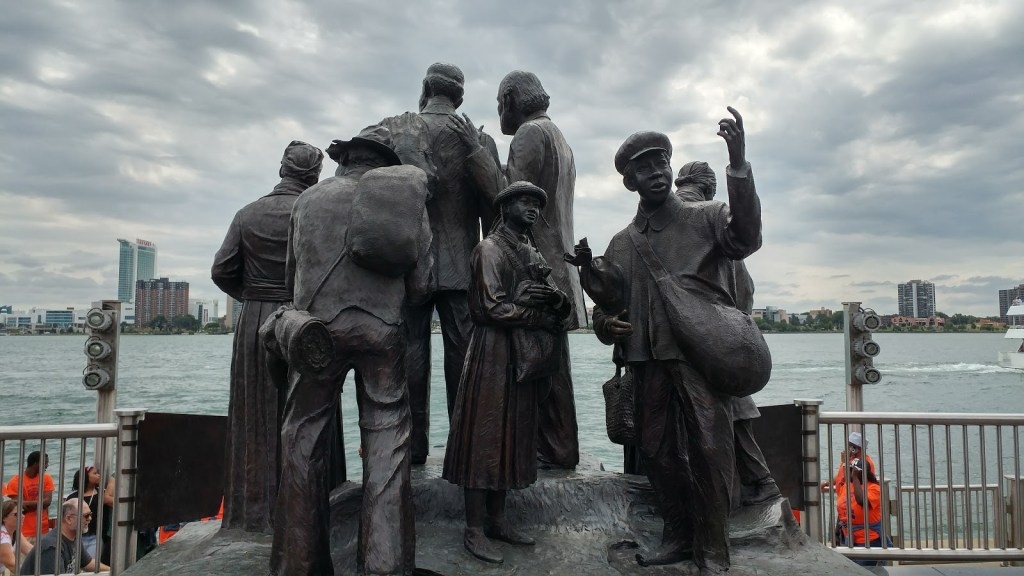
Gateway to Freedom monument – Detroit River

Having acknowledged the shadow that hangs over this passage, what word do we hear that speaks to us? Crossing the river is an act of faith. The people of Israel are camped at the edge of the river. They can see across to the other side. They may have heard stories of dangers ahead, but they’ve also heard that the land is theirs for the taking (Josh. 2:22-24). The one who stands before them as their leader is young and untested. Moses is dead and buried. To cross the river under the leadership of Joshua is an act of faith, but God promises a sign.

Joshua gathers the people to the edge of the river and gives them instructions, as received from Yahweh. They’re to select representatives, one from each tribe, perhaps to serve as a council of elders, as they cross into the new land of promise. They will join Joshua in leadership. Then, Joshua commands the priests to take the Ark of the Covenant and walk ahead of the people. When the priests bearing this Ark reach the water’s edge they are to step into the river. As they do this the waters will part, just as at the sea when the people of Israel escaped slavery in Egypt, so that the people can cross over on dry land. So, at the direction of Joshua, the priests move into the center of the river and stay there until everyone passes through the waters and into the Promised Land.

The symbolism of the Ark of the Covenant is important. It serves as a tangible sign of the presence of God who goes with them. Remember that in the Exodus story, Aaron created a golden calf as a representation of Yahweh. This was not acceptable. The Ark, on the other hand, was not seen as a graven image. It did not provide a physical representation of Yahweh. However, it did serve as a sign of God’s presence in their midst. It was a symbol of God’s leadership, and thus of Joshua’s as well. As they took the journey into the land, they needed to know that they did not go alone.  With this we may sing the third stanza of “Guide Me, O Thou Great Jehovah” (William Williams, 1745).

When I tread the verge of Jordan,

bid my anxious fears subside;

                Bear me through the swelling current;

land me safe on Canaan’s side;

                Songs of praises, songs of praises,

I will ever give to thee, I will ever give to thee.

bobcornwall

Robert Cornwall is the Pastor of Central Woodward Christian Church in Troy, Michigan and is the author of a number of books including Marriage in Interesting Times (Energion, 2016) and Freedom in Covenant (Wipf and Stock, 2015).

Dry Bones and the Breath of Life – Lectionary Reflection for Lent 5A (Ezekiel)

cropped-comesundaylogov2.png

Ezekiel 37:1-14 New Revised Standard Version (NRSV)

37 The hand of the Lord came upon me, and he brought me out by the spirit of the Lord and set me down in the middle of a valley; it was full of bones. He led me all around them; there were very many lying in the valley, and they were very dry. He said to me, “Mortal, can these bones live?” I answered, “O Lord God, you know.” Then he said to me, “Prophesy to these bones, and say to them: O dry bones, hear the word of the Lord. Thus says the Lord God to these bones: I will cause breath to enter you, and you shall live. I will lay sinews on you, and will cause flesh to come upon you, and cover you with skin, and put breath in you, and you shall live; and you shall know that I am the Lord.” So I prophesied as I had been commanded; and as I prophesied, suddenly there was a noise, a rattling, and the bones came together, bone to its bone. I looked, and there were sinews on them, and flesh had come upon them, and skin had covered them; but there was no breath in them. Then he said to me, “Prophesy to the breath, prophesy, mortal, and say to the breath: Thus says the Lord God: Come from the four winds, O breath, and breathe upon these slain, that they may live.” 10 I prophesied as he commanded me, and the breath came into them, and they lived, and stood on their feet, a vast multitude. 11 Then he said to me, “Mortal, these bones are the whole house of Israel. They say, ‘Our bones are dried up, and our hope is lost; we are cut off completely.’ 12 Therefore prophesy, and say to them, Thus says the Lord God: I am going to open your graves, and bring you up from your graves, O my people; and I will bring you back to the land of Israel. 13 And you shall know that I am the Lord, when I open your graves, and bring you up from your graves, O my people. 14 I will put my spirit within you, and you shall live, and I will place you on your own soil; then you shall know that I, the Lord, have spoken and will act, says the Lord.”

********

   The Babylonian exile was a tragic, and yet fruitful event in the life of the people of Israel. It was tragic, because the nation was torn apart. Yet, the exile also gave Judah an opportunity to rediscover its identity as a people. Much of what we know as the Old Testament emerged in the context of the exile. While, it was a challenging time for the people of Judah, who found it difficult to live in hope of a new and better day.


Ezekiel was a prophet who arose in the context of the exile, and he spoke words that chided the people when they were unfaithful, but he also shared words that offed hope of a new day, when the people of Israel would experience restoration. One of the most powerful words of hope to be found in Ezekiel, if not all of scripture, is this passage from Ezekiel 37. Can dry bones live? That is the question of the hour. It is the question that YHWH asked of the prophet after delivering him to a plain covered with dry, lifeless bones. Can these bones live? All that Ezekiel can answer is: “you know.” That is, Ezekiel has no idea how dry, lifeless bones could ever be restored to life. Only God knows, and it’s possible that as the conversation started, Ezekiel had his doubts.

If Ezekiel has doubts, God has a plan. There’s a reason why God brought Ezekiel out to this plain covered with dry bones. God wanted Ezekiel to better understand his prophetic calling. God wanted him to preach, to share the word, so that Israel might once again live. This is the word given to Ezekiel: “say to the bones: “hear the word of the Lord.” I think we should let that phrase sink into our hearts and minds. “Hear the Word of the Lord.” Remember the message of John’s prologue, which declared that the Word (Logos) was in the beginning with God and was God, and that all things came into being through him, and “in him was life” (Jn. 1:1-4). The Word of the Lord is life, and if Ezekiel will preach to the bones, then God will breathe life into them, so that the bones will know who the LORD is.

Ezekiel does as God asks, and then witnesses God’s fulfillment of the promise made to Ezekiel. The bones begin to rattle and come together to form skeletons (we could use a bit of Disney animation here). On these skeletons flesh appears. But, the text of Ezekiel says that to this point “there was no breath in them.” It would be fitting to go back to Genesis 2, the second creation story, where God forms the first human from the dust of the earth. The basic building blocks are there, but life isn’t yet present. Life awaits the breath of God. As we read in Genesis, God “breathed into his nostrils the breath of life; and the man became a living being” (Gen. 2:7). In Ezekiel, God tells the prophet to “prophesy to the breath, saying: “Thus says the Lord God: Come from the four winds, O breath, and breathe upon these slain, that they may live” (Ez. 37:9). When Ezekiel complied, the winds came forth, and filled the lifeless bodies with breath. Of course, the Hebrew word, like the Greek word, for breath is also the word for Spirit (ruach/pneuma). In the biblical story, life isn’t separate from the presence of God’s spirit.

It is important that we recognize that Ezekiel isn’t speaking about individuals. He has in mind a people, the people of Israel, who have experienced the devastation of conquest and the humiliation of exile. Not everyone in the nation of Judah found themselves in Babylon, but whether in Babylon or in the land of Israel, the people of Judah had lost their sense of identity. It was as if they had died.  The Spirit of God seemed absent from the people. Now, it needs to be said that the Spirit of God wasn’t truly absent, but the people seemed disconnected from the life-giving Spirit of God. The presence of the Spirit can be seen in the work of the prophets, including Ezekiel.

This is a well-known passage of scripture. It’s vivid in its descriptiveness. The valley of dry bones coming back to life; it’s a powerful image. But what does it have to do with us? What word does God have for the church in the 21st century, a church that is beginning to see itself in terms of exile. We seem to be a collection of dry, lifeless bones scattered across the plain. I hear it all the time. I hear it from colleagues who bemoan what appears to be the prolonged death of the church. I hear it from church members, who remember the glory days, when Sunday was marked by church attendance. Churches were full. The congregation I now serve is relatively small, but once it was a grand and powerful congregation. Its pastor was nationally recognized (he served as President of the Federal Council of Churches). The church sat on Detroit’s “Piety Row.” Times changed, the church began a slow decline, and it eventually moved to the suburbs. For a long time, it clung to its former heritage, but the reality is that the congregation had gone into exile. This congregation isn’t alone in this, even if a congregation hasn’t moved from its original space. The promise here, of course, is that the exiles will return to the Land, to the soil, upon which the people had once been a nation of some importance. It’s not likely that our congregations will return to their original glory, but the spirit of exile can give way to a new spirit of hope and service. We can take root in our new realities, and be witnesses to God’s gracious presence. The dry bones can hear the Word of God and come to life, filled with the Spirit, so as to become signs of God’s presence in the world.

Perhaps the key to restoration is attending to the Word of God. I speak here to my more “progressive/liberal” colleagues, who often struggle with Scripture. Yes, Scripture can be difficult to navigate. It says things that we may find problematic. After all, it emerged in a very different world, and yet it does have something powerful to say, if we’re willing to listen. While critical scholarship is essential to getting the context straight, if we begin and end there, we may end up missing a Word from God. Walter Brueggemann suggests that we would be better of moving on from focusing our attention on questions of historicity, and focus more on the overarching narrative that is Scripture. He speaks of the Exodus story here, but I think it holds for other conversations. Of the biblical narrative, he writes that we might see it as “a script that is waiting to be performed; it is always being given new performance, even in our own time . . .” [Rebuilding the Foundations, p. 193]. With that in mind we can get a sense of the overarching message of this narrative. Kelton Cobb writes that “at the core of the biblical narrative is the story of displacement—of having wandered a long way from home, and longing to return. This is the underlying plot of being cast out of Eden, of being foreigners in Egypt, of the journey to the promised land, of the long of exiles in Babylon to return to the land of their fathers” [Feasting on the Word, 126].

It is this narrative of exile and return that defines our own realities, including as churches. When we feel as if we’re in exile, we long to return home. That might be why there is such interest in genealogies. We want to know where we belong, so we can return to our homeland. When I went to England, during my sabbatical, I had this feeling of connecting to my roots.  This was my homeland. When I went to Christ Church Cathedral and experienced Evensong, it was as if I had come home. So, I understand this longing for home. It is a longing that defines salvation. As Augustine wrote in The Confessions, the restless heart will not find rest until it rests in God. Is this not our own desire? Do we not want to find our homeland? For Judah, it was the Land, for us, it is the realm of God.

So, what do we make of this powerful story? What word does it have for us? At one level this might be a good word about the power of preaching, even if our culture doesn’t seem to value preaching in the same way it once did, there is her a call to bring the Word so that the Spirit might move. When we hear the word “prophesy,” a number images might come to mind, most of which don’t seem to apply to those of us who enter pulpits to preach. But, in many ways that is what we’re called to do. We’re asked to bring a Word from God to a community. Ron Allen and Clark Williamson write that “preaching her is the means of restoration. Through preaching the breath of God enters the bones. An implication is that pastorally sensitive prophetic preaching can play a key role in revitalizing community” [Preaching the Old Testament, p. 37].


This is the word given to Israel, and by extension to the Church: “I will put my spirit within you, and you shall live, and I will place you on your own soil; then you shall know that I, the LORD, have spoken and will act, says the LORD.” The church in the West is experiencing a reality that it hasn’t faced in centuries. No longer supported by government or even cultural establishment, it must fend for itself, or depend on the Spirit of God. Many congregations feel as if their bones are “very dry.” They feel as life has been drained from them, but here is a word of hope. Say to the bones – Live. Call for the wind of the Spirit to breathe life into the bones of our congregations. We may be in exile, but the realm of God is there in front of us.
Picture attribution: Elkan, Benno, 1877-1960. Ezekiel in the Valley of the Dry Bones, from Art in the Christian Tradition, a project of the Vanderbilt Divinity Library, Nashville, TN. http://diglib.library.vanderbilt.edu/act-imagelink.pl?RC=55841 [retrieved March 27, 2017]. Original source: http://commons.wikimedia.org/wiki/File:Collantes,_Francisco_-_The_Vision_of_Ezekiel_-_1630.jpg.

bobcornwall

Robert Cornwall is the Pastor of Central Woodward Christian Church in Troy, Michigan and is the author of a number of books including Marriage in Interesting Times (Energion, 2016) and Freedom in Covenant (Wipf and Stock, 2015).

Is God With Us? – Lectionary Reflection – Lent 3A (Exodus)

cropped-comesundaylogov2.png

Exodus 17:1-7 Common English Bible (CEB)

17 The whole Israelite community broke camp and set out from the Sin desert to continue their journey, as the Lord commanded. They set up their camp at Rephidim, but there was no water for the people to drink.The people argued with Moses and said, “Give us water to drink.” Moses said to them, “Why are you arguing with me? Why are you testing the Lord?” But the people were very thirsty for water there, and they complained to Moses, “Why did you bring us out of Egypt to kill us, our children, and our livestock with thirst?” So Moses cried out to the Lord, “What should I do with this people? They are getting ready to stone me.” The Lord said to Moses, “Go on ahead of the people, and take some of Israel’s elders with you. Take in your hand the shepherd’s rod that you used to strike the Nile River, and go. I’ll be standing there in front of you on the rock at Horeb. Hit the rock. Water will come out of it, and the people will be able to drink.” Moses did so while Israel’s elders watched.He called the place Massah and Meribah, because the Israelites argued with and tested the Lord, asking, “Is the Lord really with us or not?”

*********

In Advent we heard the message of Emmanuel—God is with Us—in Lent we hear the question—“Is the Lord really with us or not?” The Advent declaration appears in the revelation to Joseph that the child of his betrothed was conceived of the Holy Spirit and that God would save the people from their sins through him (Matt. 1:18-25). The Lenten question is raised during a rather tense encounter between Moses and the people of Israel as they wandered across the desert. The murmuring or complaining of the people of Israel is a constant theme in Exodus. The people cried out to God, seeking deliverance from slavery. Now that they are free, they have other complaints, and the person who bears the brunt of these complaints is Moses. A chapter earlier, the complaint had to do with food. Now it’s a lack of water that concerns the people. You have to feel for Moses, because he has been put in an untenable position. He had claimed that he was acting on behalf of God, after demonstrating God’s power, the people agreed to follow him. Whether they understood the full ramifications of this decision is unknown. Of course, had we been among the people affected, we probably would be complaining as well. After all, water is essential to life, so why would you camp in place where water was absent?

Here is Moses. He’s being forced to explain the lack of water. Moses responds, strangely enough, with a question for the people: “why are you testing God?” What does Moses mean by that statement?  As for the people, they are putting the onus on Moses. Why did he bring them to this place? Why did he rescue them only to lead them to certain death from thirst?   In other words, slavery was bad. Dying of thirst was worse!

Even if we’ve not experienced such thirst, most of us have been exposed to the issue. I like watching nature programs like Planet Earth and Planet Earth II. When the programs focus on deserts, you will be exposed to animals searching for water. Perhaps you will watch as a troop of elephants cross foreboding desert sands in search of an elusive watering hole. A wide shot from the air reveals nothing but sand in all directions, but the troop marches on. Most likely this troop will include at one least one calf struggling to keep up, its only hope of survival being the discovery of that water hole. You want to root for that calf to make it, but that’s not always the way things end. In a recent show, the calf fell and couldn’t get up. The mother stayed behind, watching over her calf, even though she too was now at risk because she was separated from the rest of the troop. You grieve for that mother.

If you grieve for the elephants, then surely you must grieve for the people of Israel who face a similar fate. There are children in this caravan. They would be most vulnerable. Think of the recent stories of refugees fleeing the violence in Syria and Iraq. Remember the faces of children who face hunger and thirst. Do we hear their murmurings? Do we empathize with them, and thus with the people of Israel camped in the desert with no water in sight?

The people are understandably upset, and Moses seems to be caught in the middle. He is the one God charged with leading them out of Egypt, but did he lead them out of Egypt to a place where death was certain? For his part, Moses is wondering what he had gotten himself into when he answered the call of the burning bush. Yes, he had been able to do miracle upon miracle, including parting the sea. But, none of that mattered now, as a thirsty people demanded water. I can hear Moses say to God: “What I do to deserve this?” “What am I supposed to do with this people?” I can hear him say to God, “I didn’t learn how to deal with this kind of a problem in seminary. So, what am I supposed to do? They’re about to stone me.”  In other words, Moses was about to resign his leadership position! This is a sentiment that often marks clergy as they try to lead congregations that won’t go easily into the night. In this case, the people seem to have a point. They didn’t sign on to a trip that would to their death in a land without water.

Of course, it wasn’t Moses who delivered the people from Pharaoh. It wasn’t Moses who opened the sea or provided manna. It was YHWH. Fortunately, God had a solution. God told Moses to take the elders with him, along with the staff he used to strike the Nile, and go to the rock at Horeb, which is where God will be found standing on the rock. God instructed Moses to strike the rock with his staff, and when he did this, water would flow from that rock. If only drought-stricken lands had a staff like that. When Moses followed this command, he struck the rock in the sight of the Elders, and water began to flow so that the people could drink.

As is often the case in Exodus, this place takes on a new name. It is called Massah (Test) and Meribah (Quarrel). That is because the people tested God and quarreled. As they quarreled and tested God, they asked “Is the LORD among us or not?” They had seen God at work, but they still weren’t sure that God was with them. This episode might be remembered as one of those times when Israel tested God. That is, they showed a lack of faith. Consider the word of the Psalmist: “They tested God again and again, and provoked the Holy One of Israel” (Ps. 78:41).

I have never seen the parting of the sea, bread fall from heaven, or see someone strike a rock to get water to flow from it. Now, I know that there will be those who want to explain how all of this could happen. We moderns love natural explanations of biblical miracles. Regardless of the explanations, I’ve not seen anything close to what is described here with my own eyes. So how might I as a human being know if God is with me? Should I take my ability to find a rare parking spot as being a sign of divine presence? I would love to have the power to pray for one of my parishioners who is experiencing health problems, and watch those problems immediately disappear, but I’ve not seen that happen, though I do believe in healing and I do pray for people. I trust that God hears my prayers. But, how do I know that God is with me?

In this story, God provided the people with water to sustain them. God provides us with water as well that will sustain us—spiritually. Remember the story of Jesus and the Samaritan woman. He offers her living water. He tells her that everyone who drinks the water of Jacob’s well would again thirst, but “those who drink of the water that I will give them will never be thirsty. The water that I will give will become in them a spring of water gushing up to eternal life.” The woman told Jesus, “I want some of that water” (Jn. 4:13-15).  So do I!

So, the answer is—yes, God is with us!
Picture Attribution: Chagall, Marc, 1887-1985. Moses Striking the Rock and Bringing Forth the Water, from Art in the Christian Tradition, a project of the Vanderbilt Divinity Library, Nashville, TN. http://diglib.library.vanderbilt.edu/act-imagelink.pl?RC=54659 [retrieved March 13, 2017]. Original source: http://www.flickr.com/photos/abeppu/3815912913/.

bobcornwall

Robert Cornwall is the Pastor of Central Woodward Christian Church in Troy, Michigan and is the author of a number of books including Marriage in Interesting Times (Energion, 2016) and Freedom in Covenant (Wipf and Stock, 2015).
A Blessing to the Nations – A Lectionary Reflection for Lent 2A (Genesis 12)

cropped-comesundaylogov2.png

Genesis 12:1-4 Common English Bible (CEB)

Abram’s family moves to Canaan
12 The Lord said to Abram, “Leave your land, your family, and your father’s household for the land that I will show you.I will make of you a great nation and will bless you. I will make your name respected, and you will be a blessing.
I will bless those who bless you,
those who curse you I will curse;
all the families of the earth
will be blessed because of you.”
Abram left just as the Lord told him, and Lot went with him. Now Abram was 75 years old when he left Haran.

**********

This short passage is one of the most foundational texts in scripture (at least that’s my view). God calls Abram (name not yet changed to Abraham) to leave his home and extended family, and travel to a foreign land. If he does this then God promises that he will become a “a great nation” blessed by God. Not only will Abram be blessed, but in addition “all the families of the earth will be blessed because of you.” The lectionary selection is brief and yet powerful. God asks a lot of Abram, telling him to leave behind everything he has known. In a world in which tribe was central, it was risky to go to go to a land in which one was a stranger. While the promise itself was wonderful, the question was how would it work out?

The outworking of this call would have many twists and turns, and as the writer of Hebrews notes, Abraham set out “not knowing where he was going.” Abraham, Isaac, and Jacob, all lived in tents and Sarah was barren, but the promise revealed itself over time, but “all of these died in faith without having received the promises, but from a distance they saw and greeted them” (Hebrews 11:8-13). There would be times when Abraham took matters into his hands, such as when in pursuit of an heir he took Sarah’s slave, Hagar, and had child with her. Despite the twists and turns, the journey to blessing starts here, and continuing through the Covenant of Sinai to that of Calvary and the embrace of the Gentiles into God’s realm.

As a Christian, I interpret the call of Abraham through the lens of Jesus. He is, as Paul suggests, the seed of Abraham, through whom the blessings of God would be revealed to the nations (Gal.3:15-18). With this in mind, it’s appropriate to remember that Matthew’s genealogy traces Jesus’ lineage back to Abraham (Matthew 1:1-17). For Matthew Jesus, the Messiah, is the son of David and the son of Abraham. But connecting Jesus’ mission to Abraham, he envisions Jesus as the one through whom all the nations will be blessed. That is, he will save the people from their sins (Mt.1:21). From this perspective, the coming of Jesus is not a course correction on the part of God, but a natural extension of the call of Abram. That means the church doesn’t replace Israel, but as Paul notes, the Gentiles are grafted into the olive tree that is Israel, so that the nations might share in the blessing that God first promised to Abraham and to Israel (Rom. 11). As we ponder the call and the end result, it is wise to remember the promise of Second Isaiah, that Israel would be a light to the nations so that God’s salvation would reach the ends of the earth (Is. 49:6).

Theologian Clark Williamson has devoted much attention to the question of the church’s relationship to Israel, especially in a post-Shoah world. He writes:

Israel was to be a priestly people, serving others, not itself. God’s covenant was not merely for Israel’s good but for the good of all human beings, Gentiles and Jews. God chose Israel as an instrument so that all peoples may come to know God and God’s purposes for them. [A Guest in the House of Israel, p. 125].

So, for Christians reading this call, which will be formalized more fully in Genesis 15 when the promise a child and heir is given (and sealed through sacrifice), and then again in Genesis 17, when God explicitly makes a covenant with Abram and in the process changes his name to Abraham (and that of Sarai to Sarah).

According to the reading from Genesis 12, Abram accepted the call and headed out from Haran to Canaan. He did so, accompanied by Lot and those closest to him, with only the promise of a blessing.  The promise is this—the families of the earth will be blessed through him. As we contemplate this call it’s good to note that while God seems narrow the focus to one family, the earliest readers of this promise, as descendants of Abraham and Sarah, would have understood themselves to be that nation through which God would bless the families of the earth. They had a special calling from God. They had a message to share with the nations. While it would be easy to forget this calling, and focus inward rather than outward, time and again messengers would remind the people of their calling. It wasn’t just Israel that was to be blessed, it was the entire creation. Having attended a stewardship workshop recently, I’m reminded that this is a stewardship issue. That would mean that the promise ultimately is rooted in the creation of humanity, who are blessed by God and charged with having dominion (management) of God’s creation (Gen.1:26-31).

The call on Abram and his descendants was to be a blessing to the nations. It would be through this people that God would bless creation. For Christians, this means recognizing that we have been, as noted earlier, grafted into the olive tree that is Israel. We have been adopted into the family through the one who is the seed of Abraham. But as the Gentiles are drawn into the family, and blessed by God, that doesn’t nullify the previous covenant (Gal. 3:15-18). There is a tendency for Christians to read Paul in a supersessionist manner, so that Jesus replaces Israel. That would be inappropriate. For our purposes, let us simply understand Paul’s reference to seed to be a sign that God always intended to bring all of creation into the fold, and that Israel plays an important role in this, as does Jesus.

While there will always be interpretive questions to wrestle with, since three religious traditions claim descent from Abraham, and that these three traditions have often been at odds with each other, it would be wise to affirm the common ancestry, and move to the question of the nature of this blessing. After all, the words bless and blessing figure prominently in this passage and in Genesis. Lest anyone think too highly of one’s self, it is also good to remember that the blessing spoken of here is a gift of God, though it is a gift that must be received. Remember that Abram is told that those who bless him will be blessed and that those who curse him will be cursed. As James McTyre notes, “Abram is called by God to serve as a mirror. Instead of images, Abram will reflect blessings and curses on the land where he will sojourn” [Feasting on the Word, Year A, 2:51].

From a Christian point of view, the church, as the body of Christ, reflects God’s blessings to the world. But what does this mean? What is a blessing? It’s a good question since the words bless or blessing figure prominently in this passage and in the rest of the story. For modern readers the word blessing may seem quaint but not all that meaningful. However, in Hebrew the word connotes a sense of well-being or flourishing. That is what God wants to see happen for creation. He wants it to once again flourish. As to what this means, Miroslav Volf suggests that flourishing means that one does not live by bread alone. The material world is important, for we are material beings, but in his argument as to why a globalized world needs religion, Volf notes that “when we live by bread alone, there is enough bread, not enough even when we make so much of it that some of it rots away; when we live by bread alone, someone always goes hungry; when we live by bread alone, every bite we take leaves a bitter aftertaste; . . . living by ‘mundane realities’ and for them alone, we remain restless and that restlessness in turn contributes to competitiveness, social injustice, and the destruction of the environment as well as constitutes a major obstacle to more just, generous, and caring personal practices and social relationships.” We need bread, but we need more than bread. We need the bread of life.   [Volf, Flourishing, p. 22].


There is a thread that runs from creation (Genesis 1) to new creation (Revelation 22). It runs through Abram and on to Jesus, through whom we are grafted into the tree, so that we might be reconciled and share in the blessings of God as was promised to Abram as he left Haran for a new land.

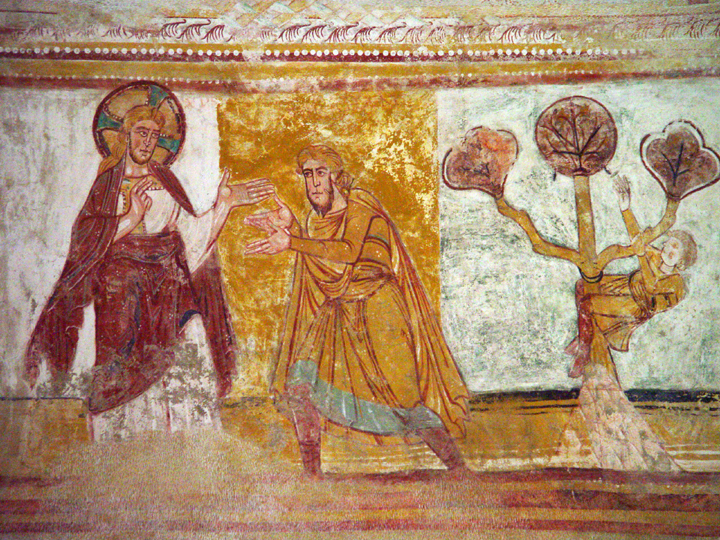
Picture attribution: St. Savin – Calling of Abraham, from Art in the Christian Tradition, a project of the Vanderbilt Divinity Library, Nashville, TN. http://diglib.library.vanderbilt.edu/act-imagelink.pl?RC=33460 [retrieved March 7, 2017]. Original source: Images donated by Anne Richardson Womack, Vanderbilt University, and James T. Womack, Montgomery Bell Academy, Nashville, TN.

bobcornwall

Robert Cornwall is the Pastor of Central Woodward Christian Church in Troy, Michigan and is the author of a number of books including Marriage in Interesting Times (Energion, 2016) and Freedom in Covenant (Wipf and Stock, 2015).

Be Holy, Love Thy Neighbor! – Lectionary Reflection – Epiphany 7A (Leviticus)

cropped-comesundaylogov2.png

Leviticus 19:1-2,9-18  New Revised Standard Version (NRSV)

19 The Lord spoke to Moses, saying:  2 Speak to all the congregation of the people of Israel and say to them: You shall be holy, for I the Lord your God am holy. 9 When you reap the harvest of your land, you shall not reap to the very edges of your field, or gather the gleanings of your harvest. 10 You shall not strip your vineyard bare, or gather the fallen grapes of your vineyard; you shall leave them for the poor and the alien: I am the Lord your God. 11 You shall not steal; you shall not deal falsely; and you shall not lie to one another. 12 And you shall not swear falsely by my name, profaning the name of your God: I am the Lord. 13 You shall not defraud your neighbor; you shall not steal; and you shall not keep for yourself the wages of a laborer until morning. 14 You shall not revile the deaf or put a stumbling block before the blind; you shall fear your God: I am the Lord. 15 You shall not render an unjust judgment; you shall not be partial to the poor or defer to the great: with justice you shall judge your neighbor. 16 You shall not go around as a slanderer among your people, and you shall not profit by the blood of your neighbor: I am the Lord. 17 You shall not hate in your heart anyone of your kin; you shall reprove your neighbor, or you will incur guilt yourself. 18 You shall not take vengeance or bear a grudge against any of your people, but you shall love your neighbor as yourself: I am the Lord.

********

Gray and Gold, John Rogers Cox - Cleveland Museum of Art
Gray and Gold, John Rogers Cox – Cleveland Museum of Art

The people of God are called to emulate God’s holiness. The word “holy” carries a bit of baggage, because it’s often linked to smug self-righteousness. Words like puritanical, legalistic, and pharisaical are offered as synonyms.  When it comes to the holiness code detailed in Leviticus, we tend to think in terms of ritual purity, rather than in terms of calls for compassion and service. Then we come to Leviticus 19, which calls for the people of God to be holy, even as God is holy. Here holiness is spoken of in terms of loving one’s neighbor as one’s self.  Indeed, Jesus draws the second great command from Leviticus 19:18—the first command, the call to love God with one’s entire being is drawn from Deuteronomy 6:4-5 (Matt. 22:34-40). So, perhaps we need rethink our understanding of holiness.

The Old Testament reading for the seventh Sunday after Epiphany (Year A) includes the call to holiness, and then moves to the social implications of this call to holiness. It is the only time in the three-year lectionary cycle that we visit Leviticus, and that is only if the season extends to at least seven weeks. Thus, we might be missing out on important words from scripture.

The selection begins with the call to be holy, but ends with a call to love one’s neighbor. These two bookends are important, because they suggest that Torah (Law, Teaching) connects love and holiness. It is a reminder that grace and love are present in scripture prior to the New Testament. Jesus did not invent grace, he simply offered us a new way of understanding that biblical vision. In fact, his own vision of human relationships, especially as laid out in the Sermon on the Mount, is formed by what we read here in Leviticus 19.

Because Leviticus is understood to be a book of rules and regulations, Christians tend to avoid it. It presents us with too many problems, so we go elsewhere for inspiration and guidance. Nonetheless, there is much wisdom to be found in the book’s instructions on what it means to be holy as God is holy (Jesus picks up on this call to holiness in the Sermon on the Mount, with the rendering in Matthew 5 speaking of being perfect as God is perfect—Matthew 5:48). So, what does it mean to be holy as God is holy?

Leviticus 19 provides us with a collection of instructions. Ron Allen and Clark Williamson note that “imitation of God is manifest primarily in responsible actions toward the vulnerable” [Preaching the Old Testament: A Lectionary Commentary, (WJK Books) p. 23]. This call to care for the “least of these” is rooted in the biblical vision of God’s nature, who is “merciful and gracious, slow to anger, and abounding in steadfast love and faithfulness” (Exodus 34:6).  The lectionary reading omits the opening section of Leviticus 19 (vss. 3-8), which focuses on revering parents and honoring God. Instead, it jumps to the second section of the chapter, which offers us a vision of “holiness in neighborliness” [Walter Kaiser, “Leviticus,” New Interpreter’s Bible, (Abingdon Press), 1:131]. It is a word of instruction regarding social ethics. These instructions remind us that religion not only speaks to the divine-human relationship, but also has implications for the way in which we conduct ourselves in public. Each section or paragraph closes with the refrain: “I am the Lord.” It is a reminder that the way in which we conduct our lives is a reflection on the Lord (YHWH) our Creator.

With the United States in the midst of a debate about immigration and refugee status, the opening paragraph is instructive. The author instructs Israel’s farmers to make portions of their fields and vineyards available to the poor and the alien. In an agrarian economy, this is essentially a government imposed safety net. Why? Because “I am the Lord your God.”

The commands move on from caring for the alien, the foreigner, to other areas of concern. Holiness is more than ritual purity. It has community implications. There are calls to refrain from stealing, defrauding one’s neighbor, lying to one another, bearing false witness. There is a call to respect persons with disabilities—the deaf and the blind. It is instructive that this particular word of guidance is accompanied by a call to fear God.  This is a word that churches might want to heed, as they consider ways of responding to those with disabilities. What obstacles do we put in the way of people who seek to come and worship?

There is a call for judges to be fair and impartial. This word is interesting because judges are not to distinguish between poor and rich. This word seems to stand in contrast with the idea that God has a “preferential option for the poor.” It would seem from this reading, that God doesn’t prefer the poor or the rich, but God judges each equally. It is justice that must be served. But, I wonder how we should read this passage. On the surface, it would seem that the judicial system should make no allowance for the poor, but is that the point? As Ron Allen and Clark Williamson point out, “in our times perhaps we should say that the poor should be provided with lawyers as able as those whom the rich can afford” [Preaching the Old Testament, p. 24]. Even if we affirm God’s preferential option for the poor, this is not to say that God has no concern about the welfare of the wealthy. God is God of all people, rich and poor.

At a time when “hate” seems strong in our midst, it is important to hear the call to not hate our kin. It is important that we not try to gain vengeance. It’s okay to reprove our neighbor, though I would caution great care. It’s easy to become “judgmental” and a meddler. Still, if we can, we should help our neighbors get back on track.

We began with a command to be holy, and we end with a command to love our neighbors as we love ourselves—what is often called the Golden Rule. It is worth noting, especially at this time and place in history, that if we continue reading down in Leviticus 19, that the people of Israel should “love the alien as yourself, for you were aliens in the land of Egypt” (Lev. 19:34). This broadens out what is meant in scripture by loving one’s neighbor as one self.  Allen and Williamson note that this command, to love the alien is repeated thirty-six times in Scripture, suggesting, at least by repetition, that “it is the most important commandment in the Torah” [Preaching the Old Testament, p. 25].

While we might not find every word in Leviticus appropriate to our time, these are important words that do reflect the message of grace and compassion that are present throughout scripture. They reflect the covenant commission given to Abraham and Sarah, that through their descendants that peoples of the earth would be blessed (Gen. 12:1-3).

bobcornwall

Robert Cornwall is the Pastor of Central Woodward Christian Church in Troy, Michigan and is the author of a number of books including Marriage in Interesting Times (Energion, 2016) and Freedom in Covenant (Wipf and Stock, 2015).

Choose God, Choose Life — Lectionary Reflection for Epiphany 6A (Deuteronomy)

cropped-comesundaylogov2.png

Deuteronomy 30:15-20New Revised Standard Version (NRSV)

15 See, I have set before you today life and prosperity, death and adversity. 16 If you obey the commandments of the Lord your God that I am commanding you today, by loving the Lord your God, walking in his ways, and observing his commandments, decrees, and ordinances, then you shall live and become numerous, and the Lord your God will bless you in the land that you are entering to possess. 17 But if your heart turns away and you do not hear, but are led astray to bow down to other gods and serve them, 18 I declare to you today that you shall perish; you shall not live long in the land that you are crossing the Jordan to enter and possess. 19 I call heaven and earth to witness against you today that I have set before you life and death, blessings and curses. Choose life so that you and your descendants may live, 20 loving the Lord your God, obeying him, and holding fast to him; for that means life to you and length of days, so that you may live in the land that the Lord swore to give to your ancestors, to Abraham, to Isaac, and to Jacob.


*********

We have choices to make in life. Sometimes the choices are inconsequential, such as a flavor of ice cream. Other times, they determine life and death. I’m not of the mindset or theology that suggests that God has everything planned out. That’s not to say I don’t think that God is active in the world, it’s just that I think we contribute a great deal to our futures. In my understanding of things, we have free will and so our choices make a difference. Such is the message we find here in Deuteronomy 30.

In his closing message to the people of Israel, as they prepare to cross the river, Moses offers a warning of sorts, as well as a word of blessing to the people of Israel. They will soon enter a new land, the land of promise. Their future prosperity depends on the choices they make. Will they embrace their God who led them to this point? Or, will they depart from the ways of God? Moses won’t be crossing the river them. Whatever happens on the other side of the river, will happen without his involvement.  This will be his final resting spot. He’s made his choices, but those who cross the river will have their own choices to make.

If they desire prosperity and life, rather than adversity and death, then the people will love God, walk in God’s ways, and obey God’s commandments. The heart of their life together is rooted in the commandments as summarized in the Shema: “Hear, O Israel: The Lord is your God, the Lord alone. You shall love the LORD your God with all your heart, and with all your soul, and with all your might” (Deut. 6:4-5). In other words, their future is wrapped up in the covenant that God had made with them as they left slavery and crossed the desert toward ultimate freedom. The choices they make as they prepare to cross the river will have consequences for them, but also for their descendants. That is why, after Moses delivered the Commandments to the people, he told them to pass on the words he shared to their children (Deut. 6:6).

So, if the people choose wrongly. That is, if they choose to give themselves to other gods and other ways, they will experience death. Remember the foundation of the covenant is choosing to love God “with all your heart, and with all your soul, and with all your might.” So, if your heart is led astray and you embrace other gods, you will experience the consequences of those choices. You will perish and not live for long in the land of promise. The key sin here is idolatry. So, we are faced with a question. Are we given to idolatry? Are we tempted to give our loyalty to gods other than the God of Abraham, Isaac, Jacob? The consequence here ultimately is alienation from the Land. You shall not live in it for long, if you don’t keep the covenant stipulations. Brett Younger puts it this way:

Most of our decisions do not seem important, but life and death are before us every day. We choose death when we ignore God and choose anything inferior. Death is a slow process of giving ourselves to what does not matter. Modern life is impoverished with a lack of purpose. We rush to meet deadlines that are insignificant and bow before ideas that are not worthy. [Feasting on theWord, pp. 341, 343].

So, what is significant that we should give our attention to it? What is God’s desire? What is it that God wants from us?  The prophet Micah offers some clues: justice, mercy, humility (Mic. 6:8). At this moment in time we’re confronted with the plight of refugees who flee persecution and war. How is this a concern of God? What is required of us? We witness a diversifying of our communities. How is this a concern of God? If these are concerns of God, and the word to us, is to walk in the ways of God, how should we respond?

I spend time with social media, probably more than I should, and what I witness are choices being made. Some are productive, many are not. Indeed, many of our choices as expressed on social media are destructive. They express our idolatries, our desire for power and prestige. They give vent to our anger. These are often choices that bring death not life. So, how do we move from death to life?

As we read Moses’ final sermon, his summing up of the Law, it’s not all bad news. Remember there’s a choice involved. Moses would rather the people choose life. Yes, “Choose life so that you and your descendants may live, loving the Lord your God, obeying him, and holding fast to him; for that means life to you and length of days, so that you may live in the land that the Lord swore to give to your ancestors, to Abraham, to Isaac, and to Jacob.”

I again turn to the words of Brett Younger, who writes:

Worship with all your heart. Pray genuinely. Love your church. Believe that God loves you. Remember the stories of Jesus. See Christ in the people around you. Share God’s love with someone who has forgotten it. Delight in God’s good gifts. See that all of life is holy. Open your heart to the Spirit. Search for something deeper and better than your own comfort. Live in the joy beneath it all. Let God make your life wonderful. [Feasting on the Word, p. 343].

These are wise words. These are words of life that are reflective of the message of Deuteronomy. The choice is ours. We have free will. We’re not beholden to idolatry, even if t sometimes comes easily to us. The river stands before us. We have choice as to whether we will cross over into the promised land. Once there, we’ll have other choices that are matters of life and death. Which will you choose? Life or death?

bobcornwall

Robert Cornwall is the Pastor of Central Woodward Christian Church in Troy, Michigan and is the author of a number of books including Marriage in Interesting Times (Energion, 2016) and Freedom in Covenant (Wipf and Stock, 2015).
A Light to the Nations – Lectionary Reflection for Epiphany 2A (Isaiah 49)

comesundayfb

January 15, 2017

 Isaiah 49:1-7 Common English Bible (CEB)

49 Listen to me, coastlands;
pay attention, peoples far away.
The Lord called me before my birth,
called my name when I was in my mother’s womb.
He made my mouth like a sharp sword,
and hid me in the shadow of God’s own hand.
He made me a sharpened arrow,
and concealed me in God’s quiver,
    saying to me, “You are my servant,
Israel, in whom I show my glory.”
But I said, “I have wearied myself in vain.
I have used up my strength for nothing.”
Nevertheless, the Lord will grant me justice;
my reward is with my God.
And now the Lord has decided—
the one who formed me from the womb as his servant—
to restore Jacob to God,
so that Israel might return to him.
Moreover, I’m honored in the Lord’s eyes;
my God has become my strength.
He said: It is not enough, since you are my servant,
to raise up the tribes of Jacob
and to bring back the survivors of Israel.
Hence, I will also appoint you as light to the nations
so that my salvation may reach to the end of the earth.
The Lord, redeemer of Israel and its holy one,
says to one despised,
rejected by nations,
to the slave of rulers:
Kings will see and stand up;
commanders will bow down
on account of the Lord, who is faithful,
the holy one of Israel,
who has chosen you.

**************

We are in the season of Epiphany, the season of revelation and light. It probably is true of every era, but it seems as if we have entered a season of darkness. Many feel like night has fallen, and we simply can’t see our way forward. For some, this might feel like being abandoned by God. They join the Psalmist crying out “My God, my God, why have you forsaken me” (Psalm 22:1). There is good news, however, for into this darkness steps the servant of God, who reveals the glory of God.

The Day of Epiphany has come and passed. We have joined Jesus at his baptism, where we watched as the Spirit fell upon him, and the voice from heaven declared him to be the beloved. In him, we declare, God is incarnate. In him, as John reveals, the light shines in the darkness, and despite everything that came against him, the darkness did not and does not overcome him (John 1:5). During this season after Epiphany we attend to the light. We look for the places where God is being revealed, so that we might be made new. With this in mind, we continue our journey through the readings from the Hebrew Bible.

The Word of God as revealed through the words of the one we call Second Isaiah, speaks of a Servant of God who is the light to the nations. When we read a text like this, especially reading at as Christians, we need to take stock of the multiple levels of interpretation that are present. I think it’s appropriate for Christians to see Jesus in these words, but we must be careful about jumping to that interpretation without attending to original contexts and readings.

The prophet tells of one who speaks to the Coastlands, that is to a people living faraway? Who is this one who speaks? Who is the one who was called from his mother’s womb? At level, this must be the prophet’s own sense of call. We don’t know his identity, but he reveals to us that before he was born, God had chosen him for a purpose.

I wonder, do those of us attending to this text, see ourselves being called by God from before birth? Do we have a sense of God’s guiding hand upon our lives? I wonder about that at times. Even though I didn’t anticipate being a pastor early in life, there are a few markers along the way that might be suggestive. I was an acolyte at the age of 9, serving at the altar, at St. Barnabas Episcopal Church. Now I was one of only two children in the church of an age who could do this, but still is this a sign?  I would later serve as a lay reader at St. Paul’s Episcopal Church. Fr. Green decided that since I read the liturgy with enough volume, I might as well lead it. Was this a sign of a call?  I ask these questions from the perspective of a non-Calvinist, non-predestinationist, open theist, kind of Christian, who nonetheless finds some sense of purpose in words like this.

While I think that the prophet is reading his own call into this text, it’s clear that he also has in mind the people of Israel (now the remnant we call Judah). The servant of God is Israel, or the remnant thereof. The people who heard this word lived exile in Babylon. They were wondering about their future. What they knew was that the capitol city lay in ruins, the Temple of God with it. The monarchy had been essentially destroyed as well. So, who would they be if they returned home? What would be their calling? The word of the prophet is quite direct: “You are my servant, Israel, in whom I show my glory.” When it comes to glory, we’re talking about light. A bit later in this passage, the prophet says to a people living in exile:

It is not enough, since you are my servant, to raise up the tribes of Jacob and to bring back the survivors of Israel. Hence, I will also appoint you as light to the nations so that my salvation may reach to the end of the earth. (v. 6).

It’s not enough for the exiles to return home. No, God has plans for Israel (the tribes of Jacob). God is appointing Israel to be the “light to the nations,” so that the message of salvation might reach the ends of the earth. That is Israel’s calling. It is also our calling.

From a Christian perspective, Jesus takes on the mantle of the servant. That is, Jesus is the one Isaiah describes as being the suffering servant. He is the one who is despised by the nations (even as Israel was despised). But, despite the rejection and the resistance, Jesus is the light of the world. As the light, he brings the salvation to the world. Yes, even to the ends of the earth. The commission that Jesus gives the Disciples on the day of Ascension reflects this message. “you will be my witnesses in all Judea and Samaria, and to the ends of the earth” (Acts 1:8).

The season of Epiphany (I prefer to speak of the Sundays after Epiphany rather than Ordinary Time) is a season of revelation and enlightenment. It is a season to highlight the message of salvation in Christ. Here we are, a people who have walked in darkness, but now we have seen a great light (Isaiah 9:2).   Having experienced the light, let us take up the calling to be a light to the nations, singing that children’s song: “This little light of mine, I’m gonna let it shine, I’m gonna let it shine, I’m gonna let it shine.”


bobcornwallRobert Cornwall is the Pastor of Central Woodward Christian Church in Troy, Michigan and is the author of a number of books including Marriage in Interesting Times (Energion, 2016) and Freedom in Covenant (Wipf and Stock, 2015).