Category: revised common lectionary

If God Is For Us, Who Can Be Against Us — Lectionary Reflection for Pentecost 8A (Romans 8)

Le Trinite — Cristoff Baron
Romans 8:26-39 New Revised Standard Version (NRSV)
 

26 Likewise the Spirit helps us in our weakness; for we do not know how to pray as we ought, but that very Spirit intercedes with sighs too deep for words. 27 And God, who searches the heart, knows what is the mind of the Spirit, because the Spirit intercedes for the saints according to the will of God. 

28 We know that all things work together for good for those who love God, who are called according to his purpose. 29 For those whom he foreknew he also predestined to be conformed to the image of his Son, in order that he might be the firstborn within a large family. 30 And those whom he predestined he also called; and those whom he called he also justified; and those whom he justified he also glorified. 

31 What then are we to say about these things? If God is for us, who is against us? 32 He who did not withhold his own Son, but gave him up for all of us, will he not with him also give us everything else? 33 Who will bring any charge against God’s elect? It is God who justifies. 34 Who is to condemn? It is Christ Jesus, who died, yes, who was raised, who is at the right hand of God, who indeed intercedes for us. 35 Who will separate us from the love of Christ? Will hardship, or distress, or persecution, or famine, or nakedness, or peril, or sword? 36 As it is written,

“For your sake we are being killed all day long;


    we are accounted as sheep to be slaughtered.” 

37 No, in all these things we are more than conquerors through him who loved us. 38 For I am convinced that neither death, nor life, nor angels, nor rulers, nor things present, nor things to come, nor powers, 39 nor height, nor depth, nor anything else in all creation, will be able to separate us from the love of God in Christ Jesus our Lord.

************

                At times like this, as the entire world is enveloped by a pandemic that has affected millions, how do we pray? What words fit the occasion? As a pastor and preacher, I know I’ve struggled at times at finding the words to share in worship. When Paul wrote these words we have before us, he didn’t have a pandemic in mind. However, the words remind us that no matter our situation, the Spirit will intercede for us, using our mumbles if nothing else to speak to God. With this promise of the Spirit comes a promise—Nothing will separate us from the love of God in Christ Jesus.

                This is the third reading from Romans 8 that the Revised Common Lectionary invites us to consider. We’ve been assured that in Christ there is no condemnation. Instead, we experience freedom from sin. We’ve been assured that the suffering of the present is nothing when compared with the glory that awaits us. Now, we hear that the Spirit prays for and with us. Because God sees our hearts, God hears our prayers, even if we’re not able to articulate exactly what’s on our hearts. If you view this reading from a certain angle, with an openness to the possibility, you might see here hints of the Trinity.

                Paul speaks of the Spirit using our sighs or groans to communicate what is on our hearts, but which we can’t find the words to express. In a previous paragraph, Paul spoke creation itself groaning as it awaits its liberation, even as we groan as we await our redemption (Rom. 8:19-25). So, the thought is continued, only that now we know that the Spirit groans along with creation and God’s people as we await the revelation of God’s future for us. This reference in Romans 8:26, which suggests that when we, in our weakness, can’t find the words to pray, has been interpreted in Pentecostal and Charismatic circles as a reference to the gift of tongues or as it’s sometimes described—a prayer language. While Paul likely, in my estimation, doesn’t have this idea in mind, the concept of a prayer language, as I was taught it in my Pentecostal experience does make sense [on the gift of tongues or glossolalia, see my book Unfettered Spirit, pp. 122-126].

                The promise of the Spirit’s act of intercession leads to another promise, and that for those who love God, things will work out for the best. In making this claim Paul brings in the word predestine when it comes to those who will love God. That is, God directed that those who embraced the call would be conformed to the image of Christ so that Christ might be the firstborn of a large family. As we discovered in the previous reading, we have an inheritance, together with Jesus, for we are children of God by adoption (Rom. 8:14-17). This word about foreknowledge and calling serves as a sign of God’s initiative in the process of salvation. God makes the first move in Christ. As Sarah Heaner Lancaster notes: “Paul’s remarks about predestination are words of encouragement to the recipients of this letter that God would, in fact, bring the goodness of salvation out of their suffering. Paul is not speaking here of predestination as determinism of all events. Nor is he speaking of any theories of predestination that developed much later (such as eternal decrees)” [Lancaster, Romans, Belief, p. 150]. In other words, Paul isn’t a Calvinist. What Paul is focused on here is God’s initiative and faithfulness to the purpose of salvation, which in 2 Corinthians 5:17ff, he defined in terms of reconciliation. One can, regarding salvation, envision as did Origen, that this involves some form of universal salvation. For those of us who operate from a more open and relational perspective, the way forward lies open, though God will remain committed to the reconciliation of all things. Thus, as Karl Barth suggests, those whom God calls, God foreordains to be conformed to the image of Christ. The way I read Barth’s reading of Paul, is that God has disclosed that those who love God will take up their calling to “bear witness to the death of Jesus and consequently to his resurrection” [Barth, Epistle to the Romans, p. 323].

                That leads us to Paul’s next point: “if God is for us, who is against us?” (Rom 8:31 CEB). Since God risked God’s own son to reach us, then who can bring a charge against God’s people. The one who was crucified and raised serves as our defense attorney. Since this is true, nothing can separate us from Christ’s love, not “hardship, or distress, or persecution, or famine, or nakedness, or peril, or sword” (Rom 8:35). Paul draws from Psalm 44:22, to speak of the threat of death that faces the people of God, but victory is assured. This assurance, at least as I read the text is not based on a deterministic understanding of reality, where God orchestrates things. No, it is because God will not give up the cause. God in Christ perseveres. Therefore, nothing can separate us from the love of God in Christ Jesus. Not death or life. Not angels or rulers. Not present things or future things. No form of power or anything created can separate us

                Living in and through difficult circumstances always raises questions about the nature of faith and even the existence of God. Paul’s response is simply this, while suffering may occur, God goes with us. The short term may involve suffering, but in the long term, we will be more than conquerors. That is because nothing can separate us from the love of God in Christ Jesus. In this, there is hope, “for if God is for us, who can be against us.”  

Note on the image: the artist, Cristoff Baron had a series of pieces, this being one of them, which I viewed while visiting the Strasbourg Cathedral of Notre Dame in France (September 2019). 


Weeding Time? — Lectionary Reflection for Pentecost 7A (Matthew 13)

 
24 He put before them another parable: “The kingdom of heaven may be compared to someone who sowed good seed in his field; 25 but while everybody was asleep, an enemy came and sowed weeds among the wheat, and then went away. 26 So when the plants came up and bore grain, then the weeds appeared as well. 27 And the slaves of the householder came and said to him, ‘Master, did you not sow good seed in your field? Where, then, did these weeds come from?’ 28 He answered, ‘An enemy has done this.’ The slaves said to him, ‘Then do you want us to go and gather them?’ 29 But he replied, ‘No; for in gathering the weeds you would uproot the wheat along with them. 30 Let both of them grow together until the harvest; and at harvest time I will tell the reapers, Collect the weeds first and bind them in bundles to be burned, but gather the wheat into my barn.’”


36 Then he left the crowds and went into the house. And his disciples approached him, saying, “Explain to us the parable of the weeds of the field.” 37 He answered, “The one who sows the good seed is the Son of Man; 38 the field is the world, and the good seed are the children of the kingdom; the weeds are the children of the evil one, 39 and the enemy who sowed them is the devil; the harvest is the end of the age, and the reapers are angels. 40 Just as the weeds are collected and burned up with fire, so will it be at the end of the age. 41 The Son of Man will send his angels, and they will collect out of his kingdom all causes of sin and all evildoers, 42 and they will throw them into the furnace of fire, where there will be weeping and gnashing of teeth. 43 Then the righteous will shine like the sun in the kingdom of their Father. Let anyone with ears listen!


******************

                Anyone who has tried to plant or tend a garden knows that no matter what you do – there will be weeds to deal with.  We can prepare the ground, put in new soil designed so that the new plants will flourish.  We can put down a layer of Preen and mulch.  But no matter what we do – weeds will sprout.  We can pull them out (and I do), but that won’t be the end of them.  And, as sometimes happens, the weeds become so intertwined with the plants that we can’t pull them out without pulling out the good plants.  So what do we do?

                Jesus doesn’t have an answer to our gardening problems.  He doesn’t work at Lowes or the local nursery.  But, he does have something to say about weeds.  In the prior week’s Gospel reading from Matthew 13, we come upon the “Parable of the Sower” (Matthew 13:1-9, 18-23).  This week we encounter a follow-up parable.  Now that the seeds have been sown, and some of them have taken root in good soil, it’s time to start planning for the harvest.  But, low and behold, someone (the enemy) has gone into the freshly planted soil and sown weed seeds.  And now the weeds are coming up, threatening, perhaps, to choke out the wheat (Matthew 13:24-30).    So what should be done?  The field has the promise of a great harvest, but how do we get rid of the invasive weeds?  Should we go and pull them out?  The Sower responds to their question with a firm no.

                But why?  Why let the weeds remain?  After all, it’s possible they could threaten the more desirable grains.  Now, I’m not a wheat or corn farmer.  I don’t know what the best policy is.  I’ve seen vineyards where every weed is pulled out and vineyards where weeds have been allowed to take root.  The latter doesn’t look very good, but I’m not sure that the presence of the weeds is detrimental to the grapes.  So perhaps the same is true of wheat fields.  Whatever is the best policy, we should acknowledge that Jesus isn’t in the business of providing gardening advice.  He could be totally wrong about what to do with weeds.  But Jesus does know something about human nature.  He understands that in every community of faith there will be the righteous and the unrighteous.

                The truth is, every church has a few “weeds” living amongst the righteous grains.  These are the people who cause problems.  They’re disruptive and counterproductive.  If the church decides to go right, they’ll make a fuss about the importance of turning left.  Or these folks become clergy killers, doing everything they can to undermine the ministry of those called to serve the congregation.   These kinds of people can even give the church a bad name, especially if the dirty laundry spills out into the public sphere.  So, what do you do?

                One of the reasons why it’s currently popular to be spiritual but not religious is that the institutional church is considered too stifling for a person’s spiritual growth.  But the other reason has to do with the presence of hypocrites in the churches.   If only “they” weren’t there, then we’d go to church.  They say:  If I could find a church where people agreed with my politics or my theology, then I’d go.  Yes, if only I could find the perfect church, then I’d go to church.

This desire for purity is also found within the churches — among both conservative and liberal strands of the Christian community.  We see it being played out in denominations struggling to make sense of Marriage Equality – much as they did with women in ministry and civil rights.  Will they stay together or break apart.  Often this is an issue of power – who gets to control the agenda.  But there is also an idealism present in many communities that leads them to believe that if only the problem causers could be weeded out, then the church could get on with its mission.

                But, who makes us the judges?  Why should we have the responsibility to go out and pull up the “weeds” that have been sown by the “enemy”?

                Many centuries ago, at a time when the early Christian community was emerging from the shadows, a question arose.  What should we do with bishops and other church leaders who betrayed the trust of the community by burning incense to the Emperor or turning in sacred writings to the authorities?  Shouldn’t they be excluded from the faithful?  Hadn’t they committed the unforgivable sin?  Did they not soil the church, and therefore should be excluded.  Not only that, but shouldn’t the sacraments that they administered be considered suspect?  Such was the position that the Donatist Movement took during the fourth and fifth centuries CE.  They believed that they alone were pure – because they didn’t allow anyone in the church, or at least in church leadership, who was a “traditore,” one who betrayed the church.  St. Augustine, being a leading bishop in North Africa where the Donatists had a strong presence, responded forcefully – perhaps overly aggressively – but he had a point.   The holiness of the church and its sacraments shouldn’t be dependent on the people who make up the church.  For Augustine the church was holy, not because of the people who comprised it were holy, but because God is holy.

                Yes, it would be more peaceful in the church, if there were no people because if there were no people in the church, there would be no problems.  Of course, there would be no church either.   And so here we are – the Church of Jesus Christ.  We are members of an imperfect body, made perfect through the grace of God.  But it is what it is.  Within its circle there are conservatives and liberals.  There are “true believers” and hangers-on.  There are the morally impure and the relatively pure.   Jesus says – let them grow up together because if you start casting people out, you’re liable to throw out the good with the bad.  In fact, you may find yourself on the short end of the stick.

                As Jesus puts it – the angels will take care of things at the end.  God will sort it out.  That’s not our job.  Of course, the Scriptures do speak of church discipline.  But the fact is the church is a mixed company of righteous and unrighteous.  If should try to find a “pure church,” we’re likely to end up in a smaller and smaller company.  History has shown that schism leads to schism.  Protestantism is by its very nature a product of schism that has given way to more schisms.

My own denominational tradition began as a unity movement and bequeathed to the Christian world at least three – maybe more – varieties.  Our identity statement declares that “we are a movement of wholeness in a fragmented world.”  It is useful to remember that the fragmentation needing to be healed begins in our own back yard.   Sharon Watkins, General Minister and President of my denomination, the Christian Church (Disciples of Christ), writes:

All too often the image people have of Christianity is one of narrowness rather than inclusion, judgment rather than acceptance of different points of view, fear rather than love. The truth is that we Christians have a lot of work to do.  We are not as good as we should be at showing the world what this God of love is like.  We fall short of being the best possible ambassadors of that love. [Sharon Watkins, Whole: A Call to Unity in Our Fragmented World, p. 100]

                Jesus speaks of judgment.  In fact, he speaks of the workers (angels of God) separating out the weeds from the grain (after harvesting them) and burning the weeds and chaff.  But, as for us, we’re to leave judgment to God.  While the parable ends with a word of judgment, can we not also consider the possibilities of redemption present in the church.  Perhaps if we learn to love the difficult people in our lives, then we will discover that they, like us, have experienced hurt and disappointment in life.  That is not to say there is no room for discipline to protect the vulnerable – but there can be room for redemption and reconciliation as well.


Originally published July 15, 2014 –Ponderings on a Faith Journey  https://www.bobcornwall.com/2014/07/weeding-time-lectionary-reflection-for.html


Claiming Our Inheritance – Lectionary Reflection for Pentecost 7A – Romans 8

Claiming Our Inheritance – Lectionary Reflection for Pentecost 7A – Romans 8

Romans 8:12-25 New Revised Standard Version (NRSV)

12 So then, brothers and sisters, we are debtors, not to the flesh, to live according to the flesh— 13 for if you live according to the flesh, you will die; but if by the Spirit you put to death the deeds of the body, you will live. 14 For all who are led by the Spirit of God are children of God. 15 For you did not receive a spirit of slavery to fall back into fear, but you have received a spirit of adoption. When we cry, “Abba! Father!” 16 it is that very Spirit bearing witness with our spirit that we are children of God, 17 and if children, then heirs, heirs of God and joint-heirs with Christ—if, in fact, we suffer with him so that we may also be glorified with him. 

18 I consider that the sufferings of this present time are not worth comparing with the glory about to be revealed to us. 19 For the creation waits with eager longing for the revealing of the children of God; 20 for the creation was subjected to futility, not of its own will but by the will of the one who subjected it, in hope 21 that the creation itself will be set free from its bondage to decay and will obtain the freedom of the glory of the children of God. 22 We know that the whole creation has been groaning in labor pains until now; 23 and not only the creation, but we ourselves, who have the first fruits of the Spirit, groan inwardly while we wait for adoption, the redemption of our bodies. 24 For in hope we were saved. Now hope that is seen is not hope. For who hopes for what is seen? 25 But if we hope for what we do not see, we wait for it with patience.

**************

                In movies and TV dramas, the reading of the will is always a moment of tension. What will I get? Will I be included or excluded? If you saw the recent movie Knives Out, the drama is centered on the inheritance (spoiler alert—people get murdered because of the inheritance). Of course, an inheritance can lead to blessing, if it’s shared. But the reading of the will does suggest a moment of transition. Whatever the outcome, one’s life will be different!

                Here in Romans 8, Paul speaks in near-apocalyptic terms of the prospect of moving from the present age into the future age. While the current age involves suffering, the coming age will provide freedom from suffering—both for the children of God and for creation itself. That future hope, in Paul’s terms, involves glory. This is the inheritance promised to God’s children.

According to Paul, if we are in Christ, something he’s been developing throughout the letter to the Romans, then we are children of God. Here in the reading for the seventh Sunday after Pentecost, we continue our reading of Romans 8. Paul begins by contrasting the way of the flesh and the way of the Spirit, which he had explored in the opening verses of the chapter. Paul is concerned that his readers embrace the way of the Spirit, rather than the flesh. If we live according to the Spirit, then we will experience life and not death. Here in our reading, Paul reaffirms the relationship of the Christian to the Spirit. If we are led by the Spirit, then we are children of God, literally sons of God (in verses 14-15, whereas Paul switches to the inclusive tekna in verses 16-17). It is a status that we share with Jesus the Son of God (Rom. 8:3). As such, we are no longer slaves to fear, for we are children of God by adoption.

                That word adoption is key here. In the Roman world, adoption was a common method of passing on an inheritance. Julius Caesar adopted Octavian (Augustus) as his heir, and Octavian used that adoption as the foundation for his claim to leadership in Rome. The same was true of Tiberius, who was adopted by Augustus (and on it goes). And, one could be adopted out of slavery (remember Ben Hur?). The reader would have understood the importance of adoption. So, having been adopted into the family of God, we can call out “Abba! Father!” This we do through the witness of the Spirit of God.

Since we have been adopted by God as God’s children, that makes us heirs of God, together with Jesus, whom we confess to be the Son of God. Note that Paul reminds the reader that if we are joint-heirs with Jesus, we shall likely share in his suffering. In making this point, Paul reminds us that to be in Christ does not free us from suffering, for Jesus himself suffered. Karen Chakoian writes that suffering is not to be seen as divine punishment or a sign of divine absence (something to remember in this time of pandemic). Thus, “suffering in no way negates the glory, truth, and promise of the resurrection. Rather, suffering offers evidence that these Christians are in fact already united with Christ” [Feasting on the Word, p. 259]. With this in mind, they can affirm that the inheritance (glory/salvation) is greater than the suffering.  So, while once we were enslaved, now we are children of God through adoption, and therefore, we are heirs of God and joint-heirs with Christ. Here is how Karl Barth describes this reality, in relationship to Abraham.

Like Abraham (iv.13), we are heirs of the promise, heirs of the world which God has blessed and made good, heirs of the eternal life and being and having and doing of God Himself, which, because of sin, had become invisible and indescribable, unreal and impossible. Living in the flesh, we await and hope for resurrection, we await our body with its new predicates. Of this hope our present life is the reflection, impress, and witness. Pledged to hope, our life finds there its goal. [Barth, Epistle to the Romans, p. 300].


Therefore, let us claim our inheritance, as heirs of God, and joint-heirs with Jesus, and live accordingly.

                As heirs with Jesus, we know that living with and for him, may include suffering. But this suffering, Paul suggests does not compare with the future glory that awaits us as we inherit eternal life. But we are not alone in awaiting the fruit of our inheritance. According to Paul, creation itself awaits the opening and reading of the will (to use my opening analogy). Creation, Paul tells us, “waits with eager longing for the revealing of the children of God” (Rom. 8:19). Indeed, creation, which has been subjected to futility is groaning in anticipation of its liberation. In other words, even as we are redeemed, so will creation be redeemed. In this age of debate over climate change and its related environmental challenges, it is a good reminder that God is concerned not only about humans, but creation itself. This suggests a symbiotic relationship between us as children of God and the broader created order.

                When we read Paul here, we need to use our imagination so we can envision the cosmic nature of God’s relationship with creation. Yes, God is concerned about us, and about the world we live in, but as our minds stretch to take in the larger universe, we need to consider how God might embrace the universe as a whole. I’m enough of a science fiction fan to consider the possibility that we’re not alone in the universe. So, how might the larger universe await the revealing of the children of God? In this regard, what is the expectation for the future? How might the hope of glory be revealed, which includes, according to Paul, the redemption of our bodies? It is in this spirit that we wait, patiently, for the reading of the will so we can claim our inheritance.


Picture Attribution: Fowler, John. Rising Star, Milky Way, from Art in the Christian Tradition, a project of the Vanderbilt Divinity Library, Nashville, TN. http://diglib.library.vanderbilt.edu/act-imagelink.pl?RC=56313 [retrieved July 12, 2020]. Original source: https://commons.wikimedia.org/wiki/File:Milky_Way_-_28_June_2014.jpg.

Freedom in the Spirit – Lectionary Reflection for Pentecost 6A (Romans 8)

Romans 8:1-11 New Revised Standard Version (NRSV)
There is therefore now no condemnation for those who are in Christ Jesus. For the law of the Spirit of life in Christ Jesus has set you free from the law of sin and of death. For God has done what the law, weakened by the flesh, could not do: by sending his own Son in the likeness of sinful flesh, and to deal with sin, he condemned sin in the flesh, so that the just requirement of the law might be fulfilled in us, who walk not according to the flesh but according to the Spirit. For those who live according to the flesh set their minds on the things of the flesh, but those who live according to the Spirit set their minds on the things of the Spirit. To set the mind on the flesh is death, but to set the mind on the Spirit is life and peace. For this reason the mind that is set on the flesh is hostile to God; it does not submit to God’s law—indeed it cannot, and those who are in the flesh cannot please God. 


But you are not in the flesh; you are in the Spirit, since the Spirit of God dwells in you. Anyone who does not have the Spirit of Christ does not belong to him. 10 But if Christ is in you, though the body is dead because of sin, the Spirit is life because of righteousness. 11 If the Spirit of him who raised Jesus from the dead dwells in you, he who raised Christ from the dead will give life to your mortal bodies also through his Spirit that dwells in you.


******

                The Second Reading for the Sixth Sunday after Pentecost is something of a reprise of the reading for the Fifth Sunday of Lent. That reading focused only on verses 6-11, so when we visited that reading we didn’t hear the opening word of the chapter, which pronounced a not guilty verdict on those who are in Christ Jesus. That is, there is no condemnation for those who are in Christ Jesus. The slate has been wiped clean. This is good news. It suggests we get to start life anew. That is because, in Christ, the Spirit of life has set us free from the spirit of sin and death. But, we need to be careful with what we do with this pronouncement. It’s not a perpetual get of jail card that we can use to do as we please. That would involve giving free rein to our own worst instincts, which is something Paul or Jesus would want us to do.

                When I wrote my reflection on Romans 8:6-11 for Lent, we were in the early stages of a pandemic that continues to this day. It appeared on March 24th. We knew that something big was happening, but we didn’t know what the future held. We hoped that we could be back to full strength for Easter Sunday. That was not to be, and as we pass the 4th of July weekend, cases are surging once again across the country. As we face this ongoing reality, what word might Paul have for us?

While Paul doesn’t directly address the pandemic, he does suggest that there is a path that leads to life and one that leads to death. We can think in spiritual terms only, but I think we might miss something if we only think in terms of the afterlife.  It’s good to know that when we stand before the judgment seat of God we can turn in our not guilty card. But what about the life and death issues that face us each day during this pandemic? When I consider this question, I need to confess that I live a fairly sheltered life. I live in a suburban community that has a low number of cases and deaths. But the city of Detroit, which lies just ten miles to the south from my house, has been hit hard, with African Americans suffering the greatest numbers of cases and deaths.

As I ponder these realities, I wonder about the choices we face. Like I said, I can live my life fairly safely. I can control my interactions with the public, unlike my brother who works in a grocery store or the folks that work in hospitals, nursing homes, and other similar places of work. Then there all the first responders, who also put themselves in danger. They have fewer choices because their jobs are risky. But whatever situation we find ourselves, we can consider the choice between the Spirit of life and the spirit of death. Paul speaks of either having a mindset on the flesh or one set on the Spirit. The choice is ours. I think it’s interesting that the Common English Bible uses the word selfishness where the NRSV uses flesh. While I don’t want to press this too far, could we be indulging the flesh if we refuse to wear masks and keep our distance from one another? On the other hand, might we exhibit our connection to the Spirit of life when we wear masks as a sign of our love of neighbor? Again, I realize I’m reading something into the text, but there are times when we simply need to take every opportunity to address the challenges of our day.

Even as we come to terms with the pandemic, we are also facing the reality that our nation’s history has a very problematic underside that is rooted in white supremacy and racism, which is America’s original sin. So, I want to add into the mix here this word I encountered reading James Baldwin for the first time. In a letter to his nephew, Baldwin writes:

 This innocent country set you down in a ghetto in which, in fact, it intended that you should perish. Let me spell out precisely what I mean by that, for the heart of the matter is here, and the root of my dispute with my country. You were born where you were born and faced the future that you faced because you were black and for no other reason. The limits of your ambition were, thus, expected to be set forever. You were born into a society which spelled out with brutal clarity, and in as many ways as possible, that you were a worthless human being. You were not expected to aspire to excellence: you were expected to make peace with mediocrity. [Baldwin, The Fire Next Time (p. 7). Knopf Doubleday Publishing Group. Kindle Edition.]

So, what might Paul have to say to us about the lingering legacy of slavery in the United States? How is it an expression of the law of sin and death, which we’ve been able to eradicate from our land? Paul does suggest that Jesus came into the world to deal sin and death a blow, by taking on sinful flesh. This is the good news. The bad news is that Christians, including me, find it difficult to live into that good news.

                It should be noted, that when Paul speaks here of the Law, he doesn’t have the Torah in mind. He’s speaking more generally of the values that are expressions of the spirit of death. To be in Christ is to have broken free of that law, but we have take hold of that offer so that we might participate in Jesus’ act of taking on sinful flesh so that sin might be dealt its own death blow.

                The call here is to live according to the Spirit, who brings life. Paul invites us to set our minds on the things of the Spirit and not the things of the flesh (and flesh he doesn’t mean the body, but the passions that lead us away from the things of God). So, what are we talking about here? We might think in terms of arrogance, narcissism, and similar passions. These are rooted in living our lives outside of a relationship with God. In fact, the flesh is hostile to God and the things of God. If we define God in terms of love, then it’s hostility to the love of God and others. So, getting back to the pandemic, might we think of wearing a mask as an act of love that reflects our relationship with the Living God. After all, we know that wearing a mask can deter the spread of the virus. So why do many people, including Christians vociferously object to wearing a mask? This includes preachers! Since this is true, it should not surprise us that churches that have flouted the rules have spread the virus. All this has been done in the name of “religious freedom,” though I think this is more about flesh (selfishness—CEB) than the Spirit. This is especially true since this can lead not only to spiritual death but physical death.

             When it comes to freedom, there is a sense of limits. As we consider this message from Paul, to whom do we owe our allegiance? Who/what has dominion in our lives? The choice is ours. We can give our allegiance to the Spirit or the flesh. One way leads to life and the other to death. May live in the Spirit who raised Jesus from the dead, and gives life to our mortal bodies. That is true freedom!

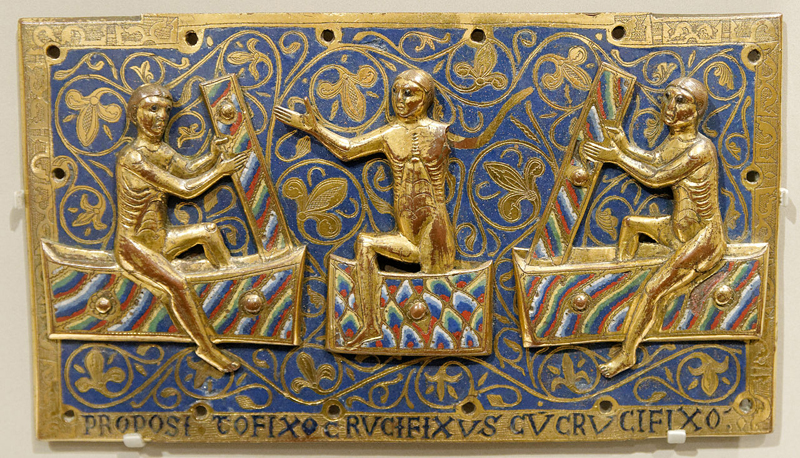
Resurrection of the Dead, from Art in the Christian Tradition, a project of the Vanderbilt Divinity Library, Nashville, TN. http://diglib.library.vanderbilt.edu/act-imagelink.pl?RC=57310 [retrieved July 5, 2020]. Original source: https://commons.wikimedia.org/wiki/File:Plaque_resurrection_dead_VandA_M.104-1945.jpg.


Why Do I Do These Things? — Lectionary Reflection for Pentecost 5A (Romans 7)

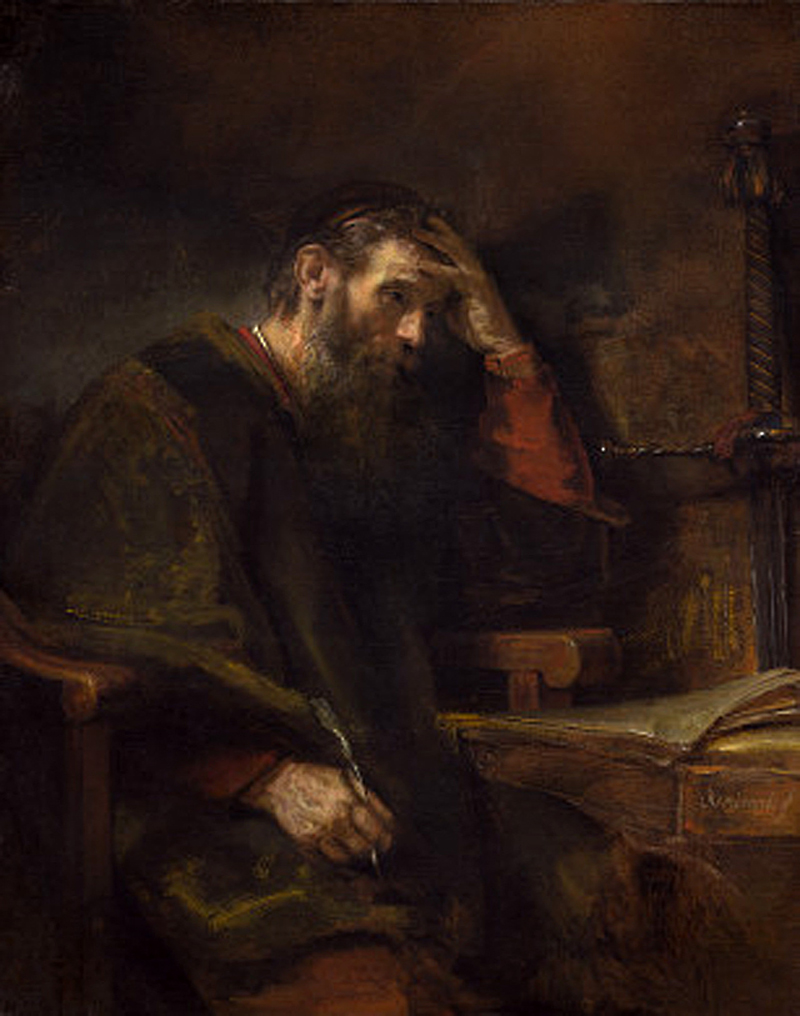
Rembrandt, Apostle Paul
Romans 7:15-25a  New Revised Standard Version (NRSV)
 

15 I do not understand my own actions. For I do not do what I want, but I do the very thing I hate. 16 Now if I do what I do not want, I agree that the law is good. 17 But in fact it is no longer I that do it, but sin that dwells within me. 18 For I know that nothing good dwells within me, that is, in my flesh. I can will what is right, but I cannot do it. 19 For I do not do the good I want, but the evil I do not want is what I do. 20 Now if I do what I do not want, it is no longer I that do it, but sin that dwells within me. 

21 So I find it to be a law that when I want to do what is good, evil lies close at hand. 22 For I delight in the law of God in my inmost self, 23 but I see in my members another law at war with the law of my mind, making me captive to the law of sin that dwells in my members. 24 Wretched man that I am! Who will rescue me from this body of death? 25 Thanks be to God through Jesus Christ our Lord!

*****************

                Why do I do these things? Why can’t I seem to do what is right? Right now the issue of racism is raging across the globe as we reckon with continuing reports about profiling and police violence against people of color, especially people who are black. Names such as George Floyd, Breonna Taylor, Elijah McClain have become part of our consciousness. While we speak of “Black Lives Matter,” we also are facing the issue of whiteness as an ideology. That is, the ideology that white Euro-American culture is superior to other cultures, and that white people are genetically superior as well. It is in this context that we hear Paul ask why he does that which he hates. He attributes it to the sin that dwells within him.

                We can debate whether sin is genetically or socially determined, but whichever choice we make, it does seem that Paul is correct that sin is a problem. Living under the dominion of sin is, Paul noted in chapter six, deadly. However, to live under Christ’s dominion leads to life (Rom 6:23). The promise of baptism is freedom from sin, but Paul recognizes that even he struggles with the power of sin. He’s no Vulcan who has learned to suppress his passions with logic. These passions that drive behavior live too close to the surface and are difficult to control.

                To affirm the premise that sin exerts power over our lives, even when we resist, doesn’t mean we’re totally depraved or unable to do anything good. As Sarah Heaner Lancaster notes, this is about human nature. Instead, it is a question of where sin resides and exercises control. That is the self. It is like a virus that has taken root in our lives, driving our behavior in ways that are contrary to our nature. In fact, as Lancaster points out, for Paul sin resides closer than the good, which is why it has so much power. [Romans, pp. 127-128].

                In his discussions of law, the problem isn’t with Jewish law. There’s nothing inherently wrong with it. The problem is with the will not being strong enough to live according to these instructions. Concerning the definition of sin, it’s not really about breaking rules. Instead, it is a distortion of our relationship with God. It is a turning from centering our lives in God to centering our lives in ourselves. Thus, as Harold Masback writes: “The very turn to self-assertion unleashes a ‘fleshliness,’ the self’s insatiable desire to secure its own acceptability through acquisition and possession rather than through trust in God’s love” [Masback, Feasting on the Word, p. 209]. As Paul reflects on his situation in life, he confesses to being conflicted. He would like to do otherwise but seems unable to do so. Now, if we’re not inclined to do what is right, then there is no conflict. The conflict comes into play when we desire to do what is right and find sin overpowering that desire. The only way out is grace. It is grace that overcomes the power of sin so that we might live into God’s desires for us.

                In our day we are beginning to recognize that sin is not only personal it can be systemic. Racism is systemic. We’re not born racist, but the system quickly forms us. Before we know the difference between ourselves and others, the virus has begun to spread. Thus, as Sarah Lancaster points out “recognizing this problem helps us see how deeply conflicted we really are and how thoroughly dependent on grace we must be.” [Romans, p. 130].

                The title of Kerry Connelly’s book speaks to the dilemma we’re facing as believers. The book is titled Good White Racist? How can I be a racist and be a good person? Connelly writes that “We hid from our own shadow side, unable to hold the paradox that as generally good people, we can do incredibly bad things” [Good White Racist? p. 11]. That’s the point Paul is making. Good people can do bad things. This is true even when we want to be different. I look at myself. I am committed to being anti-racist. My denomination provides anti-racism training, which I’ve taken. As chair of our Commission on Ministry, I require it of my colleagues, both new and old. I know better, and yet I see evidence that racism is lurking just under the surface. It’s present in the form of implicit bias. It’s present in the sense of white superiority. It’s present in white privilege.

                Paul’s discussion of sin has long been problematic for liberal Protestant Christians. We want to believe that if we educate ourselves, we will reach that utopian place of justice and peace. It’s enticing. I want to affirm it, but then I hear a voice like that of Reinhold Niebuhr, who pulls the rug out from my illusions. In Moral Man inImmoral Society, Niebuhr writes that “while it is possible for intelligence to increase the range of benevolent impulse, and thus prompt a human being to consider the needs and rights of other than those to whom he is bound by organic and physical relationship, there are definite limits in the capacity of ordinary mortals which makes it impossible to grant to others what they claim for themselves” [Niebuhr, Moral Man in Immoral Society, p. 3].  He notes that educators have “given themselves to the fond illusion that justice through voluntary co-operation waited only upon a more universal or a more adequate educational enterprise.” [Niebuhr, p. 3]. But, there’s no evidence that this true. Instead, he suggests that the only way forward is through some form of coercion. That goes against the grain of my own theology, which suggests that divine love if it is truly love, is non-coercive. It does put me in a bind.

                Paul has put his finger on our dilemma. He raises questions that I’ve yet to fully find answers to. Perhaps the place to start is to recognize that the challenges we face are rooted in spiritual realities. We find it difficult to tackle the problems of our age because we believe that with a bit of education, we can overcome them. The fact is, literacy and education are universal in the United States, but we still can’t figure out how to overcome racism or provide for the common welfare of all residents. So, maybe we need to look at this from a spiritual perspective. In other words, perhaps the issue isn’t the law, it’s our personal and corporate enslavement to the power of sin, which has taken root in our lives. We claim for ourselves freedom, but are we truly free? So, perhaps racism is itself an inherently spiritual issue. Perhaps the very systems in which we live are spiritually compromised. It’s in that context that together with Paul we can cry out: “Wretched man that I am! Who will rescue me from this body of death?” (vs. 24). Perhaps the answer is to be found in that declaration of thanksgiving that Paul provides us: “Thanks be to God through Jesus Christ our Lord!” (vs. 25a). This is a recognition on Paul’s part that he can’t save himself. He needs help, and Jesus is there to provide it. Just reach out and take hold of the promise. That may seem like a copout, but perhaps it is the starting point for change. As they say in Twelve-Step programs change begins when we admit we have a problem we can’t solve on our own.


Picture attribution: Rembrandt Harmenszoon van Rijn, 1606-1669. Apostle Paul, from Art in the Christian Tradition, a project of the Vanderbilt Divinity Library, Nashville, TN. http://diglib.library.vanderbilt.edu/act-imagelink.pl?RC=55240 [retrieved June 28, 2020]. Original source: http://www.nga.gov/fcgi-bin/tinfo_f?object=1198.


What Has Dominion in Your Life? – A Lectionary Reflection for Pentecost 4A (Romans 6)


12 Therefore, do not let sin exercise dominion in your mortal bodies, to make you obey their passions. 13 No longer present your members to sin as instruments of wickedness, but present yourselves to God as those who have been brought from death to life, and present your members to God as instruments of righteousness. 14 For sin will have no dominion over you, since you are not under law but under grace. 

15 What then? Should we sin because we are not under law but under grace? By no means! 16 Do you not know that if you present yourselves to anyone as obedient slaves, you are slaves of the one whom you obey, either of sin, which leads to death, or of obedience, which leads to righteousness? 17 But thanks be to God that you, having once been slaves of sin, have become obedient from the heart to the form of teaching to which you were entrusted, 18 and that you, having been set free from sin, have become slaves of righteousness. 19 I am speaking in human terms because of your natural limitations. For just as you once presented your members as slaves to impurity and to greater and greater iniquity, so now present your members as slaves to righteousness for sanctification. 

20 When you were slaves of sin, you were free in regard to righteousness. 21 So what advantage did you then get from the things of which you now are ashamed? The end of those things is death. 22 But now that you have been freed from sin and enslaved to God, the advantage you get is sanctification. The end is eternal life. 23 For the wages of sin is death, but the free gift of God is eternal life in Christ Jesus our Lord.

********

                Whenever the words slave or slavery appear in Scripture, we should wince. We must be careful not to do anything with these words that would justify North American slavery and its legacy because that legacy is still with us. We do not live in a post-racial society. The election of a black man didn’t suddenly change our nation. To say that “all lives matter” is to miss the point. Racism is still alive and well in America. So, anything that might justify or rationalize the servitude of a particular people is simply unacceptable. It’s with this warning that I venture into this reading from Paul’s letter to the Romans, which speaks of being a slave either to sin or to God.  


We need to remember that at the time when Paul wrote this letter slavery was a dominant form of life in the First Century Roman world, with as many as two-thirds of the residents of the empire being slaves. Not all forms of slavery the same. One could be a slave and work in the salt mines or one could be a tutor to a wealthy family. Some slaves were forced into this life and others sold themselves into slavery. We should also remember that a significant number of early Christians were themselves, slaves. So, at least some of the recipients of this letter were slaves. So, it’s not surprising that Paul used this image to present his message of dominion.  


                This reading for the Fourth Sunday after Pentecost continues the discussion of the power of sin that Paul has been working with in previous verses and chapters. He has told the Roman church that “all have sinned and fall short of the glory of God” (Rom. 3:23). He wants them to know that the Law can reveal their sin, but not free them from it. Their only hope is Christ. In the opening eleven verses of Romans 6, Paul makes it clear that to be in Christ is to die to sin. He uses baptism to illustrate his message. He tells the Roman Christians that when they were baptized, they died to sin, even as Jesus buried. Then as they rise from the waters of baptism, they share in the resurrection of Jesus. Thus, in baptism, they move from death to life. To be baptized is to be dead to sin. That is, to be in Christ is to be dead in sin and alive to God.

As we turn to verse twelve of chapter six, Paul changes metaphors. Now the question is—who or what has dominion over our mortal bodies. Paul tells the readers that now that they are dead to sin and alive to God they shouldn’t “let sin exercise dominion over your mortal bodies. It’s here that turns to the metaphor of slavery but notice that it is assumed that one has the freedom to choose the nature of one’s slavery.

                Here is where things get tricky. There were different forms of slavery in the First Century, none of which were race-based. Slaves might be prisoners of war or the spoils of war. These were not voluntary forms of slavery, but one could sell oneself into slavery either for economic purposes or to advance one’s social status by serving someone of importance. This was common for tutors and other scholars. Nevertheless, to be a slave was to lose one’s freedom, even if entered into voluntarily. Thus, Sarah Heaner Lancaster writes that “all the restrictions and dangers of being someone else’s property apply as equally to the willing slave as to someone enslaved by force. Just so, misusing the freedom that grace provides by voluntarily obeying sin makes one no less a slave to sin” [Lancaster, Romans, p. 114].

                Instead of turning yourself over to sin, to let it have dominion over your life, turn yourself over to God so that your bodies might be instruments of righteousness. There is the freedom to choose, but it’s the freedom to choose the nature of one’s slavery. It is either being a slave to sin or a slave to God. It’s a question of allegiance in many ways—sin or God.  So, what is the advantage of giving dominion over to God rather than sin? Truth be told, sin often seems more attractive, but Paul suggests that the domain of sin leads to shame. In other words, Paul is drawing on the cultural understanding of honor/shame to define sin’s hold. Of course, to enter Christ’s domain means leaving behind a world that defined honor to join one that in the eyes of the broader culture might connote shame. Paul just turns things upside down and suggests that by choosing God’s dominion, one chooses the long-term gain over the short term. When one lived under the dominion of sin, one may have done things and behaved in certain ways that they now would be embarrassed about, even if those items were perfectly legitimate in the previous life.

Paul wants them to know that the choice is theirs. They can choose to let sin have dominion, but it will lead to death. Or, they could let God have dominion, and that leads to life. Or as Paul puts it in another well-worn verse: “For the wages of sin is death, but the free gift of God is eternal life in Christ Jesus our Lord” (Rom. 6:23).   


Dead to Sin, Alive to God — Lectionary Reflection for Pentecost 3A (Romans 6)

What then are we to say? Should we continue in sin in order that grace may abound? By no means! How can we who died to sin go on living in it? Do you not know that all of us who have been baptized into Christ Jesus were baptized into his death? Therefore we have been buried with him by baptism into death, so that, just as Christ was raised from the dead by the glory of the Father, so we too might walk in newness of life. 

For if we have been united with him in a death like his, we will certainly be united with him in a resurrection like his. We know that our old self was crucified with him so that the body of sin might be destroyed, and we might no longer be enslaved to sin. For whoever has died is freed from sin. But if we have died with Christ, we believe that we will also live with him. We know that Christ, being raised from the dead, will never die again; death no longer has dominion over him. 10 The death he died, he died to sin, once for all; but the life he lives, he lives to God. 11 So you also must consider yourselves dead to sin and alive to God in Christ Jesus.

***********

                When I play Monopoly it’s always helpful to obtain at some point a “Get Out of Jail Free” card. You never know when you’ll need it. When it comes to spiritual things, sometimes we treat grace similarly. Maybe you’ve seen the bumper sticker: “I’m not perfect, just forgiven.” That may be true, but it’s a sentiment easily abused (usually by the person driving the car, who cuts you off almost causing an accident). That’s why Paul told the Corinthians that while all things are lawful, not all things are beneficial (1 Cor. 6:14). Here in Paul’s letter to the Romans, we read about the power of sin and the power of grace. Paul makes it clear that we have been justified by faith through the grace obtained through the death of Jesus. Death, Paul writes in Romans 5, came to humanity through sin, but life comes through Christ, who overcomes sin through his own death. But if grace is so powerful that it overcomes death, why not sin all the more so that grace has an opportunity to work its magic in our lives. As Luther declared: “sin boldly” (I don’t think Luther had libertinism here, though).   


                Grace is not, in Paul’s mind, a license to sin. It is instead an invitation to restart our lives by moving from one realm (sin) into another (grace). Paul isn’t naïve. He understands the power of sin to gain dominion over our lives. He may not have used the term systemic in relation to sin, but he understood that sin was a power that was present in the broader culture/society. Think here of racism. Why is it so prevalent in our society? Why do we find it so difficult to break free of its hold? If it was just a knowledge thing, we could break free so easily, but it runs so much deeper than that. To be in Christ means dying to that old realm where a system, like racism, continues to reign. Grace is the starting point, but it’s not the endpoint. So, to be in Christ means dying to the old realm and being resurrected into a new life that is under the dominion of Christ. Of course, if we open the door to let it sin back in, it will make its home in our lives once again. So, no, we should sin so that grace might have greater opportunity to display itself.

This leads us to baptism as that point wherein we die to sin and are raised to new life in Christ. It is the point at which we exchange allegiances. As Sarah Heaner Lancaster notes: “Exchanging one dominion for another requires a change of allegiances. To continue in sin would show that one has not changed allegiances” [Lancaster, Romans, p. 107]. In other words, to rise to new life in Christ means that you can’t live as you once did. That old life marked by sin, by rebellion against God’s rule, has been left behind.

This change of identity is embodied in the practice of believer baptism by immersion. By being buried in the waters of baptism, we die to the old life. As we rise from the waters of baptism, we leave the old life behind. In the ancient church, baptism followed a lengthy period of teaching (Hippolytus in his Apostolic Tradition spoke of a three-year process), after which one was baptized. In those services, in which one often stripped off one’s old clothes before entering the baptismal pool, one would be asked to renounce Satan, before being buried in the waters of baptism and then given new clothes upon the exit from the baptistry. Our processes are not nearly as intensive as was true in the early years of the church, but the imagery remains powerful. In baptism we are buried with Christ, leaving behind the old life of sin, before being raised to new life, again with Christ, so that we might share in his resurrection.     


                We can’t sin so that grace might abound because if we’ve been baptized into Christ, we have died to sin and raised to new life. Therefore, neither sin nor death has dominion over our lives. Yet, we know, that in real life sin keeps tugging at us. It’s why churches often provide prayers of confession. It seems we need to die to sin anew each day. I know this is true of my own life. In part, this is because even if I have given allegiance to Christ in baptism, I still live in this world where sin rules. Karl Barth recognizes this challenge to our continued engagement with sin. He writes that “because and so long as I live in the body, I remain the old man, and am wholly and indissolubly one with him. Therefore the death of the old man and dissolution of my identity with him also involves the doing away of my union with this body. As the new man, I live no longer in it: as determined by time and things and men, I exist no longer” [Barth, Romans, p. 199]. We may have changed our allegiance, but as long as we experience this body of ours, we will be subject to sin. We can move toward that new life, as we change our allegiance, but truth be told, we will continue to wrestle with sin. We might not be as beholden as we were in the past, but it’s still there. The difference, is we struggle with sin, but no longer do we live in bondage to it.

                To quote another bumper sticker that is also easily abused, “please be patient, God isn’t finished with me yet.” That is true. Sanctification is a process, a movement toward the full embodiment of God’s grace. That being said, imperfection is not an excuse for sin, including racism and homophobia. In the end, we are called to consider ourselves dead to sin and alive to God in Christ. Thus, if we live by faith, then as Barth notes: “faith means seeing what God sees, knowing what God knows, reckoning as God reckons” (Romans, p. 206). This is the new life in Christ.  


Image attribution:  Baptism in the River Jordan during pilgrimage, from Art in the Christian Tradition, a project of the Vanderbilt Divinity Library, Nashville, TN. http://diglib.library.vanderbilt.edu/act-imagelink.pl?RC=55206 [retrieved June 14, 2020]. Original source: http://commons.wikimedia.org/wiki/File:Flickr_-_Israel_Defense_Forces_-_Christian_Pilgrims_Celebrate_the_Epiphany_in_the_Jordan_Valley,_Jan_2011_(1).jpg.


Triune Blessing — Lectionary Reflection for Trinity Sunday (2 Corinthians 13)

Perichoresis by Faithdance 
2 Corinthians 13:11-13 New Revised Standard Version (NRSV)
 

11 Finally, brothers and sisters, farewell. Put things in order, listen to my appeal, agree with one another, live in peace; and the God of love and peace will be with you. 12 Greet one another with a holy kiss. All the saints greet you. 

13 The grace of the Lord Jesus Christ, the love of God, and the communion of the Holy Spirit be with all of you.

***************

        Trinity Sunday offers a challenge, especially to non-creedal churches that don’t prescribe its observance or even require a trinitarian understanding of God. That is true for me, as a minister within the Christian Church (Disciples of Christ). Although I affirm the doctrine of the Trinity, there has always been a certain uneasiness with the doctrine within the denomination. Alexander Campbell, for example, had what looks like a trinitarian understanding of God’s nature, but refused to identify himself as trinitarian or use the word Trinity to speak of God. While I’ve written a small book on the Trinity for my denomination, I know that a significant number of my colleagues would disagree with my assessments and suggestions. Nevertheless, I will persist in my advocacy of the value of the doctrine of the Trinity for the church.

If we look only to Scripture for guidance on this matter, we are left with hints and intriguing formulas, like the one found in the final verse of 2 Corinthians 13, but we won’t find a fully developed trinitarian doctrine present in Scripture. But, as Karl Barth notes the Church Fathers and Reformers knew that to be true, but they also recognized the doctrine to be present in the words of Scripture. In other words, it is a reflection of good interpretation of Scripture [Church Dogmatics 1/1 309-310].

Here in 2 Corinthians 13, Paul concludes a letter that deals with difficult issues within this community. Now that he’s bringing the letter to a close, he appeals to them, asking that they agree with each other and live in peace, reflecting the presence of the God of land peace. The suggestion that they greet each other with a holy kiss is probably not appropriate at the moment I write this reflection, as we are being encouraged strongly to keep physically separate from each other due to the COVID-19 pandemic. But a warm greeting, even at a six-foot distance, is appropriate. Good interpretation here doesn’t require us to agree on every matter of doctrine or even practice, but it does ask that we be of one mind when it comes to the center of our faith, that would be Jesus as the Christ.

I would like to use this reflection to consider the concept of the Trinity as the Christian way of understanding the nature of God. Augustine wrote at length on the Trinity, and in his treatise On Christian Doctrine, he writes this classic statement:

The Trinity, one God, of whom are all things, through whom are all things, in whom are all things. Thus the Father and the Son and the Holy Spirit, and each of these by Himself, is God, and at the same time they are all one God; and each of them by Himself is a complete substance, and yet they are all one substance. The Father is not the Son nor the Holy Spirit; the Son is not the Father nor the Holy Spirit; the Holy Spirit is not the Father nor the Son: but the Father is only Father, the Son is only Son, and the Holy Spirit is only Holy Spirit. To all three belong the same eternity, the same unchangeableness, the same majesty, the same power. In the Father is unity, in the Son equality, in the Holy Spirit the harmony of unity and equality; and these three attributes are all one because of the Father, all equal because of the Son, and all harmonious because of the Holy Spirit.  [Saint Augustine. OnChristian Doctrine (With Active Table of Contents). Kindle Edition.]

There was for a time a sense that the Trinity was an outmoded doctrine. It seemed to make God rather complicated, and besides preachers and even professors have had a difficult time explaining it. Then along came Karl Barth who reaffirmed its importance and value to the church. For Barth and those he influenced, directly and indirectly, the conversation centers around the confession that Jesus is the Christ, and by that he means the Word of God incarnate. This is not the place for a full-blown discussion of the Trinity. On that, I suggest reading my brief treatise The Triune Nature of God: Conversations Regarding the Trinity by a Disciples of ChristPastor/Theologian (Energion, 2019).

                For our purposes, especially at this moment in time, I’d like to highlight the relational nature of the Trinity as expressed in the doctrine of the social Trinity. While this perspective risks a slide into tri-theism, it is worth the risk to think in terms of God’s nature as relational. Thus, human relationships reflect the internal relationships that is God. Jürgen Moltmann is one of the most influential theologians to advance the idea of the social Trinity. He makes use of the doctrine of perichoresis. He writes here of the interrelationship of the three persons of the Trinity:

An eternal life process takes place in the triune God through the exchange of energies. The Father exists in the Son, the Son in the Father, and both of them in the Spirit, just as the Spirit exists in both the Father and the Son. By virtue of their eternal love they live in one another to such an extent, and dwell in one another to such an extent, that they are one. It is a process of most perfect and intense empathy. [Jurgen Moltmann. The Trinity and the Kingdom (Kindle Locations 2544-2548). Kindle Edition.]

As I reflect on Paul’s closing statement, there is a relational quality that reflects the concept of the social Trinity. Note how Paul uses the words grace, love, and communion. These are all relational terms. The idea of the social Trinity suggests that human relationships reflect the relationship that exists within the Godhead. What is key is the affirmation that this relationship of Father, Son, and Holy Spirit is eternal. Traditionally, it is assumed that each member of the Trinity is always present together, though as Moltmann suggests, this is to be understood in terms of perichoresis. Some theologians have envisioned this as a dance in which the three persons are engaged with each other. Catherine Mowry LaCugna notes that while the philological evidence for this idea of dance is not great, it is an effective metaphor. She writes:


Choreography suggests the partnership of movement, symmetrical but not redundant as each dancer expresses and at the same time fulfills him/herself towards the other. In interaction and inter-course, the dancers (and the observers) experience one fluid motion of encircling, encompassing, permeating, enveloping, outstretching. There are neither leaders nor followers in the divine dance, only an eternal movement of reciprocal giving and receiving, giving again and receiving again [LaCugna, God for Us, pp. 271-272].

While there might be questions concerning this metaphor for understanding the internal relationship within the Godhead, and as to whether the Triune God wishes to invite creation into the dance, as for me, without being overly dogmatic, I can envision this description of God’s nature. I can also envision God inviting humanity/creation into the dance.

          Thee key for us is not only in relationship to God’s internal nature, but how we can understand ourselves within this conversation. Might we, if we exist as the image of God, reflect God’s relationality in our own human relationships? LaCugna writes that “mutuality rooted in communion among persons is a non-negotiable truth about our existence, the highest value and ideal of the Christian life, because for God mutual love among persons is supreme” [LaCugna, God for Us, p. 399]. To live the trinitarian life is to live “together in harmony and communion with every other creature in the common household of God ‘doing all things to the praise and glory of God’” [LaCugna, p. 401].

                While the doctrine of the Trinity is not an easy concept to digest, and it can easily end up leading dwelling in abstractions, it can also serve as the foundation for living together in the church and beyond. It is a vision of God’s nature, one that envisions God being in communication with creation, bringing wholeness and healing to broken people and communities. Considering we livin in a moment of brokenness, when the nation is more divided than we’ve seen in years, when a pandemic and the continuing challenge of racism and its presence in all parts of the community, including the police, we need to hear a word like this.  So, may “the grace of the Lord Jesus Christ, the love of God, and the communion of the Holy Spirit be with all of you” (2 Cor. 13:13).

One in the Spirit – Lectionary Reflection for Pentecost Sunday (1 Corinthians 12)

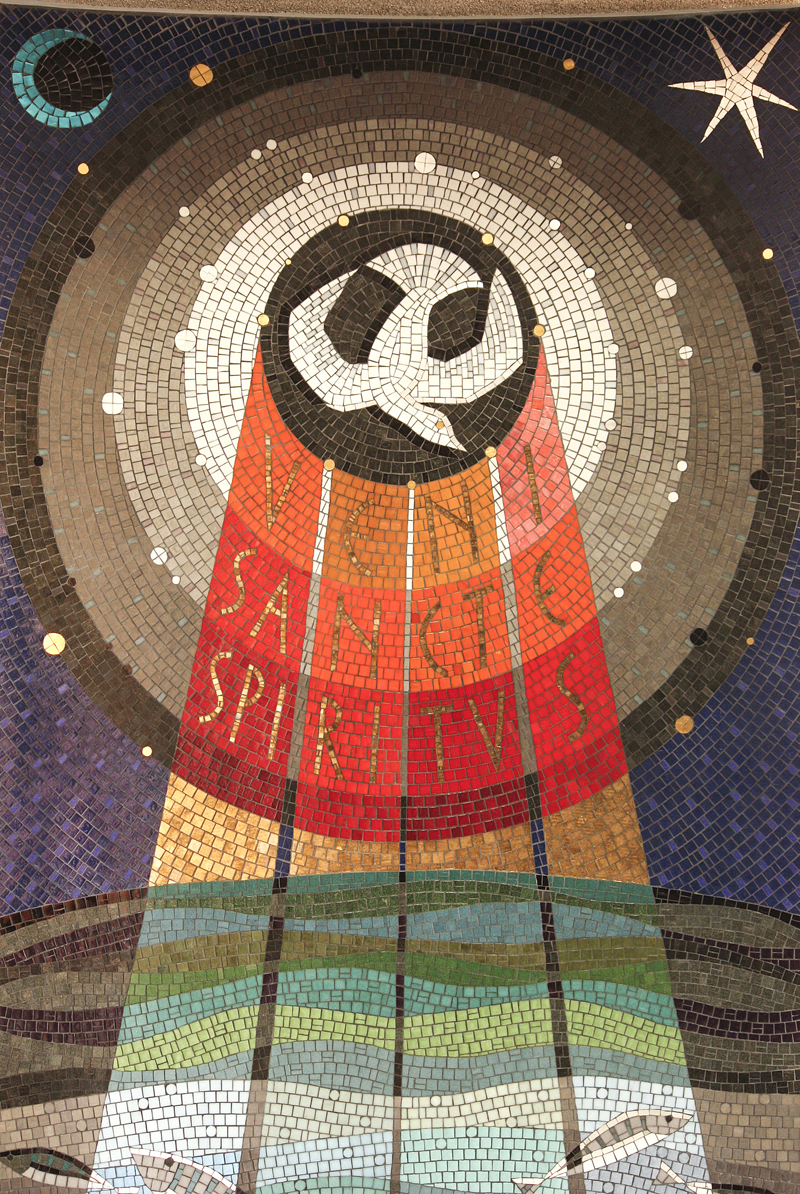
Adam Kossowski, Veni Sancti Spiritus
1 Corinthians 12:3-13 New Revised Standard Version (NRSV)
 
Therefore I want you to understand that no one speaking by the Spirit of God ever says “Let Jesus be cursed!” and no one can say “Jesus is Lord” except by the Holy Spirit. 
Now there are varieties of gifts, but the same Spirit; and there are varieties of services, but the same Lord; and there are varieties of activities, but it is the same God who activates all of them in everyone. To each is given the manifestation of the Spirit for the common good. To one is given through the Spirit the utterance of wisdom, and to another the utterance of knowledge according to the same Spirit, to another faith by the same Spirit, to another gifts of healing by the one Spirit, 10 to another the working of miracles, to another prophecy, to another the discernment of spirits, to another various kinds of tongues, to another the interpretation of tongues. 11 All these are activated by one and the same Spirit, who allots to each one individually just as the Spirit chooses. 
12 For just as the body is one and has many members, and all the members of the body, though many, are one body, so it is with Christ. 13 For in the one Spirit we were all baptized into one body—Jews or Greeks, slaves or free—and we were all made to drink of one Spirit.
*************

                We’ve been waiting for the Spirit to come. Whether we’re ready or not, the Spirit is coming and is here. That period running from the moment of Jesus’ ascension to the day of Pentecost has come to a close (and with it a very strange Easter 2020). The promise made in Acts 1, before Jesus departed, was that before long they would receive the baptism of the Holy Spirit (Acts 1:5). With Pentecost that day has come. According to Luke, the followers of Jesus spent the time between the ascension and Pentecost praying and choosing a successor to the fallen Judas so that their number (twelve) would be complete. Then came the date with destiny, the day promised by Jesus.

                It was on Pentecost Sunday, a day when Jews would have gathered in Jerusalem for one of three important pilgrimage festivals. Pentecost is the Greek term for the Jewish festival of the Feast of Weeks (Shavuot). And so as they gathered for prayer that day, the Spirit of God fell upon them, and as the Spirit baptized them, they began to proclaim the Gospel in a multitude of languages so that the crowd below heard the message (Acts 2). As I noted Shavuot was one of the three pilgrimage festivals, along with Passover and Sukkot (Tabernacles). It was both the celebration of thanksgiving for the wheat harvest and a celebration of the giving of the Torah. As a pilgrimage festival, the city of Jerusalem would have been filled with people from across the diaspora. There are several intriguing parallels and analogies between the two festivals that should be kept in mind as we celebrate Pentecost.

Since I’m focusing my lectionary reflections this cycle on the second reading (epistles), we are invited to consider the message for Pentecost that comes from 1 Corinthians 12. First Corinthians 12 to 14 focuses on things of the Spirit. In fact, it is the place we go to understand how the Spirit works in our lives. There Paul speaks about spiritual things, of which he does not want them to be uninformed (1 Cor. 12:1). The lectionary reading begins in verse three and extends to verse thirteen. The section we’re invited to consider begins with the declaration that “no one can say ‘Jesus is Lord’ except by the Holy Spirit” (1 Cor. 12:3). In other words, our ability to confess our faith is rooted in the presence of the Spirit, who empowers us to proclaim the good news to the ends of the earth.

Having made that opening declaration, Paul gets to the practical side of the equation. I should preface this by dropping down to the closing verses of our text, where Paul invokes the imagery of the church as the body of Christ. He reminds us that there is but one body with many members. What is true of the body is true of Christ and therefore of the church. I will come back to the message of verse 13 in a moment, but first let’s return to the middle section of our passage. That middle section is the first of two gift lists in 1 Corinthians 12. I have written a rather lengthy book on Spiritual Gifts titled Unfettered Spirit: Spiritual Gifts for the New Great Awakening, (Energion, 2013), I would direct your attention there for an in-depth discussion of spiritual gifts.  


What Paul does here, is describe how there can be unity in diversity in the congregation. Paul tells us that there are a variety of gifts but only one Spirit. There is, he declares, varieties of services, and the same Lord, along with a variety of activities, but one God. While I realize that Paul doesn’t have a fully developed trinitarian theology, we see hints of the possibility here and there in his letters. While I try to be careful about how I conceive of God in trinitarian terms, perhaps we can think in terms of how our own unity in diversity as a community might reflect the diversity that exists within the unity that is God.  


As to the variety of gifts, Paul offers nine in this first list, all of which are activated by the same God in each one. These gifts, which are given to the members of the body for the common good include the utterance of wisdom, the utterance of knowledge, faith, healing, miracles, prophecy, discernment of spirits, various kinds of tongues, and the interpretation of tongues. It appears from the larger context that this gift of tongues is a big issue. Apparently, some prize it above the others (see 1 Corinthians 14). However, while Paul never denies its value, he puts it below those gifts that allow for understanding. The point here is that whatever gift you have been given, it comes from God and its purpose is related to the common good. So, don’t mount your high horse, because there is no hierarchy of gifts. Your gift(s) are there so you can serve others, not so you can rise in stature. Gifts have a purpose, and that purpose, while it might prove to be a blessing, is given for the welfare of the body.

To return to verses twelve and thirteen, after we’ve heard the message that the Spirit brings gifts to us that are to be used for the good of others, we hear the message that there is one body with many members. This reality is rooted in baptism, through which we become one, whether Jew or Gentile, slave or free. In other words, as John McClure notes, “all of the usual ways in which people are organized by class, ethnicity, gender, social status, or education are irrelevant within this new creation.  All that is relevant is the way that God’s gifts empower each for the common welfare of the whole” [Preaching God’s Transforming Justice, p. 254]. Over time, the church has often failed to recognize Paul’s message as revealed here. We often follow the lead of the larger culture, just like the Corinthians. Here is a corrective if we’re willing to embrace it. Whatever gift(s) come your way, use them, Paul tells us, for the common good. Remember as well that they come to us from God through the Spirit so we can declare that Jesus is Lord.


Image attribution:  Kossowski, Adam. Veni Sancti Spiritus, from Art in the Christian Tradition, a project of the Vanderbilt Divinity Library, Nashville, TN. http://diglib.library.vanderbilt.edu/act-imagelink.pl?RC=56946 [retrieved May 24, 2020]. Original source: https://www.flickr.com/photos/paullew/8750321716 – Fr Lawrence Lew, O.P..


Give Your Anxiety to God — A Lectionary Reflection for Easter 7A (1 Peter 4-5)

1 Peter 4:12-14; 5:6-11 New Revised Standard Version (NRSV)

12 Beloved, do not be surprised at the fiery ordeal that is taking place among you to test you, as though something strange were happening to you. 13 But rejoice insofar as you are sharing Christ’s sufferings, so that you may also be glad and shout for joy when his glory is revealed. 14 If you are reviled for the name of Christ, you are blessed, because the spirit of glory, which is the Spirit of God, is resting on you. 

Humble yourselves therefore under the mighty hand of God, so that he may exalt you in due time. Cast all your anxiety on him, because he cares for you. Discipline yourselves, keep alert. Like a roaring lion your adversary the devil prowls around, looking for someone to devour. Resist him, steadfast in your faith, for you know that your brothers and sisters in all the world are undergoing the same kinds of suffering. 10 And after you have suffered for a little while, the God of all grace, who has called you to his eternal glory in Christ, will himself restore, support, strengthen, and establish you. 11 To him be the power forever and ever. Amen.

*******************
 

                Our journey through Easter is coming to a close. Pentecost is on the horizon. Preachers and congregations have choices this week. They can go with Ascension Sunday texts or they can continue with the Eastertide texts. If one chooses to stay with Eastertide, the Seventh Sunday of Easter offers us one final opportunity to engage with the letter we know as 1 Peter. Considering the moment in which we’re living, perhaps 1 Peter is a good text to stay with. Eastertide is supposed to be a season of triumph and glory. It offers us continuing opportunities to reflect on the meaning of the resurrection. The presence of the resurrection is not as evident as it is in other readings from 1 Peter, but Peter does point our attention towards the future when the glory of the Lord will be revealed, and the current moments of suffering will meet their match. 


When Peter talks about suffering and anxiety in this letter he has something specific in mind, even if we don’t know the full extent of what is going on. It’s clear that the community is facing some form of suffering, most likely harassment on the part of their neighbors. There is no evidence in the letter itself that this harassment is part of widespread imperial persecution. After all, Peter encourages them to honor the emperor and obey the governing authorities, who are authorized to punish those who do what is evil and Peter is insistent that if they suffer it should be on account of doing good and not doing evil (1 Pet. 2:11-14). Peter seems to have a bigger picture in mind here, one in which current suffering has to be endured so they can reach a larger reward, the salvation of their souls.

As we read 1 Peter, we may hear a different word that speaks to our moment in time. I’m reminded by Karl Barth that preaching is God’s word in the present, but it is a momentary word, not an enduring word. The enduring Word of God, which Peter speaks of earlier, if we follow Barth, the person of Christ. So in this moment, as we hear this word from 1 Peter as presented to us by the lectionary creators, we do so amid a global pandemic that has shut down much of daily life. There is a great deal of anxiety present in our communities, especially among those asked to go to work at this moment. While our anxieties might be different from those experienced by Peter’s audience in Asia Minor, they’re just as real. They can challenge our faith in God, whom Peter suggests we turn to and cast our anxieties on God who cares for us. Perhaps this will be for us at this moment a comforting word.

                The reading begins in chapter four with Peter suggesting that this “fiery ordeal” the Christians of Asia Minor were experiencing served as a test of their faith. That declaration may cause us a bit of discomfort. Is suffering a test to be endured? We have to hear this word with a degree of caution, but the truth is, being uncomfortable with the things of God isn’t necessarily a bad thing. Complacency can easily set in for us. We can rest on the promise that we’re saved by grace, and then go off and live dissolute lives believing that we’re free from all restrictions. Living in Christendom allowed Christians to become comfortable with their situation; something not possible for first-century Christians. In our day we can claim to be Christians and live lives that in no way reflect the way of Jesus. We can claim to be Christians and engage in racist and bigoted actions. We can turn our backs on those in need, even as we go to church and sing the songs of faith. So, Peter says to us, consider it an honor to suffer with Jesus. So, as Heidi Haverkamp writes “First Peter reminds us not to be surprised by adversity or tough times. Too often, we believe that to be ‘normal’ is to be happy, carefree, healthy, and successful. All of Scripture can witness this is not the case. To be normal is to struggle.” [Connections: A Lectionary Commentary for Preaching and Worship (Kindle Locations 10076-10078)].

                This week’s reading is divided into two sections. The first section is found in chapter 4, which contains the reference to the fiery ordeal with which faith is tested. Consider yourself blessed if you suffer for what is right, Peter says, because it is a sign that the Spirit is with you. The second section offers a word of comfort, but first, there is an admonishment. Be humble and let God lift you up. Then, “cast all your anxiety on him, because he cares for you.” This word from Peter looks back to Psalm 55:22, which declares: “Cast your burden on the Lord, and he will sustain you.” Whether from the Psalmist or Peter, that’s a word for this moment in time. We all seem burdened by anxiety, due to the uncertainty of the moment.

                While there is a word of encouragement here, a word about releasing our burdens and anxieties to God, there is another word. That word is straightforward: “Discipline yourselves.” That too is a word for us at this moment, as we become increasingly restless at our situation. We may want to go out and push boundaries. No masks, no social distancing. After all, don’t I have my rights? But then Peter tells us to be disciplined and alert, because the adversary, the devil, is on the prowl like a roaring lion. Resist the adversary. Stay focused. Be steadfast. Know that others among the faithful are also experiencing suffering. They’re not alone. This is standard procedure. But know this, Peter tells them, “after you have suffered for a little while, the God of all grace, who has called you to his eternal glory in Christ, will himself restore, support, strengthen, and establish you” (1 Pet. 5:10). While this is a helpful word, reminding us that simply being a Christian doesn’t mean we’re free from suffering, there is danger in this admonition. As Luke Powery reminds us there are those who suggest that all suffering is redemptive. That is not the case. Allowing oneself to be subjected to unjust suffering, especially when that involves domestic abuse or racial injustice is not something to countenance. So, as Powery notes, “there are life lessons learned through pain, yet those in pain need to be ministered to and not left to drown in despair” (Preaching God’sTransforming Justice, p. 249).

                Peter is working here with an eschatological framework. He wants the church to know that temporal suffering will give way to eternal blessing. As Peter writes we can see that the early Christians are still working with the premise that time is short. The Parousia, the coming of Jesus in his glory is close at hand. Standing as we do two thousand years later, we may not be working with the same sense of time. Nevertheless, the call to stay alert might not be a bad one to embrace. As we do, we can celebrate the power of God forever which is revealed in the message of Easter.

               
New Growth, from Art in the Christian Tradition, a project of the Vanderbilt Divinity Library, Nashville, TN. http://diglib.library.vanderbilt.edu/act-imagelink.pl?RC=57419 [retrieved May 16, 2020]. Original source: https://commons.wikimedia.org/wiki/File:Mua_Mission_sculpture.JPG.