Month: July 2019

Beloved Children – A Lectionary Reflection for Pentecost 8C (Hosea 11)

 
11 When Israel was a child, I loved him,
and out of Egypt I called my son.
The more I called them,
the more they went from me;
they kept sacrificing to the Baals,
and offering incense to idols.
Yet it was I who taught Ephraim to walk,
I took them up in my arms;
but they did not know that I healed them.
I led them with cords of human kindness,
with bands of love.
I was to them like those
who lift infants to their cheeks.
I bent down to them and fed them.
They shall return to the land of Egypt,
and Assyria shall be their king,
because they have refused to return to me.
The sword rages in their cities,
it consumes their oracle-priests,
and devours because of their schemes.
My people are bent on turning away from me.
To the Most High they call,
but he does not raise them up at all.
How can I give you up, Ephraim?
How can I hand you over, O Israel?
How can I make you like Admah?
How can I treat you like Zeboiim?
My heart recoils within me;
my compassion grows warm and tender.
I will not execute my fierce anger;
I will not again destroy Ephraim;
for I am God and no mortal,
the Holy One in your midst,
and I will not come in wrath.
10 They shall go after the Lord,
who roars like a lion;
when he roars,
his children shall come trembling from the west.
11 They shall come trembling like birds from Egypt,
and like doves from the land of Assyria;
and I will return them to their homes, says the Lord.
 
******************

                God is love. God is compassionate. Yet, God can get frustrated. We who are numbered among God’s creation, tend to do what is good in our own eyes. We have the freedom to do so, but often it is too our own detriment. Parents understand this. Children are loved, even though they can frustrate. Of course, parents ought to remember that they too were once children. We who are parents once frustrated our own parents and the same will be true from generation to generation. It is good to remember that Scripture speaks regularly of God’s relationship with humanity as one of parent and child. So, maybe human experience can help us understand God’s experience with us, experience that involves compassion and frustration. In this chapter we see God teaching the children of God to walk. God bends down to feed the children. God cares for the people, providing healing when needed. The vision here is kenotic. We see God act in human terms; terms we can understand. God is not a human being, and yet we require human terms to catch a vision. What better image than that of the parent and the child.

                The book of Hosea records the prophetic work of an eighth-century prophet who is perhaps best known for marrying Gomer and using her unfaithfulness as an illustration of Israel’s unfaithfulness. Marvin Sweeney puts it this way: “Hosea draws upon the traditional portrayal of Israel as the bride of YHWH to charge that Gomer/ Israel had engaged in harlotry by pursuing other lovers, prompting Hosea/ YHWH to punish the wayward bride with divorce.” [Sweeney, Tanakh: A Theological and Critical Introduction to The Jewish Bible (Kindle Locations 9564-9566). Fortress Press.] There is divorce, but also restoration. Thus, as Sweeney notes, judgment is not final but preliminary to restoration. The reading for the week from Hosea 11 looks back to Egypt, when God led Israel out of slavery and on to the Promised Land. The Tanakh personalizes the message of divine love: “I fell in love with Israel when he was still a child; and I have called [him] My son ever since Egypt” (Hos. 11:1). Nonetheless, despite this divine love for Israel, “they went their own way” by sacrificing to Baal. Despite God’s efforts to pursue a relationship with Israel (like Gomer) pursued other loves (other gods). Though God pampered Ephraim (another name for Israel), the nation “ignored my healing care” (vs. 3 Tanakh).

                When we read a book like Hosea, which at points is difficult, we discover that God is faithful despite our unfaithfulness. God invites, we spurn. God pursues. We do our own thing. God redeems. Hosea spoke to a nation that would in time disappear from history. Though Israel put its hope in Egypt (rather than Yahweh), Assyria would eventually sweep in and destroy Israel. Despite the fate of Israel, the messages delivered in the eighth century by Hosea were retained and passed on. They continue to remind us of God’s compassion despite our tendency to pursue agendas that run counter to that compassion. The word here has to do with the pursuit of other gods. There is a warning. The nation will suffer. Assyria will be their king, “because they refuse to repent” (vs. 5 Tanakh). So, God will allow them to suffer the consequences of their decisions. “The sword rages in their cities, it consumes their oracle-priests, and devours because of their schemes” (Hos. 11:6 NRSV).

                Despite everything, God is unwilling to give up on Israel. God has had a change of heart and won’t act on God’s wrath. Why? Because God is God and not a human being. Therefore, God will not come in fury. There are parental/familial analogies, but at some point, they will fall short. God is not a human being; therefore, God can see beyond the boundaries we run up against. While Israel (northern kingdom), as a nation, will come to an end in 721 BCE as a result of the Assyrian conquest, scatting its people, if we read the New Testament carefully, we will discover the presence of a remnant, the Samaritans. These people claimed descent from those original people who inhabited the land. I’m not sure what to make of this relationship, except that it does suggest (in my mind) the possibility that God was not left without a remnant who might be restored to their homes.

Among the questions that emerge from this passage of Scripture concerns the relationship between our unfaithfulness and God’s faithfulness. How does God come to us as a parent whose compassion includes discipline but doesn’t end there? I’m of the opinion that there are consequences to our actions. When we choose a pathway in life that is destructive, we will likely suffer the consequences. But that doesn’t mean we’re without the possibility of redemption or restoration. The message here is that God is always there, willing to bring healing and wholeness to our lives, despite our unfaithfulness.

Hosea spoke to the people of Israel (northern kingdom) living in the eighth century shortly before the fall of the nation to the Assyrians. The fall was quick and complete, and yet there was the promise of God’s faithfulness. Perhaps it served as a warning to the southern kingdom, which survived for a time, but after its fall did experience restoration. So, how do we hear this word? What message does God have for us through the voice of Hosea that speaks to our contemporary situations? For me and many who read this, it will be an American context. Many who read will be, like me, of European descent (white). There is unfaithfulness to God’s vision for humanity present in our context, including the church. We too follow after idols. They may be different in some ways from the gods Israel pursued, but they are idols nonetheless. They are enticements to follow a path of unfaithfulness. The list is extensive. It includes materialism, nationalism, imperialism, racism, sexism. You can add on to this list as you please. Ultimately, they are all idols that call out to us, inviting us to take a path away from the path God would have us walk. God may reach out to us as a loving parent, ready and willing to bind our wounds and embrace us with divine love.

I should note that we moderns tend to read passages like this in individualistic terms. For his part, Hosea was speaking to the community. We might want to hear this word as a word to the community because it’s rare that we simply walk in our own pathways. We tend to follow the lead of others. As a broader community, we’re hearing messages of division, of hate, of violence. The loudest voices seem to emerge not from the light but from the darkness. To give but one example, recent polls that suggest that the vast majority of white evangelicals do not believe the United States has any responsibility for refugees. Before we tar and feather evangelicals, the polls suggest that white Mainliners aren’t much more compassionate. Why is this? What idols are we pursuing that lead us astray? The previous ten chapters of Hosea speak of God’s frustration and anger. God is not happy with Israel. I dare say, God is not happy with the United States of America (and a lot of other nations). Here in chapter eleven, we hear a word of grace and compassion. We may suffer the consequences as a country and as a world and as individuals because of our corporate and individual unfaithfulness, but the good news, and there is good news to be embraced, is that God will settle us in our homes. We will experience restoration. Healing is possible. We simply must turn back, like the prodigal, and ultimately receive God’s parental compassion and love    


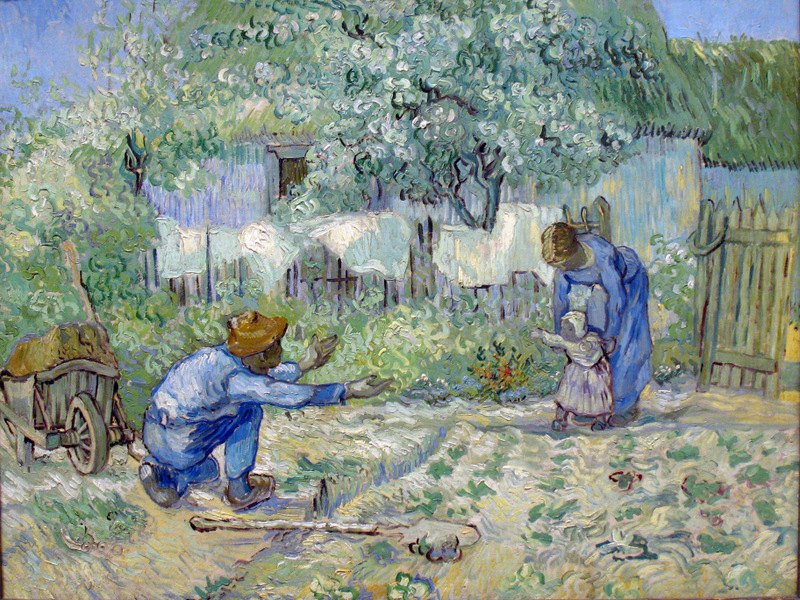
Picture Attribution:  Gogh, Vincent van, 1853-1890. First Steps, after Millet, from Art in the Christian Tradition, a project of the Vanderbilt Divinity Library, Nashville, TN. http://diglib.library.vanderbilt.edu/act-imagelink.pl?RC=55507 [retrieved July 28, 2019]. Original source: http://commons.wikimedia.org/wiki/File:1890_van_Gogh_First_Steps_-_after_Millet_anagoria.JPG.

Judgment Day — Lectionary Reflection for Pentecost 6C (Amos 8)

Amos8:1-12 New Revised Standard Version (NRSV)
 
This is what the Lord God showed me—a basket of summer fruit. He said, “Amos, what do you see?” And I said, “A basket of summer fruit.” Then the Lord said to me,
“The end has come upon my people Israel;
I will never again pass them by.
The songs of the temple shall become wailings in that day,”
says the Lord God;
“the dead bodies shall be many,
cast out in every place. Be silent!”
Hear this, you that trample on the needy,
and bring to ruin the poor of the land,
saying, “When will the new moon be over
so that we may sell grain;
and the sabbath,
so that we may offer wheat for sale?
We will make the ephah small and the shekel great,
and practice deceit with false balances,
buying the poor for silver
and the needy for a pair of sandals,
and selling the sweepings of the wheat.”
The Lord has sworn by the pride of Jacob:
Surely I will never forget any of their deeds.
Shall not the land tremble on this account,
and everyone mourn who lives in it,
and all of it rise like the Nile,
and be tossed about and sink again, like the Nile of Egypt?
On that day, says the Lord God,
I will make the sun go down at noon,
and darken the earth in broad daylight.
10 I will turn your feasts into mourning,
and all your songs into lamentation;
I will bring sackcloth on all loins,
and baldness on every head;
I will make it like the mourning for an only son,
and the end of it like a bitter day.
11 The time is surely coming, says the Lord God,
when I will send a famine on the land;
not a famine of bread, or a thirst for water,
but of hearing the words of the Lord.
12 They shall wander from sea to sea,
and from north to east;
they shall run to and fro, seeking the word of the Lord,
but they shall not find it.
 
**********************
 

            There are men, women, and children held in cages at the southern border. Many are refugees fleeing violence in their homelands. The polls suggest that a majority of white Protestants do not believe that the United States has any responsibility for refugees. What might Scripture say to this polling? What might the prophet Amos have to say to us who claim to be servants of God? The first reading for the sixth Sunday after Pentecost takes us back to Amos. In the previous reflection, I examined Amos’ encounter with the religious establishment in the northern kingdom of Israel as revealed in Amos 7. He was told by the priest to go back home and take care of things there. You see, Amos came from the southern kingdom of Judah, a kingdom that was a vassal to the richer and more powerful northern neighbor. The folks in the north didn’t care for Amos’ message. Now we come to chapter 8. Amos will not be silenced. He becomes even more pointed in his word of judgment. Of course, Amos doesn’t claim to be a prophet. He’s just a farmer sent on a mission. This isn’t his profession. It’s not his day job. He’d rather be back home tending to his farm. But God had other plans. God had a message and Amos is the chosen messenger. Isn’t that like God, to choose the unexpected person to deliver the message? Prophet after prophet asked who am I that you would send me. Jesus came out of a small town in a backwater area to reveal the truths of God to humanity.


            God has a message for the people of Israel: “the end has come.” In a passage that begins with the image of the abundance of summer fruit ends with a word about famine (of the Word of God). Throughout the passage, the message is clear: Things might look good at the moment, but judgment day is on the horizon. At the moment things were going well economically in Israel under Jeroboam II, the greatest of the northern kingdom’s monarchs. While Jeroboam and his friends were doing well, it apparently came at the expense of the people. God is not impressed. Judgment is at hand. The songs of the temple, which were probably songs of praise, will become songs of grief. Wailing will be the predominant voice in the temple—the one that would not welcome Amos into its midst.


            Scripture doesn’t prescribe a political system. We who live in the United States experience a very different context from what was experienced in the centuries in which Scripture emerged, including the Book of Amos. Israel under Jeroboam II wasn’t a democracy. Instead, monarchies, oligarchies, tribal chieftains, and empires provided the context for these messages. Prophets would speak to these realities, holding the powers of the day to account. They most often spoke on behalf of those whom Jesus in Matthew 25 called “the least of these.”


            The Word of the Lord came to Amos, who delivered to the political and religious leadership in Israel has a definite economic tenor: “Hear this, you that trample on the needy, and bring to ruin the poor of the land,” judgment is coming. You will seek a word from the Lord, and you will not find it. You will grow frustrated, but the reality is, you’ve set something in motion that you don’t seem willing to stop. Instead, you monkey with the financial system, so it benefits the powerful at the expense of the people. Some of us might remember the financial debacle of 2008. Amos declared: you buy “the poor for silver and the needy for a pair of sandals.” The rich get richer and the poor get poorer. It’s not a recent thing. It’s been going on for millennia. The Word of the Lord consistently calls the perpetrators of injustice to account.


            The declaration that comes to Israel is apocalyptic in nature: “On that day, says the Lord God, I will make the sun go down at noon, and darken the earth in broad daylight.” On that day God will turn their “feasts into mourning, and all [their] songs into lamentation.” The day of judgment will come. The day might look bright at the moment, but the clouds are on the horizon. A day of bitterness is coming, so be prepared. Famine is on the horizon, but not one involving bread. It’s a famine of silence. God is finished speaking to Israel. They’ll run to and fro seeking guidance, but it will be too late. Prophets have come and gone, and they have been ignored. So, God is finished with them. They have chosen their pathway and they will suffer the consequences.


The word of God revealed through Amos is not a happy one. I would rather hear a word of grace. I want to be comforted. Words of judgment are difficult to hear (and to be made the center of a sermon). The question is, do we need to hear words like this to get our attention. Things were going well for the northern kingdom at that moment, but dangerous times were ahead. Within a few decades, this nation will disappear from history.


How should we hear this word, we who embrace the premise that God is love? How does judgment factor in? God appears in Amos as a rather angry figure. It’s justified, but it’s unsettling. But perhaps love for creation requires a bit of anger on God’s part.  So, we come back to that poll that suggests that a majority of white Christians, haven’t been paying attention to the prophetic words that are present in Scripture. Now, that might be due to silence on the part of the preachers. Martin Luther King responded to white preachers who told him to take it slow and easy. Don’t be so forceful in your message. Dr. King responded to their counsel from the Birmingham jail. Could it be that many in the churches are no longer attentive to the word of God? Is there a famine of the Word in our midst? It’s not that the prophetic word has been silenced, it’s just that we tend not to listen.


The way I understand prophetic ministry—in its biblical context—is that the future is not predetermined. Israel could change its ways. It could listen. It could turn (think of Jonah’s message to Nineveh, which though fictional is a good reminder that repentance forestalls judgment).  The question is, will it/we listen before the prophetic voice goes silent? Will we? 


Picture attribution: Caillebotte, Gustave, 1848-1894. Fruit Displayed on a Stand, from Art in the Christian Tradition, a project of the Vanderbilt Divinity Library, Nashville, TN. http://diglib.library.vanderbilt.edu/act-imagelink.pl?RC=50942 [retrieved July 15, 2019]. Original source: http://www.mfa.org/.


Not Measuring Up? — A Lectionary Reflection for Pentecost 5C (Amos 7)

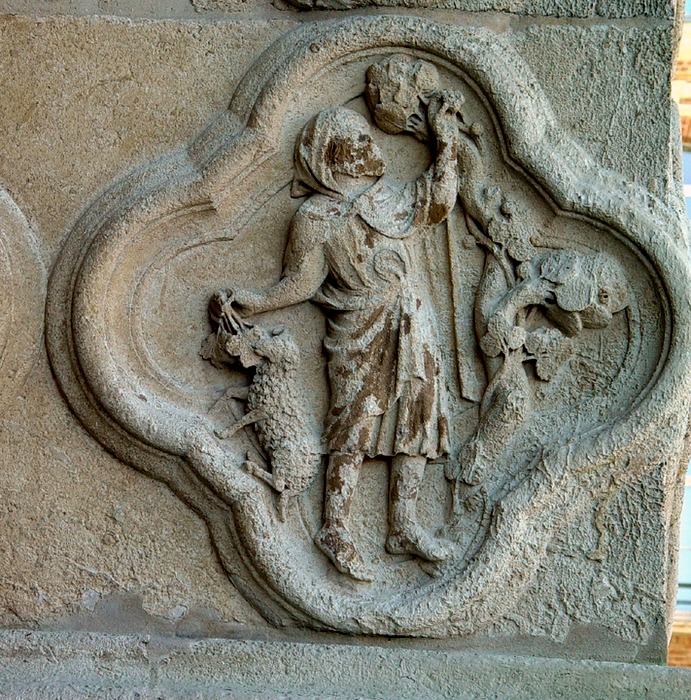
Amos the Herdsman – Amiens Cathedral
 
 
This is what he showed me: the Lord was standing beside a wall built with a plumb line, with a plumb line in his hand. And the Lord said to me, “Amos, what do you see?” And I said, “A plumb line.” Then the Lord said,
“See, I am setting a plumb line
in the midst of my people Israel;
I will never again pass them by;
the high places of Isaac shall be made desolate,
and the sanctuaries of Israel shall be laid waste,
and I will rise against the house of Jeroboam with the sword.”
10 Then Amaziah, the priest of Bethel, sent to King Jeroboam of Israel, saying, “Amos has conspired against you in the very center of the house of Israel; the land is not able to bear all his words. 11 For thus Amos has said,
‘Jeroboam shall die by the sword,
and Israel must go into exile
away from his land.’”


12 And Amaziah said to Amos, “O seer, go, flee away to the land of Judah, earn your bread there, and prophesy there; 13 but never again prophesy at Bethel, for it is the king’s sanctuary, and it is a temple of the kingdom.”
14 Then Amos answered Amaziah, “I am no prophet, nor a prophet’s son; but I am a herdsman, and a dresser of sycamore trees, 15 and the Lord took me from following the flock, and the Lord said to me, ‘Go, prophesy to my people Israel.’


16 “Now therefore hear the word of the Lord.
You say, ‘Do not prophesy against Israel,
and do not preach against the house of Isaac.’


17 Therefore thus says the Lord:
‘Your wife shall become a prostitute in the city,
and your sons and your daughters shall fall by the sword,
and your land shall be parceled out by line;
you yourself shall die in an unclean land,
and Israel shall surely go into exile away from its land.’”
**************

                The prophet Amos wasn’t what you would call a “court preacher.” He wasn’t employed by the monarchy or the religious establishment. In other words, he wasn’t a spiritual advisor to the king. As far as the monarchy and the religious leaders were concerned, he was a nuisance who brought to the land unwelcome messages. He made people feel uncomfortable. And Amos didn’t seem to care. Besides, he came to Israel from down south, from the rural community of Tekoa in Judah. According to Amos, God sent him to speak words of judgment against Jeroboam II and his regime that ruled over the northern kingdom of Israel, despite the fact that he came out of a vassal kingdom. Why bother with him. He was just a disgruntled neighbor, from a less powerful and important realm. When Amos came north, he encountered a nation that was its height. This was the reign of Jeroboam II (r. 786-746 BCE), one of the most powerful and successful monarchs in Israel’s history. So, why bother with this troublemaker?  


Sometimes we preachers want to think of ourselves as the spiritual descendants of a prophet like Amos, but I doubt the moniker fits most of us. He was too much like the guy standing at the corner with the sandwich board declaring that the end is near at hand. No, there must be a better model for us than him. Yet, here we are, with Amos standing before us, bringing what he says is another message from God. He offers Jeroboam a word from God about a plumb line.

Plumb lines, which were strings with weights attached, that was used to make sure the walls of the building were built straight and true from top to bottom. If they weren’t, the typical two-story house of that region would collapse. You don’t want that. Jeroboam and his kingdom might seem to be prospering. The stock market might be on the upswing. Employment numbers are good. The military is strong. The nation’s enemies are being kept at bay. Yet, here’s the Word of the Lord—you’re not measuring up. If you don’t get your act together you will soon collapse. History is on the side of Amos. Jeroboam might die with Israel at its height, but a quarter century later the Assyrian’s would march in and lay waste to the nation. The people of Israel and Judah might be related. They were neighbors. But they were also rivals. One nation survived (at least for a time) and the other disappeared from the map.

Amos delivered his message to an unreceptive audience. The priest at Bethel, the capital of the northern kingdom, a man by the name of Amaziah, told Amos to go home. Go earn a living elsewhere. This was the king’s sanctuary. It was his temple. He set the rules. There is a principle that was widely used in the period after the Reformation as differing religious entities took root in Europe. The principle goes by the name of Erastianism. The idea is that the religion of the king is the religion of the people—consider that Henry VIII and his successors (to this day) declared themselves the Head of the Church. That’s what Amaziah was trying to communicate to Amos. Go home. Your message is a foreign one. It doesn’t fit with what the king has decreed. Besides, the king is successful. He’s rich. He’s powerful. As for Amaziah, he represented a religious elite that supported and sustained a system that oppressed the people. The word of God was that he would get his just desserts.

Amos is not your typical preacher. As I said, he’s a bit like that street preacher with his sandwich board. He’s parked outside the Temple, annoying everyone who comes into contact with him. When Amaziah tells to go home and prophesy elsewhere (earn your living somewhere else), Amos simply says:  “I am no prophet, nor a prophet’s son; but I am a herdsman, and a dresser of sycamore trees, and the Lord took me from following the flock, and the Lord said to me, ‘Go, prophesy to my people Israel.’” He told the priest that he was just a simple farmer, a layperson, who didn’t want to come north. It wasn’t his idea. No one was paying him for this. In fact, he had to leave behind his fields and flocks to make the journey.  But when God said go, he went. He was standing there before the temple because God said: “Go, prophesy to my people Israel.”

                Amaziah told Amos to go away, don’t prophesy here. But Amos persisted. He delivered the message God had given him for Israel and for Amaziah. What is the message? Your land will be taken. Your people will die by the sword or go into exile. Things might look good right now, but before you know it, things will turn bad. Why?  Because you’re not following the ways of God. While the passage doesn’t spell things out, we will get there. It has something to do with justice.

                Speaking truth to power isn’t easy. It can be dangerous. Think about St. Oscar Romero, the martyred Archbishop of San Salvador, El Salvador, who was murdered while saying the mass in his chapel because he dared to oppose the political leadership that was oppressing the people. Now, he was a religious leader and not a layperson. But others have taken up the mantle of speaking truth to power. Lay people can be the most effective voices for justice. That is true here. Amos draws attention to the injustices of the day, injustices that had caught the attention of God.

What are we called to do? Amos heard the call and heeded it, even though he didn’t have any prophetic credentials. He was a farmer, not a preacher or a theologian. It’s not that we preachers and theologians don’t have our place, but the voice of God can and does come through the voice of the people. As for the religious leaders, we out to be circumspect. When we become the mouthpieces of an oppressive regime or when we justify unjust acts—the detention of refugee children in overcrowded and filthy camps—what might God have to say? How do we measure up?    

Picture Attribution:  Amos the Herdsman, from Art in the Christian Tradition, a project of the Vanderbilt Divinity Library, Nashville, TN. http://diglib.library.vanderbilt.edu/act-imagelink.pl?RC=29259 [retrieved July 8, 2019].


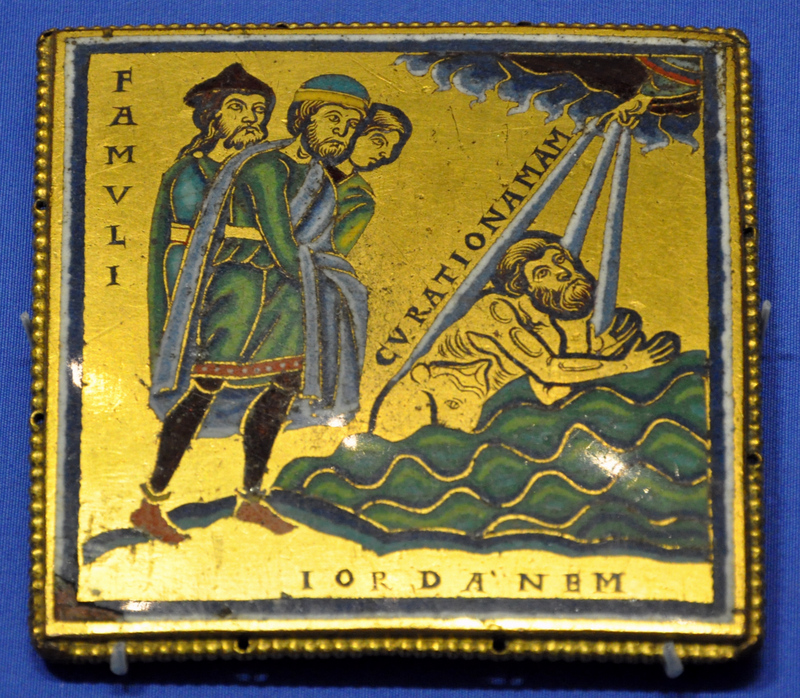
A Dip in the River – A Lectionary Reflection for Pentecost 4C (2 Kings 5)


Naaman, commander of the army of the king of Aram, was a great man and in high favor with his master, because by him the Lord had given victory to Aram. The man, though a mighty warrior, suffered from leprosy. Now the Arameans on one of their raids had taken a young girl captive from the land of Israel, and she served Naaman’s wife. She said to her mistress, “If only my lord were with the prophet who is in Samaria! He would cure him of his leprosy.” So Naaman went in and told his lord just what the girl from the land of Israel had said. And the king of Aram said, “Go then, and I will send along a letter to the king of Israel.” 

He went, taking with him ten talents of silver, six thousand shekels of gold, and ten sets of garments. He brought the letter to the king of Israel, which read, “When this letter reaches you, know that I have sent to you my servant Naaman, that you may cure him of his leprosy.” When the king of Israel read the letter, he tore his clothes and said, “Am I God, to give death or life, that this man sends word to me to cure a man of his leprosy? Just look and see how he is trying to pick a quarrel with me.” 
But when Elisha the man of God heard that the king of Israel had torn his clothes, he sent a message to the king, “Why have you torn your clothes? Let him come to me, that he may learn that there is a prophet in Israel.” So Naaman came with his horses and chariots, and halted at the entrance of Elisha’s house. 10 Elisha sent a messenger to him, saying, “Go, wash in the Jordan seven times, and your flesh shall be restored and you shall be clean.” 11 But Naaman became angry and went away, saying, “I thought that for me he would surely come out, and stand and call on the name of the Lord his God, and would wave his hand over the spot, and cure the leprosy! 12 Are not Abanaand Pharpar, the rivers of Damascus, better than all the waters of Israel? Could I not wash in them, and be clean?” He turned and went away in a rage. 13 But his servants approached and said to him, “Father, if the prophet had commanded you to do something difficult, would you not have done it? How much more, when all he said to you was, ‘Wash, and be clean’?” 14 So he went down and immersed himself seven times in the Jordan, according to the word of the man of God; his flesh was restored like the flesh of a young boy, and he was clean. 
15 Then he returned to the man of God, he and all his company; he came and stood before him and said, “Now I know that there is no God in all the earth except in Israel; please accept a present from your servant.” 16 But he said, “As the Lord lives, whom I serve, I will accept nothing!” He urged him to accept, but he refused. 17 Then Naaman said, “If not, please let two mule-loads of earth be given to your servant; for your servant will no longer offer burnt offering or sacrifice to any god except the Lord.
*********************
                Just as was true with his mentor Elijah, Elisha was a prophet known for his miracles. He healed people, raised the dead, and fed multitudes. For the most part, the recipients of these acts were members of the prophetic community. Unlike Elijah, Elisha doesn’t seem to be at odds with the monarchy. In part that is due to the fact that Elijah’s enemy—Ahab—is no longer ruling in Israel. Although what occurs here in 2 Kings 5 doesn’t seem to be that big of a miracle—someone is healed, but without any real involvement on Elisha’s part. He gives instructions, but not much else. The person healed, however, is an important figure, as is his confession, which is why it’s odd that the lectionary creators cut the story off a bit early. Yes, Naaman is healed, but why is this important? Without the confession of faith, we’re left with a nice story but not much else. Perhaps the reason for its brevity is that it seems a bit ethnocentric, and not fitting our current needs?
                The story of the healing of Naaman of leprosy is one of those stories we may have learned in Sunday School. After all, it features a warrior and a miracle. But what else is there in this story to be concerned with?
                Let’s start at the beginning. Naaman is a general in the army of the kingdom of Aram (Damascus). He has won his share of battles on behalf of his kingdom, but he had been stricken with some form of skin disease (identified here as leprosy). The disease doesn’t seem to have limited his military prowess, but it might have limited his social interactions. We learn that in his household is a young woman, a captive from Israel. She had been taken from her home in one of the many border wars and skirmishes between two neighboring countries. While we’re not told why she offered this word of advice, she informed the general’s wife, whom she served, about a prophet in Israel who had the power to heal. If only Naaman went to visit this prophet, he could be delivered from this affliction. When informed of this possibility, Naaman went to the king and asked for help in gaining access to this means of healing. The king agreed to the request, and put together some tribute for Naaman to take with him as a sign of friendship, or at least a truce, along with a letter addressed to the king of Israel (who at the time was Jehoram. He did evil in the sight of the Lord, just not as bad as his father, Ahab).
                When the king of Israel received the letter, he was horrified, because he assumed that the king of Aram was asking him, the king of Israel, to heal this general. He was so upset that he tore his robes, as a sign of grief. If he couldn’t heal the man, then surely war was on the horizon. Although one king asked the other king for assistance, the servant girl didn’t have the king in mind, but a prophet. So, something got lost in translation. Fortunately, Elisha heard about the situation and sent word to the king. He told the king to send Naaman to him, for he was the appropriate person to deal with the situation. He was the prophet that the young woman had in mind. Elisha told the king: “Let him come to me, that he may learn that there is a prophet in Israel.” There isn’t a lot of compassion in this response on Elisha’s part. It seems as if he saw this as an opportunity to demonstrate the power of Israel’s God. What is about to occur is sometimes understood to be a power encounter. It is meant to be a revelation of the power of God, as opposed to other forces and deities.
                The next word we hear is that “Naaman came with his horses and chariots, and halted at the entrance of Elisha’s house.” Naaman came to Elisha reflecting a sense of power. He had with him all the signs of his military prowess and importance. So, what would Elisha do? How would he respond?  The answer is interesting. He doesn’t even venture out from his house to greet the mighty general. He just sends word to the general, telling him to go and wash himself seven times in the Jordan. Naaman is incensed. At the very least he expected Elisha to come out and greet him, and he also expected Elisha to say some words and wave his hand over the spot. Surely there was some ritual to be performed, but why go wash in the Jordan? What’s so special about the Jordan that it would cleanse him. After all, Damascus had better rivers than the Jordan. So, he goes away, angry at being snubbed and told to do something demeaning, like bathing in the Jordan (of all places).
                Though he was angry at Elisha’s request, Naaman’s aides convince him to do as he was asked. Why is it a big deal? Elisha could have asked him to do something much more difficult. The ancient world is full of stories of difficult quests. This is pretty simple. So, Naaman, perhaps reluctantly, but still hopeful that he could rid himself of this disease, does as he was asked. Sure enough, he’s healed. The text informs us that “his flesh was restored like the flesh of a young boy, and he was clean.”  With this, the lectionary reading comes to a close. We can rejoice in the compassion of God, who provides healing even to a foreigner. In fact, Naaman represented an enemy of Israel. This is good news. Of course, this isn’t really the end of the story.
                By ending the passage at verse 14, the emphasis is on Elisha’s miracle power, but is that the intent of the story? Yes, it’s a story of compassion, even for the outsider (Naaman is both a foreigner and one with a disease that normally excluded them from society). But verses 15-17 speak of conversion. Is this not the point of the whole story? When Naaman returns to the house of Elisha, he confesses that “there is no God in all the earth except in Israel” (vs. 15). This confession reinforces a declaration made at the beginning of the story, that it was the LORD (YHWH) who given him the victories on behalf of Aram, victories that would have included wars and battles with Israel (vs. 1).

                So, at one level, if we continue on to the end of verse 17, we hear a word about the superiority of the God of Israel over the nations. It is a message that is found throughout the Hebrew Bible. Despite the smallness of the nation of Israel or Judah, despite its powerlessness in the face of its enemies, God is still in control. We may struggle with that image—it’s one that we who participate in interreligious conversations struggle with—but is also a reminder that God is not bound by national boundaries. It is also a reminder that God is concerned about the people of all nations, including a general from Aram, who has in his household a captive from Israel, who for whatever reason gets the ball rolling by informing her mistress that there is a prophet in Israel who can heal him of his disease. It is a word about humility—finding healing if one is willing to take a dip in a foreign body of water. It is also a word about a transformative experience of encountering the God of Israel.  And through this God is glorified.

Picture attribution: Naaman is cured from leprosy, from Art in the Christian Tradition, a project of the Vanderbilt Divinity Library, Nashville, TN. http://diglib.library.vanderbilt.edu/act-imagelink.pl?RC=55732 [retrieved July 1, 2019]. Original source: http://commons.wikimedia.org/wiki/File:Enamel_plaque_Naaman_BM.jpg.