Category: Eastertide

By His Wounds, We Are Healed – A Lectionary Reflection for Easter 4A (1 Peter 2:19-25)

1 Peter 2:19-25 New Revised Standard Version (NRSV)
 

19 For it is a credit to you if, being aware of God, you endure pain while suffering unjustly. 20 If you endure when you are beaten for doing wrong, what credit is that? But if you endure when you do right and suffer for it, you have God’s approval. 21 For to this you have been called, because Christ also suffered for you, leaving you an example, so that you should follow in his steps. 

22 “He committed no sin,
    and no deceit was found in his mouth.” 

23 When he was abused, he did not return abuse; when he suffered, he did not threaten; but he entrusted himself to the one who judges justly. 24 He himself bore our sins in his body on the cross, so that, free from sins, we might live for righteousness; by his wounds you have been healed. 25 For you were going astray like sheep, but now you have returned to the shepherd and guardian of your souls.

****************

                As I write this over two million people around the world are or have been suffering the effects of a novel coronavirus outbreak. Tens of thousands have died, with the numbers climbing every day. There is no vaccine and treatments that look promising seem to fall short on every front. Stores, schools, and faith communities are all shut down. Holy Week and Passover were observed in ways no one can remember. Now Muslims observe Ramadan in the same fashion. Daily life is not what it was, and whatever emerges after the worst is over will not be the same. We will not be the same. Some will be embittered by their experience, while others will be strengthened.

                In this passage from 1 Peter 2, Peter addresses the suffering experienced by his audience. He distinguishes between those who suffer justly and suffer unjustly. If you suffer for doing wrong, then you probably are getting what you deserve. But, for those who suffer unjustly, for righteousness, well that’s different. Getting back to the pandemic, we tend to distinguish between those who get the virus when flouting the recommendations from those who contract it and even die for no fault of their own. This is especially true for those front-line folks in hospitals, nursing homes, first responders, grocery workers, and others whose jobs have been deemed essential. The word here is that if you do what is right and endure in the midst of it, then you receive God’s approval.

                Peter then points to Jesus, not as a substitute but as an example. Therefore, he encourages his readers to follow in the steps of the one who “committed no sin, and no deceit was found in his mouth,” and when he suffered, as a result, he didn’t return abuse on his abusers. In making this statement Peter is drawing on Isaiah 53 and the vision of the suffering servant. The challenge posed by this passage is that it seems to suggest that there is redemptive value in suffering so that suffering is glorified. Contextually, the call to follow the lead of Jesus comes as part of a word given to slaves, who are told to obey their masters. The creators of the lectionary, however, have chosen to omit what is, in reality, the thesis statement of the passage. I understand why the lectionary creators chose to omit verses like this, but as Barbara Lundblad notes, the inclusion of the verse gives preachers “permission to talk about the need for biblical interpretation.” She suggests that it might give preachers and teachers to consider the impact of passages like this on persons who have suffered abuse and hear that they should endure the abuse as Christ endured abuse [Feasting on the Word, 437]. What was heard by Christians living in the first century when they were a religious minority, struggling to survive in a culture where slavery was a central part of the economic system, over which they had no control. That is different than a context such as antebellum North America where Christians were not a religious minority.

                When we approach texts like 1 Peter, which speaks of being servants of God and freedom in Christ, how do we as God’s free people we navigate a society that is not always conducive to our freedom? Verse 18, which is the lead-in to the lectionary reading, instructs slaves to obey their masters, not just those who are kind and gentle, but even the harsh ones. A verse like this was a powerful tool in antebellum America in efforts to justify slavery and oppress those who were slaves. Thus, we must speak against it. We can try to sugar coat it but to no avail. But what about Peter’s context? Why would he write such a word to the church?

When Peter speaks here of freedom, he was thinking of spiritual freedom. He didn’t have in mind, necessarily emancipation from slavery or an end to patriarchy. These were not within the realm of possibility, though manumission was common in the first century. Slavery wasn’t race-based nor was it necessarily permanent. When Peter appeals to the household codes he was drawing on the common cultural understandings, which suggests that Peter was telling the people to keep their heads down, be good citizens, and then perhaps they could be good witnesses for Christ’s kingdom. Thus, interpreting and applying a text like this takes a lot of wisdom.

While the creators of the lectionary decoupled Peter’s instruction to slaves, to make the passage more preachable (or at least more comfortable for preachers who could focus on Christology), we shouldn’t forget the context. If we take into consideration the larger context and disabuse ourselves of thinking that suffering is in itself redemptive, then perhaps we can hear word for today. In fact, we might hear a word of encouragement to persevere, to endure, in the midst of suffering, as we pursue the path that leads to the realm of God.

Peter doesn’t celebrate imperial authority, slavery, or patriarchy, he just assumes that this is the way things are in the world. That is not our context. We have long rejected slavery, and while we might apply some of this to employer-employee relations, even there we need to be careful. At least in my circles, we have set aside patriarchy (or are working on it). As for imperial authority, it is good to remember that in a democracy, the voice of the people is the final authority, not the president. Thus we need to find ways of hearing a word in a passage that contextually poses problems. Nevertheless, we might read a passage like this through a liberation lens. We can read it through the lens of the Civil Rights Movement, which persisted in nonviolent resistance to Jim Crow and segregation, despite facing violent responses. Consider the events that transpired on the Edmund Pettis Bridge in Selma, Alabama. This was suffering endured in a just cause, that eventually overturned injustice.

As for Jesus, he bore our sins that we might be healed. This as we, who “were going astray like sheep, . . . have returned to the shepherd and guardian of your souls.” We needn’t read this through the lens of “penal substitutionary atonement.” That is a temptation, but it’s not a necessary one (I don’t think Peter had worked out a distinct atonement theory here). Instead, we can hear in this word a reminder that we serve the crucified God who suffers with us, and as Bonhoeffer suggests, only such a God can bring healing.

 

An Imperishable Inheritance – A Lectionary Reflection for Easter 2A (1 Peter 1)

Jesus in Majesty  by Christoff Baron —  Notre Dame Cathedral, Strasbourg, France
 

Blessed be the God and Father of our Lord Jesus Christ! By his great mercy he has given us a new birth into a living hope through the resurrection of Jesus Christ from the dead, and into an inheritance that is imperishable, undefiled, and unfading, kept in heaven for you, who are being protected by the power of God through faith for a salvation ready to be revealed in the last time. In this you rejoice, even if now for a little while you have had to suffer various trials, so that the genuineness of your faith—being more precious than gold that, though perishable, is tested by fire—may be found to result in praise and glory and honor when Jesus Christ is revealed. Although you have not seen him, you love him; and even though you do not see him now, you believe in him and rejoice with an indescribable and glorious joy, for you are receiving the outcome of your faith, the salvation of your souls.

******

                We come to this reading from 1 Peter as God’s people who have found a living hope in the resurrection of Jesus.  At least that is my starting point. We also engage this passage during an ongoing pandemic that is taking lives and causing disruption of life as we had known it. We don’t know when things will change or what they’ll look like when we begin to reenter a more normal pattern of life. Most likely we will enter a new state of normality. The way we view the world, ourselves, and God likely will have changed. That which sustains me at this moment is my faith in the living hope rooted in the resurrection of Jesus, and in the imperishable inheritance that comes with that living hope.

                Easter, like Christmas, is accompanied by a plethora of activities and meanings that may not connect directly to the message of Jesus. Easter eggs and Easter bunnies, even the word Easter itself, likely has roots outside the Christian faith. The fact that at least in the northern hemisphere Easter follows the spring equinox is also suggestive that life emerges out of death. The timing of Easter is rooted in the Passover celebration, which is in modern Judaism a spring holy event. So, whatever the roots of the day, the Easter season is understood to be a celebration of life. In the resurrection, Jesus triumphs over death, bringing life to all who would embrace his message. In this reading from 1Peter, the resurrection is connected to an imperishable inheritance, which is the salvation of our souls.  


                Before we go too far with the discussion of this lectionary reading for the Second Sunday of Easter, I should say something about authorship and orientation of the letter, since we’ll be in 1 Peter for several weeks. According to the letter’s self-identification, the author is the Apostle Peter, who is writing to “exiles of the Dispersion” living in what is now Turkey (1 Pet. 1:1-2). The reference to the Dispersion or Diaspora could suggest that the audience for this letter is a community of Jewish Christians, though there are also hints in the letter that the audience was Gentile. While the audience is not easily defined, neither is the authorship. On the face of it, St. Peter is the author. If so, then this letter is rather early, as it is believed that Peter died during the reign of Nero, possibly in Rome, and near about the time that Paul was also executed. Nevertheless, there is other internal evidence that suggests that this is a much later document. Ultimately, we simply can’t say for sure, and the meaning of this passage isn’t dependent on identifying the author. So, for simplicity’s sake, I will refer to the author as Peter.

Contextually, Peter seems to be concerned about the relationship of these early Christians to their culture. We see this in his use of household codes that make parts of the letter very problematic for us today. In terms of this particular passage, the reference to exile suggests a particular cultural context. It suggests that Christians, like Jews, live on the periphery of society. In many ways, this is a self-chosen reality, because, like Jews, Christians would have been perceived as anti-social. This is because they refused to participate in patriotic duties like honoring the Roman gods. The Romans were very tolerant of religious differences, as long as you honored their gods. You can be a devotee of Isis or Mithras, just don’t neglect to give allegiance to the official state religion. For Christians, if Jesus is Lord, then Caesar cannot be lord. Thus, to confess faith in Christ led to exile/dispersion. While this is true, this letter is suggestive that Christians should keep their heads down and not call attention to themselves. All the while, Peter urges them to keep their focus on their heavenly destination. In other words, Peter presents us with an eschatological vision that is focused on the people of God bearing witness to their faith by being a holy people, even as they separate themselves from the Roman cultural and religious life.  


To follow Jesus was to take a “road less traveled.” But that road led to new birth in Christ, and thus a new beginning. It is rooted in the resurrection of Jesus, who provides us with an inheritance that is “imperishable, undefiled, and unfading.” This is, according to the promise of God our destiny. This is the inheritance given to us in Christ and kept for us in heaven. We have access to the inheritance, but not its fullness. We can taste some of its benefits, but not all of them, because of the resurrection of Jesus. You might say that our inheritance has been in a trust until such time as we are ready to receive it. While the inheritance is set aside for us, there is, apparently a few tests that need to be experienced. The genuineness of our faith is to be tested by fire so that our faith may lead to the praise, glory, and honor of Christ when he is revealed. In other words, being heirs with Christ does not mean we do not experience suffering or pain. This is part of life. Some endure more than others. But together we share in the inheritance, that is our salvation. Thus, this is not just an Easter message, it’s an eschatological one. Easter is the starting point of something that will eventuate in our own resurrection. May we, as we hear this word concerning our inheritance find hope in this moment.

This is a day of new beginnings, time to remember and move on,
Time to believe what love is bringing, laying to rest the pain that’s gone.
For by the life and death of Jesus, God’s mighty spirit, now as then,
Can make for us a world of difference, as faith and hope are born again.
                                —Brian Wren, Chalice Hymnal 518 (vs. 1-2)


The Power of Hymn-Singing — Lectionary Reflection for Easter 7C (Acts 16)

 
16 One day, as we were going to the place of prayer, we met a slave-girl who had a spirit of divination and brought her owners a great deal of money by fortune-telling. 17 While she followed Paul and us, she would cry out, “These men are slaves of the Most High God, who proclaim to you a way of salvation.” 18 She kept doing this for many days. But Paul, very much annoyed, turned and said to the spirit, “I order you in the name of Jesus Christ to come out of her.” And it came out that very hour.


19 But when her owners saw that their hope of making money was gone, they seized Paul and Silas and dragged them into the marketplace before the authorities. 20 When they had brought them before the magistrates, they said, “These men are disturbing our city; they are Jews 21 and are advocating customs that are not lawful for us as Romans to adopt or observe.” 22 The crowd joined in attacking them, and the magistrates had them stripped of their clothing and ordered them to be beaten with rods. 23 After they had given them a severe flogging, they threw them into prison and ordered the jailer to keep them securely. 24 Following these instructions, he put them in the innermost cell and fastened their feet in the stocks. 


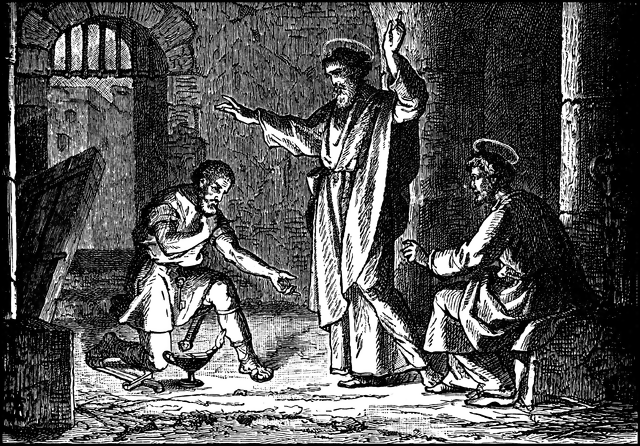
25 About midnight Paul and Silas were praying and singing hymns to God, and the prisoners were listening to them. 26 Suddenly there was an earthquake, so violent that the foundations of the prison were shaken; and immediately all the doors were opened and everyone’s chains were unfastened. 27 When the jailer woke up and saw the prison doors wide open, he drew his sword and was about to kill himself, since he supposed that the prisoners had escaped. 28 But Paul shouted in a loud voice, “Do not harm yourself, for we are all here.” 29 The jailer called for lights, and rushing in, he fell down trembling before Paul and Silas. 30 Then he brought them outside and said, “Sirs, what must I do to be saved?” 31 They answered, “Believe on the Lord Jesus, and you will be saved, you and your household.” 32 They spoke the word of the Lord to him and to all who were in his house. 33 At the same hour of the night he took them and washed their wounds; then he and his entire family were baptized without delay. 34 He brought them up into the house and set food before them; and he and his entire household rejoiced that he had become a believer in God.


**************
                It is the Seventh Sunday of Easter—although one could choose to observe the Day of Ascension (the reading for Ascension is Acts 1:1-11). The days of Jesus’ appearances is nearly complete. Pentecost is on the near horizon. The reading from Acts 1 for the Day of Ascension sets the foundation for what is to come. Jesus stands with the disciples, preparing to leave them. He gives them a commission, telling them that once the Spirit comes upon them, they are to take the gospel to the ends of the earth, beginning in Jerusalem, and then moving out from there through Judea and Samaria, and then from there to the ends of the earth. In prior readings, we have seen how the gospel has been moving outward from Jerusalem in the power of the Holy Spirit. We’ve seen the message taken to Samaria (Acts 8) and then to a Gentile community (Acts 11). We’ve witnessed the call of Paul (Acts 9) and then his crossing into Europe that results in the conversion of Lydia and her household in Philippi (Acts 16).
One thing you notice in reading the Book of Acts is that the way forward for the Gospel often requires those called to proclaim the Gospel to break through barriers. There is no easy pathway, and sometimes they have to be nudged along, so they can be in a position to proclaim the Gospel. If Paul is any indication, missionary work can be a bit complicated, filled with both setbacks and successes. In fact, Paul seems to get himself in trouble on a regular basis, and so it is with his visit to Philippi. In the reading from Acts 16 for this week, we pick up where we left off last week. Paul remains in Philippi, perhaps still residing at the home of Lydia. When the story picks up, Paul and Silas—and the rest of the mission team (note the use of the word we in verse 16)—are walking toward the place of prayer down by the riverside. As they make their way to the place of prayer, they are joined by another person. This person is a slave girl known for her prophetic powers. For some reason, she starts telling everyone that Paul and Silas are “slaves of the Most High.” This reference to them being slaves of God is important because the one doing the preaching is a slave. The assumption then is that if one proclaims a divine message, one must be a slave to that god/power.  She is a slave, so they must be slaves as well. While she calls attention to them, apparently, it’s not the kind of attention that wanted. Since this happened several times over a period of days, we’re told that Paul was annoyed by her declarations. Paul stops and tells the spirit possessing her, the spirit that is proclaiming the message that they bring the word of salvation from the Most High, to leave. Such is what happens. The spirit that possessed her, the spirit that gave her the ability to reveal things about people, is now gone. That doesn’t make her owners happy. They have just lost their livelihood. This is a good example of the economic effects of religion. So, they are thrown into prison, without trial (something that is not allowed for citizens like Paul). This is the context in which we read the remainder of the story.
Note that Paul and Silas are imprisoned because they have infringed on the economic power of certain individuals. These people who are upset with Paul are concerned not about theology but about money. This woman, who was their slave, had earned them a lot of money. If she lost that power, she was of little or no worth to them. She was a commodity to her owners. Her message may have annoyed Paul, but she had revealed the truth, and that didn’t sit well with the rest of the community.
It is interesting that the charges laid against Paul and Silas is that they were Jews who were teaching things that weren’t appropriate for Romans. This represents in part the ongoing rejection and stigmatization of the Jews. In this case, the charge that they were Jews who taught things inappropriate for Romans may have been rooted in ignorance of Judaism. After all, there wasn’t a large enough community to start a synagogue. With the charges laid against them, the magistrates had them stripped, beaten, and thrown into the innermost jail cell (maximum security). Was it the religious component or the economic one? You be the judge.  
 
So, we find Paul and Silas in jail. They are not only in jail, but they have shackles on them. You would have thought they were mass murderers, but such is not the case. It’s here, in prison, that we witness the power of hymn-singing. As Paul and Silas sit there in their cell, they begin to sing hymns to God, and Luke tells us that the other prisoners were listening. They were paying attention to the songs. As Paul and Silas sang, an earthquake hit, opening the cells and knocking off the shackles. Everyone in the jail was now free to flee, but they didn’t. They stayed put. More about that later in this reflection, so we can stay with hymn-singing.
This word about hymn-singing is enticing to me. That’s because singing hymns has always been a powerful element in my worship experiences.  Whether new or old, as long as they are singable, they carry power. I don’t know what hymns Paul and Silas sang (I don’t think there were any Wesley or Brian Wren hymns in that hymnal), whatever they were singing had a powerful effect on their situation. Whatever they sang had a liberating effect. It seems to be the precursor to their freedom. Willie James Jennings connects worship, prayer, and singing to freedom and the concerns of those who have experienced torture and imprisonment.

Praying and singing join us to tortured and chained bodies, both past and present, and to the real pressure placed on disciples’ bodies as they look toward God. Praying and singing are acts of joining that weave our voices and words with the desperate of this world who cry out to God day and night. Each time we gather in the name of Jesus and lift our voices, this point of reference should shape our reverence and drive us to see and learn and know and change the situations of those who suffer especially in that holy name. Each time we pray and sing we are also joined to the shouts of joy and praise to a God who saves and delivers and invites us to take hold of divine power by faith. [Acts: Belief, p. 164].

In other words, worship should connect us to those around us who suffer. Paul and Silas’ experience of prison connected them to Jesus’ experiences as he approached death. They would be freed, but it was in the midst of suffering that they worshipped God and found liberation.
When the jailer made his way into the cells, he assumed that the prisoners would have escaped. That’s only natural. If you have the opportunity to be free, wouldn’t you take it? The implications for the jailer were much different. If his prisoners escaped, he would be held responsible. The better part of valor would be to take his own life. He was about to do so when Paul spoke up. Paul cried out to him, begging him not to harm himself, because everyone was still in the jail, including the other prisoners who had no reason to trust in the God of Paul, and yet they put themselves into Paul’s hands. All because of some hymn-singing.
Now, the jailer was over-joyed. Although he hadn’t heard the hymn-singing, he was drawn into this worship experience punctuated by an earthquake. That led to a sermon, as the jailer asked how he might be made whole (saved). With the question asked, Paul shared the gospel with him and his household, and the Philippian jailer responded positively. Paul baptized the jailer and his family, but notice that before the baptism takes place, the jailer tends to the wounds inflicted on Paul and Silas. These are the wounds inflicted by the magistrates, in response to Paul’s act of liberating a woman who had been turned into a lucrative economic tool. There was healing and liberation all around, and mixed in was a time of worship featuring hymn-singing. So, let us sing to God with boldness, and as we sing may we be woven into the healing work of God in the world.   


Come on Over – A Lectionary Reflection for Easter 6C (Acts 16)

During the night Paul had a vision: there stood a man of Macedonia pleading with him and saying, “Come over to Macedonia and help us.” 10 When he had seen the vision, we immediately tried to cross over to Macedonia, being convinced that God had called us to proclaim the good news to them.

11 We set sail from Troas and took a straight course to Samothrace, the following day to Neapolis, 12 and from there to Philippi, which is a leading city of the district of Macedonia and a Roman colony. We remained in this city for some days. 13 On the sabbath day we went outside the gate by the river, where we supposed there was a place of prayer; and we sat down and spoke to the women who had gathered there. 14 A certain woman named Lydia, a worshiper of God, was listening to us; she was from the city of Thyatira and a dealer in purple cloth. The Lord opened her heart to listen eagerly to what was said by Paul. 15 When she and her household were baptized, she urged us, saying, “If you have judged me to be faithful to the Lord, come and stay at my home.” And she prevailed upon us.

********************
                The story found in the book of Acts begins with a commission in Acts 1:8. That commission involves proclaiming the Gospel in the power of the Holy Spirit, beginning in Jerusalem, and from there, moving outward through Judea and Samaria to the ends of the earth. The movement forward comes in fits and starts and requires guidance and regular nudges on the part of the Spirit. In Acts 9, Paul, the persecutor of the church, is called to preach, with Gentiles as his target audience. Then, in Acts 11, Peter defends his decision to go to the home of Cornelius, opening up the church to Gentiles, without qualification. That is, he baptized them without first requiring the males to be circumcised. In this action, the path forward that Paul would take is set. During this Easter season, where we focus on readings from the Book of Acts in place of the regular readings from the Hebrew Bible, the lectionary jumps from the story of Peter’s visit to Cornelius to Paul’s call to preach in Macedonia. There’s a lot of territory that is traversed between Acts 11 and Acts 16, one of which is the commissioning of Paul to take up his missionary journeys. Another event is the Jerusalem Council, at which time Paul and Barnabas explain their mission and make peace with the Jerusalem leaders on what is to be required of the new Gentile converts. When we come to Acts 16, Paul has headed out on his second missionary journey. He and Barnabas have parted ways, and Paul is joined by first Silas and then Timothy.
                The lectionary reading for the Sixth Sunday of Easter (Year C) begins in verse 9 of chapter 16. If we go back a few verses, we learn that Paul had been forbidden to preach in Asia. Paul and his companions had been attempting to go to Bithynia, but “the Spirit of Jesus did not allow them,” so they went down to Troas. That’s where we pick things up.
Now before we get to verse 9 of chapter 16, we should take note of the message that in the Book of Acts, the Spirit is the driving force in the emerging mission of the church. In this case, the Spirit is specifically linked to Jesus. It is the Spirit of Jesus who is guiding this next step in the church’s mission, and the Spirit has a specific vision of where things should go.
                When we come to verse 9, we find Paul in Troas, on the Aegean coast. He’s sleeping, not knowing what he is supposed to do. He’s been prevented from going where he intended to go, so where to next? As he slept, he had a vision—God often speaks to people in visions in Acts, sometimes they come when people are awake and sometimes when they’re asleep. In this vision a “man of Macedonia,” speaks to Paul, saying “Come on over to Macedonia.” To this point, Paul’s ministry had been focused on “Asia,” what we would call today Anatolia or Turkey. In the story being told by Luke, the Spirit is ready to move into a new field and to cross into Macedonia would mean crossing into Europe. So, things are moving forward, toward that goal of reaching the ends of the earth.
                With this vision of the “man from Macedonia” calling Paul to come on over as their guide, the missionary group sets sail from Troas and heads for Samothrace, Neapolis, and finally to Philippi, which, according to Luke, was the “chief city of Macedonia” and a Roman colony. The reference to Philippi being a Roman colony suggests that it is a rather recently planted city, having been settled—or in this case probably re-settled—by Roman soldiers and their families. Here’s where things get interesting. Since it was Paul’s custom, as a Christian who also was a Jew, to worship on the Sabbath, he went looking for a gathering of Jews to pray with. Normally, that would involve looking for the local synagogue. That proved difficult in Philippi because there was no synagogue. What Paul did find was a gathering of women, who had gone down to the river outside the gates of the city to pray. As was his custom as well, he not only prayed with them, but he shared the Gospel with them. Among this group of women was a “worshipper of God” named Lydia. The reference to her being a worshipper of God, or God-fearer, like Cornelius, suggests that she was likely not Jewish, but one who embraced Judaism without fully converting. She was also a successful businesswoman. We’re told that she sold purple cloth, which was expensive. It was the kind of cloth used to make clothes for the wealthy and privileged. It was to this group of women, that Paul preached. They responded positively so that Paul baptized them.
                Having heard Paul preach, and having been baptized by him (along with what may have been her household), he extends to him an offer of hospitality. She says to him: “If you have judged me to be faithful to the Lord, come and stay at my home.” Paul couldn’t say no. He took up her offer, gratefully, I would expect.
                Often, we think of the early Christians as being poor and marginalized. Often, they were, but not all of them. In fact, we see in the Corinthian letter signs of socio-economic divisions. Such was not the case here. Lydia was likely rather wealthy, but she used her wealth in this case to benefit the ministry of Paul.  In other words, she became a partner in that ministry. The other element of this story is the fact that Paul was willing to worship with and share the message with women. We know that Paul could write instructions for women to be silent. He could also proclaim that in Christ there is neither male nor female (Gal. 3:28). In this case, we see Paul expanding the circle to include not only Gentiles but women, who become partners in ministry.
                So begins Paul’s ministry in Europe. “A man from Macedonia” invited him over to help them, but it was a woman from Thyatira, who was staying in Philippi, who would be the first person to receive the Gospel. It’s a bit like Mary Magdalene, who is the first to receive the message of the resurrection (Jn 20). And, as Alice Connors notes, regarding Lydia, “there are no heroic deeds attributed to Lydia, no wrestling an angel to receive a blessing. She went about her life, praying and listening, selling and leading” [Connor, Fierce, p. 162]. Yes, she went about her life, in fairly normal fashion, but as she did, she became a leader in the church as it spread into Europe.  All of this began in the waters of baptism, which in the book of Acts are transformative. This was true of Cornelius and his household. It was also true of Lydia and her household. So, “shall we gather at the river, where bright angel feet have trod, with its crystal tide forever flowing by the throne of God?” [Robert Lowry in Chalice Hymnal, p. 701].


If Necessary: Easter 5 (Narrative Lectionary)

If Necessary: Easter 5 (Narrative Lectionary)

Narrative Lectionary Reflection

May 19, 2019

Read Romans 1:1-17 (CEB)

Reflection

adult-3365364_1920


“Preach the Gospel at all times. When necessary, use words.”


For many modern Christians, evangelism is something that strikes fear in their hearts.   No one wants to be pushy or mean to people. No one wants to have a faith forced upon them. That’s why this above quote attributed to St. Francis is so popular. It’s kind of an escape clause to get out of preaching the gospel.

But, the fact is as Christians we can’t escape evangelism.  Christ calls us to go and make disciples. The book of Acts shows the disciples and Paul going throughout the known world to share the gospel or good news of Jesus.

Today, we read the first few verses of Paul’s letter to the church in Rome.  This is a church that Paul had not visited yet, even though he wanted to. Paul would end up visiting Rome, but just not under his own will.  He came to Rome as a prisoner to stand trial and some think Rome is where Paul was executed.

In the opening verses of Romans 1, Paul greets the Romans by saying that he is a servant or slave of Jesus Christ “called to be an apostle and set apart for God’s good news.”  The word apostle comes from a Greek word which means “one who is sent.” Paul was called to be sent out into the known world to preach God’s good news. To be sent, you have to be called and Paul also acknowledges that.  Paul is saying that God has called him and sent him to tell the Good News to others. Being called is not limited to pastors.  Even those sitting the pews are called to be God’s sent people. You are called to be apostles, to be set apart for God’s good news just like I am.

Then we go to verses 16 and 17 where we read that Paul isn’t ashamed of the gospel.  Those are strong words for us modern Christians because we tend to be very ashamed of the gospel.  Maybe we’ve had bad experiences in church, or maybe we don’t want to look like weirdos. Whatever it is, we don’t want to upset our family and friends. Some of what we see as evangelism seems more interested in “making the sale” than it is about sharing the good news of Jesus with those around us.

But Paul isn’t interested in making the sale.  No, Paul’s sharing of the gospel, the sharing of Jesus is because his faith is deeply embedded in his life.  Paul is not ashamed of the gospel, not ashamed of the life, death, and resurrection of Jesus that he has to tell others, not in a way that is pushy, but in way that he talks about how God has worked in his own life.

The quote used at the beginning of the lesson is attributed to St. Francis, but it is not really something he said. This quote really was said by Francis:

“It is no use walking anywhere to preach unless our walking is our preaching.”

Paul lives the gospel so that it is obvious in his life and they are not just mere words. Yes, we talk about our faith, but we also live by our faith.

We know that Jesus has saved us, saved all of creation.  We know that Jesus makes a difference in our lives. It is something that we should talk about, just not like we need to sell a car today to make your commission.

A number of years ago my mother took a flight from Michigan to Minnesota.  She was seated next to a woman who it turns out was Jehovah’s Witness.  My mother was dreading an hour and a half flight with someone pushing her faith on my Mom.  

Instead, the two had a conversation.  Both were able to share their faith, but not in a kind of used car salesman way.  Instead, they shared what mattered to them and it was an honest conversation about faith and life.  My Mom told me she had a good talk with this woman; it was the sharing of lives, not trying to guilt or force someone to believe a certain way.

This what it means to be sent out, to be called by God to share the good news.  It is when we share God in our daily lives when we are not willing to keep quiet, but we aren’t willing to disrespect our family and friends and thereby ruin our witness. 


Questions

What comes to mind when you think about evangelism?

Knowing that the word apostle means sent, what does it mean to be an apostle in this day and age?

Have you ever had a discussion with a friend, relative or even stranger about faith? What was that like?


Notes:


Dennis Sanders is the Pastor at First Christian Church of St. Paul in Mahtomedi, Minnesota. He’s written for various outlets including Christian Century.

Who Am I to Hinder God? Lectionary Reflection for Easter 5C (Acts 11)

Acts 11:1-18 New Revised Standard Version (NRSV)
 

11 Now the apostles and the believers who were in Judea heard that the Gentiles had also accepted the word of God. So when Peter went up to Jerusalem, the circumcised believers criticized him, saying, “Why did you go to uncircumcised men and eat with them?” Then Peter began to explain it to them, step by step, saying, “I was in the city of Joppa praying, and in a trance I saw a vision. There was something like a large sheet coming down from heaven, being lowered by its four corners; and it came close to me. As I looked at it closely I saw four-footed animals, beasts of prey, reptiles, and birds of the air. I also heard a voice saying to me, ‘Get up, Peter; kill and eat.’ But I replied, ‘By no means, Lord; for nothing profane or unclean has ever entered my mouth.’ But a second time the voice answered from heaven, ‘What God has made clean, you must not call profane.’ 10 This happened three times; then everything was pulled up again to heaven. 11 At that very moment three men, sent to me from Caesarea, arrived at the house where we were. 12 The Spirit told me to go with them and not to make a distinction between them and us. These six brothers also accompanied me, and we entered the man’s house. 13 He told us how he had seen the angel standing in his house and saying, ‘Send to Joppa and bring Simon, who is called Peter; 14 he will give you a message by which you and your entire household will be saved.’ 15 And as I began to speak, the Holy Spirit fell upon them just as it had upon us at the beginning. 16 And I remembered the word of the Lord, how he had said, ‘John baptized with water, but you will be baptized with the Holy Spirit.’ 17 If then God gave them the same gift that he gave us when we believed in the Lord Jesus Christ, who was I that I could hinder God?” 18 When they heard this, they were silenced. And they praised God, saying, “Then God has given even to the Gentiles the repentance that leads to life.”

 
*******************
                Who am I to hinder God? If God says something or someone is clean, then who am I to say the opposite? Of course, we do hinder God. We stand in the way of God’s vision for the world. God opens doors and we slam them shut. God opens up the table to those who are not of our community and we set up fences. Despite this intransigence, sometimes God gets our attention, and we discover a different path—one that brings blessings rather than curses, healing rather than wounds.
                Peter had a vision. It had to do with appropriate dietary concerns. In this vision, which is first described in Acts 10, Peter is on the roof praying. It’s near lunchtime. He’s probably hungry. A sheet is lowered from the heavens. It’s filled with food items that he is prohibited from partaking. He hears the command to “kill and eat.” Peter responds, with deep piety, “no, I can’t eat these things. They’re unclean. Nothing profane or unclean has ever entered my mouth.” The response from heaven is clear and concise, though it is repeated three times (just to make sure Peter gets the point): “What God has made clean, you must not call profane.” Then there was a knock at the door.
When it comes to dietary restrictions, there’s nothing wrong with them. Judaism has them. Islam has them. So do other religious traditions. They often serve as boundary markers, helping define a community’s existence. Christianity may not have many food restrictions (if any), but we have our ways of defining ourselves. But what if God wishes to open things up a bit. Are we ready for it? Of course, the stories of Acts 10 and 11 aren’t really about eating shellfish, crustaceans, and reptiles. I don’t know whether Peter added lobster to his menu, but he was soon to learn a more important lesson that had to do with those whom God was ready to welcome into the realm of God and on what basis.  
 
That vision led to Peter going to the home of Cornelius, a Roman soldier and a Gentile. He had connected the dots between the vision and the knock on the door and went with the three representatives of Cornelius while taking along with him six of his own companions. When he arrives at the home of Cornelius, Peter preaches. As he is preaching, the Holy Spirit falls on Cornelius and his household, as demonstrated by the sign of speaking in tongues, just as occurred on the day of Pentecost. Since this enduement of the Spirit occurs while Peter is preaching, what is Peter going to do? He does the only thing he could do; he baptizes them and welcomes them into the church. You can read the full story in Acts 10.
                The story we read in Acts 11 is a summary report of the events that took place in Joppa and then at the home of Cornelius. Peter recounts the story that begins in Joppa, where Peter was residing after the church was scattered by Paul’s persecution of the church. Not everyone fled Jerusalem, which remains headquarters. Peter is summoned back to Jerusalem so he can explain himself. More specifically, it is the circumcision party that is demanding answers. On whose authority had he gone to the home of Cornelius? Why did he baptize them? It’s not that they opposed Gentiles joining the community, but there were hoops to be jumped through before you get to baptism. That is, you have to be made clean before you get the final seal of approval (baptism), and that included affirming Jewish dietary rules and the circumcision of males, at least that seems to be the case here. These questions shouldn’t surprise Peter since he needed a sign from heaven before he traveled to Cornelius’ home. This story serves as a reminder that up to this point, the church remained a sect of Judaism that followed the teachings of Jesus. There were, of course, the Samaritans, but they were essentially estranged members of the family. They were more easily accepted. Now that Peter had gone to Cornelius’ house and baptized them, another boundary marker was being crossed.
So, Peter recounts the story of his vision and the encounter with Cornelius. He makes the point that he remembered the word of the Lord: “John baptized with water, but you will be baptized with the Holy Spirit.” In this case, Cornelius and his household had been baptized with the Holy Spirit, and so the water was simply a confirmation of what God had already done. With that, Peter’s response was simple: “who was I that I could hinder God?” How do you respond to that? If God is for it, then how can you be against it? Gary Charles takes note of this question, writing:

That question assumes that God is at work in the world to bring about God’s purposes. Though religious tradition plays an essential role, it does not restrict God from building upon and even moving beyond tradition. Another key assumption in the question is that God is still at work, and God’s purpose often extends far beyond the horizon of longstanding tradition. [Joel B. Green, Thomas G. Long, Luke A. Powery & Cynthia L. Rigby. Connections: A Lectionary Commentary forPreaching and Worship: 2 (Kindle Locations 7895-7897). Presbyterian Publishing. Kindle Edition.]

If God is still at work and is able and willing to go beyond tradition, then who are we to hinder that work? Of course, we can’t go willy-nilly throwing off traditions just for the sake of throwing off traditions. It takes discernment, itself a gift of the Spirit, to know when to hold them or fold them. The Spirit bore witness in this case by providing a sign that demonstrated to Peter that he could baptize them, and apparently, from the accusations against him, he ate with them as well. If he ate with them, then he ate what they ate. Everything was now clean.
There is a piece of the puzzle that can be easily missed, but which is important. Peter notes that “these six brothers also accompanied me.” Peter didn’t go to Cornelius’ house alone. He took six companions. The folks in Jerusalem didn’t have to take his word alone. He had confirmation, maybe not of the vision, but of the actions on the part of the Holy Spirit. They could bear witness to the fact that the Holy Spirit fell on the household of Cornelius. They observed the filling of the people with the Spirit, which included speaking in tongues, just as on the day of Pentecost. They could back up Peter’s story, just in case members of the Jerusalem community had their doubts about Peter’s veracity.
So, where is God showing offering visions of a new way of being the church? What boundaries are being crossed by the Spirit? Women have looked to this story as evidence that cultural mores that limited their place in the church have been set aside. More recently those of us who have come to a realization that the barriers to inclusion of LGBTQ persons need to be lifted have found encouragement from this set of stories. If the Holy Spirit is at work in their lives, who are we who are straight to get in the way of God?  Who else might be standing on the outside of our communities, that God would want us to embrace?
In the case of the critics of Peter’s actions, according to Luke, they were brought to silence. After all, who was he to hinder God? With that, the critics had no response, as it was clear that God had welcomed these Gentiles (and those who followed) into the fold. With this understanding, they all rejoiced.

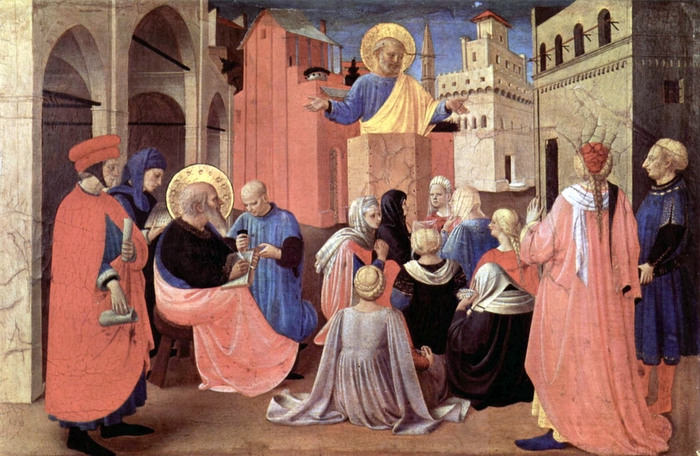
Picture Attribution:  ngelico, fra, ca. 1400-1455. Peter Preaching – [Lectionary selection, Fifth Sunday of Easter, Year C], from Art in the Christian Tradition, a project of the Vanderbilt Divinity Library, Nashville, TN. http://diglib.library.vanderbilt.edu/act-imagelink.pl?RC=47861 [retrieved May 12, 2019]. Original source: http://www.yorckproject.de.

Every Kind of People: Easter 4 (Narrative Lectionary)

Every Kind of People: Easter 4 (Narrative Lectionary)

Narrative Lectionary Reflection

May 12, 2019

Read Acts 13:1-3 and 14:8-18 (CEB)

Reflection

faces-2679755_1920It takes every kinda people
To make what life’s about, yeah
Every kinda people
To make the world go ’round*


Benny is someone you just can’t forget.

Benny is a man in his mid-60s who is developmentally disabled and a part of the congregation in Minneapolis where I once served.  Every Sunday, someone from the church would pick him up at his apartment and bring him to church.  He seems to always have a smile on his face.

But Benny can be a handful.  For one, he doesn’t really have an inside voice.  This means when he talks, everyone hears.  Which meant you might not want to share your deep dark secrets with him.  Speaking loudly in the hallway before worship service is one thing.  But you see, Benny also talks like this in worship.  Every so often as the worship service would progress, one of the pastors would say something and Ernie would respond in his loud voice.  When this would happen, we would simply and calmly answer his question and continue with the service.  

Sometimes sitting next to Benny was Norman, a man in his 50s.  Norman is schizophrenic and it always seemed that he was just on the edge of sanity.  It was not unusual during the time for prayer that he would ask for prayers because he was hearing the voices again.

After a while, we learned something about Norman; he was a budding artist.  He drew these futuristic drawings in black and white and also in color. They were jaw-droppingly beautiful.

What is wonderful to see is that both Benny and Norman are considered full participants in the community.  While I was a pastor at this congregation, no one ever complained about Benny or Norman’s antics at time.  People learned to roll with the punches with these two.  I was thankful to have been a part of a church that welcomed folks like Benny and Norman and were not embarrassed by them.

The text brings up several points to consider:

First, the church at Antioch is diverse. Acts 13:1-3 is just three verses and it lists some of the leadership of the church in the city of Antioch. At first glance, it just seems like a lot of names, mostly of people we don’t really know.  There’s Barnabas, Simeon called Niger, Lucius of Cyrene, Manaen (who had been brought up with Herod the tetrarch) and Saul also known as Paul. What’s interesting is that all of these people have a different background.  We have Lucius of Cyrene, who is probably a non-practicing Jew since there was no temple in town. Then we have Simeon who is also called Niger, possibly a North African. Then there was Manaen. He had some kind of connect to Herod Antipas the current vassal king of Israel and the killer of John the Baptist.  And let’s not forget Paul. He held the coats of those who stoned Stephen a deacon who worked to feed the widows and orphan. If you want to talk about a diverse congregation, this was it.  What does it mean that this church is diverse and what does it say about our modern churches? Are we open to all people, even those like Benny and Norman?

Second, this is a local congregation.  This is not the “headquarters” in Jerusalem. Peter and the other disciples are not here.  This a local congregation far away from the center wanting to do mission.  What message is here for the local congregations of the 21st century?

Third, the congregation sought the guidance of the Holy Spirit.  As the congregation was doing mission, they wanted to seek what God wanted them to do and the Holy Spirit answered! What would happen if in our own churches if we listened to what the Spirit is saying?

Fourth, the calling of Paul and Barnabas shows that the call to ministry is not just for pastors. The church has made a big mistake in making it seem like vocation or call, is only for those interested in ordained ministry.  But Paul and Barnabas were just members of the congregation and they were chosen by the Holy Spirit. In countless churches in every setting, the Holy Spirit is calling people to ministry.  Are we listening to the Spirit and encouraging those called to ministry?

In Acts 14:8-18, Paul and Barnabas are in the city of Lystra.  They meet a man who can’t walk.  Paul can tell this man has the faith to be healed and does just that.  When the crowds see that the man who couldn’t walk now walking, they decide that Paul and Barnabas must be gods.  Since they were speaking in a local tongue and not in Greek, Paul couldn’t immediately understand what they were saying. 

Why did the crowd think Paul and Barnabas were gods?  And why were they considered Zeus and Hermes? There is a folktale about Zeus and Hermes visiting a town in the area. No one in the town recognized them and they weren’t treated with hospitality.  Because of this, the gods destroyed the town.  Having heard such stories, the townsfolk didn’t want to make the same mistake when they heard of the miraculous news.

While Paul is the major character in Acts, here he is playing second fiddle to Barnabas who was considered the chief God, Zeus.  Why wasn’t Paul considered Zeus?  Hermes was considered a messenger of the Gods and messengers tended to speak more than the gods. 

But the important note in this text is that the crippled man already had faith that God would heal him.  How?  How did he know that the God of Israel would save him?  What Paul, the early church and the modern church learn is that sometimes mission isn’t about bringing God someplace, but going to where God is already at work.  Paul could heal the man not because he had great power, but because the man believed that this God could work a miracle.  As the modern church, we need to learn that mission is as much seeing where God is at work than it is going where there is need.

The church is made up of “Every kind of people.”  The people who made up the church in Antioch were people from various parts of society.  The church is made up of people like Benny and Norman.  Paul and Barnabas went to foreign places preaching the gospel to every kind of culture. Are we making sure that our churches are places where “every kind of people” are in mission together?


Questions

Who are the Bennys and Normans in your church? How are they treated?

How does your church do local mission?

Have you ever felt called by God to something that was not ordained ministry?

Read Matthew 10:40-42. How do Jesus’ words relate to today’s text?


Notes:

“Every Kind of People.” Sung by Robert Palmer, written by Andy Fraser. © Universal Music Publishing Group, 1978.

Dennis Sanders is the Pastor at First Christian Church of St. Paul in Mahtomedi, Minnesota. He’s written for various outlets including Christian Century.

Acts of the Spirit: Easter 3 (Narrative Lectionary)

Acts of the Spirit: Easter 3 (Narrative Lectionary)

Narrative Lectionary Reflection

May 5, 2019

Reflection

architectural-design-architecture-building-632476
Photo by Frans Van Heerden from Pexels

What is the Spirit up to?

If the above sentence made you scratch your head, you aren’t alone. Among mainline Protestant Christians, there is a lot of questions about the Holy Spirit. We might understand God and Jesus, but the Spirit?  We just don’t get it and if we are aware of Pentecostals, it might just freak us out.

But the book of Acts is really about the work of the Spirit.  Yes, it is about the beginnings of the church, but you would not have the church if it wasn’t because of the third person in the Trinity.  In Acts 8, we see Phillip moved and guided by the Spirit to witness to the Ethiopian eunuch. In today’s text, we see the Spirit moving in two people; Cornelius and Peter.

Cornelius is a Roman and a God-fearer.  He is generous towards the Jews and prays to God.  He is visited by an angel that tells him that God has heard his prayers and that he is to send for Peter.  Cornelius obeys and has some men make the journey to where Peter is.

At the same time, Peter is up on the roof of a home and has a vision.  He sees a sheet full of unclean animals and was told to kill and eat.  Peter was an observant Jew and knew that he couldn’t eat the animals.  The voice tells Peter what was God made clean is not unclean.  God had transformed animals that he couldn’t eat into animals he could eat.

Peter hears that he is being called by Cornelius’ men and goes with them to preach the Gospel to Cornelius and those gathered in his home. Peter ends by professing that God shows no partiality.

God in the Spirit was at work in Peter and in Cornelius.  Throughout the book of Acts, the Spirit sends people hither and yon to preach the Gospel.  The good news goes from Jerusalem to the far-flung places in the Roman Empire and that happened all because of the Spirit.

As many churches struggle to figure out their future in a changing environment, it is always important to figure out what and where the Spirit is at work.  Too often, congregations think it’s all on them to be a witness in our communities.  But notice that the Spirit was already at work in Cornelius when Peter is asked to go visit him. Phillip was told by the Spirit to visit the eunuch. As congregations, we need to discern where the Spirit is moving and then follow.  It’s not about having a great worship service, but it is about the willingness to be led by the Holy Spirit.  But be warned, when Peter says God shows no partiality, we should prepare ourselves to be led to places we never expected to go, to meet people we never expected to meet.


What is the Spirit up to in your church? In your community?  In your world?

Questions

What did it mean that God didn’t make anything that is unclean?  What have you thought was unclean?

Who was converted in this story?  Peter? Cornelius? Or both?

How would you describe the Holy Spirit?

Read the story of Phillip and the Eunuch in Acts 8:26-40.  How is this story similar to Peter and Cornelius? How is it different?

What does it mean to see what the Spirit is up to? How is that lived out in your life? In your church?


Notes:


Dennis Sanders is the Pastor at First Christian Church of St. Paul in Mahtomedi, Minnesota. He’s written for various outlets including Christian Century.

Who Are You, Lord? – A Lectionary Reflection for Easter 3C (Acts 9)

Michelangelo – The Conversion of St. Paul
 

Meanwhile Saul, still breathing threats and murder against the disciples of the Lord, went to the high priest and asked him for letters to the synagogues at Damascus, so that if he found any who belonged to the Way, men or women, he might bring them bound to Jerusalem. Now as he was going along and approaching Damascus, suddenly a light from heaven flashed around him. He fell to the ground and heard a voice saying to him, “Saul, Saul, why do you persecute me?” He asked, “Who are you, Lord?” The reply came, “I am Jesus, whom you are persecuting. But get up and enter the city, and you will be told what you are to do.”

 
***************
                When it comes to resurrection appearances, not all are the same. In John 21, Jesus appears to the disciples at the lakeside where they’ve gone fishing (though until Jesus showed up the fish weren’t biting). In Luke 24, Jesus appears alongside the road to a couple of travelers, but they don’t recognize him until he breaks bread. Then he disappears. While I affirm the bodily resurrection of Jesus, with Paul I do understand that whatever form the resurrected body takes, it is a spiritual body. Apparently, it has properties that we can imagine but not understand. I share all of this to get us to the story of Paul’s “Damascus Road” experience. There is a resurrection appearance here, but not a bodily one, at least not in the same way as the ones described elsewhere.
                Saul (Paul) was a zealous man. He took his faith seriously. He even was willing to enforce it with violence, if necessary. He first appears in the biblical story in Acts 7-8, where he oversees the execution of Stephen, whose preaching was upsetting the religious establishment.  Luke says that a “severe persecution began that against the church (Acts 8:1). The church was scattered throughout Judea and Samaria (see Acts 1:8 for background on the missional trajectory of the church’s life). While the church buried Stephen, “Saul was ravaging the church by entering house after house; dragging off both men and women, he committed them to prison” (Acts 8:2-3). Among those scattered was Philip who preaches in Samaria and baptizes the Ethiopian eunuch before heading off to Azotus and Caesarea (Acts 8:4-40). It appears that Saul’s actions had unintended consequences—it moves the church out of its home base and off to the intended mission field.  All of this leads us to the ninth chapter of Acts, where another resurrection appearance will set the table for the next act in the story.
                When we turn to Acts 9, Paul is still “breathing threats and murder against the disciples of the Lord.” He’s been given an assignment by the high priest to go to the synagogues in Damascus to see if there are any trouble-makers there, so he could extradite them back to Jerusalem for trial. As we saw with the story in Acts 5, where the religious authorities tried to suppress the Apostles, there is, according to Luke, an effort to extinguish this disruptive group before it gets out of hand. As we see here, things don’t go as planned. To borrow from an old play, “A funny thing happened on the way to Damascus.
                The reading from Acts 9, which forms the first reading as assigned by the Revised Common Lectionary, focuses on the first six verses, though we’re encouraged to continue reading the entire story (7-20).  Paul is on his way to Damascus when a light from heaven “suddenly blazed around him” (J.B. Phillips). With the light comes a voice from heaven: “Saul, Saul, why are you persecuting me?” Blinded by the light, Paul falls to the ground. In most pictures of this event, Paul is riding a horse, so he has a ways to fall. Now, lying on the ground, blinded by the light, Paul cries out: “Who are you, Lord?” Paul understands that this is no ordinary event, but he’s unsure of its source, or maybe he does, but he wants to make sure. After all, he was persecuting the followers of Jesus.
                The response that comes from the light is this: “I am Jesus, whom you are persecuting.” By attacking the church, which Paul will in his letters describe in terms of the body of Christ, he is attacking Jesus. You have to wonder whether Paul understood this to be true even before this encounter. Was he there “when they crucified my Lord?” He was there for the execution of Stephen, but what about Jesus? Did have any encounters with Jesus before Good Friday and Easter? Paul never says anything about this in his letters, but you have to wonder. Regarding the nature of this resurrection appearance—Jesus doesn’t appear to Paul in bodily form. It is an appearance in the form of light. It’s just as real, but it’s different. Whatever its nature, it was transformative. Jesus tells Saul to get up and go into Damascus where he will receive further instructions.
                As the story continues, Saul’s companions hear the voice but see nothing. Knowing the Saul is now blind they lead him into Damascus, where he waits for three days. While this is happening, a disciple living in Damascus by the name of Ananias has a vision, in which he is directed to go to Saul and guide him to the truth. You can imagine that Ananias, having heard of Saul’s previous activities, would be hesitant to make that visit. Here is your enemy, the one who is being sent to haul you back to Jerusalem to face imprisonment or worse. Now, you’re supposed to go and speak with him. Despite his concerns, he follows these instructions. He goes to where Saul is staying. He speaks with him. Prays with him. Restores his sight. He delivers to Saul a new set of orders. The word given to Ananias to share with the one who will be known as Paul is this:  “Go, for he is an instrument whom I have chosen to bring my name before Gentiles and kings and before the people of Israel; I myself will show him how much he must suffer for the sake of my name.” (Acts 9:15-16). By now the missional plan is beginning to take shape. The word is preached first in Jerusalem by the Apostles, led by Peter. Then, Stephen gets into the act. All of this takes place in Jerusalem. Then, after the death of Stephen, and Saul’s efforts to eradicate the church, the community fans out into other parts of Judea and Samaria. Now, we see the foundation for the next step of the Spirit’s work as outlined in Acts 1:8. Saul, the persecutor of the church, has been given a new assignment. That assignment involves, taking the message of Jesus to the Gentile world. But this new trajectory won’t be an easy one, because Saul will suffer for the sake of the name of Jesus.
                As we ponder this text, with its call of Saul to move from persecutor to proclaimer, might we consider the ways in which the church, the body of Christ, has to its shame, been the persecutor rather than the proclaimer of good news. Might we consider how the message of Good Friday became the rallying point for anti-Semitic and anti-Jewish acts of violence? Might we consider the ways in which the Bible has been used to enslave and dehumanize? Might we be blinded by the light of God so we can hear the voice of Jesus calling out to us, we who see ourselves as followers of Jesus, saying: “why are you persecuting me?”
                As we ponder this encounter of Saul with the risen Christ, which takes the form of light from heaven together with a voice, what might Jesus be saying to us? As you ponder these questions, I offer these comments by Cathy Caldwell Hoop:

God redeemed Saul, gave him a new name, and placed him on a new path. This same mercy is accessible to each of us, and to our corporate communities. The Easter miracle proves that God loves and forgives friends, betrayers, doubters, skeptics…even God’s own enemies. The God, who is Love, has no need to be defended by violent means. Love grabs Saul’s fist in midpunch and unbalances him, saving him from a life of hatred and violence. What if we could do this for one another? May Easter miracles abound! [Joel B. Green, et al, Connections: A Lectionary Commentary for Preaching and Worship: 2 (Kindle Location 7010-7013).]

In other words, this is not just a story about Saul’s conversion and his transformation into Paul, the witness to Jesus to the Gentiles. It is that, but it is more. It can serve, as we see here as an invitation to allow the Spirit of God transform our own lives so we might express through this love of God we experience in Jesus to the world. May our encounters with the Risen Christ, though they might not be as dramatic as the one described here, empower us to bear witness to God’s reconciling grace so the world might experience the peace of God.


Some Doubted: Easter 2 (Narrative Lectionary)

Some Doubted: Easter 2 (Narrative Lectionary)

Narrative Lectionary Reflection

April 28, 2019

Read Matthew 28:16-20 (CEB)

Reflection

man-2546791_1920
Image by photosforyou from Pixabay 

Note: My apologies for not writing a reflection the past few weeks.  The day after I wrote the previous reflection for Lent 4, I became very ill. It turned out I had a mild case of pneumonia. (I say mild, because I had another case of pneumonia that placed me in the hospital for two weeks when I was in my 20s.) I took some time off, partially because I was ill and also to make sure I was getting the rest I needed.  I’m still recuperating, but I’m better than I was.  

“When they saw him, they worshipped him, but some doubted.”  There is a lot in this sentence.  Why did some of the disciples doubt? What were they doubting?  The text never tells us. It could be that some of the disciples were still wondering if this really was Jesus.  After such an amazing few days, seeing their friend tortured and killed, it was too much for some to think this really was Jesus.

And yet, the text says “they worshipped him.”  Everyone worshipped and some doubted.

Can faith and doubt exist at the same time?

When I was a kid, I remember having questions about God and heaven. Did all of this exist? What if it didn’t?  Where is heaven? Why can’t I see God? Truth be told, I still have those questions at times.  I believe, but I also doubt.

So there are some among the disciples that are wondering if what they are seeing is real.  But as we read on where Jesus gives the charge of the disciple to go among the Gentiles, he doesn’t say, ‘Only those who have never doubted.'” Jesus calls all of the disciples, doubters included.  We are all called to teach the faith to people, to form Christian communities, to form people to become Christ-followers and to baptize people in the name of the Trinity,  even when we aren’t so sure.

The church I pastor is a small congregation that seeks to be more connected to the wider community and to be a public witness in the world.  But we really want to see more people become members of our church. People come to visit and don’t come back.  As a pastor, I start to doubt myself and wonder if I don’t believe enough.  But in reality it doesn’t matter if we have faith the size of Mac Truck or the size of a mustard seed, God is with us as we try to be the church in this suburb of the Twin Cities.

As humans we doubt.  At the end of the day, it is not doubt that matters to God, or that we have a perfect understanding of the resurrection or the Trinity.  What matters is faith, to place our trust in God, in the Risen Christ, in the Trinity even when none of it makes sense.  We trust in sharing our faith, we trust when we teach the faith, we trust when we are baptized and when we baptize.

What makes this passage so amazing is that all of the disciples worshipped, all of them placed their trust in Jesus and at the same time, some of them doubted as well.  And yet, they all are commissioned to go into the world.

Christ calls you and Christ calls me.  Even if we don’t understand, even if we doubt. Thanks be to God.


Notes:


Dennis Sanders is the Pastor at First Christian Church of St. Paul in Mahtomedi, Minnesota. He’s written for various outlets including Christian Century.