Category: Ordinary Time

Stand Up, Stand Up for Jesus – Lectionary Reflection for Pentecost 13B (Ephesians 6:10-20)

Ephesians 6:10-20 New Revised Standard Version

10 Finally, be strong in the Lord and in the strength of his power. 11 Put on the whole armor of God, so that you may be able to stand against the wiles of the devil. 12 For our struggle is not against enemies of blood and flesh, but against the rulers, against the authorities, against the cosmic powers of this present darkness, against the spiritual forces of evil in the heavenly places. 13 Therefore take up the whole armor of God, so that you may be able to withstand on that evil day, and having done everything, to stand firm. 14 Stand therefore, and fasten the belt of truth  around your waist, and put on the breastplate of righteousness. 15 As shoes for your feet put on whatever will make you ready to proclaim the gospel of peace. 16 With all of these, take the shield of faith, with which you will be able to quench all the flaming arrows of the evil one. 17 Take the helmet of salvation, and the sword of the Spirit, which is the word of God.

18 Pray in the Spirit at all times in every prayer and supplication. To that end keep alert and always persevere in supplication for all the saints. 19 Pray also for me, so that when I speak, a message may be given to me to make known with boldness the mystery of the gospel, 20 for which I am an ambassador in chains. Pray that I may declare it boldly, as I must speak.

**********

                Two hymns stand out from my early years growing up in the Episcopal Church. The reading from Ephesians 6 brings them to memory. They may or may not be recognizable to everyone because they don’t appear in most Mainline Protestant hymnals published over the past few decades. These hymns are “Stand Up, Stand Up for Jesus” and “Onward Christian Soldiers.” These hymns pick up aspects of the biblical message, including the one we find here in Ephesians 6.  And as the second verse of “Onward Christian Soldiers” declares:

At the sign of triumph, Satan’s host doth flee;
On, then, Christian soldiers, On to victory.
Hell’s foundations quiver, At the shout of praise;
Brothers, lift your voices, Loud your anthems raise.
Onward, Christian soldiers! 
Marching as to war, 
Looking unto Jesus, who is gone before. 

These hymns have disappeared from most of our hymnals as Mainline Protestants have rightfully tried to step away from the militaristic dimensions of our former commitment to the expansion of Christendom. But you can see why they might resonate with a church that saw itself as the vanguard of God’s saving work in the world.

                As our exploration of the Ephesian letter, which has been featured in the post-Pentecost season, comes to an end, we encounter this call to put on the whole armor of God. The author of the letter (we’ll once again call him Paul for the sake of tradition) envisions the church in a battle with the devil. If you’re in a battle you will need protection and weapons so you can stand against the “wiles of the devil.” For early Christians who lived as a religious minority within an often hostile culture, this call to arms seems appropriate. The same is true for Christians living today in places where survival as Christians is always under threat. For middle-class Mainline Protestants living in suburban North America or Europe, such a message might seem out of place. But is there a message here that speaks to our situation without embracing the militarism that seems to be tied up in the metaphor? As my Muslim friends remind me, jihad can be conceived as a form of spiritual struggle rather than holy war.  Might we understand the passage here in the same way?

                As for this passage, the author makes use of an image that would be immediately recognizable by any reader living in the Roman Empire.  With the call to put on the whole armor of God issued, we need to take an inventory of that armor that will be used not in physical warfare but spiritual warfare. Paul begins with the belt of truth. The belt might seem irrelevant, but it holds everything together. From there we move to the breastplate of righteousness. That piece of armor is much more prominent as it is the key piece of protective body armor. From there we go to the shoes (military grade), shield, helmet, and finally the sword. Now Paul gives each of these armaments a spiritual definition. Thus, the belt of truth and the breastplate of righteousness are foundational elements for the definition of the Christian identity. Christians by definition should be committed to truth and righteousness (justice. From there we move to the shoes, which enable the legionnaire to march across the empire imposing Rome’s vision of good news/peace. For early Christians, this image is a reminder that theirs is a missionary movement. They have good news to share as well, and they likely will be traversing the Roman roads, which requires sturdy shoes. So, be ready when the call comes. Recognizing that not everyone will receive their message with open arms, but might shoot flaming arrows, a good shield is required. Of course, every soldier needs a helmet, and here the helmet represents salvation, the ultimate protection. With all of this protective equipment, the soldier for Christ is ready to go on the offensive with the sword of the Spirit, which is the word of God. That is, the proclamation of the good news of Jesus. Paul seems to recognize that this evangelistic work of proclaiming the peace of God could be dangerous. So, it’s good to be prepared for opposition.

                Paul’s use of this imagery is rooted in his cosmic vision. For him, to proclaim the good news of Jesus is to engage in spiritual warfare. He might be using imagery taken from the Roman legions that were ubiquitous across the empire, especially in more restive provinces, but he’s not envisioning forced conversions. While this is a spiritual battle for the hearts and minds of the people, the enemy is Satan who has taken control of the world situation. This battle to deliver the people from Satan’s control is not a battle against flesh and blood. It is instead a spiritual battle. Unfortunately, it’s easy to move from spiritual to actual battle. This is especially true when non-Christian religions and traditions with the gods of the other traditions being conceived as demons. Thus, Christianity is good, the other religions are evil. Therefore, they must be destroyed (together with their adherents). We’ve seen this take place down through the centuries. As Miguel de la Torre and Albert Hernández write: “Over the next two thousand years, this exclusive understanding, coupled with the historical process of conquest and colonization, will lead to much suffering, misery, and death between Christians and the people of other faiths and cultures” [The Quest for the Historical Satan, p. 79]. So, whatever we say about this passage, we must be careful not to use it to justify oppression, conquest, and more.

                I should say something here about the mythological imagery here (I should note that I’ve been reading a bit of Rudolph Bultmann lately). Paul’s vision reflects a particular worldview that we moderns may have set aside, but the language of myth is designed to communicate deeper truths. For Bultmann, this imagery needed to be set aside through the process of “demythologization,” so that it could be more accessible to moderns. I’m not so sure we can completely remove the mythological elements from the conversation, because there is a growing feeling that there is more to the universe than meets the eye. So, maybe the language here is filled with mythological elements, but at the same time, it reflects cosmic realities that lay behind the evils present in this world. One way to look at this passage and conceive of our work as Christians is to recognize the reality that structural evil exists and that these structures take on a life of their own that envelope us. So, the work of God involves resistance to those cosmic forces that seek to enslave us.

                This is a war of resistance, but the question is the nature of our response. Paul doesn’t mention love here, but it probably should be brought into the conversation. Richard Beck has written an insightful book titled Reviving Old Scratch. Old Scratch is a nickname for Satan that Beck encountered as he taught a bible study in a maximum-security prison. He writes that what he learned at the prison was that “there are forces in the world satanically opposed to love. So, if love is going to invade and establish a beachhead in our lives, we’re going to have to fight for it. That is what I mean by spiritual warfare.” It is a path that took Jesus to the cross [Reviving Old Scratch, p. 97]. In the book, Beck reminds us that social justice is itself a form of spiritual warfare, and therefore needs to be engaged in with spiritual weapons lest we make people the enemy rather than Old Scratch.

                The work of spiritual warfare as outlined here includes the proclamation of the good news of God’s peace (as opposed to the Roman peace) and prayer. The closing paragraph of our passage calls on the readers to “pray in the Spirit at all times in every prayer and supplication.” This requires alertness and perseverance as they pray for the saints of God, including Paul and his companions. In fact, Paul (or whoever the author is) asks that they pray for him specifically asking that he might have boldness as he proclaims the “mystery of the gospel.” Why? Because he is an “ambassador in chains.” Tradition suggests that Paul is writing to the Ephesians from prison, perhaps in Rome. Yes, even in prison he continues his work of proclamation. Therefore, he asks for boldness. Yes, knowing that the churches are praying for him gives him boldness. The question then for us as modern Christians who likely aren’t sitting in prison is what does boldness look like?

                We live in challenging times. Churches are struggling to survive. In North America and Europe, it’s not a matter of persecution and oppression, but the world is not as receptive to the message. To be honest, Christians have been part of the problem. But there is also something spiritual out there that requires our attention. It requires boldness. But standing firm for what is true and just requires boldness also requires grace and love so that we might be peacemakers, not spiritual warmongers.

                For more background on the passage see my Ephesians: A Participatory StudyGuide, (Energion Publications, 2010), pp. 85-97.

Wise Living – Lectionary Reflection for Pentecost 12B (Ephesians 5)

Lamp of Wisdom – Waterperry Gardens, Oxfordshire


Ephesians 5:15-20 New Revised Standard Version


15 Be careful then how you live, not as unwise people but as wise, 16 making the most of the time, because the days are evil. 17 So do not be foolish, but understand what the will of the Lord is. 18 Do not get drunk with wine, for that is debauchery; but be filled with the Spirit, 19 as you sing psalms and hymns and spiritual songs among yourselves, singing and making melody to the Lord in your hearts, 20 giving thanks to God the Father at all times and for everything in the name of our Lord Jesus Christ.


*************

            Be imitators of God. That is the message we heard from the previous lectionary reading (Eph. 5:1). As we discovered any attempt to live in this way requires the assistance of the Holy Spirit.  As chapter 5 continues, the author (for simplicity we will call the author Paul) calls on the readers, most of whom were of Gentile background, to live as children of light (Eph. 5:8) rather than as children of darkness. There is a bit of “comeoutism” here, as Paul reminds the readers of their former lives that were marked by all manner of disobedience. So, don’t go back to that life (Eph. 5:3-14). Remember, you are a new creation in Christ, so live accordingly. What we have here is not only an ethical imperative but a call to discipleship. This is what it means to be a disciple of Jesus.

            The reading from Ephesians 5 is brief, but it follows upon what came before concerning their new status as children of life and precedes the household code that presents so many problems to Christians. What does it mean for wives to submit themselves to their husbands? What does it mean for husbands to love their wives as Christ loved the church? The lectionary creators have chosen to avoid these verses, which gives preachers a break but doesn’t give us the ability to answer that question (for a discussion of the household codes and the idea of mutual submission see my Ephesians’ study guide, pp 71-81).

            Here in our reading, the focus is on wise living. So, as Paul writes: “Be careful then how you live, not as unwise people but as wise, making the most of the time, because the days are evil” (Eph. 5:15-16). You will notice a bit of the apocalyptic here with the reference to the days being evil. For a minority religious community whose beliefs and practices stand apart from the rest of the community, this seems like an apt description of the situation. For Jewish Christians, there is a long tradition to draw upon, but for Gentile Christians, this is all new. To be in Christ is to leave behind everything they understood to be true. So, Paul asks them to live wisely. For Jewish Christians at least, the Wisdom tradition might have given them guidance, whether that be the canonical book of Proverbs or the non-canonical books like Wisdom of Solomon. So, guided by Wisdom (Sophia), they should refrain from all foolishness. Instead, seek to discern the will of God. In other words, wisdom and the will of God are parallel to each other.

            Paul issues a contrast here. Don’t get drunk with wine because that’s debauchery. No Bacchanalia for these believers, who might have participated in the rites of Bacchus/Dionysius before their conversion. For Mainline Protestants, many of our traditions were at one point committed to a temperance message. My own denomination, the Disciples of Christ, can claim as one of its own Cary Nation, who was known for taking her hatchet to saloons to do damage to their trade. In recent years, we’ve thrown that message off, even if we continue to use grape juice in communion. The danger is to go the other direction in reaction. Unfortunately, we are beginning to see the growth of alcoholism among Protestant clergy. While a sermon about refraining from too much alcohol consumption might not go over well in our congregations, the warning to stay clear of drunkenness is likely worth heading as drunkenness is not a good expression of Christian discipleship. In addition, addictions of any kind can be damaging to the health of individuals and communities.

            So, instead of getting drunk with wine, which might have been part of these Christians’ former worship experiences, Paul invites them to be filled with the Spirit. This call to be filled with the Spirit reminds us of the promise we hear in Acts 2, where those who are being saved in Christ will receive the gift of the Holy Spirit (Acts2:38). Here in Ephesians, it is the Spirit who inspires and empowers the people of God as they move toward maturity in Christ, gifting the church with persons/gifts that equip the saints for ministry as they move toward maturity in Christ (Eph. 4:11-13). [For more on the subject of spiritual gifts see my book Unfettered Spirit: Spiritual Gifts for a New Great Awakening, 2nd edition, (Energion Publications, 2021)].

            This call to be filled with the Spirit leads to the next point in the passage. That point has to do with worship. The worship of God is the foundation of the Christian life. So, as we are filled with the Spirit we gather to worship God, sharing together in singing “psalms and hymns and spiritual songs among yourselves.” Yes, as we are filled with the Spirit we can sing and make melody in our hearts to the Lord. As someone who finds singing to be foundational to my own worship life, I’m especially appreciative of this encouragement to sing to the Lord. Interestingly, the next phrase in the reading takes us beyond the corporate worship experience, though assumedly it flows out of that experience. Paul asks us to give thanks to God the Father As we do this, we can give thanks to God “at all times and for everything in the name of our Lord Jesus Christ” (Eph. 5:20).

            With that, the reading ends, but the chapter does not. Interestingly, the Common English Bible extends the sentence to include verse 21: “and submit to each other out of respect for Christ.”  So, wise living includes submission to one another out of respect for Christ. That, of course, leads into the Household code that begins in verse 22 and continues through Ephesians 6:9. It is important to note that the verb in verse 22, which enjoins wives to submit to their husbands is derived from verse 21. In that transition verse, the author calls on the people of God to submit themselves to each other “out of reverence for Christ.” [For more on mutual submission see my Marriage in Interesting Times: A Participatory Bible Study, (Energion Publications, 2016), pp. 55-64]

            Whether the author (Paul) envisioned this as a call for a form of mutual submission that would overturn the traditional understanding of the household codes is difficult to discern. Nevertheless, however the household codes are understood, the call here is to live wisely as an expression of the Spirit-filled life that shows respect and reverence for Christ Jesus. In doing so, one will be an imitator of God (Eph. 5:1).

For more on this passage and its larger context see my Ephesians: A Participatory Study Guide, (Energion Publications, 2010), pp. 59-83].


Image Attribution: Lamp of Wisdom, from Art in the Christian Tradition, a project of the Vanderbilt Divinity Library, Nashville, TN. https://diglib.library.vanderbilt.edu/act-imagelink.pl?RC=54977 [retrieved August 8, 2021]. Original source: http://www.flickr.com/photos/rowanbank/5815103193/.

A Christian Way of Living – Lectionary Reflection for Pentecost 11B (Ephesians 4:25-5:2)

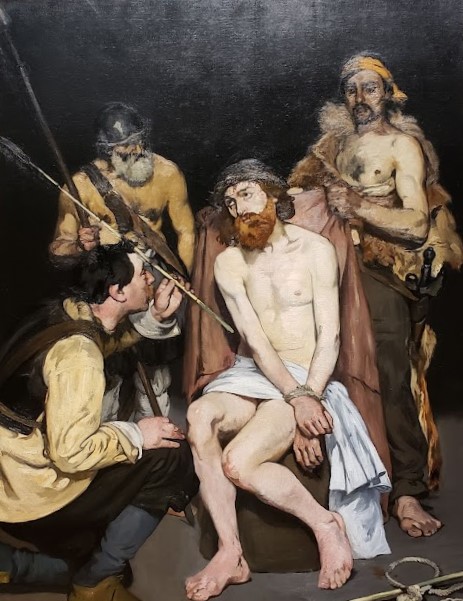
Jesus Mocked by the Soldiers – Eduoard Manet 1865

Ephesians 4:25-5:2 New Revised Standard Version

25 So then, putting away falsehood, let all of us speak the truth to our neighbors, for we are members of one another. 26 Be angry but do not sin; do not let the sun go down on your anger, 27 and do not make room for the devil. 28 Thieves must give up stealing; rather let them labor and work honestly with their own hands, so as to have something to share with the needy. 29 Let no evil talk come out of your mouths, but only what is useful for building up, as there is need, so that your words may give grace to those who hear. 30 And do not grieve the Holy Spirit of God, with which you were marked with a seal for the day of redemption. 31 Put away from you all bitterness and wrath and anger and wrangling and slander, together with all malice, 32 and be kind to one another, tenderhearted, forgiving one another, as God in Christ has forgiven you. Therefore  be imitators of God, as beloved children, and live in love, as Christ loved us and gave himself up for us, a fragrant offering and sacrifice to God.

************

                Interestingly, polls suggest that people are leaving the church (dones) or avoiding Christianity altogether (nones) is that they feel that Christians don’t live a very Christian life. I want to rebut this feeling, but when I look around at the state of the world, especially American Christianity, it’s hard to disagree with the sentiment. Clergy scandals that range from pedophilia to embezzlement are rampant. There are political alliances that undermine Jesus’ call to love one’s neighbor. I know I was appalled to see the “Christian Flag” being carried by rioters as they stormed the capital building (to be honest I’ve never liked the Christian flag, but that was the last straw for me). Now, I know that these are not the only expressions of “Christianity” present in our midst, but they do resonate with the broader public. So, a word like the one we hear in the reading from Ephesians for the Eleventh Sunday after Pentecost is worth considering as an antidote to the current situation. What we hear in this reading is a call to live one’s life in a way that reflects the message of Jesus. Surely this would be a good vaccine!

                The word we encounter here at the end of chapter 4 and the beginning of chapter 5 of Ephesians picks up after a conversation concerning spiritual gifts. According to Paul (remember for sake of tradition and brevity I’m assuming Pauline authorship even though it is disputed) these gifts have been given to the church by the grace of God to equip the saints for ministry so that the saints might move toward maturity in Christ (Eph. 4:7-16). The reading for the Eleventh Sunday is an outgrowth of that earlier word from Ephesians 4. There is, however, a paragraph that separates the two lectionary readings that need to be mentioned. In verses 17-24 Paul tells the readers, who are mostly Gentile, not to live as Gentiles. That is, they should not live in the futility of their minds with darkened understandings that result from living outside the sphere of God’s reign. Paul reminds them that because they are in Christ, they have to put away their old (may we say pagan) way of living. In line with the eschatological vision of the early church, Paul reminds them that to be in Christ means moving from the old world/life/creation to the new world/life/creation. Since they are in Christ they should clothe themselves in a manner that reflects that they have been “created in the likeness of God in true righteousness and holiness”  (Eph. 4:24).

                The paragraph omitted by the lectionary creators is an important connector between the word about spiritual gifts and the call to live a life that is worthy of their calling as saints of God. Now that they are clothed with Christ, Paul tells the Ephesians (and all other readers if this was, as it appears, a circular letter) to put away falsehood, speak truth to one’s neighbors (now that’s a word for today), not let anger lead to sin (Paul recognizes that anger is a normal experience, just don’t let it fester and lead to evil deeds), and finally, he tells them not to make room for the devil. This last reference needn’t be taken literally in reference to a personage called the devil, but it is a recognition that evil is a spiritual force that can take root in our lives if we give it room to maneuver (vs. 25-27).

                Now Paul’s not finished. He also speaks of those who transgress the law by stealing rather than engaging in honest work so they can set aside a provision for the  needy. Paul’s is still not finished. He also includes a word about our speech. Don’t let any evil talk come from your mouth is the message that he gives them. What does he mean by this? Well, the phrase that follows is pretty clear. Let what you say build up others and provide words of grace. It is worth considering the message of James concerning the tongue, which he calls a “restless evil, full of deadly poison” (James 3:8). Yes, it can be used to bless God, but it can also be used to curse those who are created in the likeness of God. James tells us that this is not the way things are supposed to be (James 3:9-10).  While we don’t have a full rundown of the Ten Commandments here, I think we get the point. The Christian life may begin with grace, but there are ethical expectations for us.

                Earlier in the chapter, Paul speaks of his desire that the people experience the “unity of the Spirit in the bond of peace.” He reminds us that there is but one body and one Spirit as well as one Lord, one baptism, and one God (Eph. 4:3-5). If you go to this passage do you see a possible allusion to the Trinity? In our reading, we hear the author tell the people not to “grieve the Holy Spirit of God with which you were marked with a seal for the day of redemption” (Eph. 4:30). The reference to the seal of the Spirit could be understood as being baptism. So, to those who are sealed in the Holy Spirit through baptism, they are called upon to live accordingly. Don’t grieve the Spirit by living in a way that dishonors the Gospel with which they are sealed through baptism.

                Having spoken of this seal of the Spirit, the author again addresses the Gentile way of living. Since they are sealed in the Spirit, they should put away bitterness, wrath, anger, wrangling, slander, and malice. Instead, they should be kind to each other, be tenderhearted, and forgive one another, even as God in Christ has forgiven them. With this word as a foundation, Paul makes a major ask of them— “Therefore be imitators of God, as beloved children, and live in love, as Christ loved us and gave himself up for us, a fragrant offering and sacrifice to God” (Eph. 5:1-2).

                Imitate God as beloved children. How might one imitate God? Paul’s answer is this: “live in love, as Christ loved us and gave himself up for us, a fragrant offering and sacrifice to God.” Later in this chapter, Paul will encourage husbands to love their wives as Christ loved the church by giving themselves up for their wives (Eph. 5:25). However, we read that reference (and it can be read as a call to mutual submission (Eph. 5:21), it seems logical to answer the question of how to imitate God is to love as Jesus loves. Perhaps if we love as Jesus loves we will show the world a different face. Is that not a message for today?

                For more background on the passage see my book Ephesians: A Participatory Study Guide, (Energion Publications, 2010), chapter 6.

No More Dividing Walls – Lectionary Reflection for Pentecost 8B (Ephesians 2)

Ephesians 2:11-22 New Revised Standard Version


11 So then, remember that at one time you Gentiles by birth, called “the uncircumcision” by those who are called “the circumcision”—a physical circumcision made in the flesh by human hands— 12 remember that you were at that time without Christ, being aliens from the commonwealth of Israel, and strangers to the covenants of promise, having no hope and without God in the world. 13 But now in Christ Jesus you who once were far off have been brought near by the blood of Christ. 14 For he is our peace; in his flesh he has made both groups into one and has broken down the dividing wall, that is, the hostility between us. 15 He has abolished the law with its commandments and ordinances, that he might create in himself one new humanity in place of the two, thus making peace, 16 and might reconcile both groups to God in one body through the cross, thus putting to death that hostility through it. 17 So he came and proclaimed peace to you who were far off and peace to those who were near; 18 for through him both of us have access in one Spirit to the Father. 19 So then you are no longer strangers and aliens, but you are citizens with the saints and also members of the household of God, 20 built upon the foundation of the apostles and prophets, with Christ Jesus himself as the cornerstone. 21 In him the whole structure is joined together and grows into a holy temple in the Lord; 22 in whom you also are built together spiritually into a dwelling place for God.

***********

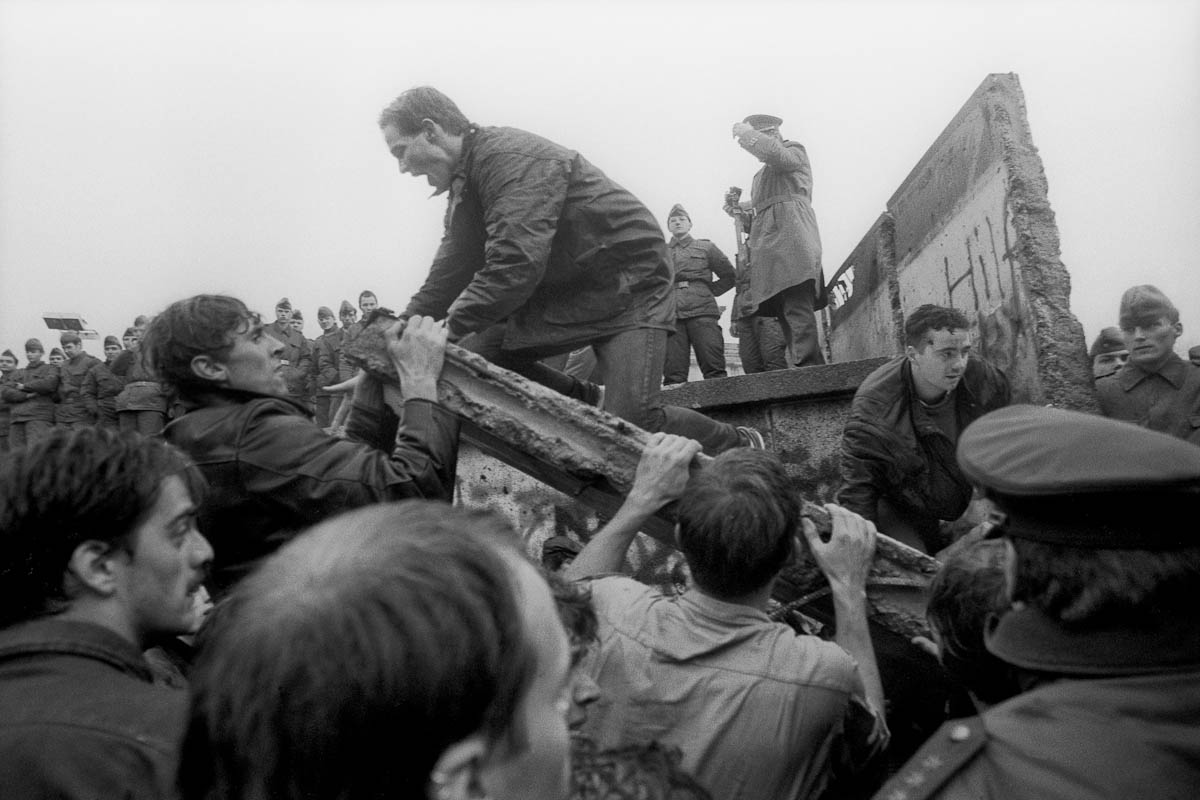
                It’s been decades now since Ronald Reagan stood at the wall in West Berlin and declared: “Mr. Gorbachev, tear down this wall.” Well, Mr. Gorbachev didn’t actually tear down the wall, but in 1989, while the world watched (I watched) residents of East and West Berlin mounted the wall and began to tear it down, uniting the divided city. Before too long, the wall of separation that divided East and West Germany came down as well, allowing the two parts of the country to come back together. It was an amazing sight that for a moment gave the illusion that a new age in world history had begun. Unfortunately, many dividing walls remain in place across the globe, including in many of our communities. There is a wall running through Palestine dividing Israel from the Palestinian territories. There is the wall that runs across the southern border of the United States that has become a focus of attention in the United States. These are literal walls, but there are other walls that are spiritual/cultural/ethic that continue to divide persons and communities from one another.

                The lectionary takes us back to the Ephesian letter for the Eighth Sunday after Pentecost. In this letter, the author, whom we will again refer to as Paul even though the authorship of the letter remains contested, speaks to a concern present in the early church. That concern is the ongoing tension existing between Jewish and Gentile believers. If, as many scholars believe, this letter was written in Paul’s name after his death, we are reading a letter written as  Gentiles had begun to be the dominant group within the church. It would appear that the wall of separation that we witness in the Galatian letter was still present within the church. The letter is, it would appear, written to Gentile believers because Paul reminds them that once they were strangers and aliens (xenoi) and therefore far off from God’s people. That is, they are part of the household of God that is built on the foundation of the apostles and prophets, with Christ as the cornerstone. Therefore, while the Gentiles were once a people without hope because they were without God, now they are no longer Gentiles but they have become citizens in the Israel of God. Now that they have embraced the message of Jesus there is no distinction between Jew and Gentile for all make up the one people of God in Christ.  Therefore, now Jew and Gentile were one people in Christ.

                In fact, in Christ, God has created a new humanity, reconciling both Jew and Gentile to God through the cross, “putting to death that hostility through it” so that there might be peace (vss. 15-16). That dividing wall has been broken down, just like the Berlin Wall. In the process of doing this, we’re told that Christ has abolished the law, with its commandments and ordinances. Most likely, the author has in mind the ordinance of circumcision not God’s moral commands, like the commandment against murder. What is abolished is the requirement to fulfill certain observances that had once divided Jew and Gentile from each other and had created hostility between the two. Note that in verse 11, Paul acknowledges that the Gentiles had once been known as the “uncircumcised” by the “circumcised.” Thus, for the citizens of God’s realm, circumcision had been the marker, the documentation, of their citizenship (at least for males). The hostility that had existed between those inside the household of God and those outside based on circumcision as proper documentation of citizenship would have to go if the church was going to move forward with both Jewish and Gentile members.

                The dividing wall was demolished through the cross. Sammy Alfaro puts it this way:

In the one act of the cross, those who were far off and those who were near were reconciled unto God. No special shortcut treatment for the chosen nation and no back-of-the-line stiff-arm status for Gentiles. Hearkening to the Trinitarian blessings of God in the first chapter of the letter, access to God takes on Trinitarian form: the Son provides the means and the Spirit the avenue for reconciliation with the Father (v. 18) [Connections, p. 172].

To be in Christ is to become part of the Temple of God, the place where God meets God’s people. The means of access to God has been opened up to all through Christ. While there was, in the Jerusalem Temple, a “Court of the Gentiles,” access to the Holy of Holies had been denied to them. Now, even that was open to Gentiles through Christ, who is the fulfillment of the Law.

                So, what do we make of this word to the church? Do any walls of hostility still exist within the church? By church, I don’t simply mean local congregations or even denominations, I mean the church at large. The answer, of course, is yes, walls still exist. Some are doctrinal, others are ethnic. Some churches fully welcome LGBTQ persons, affirming their personhood so that there are no barriers to their participation. They are, in Christ, fully citizens of the realm. There are other churches that either won’t allow LGBTQ folk in the church or at the very least limit how they are present (“don’t ask, don’t tell”). Some churches ordain women and churches that don’t allow women to speak in the church (at least not when men are present). I think you get the picture. We may say we are one in Christ, but we remain divided. Thus, this word to the church given centuries before must continually be revisited. What walls must come down today? How is the Spirit at work breaking down these walls?

For more on this passage see my book: Ephesians: A Participatory Study Guide, Energion Publications, p. 23-33].

Chosen for Blessings – Lectionary Reflection for Pentecost 7B (Ephesians 1)


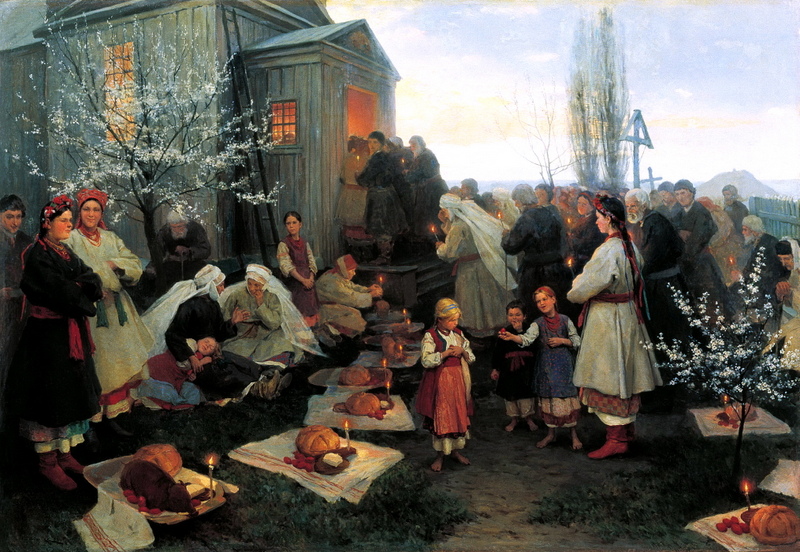
Waiting for the Blessing —  Pymonenko, Mykola


Ephesians 1:3-14 – New Revised Standard Edition


Blessed be the God and Father of our Lord Jesus Christ, who has blessed us in Christ with every spiritual blessing in the heavenly places, just as he chose us in Christ before the foundation of the world to be holy and blameless before him in love. He destined us for adoption as his children through Jesus Christ, according to the good pleasure of his will, to the praise of his glorious grace that he freely bestowed on us in the Beloved. In him we have redemption through his blood, the forgiveness of our trespasses, according to the riches of his grace that he lavished on us. With all wisdom and insight he has made known to us the mystery of his will, according to his good pleasure that he set forth in Christ, 10 as a plan for the fullness of time, to gather up all things in him, things in heaven and things on earth. 11 In Christ we have also obtained an inheritance, having been destined according to the purpose of him who accomplishes all things according to his counsel and will, 12 so that we, who were the first to set our hope on Christ, might live for the praise of his glory. 13 In him you also, when you had heard the word of truth, the gospel of your salvation, and had believed in him, were marked with the seal of the promised Holy Spirit; 14 this is the pledge of our inheritance toward redemption as God’s own people, to the praise of his glory.


********

                Every professional team sport has a draft in which teams chose athletes to stock the team. If the team has the first pick in the draft, the choices are limited only by the number of athletes available. It’s a coveted position to be in, though the pick comes with a caveat. The team with the first pick normally is the one with the worst record in the league. That is, they are a bad team. The hope is that by giving the worst team in the league the first pick, they can begin improving themselves (as long as they choose wisely).

                The opening chapter of the Ephesian letter takes up the question of being chosen by God to be part of God’s team. In a sense, everyone is a first-round pick. At least that’s one way of reading the passage before us. Just a note, the passage is also featured in the lectionary for the Second Sunday after Christmas. Liturgically, the context is somewhat different. Instead of a Christmas message, we find ourselves situated on the Seventh Sunday after Pentecost (Year B). The reading is the first of several that will take us through the letter until we reach chapter six.

                When it comes to conversations about the Ephesian letter, the identity of the author always comes up. There is no consensus, with some scholars accepting the traditional view that Paul is the author. After all, the letter opens by identifying the author as the Apostle Paul (Eph. 1:1). Others argue that based on the theology, the style of writing, and other markers, it must be the product of a later author. I address some of this in my Participatory Study Guide on Ephesians, though I don’t take a position on the question of identity. For our purposes, I’m not sure it matters whether it is Paul or someone writing in Paul’s name (according to ancient practice this doesn’t make it a fake letter if Paul didn’t write it). What seems clear is that the author is a Jewish Christian/Christian Jew, and the audience is predominantly Gentile. Note that Paul uses the word “we” in verse 12 and “you” in verse 13. The we who were the first to set their hope in Christ would have been Jewish believers in Jesus. Nevertheless, as verse 13 spells out, “you” (Gentiles) are also included in this act of adoption since they had heard the word of truth and believed in Christ and had received the seal of their salvation, the Holy Spirit. If we keep all of this in mind, then we can for the sake of simplicity call the author Paul.

                “Paul” begins by affirming the many spiritual blessings God has poured out upon God’s people, doing this in Christ.  Having declared that God is the giver of spiritual blessings in and through Christ, Paul speaks of God choosing “us” before creation to be holy and blameless, predestining us according to God’s plan. If we understand the author to be of Jewish descent and most of the audience is Gentile Christians, then the “us” includes both Jewish and Gentile Christians, creating the bridge that the author wishes to build between the two communities.

                Now, words like choose and predestine found here tend to be problematic for some audiences. Indeed, it is a problem for me. So, what does it mean for God to have chosen “us” from before God began to create? How does that affect our own ability to choose? For those of us who embrace an “open and relational” view of God, which assumes that the future is open how might God predestine us for adoption as God’s child? Don’t we have a choice in the matter? As we ponder these questions, we can return to the opening line of the passage, which calls on us to offer blessings to God who has blessed us in Christ with every spiritual blessing.

                It is, in my opinion, best if we do not read these words about predestination in an individualistic manner. It’s not that God has predestined each of us individually for salvation (or damnation for that matter), rather God has chosen Jesus to be the agent of reconciliation. Thus, Jesus provides the means by which we are adopted as children of God. According to our reading, this involves the blood of Christ. Paul doesn’t go into graphic detail here. He doesn’t refer to the cross, only that in some way the blood of Jesus is the means by which we receive forgiveness of sins and receive God’s grace. Whatever the means, this act of grace is costly and should not be taken for granted.

                As the passage continues, Paul takes up the matter of our inheritance as one’s adopted as children of God. When it comes to adoption, the New International Version uses the word “sonship,” which is rather gender-specific but would reflect the way inheritances were understood in the ancient world, as an inheritance generally went to a son and not to a daughter. Thus, the choice made by the NRSV translators is likely a better one for a modern Christian audience. Now, when it comes to the heirs of God in Christ, note that the author speaks of all things being gathered up, both in heaven and on earth. Thus, in Christ we receive an inheritance. This reference to all things being gathered up is intriguing because it is suggestive while not being definitive that God has an eye toward universal reconciliation/redemption (vs. 10). While this word includes heaven, it also speaks of God’s care for the creation.

                This is a passage rich in meaning. It raises difficult questions that might not be resolvable in a sermon, but what it does say is that God is concerned about the creation, so much so that God has chosen a way of redeeming that which is broken. This comes as an act of grace in Christ and through the Holy Spirit (there is a Trinitarian feel in this passage). What it does, however, is invite gratitude to God on our part for the decision to choose us in Christ to be the recipient of God’s blessings. This need not require of us a belief that God determines all things. It does suggest that God has chosen to act on our behalf to bless us in Christ. In that way God is sovereign—not as a tyrant or despot but as one who acts graciously on our behalf, inviting us to become part of the family of God. That is not something we earn but which we receive as a divine gift in Christ our savior.   

For more on this passage see my book on Ephesians in Energion Publication’s Participatory Study Guide series.      

Image attribution: Pymonenko, Mykola. Waiting for the Blessing, from Art in the Christian Tradition, a project of the Vanderbilt Divinity Library, Nashville, TN. https://diglib.library.vanderbilt.edu/act-imagelink.pl?RC=55788 [retrieved July 4, 2021]. Original source: http://commons.wikimedia.org/wiki/File:PimonenkoNK_PashalZautrRYB.jpg.

Mystical Experiences, A Thorn in the Flesh, & Boasting – Lectionary Reflection for Pentecost 6B (2 Corinthians 12)

2 Corinthians 12:2-10 New Revised Standard Version

I know a person in Christ who fourteen years ago was caught up to the third heaven—whether in the body or out of the body I do not know; God knows. And I know that such a person—whether in the body or out of the body I do not know; God knows— was caught up into Paradise and heard things that are not to be told, that no mortal is permitted to repeat. On behalf of such a one I will boast, but on my own behalf I will not boast, except of my weaknesses. But if I wish to boast, I will not be a fool, for I will be speaking the truth. But I refrain from it, so that no one may think better of me than what is seen in me or heard from me, even considering the exceptional character of the revelations. Therefore, to keep me from being too elated, a thorn was given me in the flesh, a messenger of Satan to torment me, to keep me from being too elated. Three times I appealed to the Lord about this, that it would leave me, but he said to me, “My grace is sufficient for you, for power is made perfect in weakness.” So, I will boast all the more gladly of my weaknesses, so that the power of Christ may dwell in me. 10 Therefore I am content with weaknesses, insults, hardships, persecutions, and calamities for the sake of Christ; for whenever I am weak, then I am strong.

***************

                Mystical experiences can be powerful, even life-changing, but it’s best not to boast about them. Thorns in the flesh on the other hand could be a reason to boast, though even this might be problematic. We see both kinds of experiences discussed in the reading for the Sixth Sunday after Pentecost. It is a word about boasting, mystical experiences, and thorns in the flesh, and in verse 1, which the lectionary omits, Paul acknowledges that he has to boast even if it’s not expedient to do so. However, the false apostles, who had come into the community and disrupted their lives with their boasts, need to be answered (2Cor. 11:12-13). Although Paul planted the church in Corinth, some of the people in the church had embraced these false apostles who had variously accused him of being weak, untrained in his speech, and more (2 Cor. 10:10; 11:6). The question is, about what should he boast? A mystical experience? A thorn in the flesh? The former might impress some in the congregation, but would the latter?

                Now he could choose to boast about mystical experiences, which he speaks of here in 2 Corinthians 12. Though he suggests that the mystical experiences he will speak of belong to someone else. However, he is more than willing to boast in what he calls his thorn in the flesh. When it comes to the mystical experience, I’ve always wondered whether Paul was speaking of himself, but didn’t want to go there. Karl Barth makes the same assumption that it was Paul who had this mystical experience, but he writes that “this is the distinctive thing with the description of this ecstasy—he puts a space between himself and this man. And it is only at this remove that he will take part in the glory which this man—himself—has by virtue of these high things” [Barth, CD, 1:2, p. 332]. So, instead of owning up to being the one with the mystical experience, Paul chose to emphasize his thorn in the flesh. As to its nature, Paul doesn’t say, but it’s clear he had sought relief to no avail.   

                In this reflection, I want to look at both the mystical experience and the thorn in the flesh. The former is intriguing. What does Paul mean by a third heaven or paradise? At the same time, his thorn in the flesh is intriguing. One thing we know from this letter is that Paul feels the need to defend his ministry. Whatever the thorn was, it might be one of the reasons why the Corinthians have been dismissing his ministry. He looks weak and in Greco-Roman culture, weakness was not something to boast about. If he wanted to a successful religious leader then he needed to be a “manly man!”

                We begin by exploring this mystical experience that a person had some fourteen years before. If this letter is written around 55 CE, then we’re talking somewhere around 40-41 CE, before a congregation had been planted in Corinth. Paul writes that he doesn’t know if this was an in-body or out-of-body experience, but whatever the case he knew of a man who was caught up into the “third heaven.” He then adds that the man was caught up into Paradise, thus equating the two. The message here parallels other apocalyptic claims to visions that were present in Jewish/rabbinic thought (see 1 Enoch). Whether Paul believed there were only three heavens or levels of heaven isn’t known as there is evidence of belief in more than three heavens. Whatever the case, Paul seems to believe  that there are at least three levels, and following 2 Enoch 8, Paradise is the equivalent of the third heaven. There, the man heard words that could not be repeated. These were divine secrets that could not be shared with those on earth. While he might boast on behalf of the man who had the visions/mystical experience, he is only going to boast in his weaknesses.

                He might not boast of mystical experiences, but he is willing to boast about his weaknesses. Again, that makes little sense in a Greco-Roman context. I sense that the false apostles have been sharing their grand visions as a way of proving their legitimacy. But, while he likely could do so (Damascus Road), he chooses not to go that route. He instead boasts in the fact that he had been given a thorn in the flesh that God had chosen not to deal with. As C.K. Barrett notes, “Paul does not wish too high an opinion of him to become current; it would obscure the fact that it is to his Gospel, and not himself that men should attend, and that he is a more effective witness to Christ crucified if he endures suffering and disgrace” [Barrett, Second Epistle to the Corinthians, p. 313]. Thus, Paul makes it clear that if he is to bear witness to the crucified Christ he can’t glory in mystical experiences, which, as we know from the first letter, the Corinthians valued.

                So he turns to the thorn in the flesh, which he calls a “messenger of Satan.” Interestingly, he suggests that this thorn was sent upon him so that he might not become too elated by his visions, which leads to the suggestion that the above mystical experiences were his own. Now, this angel of Satan is actually sent by God, reminding us that in Paul’s mind, God is sovereign. Whatever happens, happens because God desires it. That doesn’t sit well with my theology that is rooted in an acknowledgment that God acts out of love and that God is not the author of suffering, but for a moment let’s simply let Paul talk. So, Barrett writes: “God allowed Paul astounding revelations of heavenly truth, which could not be communicated, but he did not intend that these should go to the apostles head” [Barrett, Second Epistle to the Corinthians, p. 314].

                The question then concerns the nature of this thorn. It has often been assumed that it is a physical ailment of some type, such as blindness, but that is not a necessary conclusion. Barrett suggests that a speech impediment might be possible as it would have given a bad first impression (Gal. 4:13-15—though here Paul speaks of his eyes) [Barrett, p. 315].  Whatever it was Paul sought relief on three occasions but wasn’t granted it. The answer to this prayer was simply: “My grace is sufficient for you, for power is made perfect in weakness” (2 Cor. 12:9). Therefore, he has chosen to boast in this expression of weakness so that Christ’s power might be more evident in his life. So, he remains content with “weaknesses, insults, hardships, persecutions, and calamities for the sake of Christ, for whenever I am weak, then I am strong” (2 Cor. 12:10). Might these be what Paul had asked to be delivered from, but from which he was told that God’s grace is sufficient. Thus, having heard this, he was content to be buffeted by Satan if that served the purpose of the Gospel.

                The passage presents us with a series of questions. In a culture that prizes success, does the message Paul presents resonate today? Might we be better off testifying to our conversations with God instead of being content with suffering? Having spent my ministry life as pastor of small churches, I have at times felt as if my ministries were considered less valuable than that of the big churches. What do you say at a clergy gathering when colleagues glory in large numbers of baptisms or stewardship drives that bring in huge sums? The message here seems to be simply, “my grace is sufficient.” That is not to say that those ministries lack value, but only that we should not measure the value of a ministry on human standards of success. Since this passage is designated for a Sunday near Independence Day (in 2021, July 4th falls on a Sunday), how might it be heard at this moment? It is easy to glory in the nation’s history, but right now that might not be wise. At the same time for some in our context, a word about being content with suffering might be inappropriate. At the end of the day, the question then concerns what is the nature of grace in our context? How might it create strength in us, even when we may feel weak? There is a time and a place for mystical experiences, but it is the grace of God that emerges even in our weakness that engenders true strength. May we entrust ourselves to the grace of God.    

No Obstacles to Salvation Here – Lectionary Reflection for Pentecost 4B (2 Corinthians 6)

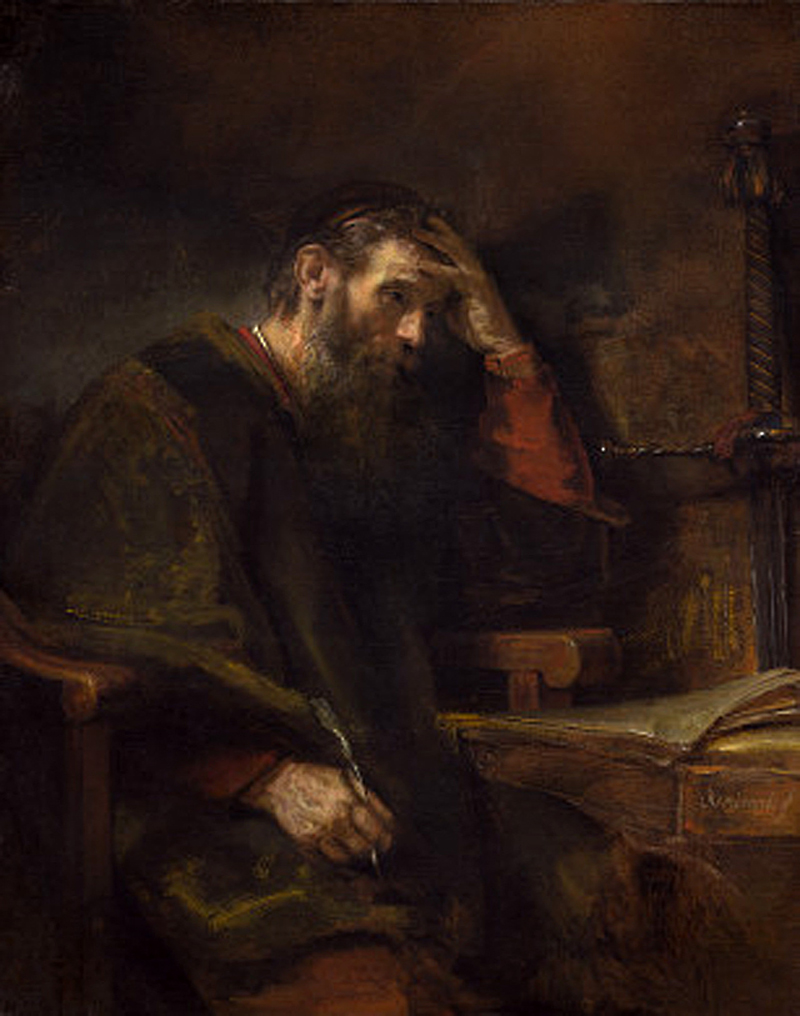
Paul – Rembrandt

2 Corinthians 6:1-13 New Revised Standard Version

As we work together with him, we urge you also not to accept the grace of God in vain. For he says,

“At an acceptable time I have listened to you,
    and on a day of salvation I have helped you.”

See, now is the acceptable time; see, now is the day of salvation! We are putting no obstacle in anyone’s way, so that no fault may be found with our ministry, but as servants of God we have commended ourselves in every way: through great endurance, in afflictions, hardships, calamities, beatings, imprisonments, riots, labors, sleepless nights, hunger; by purity, knowledge, patience, kindness, holiness of spirit, genuine love, truthful speech, and the power of God; with the weapons of righteousness for the right hand and for the left; in honor and dishonor, in ill repute and good repute. We are treated as impostors, and yet are true; as unknown, and yet are well known; as dying, and see—we are alive; as punished, and yet not killed; 10 as sorrowful, yet always rejoicing; as poor, yet making many rich; as having nothing, and yet possessing everything.

11 We have spoken frankly to you Corinthians; our heart is wide open to you. 12 There is no restriction in our affections, but only in yours. 13 In return—I speak as to children—open wide your hearts also.

************

                Today is the day of salvation that means entering into a partnership with God, who, as we saw in 2 Corinthians 5 has reconciled us to Godself in Christ and given us the ministry of reconciliation. So don’t wait, receive the grace of God. Don’t let it go to waste by receiving it in vain. After all, Paul quotes from Isaiah 49:8, which affirms the promise that on the day of salvation God has helped us. That promise, of course, is rooted in God’s covenant promise to Israel, to restore the exiles to their homeland. As Scot McKnight notes, Paul uses “Israel-remnant-servant imagery” to reveal “a loving, faithful covenant God” who is working to bring the exiles home. With that as the foundation, “Paul sees his own mission to the Corinthians as (hopefully) accomplishing the same salvific purpose of God as he announces redemption in Christ! This appeal to Isaiah 49 is a pastorally creative and apocalyptic reading of the Bible backwards” [Connections, p. 100]. Therefore, today is the appropriate day of salvation, so take hold of it.

                As noted in earlier postings, Paul’s letters to the Corinthians have strong apocalyptic elements. There is an urgency to his message. Don’t waste time on unimportant things. As for the Corinthians, they’re restless. They want to move on from Paul’s oversight, which they seem to think is rather paternalistic. Writing this post as the COVID-19 pandemic seems to be winding down, you can feel some sympathy with the Corinthians. We just want to get on with our lives. Freedom is our watchword. The same is true here. There are elements of human life that don’t seem to change much. Context changes, but the emotional elements don’t seem to change that much. So, we can identify. Of course, Paul is not without his emotional involvement. We say that clearly on display in the way he responds to their resistance to his message.

                We see Paul’s emotions on display in the way he speaks of his involvement with them in verse 3. He insists that he and his companions had not put any obstacles in the way of anyone’s relationship with God. He claims that the Corinthians cannot find fault with his efforts on their behalf. In other words, they are people of integrity. In our day, it seems as if everyone’s integrity is in question. Perhaps it’s the 24 hour a day news cycle and social media that fuels this. It could be that too many scandals have been uncovered, including in the religious realm. It’s not that this didn’t happen in days of yore, it’s just that it’s more difficult to keep things under wraps. Once the cat is out of the bag you’re
not putting it back in.

                As we read through this passage it becomes clear that some question Paul’s integrity. After all, he claims that they have treated him as if he is an imposter (2 Cor. 6:8). It is for this reason that Paul finds it necessary to defend his ministry (and that of his companions). So, we read in verses 4-10 a lengthy description of his trials and tribulations as well as a strongly worded statement concerning his integrity. You can sense here that Paul’s emotions are on full display. He’s being vulnerable before them. So, he reminds them that he has endured many tribulations on their behalf ranging from imprisonment to shipwrecks. He’s spent many a sleepless night and experienced hunger, just so he could proclaim the gospel to them. He and his companions have also tried to live pure and holy lives, speaking the truth and expressing love for them (integrity!). Yet, as I noted above, they are treated as if they are imposters. Nevertheless, while
they may have nothing (of material value) they possess everything.

                I expect that many clergy identify with Paul. They’ve given their all and feel as if it is all for naught. I’ve seen and heard the stories on clergy Facebook pages. All of this has been intensified during COVID as some members have pushed to reopen before it was deemed safe and pressure was put on these clergy to go against what they believed was best (I’m thankful that the congregation I serve didn’t put that kind of pressure on me). Perhaps these words from Paul can at least give solace and maybe even encouragement to speak out. It’s biblical, after all!

                As I read the passage, I wonder if the key to understanding this passage can be found in verse thirteen, where Paul calls them children. He feels as if he must speak to them as if they are children, and for Paul, that is not a compliment. He speaks to them as if they are immature and in need of proper guidance (and that may be true if the letters reveal the truth about what was happening in Corinth). Not only are they children, but in his mind, they are his children. After all, he founded this church and he feels a certain responsibility for their welfare. That is true even though he must speak to them through letters. Thus, this is a pastoral letter.  As for the Corinthians, they believe they are mature and no longer in need of Paul’s paternalistic guidance.  They want their freedom to do as they please, because they know what is good for them, despite what Paul might think. I wonder if Paul’s litany of trials and tribulations fell on deaf ears and closed hearts. He would like them to show some gratitude and they show disdain.

                So, what do we make of this? How might it preach? In fact, if you’re a preacher do you use this to impress upon the congregation how much you’ve given up for them? Probably not. I don’t think it would go over well. It might appear as if you have a martyr’s complex (and that never looks good). So, you might just as well read the passage and let it speak as it will and those with ears to hear will hear.

                Ultimately what Paul does here in chapter 6 is deepen the call to embrace Jesus’ offer of reconciliation (2 Cor. 5). He has likely challenged their cultural expectations. He’s pushing them to move beyond their social context and embrace the values of God’s realm. Paul offered a message of humility and meekness to a culture that embraced power and riches. He seemed to be saying, it’s okay to be perceived as weak (unmanly).  As Dan Dick writes: “To offer blessing to the poor and extend woe to the rich defies common sense and is about as countercultural a message as one can preach. Honoring gentleness and meekness over power, humility, and contentment over fame, and simplicity and poverty over wealth seem ridiculous in cultures structured around achievement, popularity, and success, but this is the foundation upon which our Christian faith is built” [Connections, p. 103].  If I’m honest, I too would like a bit of fame
and power. I have more than some. It’s built into my social context as a white male. But, I’m also a small church pastor (well, I am retiring at the end of the month and I did have a nice farewell party. So, I have nothing to complain about). It’s to compare our situations and feel as if we’re being slighted. Paul understands. He might be feeling that himself. Yet, he also seems to understand that he is the recipient of grace and God’s act of reconciliation. With that, Paul can tell the Corinthians to stop resisting the work of God. Embrace God’s reconciling grace and join in the work of God in the world. God is looking for partners in this endeavor. So, open your hearts to God for to day is the day of salvation!   

Image Attribution – Rembrandt Harmenszoon van Rijn, 1606-1669. Apostle Paul, from Art in the Christian Tradition, a project of the Vanderbilt Divinity Library, Nashville, TN. https://diglib.library.vanderbilt.edu/act-imagelink.pl?RC=55240 [retrieved June 11, 2021]. Original source: http://www.nga.gov/fcgi-bin/tinfo_f?object=1198.

Becoming the New Creation – Lectionary Reflection for Pentecost 3B (2 Corinthians 5)

2 Corinthians 5:6-17 New Revised Standard Version

6 So we are always confident; even though we know that while we are at home in the body we are away from the Lord— 7 for we walk by faith, not by sight. 8 Yes, we do have confidence, and we would rather be away from the body and at home with the Lord. 9 So whether we are at home or away, we make it our aim to please him. 10 For all of us must appear before the judgment seat of Christ, so that each may receive recompense for what has been done in the body, whether good or evil. 
[11 Therefore, knowing the fear of the Lord, we try to persuade others; but we ourselves are well known to God, and I hope that we are also well known to your consciences. 12 We are not commending ourselves to you again, but giving you an opportunity to boast about us, so that you may be able to answer those who boast in outward appearance and not in the heart. 13 For if we are beside ourselves, it is for God; if we are in our right mind, it is for you.] 14 For the love of Christ urges us on, because we are convinced that one has died for all; therefore all have died. 15 And he died for all, so that those who live might live no longer for themselves, but for him who died and was raised for them.

16 From now on, therefore, we regard no one from a human point of view; even though we once knew Christ from a human point of view, we know him no longer in that way. 17 So if anyone is in Christ, there is a new creation: everything old has passed away; see, everything has become new!

*************

                Paul’s declaration that “if anyone is in Christ, there is a new creation” has proven to be foundational for my faith. Although that declaration is couched in apocalyptic language, it is a comforting and encouraging word. That is because it offers a message of new beginnings. To put it in Johannine terms, it offers the promise of being “born again.” According to Paul, the old life has passed away, so it no longer has a hold on me. I know I’m not alone in reading this passage in that way. Of course, Paul did have apocalyptic expectations that did not come to fruition in his lifetime. As we see here, he assumed it would not be long before the world stood before the judgment seat of Christ (vs. 10). While the earth continues its journey around the sun and Jesus has to return to inaugurate that new creation, can we not take from this message a promise that the past does not control our present or our future.

                Before we get too far in this conversation, I need to take note of the fact that the lectionary excludes verses 11-13 from our reading from 2 Corinthians 5. These excluded verses remind us that Paul is feeling the need to defend his ministry, even to the point of accepting the charge that he and his cohort are not of sound mind. While making that “admission” he clarifies by saying that if he’s not sane, it is because of his service to God. Yes, it’s God’s fault! Perhaps, the reason he has been criticized is that he hasn’t been engaged in competitive boasting. In other words, he’s not operating in ways the culture expects. That leads some to feel as if he’s weak. But, to Paul’s mind, they’ve missed the point that he’s been making. Boasting is not the way of Jesus.

                Now, one can easily jump from verse 10 to verse 14 without missing a beat. Nevertheless, the missing verses do provide a context for understanding Paul’s message of reconciliation. Ultimately, the core message of the passage is that when we are in Christ we become a new creation. That old life of ours has been replaced by the new creation.

                Focusing for a moment on verse 10, we read Paul’s words about standing before the judgment seat of God. That sounds ominous, and yet it would seem to be a necessary step in the process of being transformed from the old life to the new. When we stand before God our deeds are weighed and the appropriate “recompense” is given out. For Paul, if we are in Christ standing before God’s throne should not be a scary proposition. He has confidence because he walks by faith. When it comes to his situation in life, it doesn’t matter whether he is standing in the physical presence of Jesus or not, he knows what the future holds for him. So, he’s too concerned about his own bodily life, whether he’s here or there. It doesn’t matter to him. That’s because he understands himself to be living already in the realm of God.  But it appears he’s ready to leave behind this life and enter the new creation in all its fulness. He’s ready for the day of the Lord to come. The confidence comes from knowing/believing that this is his future. In the meantime, as Paul notes in verse 11, he and his cohort will continue to try to convince others of the truth he has embraced in Christ.

                The confidence Paul has is rooted in the cross, believing that Jesus died for all and then raised for them as well so that those who now live might live no longer for themselves. Thus, as C.K. Barrett writes: “Because Christ, being the person he was, died and was raised, there exists the universal possibility (he died on behalf of all; all died) of a new kind of human existence, no longer centred upon self but centred upon Christ” [Barrett, The Second Epistle to the Corinthians, p. 169]. This describes Paul’s own sense of purpose. As a follower of Jesus, he has been reconciled through the cross and the resurrection, so he is committed to the ministry of reconciliation in Christ. This is his calling, and he believes it should be our calling as well.

                Verse 16 is intriguing because Paul speaks of having once known Jesus according to the flesh, but no longer does he view Jesus in that way. Is he speaking of having known Jesus when he was walking the earth or is he speaking in more theological terms? That is, will he no longer look at Jesus from a purely human perspective, but instead will affirm the divinity of Jesus? Whatever Paul means here, he no longer looks at Jesus the same way as before. Here we might remember that Paul the persecutor became Paul the reconciler.

                As we reach the end of the passage, we come to the verse that has spoken to me so powerfully over the years. The message of Paul is simple: “if anyone is in Christ, there is a new creation: everything old has passed away; see, everything has become new!” You can see the apocalyptic dimensions of this passage. Paul, like John the Revelator, envisioned a passing away of the old earth and the revelation of the new earth. He might not be as colorful in his language, but the message is essentially the same. What is will be replaced with what will be. The question is, what we should we do now? For Paul and for Jesus, who is also an apocalyptic prophet, we should live now as if we are already living in the new creation. Paul goes on from here to speak of a calling. Having been made new in Christ, we are called to take up the ministry of reconciliation (vs. 18). In fact, the lectionary creators likely cut things off a bit too soon. The calling to engage in the ministry of reconciliation that is rooted in the fact that we are now a new creation forms part of God’s larger work of reconciling the world to God’s self (vs. 19). Therefore, as Paul writes in verse 20, God has called us to be ambassadors through whom God is making an appeal. It’s not enough to affirm our status as a new creation if we don’t take the next step and embrace our calling to be ambassadors of reconciliation so that the work of new creation/recreation can go forward.  

                This calling, to live as if the new creation has already begun to take hold in this world. The transformation is underway. But, to see this occur requires faith. That is why,  as Paul writes in verse 7, we must walk by faith and not by sight. When we look around at the world in which we live, it might seem as if there is no evidence that the new creation is present in this old world of ours. It seems as if there is a mass shooting every day. Conspiracy theories are rampant, threatening the democratic foundations of the United States and other nations. Racism is rampant, taking a variety of forms. Too often Christians are deeply embedded in much of these problems. Nevertheless, Paul asks us to look at things from a different vantage point. That is, he invites us to look at the world through the lens of Christ’s promise of reconciliation. If we do this, then we can join in the effort to bring true reconciliation to the world, and with it, the new creation.

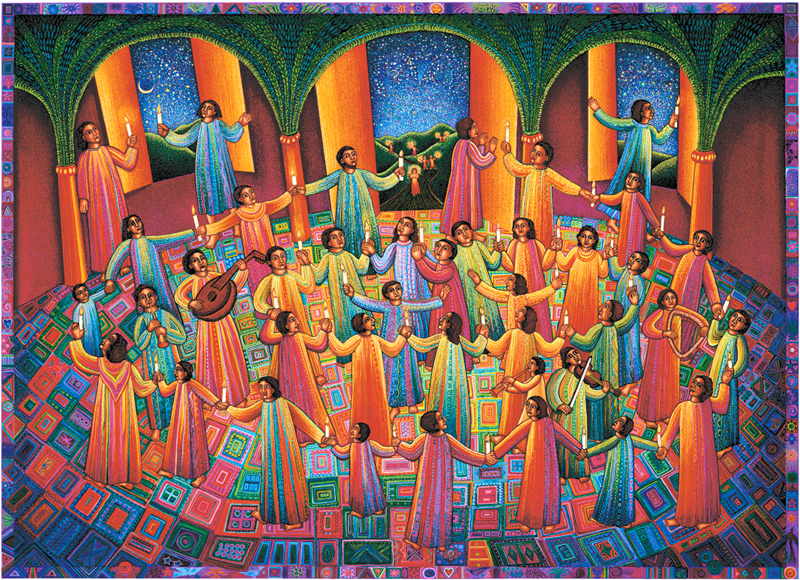
Swanson, John August. Celebration, from Art in the Christian Tradition, a project of the Vanderbilt Divinity Library, Nashville, TN. https://diglib.library.vanderbilt.edu/act-imagelink.pl?RC=56538 [retrieved June 5, 2021]. Original source: http://www.JohnAugustSwanson.com – copyright 1997 by John August Swanson.

Wondering Where the Lions Are: Advent 1(Narrative Lectionary)

Wondering Where the Lions Are: Advent 1(Narrative Lectionary)

Narrative Lectionary Reflection

November 29, 2020

Read: Daniel 6:1-27

Reflection

Between ages 7 and 10, I took swimming lessons at the YWCA and YMCA.  I had a good time in the water and loved to use the paddle boards and make big splashes in the pool.  

But there was one thing that scared me to death…the deep end of the swimming pool. You see, I could touch the end of the pool on the shallow end. However as you moved farther away from the shallow end, it became harder and harder to touch the floor.  You would get to that point where you couldn’t touch the bottom of the pool and you get a bit scared.  Of course, the reason I was in a swimming class is to learn how to swim, even in deep water, even in the places where I couldn’t just touch the bottom. Swimming was suppose to teach me how to handle the deep end, how to manuver in a place that seemed scary.  The swimming instructors were teaching me to trust the skills I’ve learned to tackle the deep end.  Not to get cocky in my skills, but to trust what I’ve learned to prevent me from drowning.

 This is the first day of the new church year, so I guess I should say Happy New Year.  This is the first Sunday of Advent, that season before Christmas where we await the coming of the Savior and also are reminded of why we need to Christ to come and save us and there is no one more deserving of salvation than the character in today’s text.

Daniel and the Lion’s Den is one of the first Bible stories children learn about. Daniel, an Israelite in exile, is a faithful worker in the court of King Darius of Persia.  Daniel does such a good job in his position as a chief administrator that the king is interested in promoting him to be the second in command in the Empire; only the king would be higher than Daniel.

His fellow administrators can’t stand that this foreigner is showing them up, so they devise a plan to trick the King into sending Daniel to the lions where he would meet his end.

When the days comes to send Daniel into the lion’s den. The administrators are joyous because they have this foreigner where they wanted him and soon, their troubles would be gone.  King Darius is nervous; he hates to lose such an able worker and he probably feels this charge is all trumped up. But he can’t do much other than hope Daniel’s God would save him.

The king didn’t sleep all night.  The king races to find Daniel is safe and sound, while Daniel’s rivials and their families face the lions and meeta cruel fate. 

What an odd text to start Advent with!  But maybe it isn’t so weird.  Daniel was facing an unjust punishment.  God comes to the rescue and save him from devastation.

Advent is a time of waiting for Christ, waiting for salvation.  Daniel waited for salvation as well and God did save him.  But the story here is not that God won’t let us face bad times.  The list is long of good people, faithful people who were killed by despots past and present.  The story here is that God will prevail even when it seems that evil will have the last word.  Even if Daniel were swallowed by the lions, this would still be a tale of God winning over evil, because God is bigger than corrupt administrators or a fumbling king.

The thing that scared me about the deep end of the pull is that I would be engulfed by water, that I would drown.  Daniel could have been scared about how the lions would pull him apart and then devour him.  But he has faith in God and is able to face down the lions because God is faithful.  The lions might kill him, but they have no power over him.

As I said before, trusting God doesn’t mean you won’t face trials.  We wait and hope for salvation, but that doesn’t always come in the way we want or expect.  Martin Luther King, Dietrich Bonheoffer, Oscar Romero and countless other disciples and followers of Jesus did not come to happy endings and yet they believed in a God that would save them, a God that never allowed evil to have the last word.

We wait in Advent for the coming of Jesus.  Jesus will not take away all the bad things in our lives.  We will still get cancer.  Our loved ones will still die.  We will get laid off.  The lions are always there waiting to have a midnight snack.  But we have hope.  Hope not that things will be okay, but that God is with us and will never ever let evil win. We wait knowing that Jesus is coming to be with us, to be with us in all of the dark times in our lives and to give us the faith to stand up to intolerance because the forces of darkness will never ever have the last word.

By the way, I’m still scared of the deep end of the pool.  But I also trust what I learned in swimming class.  May God give us the same courage in all the deep ends of our lives.


Photo by Laura Seaman on Unsplash


Don’t You Forget About Me: Christ the King Sunday(Narrative Lectionary)

Don’t You Forget About Me: Christ the King Sunday(Narrative Lectionary)

Narrative Lectionary Reflection

November 22, 2020

Read: Jeremiah 31:31-34

Reflection

Imagine with me that you wake up one morning and everything seems normal.  You listen to the news on the television and make breakfast and then head to work.  

When you get there, you expect to see your friend Bruce.  You’ve known him for nine years and his personality is such that everyone in the office knows who Bruce is.  You pass his desk and it’s empty.  In fact, it seems like no one had used his cubicle for months.  There is no nameplate or anything that shows he worked at your office. You ask around what happened to Bruce.  Everyone gives you a strange look.  To a person, no one remembers Bruce.  At first you think it’s a joke, but then you realize people are serious.  They act like Bruce never existed.  

You get to work, but you have this odd feeling.  Why can you remember Bruce, but no one else can?  

The day ends and you get back to your home to get ready to have dinner with your brother Nathan and Aunt Sophie.  You get ready and drive to the restaurant.  You see your brother you start catching up on things.  After a while, you ask where is Aunt Sophie.  Nathan gives you a blank look.  He asks who is Sophie.  You tell him that she’s your father’s sister and has two kids: Ben and Olivia.  But those names don’t register either.  Now you start to get nervous.  You finish dinner and get to bed hoping this is just a weird day.  

The next day, you give Nathan a call.  The phone rings and rings, when finally a woman picks up.  You know this is Carol, Nathan’s finance.  You ask to speak to your brother and for a moment, there is silence.  She doesn’t know a Nathan.  You are shocked.  Nathan and Carol had dated for six years.  

You hang up the phone.  You wonder what in the world is going on.

This keeps happening over a few days.  Friends, relatives and significant others just seem to vanish with the people around them having no memory of their existence.  One day, you realize everyone around you has vanished.  You sit in your room, in tears.  You pledge to remember these people, to believe they existed and mattered.  And you hope one day they will return. You hope you won’t be forgotten.

In our text this week, the people of Israel are not in a good place.  This text is being written to a people who have gone through the worst thing possible, at least to them.  Their homeland, Judah or the Southern Kingdom was one of the last places standing during the rise of the Babylonian Empire.  Finally, the Babylonians swept in and invaded.  Jerusalem is destroyed. The temple built by Solomon is brought down. The people were taken far away from their homes to live in Babylon.  They were in a new culture with new gods.  They remember the old days and they also remember how they didn’t follow God. They remember worshipping other gods. They remember treating the poor unjustly.  They know they hurt God. They probably think they deserved this punishment, which of course, they did. They might have wondered if God had forgotten them and moved on.

But then they hear this passage from Jeremiah.  They knew he was the old prophet.  Back in the day he preached that the people repent and no one listened to him.  These days, everyone wished they had.  

People gather around to hear what the old prophet has to say.  He tells the people that one day, they will go back home.  That made people feel good.  Their time in Babylon was more only for a time.  Their memories of a past land that doesn’t exist anymore will no longer be memories.  But there was still more Jeremiah had to say.

He tells them that soon he will make a new covenant with the people.  The old covenant was the one made during their journey from Egypt to the homeland.  After years of a broken relationship, God wants to get back together and start a new.  God will make a new covenant, not one that’s written in stone, but written in the hearts of the people.  God was going to transform the people from the inside out.  

Then Jeremiah says something that just blows everyone’s mind.  God will forget the sins of the people.  God had not forgotten God’s people, but the sins of the people would be liked they never existed.  Even when all has vanished in front of them, God is still there remaining faithful.

The people were smiling.  It would be years, decades before the people could come back, but they knew that God had not forgotten them.  God always wanted a relationship with the people of Israel and they were ready to renew the relationship and start over with God.  

When we look at the Bible, we tend to see two sides of God.  We think the Old Testament is filled with stories of an angry god ready to punish people.  We think the New Testament is about a God of love, a God that gives second chances.  But this passage puts a lie to that thinking.  It is in God’s nature to love passionately and to give second, third and fourth chances. Like an addict that falls off the wagon again and again, God is there to transform us into something wonderful.

This passage is about the covenant God establishes with the people of Israel, so it is not our covenant.  But it is a reminder that we live under a gracious covenant as well.  Because of the life, death and resurrection of Christ, God doesn’t remember our sins either.  God works at making us followers by working from the inside out.  We remember how good God is to us and God forgets our sin, making it possible to begin anew.

On this Christ the King Sunday, we are reminded that Jesus is a king, but he is not like other kings.  If we were following the Revised Common Lectionary, which we have done in recent years, today we would read the passages from the passion, those last few hours before Jesus’ death.  The crucifixion is a reminder of the lengths God will go to prove God’s love for us.  In the form a Jesus, a king is willing to lay aside a crown and die for the sake of others.  This is the God we find here in Jeremiah, the one that is willing to start anew to forgive and forget. To restore and to heal.

Next week, many of us won’t be traveling to see Mom and Dad or any other relative.  We have been urged to not travel to see our loved ones because it could cause the coronavirus to spread.  In a year where we feel cut off, it is easy to feel like we have been forgotten.  But what this passage reminds us is that God doesn’t forget us.  Even when we feel alone, we aren’t alone and in this dark time, it can give a sense of hope.

Decades later, the people make their way back to Judah.  After years of abandonment, the cities would be repopulated.  It is with happiness that they realize God didn’t forget them, but God also forgot their sins.  It was a new day.

Photo by Forest Simon on Unsplash