Category: revised common lectionary

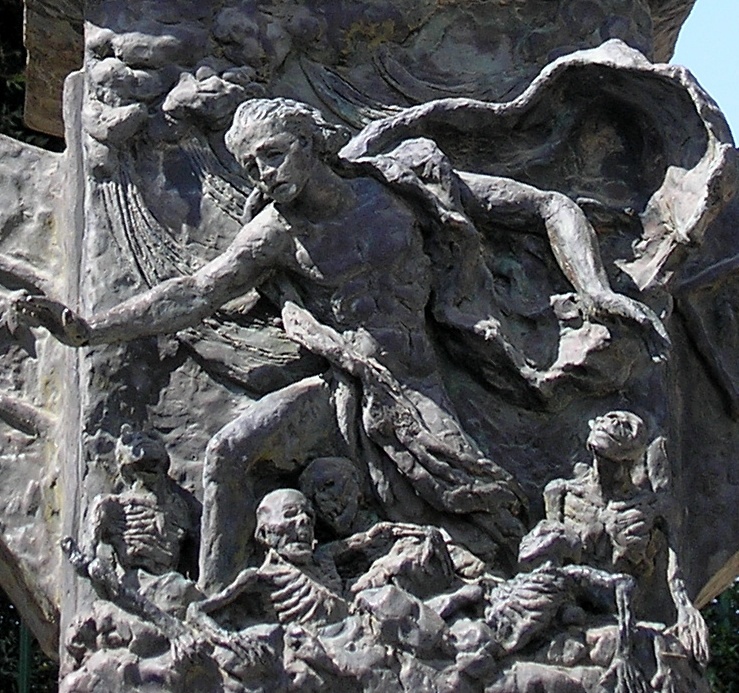
I Saw the Lord – Lectionary Reflection for Trinity Sunday (Isaiah 6)

Marc Chagall

Isaiah 6:1-8 New Revised Standard Version (NRSV)

6 In the year that King Uzziah died, I saw the Lord sitting on a throne, high and lofty; and the hem of his robe filled the temple. 2 Seraphs were in attendance above him; each had six wings: with two they covered their faces, and with two they covered their feet, and with two they flew. 3 And one called to another and said: 
      “Holy, holy, holy is the LORD of hosts;
       the whole earth is full of his glory.” 
4 The pivots on the thresholds shook at the voices of those who called, and the house filled with smoke. 5 And I said: “Woe is me! I am lost, for I am a man of unclean lips, and I live among a people of unclean lips; yet my eyes have seen the King, the LORD of hosts!”
6 Then one of the seraphs flew to me, holding a live coal that had been taken from the altar with a pair of tongs. 7 The seraph touched my mouth with it and said: “Now that this has touched your lips, your guilt has departed and your sin is blotted out.” 8 Then I heard the voice of the Lord saying, “Whom shall I send, and who will go for us?” And I said, “Here am I; send me!”

********************

As we move from Pentecost Sunday to Trinity Sunday, we find ourselves drawn into the heavenly realm (with the prophet Isaiah). While Easter celebrates the resurrection of Jesus and Pentecost the outpouring of the Spirit, Trinity Sunday lifts our attention to God in God’s fullness – as Father, Son, and Holy Spirit, Mother of us All. As to what we are attending to on Trinity Sunday, theologian Joe Jones writes that “the doctrine of the Trinity is simply that set of rules and concepts proposed for understanding of the self-revealing God witnessed to in the Bible” [A Grammar of the Christian Faith, 1:151]. The Trinity, then, is the term we use to speak of the way in which we encounter the one who covenanted with Israel, who was incarnate in Jesus of Nazareth, and who empowers the church as it carries out its mission in the world. The idea of the Trinity is related to the Christological question. As Joe Jones puts it: “Everything pivots around the issue of the divinity of Jesus Christ. If Jesus Christ is not essential to the identification of who God is, then the doctrine of Trinity is unnecessary” [Grammar, 1:151]. While the first reading from Isaiah 6 does not mention either Jesus or the Holy Spirit, as a Christian I read this passage in light of my affirmation of the doctrine of the Trinity. That is, the one whom Isaiah claims to see is the one Christians have understood in terms of our confession of the triune nature of God.

So, with that context-setting statement, we are ready to hear the word from Isaiah, the one who was drawn into the presence of God in the year that King Uzziah died (around 740 BCE). In the description of the vision, that prophet finds himself standing before the throne of God. The prophet reported “I saw the Lord sitting upon a throne, high and lifted up; and his train filled the temple.” Note the use of the term temple, which suggests that this is the location at which God is encountered. This is the location at which heaven and earth intersect. To make reference to Dr. Who’s Tardis, it is apparently larger on the inside than on the outside.

There is no explicit reference to the Trinity here, and yet the reading does draw our attention to the God Christians believe was incarnate in Jesus, and thus reveals to humanity the God who is unseen. In this vision, the unseen God is revealed to the prophet in the Temple, where the prophet sees seraphs (six-winged creatures) ministering before the throne of God. One seraph sings out: “Holy, Holy, Holy is the LORD of hosts; the whole earth is full of his glory.” In other words, while the Temple is a meeting place, it’s not just the Temple, but the whole earth that is filled with the glory of God. This is a magnificent sight, for what the prophet experiences is the holy, the sacred. That makes the prophet’s response understandable: “Woe is me!” I too would feel overwhelmed by such a sight.

This is not just a theophany—an appearance of the divine—it is the moment of a prophetic call. The prophet is invited into the presence of God not for voyeuristic reasons, but with a call in mind. It is also moment of transition in the life of Judah. The king is dead, a new king is set to come into power. So, Isaiah will have as his ministry focus, speaking to the new king on behalf of God who covenanted with Israel. It’s a recognition that even the most righteous of kings need some prodding from God’s prophets. With this transition in mind, God calls out from the throne: “Whom shall I send, and who will go for us?” Standing there before God’s throne, the Isaiah hears the call and responds. I’m wondering, based on the nature of the story, if Isaiah is not in the Temple at the time of the vision. So, the calls goes out, and Isaiah responds favorably. While this is true, the account also reveals Isaiah’s nature reticence to take up the call. Before even hearing the call, Isaiah has declared that he is unworthy to be in the presence of God. That confession is true for most true prophets.

Isaiah has made the claim that he is unfit for the task: “I am a man of unclean lips.” That may be true, but the problem is taken care of when one of the seraphs attending to the throne of God takes a pair of tongs, lifts a coal from the altar, and presses it against Isaiah’s lips. If it is a live coal, as the text suggests, it would be burning hot. In this case, it serves as a purifier. Having had his lips seared by this coal, he no longer has an excuse. He has been made ready to speak for God (for that is the purpose of a prophet). So, when the call comes, he simply declares “Here am I, send me.”

The call has been issued by God, whom we name using the grammar of the Trinity. Isaiah has answered: “Here am I, send me.” That same call has been issued time after time, and with fear and trepidation persons have answered the call. This June I will celebrate the thirty-third anniversary of my own ordination. I too have felt unworthy of the call, but the call has been issued, and I have answered—though I cannot say that I experienced a vision such as that of Isaiah.

The vision of Isaiah is a reminder that God may be unseen, but God is not unrevealed. Isaiah declares “I saw the Lord.” The doctrine of the Trinity is an expression of what is revealed here. We confess that God has been seen in the incarnate one, in Jesus. So, with the heavenly beings, we can sing “holy, holy, holy is the Lord of hosts, the whole earth is full of his glory.” We can add the refrain from the hymn: “God in three persons, blessed Trinity.”

Robert Cornwall
10646937_10204043191333252_4540780665023444969_nBob is a  Disciples of Christ pastor, church historian, and author.  He currently serves as Pastor of  Central Woodward Christian Church (Disciples of Christ) of Troy, Michigan. He holds a Ph.D. in Historical Theology from Fuller Theological Seminary, along with an M.Div. from Fuller and a B.S. degree from  Northwest Christian University in Eugene, OR.  Bob has authored several books, as well as numerous articles and book reviews.   He currently edits Sharing the Practice(Academy of Parish Clergy) and among the books already published, he has a number of books that have appeared with Energion Publications — Marriage in Interesting Times: A Participatory Study Guide, Unfettered Spirit:  Spiritual Gifts for a New Great Awakening, Worshiping with Charles Darwin, Ultimate Allegiance: The Subversive Nature of the Lord’s Prayer and Ephesians:  A Participatory Study Guide, and Faith in the Public Square (2012). He’s also the author of Freedom in Covenant (Wipf and Stock, 2015). For more on my books, see my Amazon Author Page:  amazon.com/author/robertcornwall.
 

Life-Giving Breath of God – A Lectionary Reflection for Pentecost Sunday

Life-Giving Breath of God – A Lectionary Reflection for Pentecost Sunday

Ezekiel 37:1-14 New Revised Standard Version (NRSV)

37 The hand of the Lord came upon me, and he brought me out by the spirit of the Lord and set me down in the middle of a valley; it was full of bones. He led me all around them; there were very many lying in the valley, and they were very dry. He said to me, “Mortal, can these bones live?” I answered, “O Lord God, you know.” Then he said to me, “Prophesy to these bones, and say to them: O dry bones, hear the word of the Lord. Thus says the Lord God to these bones: I will cause breath to enter you, and you shall live. I will lay sinews on you, and will cause flesh to come upon you, and cover you with skin, and put breath in you, and you shall live; and you shall know that I am the Lord.”
So I prophesied as I had been commanded; and as I prophesied, suddenly there was a noise, a rattling, and the bones came together, bone to its bone. I looked, and there were sinews on them, and flesh had come upon them, and skin had covered them; but there was no breath in them. Then he said to me, “Prophesy to the breath, prophesy, mortal, and say to the breath: Thus says the Lord God: Come from the four winds, O breath, and breathe upon these slain, that they may live.” 10 I prophesied as he commanded me, and the breath came into them, and they lived, and stood on their feet, a vast multitude. 

 11 Then he said to me, “Mortal, these bones are the whole house of Israel. They say, ‘Our bones are dried up, and our hope is lost; we are cut off completely.’ 12 Therefore prophesy, and say to them, Thus says the Lord God: I am going to open your graves, and bring you up from your graves, O my people; and I will bring you back to the land of Israel. 13 And you shall know that I am the Lord, when I open your graves, and bring you up from your graves, O my people. 14 I will put my spirit within you, and you shall live, and I will place you on your own soil; then you shall know that I, the Lord, have spoken and will act, says the Lord.”


***************
                When it comes to the church, the future can look bleak. At least in Europe and North America the church is retreating in the face of an ever more secular world. Christendom appears to be dead. While Christianity retains vestiges of the old ways, it has lost much of its cultural/social influence. There are those who cling to the stories of past glory and try to worm their way into positions of influence. It happens on the right and on the left. Where once the church was the religious face of empire, it has been replaced by other figures. Therefore, a more appropriate image for the church’s place in society might be exile. Thus, the words of prophets like Ezekiel can resonate, speaking words of hope to us in these challenging times.
The prophet Ezekiel is known for his imagery, and none of his images are as eye-catching as the valley dry bones. This image is an animator’s dream fulfillment. But what message does it convey? What did Ezekiel’s original audience take from it, and what does it offer to us as we gather on Pentecost Sunday? What word does it deliver concerning the life-giving presence of God, which blows into the community on Pentecost Sunday bringing life where once death seems to reign?
Pentecost Sunday is understood by many in the church to be the birthday celebration of the church. We wear red and perhaps make worship a little livelier. There’s no place on this day for sad faces. It’s a day to party, because the Spirit descends upon us, empowering our witness to the risen Christ, who now sits at the right hand of the Father. Life is restored, where death had reigned.
The story of Pentecost appears in the second chapter of the Book of Acts. It is a well-worn text that offers insight and encouragement. But what does Ezekiel offer us? What word does it speak to us? Perhaps the word it speaks is that there is life in the midst of exile. The word from Ezekiel challenges triumphalist visions, while providing us with a foundation to hear the promise of the life-giving Spirit that moves through the community empowering our witness.
The Pentecost story begins some ten days after the ascension of Jesus. The disciples (150 of them) are gathered in what we know as the “the upper room.” They appear to be praying, as they had been instructed by Jesus (Acts 1). Jesus had promised to send the Spirit, all they had to do was wait. When the Spirit came upon them, they would experience renewal and new life, and would be empowered to preach the good news to the world, moving from Jerusalem to the ends of the earth. All they had to do was wait. Finally, on the Day of Pentecost (a major Jewish festival), the Spirit fell upon the disciples. They began to preach. Revival broke out. People responded and were baptized (some 3000 according to Acts). Thus, the church is born, and their mission begins, one that extends to us (Acts 2).
                The first reading for Pentecost Sunday comes from Ezekiel 37 (unless you choose to read Acts 2 in this spot), which speaks to a people living in exile. They are discouraged, wondering if they will ever return home. In other words, they have experienced death. God gives to Ezekiel a word to share with the people of Judah in the form of a vision. He is taken in the Spirit to a valley filled with dry bones. This is Israel. It is a nation of dead, bleached bones. Would the nation be restored? Or would they live out their lives in exile, a people without a country. God says to Ezekiel—prophesy to these bones. Tell them to let God’s breathe enter them so that they might be restored to life. So, Ezekiel did as he was told. He called for the four winds to come and breathe life into the bones. The winds came, and the breath of the Spirit filled the bones. They began to come together. Life returned to the bones. To those who doubt that life can be restored to Israel, Ezekiel is directed to say to the people: “I will put my spirit within you, and you shall live, and I will place you on your own soil; then you shall know that I, the Lord, have spoken and will act, says the Lord.”
                What word do we hear from Ezekiel on this Day of Pentecost? Is there a word of hope here for the church that is, it would seem, experiencing exile? Christendom has died, at least in Europe and North America. Churches are experiencing difficult times, with aging congregations, declining attendance, and financial challenges. There is a sense of hopelessness creeping through the church. We see it expressed in a variety of ways, including grabs for power or sense of resignation. So, what work of the Spirit should we expect in our age? Are we that valley of dry bones? Is there a wind of the Spirit present that will fill us with the breath of God?
                The church may never again reach the levels of power it once wielded, but that does not mean that there is no hope. The days when the church defined the public square is over, but God has not been banished. We still have voices to proclaim the glory of God. We can call upon the four winds, inviting them to fill the valley of dry bones, bringing to life communities that can embody and declare the glory of God before the world. As John McClure puts it: “The story of dry bones takes place at the intersection of human weakness and divine power. It reminds us that God’s power is made great in our weakness, and that the power of the church wields is not the power of the sword, but the power of God’s Spirit working through the Word proclaimed” [Preaching God’s Transforming Justice, Year B, p. 255].

                The church is called to proclaim and embody the Gospel. We do this in a variety of ways, but ultimately this is about the Spirit, who empowers and guides us in this work of God. We are participants in the proclamation of the Gospel in word and deed, but ultimately this isn’t about us. It’s about the Spirit. Yes, Ezekiel played a role. He spoke the words. He called for the winds. But it was the Spirit and not Ezekiel that gave life to the bones. It is the Spirit who gave life to the church on Pentecost and on every day of every year. With that we go forth with hope.

Elkan, Benno, 1877-1960. Ezekiel in the Valley of the Dry Bones, from Art in the Christian Tradition, a project of the Vanderbilt Divinity Library, Nashville, TN. http://diglib.library.vanderbilt.edu/act-imagelink.pl?RC=55841 [retrieved May 14, 2018]. Original source: http://commons.wikimedia.org/wiki/File:Collantes,_Francisco_-_The_Vision_of_Ezekiel_-_1630.jpg.

10646937_10204043191333252_4540780665023444969_nRobert Cornwall is the Pastor of Central Woodward Christian Church in Troy, Michigan. He holds the Ph.D. in Historical Theology from Fuller Theological Seminary. He is the author of a number of books including Out of the Office (Energion, 2017), Marriage in Interesting Times (Energion, 2016), and Freedom in Covenant (Wipf and Stock, 2015) and blogs at Ponderings on a Faith Journey.
 

Final Instructions: Lectionary Reflection for Ascension Sunday

Final Instructions: Lectionary Reflection for Ascension Sunday

1 In the first book, Theophilus, I wrote about all that Jesus did and taught from the beginning 2 until the day when he was taken up to heaven, after giving instructions through the Holy Spirit to the apostles whom he had chosen. 3 After his suffering he presented himself alive to them by many convincing proofs, appearing to them during forty days and speaking about the kingdom of God. 4 While staying with them, he ordered them not to leave Jerusalem, but to wait there for the promise of the Father. “This,” he said, “is what you have heard from me; 5 for John baptized with water, but you will be baptized with the Holy Spirit not many days from now.” 
6 So when they had come together, they asked him, “Lord, is this the time when you will restore the kingdom to Israel?” 7 He replied, “It is not for you to know the times or periods that the Father has set by his own authority. 8 But you will receive power when the Holy Spirit has come upon you; and you will be my witnesses in Jerusalem, in all Judea and Samaria, and to the ends of the earth.” 9 When he had said this, as they were watching, he was lifted up, and a cloud took him out of their sight. 10 While he was going and they were gazing up toward heaven, suddenly two men in white robes stood by them. 11 They said, “Men of Galilee, why do you stand looking up toward heaven? This Jesus, who has been taken up from you into heaven, will come in the same way as you saw him go into heaven.”
************
                Churches that follow the Christian Year will be either observing the Seventh Sunday of Easter or the day of Ascension (which does not fall on Sunday). In either case the first reading comes from Acts 1. The text for Ascension is the first eleven verses, while the Seventh Sunday texts come from Acts 1:15-26, which contains the call of Matthias to replace Judas Iscariot as the twelfth Apostle. The Matthias story is an intriguing one, but it is here in verse 8 of Acts 1 that the foundation for the Book of Acts is laid. So, I will address the first reading for the Day of Ascension.
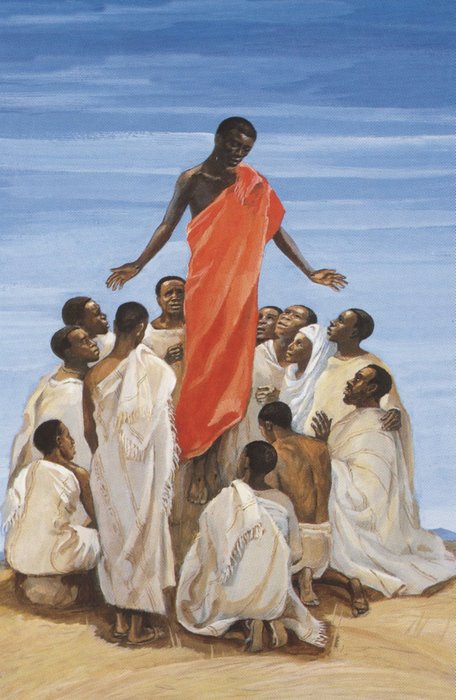
                Luke invites us to imagine gathering with Jesus after forty days of post-Easter appearances for final instructions prior to Jesus’ physical departure from the disciples, which opens a new phase of Luke’s Gospel story. Chapter one of the Book of Acts marks a point of transition from Jesus’ earthly ministry to the Spirit-empowered mission of the church. The message for this moment in time is to “wait.” Now is the time for the Spirit of to come down upon the believers, so that they might bear witness to the Gospel, from Jerusalem to the ends of the earth. While it was good to be with Jesus in the flesh, it is time to leave the womb and enter the world, bearing the message of salvation.

Boundary-Breaking Spirit – Lectionary Reflection for Easter 6B (Acts 10)

Acts 10:44-48  New Revised Standard Version (NRSV)

44 While Peter was still speaking, the Holy Spirit fell upon all who heard the word. 45 The circumcised believers who had come with Peter were astounded that the gift of the Holy Spirit had been poured out even on the Gentiles, 46 for they heard them speaking in tongues and extolling God. Then Peter said, 47 “Can anyone withhold the water for baptizing these people who have received the Holy Spirit just as we have?” 48 So he ordered them to be baptized in the name of Jesus Christ. Then they invited him to stay for several days.

***********

                The full story of Peter’s encounter with Cornelius, and his household, unfolds over two chapters of the book of Acts. We have been given just a snippet of that story by the Revised Common Lectionary, but this snippet is powerful. It is a reminder that the one who pours out the Spirit on the church is the initiator of mission, not us. It is also a reminder that the Spirit of God is in the business of breaking through barriers and boundaries, whether religious, cultural, or social. Standing in the center of the story that lies before us is the Spirit of God, who fills a Gentile household, giving to each of them something that had been given to Peter and his community on the day of Pentecost. That would be the gifting of tongues, which in this case becomes a sign of inclusion. Where there was once a barrier separating Jew and Gentile, the Spirit broke through and set the stage for what was to come.

Continue reading “Boundary-Breaking Spirit – Lectionary Reflection for Easter 6B (Acts 10)”

Water! Baptism! Time to Rejoice! — Lectionary Reflection for Easter 5B

Water! Baptism! Time to Rejoice! — Lectionary Reflection for Easter 5B

Acts 8:26-40 New Revised Standard Version (NRSV)

26 Then an angel of the Lord said to Philip, “Get up and go toward the south to the road that goes down from Jerusalem to Gaza.” (This is a wilderness road.) 27 So he got up and went. Now there was an Ethiopian eunuch, a court official of the Candace, queen of the Ethiopians, in charge of her entire treasury. He had come to Jerusalem to worship 28 and was returning home; seated in his chariot, he was reading the prophet Isaiah. 29 Then the Spirit said to Philip, “Go over to this chariot and join it.” 30 So Philip ran up to it and heard him reading the prophet Isaiah. He asked, “Do you understand what you are reading?” 31 He replied, “How can I, unless someone guides me?” And he invited Philip to get in and sit beside him. 32 Now the passage of the scripture that he was reading was this:

“Like a sheep he was led to the slaughter,
and like a lamb silent before its shearer,
so he does not open his mouth.
33 In his humiliation justice was denied him.
Who can describe his generation?
For his life is taken away from the earth.”

34 The eunuch asked Philip, “About whom, may I ask you, does the prophet say this, about himself or about someone else?” 35 Then Philip began to speak, and starting with this scripture, he proclaimed to him the good news about Jesus. 36 As they were going along the road, they came to some water; and the eunuch said, “Look, here is water! What is to prevent me from being baptized?” 38 He commanded the chariot to stop, and both of them, Philip and the eunuch, went down into the water, and Philip baptized him. 39 When they came up out of the water, the Spirit of the Lord snatched Philip away; the eunuch saw him no more, and went on his way rejoicing. 40 But Philip found himself at Azotus, and as he was passing through the region, he proclaimed the good news to all the towns until he came to Caesarea.

***************

Here lies one of the most unique passages in scripture. It involves two primary characters—Philip, one of the Seven called by the church to serve tables (Acts 6) and the Ethiopian Eunuch, who is traveling home from Jerusalem by way of the road leading from Jerusalem to Gaza (most likely to pick up a ship that would transport him toward home). There is also an angel of God, who sets up a meeting between these two men. Standing behind this encounter is the church’s mission statement found in Acts 1:8. In that verse Jesus tells his followers that when the Spirit comes, they will bear witness to him beginning in Jerusalem, and from there to Judea and Samaria, and then to the ends of the earth. Philip has already participated in that expansion by preaching in Samaria, in what was the first outreach of the early church beyond the original core Jewish audience. Now, with this encounter, it appears that the expansion continues, with Ethiopia being opened up to the message of the gospel. But not only that, but there is a word of inclusion of one who had been excluded or at least marginalized.

It would appear that Philip was still in Samaria when the angel appeared to him and directed him to go down to the road leading from Jerusalem to Gaza. The angel doesn’t tell him what to do or who he would meet. The word is simply go down to the road, and he follows the lead of the angel. Low and behold, when he arrives at the road he hears a man reading the scriptures while riding in a chariot. As for the man in the chariot, we quickly learn that he is Ethiopian, a royal official (apparently, he is the head of the department of the treasury), and he is a eunuch. This latter fact is central to understanding the story. He serves the Queen, the Candace, and being a eunuch, he is trustworthy (see the book of Esther for the role of eunuchs in a royal administration). While he is a trusted official, he is also excluded from the worship of Israel. We’re told that he was returning from Jerusalem, where he had gone to worship, but that would have been difficult since, according to Leviticus he would have been excluded from the Temple (Lev. 21:20).

While he might not have been welcomed into the circle of worshipers, he was a student of scripture. We’re not told if he was of Jewish background, a convert, or a God-fearer. Whatever his religious location, in this moment in time he is reading from Isaiah. The passage has messianic implications. In fact, when Philip flags him down and gets in the chariot, the Ethiopian asks Philip about the identity of the one spoken of in the prophecy—is it the prophet or another? That gives Philip the opening he needs to share the gospel. What all he says is not written down. What is noted is that the Ethiopian responded positively to the explanation and went on to ask whether he could be baptized. After all, there was a pool of water by the side of the road. What prevents him from being baptized? Philip, who had already baptized Samaritans, without authorization, can’t see why he should withhold the water in this case. So, they get out of the chariot, go down to the pool, and Philip baptizes him. As soon as the man comes out of the water, the Spirit snatches Philip away, delivering him to another area needing evangelizing.

The reading opens up a number of questions, including the question of who authorizes baptism. It’s not in Philip’s job description, which involves table service. But Philip has a bigger sense of call, and his ministry is affirmed by the Spirit. How do you say no to the Spirit of God? Then there is the status of the Eunuch. We know something about the barriers to his inclusion, but that doesn’t appear to be a problem here. Philip doesn’t seem to care. He just shares the good news, and when the request for baptism comes, he goes for it. There is here an immediacy to the sacramental act that many of us might be uncomfortable with. It’s true that over time, the churches moved from immediate baptism to prolonged instruction prior to baptism. I don’t know if either is the correct method, but at least in the New Testament baptism accompanies profession of faith rather quickly.

Perhaps the message here concerns the work of the Holy Spirit, who in Acts seems intent on pushing boundaries. It’s not that there are no rules or rites of inclusion, but they are not as narrowly drawn. Better yet, they are expansive. They force a person to fit a particular set of cultural expectations, even as one experiences a change in identity. That is, the man remains an Ethiopian and a eunuch, but through his baptism into Christ, he becomes a new creation. That which had once defined him spiritually no longer does.

We as church are often content to remain within our circles of comfort. We tend to sit in the same pew; sit with the same people at coffee hour; talk with the same people after church. We don’t mean to snub the new-comer, we’re just comfortable with our context. The Spirit of God, however, has an uncanny ability to upset our comfort zones. With the case of this encounter, Willie James Jennings notes that this is a “story of divine compulsion.” In other words, Philip doesn’t initiate the encounter, God does. Jennings writes further: “The Spirit is driving a disciple where the disciple would not have ordinarily gone and creating a meting that without divine desire would not have happened. This holy intentionality sets the stage for a new possibility of interaction and relationship” [Acts: Belief, p. 87]. In Jennings reading of Acts, he reminds us that in the history of the church, too often we have combined the invitation to discipleship with a vision of “civilization” that has nothing to do with the Gospel. So, here in this story, we have an invitation to celebrate our differences, knowing that realm of God is a diverse realm, and through the Spirit’s work, we are brought into relationship with each other.

As we hear this story of a divinely set up encounter between a follower of Jesus and seeker of God, we are invited, in my reading, to enter the lives of others, people who are different. We enter their lives, sharing the good news of Jesus, but without expecting them to become “just like me.” But, together, in our differences and diversity, we move toward the realm of God, each being transformed by the Spirit (not by any cultural visions). In the case of the Ethiopian Eunuch, the differences include ethnicity and sexual identity. These are not changed by the encounter, but the heart of this man is drawn toward Jesus, into whose life he is baptized. From there he rejoices in his encounter with Jesus.

Without any further ado, Philip is caught up by the Spirit and deposited at Azotus, where he begins preaching again as he journeys toward Caesarea. As for the Ethiopian, nothing more is said. One can assume that he returned to Ethiopia, where like so many others in Luke-Acts, he shared the good news. While Christianity was officially established in the fourth century CE, could a see have been planted much earlier, all because of a Spirit led encounter?

10646937_10204043191333252_4540780665023444969_nRobert Cornwall is the Pastor of Central Woodward Christian Church in Troy, Michigan. He holds the Ph.D. in Historical Theology from Fuller Theological Seminary. He is the author of a number of books including Out of the Office (Energion, 2017), Marriage in Interesting Times (Energion, 2016), and Freedom in Covenant (Wipf and Stock, 2015) and blogs at Ponderings on a Faith Journey.

A Word About Salvation – A Lectionary Reflection for Easter 4B

A Word About Salvation – A Lectionary Reflection for Easter 4B

Acts 4:5-12 New Revised Standard Version (NRSV)

5 The next day their rulers, elders, and scribes assembled in Jerusalem, 6 with Annas the high priest, Caiaphas, John, and Alexander, and all who were of the high-priestly family. 7 When they had made the prisoners stand in their midst, they inquired, “By what power or by what name did you do this?” 8 Then Peter, filled with the Holy Spirit, said to them, “Rulers of the people and elders, 9 if we are questioned today because of a good deed done to someone who was sick and are asked how this man has been healed, 10 let it be known to all of you, and to all the people of Israel, that this man is standing before you in good health by the name of Jesus Christ of Nazareth, whom you crucified, whom God raised from the dead. 11 This Jesus is

‘the stone that was rejected by you, the builders;

it has become the cornerstone.’

12 There is salvation in no one else, for there is no other name under heaven given among mortals by which we must be saved.”

**************

A healing leads to preaching, and preaching leads to arrest, which leads to a trial, and a trial gives an opportunity for preaching. At least that’s the way things seem to work for Peter and John here in chapters three and four of the Book of Acts. Peter had been preaching to a large crowd in Solomon’s Portico, after healing the man who was disabled at the gate to the Temple. In other words, an act of power opens an opportunity to explain the source of power, which of course leads to the message of the cross and the resurrection. While you might think that it would be the cross that stirs the pot here, it is really the message of the resurrection. It appears from the opening verses of chapter four that it was the message of resurrection of the dead that got the attention of the religious leaders, who order them arrested. That is the background story for Peter’s next sermon, this time delivered in front of the religious leaders who have gathered to pronounce judgment on Peter and John.

Unfortunately for the leaders, Peter takes advantage of this appearance to speak once again about the resurrection. Peter begins his defense with an acknowledgment that it seems they had been arrested for doing something good, that is, bringing healing to a man who had suffered for years. The question was—how did they do this? The answer is simple—they acted in the power of the one whom the religious leaders had crucified, but whom God vindicated by raising him from the dead. If you want to know how this happened, well that’s the answer—Jesus! Yes, this Jesus whom God has raised is the source of healing, which means they have been arrested for doing a good deed in the power of the risen one!

This is all boiler-plate apostolic preaching. We hear this message time and again, whether on the lips of Peter or Paul. Central to the message is that of the resurrection, which divides Sadducees and Pharisees. While the two parties aren’t named in this selection, according to Luke, the arresting party included priests and Sadducees. In this scene the Pharisees are absent, so Peter can’t divide and conquer like Paul will do in a later scene. Since the opposition in this scene are Sadducees, for whom the resurrection doesn’t fit into their theology, you can understand their consternation at hearing Peter preach about the resurrection in their presence. For Peter and the early church, as was true of the Pharisees, the resurrection was the key to their theology. It was the revelation of God’s power present in Jesus. Since this is the Easter season, this passage offers the preacher and the church an opportunity to again reflect upon and celebrate the Resurrection.

Where this passage becomes controversial in modern contexts, is the wording of verse 12. This verse is often used as a proof text to defend the premise that one cannot be saved without confessing faith in Jesus, for “there is no other name under heaven given among mortals by which we must be saved.” In other words, it is a foundational text for an exclusivist vision of salvation. A question that might be asked of Peter concerns what he means by salvation and how Jesus is the name by which one is saved. Is Peter setting up a point of division? Is this a red line, at which Peter is asking his accusers (and anyone else) to dare to cross? That is, one’s eternal destiny hangs on how one responds to the message of Jesus. That is how it has often been read, but is this how Peter means it to be heard? Is it how Jesus would have us hear it? Or, could we read it in a more inclusive way?

We might want to start by remembering Peter’s audience, which is comprised of fellow Jews. It’s important that we remember that Peter was a Jew before he met Jesus, and that he remained a Jew after he met Jesus, and he remained a Jew even as he stands before the Sanhedrin, accusing them of their complicity in the death of the one by whom he has engaged in healing ministry. So, once again this is an intra-family debate, with Peter inviting the religious leaders to affirm God’s work in and through Jesus. Yes, they had participated in his death, but God overturned that deed in the resurrection. Of course, the court here is composed of a group of leaders who deny the resurrection of the dead, and so they would be reticent to accept Peter’s message of vindication. In their minds, Jesus is dead and remains dead, and therefore is unavailable to empower Peter and John. Nonetheless, this is Peter’s testimony, and apparently some 5000 people had stepped forward to follow Jesus through his ministry. In other words, Peter and his partner John were stirring the religious pot, undermining the authority of the religious leaders, who were charged with keeping order by the Roman occupiers. Nonetheless, Peter remains firm: “the stone that was rejected by you, the builders; it has become the cornerstone.” There is salvation in no other name.

When we hear the word salvation (Greek: soteria), it is good to remember that this word has a variety of nuances and meanings. Context is important if we’re going to understand its meaning. When it comes to Acts 4:12, almost all translations offer up “salvation.” However, we could translate this word as healing, which makes sense in this context. After all, they are under arrest, at least in their own minds, for healing someone in the name of Jesus. There are other ways of rendering the word, including rescue and spiritual wholeness. In other words, Peter might have something in mind other than getting to heaven. In fact, there is nothing in this passage that hints at salvation being the means of gaining heaven. So, he might be speaking in very terrestrial terms.

I find wisdom in the reading of the passage by Fred Craddock and Eugene Boring, who point out that “Luke is not here addressing the theoretical issue of the eternal destiny of people in distant centuries and countries who have not heard the Christian message.” In context, he is expressing his belief that the God of Israel has acted in Jesus, who was crucified, but was raised by God, and it is in Jesus that the power of God is being revealed in the healing of this man who had been disabled, but who is now running around proclaiming his healing. Craddock and Boring also remind us that Luke’s theology of salvation is not reflected either in the view that “the Christian way is only one of ‘many roads to God,’” nor are we being “encouraged to believe that only confessing Christians are finally accepted by God.” As we ponder this passage, we would be wise to heed our commentators and affirm that “on the basis of this text, Christians ought to say neither than only Christians shall ultimately be saved nor that people can be saved through a variety of saviors. Christians should confess their faith that the God revealed in Christ is the only Savior, without claiming that only those who respond in faith will be saved” [The People’s New Testament Commentary, (WJK Press, 2009), p. 378].

As we continue the Easter journey, may we ponder together the power of Jesus name, by which God brings healing and salvation. For Peter, the risen Jesus was the only means by which the God of Israel acted to bring healing, wholeness, and salvation. In him God’s power was let loose.Peter invites us to embrace the Risen One, as we walk in God’s wholeness.

10646937_10204043191333252_4540780665023444969_nRobert Cornwall is the Pastor of Central Woodward Christian Church in Troy, Michigan. He holds the Ph.D. in Historical Theology from Fuller Theological Seminary. He is the author of a number of books including Out of the Office (Energion, 2017), Marriage in Interesting Times (Energion, 2016), and Freedom in Covenant (Wipf and Stock, 2015) and blogs at Ponderings on a Faith Journey.


Turn Back to God – A Lectionary Reflection for Easter 3B

comesundayfbActs 3:12-19 Common English Bible (CEB)

12 Seeing this, Peter addressed the people: “You Israelites, why are you amazed at this? Why are you staring at us as if we made him walk by our own power or piety? 13 The God of Abraham, Isaac, and Jacob—the God of our ancestors—has glorified his servant Jesus. This is the one you handed over and denied in Pilate’s presence, even though he had already decided to release him. 14 You rejected the holy and righteous one, and asked that a murderer be released to you instead. 15 You killed the author of life, the very one whom God raised from the dead. We are witnesses of this. 16 His name itself has made this man strong. That is, because of faith in Jesus’ name, God has strengthened this man whom you see and know. The faith that comes through Jesus gave him complete health right before your eyes.

17 “Brothers and sisters, I know you acted in ignorance. So did your rulers. 18 But this is how God fulfilled what he foretold through all the prophets: that his Christ would suffer. 19 Change your hearts and lives! Turn back to God so that your sins may be wiped away.
***********

Note: During the season of Easter the First Reading from the Revised Common Lectionary is drawn not from the Hebrew Bible, but from the Book of Acts.

John the Baptist and Jesus had a common message: Repent. Turn back to God. Stop your rebellion. In the post-resurrection age, Peter picked right up with their message. He proclaimed to any who would listen: turn from your sins and embrace the realm of God. For Peter this messaging included reminding his audience that the religious and political leaders conspired to kill Jesus, the author of life. So, “turn back to God so that your sins may be wiped away.” Preaching a message of repentance so soon after Easter Sunday is probably a bit radio-active. After all, shouldn’t we be celebrating the coming of spring. For those of us who live in colder winter climates, spring is something is to be celebrated. So, why talk about sin and repentance? Perhaps, in Peter’s mind (and Luke’s), repentance and resurrection are related. After all, it was the conspiracy to have Jesus executed, because of his message of repentance, that led to his death and then resurrection.

The lectionary reading begins with Peter’s message to the people, but who are these people Peter is addressing, and why is he speaking? Acts 3 begins with a beggar sitting at the gate to the Temple. Luke tells us that he is crippled, and that he depends on alms shared by those who go to the Temple to worship. It’s a good plan. Surely worshipers will be generous. Among those worshipers are Peter and John, who apparently go up to the Temple in Jerusalem to worship three times a day. If they have been through this gate with any frequency, and I’m assuming they had, they would have run into this man. They know his message. Maybe they have thrown a few coins his way. In any case, as they walk by on their way to worship, the man calls out to them, asking for alms. The two apostles stop and face the man. He wants money, but they decide to give something else. There is a song, that I sang years ago in Bible study and at camps. It tells the story of this encounter:

Silver and gold have I none, but such as I have give I thee,
In the name of Jesus Christ of Nazareth, rise up and walk.
He went walking and leaping and praising God,
Walking and leaping and praising God,
In the name of Jesus Christ of Nazareth, rise up and walk.

When the people see the man walking and leaping, they want to know what happened. How can this man, who sat begging alms, perhaps for years, now be jumping around and praising God?

This eruption of praise and the attending questions, gave Peter his opening. It is now sermon time. A crowd gathers, eager to hear from these workers of miracles, who once walked with Jesus. Now, remember, Luke only gives summaries of sermons, not the full text. But the text as given starts with a rebuke. He’s asking them why they needed to ask the question. Didn’t they realize that the power of healing was with Jesus, whom, according to the apostles, they conspired to kill by delivering Jesus to Pilate. Peter gives a witness to Jesus. You conspired with Pilate, but God raised him instead.

Once again, we must be careful how we read a passage like this. It can and has been used as fuel for anti-Jewish and anti-Semitic exclusion and violence. Even today, there are those who accuse Jews of being Christ-killers. Let us remember that Peter and John and Jesus and John the Baptist, were all Jews. The religious leadership, who derived power from Rome, as was so of the case, turned Jesus over (at least that’s how Luke tells the story). Most likely they did this, because Rome didn’t like people challenging its authority. You could believe whatever you wished, but just don’t challenge Rome’s authority. So, let us be careful how we read this passage. In this particular case, we have before us an in-house conversation. Peter is addressing his own community and reminding them of what has happened in the past. Jesus, like earlier prophets of God was struck down by the powers that be, but God turned the tables and his raised him from the dead. So, turn back. Choose a different path.

When we read a passage like this from the lectionary, we’re not only asking what it meant back then. We’re asking, what does it mean for us today? So, the message is this: “Turn back to God.” Repent of your sins, and God will forgive, wiping away your sins. Perhaps the way to read this today is ask the question of our own complicity in deeds of destruction. How have we rejected God’s messengers?

The healing of the man that brought Peter and John to the attention of the people is a sign that life reigns victorious. Willie James Jennings writes:

The man healed is now a sign of the man resurrected from the dead, the author of life itself. Now the actions of the One confront the wayward propensities of the many. If peoples are often seduced by the power of violence and take up the weapons of death, here is Jesus the Messiah who has overcome the effects of violence and the pull of death. If peoples are prone to choose against their own well-being and life, here is the Messiah who heals, restores, and gives life. [Jennings, Acts, Belief: A Theological Commentary on the Bible, (WJK Press, 2017), p. 43].

Peter and John stand before their neighbors, who like them have come to worship the God of Israel. The apostles proclaim the message that the Messiah of God, the one who was rejected, has been accepted by God, and brings life, even in the midst of death. So, will you join with God, and turn away from the path of destruction? Will you join the movement for the common good of all?

Robert Cornwall is the Pastor of Central Woodward Christian Church in Troy, Michigan. He holds the Ph.D. in Historical Theology from Fuller Theological Seminary. He is the author of a number of books including Out of the Office (Energion, 2017), Marriage in Interesting Times (Energion, 2016), and Freedom in Covenant (Wipf and Stock, 2015) and blogs at Ponderings on a Faith Journey.

Christian Community in the Shadow of the Resurrection

comesundayfb

Acts 4:32-37 New Revised Standard Version (NRSV)
32 Now the whole group of those who believed were of one heart and soul, and no one claimed private ownership of any possessions, but everything they owned was held in common. 33 With great power the apostles gave their testimony to the resurrection of the Lord Jesus, and great grace was upon them all. 34 There was not a needy person among them, for as many as owned lands or houses sold them and brought the proceeds of what was sold. 35 They laid it at the apostles’ feet, and it was distributed to each as any had need. 36 There was a Levite, a native of Cyprus, Joseph, to whom the apostles gave the name Barnabas (which means “son of encouragement”). 37 He sold a field that belonged to him, then brought the money, and laid it at the apostles’ feet.

******************

During the Easter season, the first reading in the Revised Common Lectionary comes from the Book of Acts (as opposed to the Hebrew Bible). As we move through this season of post resurrection visitations on the part of Jesus, we hear words about life in the early church. On this Sunday we hear a word about a community that has chosen to live the common life. When I was teaching a college class on the book of Acts years ago, I liked to tell the students, who were from a conservative Christian background, that this was evidence that the early Christians were communists—long before Karl Marx came around. I’m not sure they appreciated my making note of this, after all communism is a dirty word in some circles. but it was a good conversation starter.

Throughout the history of the church, there have been attempts to approximate this model of Christian life, but it never became the dominant form of Christian community. We don’t even know how long this form of community existed in Jerusalem. But, even if it did not last more than a year or two, what might we take from the message that they were all “of one heart and soul?” At one level there appears to have been a concern for the welfare of the entire Christian community. They shared equally of their resources so that no one was in need. Gustavo Gutierrez, who is one of the founders of Latin American Liberation Theology, writes in his seminal text that this act on the part of the Jerusalem church “was not a question of erecting poverty as an ideal, but rather seeing to it that there were no poor…. The meaning of the community of goods is clear: to eliminate poverty because of love of the poor person” [A Theology of Liberation, (Orbis)1973), p. 301].

We’re told that the members of the community sold their property and brought the proceeds, laying them at the feet of the Apostles, who then distributed the goods among the people. One member in the community stood out as an exemplar, and that was Barnabas. Barnabas is an intriguing figure in the history of the church. We are told that he came from Cyprus and that he was by descent a Levite. Thus, he was of the priestly caste. He seems to have been a person of some means, as he is held out as an example of one who sold all so that the community might thrive (as opposed to Ananias and Sapphira in Acts 5). Barnabas will go on to become a leader in the church at Antioch, and a partner in ministry with Paul on Paul’s missionary journey. Luke likely mentions Barnabas and his example because he was known to the readers, at least by name and story.

One of the messages of this passage is that standing at the heart of the Gospel is compassion for the other. One of the attractions to the early Christian church was the welcome given to people on all socio-economic levels. It wasn’t always easy, as we discover when reading 1 Corinthians. Despite the challenges, the Christian community was one of the most economically diverse religious communities of its day. That commitment, which was always difficult to put into practice, helped spread the faith throughout the Roman Empire.

The reading for the second Sunday of Easter has a stewardship element to it, connecting as it does money to discipleship. Willie James Jennings, in his theological commentary on the Book of Acts, writes that “money matters are inescapable. They are at the heart of discipleship, but they are not the heart of discipleship.” Our relationship to money says a lot about us. There is no joy to be found in poverty, despite St. Francis of Assisi’s claims. At the same time, money doesn’t necessarily make a person happy (there a lot of unhappy rich people). People who give, however, tend to be happier people. So, there does seem to be a benefit of giving, even if we don’t sell everything and give it to the church (that’s not a stewardship message that will go over well). Back to the insight into this matter from Willie James Jennings:

“Money here will be used to destroy what money normally is used to create: distance and boundaries between people. Distance and boundary is not merely between the haves and have-nots, but also between the needy and the comfortable, and between those who testify to Jesus and those who, like Jesus, help those with little or nothing” [Jennings, Acts: Belief, (WJK Press, 2018), p. 50].

Ultimately, this is not only the story of giving, but as Jennings points out, it is about the joining together that comes because of these acts.

The message of community expressed here was not new, at least not to the Jewish community. The principles of sabbath and jubilee were strongly implanted within Judaism, even if these principles might not have been fully embraced or developed. The principle of Jubilee, with its plan of redistributing land back to the original owners after fifty years, was designed to prevent monopolies of land or money. Thus, this is part of an overarching theme of justice that marks the biblical story.

As we attend to this passage today, in an age of increasing gaps between rich and poor, between management and worker, what message do we hear? How is Jesus speaking to the church on matters of income inequality? We need not go as far as this community, but what is it that we hear in this reading? To put it differently, what does it mean to be a disciple of Jesus? For American Christians, who tend to grow up with an individualistic world view, what do we hear in this passage? Even if the model espoused here is not perfectly adaptable to our community, and may have been quickly abandoned, what does it mean for us to be “of one heart and soul?” How might we better exhibit God’s compassion for the poor in our own lives. It’s possible that some reading this are struggling financially, while others are blessed. How might this speak to both situations?

These are all important questions that for us are being raised in the shadow of Easter. So, the further question concerns the connection of resurrection to community, and how it is lived out in a world that often devalues human life. As Gutierrez prophetically writes:

“The ‘poor’ person today is the oppressed one, the one marginated from society, the member of the proletariat struggling for his most basic rights; he is the exploited and plundered social class, the country struggling for its liberation” [A Theology of Liberation, p. 301].

What then is the message of resurrection in this context?

10646937_10204043191333252_4540780665023444969_nRobert Cornwall is the Pastor of Central Woodward Christian Church in Troy, Michigan. He holds the Ph.D. in Historical Theology from Fuller Theological Seminary. He is the author of a number of books including Out of the Office (Energion, 2017), Marriage in Interesting Times (Energion, 2016), and Freedom in Covenant (Wipf and Stock, 2015) and blogs at Ponderings on a Faith Journey.

Death Has Been Swallowed Up Forever – Lectionary Reflection for Easter B – Isaiah 25

Isaiah 25:6-9 New Revised Standard Version (NRSV)

On this mountain the Lord of hosts will make for all peoples
    a feast of rich food, a feast of well-aged wines,
    of rich food filled with marrow, of well-aged wines strained clear.
And he will destroy on this mountain
    the shroud that is cast over all peoples,
    the sheet that is spread over all nations;
    he will swallow up death forever.
Then the Lord God will wipe away the tears from all faces,
    and the disgrace of his people he will take away from all the earth,
    for the Lord has spoken.
It will be said on that day,
    Lo, this is our God; we have waited for him, so that he might save us.
    This is the Lord for whom we have waited;
    let us be glad and rejoice in his salvation.

*********************

                Easter celebrates the victory of life over death. We gather on Easter morning to declare in song and prayer: “Christ the Lord is Risen today.” We joyfully sing: “The strife is o’er, the battle done, the victory of life is won, the song of triumph has begun. Alleluia!” Easter is a glorious moment in the Christian year, for it celebrates resurrection—God’s victory over death. As Paul reminds us, our resurrection is rooted in the resurrection of Jesus. (1 Corinthians15:20)
                The Gospel reading for this cycle of texts comes from either Mark 16 or John 20. Mark 16 gives us a rather abbreviated version of the Easter story. It may leave us wanting more, which is why many will turn instead to John 20, which invites us to encounter the risen Jesus through the witness of Mary Magdalene.

Continue reading “Death Has Been Swallowed Up Forever – Lectionary Reflection for Easter B – Isaiah 25”

God the Vindicator — Reflection for Passion Sunday (Isaiah 50)

comesundayfb

Isaiah 50:4-9 New Revised Standard Version (NRSV)
4 The Lord God has given me
the tongue of a teacher,
that I may know how to sustain
the weary with a word.
Morning by morning he wakens—
wakens my ear
to listen as those who are taught.
5 The Lord God has opened my ear,
and I was not rebellious,
I did not turn backward.
6 I gave my back to those who struck me,
and my cheeks to those who pulled out the beard;
I did not hide my face
from insult and spitting.
7 The Lord God helps me;
therefore I have not been disgraced;
therefore I have set my face like flint,
and I know that I shall not be put to shame;
8 he who vindicates me is near.
Who will contend with me?
Let us stand up together.
Who are my adversaries?
Let them confront me.
9a It is the Lord God who helps me;
who will declare me guilty?
*****************
We have reached the penultimate moment in the Lenten journey. Christians, at least in the West, will be observing Palm Sunday, or perhaps Passion Sunday. I have always approached Palm Sunday with a bit of unease. After all, the triumphal nature of the day is fleeting. So, perhaps focusing on the Passion is more appropriate, even if we might regather on Friday to hear again the passion story. The reading from Isaiah 50, which forms the third Servant Song, has been read by Christians, along with the other Servant Songs, down the centuries as descriptions of the suffering Jesus experienced as he went to the cross. While the fourth Servant Song is the most revelatory when it comes to the Servant’s suffering (Isa. 52:13-53:12), this Song offers insight into his experience as one who was struck and bruised, but vindicated. In this reading for Passion Sunday, we hear this promise of vindication, making clear that the attacks on the servant are not the last word.
The prophet declares that God has given him the “tongue of a teacher.” That is his calling, but he is also a teacher who listens to the one who wakens him. The one who speaks is a teachable teacher, and this is important because the audience is not always receptive to the message. Therefore, the prophet tells us: “I did not turn backward. I gave my back to those who struck me, and my cheeks to those who pulled out the beard; I did not hide my face from insult and spitting” (vs. 5b-6). You can understand why the church has applied this passage, and other similar texts from Isaiah’s servant songs to Jesus. He was a teacher whose message was not well received by everyone. His opponents struck him, pulled at his beard, and faced insult and spitting.”
As we hear this message to the church in preparation for Holy Week, we should go behind the text to the original audience. That audience was likely the Judean exiles. Sometimes Judah itself is the Suffering Servant. In this case, it could be the prophet. The question is, should we focus on the suffering or the vindication? Christopher Seitz notes, following Claus Westermann, that this poem, and it is a poem/song, should not be read as a lament, but rather as a “psalm of confidence.” There is no complaint offered. Suffering is acknowledged, but it leads to a statement of confidence in the God who vindicates [“Isaiah 40-66,” New Interpreter’s Bible, (Abingdon Press), 6:436].
The prophet declares with confidence in verse 7: “The Lord God helps me; therefore, I have not been disgraced; therefore, I have set my face like flint, and I know that I shall not be put to shame.” The prophet, who has been called to teach the people, and has listened to the voice of God, has faced challenges, but because God is the helper, the prophet will not be disgraced or put to shame. Rather than be disgraced or shamed, the prophet is vindicated by God.
When read within the context of Passion Sunday, the reading from Isaiah is a reminder that despite the suffering that Jesus experienced, God vindicated him through the resurrection. For Israel, despite the suffering it had experienced in the Exile, it would be reconstituted. Israel would be resurrected. Taken together, Israel/Jesus are vindicated by God. Teresa Lockhart Stricklen notes that the while the Servant Community looks weak and defeated, “the power of the unseen God is at work to reconstitute that community and thereby reveal the power and purposes of the God of Israel.” Christians look to “Jesus on the cross, like Israel in exile, appeared to be weak and defeated, but God raised Jesus from the dead, thus again affirming God’s power and life-giving purposes” [Preaching God’s Transforming Justice, (WJK Press), p. 185]. The resurrection, like the reconstitution of Israel is God’s vindication. So, who can contend with those whom God vindicates and helps? If God helps, then who can declare Israel/the Prophet/Jesus guilty?
We can take this passage a step further. Rather than focus on the question of the identity of the Suffering Servant, we can ask the question of what it means for us to be servants of God, even in the face of resistance and persecution. How might we be the teachers who are awakened by God, so that we might share the God News, knowing that God helps and vindicates? Jon Berquist points us in that direction. He notes that when reading this in our Lenten context, we hear a word concerning our own calling.
Lent has emphasized confession, repentance, humility, submission to God’s will, and the desire to recommit one’s self to the work of God in the world. With these concerns framing our approach to the text, we understand Isaiah’s call to be servants and teachers, to sustain others while realizing that we are still learners ourselves, to live out our own vulnerabilities, to recognize that only God will save us from the persecutions and rejections of the world that will inevitably result from our commitment to God’s purposes, and to know that God’s salvation will come only through our persistence in the work of serving and teaching in the face mounting opposition. [Feasting on the Word, (WJK Press), p. 163].
Jesus faced his own tormenters, putting his face forward like flint. Israel did the same. Shall we follow their lead? The good news here is that we can go forth into Holy Week with confidence, knowing that God is our help. God is our vindicator. No one can stand against God, so let us stand together and move forward with boldness on the path set before us by Jesus.