Month: February 2019

Reflecting God’s Glory — Lectionary Reflection for Transfiguration Sunday (Exodus 34)

Exodus 34:29-35 New Revised Standard Version (NRSV)
29 Moses came down from Mount Sinai. As he came down from the mountain with the two tablets of the covenant in his hand, Moses did not know that the skin of his face shone because he had been talking with God. 30 When Aaron and all the Israelites saw Moses, the skin of his face was shining, and they were afraid to come near him. 31 But Moses called to them; and Aaron and all the leaders of the congregation returned to him, and Moses spoke with them. 32 Afterward all the Israelites came near, and he gave them in commandment all that the Lord had spoken with him on Mount Sinai. 33 When Moses had finished speaking with them, he put a veil on his face; 34 but whenever Moses went in before the Lord to speak with him, he would take the veil off, until he came out; and when he came out, and told the Israelites what he had been commanded, 35 the Israelites would see the face of Moses, that the skin of his face was shining; and Moses would put the veil on his face again, until he went in to speak with him.
**********************
                It is Transfiguration Sunday, which is a day that calls us to reflect on Jesus’ ascent to the top of the mountain, taking with him Peter, James, and John. When the group arrives on the mountain top, Jesus meets with Moses and Elijah, whom many assume represent the Law and the Prophets. As the conversation continues, Jesus begins to glow, the divine radiance shining forth. As they watch this scene unfold, Jesus’ companions are overwhelmed by what they see. You might say that they are in awe of what they see. Not knowing what else to do, they ask Jesus for permission to erect tents for the three figures. As they ask this question, Moses and Elijah disappear from the scene, leaving Jesus alone with his disciples. At that moment a voice from the heavens rings out declaring, much like at his baptism: ““This is my Son, my Chosen; listen to him!” (Lk. 9:28-36).
                The first reading from the Scriptures takes us to Exodus 34. Here again we go to the mountain top, and when we do, we see another divine encounter. In this scene Moses has gone up to the top of Mount Sinai to speak with YHWH. This is the second time he has done this. When we pick up the story, Moses is descending the mountain, carrying with him the two tablets that define the covenant God desires to make with Israel.  This is the second set of tablets, since Moses broke the first set after discovering that Aaron and the people had created a golden calf while he was on the mountain speaking with God (Ex. 32). This is the second opportunity for Israel to make covenant with YHWH, which occurs after Moses intercedes with God (Ex. 33:12-23). Once again Moses spends forty days and forty nights on the mountain, neither eating nor drinking. Communion with God, apparently, was sufficient (Ex.34:27-28). Having been on the mountain for forty days and nights, it’s time for Moses to return to where Israel camped out in Sinai.
When he arrives with the tablets in hand, his face shone with the glory of God, only he did not know this. That is, until he realized that Aaron and Israel were afraid to approach him because his face shone so brightly. In time he was able to convince them to come and hear his words, words given to him by God on the mountain. When he was finished, he put a veil over his face, until his next visit with YHWH. The fact that his face reflected the glory of God’s presence was a sign to the people that God was with them, and that God was guiding them through the auspices of Moses. The moment of transfiguration described in the Gospels, is an unveiling of God’s presence in the person of Jesus. The three disciples were drawn into the divine presence and saw how Jesus radiated with that presence. As for Moses, he reflected the divine presence by his countenance. It was a bit off-putting to the people, who didn’t know what to make of it. Thus, because the radiance of his face was so great, he covered his face with a veil, so as not to overwhelm his fellow Israelites.
The reading from the epistle, which comes from 2 Corinthians, has a bit of a different take on the situation. Paul saw the veil as a means by which Moses hid the fact that the glow was fading with time. He saw this as symbolic of the inability of Israel to discern the identity of Jesus as its Messiah. Only in Christ, Paul believes, is the veil set aside so we can see the glory of God present in Jesus so that we might be transformed (2 Cor. 3:12-18). Paul and Luke have this Mosaic encounter in mind. We have to be careful here not to read this story in a supersessionist mode, so that this becomes a word about God’s rejection of Israel. Instead, may we read this as an invitation to perceive the glory of God present in Jesus, a glory that Moses encountered as well. He experienced that transformation that Paul spoke of, but as a human being, he like us, must continually return to God’s presence lest the glory that is God fade. It’s not a one-time occurrence. For Luke, the presence is found within Jesus, and it is revealed through a momentary unveiling. For us, like Moses, we must continually return to God’s presence so we might increase in our reflecting of God’s glory. As Paul reminds us, we may have veils over our faces, which not only hide the fact that the glory of our encounters with God are fading, but these veils may prevent us from seeing what is true and what is right. So, maybe what was designed to protect is now a hindrance.
                How should we read and respond to this story? In both the Exodus encounter with the Divine and the transfiguration of Jesus, we learn something about the central figure. Moses had been dealing with a rather recalcitrant community, that questioned his authority. Having this sign of his encounter with God reflected in his face reinforced his claim to leadership in the community. As for Jesus, the unveiling, together with the heavenly voice, confirmed in the three disciples that Jesus was one to be listened to, even if they didn’t share the news broadly. But there is also a sense here of wonder or awe at being in the presence of God, even if you must hide in the cleft of the rock (Ex 33:17-23).
                There are many times and places where we can gain a sense of God’s presence. Being in nature can create within us a sense of wonder or awe, and if we’re attentive we will recognize in nature a reflection of God’s creative presence. Although our experiences of worship don’t always create within us a sense of awe at the presence of God, there are times when such occurs. We might even glow with the love and glory of God reflecting off our faces, while we sing something like “Shine Jesus Shine.”

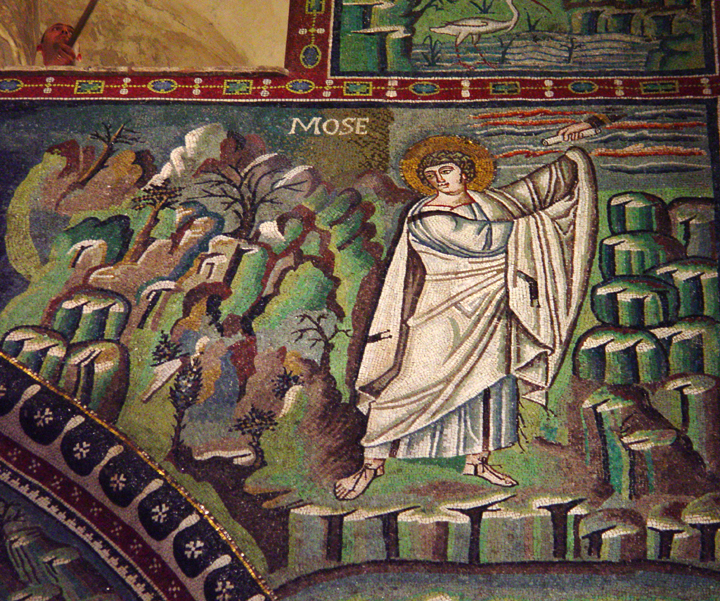
Picture Attribution: St. Vitale – Moses Receiving the Law on Mt. Sinai, from Art in the Christian Tradition, a project of the Vanderbilt Divinity Library, Nashville, TN. http://diglib.library.vanderbilt.edu/act-imagelink.pl?RC=32149 [retrieved February 25, 2019]. Original source: Images donated by Patout Burns, Vanderbilt University.

 

Loaves Abound!: Epiphany 6

Loaves Abound!: Epiphany 6

Narrative Lectionary Reflection

February 24, 2019

Reflection

liene-geidane-76621-unsplash

A modern interpretation of the feeding of the 5000 as a parable about sharing.  That take says that when Jesus uses the bread and fish that the disciples found, others who had brought food, felt safe to bring their it out and share it with others.  The reasons behind seeing this story as one about sharing is that it doesn’t put it all in God’s hands.  We are also called to feed the poor among us. An example of this comes from Episcopal author Barbara Brown Taylor who explains that she has a problem with miracles:

“Miracles,” she writes, “ let us off the hook. They appeal to the part of us that is all too happy to let God feed the crowd, save the world, do it all. But in this story,” she writes, “God tells us, out of God’s own deep pain and sadness for the world, ‘Stop waiting for food to fall from the sky and share what you have. Stop waiting for a miracle and participate in one instead.” 1

On the other hand, theologian Stanley Hauerwas says that we have lost the language to explain miracles.  He writes:

“Those of us who dwell in the time called modernity do not easily recognize miracles because we have lost any sense of the miracle of life. Wendell Berry suggests that we cannot recognize the miracle of life because we use the wrong language to speak of the world and its creatures. We use the analytic language that gives power to experts and fails to designate what is being described. As a result, the world has been reclassified from creature to machine, making us strangers to our own lives.” 2

Which one makes sense?  The focus on sharing seems plausible and reasonable.  But looking at Barbara Brown Taylor’s quote, it seems to tell us that God doesn’t intervene into our lives, but tells us to figure it out ourselves. When God does seem to get involved, it seems like it focuses on morals than it is focused on God. A pastor responds that for him the greater miracle was Jesus getting people to share than it is having Jesus feeding 5000 with the loaves and fish.  The pastor’s belief is that the point of this story is for us to learn to share, to be moral people. Jesus does want the disciples to feed the crowd, but he has to show them how that happens.

If you see this story alone then, you could see this as a moral tale, but this story is linked to how God feeds the Israelites as they traveled in the desert. The people had to rely on God to feed them daily.  It also looks towards the church where bread and wine remind us of Christ’s work on the cross.

Some have a hard time coming to terms with Jesus performing a miracle.  The sharing story just makes more sense than taking a little food and feeding it to 5000 people.  At the end of the day, how we look at the story depends on who is the focus of the story, the disciples or us or God? The answer will lead us down one path or another.

Notes:

  1. http://www.fourthchurch.org/sermons/2014/080314.html
  2.  Hauerwas, S. (2006). Matthew (p. 140). Grand Rapids, MI: Brazos Press.

Dennis Sanders is the Pastor at First Christian Church of St. Paul in Mahtomedi, Minnesota. He’s written for various outlets including Christian Century.

God Provides, Reconciles, and Redeems – Lectionary Reflection for Epiphany 7C (Genesis 45)

bourgeois_joseph_recognized_by_his_brothers

Genesis 45:3-15 New Revised Standard Version (NRSV)
3 Joseph said to his brothers, “I am Joseph. Is my father still alive?” But his brothers could not answer him, so dismayed were they at his presence.

4 Then Joseph said to his brothers, “Come closer to me.” And they came closer. He said, “I am your brother, Joseph, whom you sold into Egypt. 5 And now do not be distressed, or angry with yourselves, because you sold me here; for God sent me before you to preserve life. 6 For the famine has been in the land these two years; and there are five more years in which there will be neither plowing nor harvest. 7 God sent me before you to preserve for you a remnant on earth, and to keep alive for you many survivors. 8 So it was not you who sent me here, but God; he has made me a father to Pharaoh, and lord of all his house and ruler over all the land of Egypt. 9 Hurry and go up to my father and say to him, ‘Thus says your son Joseph, God has made me lord of all Egypt; come down to me, do not delay. 10 You shall settle in the land of Goshen, and you shall be near me, you and your children and your children’s children, as well as your flocks, your herds, and all that you have. 11 I will provide for you there—since there are five more years of famine to come—so that you and your household, and all that you have, will not come to poverty.’ 12 And now your eyes and the eyes of my brother Benjamin see that it is my own mouth that speaks to you. 13 You must tell my father how greatly I am honored in Egypt, and all that you have seen. Hurry and bring my father down here.” 14 Then he fell upon his brother Benjamin’s neck and wept, while Benjamin wept upon his neck. 15 And he kissed all his brothers and wept upon them; and after that his brothers talked with him.

****************

If you grew up learning the stories of the Bible you will have heard the stories of Joseph and his brothers. You would know that Joseph was Jacob’s favorite son, for he was the first-born child of Jacob’s favorite wife (Rachel). You may know that Joseph was a bit arrogant, especially after his father gave him a coat of many colors. In his arrogance he told his brothers that they would bow down to him and serve him. This arrogance on Joseph’s part so angered his older brothers, that they sold him into slavery in Egypt. Once in Egypt he made his mark and rose in stature, but then ended up in prison after Potiphar’s wife tried, unsuccessfully, to seduce him, and subsequently crying attempted rape. Joseph was arrogant, but not a rapist. His ability to interpret dreams got him freed from prison and eventually brought to the attention of Pharaoh, who had a dream he couldn’t understand. Joseph interpreted the dream, telling Pharaoh that a famine was coming, and that Pharaoh should plan for that eventuality. Pharaoh decided that it would be wise to give responsibility for this project to the one who interpreted the dream. Thus, Joseph moved from slavery to prison to chief minister. Not bad for an arrogant brat! Then again, his father was something of a trickster who always seemed to come out on top!

Joseph fulfilled his responsibilities, and provision was made for the time when famine arrived, not only in Egypt but as far away as Canaan, the land of his father and mother. When Jacob heard that there was food to be had in Egypt, he sent his sons to purchase supplies. This they did, not knowing that the one who would provide for them was their long-lost brother. They may not have recognized him, but he recognized them. So he played a trick on them, to test them. He had a silver cup he used for divination (yes Joseph practiced divination) placed in Benjamin’s belongings, and then sent his guards after them. That episode, leads to the reading for the seventh Sunday of Epiphany. It’s rare to make it seven Sundays in Epiphany, but here we are with this encounter between estranged brothers, which serves as another manifestation of God’s presence.

In the chapter prior, Joseph sets up a test (trap) to see, apparently, where the heart of their brothers was? Had they changed over the many years of separation. And, what would they do about their brother Benjamin? Would they ransom him or not? Judah does so. He pleads for his brother’s life. This leads to the moment of revelation.

When Joseph could no longer keep up the act, having been satisfied that his brothers had changed, and wanting to provide for his long-lost father, he identifies himself as their brother. Now, you can just imagine the first thoughts of his older brothers. Here was the brother they first tried to kill, then sold into slavery. They figured he was dead by now. Instead, he had risen to be the second most important person in the land. He could easily have them killed. So, what would he do to them?

Joseph, who desired to be reconciled, quickly let them know they had nothing to fear. They may have meant him harm many years before, but things sometimes have a way of working out for the benefit of all, even when they are entered into with the wrong motives. There is a bit of a theological challenge here. Joseph, in trying to allay their fears, tells them that while they meant him harm, “God sent me before you to preserve life.” This episode raises a question that is worth exploring. Does God cause bad things to happen, so good can come of it? Or, does God work with us to bring good out of bad situations? In other words, did God orchestrate all of this, or did God partner with Joseph to bring a blessing out of a difficult situation? As for me, I affirm the second position.

Tom Oord takes up this episode in his book God Can’t. He suggests that “God took what God didn’t want and squeezed good from it. God brought good from bad, positive from negative, health from hate. God redeemed.” God did this in Joseph’s situation. The brothers may have intended harm for Joseph, but God didn’t. Nevertheless, God did bring good out of bad. [God’ Can’t, p. 115].

Having revealed himself to his brothers and suggesting that God had brought good out of bad, he invited his brothers to bring their father to Egypt so they could settle in Goshen and enjoy the bounty that was God’s provision. They do so. They gather their father and settle in Goshen. And all is good, or so it seems.

It’s interesting that the brothers remain suspicious of Joseph’s motives. Once their father has passed from the scene, they begin to worry. Maybe Joseph hasn’t really forgiven but didn’t want to his father. Now that the father is dead, well Joseph might decide to exact revenge. Joseph, who was good at reading things, realized his brothers were worried, so he reassured them. He told them, “Do not be afraid!” He assured them that “even though you intended to do harm to me, God intended it for good, in order to preserve a numerous people, as he is doing today. So have no fear; I myself will provide for you and your little ones.” (Genesis 50:15-21).

What we see in this final episode of Genesis is a reminder that God is committed to the covenant God made with Abraham and Sarah and their descendants. God will continue to be with them, even when a time will come when there will arise in Egypt a Pharaoh who knew not Joseph. (Exodus 1:8). This new Pharaoh grew frightened of this “foreign presence” in the land. But that’s another story, except that it too is part of the covenant story. God will not forget God’s people. God is always on the lookout for partners, whether Abraham, Jacob, Joseph, or Moses.

As for the relationship of estranged brothers, Joseph’s actions presaged the words of Jesus as recorded in Luke regarding loving one’ enemies:

37 “Do not judge, and you will not be judged. Do not condemn, and you will not be condemned. Forgive, and you will be forgiven. 38 Give, and it will be given to you. A good measure, pressed down, shaken together and running over, will be poured into your lap. For with the measure you use, it will be measured to you.” (Luke 6:37-38 NIV).

And the covenant people kissed, wept, and made up—though it took more than once before everyone was truly convinced! This is a good reminder that forgiveness is not easy. Sure, Jesus tells us not to judge or condemn. Forgive, and we’ll be forgiven. Yet, we know the difficulties involved. Joseph learned some important lessons during his sojourn in Egypt. It took some time for him to come to the point of forgiveness. It took longer for his brothers to believe him. Reconciliation is not easy. But it is possible, when we join with God in the act of redemption. This act of reconciliation that took place here is one small part of a larger story or redemption, which we are invited to share in. Thanks be to God!

Picture Attribution: Bourgeois, Leon Pierre Urbain. Joseph recognized by his brothers, from Art in the Christian Tradition, a project of the Vanderbilt Divinity Library, Nashville, TN. http://diglib.library.vanderbilt.edu/act-imagelink.pl?RC=55355 [retrieved February 17, 2019]. Original source: http://commons.wikimedia.org/wiki/File:Bourgeois_Joseph_recognized_by_his_brothers.jpg.

That’s the Way of the World: Epiphany 5

That’s the Way of the World: Epiphany 5

Narrative Lectionary Reflection

February 17, 2019

Read Matthew 13:24-43 (CEB)

Reflection

wheat-865152_1280

Over the last decade, I’ve planted a garden in front of my house.  Every year I am amazed to see the coneflowers and daylily bloom so brightly to provide a sense of color to the front lawn.  But among the flowers, there are always weeds.

The weeds can make it hard for the flowers I’ve planted to truly bloom. I don’t want my flowers to get choked off by the weeds.  So, I try to pull them up by the roots in a vain hope that the weeds will no longer threaten my flowers.  Every so often, I want to use some kind of weed killer like Roundup to get rid of the weeds.  But then I wonder, in trying to kill the weeds, would I also kill the flowers? 

In the parable of the wheat and tares, the servants are not wrong in wanting to get rid of the weeds. They were worried that the weeds could end up choking the wheat. That’s what things like weeds or invasive species do: they end up wiping out the native crop.  Throughout the Great Lakes Region, there is a fear that the Asian Carp, an invasive species will get into the Great Lakes, throwing the aquatic life of the Lakes into havoc. The Great Lake States are deciding what to do as the pesky fish makes its way closer and closer to the Great Lakes.  The carp, like weeds, can be devastating.

The way of the world is to fight back against the evil we see in our world.  The way of the world is to fight the weeds using whatever is possible. The goal is to rip out the weeds, spray as much weed killer as possible. Stop the carp.  But God seems to want to keep the weeds until the proper time comes. That seems rather counter to how we want God to act. But the ways of God seem to want to keep the weeds of the world in the gardens and fields until the harvest.  While the ways of the world want to punish and destroy, God seems to want to do something different at least until the harvest.

The Kingdom of God is not like any other kingdom in our world.  We are left more often than not, scratching our heads. God intends to keep the weeds of the world for now. While the weeds can be people who are threatening, the weeds can also be that which is in our own hearts.  Martin Luther has said we are saint and sinner at the same time. We are also wheat and weed. God is rushing to judgment, but God is patient giving all of us time to repent and change.  Even at the time of harvest when the fires come they are not fires meant to destroy.  God is graceful and uses the fires to burn off that which is not pure, until we become the people God wants us to be. God seems to want the fire to purify, to burn away the weed that is found in all of our lives, so that we maybe be finally free from the powers of sin.

This spring I will be planting more flowers and I will be weeding.  But I am glad that God has given grace to me, wheat and weed, and I await the day when the fires of wholeness will come.

Dennis Sanders is the Pastor at First Christian Church of St. Paul in Mahtomedi, Minnesota. He’s written for various outlets including Christian Century.

Trust in the Lord and Live Abundantly – A Lectionary Reflection for Epiphany 6C (Jeremiah 17)

Jeremiah 17:5-10 New Revised Standard Version (NRSV)
 
Thus says the Lord:
Cursed are those who trust in mere mortals
and make mere flesh their strength,
whose hearts turn away from the Lord.
They shall be like a shrub in the desert,
and shall not see when relief comes.
They shall live in the parched places of the wilderness,
in an uninhabited salt land.
Blessed are those who trust in the Lord,
whose trust is the Lord.
They shall be like a tree planted by water,
sending out its roots by the stream.
It shall not fear when heat comes,
and its leaves shall stay green;
in the year of drought it is not anxious,
and it does not cease to bear fruit.
The heart is devious above all else;
it is perverse—
who can understand it?
10 I the Lord test the mind
and search the heart,
to give to all according to their ways,
according to the fruit of their doings.
**************
 
                Having encountered the calls of first Jeremiah and then Isaiah to their respective prophetic ministries, we now turn to the word of the Lord, given to us through the prophet Jeremiah. He calls on us to our trust in God and not in our own strength. Trust is the key word. In whom or in what do you put your trust? Is it God? Or is it someone or something else? By trust we do not mean belief but commitment. To whom will you commit yourself? There are consequences attached to our choices.
Jeremiah’s message was one the kings of Judah found difficult to hear and abide. The same was true of the general populace. As for the kings, perhaps it takes a bit of hubris to be a leader, especially a national leader. As such, there is a human tendency to trust in one’s own strength. However, this can prove disastrous, as the kings of Judah discovered. The invitation is to put our trust in God, but you don’t have to be a king to find this to be difficult. It can be difficult even for devout people of faith. I will admit this being true for me, as a pastor of a church. Don’t worry, I’ve got this!  But remember, choices have consequences.
Putting your trust in God sounds good, but is it practical?  In answer to that question, we raise armies and build walls. We do this, hoping to protect ourselves, because how can really trust a God whom you cannot see? As it turned out, when it came to Judah, Jeremiah was correct. Disaster would come Judah’s way. Jerusalem would be destroyed and with it the Temple. The leading citizens would be carted off to Babylon, where they would live in exile for a couple of generations. Yes, the heart is devious, but what takes place in the mind and the heart can’t be hidden from the Lord. Maybe we know this (I think we do), but we ignore the fact!
 So, “cursed are those who trust in mere mortals and make mere flesh their strength, whose hearts turn away from the Lord.” Their fate will be difficult. They will be like a shrub in the desert. I’ve watched enough nature programs to know that there is life in the desert, but it is not an easy life. You have to be hardy to survive. This past summer, my son and I drove across a couple of deserts in our trek west. This wasn’t my first desert crossing, but it’s the most recent. The vision of small shrubs and scrub brush covering the desert floor is fresh in my mind. These bushes hug the ground hoping to find sufficient moisture in the ground to survive. In Jeremiah’s vision those who trust in human strength are like that desert shrub, which holds for dear life.  
 
Jeremiah offers a contrasting vision to the desert shrub. This second simile speaks of a tree planted by the waters. The tree has a steady source of nourishment, so it doesn’t fear the possibility of drought. When a drought comes, it has the ability to draw moisture through its deep root structure. The result isn’t just survival, but the ability to continue producing fruit. Again, I’ve watched plenty of nature programs, so I know that when trees have access to water they flourish. Water is the essence of life. It is the key to abundant life.
Such is the case for us when we put our trust in God.  That is, when we put our roots down into soil that is able to draw from the waters. When I hear these words of Jeremiah concerning to tree planted by the water, I think of Jesus offering living water to the Samaritan woman at the well (Jn. 4:10-16). If we draw upon this water, we will never thirst again. Now, we needn’t wait for Jesus to offer us living water. Jeremiah also speaks of living water. All we need to do is move down a few verses in chapter 17. Then we will hear Jeremiah declare on behalf of God: “O hope of Israel! O Lord! All who forsake you shall be put to shame; those who turn away from you shall be recorded in the underworld, for they have forsaken the fountain of living water, the Lord” (Jer. 17:13). With that declaration concerning the fountain of living water, Jeremiah prays: Heal me, O Lord, and I shall be healed; save me, and I shall be saved; for you are my praise” (Jer. 17:14).
This is the good news. Put your trust in God. Put down roots so you can tap into the living water. Then, as Jesus reminds the woman at the well, you will never thirst again. It is the reason why, people came to Jesus seeking healing (Luke 6:17-19). 
 
Unfortunately, the heart is devious, or as James Howell translates it, the heart is “fickle” [Feasting on the Word, p. 341]. Yes, we are a fickle lot, and so we find it difficult to stay true to the path set before us. We think we know the way to the water, and yet we find ourselves wandering in the desert, with no water in sight. If only we would put our trust in the Lord and sink our roots down by the riverside, so that we might find nourishment, then we will thrive. That is, we will bear fruit, even when drought comes our way. But we have to let go, and that’s not easy.  
 
The passage seems to hold out a vision of divine retribution – curses are pronounced – but perhaps it would better to understand this as a recognition that choices have consequences. When we put our trust in ourselves, we find ourselves in the desert, with no nourishment available to us. One of the consequences that emerges with this choice is fear. Yes, is given a chance to take hold of our lives. We see this in this time of our lives. As a result, we find ourselves putting up walls—some of which are literal in nature, but many more are metaphorical. It’s the latter that we need to recognize, and tear down, because there is no safety to be found in these walls. So, allow yourself to be planted by the waters, so you can flourish and bear fruit.
The question then is: in whom will we put our trust? Living as we do in an increasingly secular age, where traditional understandings of reality are set aside, this is not an easy question to answer. Yet, it is the one that Jeremiah poses to us. With the question posed, may we put our trust in the Lord, so that we might drink of the living water, and thus live abundantly and bear much fruit.

Robert Cornwall is the Pastor of Central Woodward Christian Church in Troy, Michigan. He holds the Ph.D. in Historical Theology from Fuller Theological Seminary. He is the author of a number of books including Out of the Office (Energion, 2017), Marriage in Interesting Times (Energion, 2016), and Freedom in Covenant (Wipf and Stock, 2015) and blogs at Ponderings on a Faith Journey.